 By Bhuvi Gupta
Today’s column is a bit different from my usual deep dive into a single topic, with some thoughts from my notepad about things that have caught my eye in the last fortnight.
2020 has been strange, to say the least, and I, like most, have been awaiting the festival season to celebrate and feel some joy. A sentiment shared by the corporate sector, which depends on this quarter for their profits, but this year, it’s depending on it for minimising losses. The initial reports are showing signs of recovery and buoying positive sentiment. According to data from Redseer Consulting, the first week of festive sales conducted in the last fortnight has seen an increase of 51% in Gross Merchandise Value (from $2.7 billion in 2019 to $4.1 billion). While this is partly also fuelled by offline consumption moving online, the economy is heaving a sigh of relief.
Micromax’s Comeback
 You might have seen Micromax’s relaunch campaign helmed by the CEO, Rahul Sharma. With more than half a million people yet to go online in India, combined with the high replacement rates for smartphone for people, the smartphone categpry is and will be on fire for the coming decade at least. Every year the festive e-commerce sales also depend on smartphone sales with the category contributing upwards of 40% to the GMV. Coming back to Micromax, India’s Number 1 homegrown smartphone brand, in the relaunch video (link – https://www.youtube.com/watch?v=aRo69b1wTNg), Rahul Sharma plays all the cards which are sure to strike a chord in the average Indian’s heart – he talks about being a middle class boy who took a loan of 3 lakh from his father to launch Micromax, but with the onslaught of Chinese smartphone makers stumbled, and lost his way, vision and subsequently market share. He touches on the ‘Make in India’ call to rouse audiences to buy the new series aptly titled ‘In’
The problem of course is that the story, while compelling omits certain points Micromax built its market share on the back of great marketing. It took China-manufactured phones and branded them as Micromax devices. As a result, because of a lack of R&D, the after-sales service and support was negligible – a weak point which all the China mobile behemoths took full advantage of to wipe out market share (and rightly so, after-sales service is crucial for an essential device like a phone). He also forgets to mention his marriage to Bollywood/ Kollywood/ Tollywood star Asin, which makes his description of the middle-class boy-next-door a little hard to stomach, as these descriptors no longer hold true.
While the majority of the market is oblivious to these facts, and these points will work, I am sure it will give competition to the Chinese behemoths which control the smartphone market for a large part today.
Hooked by Nir Eyal
 The advent of the internet has brought with it great changes in marketing in the last decade. A key differential of the digital evolution as compared to the TV evolution is how understanding consumer behaviour has become easier. This in turn has lead to building products, which fit target audiences better. The concept is beautifully explained in my latest read, ‘Hooked’ by Nir Eyal.
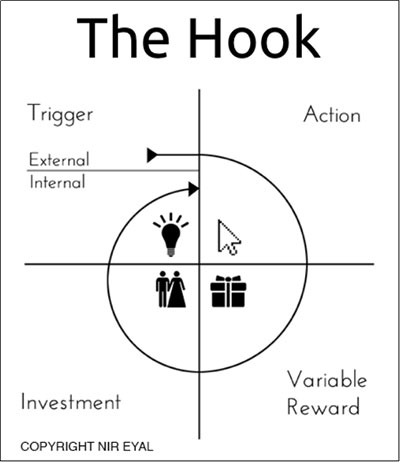
Eyal has explained the consumption process through a four step model – a internal trigger like a frisson of anxiety or external trigger such as an ad, which leads us to the action of logging into social media like Facebook or Twitter, which through previous interaction, we know will reward us by showing us our posts which has been liked, or content which is of interest to us, thereby assuaging our anxiety.
Such feedback loops help in establishing habits, which make these products so addictive. The fourth quadrant which focuses on ‘Investment’ explains why such habits are so hard to break – users invest time and build a community of friends and followers which feeds these feedback loops and creates stickiness to the platform.
While the book focuses on digital products like Facebook, the concepts can be applied to other industries and products. All in all a great read on understanding consumer behaviour and psychology.
That’s all from me today. Do share if you have read ‘Hooked’ or whether I have inspired you to pick up a copy.
Bhuvi Gupta is a marketer with over 10 years across industries, of which the last six have been in Media & Entertainment. She has been a part of many launch marketing campaigns – specifically at the Times of India group, Republic TV and the latest in marketing a Bollywood film. She will write on A&M (mostly marketing, but often on advertising too) every other Tuesday. Her views here are personal. She tweets at @bhuvigupta3