Tag: Realty Check

  • Realty Check | Day 8 | Salil Sadanandan: Indian consumers demand a Better Lifestyle

    By Salil Sadanandan
    Managing Director, Kohler Kitchen and Bath India


    It is time to move into that dream house… But take a step back and think about the journey of making the house into your home.


    The realty sector is seeing a boom where the choices that we make on a house are really driven by lifestyle desires than ‘needs’. With bling becoming the new subtle, young couples and nuclear families are increasingly looking up for home solutions which add a bit of zing to their home and thus their lifestyle.


    With the power of the internet, there has been a rise in the number of online search portals available to answer almost every consumer query. This has not only increased the expertise of buyers but also demands for speciality and customised offerings. With young professionals travelling frequently for work and staying in modern boutique hotels, aspirations to have a similar house tend to increase.


    One of the most important and frequently used, yet not-talked-about-much rooms of the house is the ‘bathroom’ or the ‘restroom’ or the ‘powder room’ – as one may prefer to call it. The bathroom is a space that indulges the senses, calms the spirit, and cleanses the mind. Everything in this space contributes to the experience and how a person interacts with it.


    As bathrooms continue to evolve, the products installed are also evolving in terms of the design, technology and craftsmanship involved. Products as simple as bath and toilets are employing technology such as chromatherapy, UV cleaning and touch interface. There are also designer products available that are made on special orders, these are hand-made and involve intricate designing.


    With increased awareness and access to better technology, advanced products, etc., Indian consumers are demanding a better lifestyle. No longer are consumers seeking basic amenities and a solution for their needs, but they are looking at added benefits, striving to understand the science and technology that form a product and are looking at how the product elevates their standard of living. The bathroom segment is witnessing rising demand from customers for innovative products, designer accessories as well as customized solutions for their bathrooms.These trends project a fabulous growth for the luxury bath industry in the coming years.


    Coordinated by Shobhana Nair


  • Realty Check | Day 7 | Adhil Shetty: Real Estate Sector is Buzzing with Positivity

    By Adhil Shetty
    CEO, BankBazaar.com


    The real estate sector once considered to be the sunshine sector of the Indian economy is slowly bracing itself for the good times once again. The sluggish period of the last couple of years triggered by rising inflation, falling sales and high real estate prices seems to be stabilizing.


    The good news for the real estate sector started with the announcements in the annual Budget where the newly formed government prioritized its commitment to revive the sagging fortunes of the sector. The multi-dimensional announcements from the introduction of Real Estate Investment Trusts (REITs) and Infrastructure Investment Trusts (InvITs) to focus on developing 100 new smart cities and emphasis on affordable housing saw the real estate sector is buzzing with positivity.


    Capital influx for the sector: The real estate sector has always been struggling to raise adequate capital due to various reasons. The government’s announcement of reducing the size of projects eligible for foreign direct investment along with reducing the minimum investment limit for FDI means more capital inflow is likely to enter the Indian markets. The re-introduction of Real Estate Investment Trusts is also helping real estate companies raise capital from the financial markets as people are investing in Real Estate Investment Trusts owing to the massive upside of the real estate and infrastructure sector in coming years.


    Affordable housing: a win-win situation: End-users often complain of the rising real estate prices in the country. With the focus shifting towards affordable housing, real estate companies would now be able to complete their projects well within their timelines while end-users can finally get affordable housing options. With the allocation of Rs 4000 crore for low-cost housing alone, there is no doubt that the sector can trigger massive sales helping real estate companies shift their attention to low-cost housing projects at a bigger pan-India level.


    Incentives on home loans likely to boost sales: With easing of inflation and tax incentives announced in the annual budget for home loan borrowers, more people are likely to take home loans to reduce their tax liabilities. The home loan rebate on self-occupied property has been increased from Rs 1.5 to Rs 2 lakh while income tax deduction limits under Section 80C on repayment of principal amount on housing loan has been increased from Rs 1 to Rs 1.5 lakh.


    Real Estate watchdog remains an issue of concern: The lack of a real estate watchdog remains a primary concern for both domestic and NRI investors. With an increase in the number of complaints against various builders and developers across the country, end-users often find themselves running from pillar to post to get their issues resolved. Once a real estate sector watchdog is put in place, the realty sector can reach its massive upside bringing in good days to end users, investors and real estate companies alike.


    Coordinated by Shobhana Nair

  • Realty Check | Day 6 | Aditya Verma: Paradigm shift from unorganized to organized retail scenario

    By Aditya Verma
    CEO, Makaan.com


    The Indian real estate sector is one of the fastest growing real estate market in the world. Real Estate is a driving force of the Indian economy which the Indian government also realizes, thus, it has introduced several friendly reforms to boost the overall sentiment of the industry.


    Over the past few years, private participation from real estate developers has changed the face of India by developing the state of the art infrastructure. Today, India houses some of the most beautiful architectural marvels in residential, commercial and retail spaces. The development has not been confined to metro cities, as developers have come up with architectural masterpieces in the Tier II and Tier III cities as well. Another interesting aspect is the expanding borders of most Indian cities like Delhi, Mumbai, Bengaluru, Kolkata, Pune, Hyderabad and Chennai. All these cities have expanded in size to accommodate development activities.


    Due to improved infrastructure and facilities, most Indian cities have seen a steady property price appreciation. Although, there has been a slight consolidation in the recent past, prices have increased handsomely over the past decade and in future too the real estate market is set to deliver returns higher than any other asset class in the country.


    Many households now enjoy double income benefits, people have more disposable income and they prefer to buy their own property rather than living on rent. This change in attitude has led to increase in demand in the residential housing segment. The real estate market is also witnessing a decent demand for commercial development due to a paradigm shift from unorganized retail towards organized retail scenario. Several MNCs are looking to invest in commercial areas in India to establish their offices here.


    The real estate sector is faced by some issues like liquidity crunch, unsold inventories, labour problems, etc that have capped its growth in the recent past. The new government has announced some friendly reforms like incentive for affordable housing, developing 100 smart cities, speeding up the road development projects, increase in the income tax exemption on repayment of interest on home loan from Rs 1.5 to 2 lakh and increase in IT exemption limit from Rs 2 to 2.5 lakh that has started a sentiment revival for the sector. With continued growth driven strategies and activities coupled with due attention and support from the government will help the real estate of India to skyrocket.


    Coordinated by Shobhana Nair


  • Realty Check | Day 5 | Sumit Jain: High demand for Ready-to-Move-in Properties

    By Sumit Jain

    Co-founder and CEO, CommonFloor.com


    The Indian real estate market has witnessed the emergence of various trends over the last one year. And one significant trend seen is the increased demand for ready-to-move-in properties. Various factors are responsible for this rise in demand. Inordinate delay in project delivery, leading to increased pressure of EMIs plus rental values,has pushed demand for ready-to-move-in projects pan-India. Additionally, a number of projects have been completed recently and are ready to occupy.


    Figure 1

    Source: CommonFloor.com Listing Data


    Ready-to-occupy property market

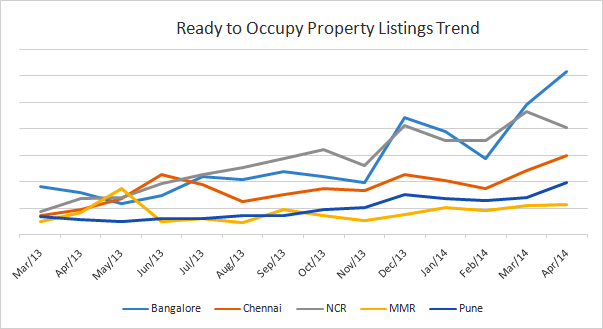
    According to data, there has been a decent rise in the number of ready-to-occupy property listings over the last one year across cities. Figure 1 indicates that while most cities saw a significant increase in the number of ready-to-occupy property listings, MMR and Chennai regions were seen to be more or less stagnant. This could be attributed to various reasons.


    In MMR – Mumbai, Thane and Navi Mumbai – property prices have become unaffordable for many. Property buyers were hoping for some price corrections but no significant change was seen with exceptions of minor corrections (within 5 per cent) in certain localities. Hence, buyers preferred to wait and watch. Developers, on the other hand, are reluctant to offer any discount on account of increased input cost and high capital cost due to high interest rates. As a result, property prices have reached their peak and sales have been stagnant.


    In Chennai, too, the ready-to-occupy property listings remained stagnant over the year. The overall economic environment could be one of the major reasons for this. However, real estate activity is expected to pick up over the next few months.


    Bengaluru saw a significant increase in the number of ready-to-occupy property listings. Q1-2014 witnessed an increase of almost 35 per cent in ready-to-occupy listings as compared to previous quarter (Q3-2013). This is primarily because most of projects have completed resulting in ample supply. The trend shows that there is an increasing interest for ready-to-occupy property as against under construction. There have been inordinate delays in several under construction properties due to multiple reasons and buyers, in turn, have to suffer. Hence, they prefer to opt for properties where they can instantly move in.


    Surprisingly, NCR has seen about 19 percent increase in Q1-2014 as compared to Q3-2013. This increase can be seen particularly because the investors are seen to exit the market and they released their inventories. They are also offering discounts in the tune of 15-25 per cent in order to lure the customers. According to CommonFloor data, several projects have completed over the last one year and there is ample ready-to-occupy supply available in the market. On the other hand, various under construction properties are being delayed on account of low sales resulting in fund crunch etc. Moreover ready-to-occupy properties offer various benefits such as –


    :: Tax benefits such as no service tax

    :: Immediate rental income or saving of rent, and

    :: Less risk of interest-burden when construction is delayed.


    Figure 2

    Source: CommonFloor.com Listing Data


    Under-construction property market

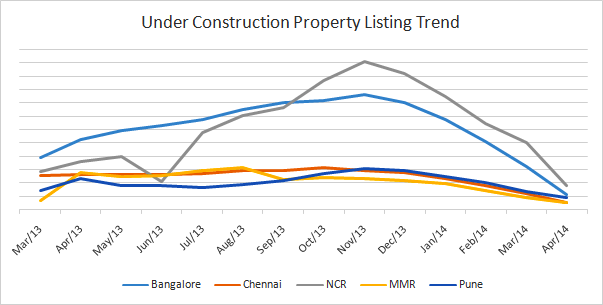
    Figure 2 clearly shows the declining trend of under construction property listings. This can be attributed to various reasons. According to CommonFloor quarterly report – Q4 2013, the overall new launches of projects in top seven cities including NCR, Bangalore, Chennai, Pune, Hyderabad, MMR and Kolkata declined by 18 per cent as against the same quarter in 2012. Grim economic scenario coupled with rising interest rates, high inflation and depreciating rupee resulted in low buyer sentiment and hence decline in launches.


    Moreover, CommonFloor survey conducted earlier on post-election expectations confirmed the fact that a stable government with new reforms in the sector would give a major fillip to the real estate industry. The survey also strengthened the fact that buyers, in the current scenario, preferred to opt for ready-to-occupy property as against under constructed.


    As per CommonFloor Listings data, there was a significant decline in the number of listings for under construction properties in Q1 2014 as compared to Q4 2013. Chennai witnessed maximum decline of about 40 per cent followed by MMR which saw a decline of 37 per cent, Bengaluru by 35 per cent, Pune by 32 per cent and NCR by 26 per cent. This decline clearly highlights the growing preference of property buyers. Demand is now tilted towards ready-to-occupy properties as investors are taking a back seat and now the realty sector is being driven largely by the end-usersin most metros.


    However, the debate on ready-to-occupy vs under construction properties is a never-ending one and will seldom find a concrete conclusion. Sheer attractiveness in terms of monetary benefits might attract denizens for under-construction property. But the bottom line is that one should carefully analyse the pros and cons of both and accordingly base his/her decision. For immediate requirement, it makes sense to opt for ready-to-move in properties. On the other hand, if one is looking for higher returns and has high risk-taking appetite then he may opt for under-construction properties. But, unlike earlier, new trends are emerging that are all set to shape the future of the Indian real estate market.


    Coordinated by Shobhana Nair


  • Realty Check | Day 4 | Honey Katiyal: Getting right advice most critical

    By Honey Katiyal
    CEO, Investors Clinic Infratech Pvt Ltd


    Today, the real estate sector has already transformed from being unorganized to a professional, dynamic and organized sector over the past few years and Investors Clinic has played a significant role in bringing about this change. Investors Clinic acts as strategic advisers to both, real estate developers and buyers. The company’s business model is aligned to become a real estate advisory and portfolio management firms. It’s their business to understand our clients’ financial requirements and go on to serve premier corporate houses in both domestic and international arena. Today, more and more well-educated professionals are joining the real estate bandwagon. Business school graduates who aspire to be entrepreneurs look up to the real estate sector as a worthy option. There is more trust between buyers and builders owing to the professionals.


    The real estate sector in India has given a red carpet welcome to a stable government. Realtors and local players expect that the market is now all set to pick up after the polls and with PMO’s declaration of goal to develop at least 100 cities over a period of five years, a high paced double digit growth is expected.  Proposed tax reforms and policy improvements should definitely benefit both buyers and real estate developers. This period, being start to another expected bull run in the sector, is definitely an appropriate time to invest.


    Real Estate is one of the few investment vehicles where, factors like the ability to make a downpayment, leveraging your capital etc can increase the overall return on investment. Real Estate provides Competitive Risk-Adjusted Returns which makes it a attractive stable market for investment. Accordingly getting the right advice to invest at the right time and on the right option is the most critical aspect faced by the prospective buyer.


    The most crucial concern is that the consumers are portrayed as victims by the people having their investments gone bad. This is a one-in-a-hundred scenario where people who invest their stakes with a greedy eye allowing themselves to fall into a the trap of false bank guarantees and fake promises offered. A genuine buyer never invests without doing his/her homework. Consumers are well aware of the risks and speculations associated with each and every investment of such kind.


    Hence, here at Investors Clinic we have made it our job to provide consumers the relevant and genuine information with regular updates. Investors Clinic is a one-stop shop which provides latest updates and acts as the real estate advisory service linking the buyers with the developers, thus safeguarding their interests. As per Mr. Honey Katiyal, CEO, Investors Clinic Infratech Pvt Ltd, “This is just a beginning of the kind of advancement we want to bring in the Indian real estate sector. We, at Investors Clinic aim to bring the best options possible to our customers”.


    A lot of issues and concerns can be solved if project delays that are often beyond the control of the developer can be put to an end. For instance, there may be a change in policy or genuine shortage in raw material, these things put the developer in jeopardy. Secondly, if only registered, licensed and reputed vendors are allowed to exist and conduct business, many concerns in the industry will be resolved. Government policies need proper implementation across the country. Finally, the buyer and builders should not have to pay heavily for changed policies, and added costs owing to government increasing raw material costs while the projects are under construction. These unjust features if, given proper light to can change the whole framework of the real estate arena.


    Coordinated by Shobhana Nair


  • Realty Check | Day 3 | Balaji R: Need for focused push for real estate sector to remain buoyant

    By Balaji R
    CMO-Vizag & Chennai, Shriram Properties


    The Indian construction market is expected to be the world’s third largest by 2020. It is currently the fourth largest sector in the country in terms of FDI inflows. The market is projected to reach US$ 649.5 billion by 2020 from US$ 360 billion in 2010.


    Real Estate contributes about 5 per cent to India’s GDP. The market size of this sector is expected to increase at a compound annual growth rate (CAGR) of 11.2 per cent during FY 2008–2020.


    The Government of India has shown support for the industry. It has allowed foreign direct investment (FDI) of up to 100 per cent in development projects for townships and settlements, as well as formally approved 577 special economic zones (SEZs).


    Growth:

    Real Estate is an integral ingredient in the formation and growth of all businesses and steadily maturing into a big business itself. As such the performance of the real estate sector depends largely on the performance of the economy and the businesses in specific. Decision-makers have been in a state of indeterminacy given the fabric and structure of how the country keeps oscillating between promises and optimism and persistent challenges and policy inertia.


    At a juncture like this, there is a need for a focused push in the right direction for the real estate industry to remain buoyant going forward. It is therefore essential for all stakeholders to equip themselves with a deeper understanding of not only the real estate sector but also the businesses they serve.


    There is vast opportunity for the real estate sector to grow. The healthcare sector is estimated to touch US$ 100 billion by 2015. Also, emergence of nuclear families and growing urbanisation has given rise to several townships that are developed to take care of the elderly. Further, growth in the number of tourists has resulted in demand for service apartments.


    Issues of Concern:

    The year 2013 was a year of survival for the real estate sector, but expectations are now high among developers and analysts.


    So how would 2014 pan out for realty? The first three quarters would see much of the problems of last year persisting, before showing some signs of change. Few experts believe that prices in several locations will go northward.


    That would be constraints since the problems of the sector remain unsolved, and policies have made no substantial impact, and those on the cards may not be enough to give the required momentum.


    Real Estate is an asset class that demands specialised skills and the complexity surrounding this sector increases in the Indian context.  Compared to the mature real estate markets in the developed nations, buyers in India need a higher degree of diligence before entering into property agreements.


    Issues pertain to ownership rights of the property, understanding the difference between usable area and saleable area in absence of standardised definitions, completion of the project and receipt of the completion certificate and so on. Further, when evaluating multiple investment opportunities, the absence of industry standards in developer ratings, building structure comparison, price distinction across different projects and other factors create difficulties in arriving at a direct comparative approach. In brief, information asymmetries and laxity in disclosure norms need to be addressed for the sector to achieve optimum potential in development and investments.


    :: It was a year of “slow-down, stagnancy and stalling” for real estate.

    :: It was a year of much economic turbulence. The current account deficit has fallen to 1.2 per cent of GDP in July-September period, while inflation is again above 10 per cent, as recorded in October. Wholesale price inflation was at an eight-month high of 7 per cent while retail inflation crossed 10 per cent.

    :: The rupee dropped sharply by net 22 per cent during first two quarters. Private equity (PE) investments witnessed a drop of over 65 per cent for the quarter-ended September 2013. All of this has negatively impacted investment sentiment.”

    :: Even as the rupee fell, NRIs cashing in on the foreign exchange situation did not show up in sales numbers.

    :: Monetary tightening resulting from RBI’s measures to control inflation was the major macro influence on the real estate business in India

    :: High interest rates, spiralling vacancy levels and lower margins arising from inflationary pressures too, led to a slowdown which resulted in reduction of new launches and also delayed project deliveries. Developers with exposure to residential projects are worried as slow sales have created a situation of oversupply in many parts of the country.


    Persistent problems

    India has its own unique and integral complexities and business is not an exception to it. Corporations strive for increased efficiency and productivity amidst these complexities. Real Estate is an integral ingredient in the formation and growth of all businesses and steadily maturing into a big business itself. As such the performance of real estate sector depends largely on the performance of the economy and the businesses in specific. Decision makers have been in a state of indeterminacy given the fabric and structure of how the country keeps oscillating between promises and optimism and persistent challenges and policy inertia.


    The recently approved Real Estate Regulatory Bill is an important initiative by the government to address the concerns of real estate sector. Land Acquisition and Rehabilitation and Resettlement Bill that is yet to be approved is also expected to be another step towards regulating the real estate sector. However, information asymmetries and laxity in disclosure norms need to be addressed for the real estate sector to achieve optimum potential in development and investments. While the real estate sector is moving ahead slowly and steadily, certain inaction is resulting in to stagnation from this dense and multifaceted much to be attained growth.


    At a juncture like this, there is a need for a focused push in the right direction for the real estate industry to remain buoyant going forward. It is therefore essential for all stakeholders to equip themselves with a deeper understanding of not only the real estate sector but also the businesses they serve. The key for businesses to do well will be their ability to decipher this complexity and embrace it with a pragmatic approach, and the same applies to real estate sector.


    References: Ministry of Finance, Press Information Bureau (PIB), Media Report, Department of Industrial Policy and Promotion (DIPP), CREDAI, The Union Budget 2014-15


    Coordinated by Shobhana Nair

     

  • Realty Check | Day 2 | Ashok Gupta: Tier 2 and 3 cities growing at rapid pace

    By Ashok Gupta
    CMD, Ajnara India Ltd


    It is true that land is limited and more of it cannot be created and thus the value of the real estate sector is of prime importance to every country. In India, this sector contributes the most to the gross domestic product and employment of the country; as the sector contributed 6.3 percent to the Indian GDP in the final quarter of the last year and went on to provide as much as 7.6 million job opportunities in 2013, and this is not the first time that this sector has produced such results. This goes to show the performance of this sector in the nation’s upbringing.


    The real estate sector in India is divided into numerous clusters today with various top notch brands having their presence in almost all major states and cities. At present Bengaluru, Delhi/NCR, Mumbai and a few other developed states fall under the Tier 1 category of real estate as they are infrastructurally well-equipped and hold the presence of India’s best developers. Speaking of Tier 2 and 3 cities like Bhopal, Lucknow, Indore, Raipur, Vadodara, Patna, Ranchi, Chattisgarh and others, they have learnt from the Tier 1 regions and are developing at a rapid pace. This has come out as a major growth driver for the Indian real estate sector in general.


    In the past few decades, this sector was popular amongst end-users only as enough investment in property was not prevalent. While real estate as an asset is regarded as the safest and highest return providing investment today, currently there are more of investors or second home buyers than end users. Also, due to the immense impact of globalisation in India, top companies around the globe are settling in and hence, the demand for commercial property has sky-rocketed in the last decade or so. The last five years especially witnessed a huge revolution in demand for real estate as more and more brands have entered and people have started to understand the value of this sector.


    The only thing that remains now is the due credit that this sector is to receive from the governing bodies in the country. There is an urgent need to form a separate government entity for this sector so as to aid in cleaning the dirt persisting in the sector which will help to safeguard the interests of the future investors and stakeholders.


    Coordinated by Shobhana Nair


  • Realty Check | Day 1 | Dr Sunit Sachar: Much demand for Affordable Housing

    By Dr Sunit Sachar
    Senior VP-Marketing & CRM, Parsvnath Developers Ltd 


    The Realty Sector is one of the biggest contributors to the GDP of the country. It was approximately 10.6% in 2011 which has come down to 6.5% in 2013 and is now in the slab up to 5.4% due to the dwindling sale and development experienced. The Real Estate sector enjoys the qualification of being the second largest employer in the industrial sector following IT and is instrumental in influencing over 4000 industries directly or indirectly.


    The major concern that has influenced the sector was the instability of the political scenario (the situation now has been changed) which had influenced the economic scene of the country to a great extent. With the coming of the stable government at the Centre and the government having constructive plans which have already been announced, the possibility of a brighter future is on the anvil. The government, which is the biggest spender of money, has shown interest in developing of the basic infrastructure facilities and urbanization in the country which is bound to influence the growth in the economy as well as contribute towards better sentiments in the market place which shall result in overall good. With recent government policies for the benefit of the middle class, the home loans, the announcement of Rs 37,880 crore for NHAI to undertake 8500 km of highway in addition to Rs 3000 crore for road to the NE Region, Rs 700 crore to be allocated for 100 Smart Cities, Rs 11,600 crore to be planned for harbour projects, with 16 new ports to come up, the liberalization of FDI policy, streamlining of land use, motivating bureaucracy and steps towards reforms are all constructive policies which will help improve government planning thereby resulting in better circulation of monie which in turn shall contribute towards the demand of goods and services leading to industrial growth and employment generation etc. All this will not only boost public sentiments but also the Real Estate sector which will contribute healthily to the coffers of exchequer enabling the government to go in for spending on infrastructure and development of urbanization.


    In a recent survey conducted amongst 3400 home buyers/investors (68% end-users and 32% investors ) conducted by Realty Plus–99 acres.com, it has been found that barring 15% people, all are buoyant about the future and 75% people said definite ‘yes’ when asked about thinking of purchasing a home in the near future. However, it is interesting to note that 51% people preferred Ready to Move in property, 26% under construction property and 23% are looking at newly launched property.


    Although there is a great expectation of the reduction in bank loan interest rates, 40% people would like to wait for it to happen, the other section is ready to take a plunge forward if they are influenced with the builder’s track record or when they get the option of ready to move in or near-completion hopes.


    It was observed that 73% people preferred property of Rs 50 lakh and 40% of out of that between Rs 25 to Rs 50 lakh. Thus, it is clear that there is a tremendous demand for Affordable Housing. In fact, a great amount of stress is being laid on this housing segment by the Government.


    It was seen that 70% of the people preferred to purchase the houses in major Metros and NCR, greater importance is given to location, connectivity, facilities around, builders brand equity apart from project specifications and ticket size of the Units. Amongst residential properties, 75% of the Buyers like to go in for Group Housing/Independent Floors,15% Independent Houses / Villas, 5% for High-end property and 5% for Serviced Apartments.


    Twenty-six percent people feel that there will be no change in prices while 28% are expected to go down by 10% while 46% of the people expect that there will be price increase of minimum 10%. The industry has experienced unsold inventory, subdued transactions, uncertain political environment, economic slowdown, non-rise of income levels, increased construction cost, slow pace of construction, and preference for low value property and domination of actual users.


    Coordinated by Shobhana Nair