Tag: Realty Check

  • Realty Check | Day 20 | Dinesh Ethiraj: Need for satellite townships to be well-connected & self-sufficient

    By Dinesh Ethiraj
    Director, Green Tree Homes & Ventures Pvt Ltd


    Satellite townships have been growing in our country. These townships came into existence as a solution to the haphazard development of suburban areas in major cities. The city limits are becoming overcrowded and the land prices have hit the roof. Land prices increase as the environment becomes bad, and then quality becomes expensive to super expensive. This has made the government and the real estate developers to look for development of habitat outside the city limits.


    There is a need for the satellite towns to be developed. According to a study done by Jones Lang LaSalle on ‘Satellite Townships’, “Cities like Mumbai, Delhi, Chennai, Bengaluru and Kolkata, etc, provide three to five times the number of houses as compared to their parent cities. Every year, when the Mumbai Metropolitan Region constructs about 24,000 houses, Mumbai City builds 1000 houses, her suburbs build about 5,000 and the remaining 18,000 are constructed in her satellite towns of Thane and Navi Mumbai. Chennai constructs about 18,000 houses annually, of which only 3,000 are in the city limits, while a whopping 15,000 are in the suburbs and satellite towns.”


    The idea behind developing satellite townships is to bring up planned habitations to ease population growth in towns. All major towns of the state are presently marred by unplanned growth that is stressing public utilities.


    Affordability drives many to these townships. With several industries setting up factories far way from cities, developers know there will be a demand for the residential properties and they go early and tap the market way ahead before the infrastructure is built.


    Most of the satellite townships are poorly connected with main city.  They continue to suffer from a lack of proper roads, water, electricity, sewage systems, public transport, hospitals and schools, etc. Inhabitants buy properties thinking things will get better in 15- 20 years. But that’s lot of time to wait for the development.


    Satellite towns should be well-connected and must be self–sufficient. It simple terms it should be a small city by itself.  The city agencies should be innovative and use market dynamics to raise and deploy funds for infrastructure.


    The state governments can provide with plying mini / bus between the towns and cities. They can improve the quality of commuting for a better and safer journeys. Develop not just road connectivity, but also extend the connectivity via metro rails(once its in place). We have different rail connectivity, and road connectivity most of these and not interconnected.


    Many flyovers are built without logical connectivity.  Such things add to the pains than to gains. Good quality roads must be put in place. Proper facility of water, electricity, sewage systems, public transport, hospitals and schools, etc


    Bengaluru’s NICE Road has a really good connectivity. Developers are quiet upbeat about the integrated township development, they feel that the governments, both the central and State should do more  to promote such developments. Governments can give rebate for the developers to encourage them to work along with the governments for development.


    Governments, the developers and citizens have to wake up to the call of the growing satellite townships. They answer all needs to have better facilities to live in. And better connectivity to the cities, better schools, hospitals etc. We need to push for the change to happen.


    Coordinated by Shobhana Nair

     

  • Realty Check | Day 19 | Vijay Machindar: Holistic view on real estate sector for all-round happiness

    By Vijay Machindar
    Managing Director, Ornate Spaces Pvt Ltd


    It’s interesting that this article just as the first 100 days of the Prime Minister Narendra Modi government are being celebrated. There is indeed overwhelming support for the Modi and the BJP-led National Democratic Alliance that even naysayers will contend that the mood on the street is definitely upbeat.


    This after all the gloom was welcome, especially by the real estate sector since it can only prosper if the sentiments are positive not just in the industry but also among all citizens as only then will property be sold and bought.


    It’s important that the government and civic administrations have a holistic approach to infrastructure development. In the short run, this may impact some interests, but it is the only way in which we can ensure the well-being of everyone. It is critical that all stakeholders respect the need for proper civic infrastructure.


    This holistic view means that in all of the real estate development activity, we do not ignore the environment. The world including India has paid a price when nature has been plundered. We need to take care of the environment.


    The long term prosperity and happiness of all stakeholders can only be achieved if in our pursuit of building property, we do not ignore the environment. Mother Nature needs the respect she deserves.


    Coordinated by Shobhana Nair


  • Realty Check | Day 18 | Ajit Koushik: Good prospects for serviced apartments sector in India

    By Ajit Koushik
    Area GM – India, Ascott Ltd


    In the India scenario, the number of international arrivals into India has increased over the last few years owing to an increase in FDI. Now that a new government has been formed, FDI into India expected to nearly double from US$29 billion in FY 2013-2014 to US$40 – 45 billion in 2015 (Source: Department of Industrial Policy & Promotion and Care Ratings Report 2014).


    With increasing FDI and more multinational companies setting up operations in India, demand for quality accommodation will grow from the influx of expatriates, project teams and business travellers (both foreign and domestic). The number of international tourist arrivals in India in 2012 was around 6.8 million and is growing annually by 4.3%. The number of domestic tourists traveling within India in 2012 was 1036 million and has been growing at 19.9% year on year. (Source: Report titled “India Tourism Market & Future Forecast (2009 – 2015)” by ResearchandMarkets.Com). These factors indicate that India is a key market with huge demand and evidently there is a limited supply of quality serviced residences. There are only a few global players who have currently entered the India market. So in terms of the long-term accommodation, there is still a potential for the serviced apartment category.


    Foreign expatriates and business travellers coming into India on extended stays of more than a month are no longer satisfied with small hotel rooms. They prefer larger spaces that provide a home-like atmosphere complemented by the services and facilities of a hotel. That’s where serviced residences come in.


    Coordinated by Shobhana Nair


  • Realty Check | Day 17 | Abhaya Shankar: Towards energy efficient buildings

    By Abhaya Shankar
    Managing Director, HIL Limited


    A robust growth in employment, education and health care coupled with the booming urban population is expected to give the Indian real estate sector the much needed push as India continues to be a favourite real estate hub for global investors. Estimates point at steady housing demand throughout the year for the Indian economy, as the industry too gears up on meeting this demand. The Confederation of Real Estate Developers’ Associations of India (CREDAI) has also identified demand from Tier-II and Tier-III cities, which is ideally a resultant of burgeoning consumer spending. Additionally, the recent move to introduce REITS, or Real Estate Investment Trusts, is a progressive one as well as it is expected to help both developers and investors, through better financing and investment options.


    The move towards green is sweeping the real estate space and looming large, given the rising environment awareness and the mounting pressure for retaining ecological balance. According to the Indian Green Building Council (IGBC), out of the 25 billion sq ft of built up area in India, green spaces currently cover more than two billion sq ft and is aims to reach 10 billion sq ft by 2022. Over 300 new green buildings are coming up across different locations in India with the concept seeping in. Green buildings strive to optimize demand for electricity, water and other natural resources (in construction, operation and demolition); generate all their electricity on site through renewable energy; cater to their water demands through sustainable processes such as rainwater harvesting; and recycle all waste on site.


    Given the paradigm shift to green buildings, India, the second largest real estate market in the world, can save a good Rs 83,000 crore every year by investing in energy efficient buildings- an amount equal to the combined current expenditure on health and education. Sustainability is, thus, the key to making rapid strides of progress in the real estate sector in India and elsewhere. Sustainable buildings benefit occupiers with several operating cost reductions Green buildings with sustainable elements can save up to 20 per cent in total electricity costs.


    The concept of co-creation has also emerged anew in the Indian real estate industry as customers who have a long term relationship with the dealers need to be aptly managed in terms of delivery of expectations. The quality and effectiveness of communication with customers during the various stages of the project life cycle (and even after that) creates the experience of “absolute delight” which sustains in the longer run. From updating themselves with CRM software applications to taking into account customer feedback, real estate companies and dealers are walking that extra mile to co-create a shared value proposition and ensure the customers a truly differentiated customer experience.


    Coordinated by Shobhana Nair


  • Realty Check | Day 16 | Nimesh Bhandari: How Technology can aid home buying process?… Powered by Bloomberg TV India

    By Nimesh Bhandari
    Co-Founder and Director and Chief Operating Officer, RealtyCompass.com


    For many people buying a home is once in lifetime experience. The dream process of buying a home will become a nightmare if adequate attention is not given for the whole process of choosing the right builder, location and project.


    In the last 20 years, the landscape of home buying has completely changed with a large number of young home buyers and umpteen supplies of new homes. Also, technology is playing a critical role in changing the whole home buying process and addressing some critical problems which are otherwise unaddressed.


    In this article let us look at what has changed in the last 10 years in real estate, and how technology is changing the process.


    Rapid Growth of Condominium Culture

    Riding on the liberalization wave and on sustained economic development, the realty market in India has expanded leaps and bounds in Metros, Tier-1 and Tier-2 cities. Most of urban India (except Mumbai), lived in independent houses in the 1990s.  But the shortage of urban land coupled with rocketing rates of land made apartment is the way to go forward. Gated communities, condominiums and integrated townships have become the buzzwords of home buyers.


    In less than 10 years, the number of builders has swelled from couple of thousands to over 20,000 builders across India. The real estate sector contributes over 6.3% to GDP and more than 7.6 million jobs per annum. Real Estate is second largest employer next only to agriculture. Regional builders are consolidating their position in a region and expanding their footprints to other regions. With over 81 million new homes required by 2030 for Urban India, the sector will witness robust growth.


    More Choices creates maze of complexity for consumers

    With an amplitude of choices in terms of builders and projects, consumers no longer can depend on their friends and relatives to figure out the best choice.  Consumers today are being bombarded about the new launches every week via Newspapers, Billboards and Radio. Though more choice is good for consumers, it is difficult for them to make a decision without proper guidance. Take for example a market like Bengaluru which has about 4000+ ongoing projects from over 1500 builders and it is impossible for a consumer to take a stock of all the projects without the help of a technology. Even if the consumer’s preference is limited to 2-3 localities, the consumer has more than 200 projects for the budget range to choose from. As a result, either the consumer is forced to settle down with a house which not necessarily is the best choice; or they end up searching the house for a long period of time. The search cost of buying home is very high and risk premium sky rockets while considering buying a home from non-reputed builder.


    Technology as an aid to cut the clutter

    The power of technology, internet and mobile can relieve the consumer from the pain of searching home in a big way.  India already has over 200 million Internet users and is set to cross 240 million mark by June 2014. Bulk of the internet users in India are mobile users – 150 million, while just 50 million are desktop/broadband users. The internet gives the power of search and comparison in user’s hands.


    User can search, compare and refine the projects based on preferences and quickly shortlist the projects.  Saving projects for future discussion with friends and families is convenient. Technology also provides an option to search using multiple devices and from different locations with ease. With the help of technology, internet portals can also recommend projects to the users based on his past behavior. Technology empowers the portals to capture complex buying behaviour of user and create intelligent algorithms to recommend the right property.  All this helps the user to shorten the purchase cycle and compare and evaluate more options in short nick of time.


    With smart mobile devices in consumer’s hands, they can even enquire about a property on-the-move. They can do an on-site comparison of nearby projects and mobile can help them navigate to a nearby project.


    We have still scratched a surface of what a smartphone can do to a home buyer, and there are a lot of interesting use cases which people are working on. As augmented reality evolves, it will open new avenues for the users. They can not only know the history of project/builder, but can also get a futuristic 3D view of the nearby area by zooming in time.


    Social Recommendation about the projects

    The hyperconnected digital world also enables the user to check user reviews and recommendations about a builder/ project. Consumer today can ask questions in a social forum and can get different perspective from other consumers and experts. Technology has enabled the whole experience of property buying so transparent where consumer can get all information in an unbiased way and can also check for the reference/recommendation with the help of technology and social media.


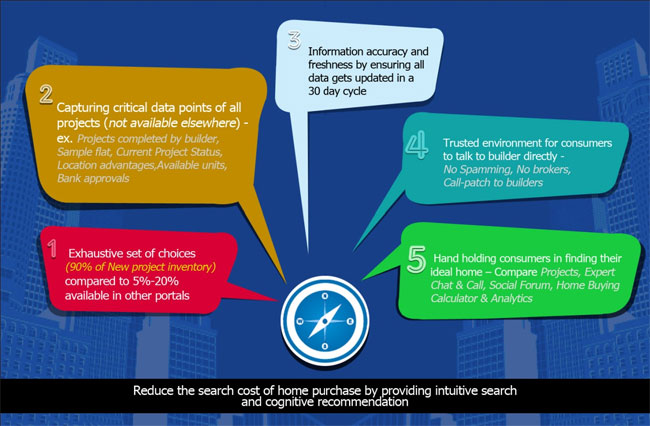
    The digital era has transformed the home buying experience, buy making it more exhaustive, methodical and efficient. The graphic below summarizes the benefits of digital medium compared to traditional platforms


    Let us take a real life example where Ramesh had a budget of 50 lakh and he starts looking for a home in Bengaluru. He is not sure of the exact location, but wants to have ready-to-move-in apartments. Ramesh goes online to realtycompass.com and starts exploring Bengaluru and sees that there are 76 ready-to-move apartments in his budget range.  He then digs further, and finds that there are large number of ready apartments in Whitefield and Electronic city in his budget.  He starts researching about the locality with respect to upcoming infrastructure, amenities and deals in both Electronic City & Whitefield.  He comes to conclusion to buy a house in Electronic city and then looks at toprated projects in his budget.  He identifies six projects which have ample units left and have very good accessibility rating.   He then compares these projects with similar projects in the area and identifies 3 projects where he wants to go for a site visit.  When he is near the site, he compares the project with nearby project in front of the builder and is able to negotiate with the builder.  Builder offers a good deal. He immediately checks out the review of the project and talks to few other people who have enquired in this project. He gets positive review about the project and is books his home in it.


    As you can notice here, technology helped Ramesh cut down on his time spent, travel and phone bill by being able to quickly identify the location and projects where he wants to go for a site visit.


    Coordinated by Shobhana Nair


  • Realty Check | Day 15 | Bhavesh Barot: Need to Buying a New House: Check the Fixtures Inside & not just the Structure Outside

    By Bhavesh Barot
    India-Business Head, iB Rubinetterie


    The property boom has made it difficult for an individual with a modest income to buy a house in Mumbai or in any of the metro cities for that matter. So the question of buying that dream house and make it a dream home by decorating it just evaporates the moment the burden of an EMI starts. Thus, it is very important for every new house buyer to look into every detail inside the house so that they decide to buy besides looking into a builder’s credibility and locality.


    People fall for the same fancy jargon used by builders like:

    Imported tiles

    Modular kitchen – brand of international repute

    High-End Designer Fittings & Fixtures

    Blah Blah Blah


    What they all forget is that these are all a very well-strategized marketing tactic employed by most of the builders.


    Reality is bitter and what you get for what you pay besides four walls is even worse.


    Imagine you have moved into this house that you just bought in some considerably good locality from an equally good builder. You have spent almost all your savings to make the downpayment and of course more than 70% as a loan for which you start paying EMI which is taking away more than 50% of what you make (in many cases even what your wife makes) every month.


    Between all of this, one fine day your fixtures in bathroom that is basin mixer and shower mixer (diverter) break down. You have no clue what brand it is because you never bothered to ask the builder. After research and some prayers you find out what make it is and just if you are lucky it’s not from a neighbouring country. The world calls the people of that country Chinese but I don’t know what we should call them because they have killed almost every industry with their cheap supplies in our country. You make a call to the company of its origin for service or replacement (which is practically not possible unless you have bought it from an online store where you get replacement or moneyback for a 30-day period). They send their technician to have a look and as usual something is broken so you end up paying or worse you are told that the damage is beyond repair and the company won’t provide free replacement for this kind of damage. Now in this case you have already started getting nightmare of going to some shop and spending a king’s ransom to buy a new set of fixtures and definitely the ones that you wouldn’t like in their aesthetic appeal and would surely compromise on its quality. So forget about the ones that you like, especially from Italian designer company which you always dreamt of buying coz that is certainly out of your reach.


    In a quest to liquidate their investments and squeeze every drop of revenue, what real estate developers miss out on, is such details like providing quality fixtures for kitchen and especially for the bathroom which has evolved over the years and has become the most important room in any house and these are very fixtures of which life cycle is at least 10 years and customers if nothing will praise the builder for providing good quality interior items. They ignore the fact that by paying just a little premium they can get very handsome bargain from some really reputed brand. Just by cutting down on negligible share in their margins they can provide customers with some very high quality and designer products that everyone is craving for.


    What every buyer of new house must look into is not just the clearances received by builder from a million different department but also the products provided inside the house, that they are going to use every single day of their lives. Demand for what you are paying as you are definitely not paying for just the four walls.


    Builders and every real estate developer must remember that customers will remember and praise them not just for the beautiful structure that they have built but also what they have provided in inside as that is what customers are going to use in their daily lives and it is these very products that will remain with the customer for the span of 5-10 years.


    The decision is yours.


    Coordinated by Shobhana Nair


  • Realty Check | Day 14 | Shashi Kumar: Real Estate needs a regulator

    By Shashi Kumar
    President, Wholesale Lending, DHFL


    The new government has created a euphoria increasing the velocity at least in places like Navi Mumbai, Chennai and Bengaluru. The stockmarket has gone up and there’s a lot of excitement and positivity in the realty sector. Having said that, I also believe there are a lot of changes that have to come into this sector.


    Firstly, housing is a very common man’s problem and therefore there must be a central body which should govern it. Even though it affects the entire country, it is a state subject and therefore depends a lot on the ruling party in each state. For example, there are some states which are regressive and some which believe that it has to be controlled in some particular function. That hampers growth.


    Internationally, some developers are good in building hotels where as some are good in building malls. Some are good in dome shapes while some are an exception with their plans for 10 thousand acres of land. They have expertise in doing that and hence have a common strategy. Unfortunately, if you come to India, one developer is good in some state but not so good in another. There’s no cross border value being added.


    Secondly, every person in this country needs a house therefore the demand is very high. But the customer is always at the receiving end of all issues be it the delays of approvals, high cost of finance, etc. There are regulators keeping a check on the prices in other sectors like telecom and insurance but not so in the real estate sector. Neither the government nor the developer takes the onus. The entire brunt has to be borne by the customer.


    The Prime Minister has very enthusiastically spoken about affordable homes and I think a lot of bodies are being set up and if all of them come under one body then that in itself will give a boost. Neither of this will be successful if the government is not party to it. They can’t just leave it to the private sector. Acquiring land, building and selling it at a price which is unaffordable can’t happen unless the government makes it very clear that these places are only for affordable houses.


    However inspite of this, I definitely feel that there’s a strong and positive wave in the sector and everyone including customers, developers and financial institutions will be watching this space very eagerly for the coming months.


    Coordinated by Shobhana Nair


  • Realty Check | Day 13 | Entire real estate ecosystem needs encouragement

    By Saurabh Dant

    CEO, Sakshi Developers


    The real estate sector is a mirror of the way the economy is going. And both the economy and the real estate depend on each other for their respective well-being. Successive governments have realised this and an encouragement of the construction business is a surefire way to boost the economy.


    Earlier, the industry was looked at with suspicion, now that has change. What makes the health of the real estate sector very important is that it impacts several industries and hence facets of the economy. In fact there is no other industry which has such a major impact on the economy as real estate!


    It’s therefore very vital that the government – both at the Centre, the State and the local levels – provide the right environment for the construction activity. The good thing is that there are several right-thinking individuals in government and they are beginning to realise the importance of this.


    The policy framework has to be such that all strata of society are able to look at being able to buy a house. A home should not be a privilege of a chosen few or the rich.


    If the policies and guidelines are right, finance will also be available at an attractive price making it possible for people to take loans. As it’s evident, it’s just not just the builders or buyers who need help. The entire ecosystem needs the encouragement from the government and other big players in the business. This is the only way in which the real estate sector, and hence the economy, will look up.


    Coordinated by Shobhana Nair


  • Realty Check | Day 12 | Sachin Kulkarni: Sustainable, multi-pronged strategy needed for Affordable Housing

    By Sachin Kulkarni
    Managing Director, Vastushodh Projects


    Homebuyers find themselves in a dilemma over when to buy their dream home. While favourable economic conditions lead to higher disposable incomes, they also lead to spiralling real estate prices, making it difficult for home buyers. On the other hand, during economic downturns, while real estate prices decline, people tend to adopt a more cautious approach to investing in properties.


    Though 2013 was largely viewed as bad year for the real estate business due to the slowdown, there was and there will be always huge demand for affordable houses in India. In the Pune sector alone, there is a demand for 6 lakh such houses by the people who are earning between Rs 15,000 to 50,000 per month.


    What the government needs to do to promote affordable homes?

    There cannot be one single solution with the government for promoting affordable housing. It has to be a sustainable, multi-pronged strategy.


    To begin with, the government needs to define affordable housing. There seems to be confusion between affordable housing and slum rehabilitation which are two entirely different things.


    There are different solutions for metros, urban centres, district headquarters and growing towns to address this issue of housing. I think the government has to be open to new ideas, new technology, new partners and new ways of funding affordable housing in India!


    5 things developers can do to make the houses affordable:

    1. Plan and Construct smaller units. 1 BHK, 1 RK etc

    2. Explore locations on city periphery

    3. Get rid of unnecessary amenities and frills & fancy specifications

    4. Create pressure on the Govt/PMC/ State to make sanctions easy & faster.

    5. Adhere to the various policies introduced by Govt, for example: Accept Inclusive housing policy within PMC (20 % EWS, LIG). Construct & Provide the mandatory smaller units in townships (10% Smaller units)


    Coordinated by Shobhana Nair


  • Realty Check | Day 11 | Rahul Nahar: Smart Cum Affordable Housing is Need Of The Hour

    By Rahul Nahar
    Managing Director, XRBIA Developers Ltd


    The global real estate sector has changed significantly and India is no exception and the real estate market witnessed a contraction in both volume and value.


    Real Estate developers were gripped with the liquidity crisis and were forced to change the ways of doing business. This familiarized the developers to focus on the Affordable Housing segment, which has become the buzzword in the real estate market for the last few years. Also, the urban population will diversify in the years to come. This creates a concern for need of affordable housing in the urban areas including Mumbai.


    The significant demand in Affordable Housing would be a key growth driver for the real estate sector. Affordable Housing defines itself in three key parameters viz. income level, size of dwelling unit and affordability.


    Prior to the crisis, developers bought land with part-payment and launched projects; this meant regular cash flows from upfront payments was required to fund chain of projects. The developers continued with this practice and acquired huge land parcels by leveraging their balance sheets.


    As per the reports shared by United Nations Department of Economic and Social Affairs, it states that there will be rapid growth in India, China and Nigeria for Smart cum Affordable Housing.


    Mumbai being the sixth most populated city with a population of more than 21 million, Affordable Housing concept applies more for them as presently, 54% of global population resides in urban areas, which is expected to increase to 66% by the year 2050.


    The Reserve Bank of India’s recent policy announcements on affordable housing are an excellent fillip to the housing sector. But by giving such benefits to any house priced under Rs 50 lakh, they have ensured that the Middle Income Group homes will be as protected as Low / Economically Weaker Section homes, as a result of this, it gives no incentive to builders to build affordable housing.


    There is huge demand for more affordable housing projects all over India with each unit priced less than Rs 20 lakh. This is especially true in the Mumbai Metropolitan Region in the far northern edges of Mumbai such as Boisar, or the eastern suburbs like Thane, Kasara, Shahapur and the eastern Mumbai district areas of Khopoli, Karjat, Vangani, Neral and Shelu.


    Despite a setback in figures, Mumbai has led the affordable segment. Karjat, Palghar and Boisar in Mumbai have multiple on-going projects catering to low income groups. In Karjat of Eastern Mumbai District alone there are around 80 such projects.


    The real estate companies are now uniquely designing to optimize living spaces and offer a solution that addresses the needs of an ever-growing population.


    The contemporary design adopted in the affordable housing, features solutions to two of today’s most challenging problems: how to conserve space and help save the environment.


    Issues of Concern

    The key supply constraints for affordable housing are as follows:


    :: Availability of Land price at which its available

    India needs to answer going forward is with respect to adequate supply of land for housing purposes. The Government’s vision of “Affordable Housing for All” will require acquisition / supply of large land parcels on a regular basis.


    Given limited availability of land in urban areas, it becomes unviable for developers to provide affordable housing without Government support.


    :: Financial and Regulatory Support:

    Financial and regulatory constraints have plagued/ inundated the housing sector in India. Commercial banks and traditional means of housing finance typically do not serve low-income groups, whose income may be vary with crop seasons, or is below the ‘viable’ threshold to ensure repayment, or who cannot 6 provide collateral for loans . Microfinance institutions are considered to be the next best alternative to for financing the Low / Economically Weaker Section category. However, there are challenges faced by microfinance institutions which prevent them from extending housing loans. According to CREDAI, real estate also faces multiplicity of taxes at different points of housing transactions and average to a little over 25 percent of the property rates.


    :: Easy financing and subsidised interest rates

    :: Also increase of FSI for projects falling in this category gives the economies to reduce the cost.


    Conclusion

    Affordable Housing is expected to have a positive by improving basic quality of life. Problems like traffic congestion, air quality, commute times, etc. can be resolved by providing proper housing facilities to the weaker sections of the society. While the concept of affordable housing seems to be a simple solution to current housing woes, its execution remains complicated due to the unclear policy framework. To make affordable housing work in India, it would require “will” from all the stakeholders by slightly adjusting their interests towards a wider social cause.


    References:

    Media Reports, KPMG report On Affordable Housing


    Coordinated by Shobhana Nair


  • Realty Check | Day 10 | Jacob Mathew: Important to build a brand image for cement

    By Jacob Mathew
    Head – Image & Communication, Zuari Cement Ltd


    In the realty sector, cement is a very crucial link. Cement being a commodity, it is very important to build a brand image. The truly differentiating factor in cement is only the brand. This is where an effective branding and marketing exercise size plays a vital role.  Across industry, above the line (ATL), below the line (BTL) and through the line (TTL) methods are used for effective communication.  The primary step for a small brand is to identify its attributes and promise the value offered by the brand. The USP tells your target market the compelling reason to buy a brand. Once the USP is identified, then you begin to build and communicate your brand aspects based on the same. Tighter budgets are not necessarily a constraint.


    In the long term, trust vis-à-vis product quality and durability are the most important factors. The top three priorities while designing a campaign or planning a branding exercise should be identifying the communication objective, deciding the campaign message and optimum communication channel mix, and determining campaign effectiveness.


    Our brand experience shows that there is a correlation between the investment and its impact on sales. Additionally, it creates higher recall and loyalty of the consumers towards the brand and adds to the ‘premium’ effect of the brand. The payoff is a gradual reciprocation of the branding exercise.


    Coordinated by Shobhana Nair


  • Realty Check | Day 9 | Jackbastian Nazareth: After the elections, fence-sitting investors have become active

    By Jackbastian Nazareth
    Group CEO, Puravankara Projects Limited


    Real Estate is completely driven by market sentiments. In the last 6-7 months, demand in the market has revived. The industry also saw some new launches. Government agencies and authorities also came out with some favourable steps like the Regulatory Bill and REITs which has further strengthened sentiments. The trend is expected to continue.


    Despite an overall slowdown in the economic scenario due to high inflation and reduced sentiments, the Indian real estate sector continues to be a favoured destination for global investors. Real Estate sector growth is projected to be around 15% YoY, in the next 3-5 years even as India’s GDP grows by 12-13% according to IMF estimates.


    Global investment in the real estate sector is likely to increase 55 per cent to $45.3 trillion by 2020 from $29 trillion in 2012. The future investment in developing Asia-Pacific countries, which includes India, is likely to rise by 140 per cent to $10.2 trillion by 2020 from $4.3 trillion in 2012.


    Consumer confidence is expected to remain subdued until the second quarter of 2014 due to uncertainties surrounding macro-conditions. However, after the elections, fence-sitting investors have become active. The increase in absorption of residential units will help reduce the currently large inventory holdings of developers and residential prices are expected to raise 10-12 per cent during 2014.


    While domestic demand will remain stable, NRI demand will be on the rise because of rupee-dollar fluctuations.  The depreciating rupee has rendered properties in India almost 20 to 30% cheaper for NRIs. Consequently, the value of NRI remittance has risen over the last 5 years, amounting to nearly $70 billion in 2012, 2 to 4% of which was apportioned to real-estate purchase. The NRI market contributes around 35 to 40% of the total real-estate investment in India; that trend is expected to continue in the coming years


    The coming year could be a defining period for India’s construction industry. Liberalization of policies and a concerted effort by the government can open several doors to the construction companies. The real estate regulatory bill will usher in greater transparency and standardization in the sector.  One remains optimistic that the bill would be a step closer in affording industry status to real estate and enable favourable RBI policies.


    The housing industry of India is one of the fastest growing sectors. A large population base, rising income level and rapid urbanization leads to growth in this sector. Housing shortage estimated for urban India at 18.78 million and rural India at 43.67 million wherein 90% shortage is for Below Poverty Line and EWS/LIG segments


    The issues pertaining to housing are deeper and more inherent than those pertaining to consumer durables or the automobile industry. Resolving these issues involves fiscal adjustments to key real estate-linked policies and may even require constitutional amendments. That said, the support extended to the affordable segment is positive, and will hopefully help revive construction activity beyond the leading 3-4 metropolitan cities.


    With new regulations in place, affordable housing will definitely continue to be an area of focus. We expect more developers to enter into the budget homes segment in order to take advantage of tax incentives, and also the greater demand-supply mismatch there. However, the key to success of such schemes remains the timely and transparent implementation of the announced scheme and the completion of the said projects.


    Domestic construction overall has also been jostling with steep and steady rise in prices of land, cement and other input materials over the years. Steel, cement and labour are the main components of house construction and account for almost 75 per cent of overall construction cost and these have witnessed significant rise during the past few years. Labour cost alone in the construction industry has increased by over 30 per cent compared to last year (2012-13).


    Additionally, the current high interest rate of bank’s loans also contributed in rise of construction cost. State governments need to adopt a proactive role in creating affordable housing and work on the public private partnership model with realtors to develop such projects. Once the single window clearance for real estate projects comes into existence the realty sector will get a major boost – CREDAI


    The current economic churning has hit hard on most of the sector and real estate has witnessed the severe blow as most of the housing developers are grappling with huge inventories. In these circumstances, affordable housing segment has enough growth prospects if it is backed by proper policy framework by the government and increased public private participation.


    Structural changes at the regulatory level, stiff policy actions to restore the land acquisition, speedy single window clearance among other reforms will be very welcome.


    The Real Estate regulatory bill will assure in greater transparency and standardization in the sector. One remains optimistic that the bill be a step closer in affording much needed industry status to Real Estate and enable favourable RBI policies.


    With the rise in the number of cities, urban infrastructure has not kept pace and has emerged as one of the biggest challenges. The Government has initiated a number of projects such as the construction of metro rail lines in many Indian cities and is also looking at ways to integrate it with intelligent transport system and introducing 100 smart cities. India needs specific governance and management as it is a complex nation. There is a need to adopt and adapt the new India vision.