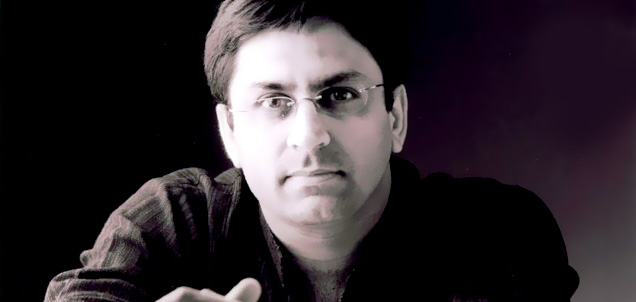
By Anil Thakraney
I did a few ad films with Ram Madhvani nearly 18 years ago. Both of us were very young at the time, quite fresh into the ad business. But there was one difference: While I was floundering around, trying to find my way, Ram was already on top of his game. He was confident, committed and meticulous in his work.
As the years rolled by, Ram has cultivated a powerful name for himself in the Indian ad world. He is, for many ad agencies, the go-to filmmaker. But it’s not been a linear journey. The director has had to keep re-inventing himself to stay relevant in a market that has seen many rapid changes. And this is the key reason behind his continuing success; Ram has thrived even as many big names in the ad filmmaking business fell by the wayside. The director’s dazzling portfolio contains many memorable commercials. Happydent (which won two Cannes Lions), LMN, Hippo, Airtel, Coke, Bisleri and Adidas, to name just a few.
Over a long session, we discuss his craft, his sensibility and his views on advertising and filmmaking. This is not an interview; it is a solid training session for all those associated with the ad world. Not just on filmmaking… on life itself.
| Director Ram’s Mantra |
| 1. The director’s job is to have a vision, and then to pass it on to the team. To the art department, the camera department, the actors, etc2. Intellectual rigour without intellectual rigour mortis.3. Have an opinion and not a judgment.4. Don’t organize shoots, host them.
5. Meditate daily to connect with your own self.
6. Try to see how cinema or advertising can be the vehicle to self knowledge.
7. Have a conscience. Can you face yourself, look yourself in the eye, on the work you do?
8. ‘If you don’t know where you are going, all roads will take you there.’ (From the Wizard of Oz.) |
Q: How did a nice Gujju boy become an ad filmmaker? Didn’t want to pursue the family business?
I was very clear from the age of 16 that I wanted to be a filmmaker. Actually, there’s an interesting story. My school friend tells me it happened because of the smell of burning film. We used to watch all kinds of movies when I was at school in Panchgani, this used to be on Saturdays in the assembly hall. There was this old projector, and the film would tear and burn. Maybe that’s how it started! Films, of course, happened much later, after college and theatre. My father expired early, and I had to earn a living. I sold carpets, I sold diamonds, I sold milk, in fact, I even worked as a peon for a while. (Laughs.) But in the evenings I would either do theatre or catch up with international cinema. Later on I did a course at NYU, when I worked for a while with my elder brother who was in America. I came back and joined Equinox. And two years later, Sumantra (Ghosal) offered me a partnership.
Q: But why ad films?
Because the family felt that rather than getting into the big bad world of feature films, it’s better to get into the big ad world.
Q: Which was your first ad film as director?
Baygon Spray – ‘No entry for pests’. I still have a copy of the cheque with me. (Smiles.)
Q: Is Sumantra still active? Or are you the sole owner of Equinox?
No, he’s retired, I am now the sole owner. Sumantra is of course the Chairman and he’s on the board of directors. He’s my guru; I consult him on many things. He is more than an elder brother… in fact, Sumantra gave away my wife.
 |
“I have to re-invent, I have to be on top of the game. I would hate it if people said, ‘Ram used to make great films at one time’” |
Q: It’s been over two decades. What keeps you going?
Fear. That I will become a has-been. I have to re-invent, I have to be on top of the game. I would hate it if people said, ‘Ram used to make great films at one time’.
Q: Which ad film turned things around for you? You did a number of mediocre ads when you started out, and I recall I was one of those guilty of palming off rubbish storyboards onto you.
(Laughs.) You know, sometimes you take on work in order to convert it. In the hope that because people saw the hard work you put in the film, tomorrow you will be considered for a better film. At the same time, when you are doing that work, you do think it will be of some import.
Q: I always thought you made such films only for money.
To be honest, I haven’t been a profitable director for this company till as recently as a few years ago. I would not be living today in a 2BHK house in Prabhadevi if I had made lots of money. In fact, if I had made a lot of money, perhaps I wouldn’t be in the game today. People know if you are out there to do your work, or to make money. Also, very often a friend calls up and says, ‘This is how much I have, will you do it?’ There is no option but to say yes, and then try and figure how to make it work. Because if I say no, they’ll go to the next person and forget me! (Laughs.) I was reading somewhere that the Sistine Chapel was the world’s biggest hoarding for Christianity. Who commissioned Michelangelo? The Pope did it. And when you look at it, it was meant to advertise a certain thing. So if Michelangelo can be commissioned, why can’t I be? (Laughs.)
|
“From last year I have started doing theatre workshops for every film, I bring all the actors together, I do familiarization and touchy-feely exercises.”
|
 |
Q: Still, which was the first film that made you proud?
I had done a lot of good work for a long time. Tata Steel, Thums Up, Dunlop Spectrawide, etc. But I wasn’t considered an A-Lister. And I was very upset about this. I thought maybe I am not a pedigree top dog. So I went for a week to my friend’s farm in Kodaikanal, and I sat down and wrote what I needed to do to at least become a footnote in the history of advertising film producers and directors. I decided the first thing to do is to acknowledge that you are a mongrel. Two, look at what’s your voice, and what is everyone else’s voice. And having done that, see where you want to go. Then I decided I will only do films with a visual language. Because, at that time, I wasn’t too respectful of the Indian tradition of acting. Which was about ‘to show’ and not ‘to be’. A number of my friends suffered because I took their scripts and converted them into visual language films, and I screwed up a lot. But three or four films got talked about. One of them was Adidas with Sachin Tendulkar. And then for five years I followed the visual language route, and it culminated with Happydent. And then I realized that people are now expecting me to do a certain kind of work. So last year I decided to become a humanist, I re-invented again! You must have seen that with Airtel’s ‘Har Ek Friend’. My mission now is to try and get truth into acting. On how do I make the audiences believe that these actors existed before ‘Action’ and after ‘Cut’. For e.g., in the Airtel ‘Classroom’ ad, those kids in the classroom have a life before and after the ad. From last year I have started doing theatre workshops for every film, I bring all the actors together, I do familiarization and touchy-feely exercises.
Q: Is there one aspect of filmmaking you enjoy the most?
I don’t like shootings. I have been trying very hard to make the shooting space like my home. So I am figuring out how to do housekeeping. When I go to a studio floor, my production team has to show me a map on where things will be kept. I also do human traffic policing. When I walk from my video assist to my actor, sometimes I feel I have to wear a rugby helmet just to push people out of the way. I have a very polite person stationed at the shoot, whose job is to ensure people stand where they are supposed to stand. I think I am 25% there in terms of making it my home environment. I don’t want to organize a shoot, I want to host it.
Q: What is the sensibility you bring to your ad films?
What I like to be is an experimental filmmaker, one who’s precocious and is looking upon, with curious wonder, at this art and this craft. And practicing it in a non-judgmental manner. I am here to play with clay. Currently, as I told you, I like to do human work. Now when you look at a film, you won’t be able to say, ‘That’s definitely Ram.’ Right now, I don’t know what my voice is, but I know what I have lost. I think I have lost a bit of the experimental nature, I have become too popular. (Laughs.) I actually want the surprise factor. I want people to say, “Haila, he did that?”
Q: You made the Tata Docomo ‘maid’ film, where the bai was seen stealing a mobile phone. It was criticized for promoting a stereotype. Regret the film?
No, I don’t. These things shouldn’t be taken so seriously, there was no such intention. It was not a judgment on all maids, it was about this one character in the film. It did not even occur to any of in the team that we are stereotyping someone. But I must tell you I don’t do fairness creams. There no logical reason for this, it’s just a stupid hang-up. I don’t want to tell people that if you are white, you will become this or that.
Q: How do you keep yourself refreshed and relevant in the changing milieu?
I have the greatest collection of books on films. I have also been a voracious reader. But in the last few years, I have stopped reading. Every book I read entertained and enriched me in that moment, but it hasn’t enriched me in the long term. Apart from a few books, like the Bhagwad Gita and Patanjali’s Yoga Sutras. And these are the kind of books I am now reading. I have become very sceptical about Western philosophy, because the epitome of that philosophy is: ‘I think therefore I am’. The epitome of Eastern philosophy is: ‘Don’t think’. The whole purpose of life is to find peace rather than the buzz in our heads. Western society wants us to have more buzz. Eastern philosophy told us 5,000 years ago that the mind is not where you reside, you reside in your heart. The greatest distance I have traveled in the last twenty years is between the mind and the heart. From the intellectual side, I have moved to the emotional side.
Q: Do awards meaning anything to you?
Yes, they do. Because I am living in a world where they do, people do judge you for that. I have won two Cannes awards, and it has helped. At the same time, I have no creative envy, and that’s happened because of Sumantra. There was an indoctrination of creative generosity that happened at a young age. Whenever I see a great ad film done by anybody, I send out a congratulatory SMS. And that generosity gives me greater joy that what envy would have given me.
Q: Creative directors you most enjoy working with.
Prasoon Joshi. He’s got a poet’s mind, and he’s also a true intellectual. And Aggie (Agnello Dias). He’s very rooted. I would also include Raj Kurup and Ravi Deshpande.
 |
“I am finding that nobody in Indian advertising is doing pure emotional work. Kal Bhi Aaj Bhi Kal Bhi and Hamara Bajaj had soul, they made you cry, and that is something we have lost.”
|
Q: Is there something that disappoints you about ad agencies in India?
I think we need more of the Indian voice in the ads. Right now what’s happening is the universal joke. If there is one nation that can teach the world about heart and emotion, it’s us. The reason Bollywood works is because they are purely in the emotional territory. I am finding that nobody in Indian advertising is doing pure emotional work. Make me cry, I am sick and tired of being made to laugh. Thailand has a voice, so do South America and England. Kal Bhi Aaj Bhi Kal Bhi and Hamara Bajaj had soul, they made you cry, and that is something we have lost.
Q: Anything else?
There is too much internecine warfare amongst the ad agencies. Everybody is out to get each other. I don’t know why that is, it’s perhaps the very nature of competition. Maybe it was different when Mr Subhas Ghosal and Mr Gerson Da Cunha were around, maybe there was a certain camaraderie then. Also, there isn’t enough of passing on of knowledge. So if I want to learn, there is no trade journal. A lot of it is I-Me-Myself.
|
“There is too much internecine warfare amongst the ad agencies. Everybody is out to get each other.”
|
 |
Q: I watched your feature film, Let’s Talk. It was very well received and yet you didn’t make another film.
I was supposed to direct a big budget film with Vidhu Vinod Chopra producing it. It was a fantasy film called Talisman. But I wasn’t happy with the script. I have been approached by many people, but I think they are approaching me for my craft. And I believe cinema should have something to say. Now, the things I want to say, I am not getting the money to say them. And what they want me to say, I don’t feel like saying it. Right now I am in a situation where the universe has not conspired and grace has not descended. (Laughs.)
Q: Which genre of cinema excites you?
Three of them. Love and infidelity. Food. And spirituality.
Q: Er, why does infidelity excite? Worried about it?
As a warning! (Laughs loudly.) In this business, you do get close to people. And you have to tell yourself, ‘Hey, hang on!’. I am extremely happily married for 24 years, and I have no such desires. But I get completely amazed with other people when they go through it, because it’s so much heartache and suffering. Why don’t they just do their work yaar? (Laughs.)