Tag: Rajdeep Sardesai

  • Anil Thakraney: Bad times looming for editors/content heads

    By Anil Thakraney


    What’s the best way for large advertisers to get some ‘good press’ in the media? Use PR agents? Throw lavish parties? Suck up to the editors? Naaah! All that is old fashioned stuff. Nowadays, at least in India, where the media acquisition laws are weak, the industrialists simply go ahead and buy a large stake in a media house. Thus controlling the content, whether the proprietors would like to accept that or not. Recently, Ambani picked up a substantial stake in the Network 18 group. And now the Birlas have bought into the India Today group. Am quite certain more large industrial houses are eyeing similar acquisitions in the media.


    This is obviously terrible news for content heads. Because their powers get badly curtailed. Of course, the worst case scenario, which means direct intervention in the content agenda, sucks big time… that’s a nightmarish situation. But even the best case scenario sounds pretty depressing. Because that would mean the media house cannot report/write a single word against the shareholding industrial group. And will often be compelled to project them (and all their partners and subsidiaries) in a favourable light. Consider this: If Mukeshbhai gets caught in a scandal, will Rajdeep Sardesai even think of going after the big man? You know the answer.


    I can understand why the corporate world wants to invest in the media. Because it’s a powerful weapon to have in the war chest, and industrialists can leverage business/political deals with its help. The question is: Can we not have tighter laws on media acquisition, like it happens in the western world? Surely the time has come for that.


    As a journalist, what worries me most is the yet another body blow to the freedom of expression. Already the industry has suffered because of paid news, sponsored news and other malpractices. Not to speak of the greater powers bestowed to the marketing department of the media company. And now this! Clearly it’s not a good time to be a journalist in this nation.


    As for moi, I am seriously thinking of shifting back to advertising. The advertisers are calling all the shots anyway. 🙂


    * * *


    PS: Haha. The advertising life depicted accurately and hilariously in pictures. If you belong to the ad world, you will identify with every single situation. I am sure you are living them right now!


    Link: http://thisadvertisinglife.tumblr.com/


    Anil Thakraney is a Mumbai-based commentator and editor. He is also Editor-at-large, MxMIndia. The views expressed here are his own


  • Paranjoy Guha Thakurta upgrades book on ethics


    By Shruti Pushkarna


    Veteran journalist, Paranjoy Guha Thakurta came out with a second expanded edition of his book, ‘Media Ethics: Truth, Fairness and Objectivity’. The revised edition of the book was launched in the capital on April 27 at the India International Centre.


    The first edition of this book had come out in 2009. When asked, why he decided to bring out a second edition, Mr Thakurta told MxMIndia, “After the book came out three years ago, a lot of people came up with suggestions on how this book could be improved. So this book is about 40 per cent bigger than the earlier edition and there are new chapters…there is an entirely new chapter on corruption in media. There’s also a new chapter on Reality television and some of the existing chapters have been drastically rewritten and revamped.”


    ‘Media Ethics’ discusses key ethical issues in media today, delving into issues like truth, objectivity, sensitivity and privacy. The expanded edition has new chapters on paid news and reality television. It has also has revised chapters on introduction to media ethics, media market, new media and ethics of advertising.


    Attending the event were senior journalists, academicians and students. The launch was followed by a discussion on media ethics by an eminent panel comprising Chief Election Commissioner, SY Quraishi, and senior journalists, Vinod Mehta and Rajdeep Sardesai.


    Media has to inform and educate…

    Addressing the gathering at the book launch, Chief Election Commissioner SY Quraishi said, “The title of this book, truth, fairness and objectivity is an acid test of media’s fairness. This book is a virtual encyclopaedia and Paranjoy is a crusader of media ethics.”


    Mr Quraishi, in his address, also touched upon issues like paid news, opinion polls, hate mails on social media and the whole debate around freedom of expression in the internet age. He said: “Media has a duty to inform and educate the citizens of this country. And, in the context of elections, media has assumed new proportions. There was a revolutionary 30 per cent increase in the voters turn out in UP this year because of the partnership between the CEC and the media.”


    Talking about freedom of expression, he said, “No one wants to encroach on freedom of expression but there are some things which are illegal. Anonymity of the internet media is disturbing and damaging.” Mr Quraishi concluded by saying that media is like the eyes and ears of the society and we should do everything possible to check malpractices in media.


    Editors are like ordinary people…

    Mr Vinod Mehta, Advisor, Outlook magazine started his address by saying that the custodian of any media organization is its Editor. If the Editor is corrupt, the organization is corrupt. He said: “The biggest myth about media is that editors are like gods, that they are independent, that they make no mistakes and they are on a social mission to tell the truth. While this might largely be true, it is highly exaggerated. Editors are like ordinary people, often most opinionated, and they have a view on everything. So they come with their own baggage. So what you get in media is various shades of opinions where the editor’s point of view is reflected. After this polarization of views, in the end you get something approximating the truth.”


    Mr Mehta added that one of the greatest assets of media, which is public trust, is declining and the uproar that used to be about the fourth estate has gone down significantly in the last few years.


    According to Mr Mehta, two reasons for the rise of unethical practices in media are: the reluctance on the part of media persons to admit their mistakes and secondly, intense competition, which has created its own problems. He also said that Editors often assume a larger than life role, thinking that they are setting the national agenda. He said: “We journalists are not players, we have the best ring side seats but we are not players, we can’t get involved in the game.”


    On self-regulation, Mr Mehta said: “We in the media are always telling the other guy what’s wrong, we never correct ourselves. Self-regulation is always for the other guy. So I believe we need a strict code of conduct.” Mr Mehta also suggested that all Editors like politicians should declare their assets on the Editors’ Guild website.


    Problem lies in the business model…

    Mr Rajdeep Sardesai, Editor-in-Chief, IBN18 Network confessed: “Media is more powerful than ever before, but it is also less respected than ever before. In this age of quantification we are facing a credibility crisis.” But he added that the viewer has almost a ‘schizophrenic’ attitude towards the media, so the messenger (media) who is expected to play ‘god’ is repeatedly shot at. Mr Sardesai indicated two main threats to the main stream media, internal and external. Talking of the external threat he said: “The business model is the main problem. The declining ethical standards are because of how the business model is, where 95 per cent dependency for revenues is on advertisements. The channels have to pay what is called a carriage fee, which is actually illegal and completely unethical.”


    Mr Sardesai offered ‘disclosure’ as a solution to paid news. He said: “If it is paid news, then it needs to be said that it is paid news. Disclosure is the only way out, tell the world it is paid news. If an advertiser or a political party is sponsoring a certain programme, then you need to mention outright that the show is sponsored by xyz. But the problem is, in this era of maddening competition and declining revenue, who will set the rules of disclosure?”


    Speaking of the internal threat, Mr Sardesai said that this is one area where you can’t blame the proprietor. He said: “Who asked us (journalists) to replace sense with sensationalism, to replace news with noise? The moral compass that makes journalism different from any other profession has gone.” Mr Sardesai cited the example of theNorwayissue where a domestic problem within a span of no time took the shape of a diplomatic battle.


    He also added that what has changed about media today is the fact that the public is turning against media, the public is willing to teach media a lesson. For ethical cleansing to happen, Mr Sardesai concluded, “We have to name and shame the transgressors and the naming and shaming has to happen by someone within the system.”
     

  • [MxM Journalism Review] Why must TV news depend on print eds for analyses

    By Ranjona Banerji


    Where would TV journalists be without their colleagues in print? (I thought I’d say cousins but then that would make me related to TVwallahs too so…) Every time there’s some big issue to discuss (which in TV land is every day), out come a whole array of print seniors (and sometimes not so seniors).


    During the election coverage on Tuesday we had Shekhar Gupta, Vinod Mehta, Neerja Chowdhury, Manini Chatterjee, Siddharth Vardarajan, Vandita Mishra, Hartosh Singh Bal… and many more worthies.


    I’m thrilled for my friends and colleagues in print who I see on TV all the while at other times – Ayaz Memon, Sidharth Bhatia, Anil Dharker, Arati Jerath… At any time you are likely to see Dileep Padgaonkar, Bachi Karkaria, Tavleen Singh giving their considered opinion on this and that. The list is endless and I apologise to anyone I have left out. I don’t mean it. But it makes me wonder about our esteemed TV anchors and editors. Do they trust their own judgement so little that they cannot carry a programme by themselves? Have they not managed to hone their opinion creating abilities? And if that’s true, what have they been doing for all these years in TV?


    TV wallahs often feel that print journalists are too critical of them. But when they do nothing to change those perceptions and instead feed them by calling print journalists as experts all the while? How often do you see print journalists on BBC and CNN?
    My advice to TV wallahs is: have a little faith in yourselves.


    Having said that, I then remember the columns which Rajdeep Sardesai, Sagorika Ghosh and Barkha Dutt write for Hindustan Times (since few other print publications condescend to give them a platform and rightly so) and I really wonder at myself!


  • Freaking News: How the media covered 10 years of Gujarat riots

    By Ranjona Banerji


    Interesting to see that Hindustan Times has gone for all out coverage of 10 years of the devastating riots in Gujarat, while The Times of India has played it down. This is particularly intriguing because at the time, TOI quite beat all other papers when it came to covering the Godhra train attack and the subsequent riots. Disclosure: I was deputy resident editor of the Ahmedabad edition of The Times of India at the time.


    Of course, it must also be pointed out that Hindustan Times does not have an edition in Gujarat, only a bureau and as Sujata Anandan, political editor for HT, then Mumbai bureau chief, pointed out in a related piece, she had to send people from Mumbai to cover the terrible events. It is possible however that the Delhi edition of TOI has not picked up the relevant stories, which is even odder because 10 years ago it was TOI Mumbai which shied away from riot-related stories and opinions. Apparently the resident editor at the time did not think it was relevant.


    On Tuesday, in the Hindustan Times, Harsh Mander, former IAS officer now social worker who works with Gujarat riot victims, hopes that there will be, well, hope soon. The day before Ashok Malik had asked whether it is time to forgive and forget. I wonder about that and our ability in India to behave as justice is an on and off system which we press when it suits us.


    Television, in particular CNN-IBN and NDTV, did focus on the riots and their aftermath: after all both their main faces Rajdeep Sardesai and Barkha Dutt did cover the riots extensively, perhaps for the same channel at the time, my memory fails me here. As a print journalist however, the strident hysteria of TV reporters and anchors, especially at such critical times, can often be more of a hindrance than help and so it was 10 years ago in Gujarat. Provocative people may make for good television but sometimes it can lead to irresponsible journalism.


    * * *


    Having spent a few days in Delhi, or more correctly Gurgaon, it is fascinating to see how crime dominates the papers. Is this because crime dominates events here or because local journalists look out for it?


    * * *


    On TV land on Monday night, Arvind Kejriwal’s remarks about Parliament being full of robbers, rapists and murderers got some play (see what I mean about TV promoting people just to create good television?). Karan Thapar on CNN-IBN wanted to know whether everyone agreed with Kejriwal and the Election Commission’s intent to tweak existing laws to bar people accused of severe crimes for contesting elections, within a certain time limit.


    The normally rambunctious Chandam Mitra of the BJP, normally quick to have hysterics was abnormally quiet as he hummed and hawed and said a debate was necessary and suppose the accused was later proven to be innocent? (Incidentally, this problem of later being proved innocent never bothers the BJP where Muslims accused of terrorism as concerned!).  An activist pointed out that the proposal was seven years old and surely that was enough time to debate the matter.


    Prashant Bhushan, who defended Kejriwal, said a few innocent people suffering was a small price to pay to keep criminals out.


    The Times of India, in its second editorial, slammed Kejriwal and Team Anna for swinging their “bludgeon in all directions while assuming partisan and authoritarian overtones”, which can only lead to the movement floundering.


    * * *


    On NDTV, Congress leader Renuka Chowdhury got into a made-for-TV fight with an anti-nuclear activist. This was more interesting than the issue itself – foreign-funded NGOs – which got nowhere.

  • CNN-IBN’s Indian of the Year on Friday

    By Akash Raha


    CNN-IBN is all set to host Indian of the Year 2011 in New Delhi on December 16, 2011. In its sixth edition, this initiative will celebrate and honour famous personalities from various walks of life. The chief guest at this occasion will be Speaker of the Lok Sabha Meira Kumar.


    Speaking about the event, Rajdeep Sardesai, Editor-in-Chief, CNN-IBN, IBN7 & IBN-Lokmat, said, “CNN-IBN Indian of the Year awards have created a benchmark of excellence in choosing the most influential and deserving winners. The immense success of the award in the past has raised the bar for this initiative and we are looking forward to a great show this year as well.”


    These iconic Indians will be chosen from five different categories – Politics, Sports, Business, Entertainment and Public Service. The awards are chosen by a four-tier selection process which includes nominations from the Network18 editorial board, ratification by the jury, and voting by the electoral college and Indian citizens.


    The CNN-IBN Indian of the Year winners in the past have been:

    2010 – Nitish Kumar

    2009 – A R Rahman

    2008 – G Madhavan Nair & Team Chandrayaan

    2007 – E Sreedharan

    2006 – Dr Manmohan Singh

  • More bite for toothless PCI?


    By Akash Raha

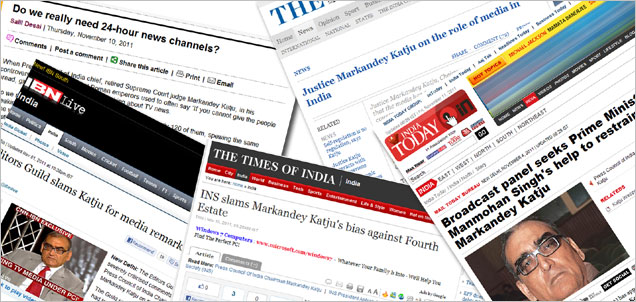
    Recently Chairperson of Press Council of India (PCI), Justice Markandey Katju triggered a volley of criticism and discussion after he lambasted the broadcast media, saying most of them suffer from “very poor intellectual level”. He went on to suggest that broadcast media should come under the purview of the PCI. MxM India asked some well-known media faces what they think.

    Arnab Goswami, Editor in Chief, Times Now and Vice President, Broadcast Editors’ Association (BEA) told MxMIndia: “I don’t know why Justice Katju is making these comments. There is absolutely no need to try and demolish the principle of self-regulation in TV news which ensures that electronic media is free and out of control of vested interests. Justice Katju should not make these sweeping generalizations.”

    Upset over Justice Katju’s comments on the media, former Chief Justice of India J S Verma too is reported to have recently called the PCI an “ineffective” body and said it should wrap up if it does not meet its mandate. Verma chairs the News Broadcasting Standard Authority (NBSA), which is set up by the News Broadcasters Association (NBA). In a recent statement Verma said that he is “deeply anguished” with the kind of language that Justice Katju uses which “sounds authoritarian”. NBA has requested the Prime Minister to stop the PCI from meddling with the dealings of broadcast media.

    On whether broadcast media should come under the ambit of the PCI, Rajdeep Sardesai, Editor in Chief, IBN18 Network said “I believe that the self-regulation mechanism which has been put in place by major news broadcasters must be allowed to strengthen itself. The Press Council has been unable to curb pernicious practices in the print media such as ‘paid news’, so I don’t see how mandating it to now to oversee the electronic media will serve any purpose.”

    Talking about whether he thinks electronic media should be brought under the purview of  PCI Paranjoy Guha Thakurta, an independent journalist and critic, said, “The electronic media needs to be regulated independently – this is because self-regulation is inadequate and ineffective under certain extreme circumstances. The regulator should be independent of both media interests – including the interests of the big corporate media – as well as the government. Even if the regulator is funded by the government, it can be truly autonomous and/or independent if it is Constitutionally mandated thus – such examples include the Supreme Court of India, the Election Commission of India and the Comptroller & Auditor General of India. Ideally the electronic media should have a separate regulator. Even if the ambit of the Press Council of India is widened to include the electronic medium, it has to be made truly independent and autonomous and, most importantly, empowered. The Press Council in its current form has no punitive powers and is hence akin to a toothless tiger.”

    To put things in perspective, PCI was established as a statutory print watchdog by an Act of Parliament in 1978. In recent times, PCI has come under question following chairperson Justice Markandey Katju’s recent remarks on the state of the media in India and its inability to keep a check on paid news.

    When asked if Justice Katju was trying to police the media, Mr Guha Thakurta played down the suggestion, saying, “The Press Council of India is a quasi-judicial body set up an act of Parliament. The way it is supposed to function has been clearly laid down. There is no question of Justice Katju (or for that matter, any Chairman of the Press Council) acting as either a good cop or a bad cop.”

    The question remains, should news broadcast come under the ambit of PCI? One of the reasons for opposing such a suggestion remains that since PCI has been unable to check the menace of paid news in print, there is no reason why it should make any positive change in the broadcast industry. Another argument says that the only reason why PCI has been unable to make a change is because it is still a toothless quasi-judiciary body and the government needs to empower it and give it some tooth. Either way, in this chatter and amidst much confusion is set Justice Katju and his criticism of media professionals as he sees them as naïve and stupid. Criticism which has obviously riled the veterans of the broadcast industry.

    In the wake of this controversy, several discussion forums are being organized on the PCI, the question of paid news, etc. The Foundation for Media Professionals (FMP) is organizing a panel discussion in collaboration with the Press Club of India on the topic ‘Media and Public Interest: Freedom vs Accountability’ on November 12 at Press Club of India, New Delhi. The panelists at this discussion will be Markandey Katju, Rajdeep Sardesai, Neelabh Mishra, Zoya Hasan, Pankaj Pachauri, Abheek Barman, Madabhushi Sridhar and Paranjoy Guha Thakurta with T R Ramachandran as moderator.

    Later, on November 18, MxMIndia has partnered the event ‘Paid News: Fooling People all the Time’ organised by Moneylife Foundation and Citizens Action Network with the support of industrialist Cyrus Guzder to be held in Mumbai’s Madame Cama Hall. The evening will see the screening of the documentary ‘Brokering News’ followed by a panel discussion with senior journalists and the film-maker Umesh Aggarwal. The panelists at this discussion are Umesh Aggarwal, Ayaz Memon, Paranjoy Guha Thakurta, Bhawana Somaaya, and Sucheta Dalal. This panel plans to discuss the issue of paid news, which has been a bugbear even for regulatory bodies such as the PCI.

    For more: http://www.mxmindia.com/2011/11/mxmindia-partners-%E2%80%98paid-news%E2%80%99-event/