Tag: Rajan Anandan

  • Aroon Purie to deliver AAAI Subhas Ghosal Memorial Lecture on Oct 7

    By Our Staff


    The Advertising Agencies Association of India (AAAI) and the Subhas Ghosal Foundation (SGF) are have announced that the Subhas Ghosal Memorial Lecture will return this year with Aroon Purie, Chairman and Editor-In-Chief, India Today Group, as speaker. The event will be held on Friday, October 7 in Mumbai. While talking about his personal and professional experiences, Purie will share many valuable insights which he has gained during his lifetime.


    With the support of Advertising Agencies Association of India (AAAI), the SFT has been hosting its ‘AAAI Subhas Ghosal Memorial Lecture’ series, for several years, where industry leaders like Rajan Anandan, Uday Shankar, Ronnie Screwvalla have delivered keynotes.


    Said Sam Balsara on behalf of SGF: “We live in an age where media and advertising are shaping and also rapidly changing society. It will be interesting to hear Aroon speak about his journey, how he built a media empire, as well as his views on life today and how the media has changed over the years. I believe this lecture will be helpful and enlightening for both immigrants and natives of the advertising and media”.


    Ahead of the lecture, Anupriya Acharya, President, AAAI added: “Aroon Purie has been at the forefront of change and innovation in the news business as it transitioned from print to electronic media and then to digital and social media. A recipient of the Padma Bhushan award, his contribution to Indian journalism is exemplary. I am sure that Aroon’s life experiences will be fascinating for the audiences and we look forward to his perspectives at the Subhas Ghosal Memorial Lecture.”


  • Indian mobile gaming industry on its way to $5B+ by 2025: Sequoia India-BCG report

    By Our Staff


    Sequoia India has partnered with BCG to launch a report titled ‘Mobile Gaming: $5B+ Market Opportunity’. It is to assess the current mobile gaming market in India, and its prospects for expansion.  The report probes into the evolution of Indian mobile gaming in terms of genres, engagement, and monetization dimensions.


    Said BCG Managing Director and Senior Partner, Vikash Jain: “The gaming industry in India has seen a growth of almost 40% in 2019-20, more than that of OTT, television and social media platforms. 86% of this market consists of mobile phone users. While there is large dependence on ad revenues today, increasing traction and engagement is expected to drive higher willingness to pay which will drive new ways of user monetization and rising ARPUs in the coming years.”


    Talking about investor sentiment, Rajan Anandan, Managing Director, Sequoia India added: “Monetisation of Indian games, which has been a concern in the past, is already at $1.8B revenues ramping very rapidly. The industry is witnessing a significant investor interest in Indian gaming.  In fact, a third of all the funding for gaming in India came in the first quarter of 2021. The rise of gaming platforms is especially exciting, as evidenced by 80% of all funding going to platforms.”


    The consumer survey conducted by BCG as part of this report, which gathered insights from 3200+ respondents across 21 locations in India to ensure comprehensiveness and representativeness, investigates gaming habits of the Indian gamer. BCG Managing Director and Partner, Mandeep Kohli explains, “The Indian gamer is not defined by their demographic. They are rather defined by their context – their needs, preferences, and gaming habits. An average player who plays to avoid boredom may spend around 1-2 hours on games, while a die-hard gamer who plays for the competitive spirit, can spend nearly double the time on gaming while playing the same game or a different game all together. Companies that are able to understand these varied consumers and identify which ones are they really serving are the ones which will lead the market.”


    For the stakeholders, the report highlights key imperatives that will drive the next wave of growth for this fast-paced industry. These include enhancing the discovery and adoption through casual and free to play games, improving usage and retention by diversifying genres to increase engagement and retention, and effectively driving monetization through localized pricing strategies, among others. MPL, for example, has a genre agnostic platform. This has led to them being popular with a wider variety of gamers, resulting in more paying users and higher retention than most others in the space.


    “80%+ of the mobile gaming market is driven by user spends, i.e., in-app purchases and real-money games, further catalysed by wide availability of quality smartphones, affordable internet and UPI,” said Prachi Pawar, Associate, Sequoia India.


    Finally, the report also delves deep into the strategic choices of some of the most successful mobile gaming companies in India – Nazara, MPL, Dream11 and Gameskraft. “Being the first movers in their respective segments, some of these companies have helped shape the Indian gaming market. They continue to bet on new growth opportunities and build competitive advantage to stay ahead in this high-stakes game ,” added BCG Principal, Wamika Mimani.


    Opportunities in this ever-growing gaming industry are immense in India. New stories are emerging every day, and many believe the best is yet to come.


  • Rajan Anandan to deliver Subhas Ghosal Lecture

    By A Correspondent


    Advertising Agencies Association of India (AAAI) and Subhas Ghosal Foundation (SGF) have announced the Subhas Ghosal Memorial Lecture by Rajan Anandan, Vice President, Google India and South East Asia on Thursday, September 20, 2018 in Mumbai.


    Anandan will speak on what the new internet sser is like and what to expect in the digital world we now live in, a few years from now.


    Said Ashish Bhasin, President, AAAI: “In a world that is rapidly being disrupted by digital, it will be extremely interesting to and important for everyone to prepare themselves. We at AAAI look forward to Rajan Anandan’s perspectives at the Subhas Ghosal Memorial Lecture.”


    Added Sam Balsara, on behalf of SGF: “Both Digital Natives and Digital Immigrants will find the lecture useful and enlightening.”


    All members of Advertising, Marketing, Media and Digital community are welcome to attend the event sponsored by ABP Live. However, RSVP to Sudesh Kapoor at aaai@aaai.inis a must. If you need an invitation, please send an email from your official email id to Mr. Sudesh Kapoor.


  • Google launches language support for Telugu ads

    By A Correspondent


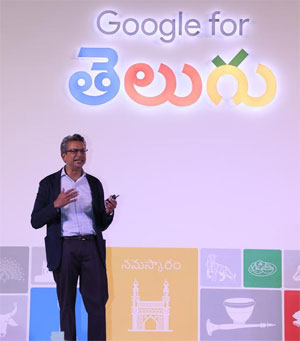
    Google India announced the launch of Telugu language support for its advertising products – Google AdWords and Google AdSense to enable Telugu language web publishers and advertisers reach out to the large base of internet users in Telugu. With this launch, Google has now scaled up its support for Indian language advertising covering Hindi, Bengali, Tamil, and Telugu.


    Announcing the launch, Rajan Anandan, Vice-President, South East Asia and India, Google said:“Expanding support for local Indian languages on our ad platforms are aimed towards making India’s Internet more useful for a billion Indians. In the last few years, we have systematically addressed the barriers that prevent local language users in India to gain from the Internet. And the key to building a flourishing local language internet that serves India’s need – requires the Industry to come together and bring the richness of useful content that India needs. We hope this launch will enable publishers to create more content in Telugu language and help advertisers to connect with their users in local Indian languages.”


  • Tata Trust & Google team up to launch ‘Internet Saathi’

    By Dyanne Coelho


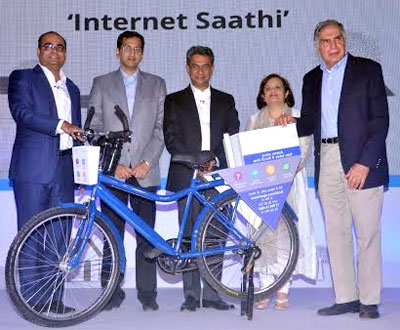
    Sandeep Menon, Country Marketing Director, Google, R Venkataramanan, Executive Trustee, Tata Trusts, Rajan Anandan, VP and Managing Director, Google South East Asia, Debjani Ghosh, Vice President SMG, Managing Director – South Asia, Intel & Ratan Tata, Chairman, Tata Trusts

    There was a time when one had to wait at least seven years to get a phone. Ratan Tata, Chairman of Tata Trusts, certainly remembers that time, and also acknowledges how far we’ve come today with the use of technology. Tata brought this up at the launch of ‘Internet Saathi’, an initiative put together by Tata Trusts and Google, and aimed at empowering rural women and their communities to use the internet to enable development. In fact, the initiative aims to bridge the rather large gender divide as well, when it comes to the use of technology.


    Studies show that only 12 per cent of internet users in rural India are women, according to Sandeep Menon, Country Marketing Director, Google.  said. He highlighted a study carried out in rural India to understand what it is that stops women from using the internet. The key findings were trouble knowing how to use it, the question of what’s in it for them, and lack of a point of access. “While women in the urban areas are making rapid progress using the internet, women in rural areas are getting left behind,” Rajan Anandan, VP and Managing Director, Google South East Asia pointed out.


    With enough statistics in hand to understand the urgent need of women empowerment in the rural areas, vis-à-vis technology, the team has designed a cart, built on the back of a cycle – akin to India’s traditional distribution system which is used to carry everything, from ice-cream to industrial supplies. The cart is fitted with internet-enabled Android One devices, tables and portable chargers, keeping in mind power cuts in many villages. Women will be trained to use these devices, but Menon highlighted that that is the most important thing as the women are curious to know more. “We’ve realised that all we need to do is spark curiosity, and then the women automatically take an initiative to learn the rest themselves and to teach others in the village as well,” he added.


    Debjani Ghosh, Vice President SMG, Managing Director – South Asia, Intel, quoted a UN report which said that across the world, about 25 per cent fewer women than men are using the internet, and the biggest reason for this is that women believe that it is not meant for them. Incidentally, Intel has been a long-term partner of Google India’s Helping Women Get Online (HWGO) initiative.


    Internet Saathi is set to kick off from Gujarat, Rajasthan and Jharkhand, and will eventually be rolled out across the country. It plans to reach 4, 500-odd villages and five lakh women and rural communities over the next 18 months. The internet cart will be available in the village for a minimum of two days every week for over a period of four to six months. It is aimed at creating awareness and will provide adequate training for using the devices. Once the cart has completed the training in a cluster of three villages, it will be moved to the adjoining cluster to complete a similar cycle. The initiative has roped in local self-help group federations and NGO members to help with the training programme.


    While many women in the rural areas still cannot read the language they speak, they use the internet to watch cooking videos or other such material that they find interesting, Ghosh explained, talking about previous initiatives undertaken in the rural areas.


    Asha Devi and Vimla Devi belong to a village called Varkheda in Rajasthan, and were present at the event. Clearly excited about the initiative, they said: “We will be able to get information that earlier we had to go to the city to get.” Added Vimla: “Even after they leave, we teach the other women [how to navigate the internet] and we try to spread the word.”


    “We have a commitment to educate [people] and create prosperity in the villages of India, and we will address it through education and expanding the knowledge base,” Ratan Tata said. “Philanthropy has changed in India over the years. Today, India is a different nation and people demand self-respect and want to be capable of enabling their own livelihood. There is a keen desire to be a part of the world that is today, not the world of yesterday. Digitisation is not only about opening up [a new] India to people, but it’s about connecting them to the rest of the world.” What better way than with the Worldwide Web.


  • LinkedIn’s Nishant Rao appointed IAMAI Chairman

    By A Correspondent


    Nishant Rao

    Nishant Rao, Country Manager – LinkedIn, is the new Chairman of Internet and Mobile Association of India (IAMAI). Rao would be taking over from Rajan Anandan, Managing Director – Google India.


    Nishant Rao takes over at a time when the industry is going through a growth trajectory with more than 300 million internet users and more than 200 million mobile internet users. He said: “This is an exciting phase in growth story of internet in India. The digital industry is growing steadfastly and with that we now have regulatory and policy issues cropping up. IAMAI has been working persistently towards the growth of the medium and is also working with all stakeholders to create a conducive digital eco-system. It is our vision to work closely with the government, agencies and members to ensure a healthy growth and functioning of the digital eco-system.”


    Vinodh Bhat, Co-Founder & President – Saavn is the new Vice-Chairman, who will take over his new role from Kirthiga Reddy, Managing Director, Facebook India. Kunal Shah, Founder – FreeCharge has been elected as the new Treasurer.


    The new team was announced at the 11th Annual General Meeting, which was held today.


  • GroupM’s Grand Diwali Mela draws huge response

    By A Correspondent


    The Grand Diwali Mela organised by GroupM in association with Google, Amazon.in, LINE, Games2Win and Hungama.com met with a huge response with over 55 lakh visitors patronising the event. The ‘Grand Diwali Mela’ saw very high engagement with users, who spent time getting product samples @ Re.1, enjoying movies and videos, playing games and greeting each other via the LINE messenger. The number of visits on the virtual mela as well as time spent surpasses any offline brand activation initiative organised during the festival in India.


    The event received an overwhelming response with over 55 lakh visitors, the majority of which came from mobile phones with over 45 per cent women visitors. On October 24th, Diwali day, the mela received over 4.6 lakh visitors. In all mela visitors spent over 125,000 hours browsing various brand and entertainment stalls in the mela besides which many more hours were spent on partner sites – Amazon.in, Games2win and Hungama.com.


    The ‘Grand Diwali Mela’ emerged as the largest online sampling platform for brands. Over 150,000 samples were shipped across India, with 70 per cent samples going to Tier 2 and Tier 3 towns. The samples ranged from skincare and household products relevant to both men and women. To celebrate the partnership LINE Messenger came out with a set of special edition stickers for the ‘Grand Diwali Mela’.


    CVL Srinivas
    Rajan Anandan

    On the success of the Grand Diwali Mela, CVL Srinivas, CEO, GroupM South Asia said, “We are excited about the success of the first Grand Diwali Mela. We were able to create a great platform for consumers to come and sample products and interact with brands. It is also heartening to see the reach of the virtual mela was not restricted to the metros but filtered down to smaller towns where the digital penetration is growing exponentially. We also have seen a distinct spike in access via mobile phones, a clear indicator that India is opening up readily to mobile data and communication.”


    Rajan Anandan, VP & Managing Director of Google India, said “I would like to congratulate GroupM and all the participating partners for the success of the first Grand Diwali Mela. The fact that majority of the users experienced the mela from their mobile phones goes onto show the growing importance of mobile devices in India. With over 150,000 samples being tested on the platform, the initiative is likely to open up newer ways of engaging buyers online for brands and marketers on the mobile phones. Online brand activation during festivals is a brand new territory and I am confident that we will be able to scale this further next year.”


  • Express group to hold inaugural Express IT Awards on Nov 30

    By A  Correspondennt


    The much awaited Express IT Awards is scheduled to happen tomorrow, November 30, in Bengaluru. An initiative of The Financial Express, the Express IT Awards will celebrate the best innovations in IT across various industry segments. According to a communiqué, it will recognize not only the innovator, but also the implementer and their roles, in successfully bringing a path-breaking idea to fruition.


    The jury comprises stalwarts like Nandan Nilekani, Chairman, Unique Identification Authority of India; Rajan Anandan, VP and MD, Google India, T V Mohandas Pai, Chairman of Manipal Global Education, Professor S Sadagopan, Director, IIIT, Bangalore and Kiran Mazumdar Shaw, CMD of Biocon.


    Karnataka Chief Minister Siddaramaiah will be Chief Guest and the awards ceremony is expected to see CEOs, CSO, CIOs, technology heads, innovators and policy makers amongst others in attendance.


  • Bharti Airtel & Google join hands to launch Free Zone in India

    By A Correspondent


    Bharti Airtel and Google have announced the launch of Free Zone powered by Google, which will give Airtel mobile customers access to mobile web search and feature-phone-friendly versions of Gmail and Google+ in India. The first page of a website linked from search results is provided at no data cost.


    Airtel mobile customers can access the service by visiting www.airtel.in/freezone and start using the internet without having to sign in to the service. Any user can create a Gmail account instantly on the Free Zone homepage and enjoy a multitude of connectivity and social media services from Google.


    Rajan Anandan

    Rajan Anandan, VP and Managing Director, Google India said, “The mobile internet user base is growing really fast in India. Working with Airtel on this exciting trial means that we can offer internet services at no cost to anyone with a phone. This gives people easier access to information in a way that benefits everyone, whether it’s an individual or a small business that wants to reach more people on the web. We hope this initiative will encourage more Indians to experience the value of the internet and gain from it. Students can easily look up facts to work on their assignments, housewives will be able to easily check on recipes and connect with their friends and family from their mobile phones.”


    “In this market, where feature phones predominate, our association with Google to bring Free Zone to India will encourage millions of users to discover the power of mobile internet for the very first time and leverage the amazing world of information search, email and social collaboration – at no incremental cost,” said N Rajaram, Chief Marketing Officer, Consumer Business, Bharti Airtel.


    Free Zone aims to make the web accessible and affordable to all mobile users. The set of powerful internet services available via Airtel includes Google Search, which will take Free Zone users to websites matching their search query, Gmail, and Google+ which enables users to share photos and messages with social groupings of family, friends and business or work associates. While Airtel subscribers will not incur any data charges to access these services on Free Zone powered by Google, access to more advanced services such as Attachment Download or browse through to web sites from the ones accessed in the Free Zone would be enabled through the subscription to a standard data package.


    Airtel mobile customers will be able to access the following services from mobile phone browsers through Free Zone powered by Google:

    – Gmail: Users have unlimited access to Gmail from their mobile browser. If users click on a link or attachment within the email they are directed to a page where they can purchase a data package.

    – Google+: Users can share online photos and messages with circles of family, selected friends or the public; follow updates on the things they are passionate about – from cricket to photography, music to news; and follow people they’re interested in.

    – Google Search: Users can search the entire internet and access the first page of websites from the results for free. If they click further into a website after that, they are directed to a page where they can purchase a data package.


    When users leave the Free Zone to navigate deeper into a website or download an attachment they are informed about the data charges and given the option to purchase an appropriate data package.


  • Internet influences hair, skincare and beauty buys: Study

    By A Correspondent


    Google India has released its report on a study titled ‘Women & Web’ to understand internet usage pattern and its influence on purchase decisions of women internet users in India. The study was compiled by looking at search query data for top women-oriented search categories in India and independent online research done by TNS Australia, which reached out to over 1,000 women with access to the internet in India.


    Out of the total 150 million internet users in the country, around 60 million women in India are now online and use the internet to manage their day to day life. With easy access to internet at homes, cyber cafes, offices and growing adoption of smart phones, internet is being used by women for a variety of things. The study revealed that women who are online are relatively more affluent and younger. 3 in 4 women in SEC AB are now online and 75 percent are in the 15-34 age group, with over 24 million women accessing the internet daily.


    In terms of top searched categories by women on Google in India, apparel & accessories was the biggest search category followed by food & drink, baby care, hair care & skincare. The study revealed that – Skincare, hair care, food & drink were the fastest growing search categories, with queries coming from mobile phones growing rapidly and accounting for almost 25 percent of total query volumes in these categories.


    The study also revealed data on the growing influence of digital medium on women’s purchase decisions for these categories. Data from the online research conducted by TNS Australia, highlighted that among women who had access to internet, over 50 percent said that internet research influenced their decision before finalizing a product. In terms of most researched category and influence on final purchase decisions – internet influence was the highest for skin care (72%), baby care (69%) and hair care (65%) products.


    Rajan Anandan, VP & Managing Director, Google India said, “With this report, it is clear that the internet is empowering Indian women with easy access to information and helping them to make more informed decisions in their day-to-day life. The top generic searches and most searched brands reflect that women are heavily engaged on the internet and are using it to do online research before deciding on their final purchase for categories like skin, hair and baby care products.”


    In terms of online activity, email, search and social networking were the biggest drivers for women. Downloading music, looking for educational content, job search, watching videos and consuming news were the other top activities. The report also indicated adoption of ecommerce by women in India, with 1 in 4 shoppers buying baby products online. Women also emerged as strong brand advocates – with 80 percent saying that they recommend their purchases to other women and 25 percent stating that they share it online.


    Video on the web also emerged as one the key drivers of internet usage among women in India, with women accounting for 40 percent of the total monthly YouTube user base in India. Apart from music videos, TV shows and film content, beauty & fashion videos were popular among women on YouTube. Education, health and fitness, home care & cooking were also rated among the top 10 video content categories of choice on YouTube.


    The study was compiled by Google India, by combining Google search query data in India for apparel & accessories, food & drinks, baby care, hair care & skincare product categories along with TNS Australia research conducted online of over 1000 women in the age group of 18 to 65 and industry reports. The search query data was compiled for the period of one year starting from April 2012 to March 2013. Other data sources include TGI & IRS.


    Apparels & Accessories – International

    Apparels & Accessories – Indian

    Foods & Beverages

    Baby Care

    Hair Care

    SkinCare & Cosmetics

    Zara Fastrack Coca Cola Firstcry Loreal Oriflame
    Ray Ban Tanishq Amul Babyoye Livon Lakme
    Victoria’s Secret Fab India Cadbury Babycenter Tresemme Maybelline
    Louis Vuitton Van Heusen Pepsi Hushbabies Sunsilk Loreal
    Swarovski Chennai Silks Maggi Johnsons Baby Pantene Avon


  • Decoding Digital with Rajan Anandan


    It’s not always that industry folk get an opportunity to be upclose digital luminarie and get them to answer all their queries and address all their doubts. Well, almost. The only limiting factor is the time.


    The platform provided by the International Association of Advertisers (India Chapter) facilitates that with the ‘World Goes Digital’ webinar series.


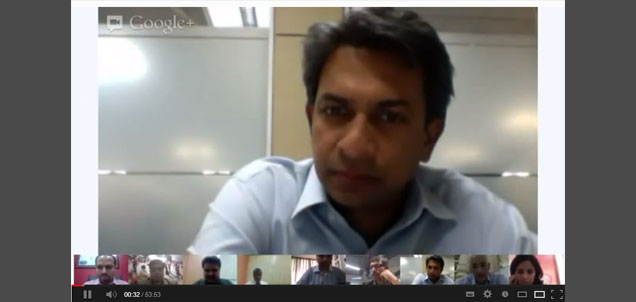
    The inaugural webinar got off to a stimulating start last week (April 26). The platform chosen was Google Hangout which allows for simulatenous ‘meeting’ of 10 people in a ‘virtual’ room. With Rajan Anandan, Managing Director, Google India, as the first guest, the series struck a discerning chord as a cross-section of the fraternity congregated online and many more watching him live on the Youtube. They heard Mr Anandan share his version and vision of the growth of online space and also posed a few questions on the scope and challenges facing the medium in India.


    Srinivasan K Swamy, President, IAA India Chapter, began with an introductory note on the role of IAA in steering such initiatives and promised more such debates in time to come. Abhishek Karnani, co-chair and Director, Free Press Journal group also spoke on the webinar initiative.


    Other than Messrs Swamy and Karnani, other panelists included: Manish Advani, head – marketing and public relations, Mahindra Special Services Group (also co-chair of the the IAA webinar series), Vishaka Singh, Executive Director, Aurora Comms, Nishad Ramachandran, Vice President, Hansa Cequity, Mudit Singhal, Founder and Business Head, Storycentre, Gaurav Mendiratta, CEO, SocioSquare and Jay Sampat, M&E practice at Accenture. Mr Advani proposed the vote of thanks and the panel was moderated by Pradyuman Maheshwari, Editor-in-Chief, MxMIndia.


    Execerpts from the conversation:

    Q: Several companies in India are reluctant to start their own digital enterprise as they feel that if something nasty is posted about them, their business will get affected. What is your advice to these companies?

    Rajan Anandan: I’d like to say that there are 150 million users on the internet and about 95 per cent of the SEC A, B 15-44 yr-olds are on the internet and are spending more time on the internet than any other medium. If you happen to sell products or services that cater to these audience group then if you are not on the internet you won’t be able to reach them. More importantly, if you do not engage with them and other companies engage with them who turn out to be competitors then the users may migrate to those other brands.  We have seen this happen in other countries as well and what’s interesting about India is that despite being at 12 per cent penetration, it already has a 150 million users. For many of us, the industries where we mainly focus on SEC A, B 15-44 this has become a must-have medium. The important thing to realize about the medium is that in the digital arena consumers are the ones that propagate brands. It used to be brands talk to consumers in a one-way dialogue but that has completely changed with the advent of the internet.


    I see two kinds of companies from the umpteen that are present on the medium.  One that says that now I can get instantaneous feedback when something is not going well or when there are opportunities for improvement and those companies are able to leverage this medium in incredibly powerful ways not just for building awareness or driving transaction but also for getting feedback from consumers. Then there is another group of consumers who say that if something goes wrong then consumers will talk about it and the whole world will find out about it. But the reality today is that with the advent of the internet, social networks and online video users are able to stay connected. There are 2.4 billion consumers on the internet today and by 2020 that number will become 6 billion. So everyone will be connected to internet by that year and unless you are selling to people outside of planet earth, it’s important to be on the internet and leverage the medium well.


    Q: A large number of SEC A, B audiences are online and in the Indian context what matters is the language.  Is all of that coming online now for brands to engage more deeply with the consumers?

    Rajan Anandan: The simplistic way to look at this is there are 150 million users in the country who speak, read and write English today. So every new user who comes to the internet today is outside of that bastion. Local language content is important today.  Some of the fastest growing websites on the internet are local-language driven. If you look at videos, especially YouTube which has 50 million unique users per month, more than 80 per cent of the views are actually non-English. We are seeing a large amount of user-generated content in local languages that are being uploaded. Also there are many web-only content creators that are emerging… but the point is that it is still very early days but the content ecosystem  will develop very rapidly. There will be three things that will be witnessed: the first is the underlined infrastructure that will enable local language content at scale. One of the important things is standardized open source fonts. Today, there are not so many open source fonts in our country but that problem will get solved over within the next one year. There are several industries that are working together…the other thing is that there is a lot of content that exists in Indian languages which is not on the web. That content we are seeing it come on to the web.  We think the news print industry has led that wave and we are seeing a lot of publishers etc come online. The third thing that will be a breakthrough in 5-10 years is web-only content creators. Today we have about 40,000 Indian content partners on YouTube and almost all of them are non-English. We are now seeing an interesting trend where content creators are focusing on creating content only for the web. As the ad ecosystem grows such models will get more interesting. Over the next 3-4 years we will see a tsunami of non-English content come to the web.


    Q: How can content creators and creative people use the online video medium effectively in terms of ROI? Also, can you reveal details on the captivity of audiences watching non-English videos on YouTube?

    Rajan Anandan: Let me share with you some statistics on that front with respect to YouTube. We have about 11,000 full-length movies, we have about 90 per cent of Bollywood music catalogue, about 80 per cent of all the regional music catalogue, TV shows of the Top 6 TV networks and live sports as well. Clearly, all this wouldn’t be there on YouTube if there wasn’t a way to monetize it. Now the monetization rates on online today are significantly lower than on TV. If you look at the TV rates, they are in the north of 3 billion dollars while digital advertising is about Rs 2500 crores till last year. So we are 1/6th the size of the ad industry in digital excluding classifieds compared to TV. But the only thing is that digital is growing at 50 per cent while television is at about 12-14 per cent I guess. So there is a way to monetize. The second part to it is that if you want to become a digital-only content creator can you make that viable and how does that compare with say being a content creator in the television space. The simple way to think about the internet is that if you are going to have the same cost structure that you do in the TV industry to make content in the internet industry your toast, because effectively the monetization rates are actually quite low and what we are seeing is that the successful content creators who are already building multi-million dollar business literally starting from scratch. They have a very different cost structure and therefore they are effectively able to make good returns. It’s very important to understand the economics of the medium and therefore build a content business that aligns with the economics of the business. The good news is that there are thousands of digital-only content creators today, which is an encouraging sign. But at the same time if you want to make say an 80-crore movie and say that you are not distribute anywhere else but only on the internet – can I breakeven on that, probably not yet. That’s going to take some time as the CPMs have to catch up and so on and so forth.


    In terms of the users and quality of broadband, the thing is that there are 50 million users including mobile. There are about 10 million unique visitors who access YouTube on mobile while about 40 million view us directly on the web. The TG is 15-44 SEC A, B and this is an interesting audience set. For example, it’s been about two weeks for IPL so the time spent on YouTube on IPL has doubled year-on-year. But my view is that with not so great connectivity India is already at the state of connectivity that there is. As broadband begins to scale out the consumption of viewer-based online content will go through the roof. If there is one thing that is preventing the internet from realizing its potential, it is broadband.


    Q: Google has been doing a lot of activities to bring new businesses online. Will you be able to share data on the kind of agencies that are coming and sticking on with the medium? If they are not hanging around then what are the reasons for the same?

    Rajan Anandan:  To give you an insight, there are about 12 million businesses in India that have more than 5 employees. That is the third largest in the world next to China and the US. Despite that huge number only 1,50,000 businesses advertise in any media. So in print at least 1,50,000 people advertise at least once in a given year; about 10,000 businesses advertise on television and about 7000 businesses advertise on radio. If you look at digital advertising, it is orders of magnitude bigger than television but less than print in India. To grow the digital and mobile advertising market the first step is for businesses to have a mobile or online presence. Over two years ago, when we launched the ‘India get your businesses online’ initiative there were only about 400,000 businesses that were online but when we looked at the quality of those website only 100,000 of them were decent. When we did a little more research behind this, we found that what works in India is generally a free model.  So we built about half a million websites for businesses for free. This was supposed to be a three-year initiative and I am excited to state that we have crossed 300,000 websites which is a three-fold growth and we are confident of achieving half a million quality websites by 2014.


    Also, businesses that are able to generate leads from the internet like travel agencies or doctors or lawyers, etc…if you see today there are half a million doctors in India but less than 50,000 of them have decent quality websites. But the ones that have a website are seeing a significant shift in the way their practice is being run. Basically, consumer-focused businesses that can be used to get leads will be the best way to move forward.  By 2015, there will be more advertisers that will advertise on digital than and by any other medium.


    Q: You have been talking about internet penetration and I have been desperately waiting to hear some bit on mobile internet penetration. Today, mobile internet penetration has crossed pc internet. There are some wonderful examples of mobile projects like M-pesa in South Africa. We hardly hear any story on mobile internet in India. What initiatives should we be taking to drive consumption through mobile internet as compared to PC.?

    Let me start by presenting some facts. There are 150 million users of which 50 million are desktop/notebook users, 50 million users access the internet through a mobile device and the other 50 million access the internet through both a desktop and a mobile device. If you look at the last 6-7 months most of the new users who are coming to the internet are mobile-first and mobile-only. We are essentially starting to see a mobile-only option taking off in India. As I said earlier, all the new users who will be added this year will be from mobile-only. They are doing pretty much the same thing as what one would do on desktops or notebooks. The only thing difficult as of now is video on mobile due to bandwidth issues but outside of that there is an explosive growth that is being witnessed in the mobile space. To quote an example, there are about 25 million smartphone users but the average user is spending about 120 minutes per day on the internet.


    For businesses there are certain implications that come along. For example, today e-commerce is at an inflection point; most e-commerce sites in India are getting between 3-10 per cent of transactions from a mobile device. However the traffic to such sites has now crossed 25 per cent. That is a huge number. Going forward we expect to see a phenomenal jump coming from a mobile device to such websites. It means that if you are a mobile company you will need to have a mobile optimized site. I am surprised to see some companies that do not have this facility. The second thing is that it is important to have native apps. Also, mobile is a very important medium top leverage branding and the good thing today is that one can have very exciting mobile ads. Our view s that the time for mobile has arrived and there is no going back now.


    The webinar can be accessed at https://www.youtube.com/iaaindiachapter
     

  • Rajan Anandan takes over as IAMAI chairman

    By A Correspondent


    Rajan Anandan

    Rajan Anandan, Managing Director, Google India, is the new Chairman of Internet and Mobile Association of India (IAMAI). Mr Anandan will be taking over from Hitesh Oberoi, Managing Director and CEO, InfoEdge.


    Speaking about his new role, Mr Anandan said, “I am excited to take over this responsibility at a time, when the industry is going through an exciting transition. The digital industry has reached an inflection point and is growing steadily. IAMAI, which has been working persistently towards the growth of the medium, is also growing. We plan to engage and interact more closely with the government to ensure that the online industry registers a balanced growth in the years to come and the internet user base widens.”


    Kirthiga Reddy, Director of Online Operations and Head of Office, India at Facebook, is the new Vice-Chairman, and will take over her new role from Dhruv Shringi, Co-Founder & CEO, Yatra.