Tag: Radio One

  • RAMcheck: No changes in top rankings in four metros

    By A Correspondent


    On Friday, January 6, 2012, Radio Audience Measurement (RAM) – which covers four key metros, Mumbai, Delhi, Kolkata and Bengaluru – released its latest radio listenership figures for Wk 43-46 (last two weeks of October and 1st two weeks of November 2011) Vs Wk 47-50 (Last two weeks of November and 1st week of December 2011).


    According to the latest RAM data, for listeners of 12 years and above, and according to radio channel shares, Radio City, Radio Mirchi, Big FM, Red FM, Fever FM, Radio One, Oye! FM were some of the top FM stations in the big four metros.


    Mumbai:

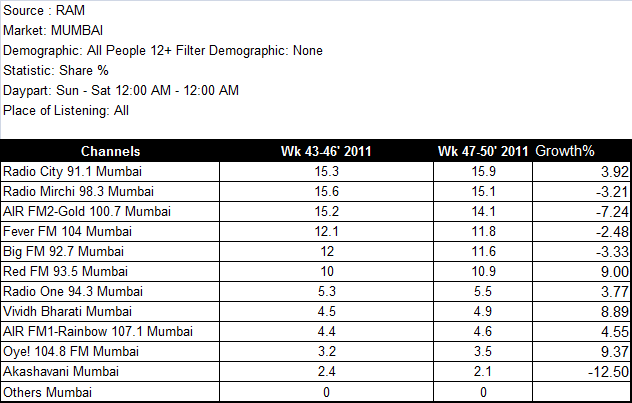
    In Mumbai,Radio City further strengthened its leadership position in Wk 47-50 as against Wk 43-46 with a growth of 3.92 per cent in its channel shares. Radio Mirchi was rated the second most popular FM station in terms of channel shares followed by AIR FM2 Gold, Fever FM, Big FM, Red FM and Radio One. The other clusters of FM stations in the city are Oye! FM, Vividh Bharati, AIR FM1 Rainbow and Akashavani Mumbai.


    Besides Radio City, Red FM, Radio One, Oye! FM, AIR FM1 Rainbow, Vividh Bharati and Akashavani Mumbai are the only radio stations to have shown growth.


    Delhi:

    Most radio stations inDelhiwitnessed growth in the channel shares in Wk 47-50 as against Wk 43-46. AIR FM2 Gold emerged as the number one FM station inDelhi, its channel share however remained stagnant. Fever FM slipped to the number two position in Wk 47-50 after its channel share saw a decline as compared to Wk 43-46. Fever FM and AIR FM1 Rainbow were the only two FM stations inDelhito have seen a decline in channel shares on Wk 47-50 as against Wk 43-46.


    Radio Mirchi was the third most popular FM station followed by Red FM, Radio City, Big FM, Radio One, and Oye! FM. The other clusters of radio stations inDelhiinclude AIR FM1 Rainbow, Hit FM, Vividh Bharati and Akashavani Delhi.


    Bengaluru:

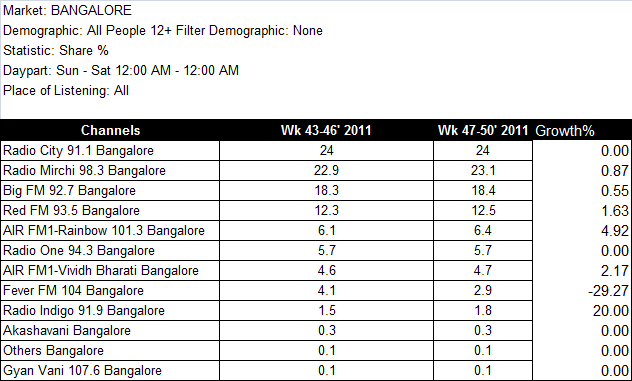
    There was no change in the station rankings in Bengaluru.Radio City continued to lead Bengaluru followed by Radio Mirchi and Big FM. While Radio City showed neither growth nor decline in its channel share, Radio Mirchi and Big FM saw marginal growth. Fever FM, however, was the only FM station that showed decline in its channel shares.


    Kolkata:

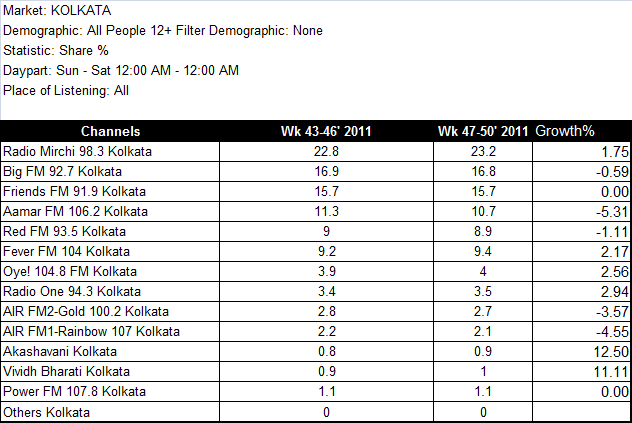
    Kolkata too saw no change in its station rankings. Radio Mirchi, Big FM, Friends FM, Aamar FM and Red FM were the top five FM stations in Kolkata in terms of their channel shares. Radio Mirchi, the most popular FM station in Kolkata has further strengthened its leadership position with a growth of 1.75 per cent in channel shares in Wk 47-50 as compared to Wk 43-46.


    While Radio Mirchi’s nearest rival in Kolkata, Big FM came a distant second with a slight decline of 0.59 per cent in terms of its channel share, the third most popular FM station in Kolkata, Friends FM remained stagnant. Besides Radio Mirchi, Fever FM, Oye! FM and Radio One were the only private FM stations in Kolkata to have witnessed growth in channel shares.

     

  • Radio One likely to turn English in Mumbai & Delhi

    By Robin Thomas


    FM radio network Radio One is likely to go English for its Mumbai and Delhi stations, MxMIndia has learnt from industry sources. This shift is likely to take place next month or early February 2012. MxMIndia did not receive any official confirmation from Radio One at the time of writing this, though industry sources have confirmed the development. Radio One, a joint venture between Next Mediaworks Ltd and BBC worldwide, operates in seven cities – Mumbai, Delhi, Kolkata, Chennai, Bengaluru, Pune and Ahmedabad.


    An English FM radio station in Mumbai and Delhi may add a fair deal of differentiation in music, but what remains to be seen is how advertiser-friendly it will be, given that listenership levels are lower than those playing just Hindi music.


    MxMIndia spoke to few industry players on whether Mumbai and Delhi markets will open up to an English FM station. One of them was of the view that an English FM station in Mumbai in particular will create a much needed differentiation in terms of music. There is a market for English audience, but it may take some time to get established, what remains to be seen is how the advertisers will react to this change. Another industry observer was of the view that while there is a market for English music listenership in both Mumbai and Delhi, it could still be challenging for the FM station in terms of revenue generation, as the audience size is small.


    On the other hand, Sunil Kumar, MD, Big River Radio feels the fact that there are audiences willing to pay a huge sum for rock concerts, the number of English newspapers, the popularity of serials such as Friends, are sure indications that there is a market for an English FM station. “There is a market for English music listeners, these are the people who have an international or global outlook, they travel abroad and are well attuned to English music. An English FM radio station will bring an additional audience to radio – that is, those who do not listen to radio. Just look at the number of English movie channels, English GECs, news channels, they are doing extremely well. Therefore, for a premium channel you don’t need a large audience but, you can charge huge premium for the audience they deliver to, which is often people in the higher socio-economic group,” he said.


    It may be recalled that when Fever FM was launched in Mumbai, it initially aired both Hindi and English songs after which they had to completely switch to Hindi. Radio One too has experimented for long with its English format in its earlier avatar of Go92.5 and Radio Mid-day. Market pressures and the desire to catch up with the more mass Bollywood hit music format got it to go completely in Hindi. Hit FM is the only 24×7 English FM station in Delhi, while Mumbai currently has no fulltime English FM station. The other 24×7 English FM stations in the country are Radio Indigo in Bangalore and Chennai Live in Chennai. All India Radio’s FM Rainbow station also plays English music.


  • FDI’s 26% allowance: Are radio players happy?

    By Shubhangi Mehta


    The government has enhanced the foreign investment limit for FM radio to 26 percent from the earlier 20 percent.


    This change ensures conformity of the foreign investment limit with other similar activities in the Information and Broadcasting sector.


    Rana Barua

    Is the increase adequate or was there more that was expected?

    Mr Rana Barua, Chief Operating Officer at RED 93.5FM, put forth his views by stating,” it’s a positive sign for sure for the industry .

    Whether Red Fm is looking at upping the Astro stake, Mr Barua said, “We will try and look at that but this will all depend on internal decisions hence there is not much to be said on this as of now”.


    “It is a welcome change but we will be able to gauge its real value closer to the bidding date of phase3 when migration policy is clear.  While radio in india is possibly one of the highest CAGR media in the world, the global economic situation needs to be accounted for in order to ascertain foreign investment’ interest,” said Mr Vineet Singh Hukmani, MD, Radio One.


    Apurva Purohit


    On this Ms Apurva Purohit, CEO, Radio City 91.1 FM said,”The increase in FDI in Radio sector from 20 to 26 percent is not really going to make any dramatic impact on the industry. It is too less and even now not on par with other media like TV or DTH.”


    Prashant Panday


    Mr Prashant Panday,CEO,Radio

    Mirchi, remarked, “A higher FDI limit will help FIIs to trade more in radio stocks that are listed. Till now, the limit was 20 percent and when FIIs approached that number, they had to take special permission from RBI to buy more. Now that limit has been raised to 26 percent and that will help increase volumes on listed radio stocks.”


    Will this encourage more foreign players to invest in the market?

    On this Mr Panday said,” Whether it will have any impact on strategic investments from foreign companies in India or not remains to be seen. On the one hand, the radio sector in India offers tremendous growth opportunities. But on the other hand, the sector’s profitability has been in question for much of the last five years. Even going forward, if bidding in Phase-3 becomes unreasonable, profitability could be in serious jeopardy. Further, foreign ncompanies are themselves operating under uncertain conditions in their own markets. Whether they will be willing to invest in India at this point in time remains to be seen.Also, given the condition of the money markets in India right now, it is unlikely that fund raising will be very easy. Given all of this, I think FDI investments into the radio sector in India will be limited.


    Mr Barua on the same said,” I’m still not sure if the rise will encourage new players to enter the market. The rise is there but when it comes to analysing it, I have always encouraged a higher percentage. In my opinion this rise is not high enough and leaves us with a doubt if it will actually egg on more foreign players”.

  • 94.3 Radio One empowers its listeners

    By A Correspondent

    Taking a leaf out of the current wave in the nation where people’s say cannot be ignored, 94.3 Radio One has also decided to follow this path. The station has just completed five years in the Bangalore market and has initiated a campaign  to give its listeners the power to choose what they want to hear on radio by organizing a public feedback forum for listeners’ to make themselves heard.

    Talking about the initiative, Shyju Varkey, National Marketing Head and Station Head-Bangalore, says, “On our 5th anniversary, we wanted to create an initiative where we could empower the listeners. We want to give our listeners the power to choose what they want to hear and what they don’t’ want to hear.  An initiative such as this has never been taken up by any radio station or any other medium before. “

    Radio One through this initiative will shortlist 600 candidates who are very well versed with Bollywood music to be a part of a research conducted by a prominent research agency.  These candidates will represent the listeners to choose the music they want to hear and decide on the most favorable tracks, which will ensure Radio One plays the music that the public desires. A reproduction of the playlist would then be announced on air after the research has been completed.

    “We were inspired by the various initiatives all around the country where people are striving to make themselves heard.  We being a radio station thus decided that we should do our part in giving citizens a voice through our station by making it completely 100 percent co-created by the listeners, for the listeners and of the listeners,” added Varkey.