Tag: Radio One

  • Dentsu Impact bags digital mandate for HT’s radio biz

    By A Correspondent


    Dentsu Impact, the creative agency from Dentsu Aegis Network, has added the mandate to its recently established Social Media Division, Dentsu Impact Digital.


    The agency has been awarded the digital mandate for all three radio businesses of the HT Media Group –  Fever FM, Radio Nasha and Radio One. Dentsu Impact also handles the creative duties for Hindustan Times and Hindustan Hindi – the two leading dailies from the HT Media group.


    Rajan Bhalla

    Speaking on the development, Rajan Bhalla, Chief Marketing Officer, HT Media said: “We have been associated with Dentsu Impact for a long time and have immense trust in the capabilities of the team. The agency’s forward-thinking approach in embracing the evolving market today, and the intent of giving us synergised solutions for digital and offline is something that helped us come to this decision. We hope to see some great work being rolled out soon.”


    Amit Wadhwa

    Added Amit Wadhwa, President, Dentsu Impact: “At Dentsu Impact, we have a clear vision of becoming a truly digitally enabled agency, and that was the thinking behind setting up our social media division. It is extremely encouraging to see clients embrace our vision and see the kind of value we bring in.  Our relationship with HT Media is an old one and one that we really cherish, and we are thankful to them for placing their trust in us once again.”


  • Radio One unveils new brand logo, goes international in Blr

    By A Correspondent


    94.3 Radio One, which changed to an international format in Delhi and Mumbai five years ago, has changed its Bengaluru station also to the international format. The change in format happened in Bangalore on January 9, 2017. Meanwhile, Radio One has also decided to relaunch its international network brand with a new logo and new on air elements to strengthen its all India product offering.


    “We have launched the Bengaluru international format and relaunched Delhi and Mumbai with some very special content. Not only are the music playlists hugely rejuvenated but the content has been acknowledged exclusively by international stalwarts like Bryan Adams, David Guetta, Padmalaxmi, Chris Daughtry, Eric Martin of Mr Big and others.  We have special segments like Celebrity wrist watch with international celebrities that tell the time of day, new innovative ways of announcing traffic and weather, a host of new shows both on weekdays and weekend. We continue to super engage our upscale audience with new content on sports, current affairs, Hollywood, travel, food and other audience interest areas in an intelligent and entertaining manner,”said Anil Machado, Chief talent and content acquisition officer, Radio One.


    “With the new product and congruence in format of the three largest radio markets, we have upwardly revised our international network pricing and are happy to see that clients and advertising agencies are supporting us in this change as they see value in this unique format and its 25 million audience target. We thank them for the same. As regards our new network logo, it combines the creativity of orange with the solidity of blue coupled with white representing the unity of purpose in all three markets,” said Saurabh Sehgal, COO-Operations, Radio One.


  • BIG Magic partners with Radio One for ad sales initiative in Ahmedabad

    By A Correspondent


    BIG Magic and Radio One Ahmedabad have announced an ad sales tie up for the city of Ahmedabad. As per the agreement, BIG Magic will facilitate sale of advertisement airtime on a non-exclusive basis on 95 FM Radio One Ahmedabad. Radio One Ahmedabad will also create new programming to attract better revenues.


    Ashwin Padmanabhan, Chief Operating Officer, For Big Magic Ltd said, “We are pleased to announce that effective January 15th, 2016 onwards, BIG Magic Limited has associated with Radio One Ahmedabad, wherein we would work together with them to sell advertising spots on95 FM Radio One Ahmedabad on a non-exclusive basis. We have always been open to exploring new avenues for our advertisers and provide them the best value. The popularity of Radio One in Ahmedabad will ensure that this move would prove to be viable for our advertisers, and a win-win for both entities.”


    Saurabh Sehgal, COO (Operations), Radio One said, “We have been looking to improve revenues in our Ahmedabad station and since BIG magic has no conflict of interest in the city of Ahmedabad it was worthwhile associating with them for the city. We will work together to create local advertiser funded programs and are positive that this is a win-win for both parties. We also look forward to more national revenues now going into Ahmedabad. This will help our sales effort.”


  • Radio One takes Delhi & Mumbai international music stations online

    By A Correspondent


    The Mumbai and Delhi radio stations of 94.3 Radio One are now available online on www.radioone.in.The stream is a ‘re-broadcast’ of the existing terrestrial radio stations which have international music aired.


    With this initiative, Radio One is the first station in India to begin a ‘webcast’ of its existing international radio stations on the internet for a pan-Indian audience, notes a communique.  While the streams can be accessed across the internet, the spoken content will retain the distrinctive Mumbai and Delhi flavour.


    To launch the webcast, Radio One has created a promotional campaign on air and social media called #LetsGoOnline.  The campaign starts with a new song created in-house by the Radio One team that recognizes that humans were ‘born to be online’.  Social media is being used for a contest that encourages listeners to make their own video for the song.  A demo video of the song ‘Lets go Online’ can be seen at http://www.youtube.com/watch?v=Og0WxwEozTA&feature=youtu.be


    The song can be downloaded free from http://snd.sc/1cYJ6bu


    Said Vineet Singh Hukmani, MD & CEO Radio One: ‘This is a milestone change and we thank music companies like Universal Music, Sony Music, Virgin Music, and others for recognizing that webcasting of existing terrestrial radio feeds in India presents a new possible opportunity with Phase 3 around the corner combined with 4G and the fast improving broadband space… Though revenue growth from this alone will take time to scale up, it allows all of us an exciting opportunity at an affordable cost.”


    Shyju Varkey, National Marketing Head, Radio One added: “Our well profiled audience across India have been requesting an international station since we launched 18 months ago in Delhi and Mumbai. Listeners in these two cities too have been demanding their favorite radio station be heard online. A cumulative reach of 9 million people in Delhi and Mumbai alone through FM Radio gave us the confidence to go online and expand this base of higher net-worth educated audiences pan-India.”


    A special debate on Radio One and Twitter will encourage listeners to converse about ‘why they love being online”. The station will pay rich tribute to brands large and small that have both globally and locally gone online to create a better and convenient world for people. For this the station has roped in Gul Panag who maintains a very strong online presence.


  • Radio One operating profit grows exponentially

    By A Correspondent


    Radio One Ltd, now renamed Next Radio Ltd, the joint venture between Next MediaWorks Ltd and BBC Worldwide, has declared its audited financial results for the year ended March 31, 2013 at the annual board meeting held recently.


    Revenue grew 16 percent to Rs 50.41 crore for the year ended March 31 as compared to Rs 43.48 crore in the corresponding period last year.


    EBIDTA profit grew exponentially to Rs 18.41 crore in the year ended March 31, as compared to Rs 0.25 crore in the corresponding period last year. The EBIDTA margin for the year ended March 31 was at 36.5 percent which is in line with the best in the media industry.


    Profit before tax (before exceptional items) improved to a positive of Rs 0.58 crore in the year ended March 31 as compared to a loss of Rs 17.78 crore in the corresponding period last year.


    The operations were sufficiently cash positive for the first time.


    Radio One MD & CEO Vineet Singh Hukmani said ‘We have transformed our business with strategic restructuring. Our focus on profiled educated audiences helped us move 100% advertising revenue to our ‘on air’ product. Led by our international formats in Mumbai and Delhi, we are delivering high quality differentiated products in each of our 7 cities at the lowest cost. Added to this we have initiated up to a 30% increase in advertising rates successfully.’


    Radio One, which runs 94.3FM, is keen to participate in Phase 3 bidding and is looking to expand to high value metro markets. “We are hopeful that the MIB will soon allow existing players with 10 year licenses to extend to 15 year licenses before phase 3 bidding. This will result in confident bidding by existing players,” added Mr Hukmani.


  • Can a Satyamev-like show be created for radio? Yes, say broadcasters

    By Robin Thomas


    Aamir Khan’s ‘Satyamev Jayate’ is the hope to recreate the Sunday morning appointment viewership that was probably lost with the entry of multiple cable television channels in the late 90s. The Sunday morning programme, which premiered on May 6 with much fanfare, has already received rave reviews from viewers and marketers alike.


    Appointment viewing in television has become a common practice, with examples galore like season one of Kaun Banega Crorepati (KBC) or soap operas suchas ‘Kyun Ki Saas Bhi Kabhi Bahu Thi’ or even earlier epic programmes like the Ramayana and Mahabharata, wherein viewers would often set the time aside for their favourite shows.


    But can the same be said about radio? Does a radio programme have appointment listenership? Can they create shows of the calibre of ‘Satyamev Jayate’?


    One of the reasons why television programming has evolved is said to be only because of multiple channel offerings, similarly radio programming is also said to evolve with more channel offering, different genres and thus big property shows which could draw more loyal listeners.


    According to GG Jayanta, National Marketing Head, Radio Mirchi, a similar kind of experience exists on radio, albeit on a smaller scale, despite the fact that music is the largest chunk of programming on most radio stations. “The breakfast show, from 7am to 11am, usually tackles issues that resonate with local sentiments – be it the case of the battered girl child or petty corruption or question paper leaks or pot-holed roads. There are expert opinions, listener call-ins, diverging points of view et al – but the tone and manner is always upbeat and offers a ray of hope to the listener – entertaining, but not frivolous. It makes for engaging content leaving the listener with a feeling that there is someone listening to their plea. This interactivity is what makes radio powerful.”


    One of the challenges for radio today is the lack of differentiation in content as most radio stations arguably sound the same, especially in the kind of music they play. Gone are the days when radio programmes like ‘Binaca Geet Mala’ and ‘Sangeet Ke Sitaron Ki Mehfil’ were highly popular with listeners who set aside time to listen to these programmes.


    Anil Machado, National Programming Head, Radio One, felt: “Radio has a lot of appointment listeners, mostly during the weekends. Programming in every medium is a challenge today, but it depends on how you create a differentiation in your content. The moment a radio station begins to move away from the herd and create a differentiated content, it will attract more listeners and thus bring appointment listenership.”


    Nonetheless, those were the days when there were not as many FM stations and the television onslaught was yet to take place. Whether or not multiple frequencies in FM Phase III would create differentiated and innovative shows and shows that of a ‘Satyamev Jayate’s’ calibre, only time will tell. But radio broadcasters would like to disagree. “In fact, Aamir Khan was on air with RJ Jeeturaj on Radio Mirchi Mumbai, wanting to interact with the audience and gauge their reaction to the show. Therefore, a similar sort of programming can happen on radio or for that matter any medium but, what is important is the audience should feel enriched,” said Mr Jayanta.


    Radio broadcasters are of the view that such programmes have always been part of radio and that the next step forward for the industry should be attempts to create differentiation in content in order to create more appointment listeners. But there are some who feel that more than shows like Satyamev Jayate, what would work on radio are shows with localised content.


    Sarthak Kaushik, Director, Programming, Hit FM felt: “A radio version of Satyamev Jayate’s calibre will not work because radio is an intensely personal and a local medium, so essentially it is the local issues that work on radio. As far as appointment listenership is concerned, it is mainly depends on the maturity of the audience. Radio is one medium which allows a lot of experimentation, all one needs is courage to experiment with a programme and how confident one is to promote that programme.”


  • RAMcheck: Besides Mumbai, no change in #1s

    By A Correspondent


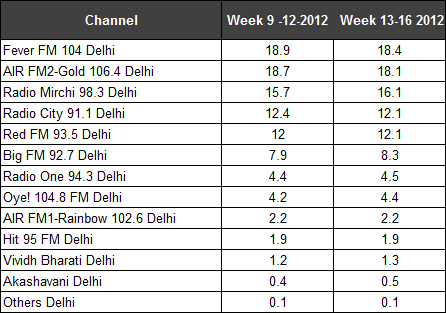
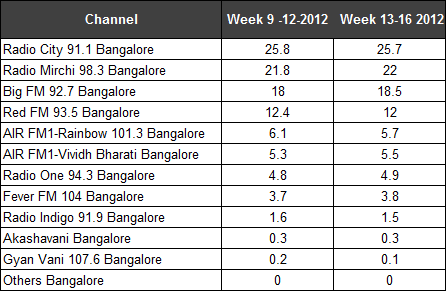
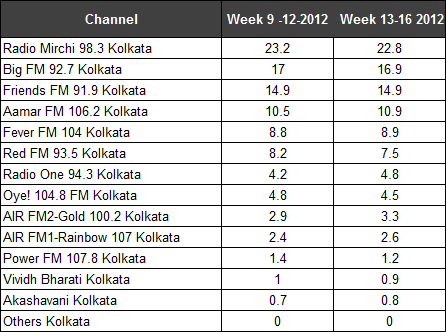
    TAM Media’s Radio Audience Measurement (RAM) – which covers four key metros, Mumbai, Delhi, Kolkata and Bengaluru – released its latest radio listenership figures for wk 13 to wk 16, 2012 (Last week of March to first three weeks of April, 2012). According to the latest RAM data, for listeners of 12 years of age and above, all places of listening, and according to radio channel shares, RadioCity, Radio Mirchi, Fever FM, Big FM, Red FM, Radio One, Oye! FM continue to be the top FM stations in the big four metros.


    Mumbai:


    Radio Mirchi emerges as the number one FM station in Mumbai with a market share of 15.3 per cent, followed closely byRadioCityat 15.2 per cent. The two FM stations are closely competing for the top spot, but what remains to be seen is which of these two FM stations retains the top spot. AIR FM2 Gold, Fever FM and Big FM make the top five FM stations in Mumbai. The other FM stations in the Mumbai market include Red FM, Radio One, Oye! FM, AIR FM1 Rainbow, Vividh Bharati and Akashavani.


    Delhi:


    Fever FM continues to be the most popular FM station in Delhi with a market share of 18.4 per cent, its nearest rival is the AIR FM2 Gold which is comfortably placed at number two with 18.1 per cent market share. Ranked three is Radio Mirchi followed by RadioCity which is ranked four and Red FM as ranked five in theDelhimarket. The rest of the FM stations in Delhi include Big FM, Radio One, Oye! FM, Hit FM, AIR FM1 Rainbow, Akashavani and Vividh Bharati.


    Bengaluru:


    RadioCity continues to maintain its leadership position in the city. RadioCity, Radio Mirchi and Big FM are the top three most popular FM stations in Bengaluru. RadioCity received a market share of 25.7 per cent whereas Radio Mirchi and Big FM received a market share of 22 per cent and 18.5 per cent respectively. Ranked four is Red FM with 12 per cent and the fifth most popular FM station is AIR FM1 Rainbow with 5.7 per cent. The other FM stations in Bengaluru include AIR FM1 Vividh Bharati, Radio One, Fever FM, Radio Indigo, Akashavani and Gyan Vani.


    Kolkata:


    Radio Mirchi is the clear winner in Kolkata with a market share of 22.8 per cent. The top three FM stations in Kolkata haven’t changed as Radio Mirchi continues to be the number one FM station of the city followed by Big FM with a share of 16.9 per cent and at the number three FM station of Kolkata, Friends FM received a share of 14.9 per cent of the share. Ranked four and five are Aamar FM and Fever FM with a share of 10.9 per cent and 8.9 per cent respectively. The other FM stations in the city are Red FM, Radio One, Oye! FM, Power FM, AIR FM1 Rainbow, AIR FM2 Gold, Vividh Bharati and Akashavani.


  • Radio One is a station with a difference: Anil Machado

    Beginning March 28, Radio One Kolkata made a transition from a station that played a mix of Hindi and Bengali songs to a full-fledged Hindi retro station. The Kolkata station is now a 100 per cent Hindi retro station, playing the biggest hits from the sixties through the nineties. By going completely retro, the FM station aims to create some differentiation in the Kolkata market which has nearly nine FM stations. The decision to go retro was taken after extensive research was conducted, which found that no FM station in Kolkata dwelled into the retro music space and that there is huge potential for a 100 per cent retro music station in the market. In conversation with MxMIndia’s Robin Thomas, Mr Anil Machado, National Programming Head, Radio One shared his view on the reasons for going retro in Kolkata, how the station is different in other markets and the response received. Radio One, a joint venture between Next Mediaworks Ltd and BBC Worldwide is operational in seven metros – Mumbai, Delhi, Kolkata, Chennai, Bangalore, Pune and Ahmedabad.


    Please throw some light on the decision to go retro in Kolkata?

    Radio One is a differentiated station in every market we are currently present in and there is no market better than Kolkata to go 100 per cent retro.  The biggest retro singers are from this market… Kolkata is a market that swears on retro music, that’s grown up to retro music. Our motive is being different in every market and we noticed huge space in retro music that no one was catering to and if they did, then they were catering in time slots. We did our research and found that people of Kolkata are crazy over retro music and that the market is huge. In fact, no other player has dwelled into this space and hence we took the step and went 100 per cent retro in Kolkata.


    What genre of retro music will the Kolkata station play?

    We would be playing the biggest hits from 60s and 70s all the way through the 90s. You can listen to over forty years of the best music ever churned out in the country. The best of retro music will be played on Radio One Kolkata station. Tune in any part of the day and you will listen to songs you have grown up listening to, and therefore you will end up enjoying the station.


    And before going retro, Radio One Kolkata played….?

    Before going retro we were playing mainly a mix of Hindi and Bengali wherein Bengali music occupied nearly 25 per cent of the music mix.


    You have tried to create a differentiated station across markets…?

    We have differentiated content in all our markets. In Mumbai andDelhi, we are the only radio station playing international music. In Kolkata we are a 100 per cent Hindi retro station. In Chennai we are the only 100 per cent request station. In Pune we are a hardcore Bollywood music station whereas others play a mix of Hindi and Marathi. InBangaloretoo we are truly a Bollywood music station whereas others play Kannada music and in Ahmedabad we stand to a maximum music, maximum choice wherein we air only two shows and the rest is back to back music. The others in Ahmedabad market, on the other hand, air approximate six to seven shows whereas we air only two shows.


    What’s the kind of response the Kolkata station is generating, particularly from the advertisers?

    The response, from both listeners and advertisers, has been overwhelming. Advertisers mainly look at audience profiling and the differentiating factors of the station, and Radio One provides that differentiating factor and the audience profile. Kolkata has nine radio stations and advertisers realize that Radio One is the only FM station that plays 100 per cent retro music, our TG continues to remain the same i.e. 30 years plus listeners. What we have noticed in the Kolkata market is that they breed music from the sixties, seventies, eighties, nineties, and the people of Kolkata know their music, the singers and lyricist and so on.


    Radio One Kolkata went retro towards the last week of March, 2012, yet you didn’t make much noise about it…?

    We went retro from the March 28, 2012. I believe that the moment your product is differentiated, it works on the principle of network marketing but, if you are similar to other stations in the same market that is when you would invest heavily in marketing. Therefore, the moment you are a differentiated product, you would automatically stand out from the herd.


  • RAMcheck: No change in #1 stations across RAM markets

    By A Correspondent


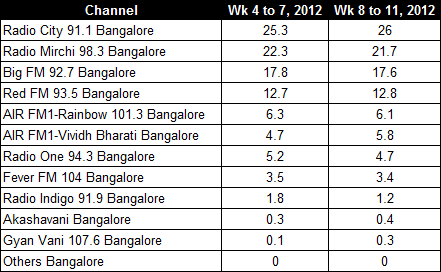
    TAM Media’s Radio Audience Measurement (RAM) – which covers four key metros, Mumbai,Delhi, Kolkata and Bengaluru – released its latest radio listenership figures for Wk 8 to Wk11 (Last two weeks of February 2012 and first two weeks of March 2012).


    According to the latest RAM data, for listeners of 12 years of age and above, all places of listening, and according to radio channel shares,RadioCity, Radio Mirchi, Fever FM, Big FM, Red FM, Radio One, Oye! FM were some of the top FM stations in the big four metros.


    WhileRadioCityretained its leadership position in Mumbai and Bengaluru, Fever FM and Radio Mirchi also continued to remain the leading FM stations inDelhiand Kolkata respectively.


    Mumbai:

    RadioCitycontinues to be the most popular FM station in Mumbai, as the FM station has maintained its leadership position in the city. Ranked second is Radio Mirchi followed by AIR FM2 Gold, Fever FM and Big FM which are ranked third, fourth and fifth respectively. These top five FM stations and Red FM, ranked sixth have secured their listenership share in double digits. The other FM stations in the city include Oye! FM, Radio One, AIR FM1 Rainbow, Vividh Bharati and Akashavani Mumbai.


    Delhi:

    According to the Wk8 to Wk 11 RAM data, Fever FM has once again retained its leadership position inDelhiwith a listenership share of 18.6 per cent followed by AIR FM2 Gold which garnered a share of 18.5 per cent. Although Fever FM is the number one FM station ofDelhi, the government owned AIR FM2 Gold is a close second. What remains to be seen is whether Fever FM is able to widen the gap between the number one and number two FM station? Or will AIR FM2 Gold claim the leadership title?  Once the undisputed leader ofDelhi, Radio Mirchi is now ranked three with a share of 15.2 per cent followed byRadioCityand Red FM with a share of 12.3 per cent respectively. The top five FM stations have received their station share in double digits. The other cluster of FM stations inDelhiincludes Oye! FM, Radio One, AIR FM1 Rainbow, Hit FM, Vividh Bharati and Akashvani Mumbai.


    Bengaluru:

    RadioCitymaintained its leadership position in Bengaluru with a share of 26 per cent, its nearest rival Radio Mirchi, on the other hand, received a share of 21.7 per cent. Ranked three is Big FM with a share of 17.6 per cent followed by Red FM which received a share of 12.8 per cent. While the top four FM radio stations in Bengaluru received a double digit share, AIR FM1 Rainbow which is ranked five received a share of 6.1 per cent. The other clusters of FM station in the city are Fever FM, Radio One, Radio Indigo, Gyan Vani, Akashavani and Vividh Bharati.


    Kolkata:

    The top five FM stations of Kolkata continue to remain the same. Radio Mirchi is unanimously the most popular FM station in Kolkata with a whopping 22.9 per cent of the station share. Its nearest rival is Big FM which received a share of 16.8 per cent followed by Friends FM and Aamar FM which are ranked four and five respectively. Kolkata is the only RAM market which perhaps has not seen a change in the top four rankings in a long time. While Fever FM and Red FM are ranked five and six respectively, other clusters of FM station in Kolkata are Oye! FM, Radio One, Power FM, AIR FM1 Rainbow, AIR FM2 Gold, Vividh Bharati and Akashavani Kolkata.


  • RAMcheck: More surprises for FM players

    By A Correspondent


    TAM Media’s Radio Audience Measurement (RAM) – which covers four key metros, Mumbai,Delhi, Kolkata and Bengaluru – released its latest radio listenership figures for Wk 4 to Wk7 (Last two weeks of January 2012 and first two weeks of February 2012).


    According to the latest RAM data, for listeners of 12 years of age and above, all places of listening, and according to radio channel shares,RadioCity, Radio Mirchi, Fever FM, Big FM, Red FM, Radio One, Oye! FM were some of the top FM stations in the big four metros.


    Mumbai:

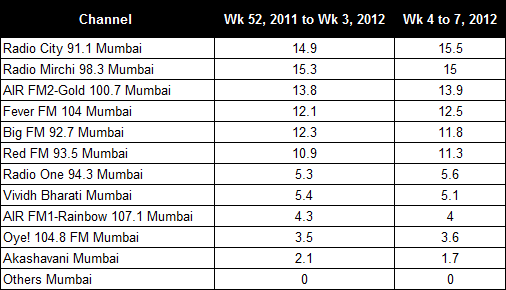
    Radio City surged ahead of Radio Mirchi as the most popular FM station in the city with 15.5 per cent channel share from Wk 4 to Wk7, 2012 whereas Radio Mirchi’s channel share stood at 15 per cent. Ranked three is AIR FM2 Gold which more or less remained unchanged in listenership share from wk 4 to 7, 2012 as against Wk 52, 2011 to Wk 3, 2012. As compared to Wk 52, 2011 to Wk 3, 2012, six FM stations witnessed growth in their listenership share in Wk 4 to Wk 7, 2012 namely, Radio City, Fever FM, Red FM, Radio One, Oye! FM and AIR FM2 Gold.


    Source : RAM

    Market: MUMBAI

    Demographic: All People 12+ Filter Demographic: None

    Statistic: Share %

    Daypart: Sun – Sat 12:00 AM – 12:00 AM

    Place of Listening: All


    Delhi:

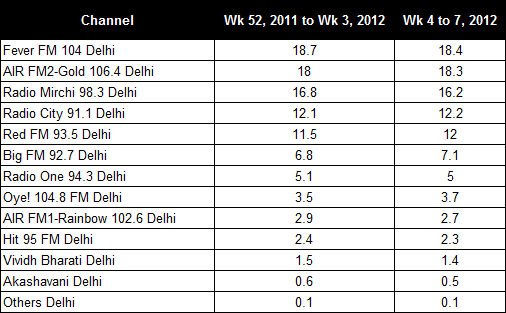
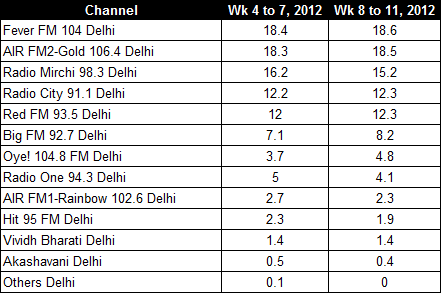
    Fever FM once again manages to retain its leadership position inDelhi, its nearest rival in Delhi is Radio Mirchi, if the government owned AIR FM2 Gold is excluded. According to figures for Wk4 to Wk 7, 2012, AIR FM2 Gold is close behind Fever FM for the top spot. What remains to be seen is whether or not Fever FM is able to retain its leadership position inDelhi.


    The Wk4 to Wk 7, 2012 RAM numbers reveals that in comparison to Wk 52, 2011 to Wk 3, 2012 only five FM stations witnessed any growth in the Delhi market. The FM stations to have seen growth in their listenership shares are Radio City, Big FM, Red FM, Oye! FM and AIR FM2 Gold.

    The other FM stations in the Delhi market are Radio One, Hit FM, AIR FM1 Rainbow, Vividh Bharathi and Akashavani Delhi.


    Market: DELHI

    Demographic: All People 12+ Filter Demographic: None

    Statistic: Share %

    Daypart: Sun – Sat 12:00 AM – 12:00 AM

    Place of Listening: All


    Bengaluru:

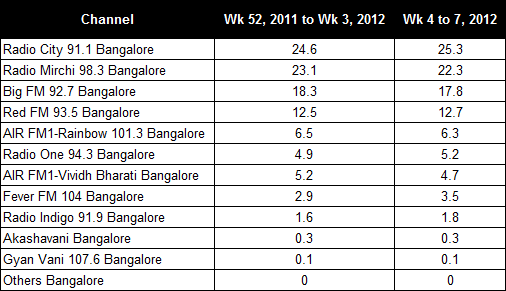
    In Bengaluru too, Radio City continues maintain its numero uno position, the FM station has managed further grow its listenership share in Wk 4 to Wk 7, 2012 as against Wk 52, 2011 to Wk 3, 2012. The second most popular FM station in Bengaluru is Radio Mirchi followed by Big FM and Red FM, ranked third and fourth respectively. Ranked fifth is AIR FM1 Rainbow and Radio One is ranked sixth. The five of the eleven FM stations in the Bengaluru market which witnessed growth in listenership share areRadioCity, Red FM, Radio One, Fever FM and Radio Indigo.


    Market: BENGALURU

    Demographic: All People 12+ Filter Demographic: None

    Statistic: Share %

    Daypart: Sun – Sat 12:00 AM – 12:00 AM

    Place of Listening: All


    Kolkata:

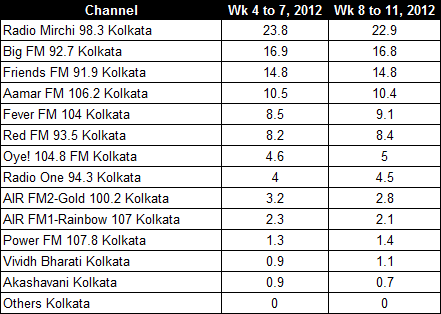
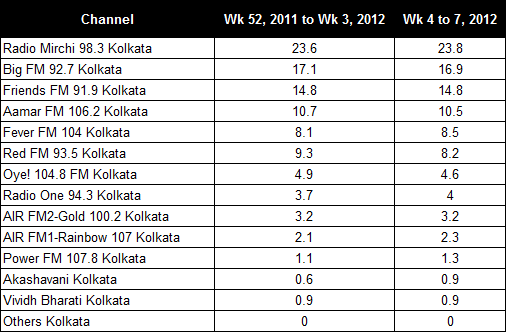
    Radio Mirchi has not only maintained its leadership position in the city, but has also witnessed some growth according to the Wk4 to Wk 7, 2012 RAM data as against Wk 52, 2011 to Wk3, 2012. Kolkata is the only RAM market to have seen no change in atleast the top three rankings. Radio Mirchi, Big FM and Friends FM continue to be the top three FM stations in the city. Ranked four is Aamar FM, followed by Fever FM, Red FM and Oye! FM. Of the thirteen FM stations in Kolkata, six FM stations in the city have witnessed growth in their listenership shares: Radio Mirchi, Fever FM, Radio One, Power FM and AIR FM1 Rainbow. Although Friends FM remained stagnant in its listenership share, nevertheless it is comfortably placed at number three. The other FM stations in the Kolkata market include Radio One, Power FM, AIR FM1 Rainbow, AIR FM2 Gold, Akashavani Kolkata and Vividh Bharati.


    Market: KOLKATA

    Demographic: All People 12+ Filter Demographic: None

    Statistic: Share %

    Daypart: Sun – Sat 12:00 AM – 12:00 AM

    Place of Listening: All


  • Listeners upbeat as Radio One switches to English

    By Robin Thomas


    By February 2012, listeners in Mumbai and Delhiwill be able to tune into a 24×7 English FM station. While the industry is already abuzz with news of Radio One turning back to being an English FM station, now there is an excitement among the listeners too, because of the differentiation the station can offer.


    “One of the reasons I don’t listen to radio is because the RJs talk a lot, I want to listen to music that I like, uninterrupted. If Radio One is switching over to English music, I expect it to switch back to Hindi, just as it happened with MTV and other FM stations. So I have no faith in another FM station turning English but, as long as they stick to English and if the RJs are good, I would listen to Radio One,” said Rupa Gulab, writer.


    What could also be considered is the fact that a 24×7 English FM station could bring untapped listeners, particularly those that were averse to listening to FM radio.


    Uday Benegal, musician and lead singer of Indus Creed, felt differently: “This is very exciting news, finally, a radio station I can listen to. I currently don’t listen to radio because there is too much of Bollywood music, but now I will look forward to Radio One as it will be English music 24×7. I am sure a lot of people who listen to our kind of music will also tune into Radio One.”


    Radio One is not the first FM station to play English songs. When Fever FM was launched in Mumbai, it played Hindi and English songs. It was only later that it switched to being a full time Hindi FM station. Go FM, which initially played only English songs, later turned Radio One to play Hindi songs. The scenario is no different among music channels either; MTV, for instance, played only English songs, now it’s a completely different channel. Besides VH1, there are no dedicated English music channels in India.


    While Radio One may bring a much needed differentiation in FM radio, what remains to be seen is whether the FM station can stay a full time English FM station or will it shift back to its old formula of Bollywood or be a mix of Hindi and English music.


    Former RJ and actor Tarana Raja feels that there is a chance that the new formula may work for Radio One. “There is an English FM station in Bangaloreand one inDelhiand both have worked well. So there is a genre for English music. I personally love listening to English music and as a listener I would like to have a choice. I hope Radio One does well and inspire other FM stations to try something different too,” she said.


    There are nine FM stations in Mumbai and 10 inDelhi, including two government-owned FM stations – AIR FM2 Gold and AIR FM1 Rainbow. There are no dedicated English FM stations in Mumbai, besides AIR FM1 Rainbow which is not a 24×7 English FM station. All the other FM stations play Bollywood songs. Delhi, on the other hand, does have Hit FM, an English FM station. The other FM stations in English are Radio Indigo in Bangalore and Chennai Live in Chennai.


    Vinod Advani, RJ AIR FM1 Rainbow feels that there is always room for another FM station in English, but a lot depends on the kind of programmes and the music played, and whether or not the RJs will be allowed to have their own identity. “Radio One will, perhaps, have technological advantage over us but, as far as I am concerned, my show has a strong listener base for English music. I don’t know whether there is a market for a second English FM station, but a lot will also depend on how knowledgeable the RJs are,” he said.


    Radio one, a joint venture between Next Mediaworks Ltd and BBC Worldwide, is operational in seven metros – Mumbai, Delhi, Kolkata, Chennai, Bangalore, Pune and Ahmedabad.
  • Anil Thakraney: Radio One is finally singing the right tune

    By Anil Thakraney


    According to market news, Radio One is all set to return to English programming in Mumbai and Delhi. And I believe that’s the right decision. It was quite late in coming, but as they say, better late than never.


    The station did start off as anEnglish channel, it played super music, and the RJs, at the time, packed in spunk. Some names that come immediately to mind include T Man, Tarana and Jaggu. The issues they discussed connected with the up-market urban audiences. However, along the way, for some inexplicable reasons, the channel joined the herd; it dumbed down, went all-Hindi, and totally lost its edge.


    Radio One became just another Hindi channel, essentially catering to the lowest common denominator. And it became a me-too radio station. What’s worse is they did this long after all the bigger radio stations had already earned brownie points with the mass listeners, and it became difficult to create a loyal base.


    In fact, speaking personally, Radio One’s dumbing down was the last nail in the coffin I had bought for my car radio. And I completely gave up on the medium and loaded my glove box with many CDs. I am quite sure this is the case with many other people. And, as a media professional, I found the station’s strategy to be quite bewildering, to say the least. Common sense suggests two things: One, there’s no point joining the rat race, as this kills the brand differential. And two, a whole lot of advertisers would want to target the up market audiences, as that’s the segment with the highest purchasing power. Even if all cab drivers tune into a channel, of what use is that to premium advertisers?


    Anyway, it appears the Radio One managers chose to learn the hard way. The station now seems to be coming full circle. And yes, I am quite thrilled. Looking forward to taking a break from my CDs, and enjoying some great music and some interesting chatter all over again.

    * * *


    PS: The London underground recently celebrated its ‘No trousers on the tube’ day. Which involves commuters travelling with their legs exposed. Hope Mumbai train commuters don’t ape this idea, and launch a ‘No shirt on the local’ day. Packed like sardines, we already have to smell armpits. Now imagine smelling naked armpits. The pits!


    Link: http://now-here-this.timeout.com/2012/01/10/in-pictures-no-trousers-on-the-tube-day-2012/#more-46049