Tag: Public Relations

  • From traditional PR to Integrated Comms


    The 2014 edition of the now-annual India Public Relations (PR) Report focused on the downturn and how agencies are coping with it. The survey – carried out across India – focused on senior PR professionals and their views on how the business was evolving. One insight emerged loud and clear: PR as we know it is dead. We are in the age of strategic integrated communication and agencies that don’t evolve will die.


    It is only fitting then that, in the midst of this change, MSLGroup’s 2015 annual report on the state of the industry changes too. Over the last three editions, our research focused on industrypersons. However, as agencies strive to become central to the marketing function and take the lead on brands, it’s important to understand how marketing heads see it. Do they believe ‘new PR’ – integrated communication – has a role to play? If yes, how important do they think it is? What would they like to see in the strategic communication agencies they turn to? How much money and time are they willing to invest in them and how are they tying it in to their business goals?


    Jaldi 5 with Ashraf Engineer on MSLGroup’s Strategic Communications Report
    Lines between the different communication disciplines are blurringFor former journalist Ashraf Engineer, joining MSL in 2011 wasn’t a career shift. He did the same, albeit for another wing of the media ecosystem. As Vice-President, Content and Insights at MSLGroup, Mr Engineer has published some insightful reports over the years. We asked him a few quick questions on the annual PR, ah, well, strategic communications report that MSL publishes.


    1. From PR Report over the last three years to Strategic Communications Report in 2015, why the change in nomenclature?
    It’s in keeping with the evolution of the industry itself. The traditional model is dead and the industry is – in large part – making the shift to a more strategic role. We can’t approach the report in the way we did earlier because our role has changed too, from old-style media relations to a holistic approach that uses a variety of tools and skills – from digital to insights to public affairs and crisis communication, to name just a few.


    2. You’ve personally edited all the editions of the report. What are your impressions of how the industry has moved from 2011 to now?

    I was the quintessential outsider in mid-2011 when I began my innings in this industry. So, to me, the distance the industry has travelled since then is all the more apparent. The pace of the shift from traditional to integrated and strategic has been staggering. That’s been the standout impression for me. Also, it’s evident that lines between the different communication disciplines are blurring.

    It’s been thrilling to watch how the industry has adapted so well to the changing paradigm.


    3. While calling PR Strategic Communications is fine, but do you really think CMOs look at PR in adding value to their marketing activity? Or is PR still a tool to get the col com in the newspapers the following day? In your study too, there is a 49 percent expectation of Media Relations from a PR agency?

    It’s important that CMOs are understanding very quickly how agencies that have been in the business of fostering conversations and storytelling are better equipped to manage their brand communication. We are in transition, no doubt, but the mindspace we occupy today among CMOs was a distant dream as close as 2011. By the time we release the next report, we’ll have travelled a significant distance more. Media relations continues to be part of the mix, but not the main driver.


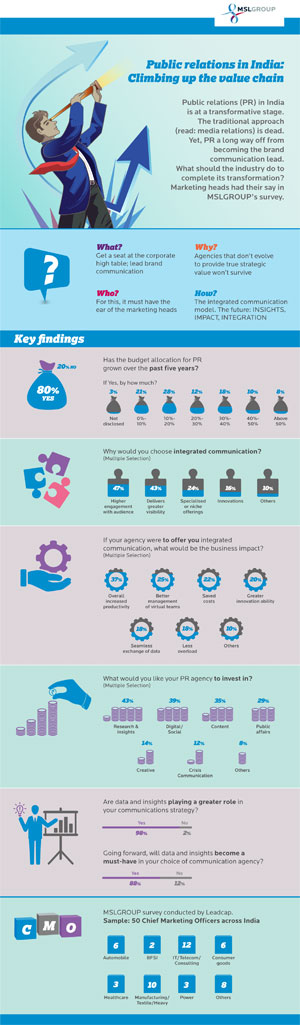
    Incidentally, 80% also say that budgets allocated to us have grown over the past five years. And that cant happen unless they see you adding value beyond media relations.


    4. In your study, did CMOs talk of talent in PR (or the lack of enough of it) as a factor that’s impacting the PR industry of its rightful place in the marketing value chain?

    Talent has been a concern for a long time. The report has a section – separate from the survey – on partnering with academia to ensure that students have the right skills when they enter the industry. While the industry has been engaging with educational institutions, a lot more needs to be done.


    Our earlier reports have dwelled at length on it and in this one CMOs talk of investing in the right capabilities – for instance, insights, creative, public affairs, etc. Its certainly a view that ties in with the talent imperative and how it affects the industrys ability to evolve.


    5. Are our PR schools equipped to train students for integrated communications?

    I think they are understanding this and the quality institutions are acting to bridge the gap. I don’t think they’re there yet, but it’s also up to the industry to ensure that it engages with these institutions through syllabus recommendations, coursework drafting, lectures, events like conclaves, etc.


    Industry-ready graduates are needed and its only to our benefit if we help ensure that institutions prepare them so.


    Our survey of marketing heads across India has been a revelation. And full of hope. While advertising continues to have the biggest share of the annual marketing budget – 45% – overall marketing budgets have grown one fourth in the past five years. One of the reasons for the budgetary increase has been the adoption of integrated communication by businesses.


    With the PR industry making a decisive shift to this model, the time is right to capitalise on this trend. In fact, so important has this trend been that two thirds of the respondents said they have already adopted the integrated communication approach in order to achieve higher engagement with audiences and greater visibility. What’s a concern is that advertising agencies are being seen as the ones adapting faster to the integrated communication imperative. Marketers say they trust advertising agencies to service their needs because they’ve delivered greater return on investment in the past.


    For the PR agencies of today to become the partners of choice tomorrow, they need to demonstrate how they can add value and shift quickly to the integrated model. Marketing heads were quick to assert that agencies that did not adopt a holistic approach would fade away. Marketing heads also emphasised that data and insights would play a bigger role in campaigns and overall communications. It’s no longer a capability to be invested in for the future but a must-have now. What emerged was a picture of a new age of marketing that demands new answers. Can the PR agencies of this age provide those solutions? The opportunity exists. It’s time to seize it.


    If budgets are the acid test, then the PR industry seems to be on firm ground. While it is still way behind advertising, a majority of respondents said that their PR budgets had increased over the past five years. However, even now, respondents said PR accounts for only 15% of the marketing budget. With advertising accounting for 45%, PR has a lot of work to do if it intends to gain the lion’s share of the marketing bucks.


    The good news is that 80% of the respondents said that the budget allocation for PR is rising. The industry has evolved and companies are recognising its contribution in their growth.


    It’s now redundant to say that PR as we knew it is dead. Both, industry experts and clients, have been stressing for a while on the need for agencies to re-examine their role. Respondents are clear that they are willing to increase their budgets provided agencies can meet the dynamic needs of the market and work as a partner that understands their business goals. As many as two-thirds (67%) of the respondents have tried the integrated communication approach in their organisations.


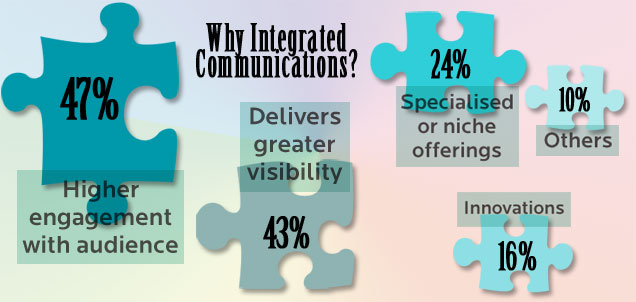
    The benefits are plenty: 47% said that integrated communication provides higher engagement with audiences and 43% said it delivers greater visibility. One respondent said that it gives consumers an opportunity to experience the brand through multiple mediums while another said that it brings together customers, employees as well as top management.


    While everyone recognises its value, it’s still early days for integrated communication in India. Some respondents said that one of the biggest challenges is adoption – it is a long process, it could get expensive and it involves getting multiple stakeholders on board.


    Also, in a situation where there are multiple businesses, multiple products, multiple consumers and multiple outcomes expected, it could get complex.


    About 37% of the respondents said that if PR agencies were to offer integrated communication, it would increase overall productivity, while 25% said it would result in better management; 22% said that it could save costs.


    When asked about the disadvantages of PR agencies offering integrated communication, 22% said that there would be difficulty in management, 18% said there would be internal conflicts and 16% believed that there would be a work overload. “PR agencies have lesser understanding of the brand. They have to prove themselves before offering integrated communication,” said a respondent


  • Amith Prabhu: The Public Relations in the aftermath of the tragedy of MH370

    By Amith Prabhu


    The last three weeks have seen the global attention focus on the uncommon incident of the missing Malaysian Airlines plane. Earlier this week, the Malaysian Prime Minister made an abrupt announcement that the aircraft had plunged into the ocean. The world at large and especially the families of the passengers on that ill-fated plane are still not convinced of the whereabouts of the MH370.


    The mess began as an operational disaster and soon tuned into a public relations nightmare. Much has been written about what could have been done and what should not have been done. This situation could happen to any airline anytime in the future given the conspiracy theories doing the rounds.


    I’m making an attempt to highlight the glaring misses from a reputational point of view in chronological order. There is some much to learn for every industry from what just happened. This will be a case study for years to come.


    Firstly, for almost 24 hours after the plane took off, there was no clear communication as to what had happened. There were mixed reports floating. Families and friends of passengers had begun to panic due to the absence of a clear picture.


    Secondly, the Prime Minister’s first address came many days after the episode and was ambiguous. It gave the impression that the plane had veered towards India and the possibility of it being in Kazakhstan. This could still be a possibility sine the idea was floated.


    Thirdly, sending text messages to the next of kin before the public announcement was a bad idea. Families should have been brought together into a common place or called by a human voice to inform about the plunging.


    Fourthly, Malaysian authorities infuriated passengers’ loved ones by telling them at a briefing this week that there was “sealed evidence that cannot be made public” in relation to the missing flight.


    Finally, there is the Triple R of crisis communications – Regret, Reason and Remedy. While the company got the first one the second and third seemed to be absent at most times.


    In the background there has been some noise of how Boeing’s name has not cropped up after the first day. I would argue saying why should it crop up. Several Boeings fly around the world every minute. Such an incident is completely the airline’s responsibility and not that of the aircraft manufacturer.


    As Robert Jensen, CEO of a firm which provides crisis communications support for a number of airline clients says, “The challenge you have with crisis communications is not to make it worse, because you can’t make it better” – If that is something reputation management professionals can understand a lot of risk can be mitigated.


  • Amith Prabhu: The Public Relations of Indian Politics

    By Amith Prabhu


    The upcoming elections will be different in every way. Unlike in the recent past when there were broadly two national parties supported by allies who were regional parties, the summer of 2014 will see an upstart at the national level in the form of the Aam Aadmi Party. In the light of these changes both existing national parties have had to work out newer strategies to offer a new perspective to the public.


    The Indian general elections is the arguably the biggest Public Relations exercise with multiple small parties wooing an electorate that no longer gets carried away by empty promises. Last week’s news that the Indian National Congress has hired a leading PR firm to primarily help it in its digital outreach was carried on the front page of a leading national daily. The news of Twitter hiring a gentleman who had previously tweeted against Narendra Modi also gathered uncalled for attention from the right-wingers.


    The next 120 days will see a lot of interesting events which will be amplified by social media in real time and on television and in print in quick succession. This makes life of communication managers within political parties all the more difficult. One will need to have an ear to the ground, eyes wide upon and be on his or her toes during this dance of democracy.


    Each party has taken a different approach to Public Relations. The frontrunner is BJP with its PM nominee – Modi, who is travelling from city to city addressing large rallies. The Congress with Rahul Gandhi is trying a different strategy of meeting smaller groups in closed door, by invitation and thematic gatherings. The new kid on the block, AAP led by Kejriwal is on a frantic membership drive targeting the man and woman on the street.


    In the midst of all this, various regional chieftains also known as chief ministers have started changing their modus operandi to follow a style that is being dictated by the incumbent chief minister of Delhi. These are all Public Relations tactics that are being smartly deployed. But today’s voter has various ways to decipher who is genuine and who is not and can see through.


    It is no longer a case of hoodwinking that will help politicians get by. Their walk and their talk should go hand in hand. India’s tolerance levels for empty promises and corruption are diminishing. Over the next 12 weeks I will be writing as many columns with a majority focusing on political public relations.


  • Amith Prabhu: Public Relations and Bad Publicity

    By Amith Prabhu


    Most people who are aware of the term Public Relations or PR thrive on abusing it. Any customer experience that does not go right is called Bad PR. Any misreporting that takes place in a media outlet is called Bad PR.


    PR can never be bad. Because PR works like medicine and it can never be bad. Wrong diagnosis can always happen but that does not make the medicine bad. To understand that better, one needs to understand that PR is not the same as publicity. PR can lead to publicity but publicity is never PR.


    Why is it then that we often hear this: Bad PR or Good PR – any PR is good? We hear that because people making that claim do not understand the concept of PR and make sweeping statements like that because they interchange Publicity with Public Relations (which are as similar as chalk and cheese).


    Hence PR revolves around offering experiences, strengthening relationships, building credibility and creating advocacy. None of these are about publicity. Educating the 99 percent who are not in PR will go a long way but the process should start somewhere and it is up to us PR professionals to drill down this idea when we see someone interchange the two terms.


    I always say there is Bad Publicity and Public Relations – a PR campaign can be good or bad but that is a different concept from the term Public Relations. A campaign can be bad because somewhere between concept and execution some errors were made. This can be debated and I hope people who disagree engage in a discussion in the comments section here.


    An instant example that comes to mind is the recent news about a Dreamliner that Air India flies losing a panel in flight and how the following day social networks were abuzz about how Air India is best avoided. That was bad publicity. Somewhere the makers of the Dreamliner – the Boeing Company had its Public Relations in place. A reporter did not focus on it in his/her report but on Air India which has never taken Public Relations seriously in recent years.


    Well, this will be a recurring topic and it is important to not use Bad PR for our own sake. Because poison and medicine are different. One man’s medicine can be another man’s poison but the fact remains that they are different.


  • Amith Prabhu: Musings from India’s only weekend summit for Public Relations

    By Amith Prabhu


    What happens once may not happen twice but once happens twice can always happen thrice. These are my favourite lines from Paulo Coelho’s The Alchemist. I’m writing this column on the car as I travel from Lavasa to Mumbai. I feel humbled that I’m part of a group of 15 young men and women who have put together the second edition of what is arguably India’s only annual weekend summit for Public Relations and Corporate Communications professionals. The last two days at the hill city of Lavasa were intense and enriching. Over 250 professionals from around the country came together to celebrate the profession.


    While a report of the event will be found elsewhere I want to highlight how the movement of PR doing PR for itself has gotten off to a solid start. Praxis was created with the singular belief that the profession needed a forum to come together and the concept was born on a Twitter conversation. Ever since the first edition took place in Pondicherry in November 2012, a lot of traction both online and offline has happened leading to a natural build up to this event which makes it obvious that this completely volunteer led event is here to stay.


    What sets Praxix aside is the entire approach of the event organisers lend to engaging with speakers, sponsors and participants. A sense of community is paramount. Attention to detail and a high adherence to punctuality give the summit a uniqueness very few events in the similar space can talk of. Having established a reputation for being a serious event with a lot of fun goes a long way in getting people to look forward to the next edition. The excellent line-up of speakers with solid content to share add to the vibrancy of the flow.


    I am glad that the collaboration between multiple generations is a fine example that several other sectors can learn from and emulate. There are a bunch of those under 30 who are focused on executing the event. There are those in the 30- to 40-year age bracket who are planning various elements of the conference. And there are those over 40 who are supporting the event by way of their presence and sponsorship.


    All eyes are on the third edition which will happen somewhere in the North around a year from now. Because whatever happens once may not happen twice but whatever happens twice will certainly happen thrice and in this case go on to happen annually. I’m glad that this was an idea whose time had come. And some of us took it upon ourselves to make it happen.


    Amith Prabhu is the founder of The PRomise Foundation which organises Praxis. During the day he is a full-time employee at a leading PR firm in its Chicago office. Views expressed here are the author’s own and don’t represent those of his past, present, future employer or of MxMIndia. You can connect with him on Twitter @amithpr


  • PR and corp comm frat all set for Praxis 2013

    By A Correspondent


    The second edition of the Public Relations and Corporate Communications Summit – PRAXIS will be held at Lavasa near Pune between September 27 and 29, 2013. The success of the first edition in Pondicherry in November last year has buoyed organizers PRomise Foundation to make it bigger and better. (*See Disclaimer)


    Five international PR leaders, an additional night and double the segments are the highlights of this years’ edition. The forthcoming summit will have two keynote addresses, three small BIG talks,  four panel discussions and three break-out Master Classes, notes a communiqué, adding: “The event will assemble an array of over 35 speakers including at least one each from the US and UK – pioneering markets for public relations. The uniqueness of the event is that not a single speaker is repeated from the first edition barring one Editor and no organisation gets more than one speaking slot.” What makes Praxis unique is that it is organized entirely 20 professionals with a full-time day job.


    The inaugural keynote will be delivered by Lord Chadlington, the CEO of the Huntsworth Group in the UK. The second keynote is by Dr Mukund Rajan who wears multiple hats at the Tata Group. He is the Tata brand custodian and chief ethics officer of Tata Sons. He is also the spokesperson of the group and the chairman of the Tata Council for Community Initiatives (TCCI). The keynotes will focus on Communicating in Changing Times with an impetus on Ethics. David Rockland, Chairman of AMEC – the International Association for Measurement and Evaluation of Communication is leading a masterclass and delivering a special address. He leads a division of Ketchum Public Relations and is travelling from New York on his debut India visit.


    There will be five panel discussions with specific themes with leaders in the respective fields discussing a topic. These will each be moderated by an editor, a senior communicator and three PR firm leaders. The inaugural panel consists of four Editors – R. Sukumar of Mint, Sachin Kalbag of Mid-Day, Shaili Chopra of Tehelka and Indrajit Gupta who is the Founding Editor of Forbes India. This panel will be moderated by Nandita Lakshmanan of The PRactice. The second day starts off with a panel on Asia where three PR firm leaders who are based in different parts of the Asia-Pacific region will discuss the Asia story and how India fits in. The three include Glenn Osaki, President – MSL Group Asia; Anne Costello, Regional Director – Asia Pacific at Text 100 Global Communications and Sconaid McGeachin, President & CEO India, Middle East, Africa & Turkey. This panel will be moderated by Shivnath Thukral, Group President – Corporate Branding & Strategic Initiatives, Essar. The third panel comprises Chief Marketing Officers of leading Indian companies in diverse sectors of technology, finance, retail and real estate. The panelists are Ajay Kakar, Chief Marketing Officer, Aditya Birla Group Financial Services; Suvodeep Das, Marketing Director, Reliance Brands; Anuradha Paraskar, Senior Vice President – Marketing, Lavasa Corp Ltd and Ashok Lalla, Global Head, Digital Marketing, Infosys. This session will be moderated by Max Hegerman, Managing Director – Edelman Digital. The fourth panel discussion has communications leaders from four Indian multinational companies discussing a wide variety of topics. The four communicators are Roma Balwani, Chief Group Communications Officer, Mahindra & Mahindra Ltd; Chhavi Leekha, Group President – Brand & Corporate Communications at Spice Global, Seema Ahuja, Head-Corporate Communications, Biocon and Sujit Patil, Head – Corporate Communications, Godrej Industries.This session will be moderated by Nikhil Dey, President (Public Relations), Genesis Burson Marsteller. The final panel consists of younger consulting firm leaders which will be moderated by Ben Smith of PRMoment. The panel that will discuss the Future of Public Relations and will have  Rishi Seth of Six Degrees, Atul Takle of Adfactors PR, Sonali Madbhavi of Gutenberg Communications and Dilip Yadav of Weber Shandwick.


    Another highlight of this year’s edition is a break out session where participants will attend one of three masterclasses including one on Measurement. The Public Affairs master class will have presentations by Ashwani Singla, Chief Executive Officer, Asia, Penn Schoen Berland and Varsha Chainani, Director, Public Affairs at Abbott Laboratories. The Internal Communications Workshop will have presentations from Aniisu K Verghese, Internal Communications Lead, Sapient and Ranjana Sabu, Internal Communications Lead, ABB. The Measurement workshop will be presented by David Rockland. The main performance at this year’s gala is by singer Ambili Menon on the first evening and the BayBeat Collective will provide entertainment on the second evening.


    A breakfast discussion on the future of Public Relations Education is planned with leaders from PR firms discussing the relevancy of academia in preparing professionals for the future. Symbiosis Institute of Media & Communication is the academic partner of the summit and will curate this discussion along with Pradyuman Maheshwari, Editor-in-Chief of MxMIndia.com This is a by-invitation event.


    The Media Partners are The Holmes Report, PR Moment, MxMIndia and Avignyata. The other event partners are – Platinum sponsor: Edelman India; Gold sponsors: MSL Group India and SIMC, Pune; Silver Sponsors: Text 100 India, Adfactors PR, IPAN H+K Strategies, Impact Research and Measurement, CARMA India, Eikona PR Measurement, Esha News Monitoring, Avian Media, Simulations India and The PRactice. Brand partners include amazon.in, Sab Miller, Pernod Ricard and Red Bull.


    The event is being held at the Mercure Hotel at Lavasa. More information is available at www.praxis2013.in or on email by contacting promisefoundationforpr at gmail or by following the organisation on Twitter at @PromiseFdn


    *Disclaimer: MxMIndia is a Trade Partner of the event


  • Amith Prabhu: Why our politicians must undertake media training

    By Amith Prabhu


    Lately, my columns have been focusing on political themes. Indian politics is my pet passion but I promise after this one will stay away from politics until something major happens in the intersection of politics and Public Relations that merits a column. The last couple of weeks have seen an increase in the number of unusual remarks by certain key politicians who talk and they were a mix of prepared statements and of the cuff statements. Either way they came across as utterances that much thought had not gone into. We will take two or three and then examine why media training is paramount to political public relations as much as it is to the world of business and other disciplines.


    First, let’s look at the statement the Defence Minister made in Parliament soon after an attack on soldiers near the border led to loss of precious lives. A K Antony said something to the effect that terrorists dressed in army uniforms carried out the ambush. This may or may not have been true. But the error was in saying it so confidently as if he were at the scene of crime. He was going by the advice given to him by top army officials but the tonality and style could have been more tentative and the choice of words could have been smarter. Had he said that ‘initial reports’ coming in are that a few Indian soldiers have been killed. However the nature of the killings indicate that this could be either an attack by the state machinery or by terrorists dressed in army fatigue. And this limits the exposure one has to taunt and triviality. While reports later confirmed that this was the information he was fed by those on the line of duty who survived.


    A few days later, the Indian Energy Minister made a comment at a press conference that there are various austerity ideas being floated. Shutting petrol pumps during the night is one of them. But nothing has been decided. It is just a proposal, urging people to save fuel by using their vehicles sparingly. This was the most stupid statement to make in a nation of 1.3 billion people where 12% own a registered motor vehicle and makes a sizable number that can panic. Was getting into the details with an idea however bright necessary? The gentleman is known to be a lose canon at times. And all this can change with media training.


    Political parties have spokesperson training programmes but do these grown up men and women care to learn? The days of having just print journalists are gone. The media fraternity includes those who write, broadcast, telecast and blog. Moreover several international media outlets are also present to cover newsworthy items of the day. Given this scenario it should be mandatory to get the political leadership undergo an intense training in talking to the media because it is not the same as talking to voters at an insipid rally. That makes the market for media training companies lucrative because the time is not far when political parties will have no option but to invest in professional media trainers. Because a large part of Public Relations is built on the bedrock of media training.


    Amith Prabhu is founder of The PRomise Foundation which organises PRAXIS – the annual summit for PR & Corp Comm professionals in India. During the day he is a full-time employee at a leading public relations firm in their Chicago office. The views expressed here are the author’s own and don’t represent those of his past, present, future employer or of MxMIndia. You can connect with him on Twitter @amithpr


  • Amith Prabhu: Modi’s online Public Relations campaign

    By Amith Prabhu


    Want a master class in online public relations? Go no further than the last 50 handles of the 600 followed by Narendra Modi on Twitter. Despite all the controversy he rakes up by things he has done and things he says his inner circle of digital marketers are indeed doing an excellent job of creating the tools that help his outreach. Clues to this avalanche are found in the list of people followed on Twitter


    I belong to the group of people who are the harshest critics of a man who presided over one of the best man-made disasters of the last decade. I write this column purely for academic reasons and don’t wish to bring my ideology to the fore. Three to four things stand out and can be insightful to those who plan similar campaigns in the future and this is neither a blog of praise nor a blog to criticize.


    First things first – he must be the first and only politician to create dedicated Twitter handles in nine regional languages that target the large states where BJP has a presence. These include Hindi, Marathi, Kannada, Assamese, Urdu, Oriya, Tamil, Bangla and Sanskrit. While most of these handles have less than a couple of thousand followers and some in the hundreds the fact that these exists and are active speaks volumes of the gameplan that he plans to unfold in the days ahead. Even the Pope does not have a presence in as many languages.


    The next initiative is the portal india272.com which describes itself as an online and on-ground volunteering platform to help the BJP in its Mission towards gaining a 272+ seat majority in the 545 seat Lok Sabha. In this sentence and elsewhere it is best to read BJP as Modi as these are all initiatives not necessarily by the party organization but by the individual and his supporters. Evidence is in the images used that focus on one person throughout.


    Of the 670 Twitter accounts that are followed there are three categories – organizations that are dominantly news outlets, BJP officebearers from across the country of different level and stature and sycophants who have Namo4Pm in their bio or display name. The Gandhi family finally has competition when it comes to people who swear blindly by them. This hero worship will reach its peak in the digital world as the election season gets closer.


    The personal website and blog: Very few Indian politicians have managed to copy the Obama style of internet presence the way Modi has and proof of this is in his personal website and blog. This single tool of owned media has neutralized all the negative earned media built up over the last decade. The debate on who writes these blogs is secondary. The fact that these exist is something for all other leaders to ponder on.


    The question that everyone asks is how many actual voters do all these outreach tools really reach? And in my opinion the numbers do not matter. Having a presence that enables young voters and the urban population that is well disposed to tablets, apps and the mobile internet is good enough. Modi has taken the lead and politicians from his own party and those from others have a lot of catching up to do.  A digital marketing plan so robust will be hard to match because real followers and likes cannot be bought like votes. In the end it is a perception game and the winner may take it all.


    Amith Prabhu is the founder of The PRomise Foundation which organises PRAXIS – the annual summit for PR & Corp Comm professionals in India. During the day he is a full time employee at a leading Public Relations firm in their Chicago office. He spent the first eight years of his post graduation career in India and is in the US for two years of which he has completed 18 months. Views expressed here are the author’s own and don’t represent those of his past, present, future employer or of MxMIndia. You can connect with him on Twitter @amithpr


  • Shishir Joshi: Journalism needs PR, desperately

    By Shishir Joshi


    “You guys have changed the way we watch news,” I remember an elderly businessman’s rather appreciative remark, when I had told him I work for a news network. This was a little over fifteen years ago. What he was referring to was his experience as a viewer of the earliest versions of the English Star News (then produced by NDTV) as opposed to years and years of watching state-owned Doordarshan.


    The world has come full circle. “You guys have changed the way we watch news,” is what a lot of people have begun saying to me, once again. However, this time, the appreciation of the previous decade has been replaced by a look otherwise reserved for skunks. Why have we become the favourite punching bags? How fair is the criticism? Are we, media or journalists, being singled out? Truth be told, journalism has invaded our lives to an extent second only to cell phones. And while one can debate on the boons and banes of a cell phone in our life, increasingly, people are finding nothing but faults in the journalism that they see or read. While there can be many a reason for journalism reaching such lows, there surely has been one defining image and line which has made us the butt of many a joke, and ridicule. And that is of a young, always-in-doubt-but-never-wrong journalist, clutching a ‘boom’ mike and seeking an answer for the priceless “aapko kaisa lag raha hai” question. This one line has been the unifying link between the umpteen reportages on rapes, molestations, thefts, murders, victories, losses, triumphs and earthquakes that we have seen on news television through interviews of people, common or uncommon. But the problem is larger.


    Increasingly, media practices and media men have become a subject of greater scrutiny. And for a profession which had been regarded so highly, gossip about A, B or She journalist’s fall is consumed with great sadistic pleasure. And to top it, there hasn’t been one big story in recent times where the credibility of some or the other mighty hasn’t been questioned. Be it Aroon Purie and his jet-lagged editorial, portions of which were picked up from Slate.com, or the ‘Radiagate’ tapes where the mightiest in television seemed to be breaking bread with bed-switchers, or down south, where the Hindu’s honcho N Ram conveniently edited colleague Chitra Subramaniam’s name from the Bofors’ expose’ credit lines, we seem to have been there and done that. It has been summed up scathingly by BV Venkat Rao in http://www.firstpost.com/india/why-the-fall-of-xerox-zakaria-is-unthinkable-in-indian-media-430088.html.


    The list seems unending. Every state seems to have a case too many of such violations. If Guwahati saw journalists accused of provoking molesters for a video story, Mumbai saw the arrest of a journalist on charges of conspiring to eliminate a former colleague. The latest is from Karnataka where journalists have been arrested as part of an ISI plot. The book threatens to get only thicker. There was a time when we had politicians, parliamentarians, businessmen, gangsters, extortionists, showmen and lobbyists, and social workers. Categories of businesses, vocations and professions. And then you had journalists, the ‘clean’ guys. Today, that line appears tampered with. It is either people from the ‘other’ categories doubling as journalists (and media owners) or worse, journalists wearing multiple hats. But this is not about where we have gone wrong. Or why.Or the ‘sensational’ and ‘breaking news’ which have become eyesores. It is about the numerous stories, the game changers, which miss our attention. For every 26/11 reportage where we have been accused of crossing the ethical line, there has been a December 3, when lakhs converged at the Gateway of India to express anger against the political spineless, resulting in ministers losing their jobs.


    For every free housing scheme that journalists have grabbed from Chief Ministers through the so called “press quota”, there has been the unearthing of the Adarsh scam, the CWG or the 2G scam. And for every Radiagate which saw journalists cross an ethical line, there has been a Coalgate expose. Relentless. Unending. Cases of exemplary journalism abound in non-urban, non-English media too. What I have pointed out are less than a handful of the hundreds of fabulous stories and efforts which journalists are working on, day in and out. For every Rakhi Sawant who gets some airtime on a news network, there are countless unsung heroes who are encouraged to become citizen journalists too, thanks to inspiring journalism. For every saanp-bicchoo story which makes it to some crime show of a news channel, there is also the story of a braveheart hospital attendant who saved lives in operation theatres when trained medical help was not within reach. For every case of public humiliation or molestation that gets played up for alleged TRP gains, there are stories of faces-in-the-crowd standing up against a road-rage bully. The 48-hour rescue operation of little Prince from a borewell in north India is now an oft repeated case study of the levels to which news networks have stooped for TRPs. But, was it only TV channels which gained or did the village also get transformed thanks to the media and political attention? Yes the latter did take place. But nobody seems to be talking about it. Or is it that people are no longer watching?


    Yes, journalism is indeed in need of serious review. Internally. And externally too. External autopsies have been done time and again. In these challenging times, under the guise of upholding free speech and democracy, every Narendra, Raj or Abu has tried surgical procedures to silence the media. For masses, it is vicarious pleasure over a cuppa chai. There is no doubt that for a vibrant democracy to thrive, it can’t be a more welcome change. Having said that, what journalism now needs is a desperate makeover. If to woo a Marathi manoos, an Uddhav can praise an estranged Raj’s political stunt, surely journalism can do with some PR.


    Networks need to play up some game-changer stories that talk of good journalism. Newspapers and social media could follow suit. Prime time can also have some promotions of non-‘sensational’ but ‘real ‘stories. People, viewers, on the other hand need to get out of their drawing-room gossip mode and start writing in to networks on what they need more, rather than stuff themselves with pap. A bit of PR on image building and reputation management could do wonders to a sagging morale. Don’t get me wrong. We aren’t talking of hiring a PR agency here. But well, in the world of paid and private treaty journalism, a bit of philanthropy from journalism’s first cousin, PR, at least in spirit, can work wonders. Applications are invited. In confidence. Beep beep, pings the inbox. Applications have already begun pouring in. Uh oh. …Anybody other than Nira Radia please…?


    For those away from ground reality, journalism and PR have always shared a love-hate relationship. Journalists are accused of being egoistic, badly behaved (on the phone) and always ones to take a short cut. PR people on the other hand are seen to be clueless at their jobs, too busy ‘selling’ a story rather than defining it on merit, and flaky. Can the twain, then, meet?


    Shishir Joshi is the co-founder of Journalism Mentor, and till recently was Group Editorial Director of the Mid-Day group of publications.


  • Road to CL2013: The way to win at Cannes is by not aiming for a metal

    The Cannes metal wins for India has been disappointing. There could be various reasons for it and the metal tally definitely doesn’t point that the work coming out of India is of inferior category. However, it does point that there is something more required from India n agencies to gain attention of the international jury. Who better that people on the Cannes jury this year to show us some light on where the agencies could improve and what really went behind the judging. We spoke to a few on the jury this year to understand where India went wrong and what can be done to reclaim some of the lost ground this year.


    Rahul Jauhari, National Creative Director, Everest Brand Solutions

    Rahul Jauhari

    I don’t think you can aim at Cannes by doing something that can win at Cannes . Most winning entries at Cannes are brilliant solutions to one business issue or another. “Let’s do something like that one” ­ is not going to get you anywhere. The point is to solve the business issue facing your brand with a wonderful idea and execution. If it is that wonderful, it will win.


    And yes, the glorious part is in doing it in a way that is relevant to the India n audience. The jury are not fools. They can see through scams, in most cases. They ask relevant questions and give a lot of importance to the logic of the communication. They reward ingenuity, but not at the cost of authenticity.Brazilwins a lot of awards at Cannes . But their work is unmistakably Brazilian. The same goes for other countries. So, the language of your entry is not a minus point, as long as you send in a good explanation.


    The jury at Cannes is now well represented by different countries. And that shows in the selection of work. “Let’s do something that integrates social media” is not the answer either. More Facebook likes is not equal to higher chances at a Cannes metal. If the idea is loved, people will spread it on social media. A print ad can lead to online furore or fan-following. The same goes for a TV ad or a radio spot. The consumer builds in social media integration without asking you. So there.


    Simply put, the way to win at Cannes is not by aiming for a metal at Cannes . Aim for a brilliant solution or idea. Execute it brilliantly. Even the simplest of ideas can win. There is that little bit about the packaging, though. When a jury member has to sift through a thousand plus entries, he or she will not suffer a poorly packaged entry. Keep it simple, keep it to the point. Sure make it enjoyable. But remember, the jury wants to know how you did it, why you did it and what it achieved. Inform them, but don’t bore them to death. And don’t try to con them. Most are highly experienced and can tell a fake from a real. Instantly.


    Sunil Gautam, Founder, HanmerMSL

    This is the fourth year for Cannes PR Lions which saw 1,130 entries from 61 countries, the highest number of entries received by Cannes Lions in this category ever. 134 entries were short listed. India had 19 entries, 1 was short-listed.


     

    The composition of jury was very good and it represented the cross-section from the world over. There was a lot of interaction and discussion before finalising the winners. According to me, it was very professional judging and the experience was awesome.


    India had 19 entries in this category, and many of them came up for lively discussion. Of these, one entry was short listed. Unfortunately, this entry didn’t get any metal. But the overall effort by the India n agencies was excellent. All the campaigns that were reviewed were very imaginative, with good strategy, execution and measurable impact and results.


    My advice to the India n public relations industry is to focus on innovative strategies, immaculate execution and measurable results in such a way that the campaigns that they implement for a client are a huge success. And not to plan campaigns from the short sighted of just winning awards. Good campaigns are appreciated everywhere and they may end up with the awards. The client comes first and they will get awarded if they deserve.


    Vikram S Gaikwad, Partner & Executive Creative Director, Creativeland Asia

    Vikram S Gaikwad

    I think there are three simple yet significant aspects to any entry. The idea, its execution and the category in which it is entered. A brilliant idea can miss out simply because it is not entered in the right category.

    With the number of entries running in thousands even in each category, each panel has a unique criteria while judging entries. So, the chances are that a great entry submitted in a wrong category might fail to even get a shortlist.

    Also, we should look at the new categories introduced at Cannes every year.I was disappointed to see little or no work in categories like Mobile, PR and Brand Entertainment & Content categories. With the size of the Indian
    market, number of brands, consumption etc, we are very much capable of capitalising on various opportunities and entering more quality work in the future.

    This year the number of metals that India won has gone significantly low. This definitely is disappointing. So, I am hoping we will make up for it
    next year.

  • IPL’s new champions- Kolkata Knight Riders

    By Sudarshan S


    April 18, 2008 to May 27, 2012 is a long wait, but as the owner and the mercurial Shahrukh Khan said: “This is something youngsters should believe in – resilience, patience, perseverance.  If you believe, you can win.”  Manoj Tiwary swings a delivery of Dwayne Bravo to the boundary on the 19.4 over, and the fireworks lit up the sky to usher in a new champion. Kolkata Knight Riders dethroned Chennai Super Kings led by Mahendra Singh Dhoni with a record of having qualified for semi-final of all the editions, and the fourth final.


    The match was not over, at 19.4th over, as the next KKR player walked in without helmets, pads, and no guards and took off from where Brendon Mcullum had left off on April 18, 2008 – the first game of IPL versus Royal Challengers Bangalore, where he scored 155, while KKR, then favourites even before the tournament started, posted 258 – the highest total in all IPLs.  Shahrukh Khan, the next player, walked in and seized the moment like a true showman.


    Every opportunity provided by the media was like a free hit that Shahrukh Khan lapped up, and displayed his candor by playing to the gallery. He wore his mask of modesty in the celebrations, and was humble enough in first congratulating his team, captain, coach and support staff, and in the same breath, he also thanked the hosts, their captain, crowds for the wonderful hospitality.  He hugged each and every player to now openly display his glee over the patient wait of the prophetic words on April 18, 2008 that had come true after ‘Four years One month and Nine Days’.  Jiving to ‘Will You be My Chhammak Chhallo’ along with the close knit family of cheer girls, and asking Navjot Singh Sidhu to comment something about the performance.


    This was KKR’s 75th game in IPL – a major milestone for a movie if it ran that many weeks, but Shahrukh would have spent 40 weeks over five years with the team by just his presence to achieve a brand valuation of about 50 odd million dollars (say about Rs250 crores), behind Chennai Super Kings ($75 million) and Mumbai Indians ($60 odd million).


    Just trying to imagine the glamour quotient of other teams, be it Shilpa Shetty for Rajasthan Royals, Preity Zinta, for Kings XI Punjab, Deepika Padukone for Royal Challengers Bangalore, and Akshay Kumar for Delhi Dare Devils.

    KKR was the only team to have a dream combination with John Buchanan as the coach, Sourav Ganguly as the captain, and a cheer BOY in Shahrukh Khan.  What changed were the coach and the captain, and this was akin to a brain and heart transplant, but the soul remained intact, and resurrected the team.  Fourth in the fourth edition, sixth in the first and third edition, eighth in the second edition – that also witnessed the Fake IPL player controversy.


    Now who remembers all that – for this was all a PR stunt – not Public Relations, but Performance and Response.  “This is something youngsters should believe in – resilience, patience, perseverance.  If you believe, you can win.”  You did.  Congratulations, Kolkata Knight Riders, Congrats Shahrukh — the Showman!


    Sudarshan S teaches public relations at various business and media schools. He also head the Mumbai-based Prognosys Marcom Services

  • The Anchor: 6 things that ail the PR industry

    By Toral Sanghavi


    1. Lack of awareness or poor knowledge on what PR can do for a company or a brand, leads to ineffective use of this marketing tool. Clients who have a different perspective of the role leads to a huge void in meeting the PR objective.


    2. PR is also looked upon as a short-term activity and expectations are far higher vis-a-vis advertising. Here it is to be appreciated that PR is not a quick fix and helps achieve goodwill – which cannot be earned overnight and has to be nurtured and sustained through long-term PR activity for the company or brand.


    3. There is no true value placed for PR activity and hence it cannot be truly measured by any accounts, which at times, leaves the client wanting for more and dissatisfied inspite of good media reportage.


    4. Lack of the right talent in this industry. Average time spent in the industry by professionals is not more than 5 years and then the general growth chart of a PR professional is to move to the corporate side of the business. This can leave a void for seasoned PR professionals in the business.


    5. Public Relations is an unpaid form of communication and hence dependent on an outside agency’s opinion and bias on the topic.  It is totally dependent on an individual’s rapport with the target media and hence media reportage and coverage can get unpredictable.


    6. The media universe is getting larger, in-depth and niche to a variety of target audience and industry. In such case, PR activities can get challenged and restricted in nature.  Also timeliness can affect coverage.


    Toral Sanghavi is Director – Clea Public Relations, India