Tag: print

  • INMA 2011: Readership, Rate Cards & a small newspaper’s success

    By Tuhina Anand


    On Day 1 of INMA-5th South Asia Annual Conference, there was a CEO Roundtable which saw discussion on the topic: ‘Have we reached an end to readership growth?’ The session was moderated by Bhaskar Das, President, The Times of India Group and on the panel were Sanjay Gupta, Director, CEO and Editor, Jagran Prakashan Ltd, KN Tilak Kumar, Joint Managing Directorand Editor, Deccan Herald, Shahrukh Hasan, Group Managing Director, Jang Group Pakistan and Tariq Ansari, MD, Mid-Day Multimedia Ltd.


    Mr Das started the session by saying that it’s a known fact that the newspaper business is undergoing challenging times and one of them is about finding a balance between a content that caters to a diverse age group at many Indian homes and remaining relevant. He also remarked that if one is bothered about physical readership when a consumer is accessing media through various touch points, shouldn’t virtual readership also be considered? He also questioned the merit of measurement vis -a-vis frequency and periodicity.


    Mr Ansari said, “The truth is that the readership of urban English newspaper has reached a plateau and the growth in terms of numbers in SEC C and D but the question is if that category is also the one which advertisers would be interested in and then the answer becomes doubtful.”


    The session also looked at growing readership in a new market with an old product as well as raised question on the need to show yoy growth of readership where in actuality it should be yoy growth of advertiser?


    In all this grim scenario, Titak Kumar of DH brought the example of Karnataka language daily which has been seeing growth since both income and literacy levels have gone up.


    Another staggering point that gives players to think about is the pricing of a newspaper. While in India, the you can get a newspaper even at Rs 1.50, Shahrukh Hasan from Jang Group pointed that in Pakistan the paper would cost anywhere between Rs 15-23 and yet not cover its production cost.


    The idea that emerged was to innovate and seize the opportunity in the industry today. Also if multiple touch points is the new reality how does one update, upgrade and monetize from these various platforms.


    In another session, the panel discussed, ‘The Advertising Challenge: Space Selling in the Age of Multiple Platforms and Vanishing Rate Card’. On the panel were, Ambika Srivastava, Chairperson, ZenithOptimedia and Vivaki Exchange, Bijou Kurien, President and Chief Executive, Lifestyle, Reliance Retail, Jayen Mehta, GM, Marketing, Gujarat, Co-Operative Milk Marketing Federation, Rohit Gupta, President, Sony Entertainment Television, Bhaskar Das, President, The Times of India Group and Aritra Sarkar, VP, Strategy, ABP Pvt Ltd.


    The panel discussed if the rates cards have a value and Ms Srivastava endorsed this view along with Bhaskar Das though he differed that the rate card can be in different format and packaged differently to create a value proposition. Mr Gupta however giving the TV industry side of the story was of the opinion that in his industry rate cards doesn’t apply as the window of opportunity is less in television and rates vary from deal to deal and client to client.


    There was another session on ‘Good Editorial Content and Credibility are Good Business Also’  where Harisvansh, Chief Editor, Prabhat Khabar took the audience on the journey of success of the newspaper which is through doing hard hitting, pro people stories that have brought transformation in the lives of a common man. For them its trust and credibility that has paid off and just like Indian Captain MSD who is also from Ranchi like Prabhat Khabar both have emerged victorious by being dependable.
  • Newspapers: Reinvent or Perish?


    By Tuhina Anand

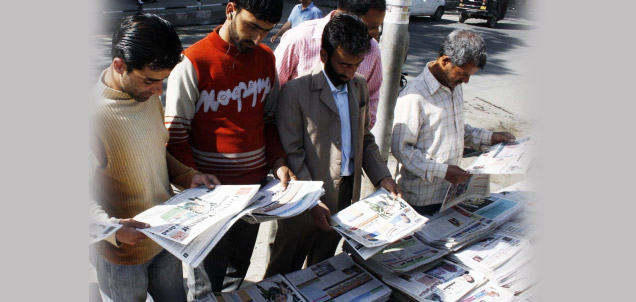
    The newspaper industry is undergoing transformation and the only way ahead is to look within and reinvent. While it may be too much to say that for the print industry the only option is to reinvent, else they will perish, but it won’t be far from the truth to say that if they don’t adapt to the changing times they will be groping in the dark and will only pave the way for their downfall. Early adoption and partnership with technology are a few ways by which the industry can look at transforming itself to cater to the Gen Y.

    Expressing his view, Mr I Venkat, Director, Eenadu, said, “Yes, we have to reinvent. I think the time has come when we no longer can continue in the traditional way. While the future of newspapers in India is still strong and will be for at least for 10-15 years and what happens henceforth I can’t really say. But in that time period, one should have reinvented and come up with multiple platform and strengthen them so that they become established models to generate revenue.”

    He maintains that printed word will remain sacrosanct though the content would undergo change to meet with the various platforms. In fact, Mr Venkat points that even now the way news is being consumed is changing where they have witnessed a significant rise in people coming to digital platform to access news.

    Shahrukh Hasan, Group Managing Director, Jang Group, Pakistan is of the opinion that the newspaper industry would not perish even if they don’t reinvent because there is lot of inherent growth still left in the print business. He said, “That said, I think reinvent I would, even if there are no threats as it is imperative for our continued growth. As it happens the print media is under lot of strain and we have seen globally it has been losing readership but in our part of the world the fundamentals that drive the business is strong, like literacy rates going up, growing middle class, migration from rural to urban areas, a very young population and the erosion of the joint family system. These are factors which impact growth and circulation. In fact they are all working in our favour.”

    “The important thing is that we have to realize that the business we are in is evolving and we have to adapt for that reason. We have to abandon tradition and adapt to reengineer to remain relevant. We are not competing with new media or television but we have to adapt in terms of how we process the news and understand what kind of news we have to provide to our readers in these changing scenario where different platforms with different speed of delivering news exist.”

    While Mr Hasan points that reinvention is not necessary but he will still go with it to be future ready. There is also another opinion which stresses that the newspaper business doesn’t need to be reinvented but it’s the newsroom that need to reinvent. Sanjay Gupta, Director, CEO and Editor, Jagran Prakashan Ltd, said, “Newspapers will remain. It will never die and it’s seen that in the most advanced economies where digital has taken over newspaper still exist. But it’s their relevance to the marketers that is changing.” Newspapers may not be relevant to the marketer as a touch point because of more varied and systematic approach that digital offers and for media companies to make journalism sustainable, Mr Gupta points that there is need to go into different revenue streams and digital comes into play in that aspect.

    So the interesting point that comes in this discussion is the decreasing relevancy of newspaper to a marketer hence bringing the digital platform to up the revenues. Also many media company pointed of unbundling of packages to advertisers that comprised a 360 degree approach.

    Reinvention in terms of digital may be the mantra for many to follow but for KN Tilak Kumar, Joint Managing Director and Editor Deccan Herald, the potential in print in its existing avatar is immense.  He said, “There is a lot of scope for print media especially rising population, growing literacy and urbanization signify that there is a lot of potential for print media to grow. We have been trying to reinvent in terms of content, design and layout. Digital is the future but it’s not a concern In India as we see it now.”

    Content is the key and even for Prabhat Khabar’s MD, KK Goenka. He reaches to his consumers in Bihar, Jharkhand and West Bengal and the paper has reached the status of the 7th largest read Hindi daily and this has happened primarily by the physical newspaper. Digital he says doesn’t play a role in the growth of his paper but yes content is the key. He says, “It’s the credibility and trust of people that we have built over the years that is responsible e for our success. It’s the issue that we have taken that is no less than a movement that has helped in building what Prabhat Khabar is today.”

  • WMC 2011: We have to be innovators as much as publishers: Aroon Purie

    By Shruti Pushkarna


    Addressing delegates at the 38th FIPP World Magazine Congress in New Delhi, Aroon Purie, FIPP

    Chairman and Chairman and Editor-in-Chief, India Today, said much had changed since he first joined FIPP at the Paris World Magazine Congress 2000. He believes, “India has arrived at the world stage and the fact that the World Magazine Congress is being held in Delhi is a reflection of that.” Mr Purie leaves the chairmanship of FIPP at the end of the Congress.


    Compared to 2000, when the Indian media space had not opened up to the world, in 2011, the media space in India is bustling with activity. With 10, 500 newspapers and 58,100 magazines registered in this country, Mr Purie emphasized, “Although newspapers are shutting down in most parts of the world, and most cities have only one newspaper; in a place like Delhi, you can get 16 English newspapers delivered to your doorstep and there are 10 Hindi language newspapers. I don’t think that’s possible anywhere in the world.”


    The demographics in the Indian market, assured Mr Purie, will make any publisher “salivate”. We have 22 official languages which means you have that many more languages to publish in. In that sense, we are like Europe, except Europe has a population of only 739 million and ours is 1.2 billion.”


    India, Purie further added, is a country “straddles many centuries simultaneously”. “That is our

    uniqueness in a way. Not far from here you’re likely to see a bullock cart on the road next to a Bentley, both stuck in the same traffic jam. So it is in the media space. We happily straddle digital as well as traditional media and both are growing rapidly.”


    Citing the latest numbers, Mr Purie added, “Consider that magazine advertising is slated to grow by

    a compound annual growth rate of 13 percent for the next five years. Internet connectivity, although

    now low in terms of penetration, still has 100 million people accessing the net. This is expected to grow to 237 million by 2015. Smartphones now constitute only 5 to 6 percent of the total phones but this is expected to grow to a 25 percent by 2015. India has 31 million Facebook users which makes India the third largest market for Facebook. India is a country rich with promise.”


    But the uniqueness of Indian market does not take away the need to innovate. Mr Purie recalled, “When I took over FIPP two years ago as the Chairman, the mood among publishers was truly dismal. It was like watching terminal cancer patients just biting their time. There is now an aggressive optimism and a growing realization that the new technology is not a cancer but one of those injections that offer rejuvenation.”


    Mr Purie believes that tablets will be both “the saviour and the biggest challenge for magazine publishers”. “For us to succeed we have to know now to design content for eyes, fingers and ears too, and provide an immersive experience to our consumers,” he said.


    Drawing a parallel with this year’s theme, ‘The 360 Opportunity’, Mr Purie reiterated the need to

    integrate the traditional models of content with new technology and new platforms.

  • Engagement Study holds hope for magazines

    By Akash Raha

    With the World Magazine Congress round the corner, New Delhi is set to host magazine publishers, marketers and advertisers from all over the world.

    However, with news doing the rounds each year that the future of magazine is in doldrums (at least on print and paper), a lot of hopes are likely to be pinned on the Engagement Study conducted by Association of Indian Magazines (AIM), which is to be announced at the congress. The study aims to become a robust currency for advertisers.

    Media planners and buyers whom MxM India spoke to about the study feel that it will herald a change for the better.

    Premjeet Sodhi, President, The Collaborative, Lintas Media Group said, “Yes, the currently available syndicated research studies in India are not adequate to take fully informed decisions about selection of magazines from a media planning perspective. A lot of additional inputs are derived from proprietary research by agencies to be able to make prudent recommendations. Overall, there is a huge scope for enhancement of the syndicated data sources from the perspective of magazines. While, I am not aware of the research design of the Engagement Study, I am sure it will fill a critical void of information for magazines and will be a valued input for media planners and advertisers. I hope that going further the research does not stay at the ‘Category Level’ and does provide information at the ‘Individual Title Level’ else the applicability of the information will always be limited.”

    S Yesudas, Managing Director – Indian sub-continent, Vizeum India said, “Personally I was shocked to see the numbers of some of the magazines when the Registrar of Newspapers of India publicized the print order claim made by magazines on its website, presumably through an oversight, as it was subsequently withdrawn.  Coupled with this is the reality of IRS certifying a consistent southward trend.  There are too many titles fighting for the same share of the audience pie, unlike the newspapers, they themselves are currently feeling the pinch.  While the engagement study might help differentiate one against the other in the same area of operation in terms of affinity, it will not make any substantial changes in the current perceptions and judgments by media planners, from an overall industry perspective. At best it will result in the publication with the highest affinity, scoring over the others compared to the current judgment allocation where the one with the perceived audience retention possibility gets 80 percent and the rest 20 percent. With the engagement study it might become 90/10 or 100 in favor of the one with highest affinity.”

    With digital being the watchword for the future, this year’s theme of the magazine congress is ‘The 360° Opportunity’.

    Dinesh Vyas, Business Head, MEC India said, “If you look at the way the print medium has been faring of late, I wonder how much of a difference the Engagement Study is going to make. The situation has changed drastically over the years and today, digital is taking away massive part of the advertiser’s money. According to me, digital is a very engaging medium, perhaps more than print as a whole. Whether Engagement Study will make a difference or whether clients will buy into a medium which is already losing interest amongst consumers, only time will tell.”

    A few questions arise here: Will the media planners and buyers appropriate the study? Will they be able to trust a survey conducted by the very group on which the study is being conducted? The answers to these questions are close at hand.

    Also Read:

    http://www.mxmindia.com/2011/09/engagement-study-may-solve-magazines%E2%80%99-measurement-blues/

  • The Anchor: Sumanto Chattopadhyay on 7 reasons why print cannot die as an advertising medium

    #1 Every time a new medium comes into being, premature obituaries are written for preexisting media. This happened with radio, when television arrived. And with TV, when the internet came along. But I ask you, are radio and television dead?

    #2 In India, newspaper circulation is on the up and up. New newspapers are being launched every day. Almost every page of every paper has an ad or two. So where does the concern arise?

    #3 If paperbacks and magazines died, we might worry that print advertising could be next. But novelists are thriving. The Economist is growing. So me no worry!

    #4 While there are writers, print advertising cannot die. As a writer, I can tell you that the urge to write is too strong to shrivel and give up the ghost.

    #5 The smart phone, tablet and laptop are just not as easy on the eye as the printed page – so to protect our ocular health we will opt for print and print advertising.

    #6 Paper running out could be a serious blow. But with afforestation and recycling we are licking that problem.

    #7 And finally, imagine sitting on the pot with your laptop and clicking on some web banner… Nah. Print rules.


    Sumanto Chattopadhyay is Executive Creative Director, South Asia, Ogilvy & Mather Mumbai.

  • 3 days to World Magazine meet


    By Akash Raha

    The FIPP’s 38th World Magazine Congress is only three days away and is going to be held for the first time in India. Approximately 600 delegates from 50 countries (including India) will be attending this event. The conference will be held from 10-12 October, 2011 at New Delhi,and the biggest names of the media and advertising fraternity, from India and internationally, will be present at this event.

    Chris Llewellyn, President and CEO FIPP, UK, speaking on WMC India edition to MxM India said “The World Magazine Congress is FIPP’s most iconic event, gathering together the great and the good from our industry and is always special. Being held in India for the first ever time is a wonderful endorsement of how the market for magazine media is developing in this country and I’m looking forward to some great interaction between the local and international publishers. More generally, being able to understand how to balance the array of opportunities that new digital platforms bring together with the many strengths of the traditional magazine is the obsession of the magazine media world, and I’m sure that our New Delhi Congress will provide real insight and guidance as to what’s working, where, and why.”

    In a conversation with MxM India Mr Mitrajit Bhattacharya, General Secretary, AIM said, “We have a huge number of delegates coming in from all over the world; from the far-east, from Europe, from America. So I think, this is going to be one of the most successful World Magazine Congress in the last decade or so. India is the toast of the world for anything and there is a lot of interests for delegates to attend the WMC 2011.”

    When asked if business transactions can be expected in the WMC Mr Bhattacharya added, “I think there is a large amount of work which is happening in the digital space, and there is a lot of business which could be driven in that area in the World Magazine Congress with the magazine publishers of India. So there would be a definite angle of business in World Magazine Congress and I know that publishers are already full with the dates in their calendar with meetings with international delegates. There is a very nice appointment dairy that we have offered to every delegate and that is getting full for many publishers. So there will definitely be business transactions in the World Magazine Congress.”

    The World Magazine Congress will begin with the opening address by Mr Aroon Purie, Chairman of FIPP, and Chairman and Editor in Chief, India Today; Mr Chris Llewellyn, President and CEO, FIPP and Mr Jussi Pesonen, CEO, UPM. This will be followed by an interaction with Mr Shahrukh Khan, who will talk about ‘My Tryst with Magazines’.

    The next two days will be packed with speakers of renown from across the globe. The key note address on the second day will be given by Ms Ambika Soni, Minister of Information and Broadcasting, India.

    The Congress’ theme for this year is ‘The 360-degree Opportunity’. The congress will showcase various innovation and means to success in today’s dynamic market. The conference agenda contains some of the world’s biggest media names, giving their own personal insights. In addition, the 2011 Congress will incorporate a large commercial exhibition, providing the opportunity for delegates to learn about new products, developments and opportunities in a highly-charged business environment.

    India is an essential market as it has 73,000 magazines, including weeklies, fortnightlies and monthlies. The market is dominated by Hindi and regional publications. About 34 percent of the overall magazine industry publications are in Hindi, followed by English publications accounting for 13 percent of the total pie. The remaining 53 percent of the market comprises regional languages such as Marathi, Bengali, Tamil and Telugu.

    FIPP’s World Magazine Congress is by far the biggest magazine event that is organized across the globe which brings forth magazine publishers and business media providers from across the globe. The biennial Congress has taken place in many different locations over the years, including United Kingdom, London (2009), Beijing, China (2007), New York, USA (2005), Paris, France (2003), Rio de Janeiro, Brazil and Buenos Aires, Argentina (2001) and Hamburg, Germany (1999).


    For more information: www.fippindia11.com

  • Design submissions invited for classical publications library in India

    By A Correspondent

    Harvard University Press is inviting design submissions for the Murty Classical Library of India, a publication series slated to debut in 2013 that will bring the classical literature of India to a global audience. The designer of the winning series logo, logotype, and jacket design will receive US$10,000 and jacket credit on all books in the series.

    The Murty Classical Library of India (MCLI), established through an endowment gift from Rohan Narayan Murty and the Murty family, will provide new English-language translations of works written in Bangla, Hindi, Pali, Panjabi, Persian, Sanskrit, Tamil, and other Indic languages, with the original text on the facing page.

    Harvard University Press Executive Editor-at-Large Ms Sharmila Sen noted, “Because the Murty family founded the MCLI in order to bring the rich literary heritage of India to the entire world, it is especially fitting that we issue an open invitation to generate a design for this landmark series.”

    Mr Tim Jones, director of design and production at HUP, added: “India’s classical literature is uniquely diverse—geographically, linguistically, and thematically—making it a special challenge to visually convey the scope and richness of the MCLI. We’re holding this contest so that designers of all backgrounds and experience can help us find an iconic way to represent the writings’ diversity.”

    Designs may be submitted until December1, 2011. Residents of, and design firms based in, the US, the UK and India are eligible to enter. Details, complete rules, and entry form are available at www.murtylibrary.com.


  • Chitralekha group announces watch awards

    By Akash Raha


    The Chitralekha group’s Watch World magazine is all set to unveil the second chapter of Watch World Awards 2011 on September 24, 2011.


    Commenting on the occasion, Mitrajit Bhattacharya, President and Publisher, Chitralekha  said, “With participation of international brands with their latest global launches, Watch World Award is an international award coming from India’s premier watch magazine. An event made possible, thanks to whole hearted participation by leading and iconic brands and a jury comprising the best from the world of horology, fashion, sports, aesthetics and design.”


    According to Chitralekha group, this year’s awards received 40 per cent more entries, 30 per cent increase in nominations and 9 new participating brands. Marquee brands like Harry Winston, Zenith, Baume & Mercier, Carl F. Bucherer, Ulysse Nardin, TAG Heuer, Greubel & Forsey, Breitling, Hublot, Girard-Perregaux, Corum, Montblanc, Parmigiani, Romain Jerome, Seiko, Citizen, Swarovski, GC, Titan, Chronotech etc participated in the awards.


    The coveted awards cover eleven product categories and six marketing categories and one mega award named as ‘Watch of the Year’. The product categories are Complicated Watch of the Year, Jewellery Watch of the Year, Sports Watch of the Year, Fashion Watch of the Year, Watch with Best Design, Watch with Most Innovative Design, Watch with Highest Utility, Watch with Artistic Excellence, Value for Money Watch of the Year, Limited Edition Watch of the Year and Concept Watch of the Year. The six Marketing Categories are Best Campaign in Print, Best Campaign on Television, Best Out of Home Campaign, Best In-store Merchandise, Best Boutique and Best Organised Event.


    The composition of the product jury members was; Mr. Antoine Simonin, an extremely accomplished Swiss master watchmaker and author, based in Neuchatel with over 50 years of watch making experience; Ms. Chhaya Momaya, leading image consultant of India; Mr. Ayaz Memon, reputed journalist and a keen observer of the luxury space and Ms Varuna D Jani, distinguished jewellery designer. Ms. Sharda Agarwal and Mr. Shripad Nadkarni, founders of Market Gate Consulting and seasoned marketing professionals made up the Marketing Jury. Both the jury panels were moderated by Chitralekha’s Mitrajit Bhattacharya.


    Says jury member Mr Antoine Simonin who is on his second visit to India to judge the awards: “I am honoured to be a part of the jury once again. There has been an exponential increase in the brands and quality of nominations this year. Seeing the response of global brands in the second year, Watch World Award has made a mark for itself in a very short span.”


    The Award night will be a weekend event (September 24-25), where VIP guests will stay overnight at Jaypee Greens Golf & Spa Resort. The night promises to be an evening to remember with a priceless exhibition of exquisite watches. Next morning guests will enjoy a game of golf at the sprawling 18-hole golf course, one of the best in India.


    The Watch World team is committed to making this annual event the most respected word for the watch industry. The event is supported by its partners, AU Finja, Luxure by Louis Philippe, GIA, Chhattisgarh Handicrafts, Bloomberg UTV (BUTV), Mint and Big FM besides outdoor and online partners.