Tag: print

  • Azim Premji wins Forbes India’s inaugural philanthropy award

    By A Correspondent


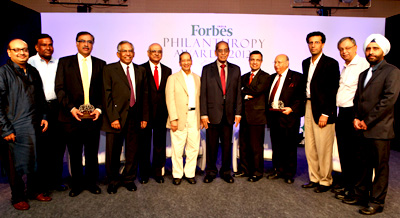
    Azim Premji with the jury (L-R): Abraham Moses, Sanjiv Sarin, MV Subbiah, AN Singh, Bhawarlal Jain, Narayanan Vaghul, Nachiket Mor, Lord Raj Loomba, Ashish Dhawan, Dr Madhav Chavan, Gurmeet Singh

    Azim Premji, chairman of Wipro Ltd, won the inaugural Forbes India Philanthropy Award in Outstanding Philanthropist category for 2012. Mr Premji, 67, the third richest Indian with a net worth of $12.2 billion, has pledged close to $2 billion from his personal wealth to Azim Premji Foundation, which is working to improve elementary education across India. He was among the ten outstanding individuals who received the award under different categories.


    The philanthropy awards were instituted by Forbes India to recognize the efforts of individuals who have given time, money, skill and expertise to solve some of the most pressing societal issues, to create model institutions and to inspire others. The winners received their awards – metalwork keepsakes depicting the Mubhi Tree, which symbolises the art of giving – at an event in Bangalore on Wednesday.


    “Our hope is that business should emerge as a strong force for good in this country and that our list of nominees for each of the ten categories will continue to grow as more and more people from the world of business step up and find new exciting ways to give back to society,” Indrajit Gupta, editor of Forbes India, said during the event.


    Mr Premji spoke about how his foundation’s university, which has 230 students and 70 professors, complements the field work they do in education. “Our objective is that we have to get more results and to scale up much more significantly in the grassroot level in the field,” he said. Later, he joined his fellow winners N Vaghul, former chairman ICICI Bank and MV Subbiah, former chairman Murugappa Group in a fireside chat to discuss what it takes to build a network of engaged corporate citizens, deepening the culture of giving back, galvanising corporate action, and how to take philanthropy in India to the next level. The session was moderated by Subroto Bagchi, chairman and co-founder Mindtree.


    In yet another fireside chat, Nachiket Mor, Chairman of the Board of Directors, SughaVazhvu, Ashish Dhawan, Founder and CEO of Central Square Foundation and Ramji Raghavan, founder Agastya International, discussed the challenges that philanthropists face when they work with multiple stakeholders, especially the government, in bringing about change. Ajit Rangnekar, dean of the Indian School of Business in Hyderabad, moderated the session.


    The event was attended by entrepreneurs, executives and academics with interest and passion for philanthropy and social good. They shared their views on themes related to philanthropy. Kiran Mazumdar Shaw, chairman and managing director of Biocon said that philanthropy is about making changes, and partnerships play a crucial role in that. Mr Mohandas Pai, Chairman of Manipal Global Education, and one of the driving forces behind Akshayapatra a mid-day meal programme, said he was motivated to do more when he realised that he was lucky to have won ‘the ovarian lottery’, many others aren’t so fortunate. Lord Raj Loomba, founder of clothing company Rinku Group, whose foundation works for the cause of widows, said his inspiration was the story of his mother, who became a widow when Raj Loomba was just 10 years old.


    The latest edition of Forbes India devoted to philanthropy was also released. Containing features on philanthropy with detailed case studies about each of the award winners, the special edition has four covers, featuring four of the winners Azim Premji, N Vaghul, MV Subbiah and Ashish Dhawan and a caption that runs across four covers: Philanthropy, done right, is too important to restrict to one cover.


    Speaking on the occasion, Gurmeet Singh, CEO, Forbes India said, “We at Forbes India strongly believe that Wealth and Philanthropy are two sides of the same coin. Therefore it was logical that we scaled up our earlier events on “Purpose Of Wealth”, “Business as a Force For Good” and “Conscious Capitalism” into a full-fledged Philanthropy Awards Evening.  Forbes India Philanthropy Awards and Dinner was a very well attended evening bringing India’s biggest philanthropists, guides and catalysts on the same platform and exploring what motivates leaders to embrace philanthropy and how India Inc needs to bring a stronger giving culture”.


    The winners were selected by a jury comprising of Narayanan Vaghul, Former Chairman, ICICI Bank, Madhav Chavan, Founder and CEO, Pratham, Shashi Tharoor, Member of Parliament and Dr Devi Shetty, Founder Chairman, Narayana Hrudayalaya Hospitals.


    The complete list of award categories and winners:


    Outstanding Philanthropist:

    The flagship award recognises an outstanding individual whose leadership and contributions of time, money, skill and expertise has brought in new thinking into solving complex social issues.

    Winner: Azim Premji, Chairman, Wipro Ltd


    Outstanding Corporate Foundation

    This award honours foundations that have taken up a social issue and have long term vision, strategy, a sustainable model and have created significant impact in their chosen areas.

    Winner: Tata Trusts


    Distinguished Family of the year

    This award honours families who have dedicated their private wealth for public good and benefited an institution or organisation in recognisable and sustainable ways across different generations

    Winner: Murugappa Family


    NextGen leader in Philanthropy

    This award recognises the accomplishments and contributions of emerging leaders in philanthropy, those who have signaled their intent through meaningful giving, have also begun to contribute significant time, skills and resources to the causes they have helped advance.

    Winner: Ashish Dhawan, Founder, Central Square Foundation


    Cause Marketing

    This award is for a company that has successfully marketed products or services in conjunction with a charity and brought significant benefits to both parties.

    Winner: Tata Tea – Jaago Re


    Corporate Catalyst

    This award is for a senior business leader who has used his influence to promote the cause of giving back not just in his or her company, but also across the entire industry.

    Winner: N Vaghul, Former Chairman, ICICI Bank


    The Good Company

    This award recognises pioneering strategic initiatives undertaken by large business corporations, where they have used market-based models to balance the twin objectives of doing well, while also doing social good.

    Winner: Jain Irrigation Systems


    The Good Samaritan Award

    This award is for an exceptional individual at any level in a company who has successfully led and galvanised support within the organisation to mount programs that help more people within that organisation to support worthy causes and give back to society.

    Winner: Abraham Moses, Director, Administration & Facilities, MindTree Consulting


    Distinguished Non-Resident philanthropist

    This award is for a non-resident Indian who has contributed significantly to a social cause in India, by giving wealth, time and expertise.

    Winner: Raj Loomba, Loomba Foundation


    The Crossover Leader

    This award seeks to recognise a professional who has successfully made the transition from a thriving career in the corporate world to work for the social or not-for-profit sector and has served as an inspiration and role model for others.

    Winner: Nachiket Mor, Non-Executive Chairman of the Board of Directors at SughaVazhvu


  • The Anchor: 7 reasons print will never die (despite declining readership figures)

    By Pankaj Arora


    #1 Akhbar mein likha hai toh kuchh toh sahi hoga:

    People believe in the written/printed word over television. Huge debates happen around what is read. Depending on the news and its impact as well as the personal points of view, layered by the individuals’ leanings, great discussions at the ground level take place on any event. However, the final word on the subject is based on what is reported.


    #2 Bijli kahaan hai bhai:

    Power is a major issue in most parts of India. Even within the top 10 cities, not all have 24-hour of electricity. And it is not necessary that they will have electricity in the few precious minutes one has before setting out for the day. Mainline newspapers are read by the working people mostly in the morning. Most often, over the cup of morning tea.


    #3 Pura maamla hai kya?

    A basic desire to understand the issues in detail requires one to spend time and dwell on the reportage in depth. Different points of views of the different affected parties as well as the implications will help print stay relevant and around.


    #4 Ghar mein TV hai. Ek!

    Most families are a single-TV household. Unless there is a major event that has taken place, the content that is watched is what the whole family can see together. So crime and horror shows probably blank out the real issues. While news is watched, it is not preferred by the whole family. As a result, the first thing that most people do is wait for the paper to get a complete perspective.


    #5Special Discount! Sab se Sasta! Diwali Ka bumper offer! Sirf Lalaji Ki Dukaan mein.

    The boom in retail will continue to percolate down through India. With more and more malls coming up even in small towns the growth in Tier 2/3 towns will require local advertising. The housewife too, laps up the newspapers or its supplement to keep herself abreast of the great deals that are made available to her.


    #6 Bade Chowk mein aaj Morcha. Dehant ki khabar. Tuition Classes. Dance Masterji.

    Local news and issues are best covered through print and will encourage proliferation of local editions as is evident for the last five years.


    #7 Train/ Bus mein:

    During travel most of the time is used constructively to catch up on the news. As travel times keep increasing, the need will only increase.


    Pankaj Arora is National Planning Director at Triton Communications


  • Jaldi 5 with Suresh Nimbalkar: Print is not declining

    The findings of Quarter 2 of the Indian Readership Survey for the year 2012 published by the Media Research Users Council saw alarm bells ringing as there was a decline seen in print readership. Although we haven’t yet seen doomsayers out on the streets, the numbers did worry print evangelists. We asked Suresh Nimbalkar, Senior Vice President, Hansa Research (which conducted the IRS research) to comment on what lies beneath the numbers:


    01 What do you infer from the continuing decline in readership (IRS) numbers that the print players have been witnessing quarter-over-quarter?

    Let’s split this question into a) Changes in print reach and b) Changes in leading publications.


    a) The print reach has been continuously going up in absolute terms. If you look at the past 3 quarters, the numbers are 350347, 352115 & 352004. Thus, there is no statistical decline in reach.


    b) If you look at the top 10 publications, 3 publications have shown a growth in numbers. What the charts may not tell you is that some of the publications which seem to have shown decline in 2012 Q2 v/s Q1 have shown good growth in past two years. There are publishers who have launched new publications and have ensured overall growth.


    Hence the print market is not declining. We always advise people not to look at quarter-on-quarter changes but look at the long-term trend to arrive at a conclusion.


    02 Ideally, few publications should gain in readership numbers at the expense of other publications where loyalty is lost on account of readers migrating to newer titles. But that is not the case here as most titles have shown a decline. What could be the possible factors for the equilibrium not being maintained?

    You have possibly looked at the top 10 publications for this inference. If you look at a wider number of publications, this may not be true. The print market is undergoing change owing to other factors such as spread of C&S, good growth in internet penetration, resulting increase in number of media used (for information, entertainment & news), paucity of time for an average individual, decreasing title loyalty etc.


    03 Regional publications have somewhat bucked the decline trend to some extent compared to the Hindi and English players. Your comments?

    There has been a significant increase in the level of marketing, new launches, geographical expansion, investment on product and reader connect among language publications for the past 3-4 years. This is evident in their market presence as well as their reach.


    4 Within the space of regional dailies, publications from the south (like Daily Thanthi, Eenadu, Malayala Manorama etc) have shown good composure over publications from rest of India like Lokmat, Gujarat Samachar etc. Will they continue to emerge a potent force going forward too?

    Owing to relatively higher literacy levels and presence of one or two dominant players in the each of the southern states, you find quite a few southern dailies in the top 10 list.


    Also, it is difficult to predict the future. However, if you look at the level of competition, it has gone up in at least 3 southern markets of AP, Karnataka and TN. This suggests that there could be changes in market shares.


    05 Do you see advertisers taking a relook at their association with the medium given the  slide in readership?

    As I said, there is an increase in the overall reach of print medium. The budget allocation by the advertiser depends on the relative attractiveness of each medium.


  • MxM Mondays: Is Radio perceived as a poor cousin to Print & TV?


    By Ananya Saha and Robin Thomas


    The onslaught of FM radio came as a breath of fresh air for listeners in India by the late nineties, and the success of FM Phase II launch further fuelled the FM growth story. According to industry estimates, radio’s overall advertising pie is around 4.5 per cent, and this is expected to growth even further with the FM Phase III launch. The medium promises reach, greater recall and marketing solutions that are cost-effective. With FM Phase III also expected to roll out soon, the radio industry gears up for another phase of growth which may see newer genres coming into play, differentiation in content, news, sports broadcasting and so on. However, despite these developments, why is radio perceived as a poor cousin to its traditional counterparts, particularly print and television? How do FM players, media planners and the advertisers view the medium?

    Comments in alphabetical order of last names

    What the radio industry has to say:


    Harrish M Bhatia

    Harrish M Bhatia, CEO, 94.3 MY FM:

    It is highly unfair to compare radio to print or television considering the policies associated with each medium and the length of time that the media have existed in the private sector. Restrictive governing policies have not allowed radio to diversify its product offering and showcase its true potential as a people’s medium. The private radio industry is still nascent and hasn’t been given the autonomy that television, or even for that matter online media, has enjoyed. Internationally, where markets are more evolved, radio enjoys about 8-10 percent of the advertising pie. Secondly, there is a lack of credible measurement systems to back the potential of radio. While dealing with the issues like long delays in Phase III implementation, music royalties and insufficient measurement tools, the radio industry has barely managed to consolidate resources and sustain itself. What is needed now is a strong mutual focus on solving these issues, hard-selling the medium and moving head-on into the third phase.


    Although it still does not address certain issues, Phase III should help open up the market for players to expand to newer markets and increase their radio footprint. What will be interesting to see is the change in dynamics that will come into play on account of the large number of non-metro stations that come up in the third phase, bringing radio on par with media like television. Advertisers will be able to benefit from this growth, leading to increased revenue potentials for radio. Moreover, with growth expected from smaller markets, the spends by national advertisers in these markets will also grow as no other medium offers reach like radio, in the fastest possible time, addressing challenges in a particular market and in their local language.


    Media spends by advertisers are not proportionately allocated to radio even though it has outgrown other media in time spent. As per the recent RAM research conducted in the four markets of Jaipur, Ahmedabad, Nagpur and Indore, average time spent listening to radio is 160 minutes as compared to IRS figures of 107 minutes watching TV, 85 minutes reading the newspaper and 30 minutes on the internet. If properly planned and used innovatively, the radio can do wonders for a particular brand. Hence, there is a need for enhancing the medium further to highlight its mammoth reach and effectiveness, which is what the radio industry as a whole should strive to do. Furthermore, radio needs to be bought on the strength or merit in particular target geography instead of as a network. Having said this, creative selling of radio has allowed greater inroads for some brands, especially in Tier II and Tier III markets, which are rapidly expanding.  Some of the key reasons have been the unique strengths of radio like customized communication to address local market needs, and ‘radio properties’ that contribute significantly in brand building.

     

    Sanjay Hemady

    Sanjay Hemady, Chief Operating Officer, HIT 95 FM,

    FM Radio is young, it has been evolving for 10 years and growing, adding value every single day to the listener and advertiser, its vast, extensive and unparalleled reach undoubtedly will take longer. Other mediums have taken long to establish, why should we compare with traditional mediums when there is no race, there is so much to achieve as a standalone medium. Radio broadcasters have been working towards creating their own territory, convincing clients, brands. The broadcaster is learning with day-to-day experience to give its best, by listening to the listener, by changing formats as necessary, positioning it differently, etc… it will take its own course, the time will come. We love objections and we solve them meaningfully.


    Expansion to newer markets will mean a bigger reach, we will get to entertain far more listeners than today, new formats will come in, fresh new talent gets identified, more jobs will get created, more brands will add radio as a definite medium. Give it some time, FM Phase III will subsequently open up a bigger offering for brands to reach out to more consumers.


    The top evolved brands across all mediums are convinced with radio, they have been consistently advertising since FM got privatized. Radio is a reminder medium, it scores on immediacy, it is about consistency and brands who have believed in the future of this medium have benefitted immensely. Brands who have worked closely to understand this medium and used it effectively are a happy partner. Going forward a collaborative approach will add more to this growth, and other extended avenues like Mobile Radio, Internet Radio, Radio Activation will also add revenue.


    Prashant Panday

    Prashant Panday, CEO and Executive Director, ENIL (Radio Mirchi):

    I disagree that it is a poor cousin of the other media! Each medium has its own relative size and one has to keep that in mind. A 48-kg lightweight boxer gets the same Gold medal in the Olympics as the 85-kg heavyweight winner gets! They are separate media and should not be compared. However, what is indeed correct is that even radio’s natural share has not yet been achieved. Worldwide, the share of radio is 8.5 percent, and this is just the average. In the countries where radio has developed well (US, NZ, Sri Lanka etc), radio’s overall advertising share is 12-13 percent. In India, radio’s advertising share is just 4.5 percent and the reason for this is that the government has simply not released enough frequencies. The share of radio will increase if 400 Khz separation is adopted by the Government as recommended by TRAI. That will increase supplies to 18-20 private channels per city.


    FM Phase 3 will only increase share from 4.5 per cent to 6 per cent or so. If we want to go to 8 percent or more, we have to release more spectrum in the major markets.


    Radio has become a “core” medium now. Every advertiser uses radio and they use it all the time. In fact, radio pricing is also quite strong. Did you know that Radio Mirchi is in the top 10 electronic media brands in the country after Star Plus, Zee, Colors, Sony, DD, Sun TV, 1-2 sports TV channels… It’s bigger than all music channels, all news channels, all regional channels, and all movie channels!


    Suresh Sanyasi

    Suresh Sanyasi, National Sales Director, Radio Indigo

    Yes, people consider radio a poor cousin. This has happened because of the endurance power of the medium. The people who do not understand the potential of the medium, cannot do much for it. Radio is and will remain a traditional mass medium. Radio works differently in different areas. Unlike television, this medium takes the demographic and area listenership into consideration. Radio as an advertising medium is harnessed largely by the retail sector and their ad spends on this medium is increasing. The medium provides immediate ROI, and is measurable.


    Regulatory issues are hampering the content creation on this medium. News and features get immediate audience. Once the regulations are eased, listenership might also increase.



    B Surender

    B Surender, Senior Vice President and National Sales Head, Red FM

    It is unfair to compare the growth and size of FM radio industry on equal terms with the print and television media here in India. To start with , FM radio was launched extremely late in India around 2002 with steep licence fees,  restriction on genres, frequencies, etc  making the business virtually unviable till the year 2005. It is only after phase two expansion with some policy corrections around 2005-06 that the industry started taking off. It has already grabbed an impressive 4.5 percent share of the media pie in India. If the Government frees FM radio further from its shackles through its phase three policies, one can expect terrific momentum in its growth.


    In my opinion, the  biggest roadblock for the industry’s progress currently is the most unreasonable restriction on entering newer genres like news and current affairs, live sports etc,  clubbed with issuing of multiple frequencies within a city. If the television industry was given the freedom to operate in these genres inspite of it being visually enabled, why not the FM radio industry?


    Phase three means a lot to our industry as it’ll considerably improve geographical coverage and reach, and enable content differentiation, to a reasonable extent, thanks to the provision for existing radio players to acquire multiple frequencies in the same city. It will consequently attract more categories of advertisers locally as well as nationally and more importantly, increase the depth of consumption of those advertising already. This in turn should take its share of the ad pie up to 7-8 percent. If they free up the news and current affairs genre, which is considered the second biggest genre on radio, properly, then the share of radio can potentially touch double digits over the next few years.


    The key word is ‘evangelising’. Industry players need to take up the task of promoting the enormous benefits of this amazing medium in such a manner that advertisers get a more holistic understanding. In India, listeners have lapped up the medium wholeheartedly across age groups. There is a clear case for radio players to pool their precious resources and launch a RAB (Radio Advertising Bureau) kind of initiative in India on the same lines as USA, UK, South Africa, etc to evangelise the medium among advertisers and ensure a substantial share of value in their minds.


    What advertisers and media agencies have to say:


    Anwesh Bose

    Anwesh Bose, Senior Vice President, DDB MudraMax

    The answer lies in the question itself. The argument today is why radio is the poor cousin. The entire eco-system of communication that is advertisers, agencies and the media owners are to blame for the condescending perception regarding the medium in our country. Before we answer the “why” we need to know the ‘what’s.


    The knowledge gap: most of the ‘professionals’ in the communication eco-system are not aware of the number of radio stations that exist in this country and a handful of them have ever seen a physical copy of the AIR rate card. An interesting fact is that the geographical coverage of radio is higher than that of any medium in this country and very few are aware of it.


    The information gap: Unlike TV and print, radio has very little data to prove its effectiveness and efficiency. In the times that we live in, most of the communication planners are data clerks; therefore for them radio is nothing but a ‘cheap’ medium that is local and low in reach therefore it is an option not an important component of a media plan.


    The perception gap: due to the lack of knowledge and information, the perception regarding the medium is dilute. Dilute perceptions lead to misplaced notions. The radio media owners have themselves done a lot of dis-service as well. There is an identity crisis among the radio brands because all of them are busy copying each other, as a result of which everyone is a ‘me-too’. Add to it the fact that it is a medium that has a one-time entry cost and no recurring costs, therefore the complete dependence on advertising revenues for sustenance. Anything that is ‘free’ is not valued.


    The ‘why’ will remain ‘why’ unless the ‘what’s are rectified. I would like to conclude by saying that it is imperative that the glaring gaps are closed and it is up to the stakeholders to do their bit. It calls for thought leadership – are we up to it?
     

    Abdul Khan

    Abdul Khan, Senior VP, Tata Teleservices

    I think poor cousin is an unfortunate phrase to be used for this medium. The current share of advertising pie that radio gets is about four percent. And, we only have ourselves are to blame for this. The problem is that the mode of distribution (airwaves) has been confused with medium. There exists woeful situation of lack of innovation, programming and talent in this industry. Radio is not in sync with the youth of the country, which is the biggest drawback given that youth is the TG for every other medium.


    The last remarkable property that one remembers on radio was Binaca Geet Mala. And radio now beams music when there lay enormous possibilities when it comes to programming. There is an enormous opportunity of delivering creativity through audio waves.


    Radio currently is not offering genuine value. Except for radio forums where issues and solution are discussed, there seems no sense of urgency from within the industry and the ecosystem. Even the discussions do not lead to reforms.


    Government regulation is not responsible for this situation. Yes, there have been regulations but other mediums also face regulations. What the ecosystem needs to understand is the fact that radio as a medium has enormous possibilities.


    Vivek Srivastava, Joint MD, Innocean Worldwide

    The perception of radio varies according to the advertiser’s profile. For the local advertisers, like retailers and jewellers, radio is a high-performance medium and a primary advertising medium at times. But for national and established advertisers, radio suffers from an image problem.


    Radio has been traditionally typecast as a low-preference medium. It has been treated as a transit medium, a medium that people listen to while they are driving or travelling. People believe that even with listeners accessing radio through their mobile phones, the listenership is actually percolating down.


    What is also hampering the growth of the medium is the fact that radio is a victim of current circumstances. There is hardly any money put in when it comes to producing for radio, even when huge budgets are allocated for production in print and television. Yes, we do see flashes of brilliance on this medium as well but it is only far and between. The whole ecosystem is responsible and should act towards making this medium more rich.


    Sanjay Tripathy

    Sanjay Tripathy, Executive Vice President-Head Marketing and Direct Channels, HDFC Life

    Radio is considered a very topical medium and advertisers can customize messages to geographies and city. While there is a great amount of flexibility that the medium offers but there are certain issues that the medium has:


    1. There is no channel or programming loyalty by consumers – Consumers listen to songs and not so much to content.


    2. It is still a medium (in larger cities) which is heard while concentrating on doing something else ie driving, cooking, etc. Therefore it becomes a medium that is on the background and not so much a primary entertainment medium as television.


    3. Radio Channel software ie Radio Jockeys have not been able to build loyalty with the consumers / listeners.


    Therefore, radio has become a support media to television or print, and is primarily used as a reminder medium.


    Radio industry is using qualitative / quantitative researches to convince marketers/advertisers but these are researches done by radio channels independently and marketers do not get a third party verified data.


    RAM, the measurement system for radio is not considered to be a credible system.
    Few of the reasons are:

    • Diary- entry method- whereby a selected person, maintains a diary of radio stations tuned into.
    • Coverage of just 13 cities including 4 metros.
    • Small sample size of 480 is used in metros to measure the effectiveness.

    Thus, advertisers and radio industry are concerned about accuracy, authenticity and relevance of RAM’s ratings. In my view, in order to be an efficient system, RAM must have higher sample sizes that are statistically significant, transparency in processes and electronic gathering of data.

     

  • The Anchor: 5 ways to make print more relevant for advertisers

    By Ashish Pherwani


    1. To make print more relevant for advertisers, we’ve got to have more interactions and more engagement through either digital or activations on radio or any other vehicle. There needs to be a level of engagement built into the print offerings of media companies. Advertisers are looking at some kind of measurement which is not just readership but a measurement of a deeper level of engagement.


    2. You have got to make print more relevant to the reader, and therefore the one-size-fix-all newspapers being generated today may not be the answer and it may call for better segmentation and better understanding.


    3. Overall, the print companies need to realize that they are no longer B2B companies, that the main asset they hold is their relationship with their consumers and their readers. And therefore, they need to evolve into B2C companies, build databases with their customers as information and optimize that database for different advertisements.


    4. As youth moves away from its consumption of newspapers and moves towards different methods of consuming media, newspapers need to be able to figure out ways to retain those youth, either on some other medium or by giving them the kind of news that they want to read. Most publishers still believe in giving out news which they believe is relevant. Therefore giving youth-centric content is something that the industry needs to work on and youth is a category which most advertisers look forward to.


    5. Print companies need to proactively come to advertisers with innovations with products that resonate with their brands.


    Ashish Pherwani is Partner-Advisory Services, Ernst & Young India


  • The Best of Print Ads – 2011


    By A Correspondent


    You may have seen only a few of them and probably even forgotten the underlying message that the campaigns had to tell. But now you could make a dash to have a hard copy of MOSAIC, a compilation of the Best in Print (campaigns) to have hit India n shores in 2011. The compilation has been put together by 23 creative agencies who have submitted their best pieces of work for the category in 2011. Conceptualised by Sanjeev Kotnala and team from the Dainik Bhaskar Group, the initiative has been made special through the “insights” and “personal favourite” sections that have been provided by Media agency bosses. These include Lynn de Souza of Lintas Media Group, Mallikarjun CR, CEO, Starcom MediaVest Group, PM Balakrishna, Chief Operating Ofiicer, Allied Media and Punitha Arumugam, Director – Agency Business, Google India.


    Lynn de Souza, Chairman and CEO, Lintas Media Group, Chairman, Aaren Initiative and Director, Karishma Initiative

    “An excellent idea to recreate interest and remind all about the power and impact of the print medium. My only reservation is that there were too many submissions of ‘pretty pictures-pithy headlines’ work that may or may not have been published and did not appear to fully grasp how the medium must be used effectively.”


    TOP 5 Choices:


    Click on the picture for larger view

    1) DNA – ISKCON (Scarecrow India)

    Reasons for choosing: The intelligent use of the cigarette-turned-food visual immediately targets the smoker and invites him/her to contribute in a very simple way to a cause that benefits both beneficiary and the giver – something not easy to achieve. I like the simple, clean look of the ad and the directness of the headline and copy.


    Click on the picture for larger view

    2) Flying machine “What an Ass” (Lowe)

    Reasons for choosing: This is my idea of perfect ad! One that has used all the elements of the print medium – headline, visual, copy to present a bold, modern attitude through a perfectly harmonised contribution of all three. It’s an unmissable ad whether you are a guy or a gal.


    Click on the picture for larger view

    3) Parker – Ramnath Goenka Excellence in Journalism Awards (Lowe)

    Reasons for choosing: A stark headline supported by the simple bottle of ink that says it all. An attention grabbing reminder of the power of the pen to influence the world. Perfect synergy for the subject – Journalism awards and the ‘always memorable’ image of a gold Parker fountain pen.


    Click on the picture for larger view

    4) The Times of India – A day in the Life of India (Taproot India)

    Reasons for choosing: Fantastic art direction – great visual appeal that hooks you into reading the whole ad. The contemporary feel, using India n kitsch, with attention to detail, is riveting. (Check out the dog lifting his leg to pee on the bed of nails!) Bright, colourful, crowded yet not messy. I could read it again and again!


    Click on the picture for larger view

    5) Vaseline ‘Dear Mr. Vaughan’ (BBH India)

    Reasons for choosing: The kind of ad that every Creative Director who woke up to it that morning would have said: “I wish I had written this”. There are some things you can do impactfully in a topical yet ‘permanent’ medium like print that you can’t do anywhere else, and this ad fits the bill. Nose-thumbingly outstanding!


    Mallikarjun CR, CEO, Starcom MediaVest Group

    “This is a fantastic initiative. As media agency professionals, our lenses to view the world are different. However, what comes across is that great creative work is universal. Really enjoyed it.”


    TOP 5 Choices:


    Click on the picture for larger view

    1) Audi – World Cup (Creativeland Asia)

    Reasons for choosing: Great connect with the Champion’s Trophy ’85 win. Most of the target audience that can buy an Audi will connect immediately with that moment. For a lot of us India ns, that was the first moment of connect with Audi.


    Click on the picture for larger view

    2) DNA ISKCON Food Relief Foundation (Scarecrow)

    Reasons for choosing: A nice calculus linking smoking to food relief. Very innovative, eye catching visuals.


    Click on the picture for larger view

    3) Indigo Campaign (Weiden+Kennedy)

    Reasons for choosing: Stark, consistent visuals. The colours, space everything reflects the qualities of the airlines. Nice word play that grabs your attention and makes you read the copy. The reference to price is as value and not cheap.


    Click on the picture for larger view

    4) Nissan Micra (TBWA\ India)

    Reasons for choosing: Simple stark visuals. Driving home the relevance of a small car without talking price, affordability etc. Great, understated use of a celebrity.


    Click on the picture for larger view

    Reasons for choosing: Great expedient use of Michael Vaughan’s comment. Superb cut through and great visuals.


    PM Balakrishna, Chief Operating Ofiicer, Allied Media

    “I think this is a wonderful initiative and exposes the fantastic creativity. It is a very different platform as it is more an appreciation of great work rather than a competition as I believe each creative is great on its own.”


    TOP 5 Choices:


    Click on the picture for larger view

    1) Bajaj Fans (Leo Burnett)

    Reasons for choosing: The best part of this creative is the way it has integrated everyday common issues and weaved them into the core communication of the product. The creative is also very well crafted visually using the very cause of the product making it very effective.


    Click on the picture for larger view

    2) Birla Cellulose (Salt Brand Solutions)

    Reasons for choosing: The sheer aesthetic treatment to the communication draws you and I like the beautiful and colourful way the creative has used nature and the human body (woman). It brings out the environmental friendly nature of the product in a very soft and appealing manner.


    Click on the picture for larger view

    3)Fuji(Grey)

    Reasons for choosing: Colour and background are intrinsic material for any great creative and nothing better than drawing inspiration from Mother Nature and wildlife. The beautiful use of the animals brings the message home effectively and creatively and connects with any photographer or photo enthusiast.


    Click on the picture for larger view

    4)NipponPaints (JWT)

    Reasons for choosing: They say a great picture is worth a thousand words and the effect is breathtaking when it is beautifully woven into the message making the communication very compelling and effective. In this case the product USP, a central factor in the category has been brought home very beautifully for correct impact.


    Click on the picture for larger view

    5) Zee 24 Taas (Draftfcb Ulka)

    Reasons for choosing: Ganpati Bappa has a significant connect with the India n diaspora and especially with Maharashtrians who revere the elephant God. I like the way the creative has beautifully engaged the viewers in an innovative and personal manner and makes it unique and different.


    Punitha Arumugam, Director – Agency Business, Google India


    “This initiative continues the long tradition of Dainik Bhaskar – breaking boundaries and setting new trends in the industry.”


    TOP 5 Choices:


    Click on the picture for larger view

    1) DNA Mumbai Marathon (Scarecrow)

    Reasons for choosing: The power of long copy. It brings back memories of the old era, which was marked by a great headline and the power of long copy. It inspires and bonds with its audience.


    Click on the picture for larger view

    2) Murphy Richards epilators (Contract)

    Reasons for choosing: The power of a picture. The visual intrigues, makes you pause, demonstrates the benefit and brings a smile – all this without a single word.


    Click on the picture for larger view

    3) MTR Spicy Pickle (Ogilvy)

    Reasons for choosing: The power of insight. A true South India n like me will see this ad and can only say “How true!” Equating spicy with ‘tears’, the way the ad captures the cultural nuances – awesome!


    Click on the picture for larger view

    4) Parker – Ramnath Goenka Excellence in Journalism Awards (Lowe)

    Reasons for choosing: The power of words. While most entries used the power of the picture, this ad stands out because it uses print for what it does best – leverage the power of words and intriguing headlines.


    Click on the picture for larger view

    5) Saffola Healthy Heart (McCann)

    Reasons for choosing: The power of an innovation. A great collaboration between the creative agency, the brand team, the media agency and the publication to convey the brand message interestingly and inclusively so as to trigger an action from the reader.

    Best of Print in Dainik Bhaskar Group’s MOSAIC
     

    Some may see India’s performance of bagging just four Press Lions at Cannes out of the 30 that were shortlisted as a drab effort, but then there are some who would like to think of it as being otherwise. After all, Press Lions as a category managed to get India its largest tally of four metals versus any other category at the awards – a valiant effort considering that India finished 2012 with just 14 metals in its kitty.


    While the category may have received its fair share of fame at the pinnacle of creative awards, many would agree that Indian adland has failed to laud the finesse that stems out from Print creatives over the years. While such is not the case in some large international markets where creative works across categories gets noticed and rewarded that gesture seems to be missing when it comes to India. Luckily for the creative frat in India, an opportunity to showcase their best works – besides the awards shows – were given a fillip by the Dainik Bhaskar Group that released the first of its kind creative compilation of the finest works produced in Print in the form of MOSAIC 2011.


    Elaborating on the initiative, Sanjeev Kotnala, VP & National Head, Dainik Bhaskar Group said, “This has been a first year for MOSAIC, which is a rich collection of 150 creative units part of 77 campaigns that have been submitted by 23 agencies.” The creative showcase has been made special through some individual comments and insights that have been posted by creative leaders of individual agencies.


    Elaborating on the thought process behind the compilation, Mr Kotnala said: “As a group, we believe that the Indian creative across mediums and media is of international standards, in its thinking, relevance and in its execution. Unfortunately there has been no single reference point for the same. MOSAIC bridges this gap and we would want it to be referred by the creative, clients, media and trade.”


    As for the method that was adopted in getting the agencies to submit their campaigns, Mr Kotnala said that it began with Dainik Bhaskar requesting the creative heads at the agency to send their best Print work. “They know better than us – as by placing it in MOSAIC affirms it to be their best work. Though we did have constraints on the number of campaigns we could place in Mosaic from a single agency. This has all been a by-invitation. On the other side, there were few agencies that sent lesser number of creative units as they felt others were not up to the standard to feature in such a compilation. So it was created and evaluated by the creative teams themselves.”


    On how print has evolved over the years as a medium, Mr Kotnala said: “Today print ads are working on all fronts of communication. They are not just for the purpose of awareness building or as a source of providing tactical information; they engage and involve the readers and are very result-oriented in their approach. We always held that the idea is more important than the medium. And it will automatically find its right medium for better efficiencies and effectively delivery of the message.”


    In fact, the compilation has been made special with the involvement of four media agency heads who’ve provided their assessment of the campaigns. They include Lynn De Souza, Chairman and CEO, Lintas Media Group, Chairman, Aaaren Inititative and Director, Karshma Initiative; Mallikarjun CR, CEO, Starcom Mediavest Group; PM Balkrishna, Chief Operating Officer, Allied Media and Punitha Arumugam, Director- Agency Business, Google India.


    With the first edition already finding appreciation within the industry, the Dainik Bhaskar group have their task cut out for the next year too. On his plans for a sequel, Mr Kotnala said, “We would want to see more regional and language work in the collection – and they still should meet the standards set. We would and could try getting clients and media owners also picking their favourites and definitely may wish to incorporate a section on media innovations. Though we have taken the task and brought out the book, in our mind it is an industry level initiative and we would want to keep it that way.”


    Mosaic 2011 can be accessed and downloaded at http://i10.dainikbhaskar.com /dainikbhaskar2010/books/ Final_Book.PDF


  • RK Swamy BBDO relaunches Parryware with unique insight

    By A Correspondent


    [youtube width=”400″ height=”225″]http://www.youtube.com/watch?v=IYefcFAeuXc[/youtube]

    As part of its brand relaunch mandate, RK Swamy BBDO has created a refreshingly new campaign for sanitary brand Parryware.


    RK Swamy BBDO, known for its insightful work, calls the bathroom “Apna sa Kona” (your very own space) in this new campaign. This insight is based on special moments which one spends in a bathroom.


    Sunil Kukreti, Senior Partner, RK Swamy BBDO, New Delhi, said: “The insight of the campaign is that the bathroom is one place in the house where you can be yourself. You might cry, dance or just ponder in this one space, which is truly yours. The ‘Apna sa Kona’ campaign is created around this.”


    The current campaign comprises of Print and TV.


    Parryware with a brand heritage of nearly 60 years is now part of the Spanish Roca Group.


  • Jaypee Cement ‘Wall Moments’

    By A Correspondent


    [youtube width=”400″ height=”200″]http://www.youtube.com/watch?v=Xbo8rqEpkrQ[/youtube]

    Jaypee Cement ‘Wall Moments’


    Background

    Jaypee Group has always been in the forefront of nation building activities by creating world-class infrastructure and power projects that ensure economic prosperity and energy security ofIndia. Jaypee Group is the third largest cement producer in the country and produces cement under the brand name of Jaypee Cement.

    As one ofIndia’s leading cement brands, Jaypee Cement has played a significant role in various landmark projects developed by Jaypee Group across the country.

    It was the opportune time for the group to highlight the brand’s promise of ‘Andar se solid’ in an interesting, engaging and visually arresting manner to the consumers.


    Insight

    While we may not realize it, the wall enjoys a special place in our lives. We all have had our share of ‘wall moments’… be it a young girl, leaning against a wall, dreamily reading a love letter; a father measuring his child’s height on the wall; a young man putting up a Rocky poster on the wall and so on.


    The Execution

    While the TVC comprises of various engaging, nostalgic wall moments in all of our lives, the difference comes through in the execution – in the manner in which these sequences flow seamlessly from one through the other.


    Right from the start of the film where a man welcomes us into a home, the treatment resembles a journey where one is being guided through from one moment to another as we move through the home.


    The TVC is also being supported by Print and Outdoor, along with Cinema as well.


    “We knew we’d hit upon a strong, resonating idea with ‘wall moments’. It was then only a matter of crafting it. The brief was opened up to the office and people were asked to dig into their own lives and pen down their wall moments. We finally picked up the best from the pool,” said Vandana Katoch, Creative Director, DDB Mudra,Delhi.


    Credits

    Creative team:  Vandana Katoch, Vishal Singh, Joy Sengupta

    Account Management: Gopal Krishnan, Raghunath, Anusheel Chowdhury

    Senior Film Executive: Vineeta Misra

    Client: Jaypee Cement

    Director: Nico

    Production House: Coconut Films


    India’s largest integrated marketing communications and services network, the DDB Mudra Group’s customized and collaborative approach helps its clients build valuable and enduring brands. Our capabilities span Advertising, Media, Digital & Data marketing, Experiential marketing (Promotions, Events, Rural), Trade marketing, Youth marketing, Localization & Pre-Media services and Brand Strategy & Design consultancy.


    With over 1,100 employees and 36 offices, offering direct contact across 1,75,000 villages, 4000 towns, 3500 schools and nearly 7 million students, the DDB Mudra Group was India’s most awarded agency network at Cannes, Spikes and Abbys among others in 2011.


    The DDB Mudra Group’s clients include Aircel, Ashok Leyland, Asian Paints, BPCL,  Bank of Baroda, Baxter, Castrol, Cipla, Colgate, Dabur, Emirates, Emami, Federal Bank, Future Group, Gillette India, Godrej, Gulf Oil, HDFC Bank, HPCL, Hindustan Unilever, HP, HUL, ITC, Jaypee, Jyothy Labs., ICICI Prudential Mutual Funds, Idea cellular, Johnson & Johnson, LIC, Lavasa, L&T, McDonalds, MSD, Malayala Manorama, Mother Dairy, Nestle, Novartis, PepsiCo,  Peter England, Philips Healthcare, Reebok,  Rotomac, Sab Miller, Shell, Star India, Standard Chartered Bank, Tata Communications, Tourism Australia, TTK Prestige, UNICEF, Union Bank, United Spirits, Volkswagen, Western Union, Worldwide Media, Wipro, Wrigley and Zydus.


  • Everest creates campaign for SAB TV’s Movers and Shakers

    By A Correspondent


    Movers & Shakers, arguably the biggest talk show India has ever seen, is returning on SAB TV, albeit with a whole new contemporary look and feel, but with Shekhar Suman at helm.


    Everest Brand Solutions has created the communication campaign for Movers and Shakers, which is phased out in two parts.


    Phase 1 kicked off the debate of what Shekhar would do the second time around. The teasers had Shekhar attempting, and miserably failing, at things like a hunger strike, boxing and cooking. Shekhar’s skills as an actor were fully exploited in the teasers.


    Next SAB TV’s Facebook fan page took things forward by asking people to suggest what Shekhar could do. Shekhar responded to each suggestion with witty takes.


    The final reveal (phase 2) happened with the launch of the TVC. Print and outdoor media are being used to support the launch exercise.


    Overall, the exercise generated tremendous engagement with responses pouring in.


    The ad films were shot in Mumbai and Chrome Pictures was commissioned to handle the production.


    Team Everest: Pramod Sharma, Bappaditya Shaha, Sandeep Sastikar, Sharif Sheikh, Nikhil Kapoor, Harish Shetty, Pooja Balani, Rahul Jauhari.


    Client Team: Anooj Kapoor, Harjeet Chhabra, Naranayan R.


  • IRS 2011Q3. Digital growth bestest. Cinema, Radio decline

    By A Correspondent

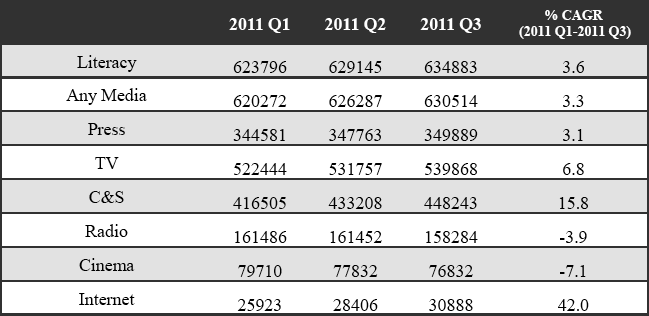
    As per the Indian Readership Survey (IRS) 2011 Q3 data, Cable & Satellite (C&S) and Internet are the two sectors which have shown the maximum growth in total reach. Radio, on the other hand, showed negative growth of 3.9 per cent CAGR with numbers declining from 161.45 million to 158.28 million. Internet, the fastest growing sector, recorded a growth of 42 per cent CAGR with the reach going up from 28.41 million in Q2 to 30.89 million in Q3.

    The total reach of the television media has also gone up by 6.8 per cent CAGR to 539.87 million in Q3 from 531.76 million in Q2 making it the third fastest growing sector.


    The Cable & Satellite (C&S) sector recorded a growth of 15.8 per cent, the only other sector to record double digit growth. C&S total reach is up at 448.24 million in Q3 compared to 433.21 million in Q2 2011. Cinema also recorded negative growth of 7 per cent with reach declining from 77.83 million in Q2 2011 to 76.83 million in Q3.


    All figures are in Average Issue Readership. Like media buyers, MxMIndia only endorses Average Issue Readership as the currency for readership measurement. Please note that these are only topline figures which have officially been supplied to the media. Sensible buying and planning happens when more data is available.


  • MxMIndia Print is coming to town… soon

    Happy to announce the completion of 3 months of MxMIndia. We launched on Onam. September 9, 2011.


    Happy to announce that we are now a 20-member team. Full-timers, near full-timers and active associates.


    Happy to announce that while our focus is on Marketing and the Business of Media, we are strong on content issues ignored by most others: creativity, journalism. Soon: more


    Happy to announce that above all things, our primary allegiance is to our readers. We are governed by a Code of Ethics and each MxMer is a signatory of that


    Happy to announce that we write about those who do not advertise and not necessarily write about those who do


    Happy to announce that we don’t have just text. Our You Tube channel has 75 videos


    Happy to announce that the refreshing feel of MxMIndia.com will soon be seen in print

    2012.Q1


    Want to be part of the great new journey?

    Editorial: Johnson Napier (johnsonn@mxmindia.com); Sales: Alok Kapuria (alokk@mxmindia.com)

    Subscription: Insiyah Rangwala (subscribe@mxmindia.com)

  • INMA 2011: New Oxygen, New Growth

    By Tuhina Anand

    Earl J Wilkinson, Executive Director and CEO, INMA spoke on New Oxygen, New Growth at the INMA-5th South Asia Annual Conference, titled ‘Roots and Wings – strengthening our core business and exploring new opportunities’. During his presentation, Wilkinson spoke about the transformation from being a newspaper to newsmedia which is where the opportunity for growth lies. The key is to identify the platform values of each medium be it newspaper, Smartphones  or tablets and use them accordingly.

    Wilkinson said, “The consumer view of newspaper is changing today as they are accessing news from webs or apps. With the changing view there is also need of new skill sets for the new media including next generation data analysis and deep understanding of consumer behavior among other factors.” He pointed that culture change is the foundation for growth story line.

    He listed three challenges that publishers are facing today- identify growth, how to remain relevant and manage complexity. He also listed the growth levers for news publishers which include operational efficiency, superior competitive strategy, best practices, sales excellence among others but what is relevant is that in this list culture change has moved up the ladder and become a key lever for growth.

    On Culture Change, he underlined the importance of listening to the market, focus relentlessly on differentiators and prioritize expenditure while putting away the rest. Wilkinson said, “Culture change is the only path to growth and in the new ecology to succeed one needs to prioritise platforms and diversify revenue streams.”

    He also talked about integration being the future and pointed how many print people are touching digital but not vice versa. He added, “While culture change is crucial to revenue, there is also a need to speak, understand and invest in readers and not indulge in one way conversation with them.”

    Opening the session and giving an overview, Tariq Ansari, INMA South Asia President and MD, Mid-Day Multimedia Ltd said that the sessions over the two days will look at imparting pointers on ways of strengthening existing business , understanding verticals where investments can be made and at the same time think on new horizons and take their business forward.

    I Venkat, Conference Moderator and Director, Eenadu talked about reinventing the print medium. He mentioned how print has undergone change with segmentation with introduction of city supplements and focusing on its target audience. He also highlighted the example of Filmfare and Femina which have enlarged their purview with awards and beauty competition. The newspapers are leaving no stone unturned to reach its TG by getting into festivals, awards, educations and job fairs too.

    He also talked about localized newspaper where Eenadu has gone beyond city, district, zone to constituency. He concluded by saying that for a newspaper every column is an opportunity. He added, “The print advantage is that while you can zap an ad on television, same is not possible in print.”