
Tag: Pratap Bose

  • Samir Mehta and Pradeep Ramakrishnan to head TracyLocke India

    By A Correspondent


    Pradeep Ramakrishnan
    Pratap Bose
    Samir Mehta

    TracyLocke India, part of the DDB Mudra Group, announced that its operations will be headed by Samir Mehta, Head- Business & Operations and Pradeep Ramakrishnan will be given additional responsibility; apart from being VP, DDB MudraMax, Media he will also be Head – Strategy & Insights, TracyLocke India.


    Pratap Bose, COO, DDB Mudra Group, said: “Tracy LockeIndiawill help build the B2R (Business to Retail) practice for clients and will create strategies for converting consumers into shoppers. With the appointments of Samir Mehta and Pradeep Ramakrishnan, we now have the momentum to aggressively push the TracyLocke India agenda, and build a great shopper marketing and retail capability for our clients.”


    Commenting on this progress, Samir Mehta, Head, Business & Operations, TracyLocke India, said: “Evolution of retail in India calls for a better understanding of how the shoppers shop at the last mile inIndia. This becomes imperative for brands. For this, brands need to develop shopper insights. With TracyLocke, who have a commendable record with working on some of the best global brands, and with the Indian retail environment being unique in its own way, TracyLocke India will be customizing the requisites of each of our clients to suit this market, which currently comprises of 95 per cent being unorganized and the remaining 5 per cent organized.”


    Adding to this Pradeep Ramakrishnan said: “Shopper marketing inIndiais not just about marrying the interests of the brand, retailer and shopper. It is more complex than that. The role of insights in this scenario would therefore be about ‘Bringing a Method to the Madness’. TracyLocke India with its proprietary tool, processes and measurement systems will lead the creation of new ways of understanding, analyzing and influencing the shopper in India.”


    TracyLocke is a creative agency founded in 1913. It is part of the DDB Worldwide Network. with a roster of clients including some of the best brands in the world such as HP, T-Mobile, Starbucks, Johnson & Johnson, Gatorade, Tropicana, PepsiCo, Sony and Unilever’s Lipton.


  • TAM releases mid-week TVRs for SMJ

    By A Correspondent


    Since Sunday last, when Aamir Khan made his debut on the small screen with Satyamev Jayate, there has been much discussion on the show and how it has established a new dimension to  entertainment television. Albeit only on Sunday mornings.


    While the all-India ratings will be out only next Wednesday, those for six metros was released this morning. According to TAM Media, in the All4+ category, the show’s prime telecast got a rating on 4.27 in the six metros for all nine channels. In the C&S4+, overall viewership TVR of the prime telecast was 4.08. In the three Hindi-speaking metros (Mumbai, Delhi and Kolkata), the show got a TVR of 3.79 on Star Plus itself. In the 6 metros (all4+), DD National scored a TVR of 0.43.


    Pratap Bose, COO, DDB Mudra was disappointed by the ratings. “To be frank, I was expecting a higher rating, so I’m surprised at a 3.79 TVR in the three metros. According to me, the show should have gotten at least a rating of 6 across sections. However, I’m optimistic and hope that as the show progresses, it will be able to do well.”


    On the other hand, Ashwini Kamat, GM, MediaCom feels that the ratings are okay since it’s mid-week rating only. “I’m sure the ratings which will come out on the coming Wednesday would be much higher. It would be closer to 4.5 TVR for the three metros.”


    Echoing the view that one must wait for the All-India ratings is Sundeep Nagpal, Director, Stratagem Media. “Given the canvas of the issues raised and the multi-channel simulcast across the country, the six-city numbers are probably not the best way to judge the popularity of the programme,” he said.


  • The Anchor: Pratap Bose list 5 reasons why awards are important

    By Pratap Bose


    1. It goes without saying that awards recognize good work. If an agency fares well at award functions, it is definitely recognized by clients, giving itself an option of fluffing its feathers.

    2. By actively participating in awards, an agency gets an edge over the other agencies in terms of attracting talent. ‘Award Friendly Agencies’ manage to get better talent.

    3. If an agency is a part of an international/worldwide group, it builds credibility for itself around the network. Awards help an agency be known by every client everywhere.

    4. Awards create healthy competition internally within different teams which leads to overall quality work by setting and breaking benchmarks internally.

    5. If an agency manages to win awards not just for creative work but for other departments as well it comes across as a holistic agency.


    Pratap Bose is COO, DDB Mudra Group


  • DDB Mudra announces new ‘A’ team

    By A Correspondent


    Madhukar Kamath, Group CEO and MD DDB Mudra Group announced on February 23 that the restructuring of the Mudra Group is complete, and shared a slew of changes in responsibility of his ‘A’ team, pursuant to the Group’s integration with Omnicom and DDB Worldwide.


    The architecture & identity of the new DDB Mudra Group will be shared with the media at a press meet scheduled on February 28, in the presence of John Zeigler, Chairman & CEO – DDB Asia Pacific, India & Japan. The effective date for the change of identity and the roll-out will be March 1.


    With regard to his senior team, Mr Kamath announced the following:

    Rajiv Sabnis will be President – DDB Mudra Group and will report to him.  He will be responsible for building the DDB Mudra and Mudra brands in Mumbai and the Western Region. He will also be responsible for initiating integration projects and business for DDB MudraMax from the existing clients within DDB Mudra and Mudra.


    Ranji Cherian will be President – DDB Mudra Group and will also report to him. He will be responsible for building the DDB Mudra and Mudra brands in the South. He will be responsible for initiating integration projects and business for DDB MudraMax from the existing clients within DDB Mudra and Mudra in the South.


    Anurag Bansal will be Director Finance, DDB Mudra Group.   He will now function as deputy to the Group CFO, Dilip Upadhyaya.


    Sudarshan Banerjee, apart from his role as Head, Mudra Ahmedabad, will now also be Director – Business Development, DDB Mudra Group and will report to the Group Chief Operating Officer, Pratap Bose.


    After a successful stint in Mudra West, Arijit Ray (currently President – Mudra West) will now work with Mr Kamath on a new assignment in the DDB Mudra Group, possibly in the DDB Asia-Pacific network.


    “With these changes in place and with Mandeep Malhotra (Mandy) driving the Experiential, Retail and OOH Agenda, Aneil Deepak (Andee) leading the planning and creative function in DDB MudraMax as National Head – Ideas, N.P. Sathyamurthy driving the MudraMax media agenda, Venkat Mallik running RAPP and Tribal DDB, Soumitra Sen and his fast expanding DDB Health & Lifestyle practice, Ashish Mishra in Water, and Radha in Maatra, Vandana Das joining us as President – DDB Mudra Group in Delhi in mid March, Sonal Dabral coming on board as the Chairman & Chief Creative Officer, from  March 1, and Pratap working closely with me as the Group COO and  driving the entire New Business Agenda, I look forward to exciting days ahead,”  said Mr Kamath.


    DDB Mudra Group isIndia’s largest integrated marketing communications and services network. Its customized and collaborative approach helps its clients build valuable and enduring brands. The group’s capabilities span Advertising, Media, Digital & Data marketing, Experiential marketing (Promotions, Events, Rural), Trade marketing, Youth marketing, Localization & Pre-Media services and Brand Strategy & Design consultancy.


    With over 1,100 employees and 26 offices, offering direct contact across 1,75,000 villages, 4000 towns, 3500 schools and nearly 7 million students, the DDB Mudra Group was India’s most awarded agency network at Cannes, Spikes and Abbys among others in 2011.


  • Y’day’s Big Story: Print wins with ‘hat ke’ ideas


    Bharat Kapadia

    By Akash Raha


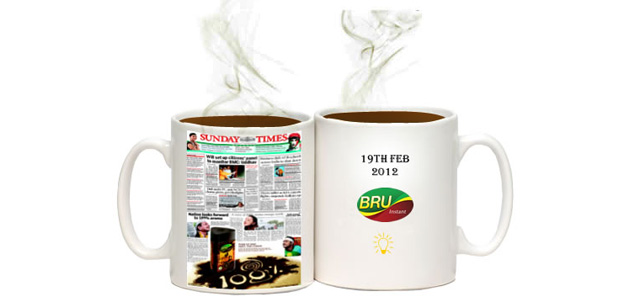
    The readers of The Sunday Times of India of February 19 woke up to a special surprise as they were served coffee with their newspapers. Well, not literally. The Mumbai, New Delhi and Bengaluru editions had a unique dimension – they broke the olfactory barrier. Each copy filled the air with the rich aroma of coffee, spreading the message for Hindustan Unilever’s flagship coffee product, Bru Gold. Veteran mediaperson Bharat Kapadia’s firm, ideas@bharatkapadia.com, unveiled its first big idea for its clients Hindustan Unilever and The Times of India group.


    “The objective was to drive home the richness of fine coffee and I knew that we could conquer this final frontier in a newspaper,” Mr Kapadia said. “The aroma of food products can create a sense of craving and can be very effective way to lead the reader to consume it.”


    In a world where it’s critical to stand out in a crowd, an idea when executed effectively can be a winner and this can be a unique consumer experience with every new fragrance. Mr Kapadia should know. Having spearheaded several ideas with the publications he has led over the years, ideas@bharatkapadia.com is a specialized ideas consulting firm in media and marketing. The fragrant newspaper concept has been tried out earlier editorially by Dainik Bhaskar and possibly some others too, but it’s the first time by a national advertiser across multiple editions.


    What experts feel on innovation

    The Times of India has been in the forefront with innovations. It’s been said and discussed in various forums that the only way the print industry can maintain its vitality is by constantly innovating and thereby evolving. That innovation is a driving factor for success is a no-brainer, yet is our print industry doing enough to innovate and create more value for the advertisers? Earlier, MxM India got in touch with leading advertising practitioners to know more about current trends and innovations that are happening in the industry.
     

    Pratap Bose

    When asked if the print industry is innovating enough of late, Pratap Bose, COO, Mudra Group said, “When it comes to print, there is very little innovation that you see. Whatever innovation you see, once it is done it is repeated time and time over again. Various forms of jackets – half, straight, up, down … Nothing fresh is coming out in print these days. The one category that continues to be beaten down is print. Barring one or two innovations from The Times of India group, which are of course very good, there is not much in terms of innovations that is happening.”


    When asked to compare print with other media, Mr Bose said, “Well, I consider all media as media, whether it is above the line or below the line. But essentially what you are seeing in the innovation space is largely happening in digital, out of home and promotions. To an extent video as well, if you want to include mainline media. Cinema is again, very few… So really, good innovation is not happening on either print or TV.”


    An issue of deliberation also is that whatever little innovation that we see in the market, is it happening in all print forms, across all linguistic barriers alike? Are print innovations happening in both English and language publications alike, or is the innovation limited to top English publications… only those who get top-end advertising moolah?


    Answering the question, Nandini Dias, COO, Lodestar UM said, “Print innovations often needs the publishing house to be able to carry out the difference. The leading publishing houses like the Bennett Coleman or HT Media manage to pull off innovations easily. For example the Cannes Gold that we won for Garnier this year was aided by The Times of India. The Times of India managed to print the day’s issue on recycled paper; for people who understand printing, they will appreciate the sheer thickness of the paper, the kind of paper needed the production team to alter their normal process , experiment and get it right before the 100% recycled paper issue got printed. So innovation happens with publications with a modern sophisticated printing and production unit. It has nothing to do with the language of the publication.”


    Divya Radhakrishnan

    Divya Radhakrishnan, Manging director – Helios Media Pvt Ltd, said, “There are lots of innovations happening in vernacular press as well. In fact groups like Dainik Jagran, Dainik Bhaskar have pioneered many an innovative concepts. The extent of innovation blends into ground activation and other media owned by the same group. A good example of that is Jagran activations.


    But while we talk about all the advertising riches innovation can drive, we cannot help but talk about the content aspect too. Often, innovations in print are condoned because they hamper its readability. Some innovations distracts an diverts the attention of a reader, thereby hampering with the content. However, Ms Dias said that it is not always so. Such a case only happens when an innovation makes reading content difficult. “For example the half gate fold is often disliked by a lot of readers as it makes holding the paper difficult or sometimes fonts in a colour, which make reading tough. Other than that innovations are done to enhance the product values and to bring it alive to the readers.”


    Yet, innovation remains a key factor for the print players for sustenance in the long run. Moreover, the ability to carry off good and meaningful innovation certainly brings more to the table and helps grab the advertisers’ attention.”


    Ms Radhakrishnan said, “Innovations for the sake of innovation is a no-go. The key objective for the innovation is to stand out of clutter and deliver the message appropriately. Given the time-spent on print media being on the decline, it’s very important that the message is delivered in a single-shot and therefore needs to be placed innovatively to grab reader attention. Another often repeated mistake is repeating the same idea often which by definition kills the concept of innovation. For example, jackets.”

     

    Nandini Dias

    Speaking on how important it is for print publications to innovate to be successful, Ms Dias said “It’s important to be able to carry out innovative options. As advertisers often come up with solutions which do not conform, publications which can help communicate their ‘hat ke’ thoughts will benefit.”


    As Steve Jobs once said, “Innovation distinguishes between a leader and a follower.” For print players, it is imperative to constantly dream up winning ideas. So, we are likely to see more ‘hat ke’ and out-of-the-box innovations like the one created for Hindustan Unilever.