GroupM India has announced the promotions of Vinit Karnik and Karthik Nagarajan. Karnik, the Business Head of GroupM’s Entertainment & Sports practice (ESP), will take over the new role of Head – Sports, Esports and Entertainment, GroupM South Asia and Karthik Nagarajan, Chief Content Officer for Wavemaker India, will take on additional responsibility at GroupM in the new role of Head of Branded Content, GroupM India.
Said Prasanth Kumar, CEO of GroupM South Asia said, “Disruption and evolution go hand-in-hand and it also brought in opportunities in the content, sports and entertainment space and it is consistently redefining the market place. Over the years, we have been building these spaces by shaping great solutions for our clients. While we will continue to build on advertising technologies that will add speed and scale, we are equally committed to enhance our creative process and enable larger solutions in the content space. We are fortunate to witness leadership grow within as they bring in experience, adaptivity and inventiveness for being fit for the future. These leadership appointments signify our commitment to the journey and I am confident in both Vinit and Karthik’s abilities and together we look forward to creating great solutions and opportunities for our clients as well as our partners.”
Added Karnik: “The new-age consumers have a better understanding of advertising and this can be seen by their ongoing interactions with brands and readiness for participation. The demand for higher personalization shows that. Data indicates that delivering high-quality personalized content is what sets successful brands apart from their competitors. Today a brand has various means to reach out to its audience be it via sports, social media, eSports, influencers etc. Hence by strengthening our offerings and by bringing together creative optimization and data, we want to ensure that the brands get to reach their consumers with content, which is highly personalized, effective and relevant for them.”
Karthik spent a significant part of his early career in consulting, as a practice head for Frost & Sullivan in the United States. Before joining GroupM in 2011, Karthik set up Nielsen’s online division and was also the India Country Head for NM Incite, the joint venture between Nielsen and McKinsey for social media consulting in India. He set up the social media practice for GroupM India, which also included its foray into advocacy. Karthik also evangelised the data agenda for GroupM by building its social analytics practice, products like Radar and the command centre offering. In 2015, Karthik conceived and launched Brew, which became the premier content up-front event for not just GroupM but the industry as well.
Said Nagarajan: “Content is a cultural intervention for a brand and the need to be authentic has never been more critical. Hence the journey of an idea today is seeped in data-led audience truths as much as it is in creativity. From an era when brands rode the trend waves, we are well and truly in a phase where brands author their sub-cultures. This is what makes it an extraordinary time to be in this industry. I am looking forward to taking on this additional responsibility at GroupM, at a time when the lines between content and commerce are blurring”.
In their new roles, Karthik & Vinit will report to Prasanth Kumar, CEO of GroupM South Asia.
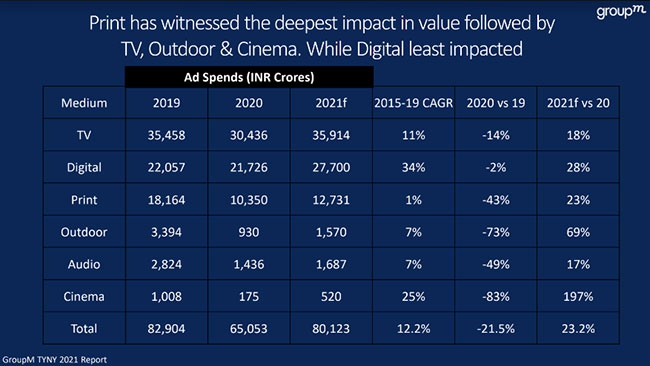
GroupM India has announced its advertising expenditure (AdEx) forecasts for 2021. As per the GroupM futures report ‘This Year, Next Year’ (TYNY) 2021, India will see a major ad recovery in 2021 given the downfall of ad spends in 2020 due to the pandemic.
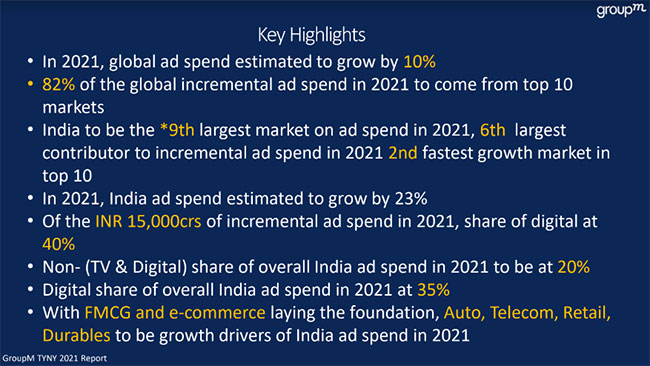
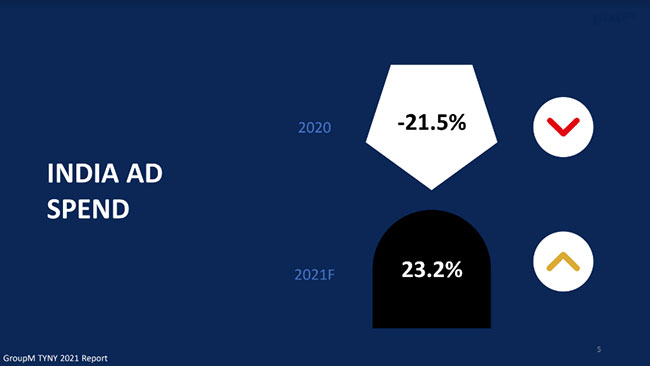
TYNY forecasts India’s advertising investment to reach an estimated Rs. 80,123 crores this year. This represents an estimated growth of 23.2%, for the calendar year 2021. India is the 2nd fastest growing market in the top 10 countries and will be the 6th largest contributor to incremental ad spends in 2021 globally. While India was ranked 9th in the global ad spend rank in 2019, it dropped to 10 in 2020 and is likely to regain its 9th rank this year.
Prasanth Kumar
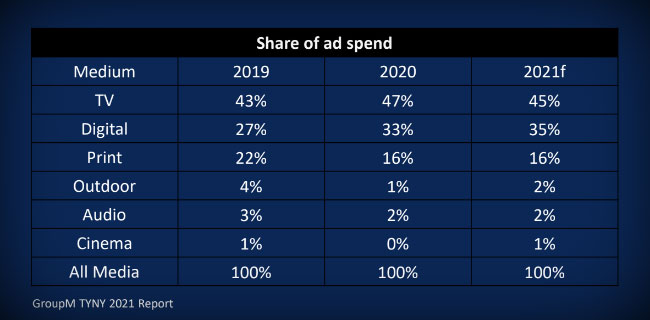
Commenting on the TYNY 2021 report, Prasanth Kumar, CEO – GroupM South Asia said, “2020 was an unprecedented year. The pandemic impacted across sectors and it, therefore, affected the media investments too. As we are aware, the year that went by had a mixture of lockdowns, many restricted market momentum and overall threw a challenge and impacted multi-industry economies. The ad industry too had its challenges and 2020 witnessed a steep drop in the overall media investments. However, we have witnessed a month-on-month upturn in the industry starting Q3 last year and we are quite optimistic about the revival that 2021 will see. With the gradual easement of the lockdown backed by seasonal spends and big-ticket events like IPL, we expect 2021 to continue to build on that momentum. While the global ad spends are estimated to see a rise of 10% in 2021, digital is expected to take 67% of ad spends. With the help of technology, marketers have adapted to pandemic-proof ways by constantly innovating, staying relevant and offering digitally charged solutions to brands.”
Digital was the only medium to witness a gain of USD 27bn globally in 2020. Digital as a media vehicle will continue to skyrocket due to the increase in digital dependency and changing consumer patterns.
Tushar Vyas
Added Tushar Vyas, President – Growth and Transformation, GroupM South Asia: “2021 will see 90% incremental ad spends on digital globally. The massive switch to digital reliance over the past 1 year has been a major driver for this shift. Brands have been forced to think big and different to transform their businesses, match the newer expectations and overcome the challenges faced. The post-pandemic era will continue to see this upsurge in digital demands. The crisis has brought about a sea change in mindset, adoption, and role of technology in doing business. Brands are seen renewing their business models and are constantly ideating to find better ways to connect with the consumer on a digital tangent.”
Ashwin Padmanabhan
While Covid-19 resulted in an overall slowdown in the global economy, Indian adspends will continue to see a month-on-month recovery considering the overall media landscape. Said Ashwin Padmanabhan, President – Partnerships and Trading of GroupM India: “Based on a strong foundation built on the back of FMCG and e-commerce, 2021 is expected to see growth across sectors like auto, telecom, consumer durable, retail and education. Manufacturing, which was severely impacted by the pandemic, is now stabilising and moving toward a positive outlook enabled by automation, technology and supply chain optimisation. 2020 has accelerated the adoption of agile, cost-effective business models, which will help brands and marketers offer better products, services and experiences to consumers.”
Sidharth Parashar
Added Sidharth Parashar, President-Investments and Pricing of GroupM India: “Along with digital, television saw a spike in consumption during the lockdown. With acceptance on the subscription bandwagon increasing, OTT will continue to witness a constructive growth and is likely to develop with more players attracting users by investing in content. Print & Radio expected to be backed by local advertisers and certain categories with marketeers leveraging the brand solutions that these media offer. We expect OOH and cinema to see double-digit growth after a difficult year. Given the uncertainty and cautiously spending consumer, brands are realising the importance of being present wherever consumers are. Hence along with continued relevance of television & other mass media, we will witness advertisers leveraging relevant platforms to reach out to its audience.”
[updated with India Today Group quote & Republic TV statement]
By Pradyuman Maheshwari
Ask present and past TV audience measurement professionals who or what is pulling down the reputation of their business, the response would be an emphatic: news channels.
TAM, a joint venture of Nielsen and Kantar (then owned by WPP and now majority owned by Bain), lost its measurement contracts from broadcasters, advertisers and agencies thanks essentially to news channels warring against it. Premier news network NDTV took TAM to court over allegations of faulty data, and this hastened the effort to set up the joint industry owned body Broadcast Audience Research Council (BARC). Eventually TAM sold its measurement business to BARC.
Like TAM in the past, the BARC team faced turbulent times from the news channels, and in a letter to the BARC chairman Punit Goenka, the News Broadcasters Association (NBA) is said to have expressed its reservations about the BARC leadership of the past.
There are murmurs that BARC CEO Sunil Lulla too has experienced some angst from news channels.
The problem is always with ratings. That some of the channels have deep political connections makes matters worse. So every time there is a peeve, news channels flock to the I&B minister for intervention. In the past, matters have also gone to Parliament and there have been committees set up to examine nuances of the business. And if it’s not the law-makers who assert themselves, it’s regulator Telecom Regulatory Authority of India (TRAI) which intervenes.
Frankly, the government ought not to have role in the business of news television. Except for running its own Doordarshan news channels, its publicity department DAVP which doles out advertising and monitoring objectionable content and addressing the media on issues and make announcements.
But by running to the government often, channel owners have invited the ministers and bureaucracy to step into a territory which they shouldn’t be treading on.
For instance, BARC’s weekly viewership data ensures that advertisers and the agencies make wise media buying decisions. It also helps broadcasters and content-makers better their content, sales and marketing act.
But the ecosystem dominated by broadcasters inflicted on itself the government’s intervention (or interference?) and got BARC to be governed by a set of rules and regulations.
There’s nothing new with what happened on Thursday. It occurred when TAM was around and it’s taken place under the BARC regime. There has been pilferage of information on the placement of set-top boxes, but the machinery is well-oiled to issue alerts when necessary.
That’s what happened when Hansa Research, one of BARC’s vendors on engagement with panel homes, alerted the police about a mess up.
Was Republic named in any written complaint? We don’t know. An FIR shared with MxM has a mention made of the India Today channel. Both Republic and India Today (by way of a report on the site) have presented their points of view.
What we did find last night was various channels shaming Republic TV and founder, editor-in-chief and managing director Arnab Goswami. Newspaper reports today – owned by media companies which also run news channels as well as a few others – have also named Republic and Goswami prominently. The reference to other channels and India Today has been understated or is missing.
So when did it all start? The war of words and ratings began even when Goswami was with Times Now. The channel was doing exceedingly well, on the back of the heated debates that it would air.
But when Goswami quit the Times Network to start Republic, the daggers were pulled out from all directions. All sides are to blame. Times Now had its issues with Goswami for quitting, hiring some ex-staffers and making no bones of the fact that he was taking on his former employer. The others got on to the act the moment Republic shot to #1 in the ratings roster. ‘News without Noise’, became India Today’s credo.
Various attempts were made to isolate Republic, including the rest of the news channels pulling out their watermarks so as to boycott BARC. On its part, Republic too countered the others – and compared its ratings with that of the others. Nothing wrong with it, except that the comparison was accompanied by much bombast. Surefire formula to rile others.
But the war took on a new turn when Goswami launched Republic Bharat. While English news channels are influential and earn fair monies, the real bucks is in Hindi news. Aaj Tak, ABP News, Zee News have been raking in the moolah over the years. While Bharat made its presence felt, it didn’t create much of a dent until the Covid-19 pandemic-led lockdown happened and the Arnab Goswami brand of hyper-aggressive, right of centre journalism took over.
And then came the controversy around actor Sushant Singh Rajput’s death. The line that Republic Bharat took on the controversy ensured it was numero uno. And not just for one week, but for now many weeks.
Advertisement buying decisions are not taken in a hurry, but buoyed by its success, Republic Bharat has hiked its ad rates.
On Thursday evening, the Mumbai police commissioner named Republic TV based on what appear to be unverified complaints and allegations. Later, on its primetime bulletin, Republic TV showed scans of the FIR naming India Today. The joint commissioner of police is reported on the India Today website stating that while India Today was named in the FIR, neither the accused nor the witnesses supported the claim. “On the contrary, the accused and witnesses are specifically mentioning the names of Republic TV…”
The India Today Group issued a statement late on Friday: “There is a malicious campaign on right now by a few vested interests to drag the name of the India Today Group into the TRP scandal that broke out on October 8, 2020,” adding: “We welcome any probe the police may wish to conduct and are fully confident that we will come out unscathed as we have not acted in any inappropriate manner. What we have right now is nothing but malicious, unsubstantiated allegations by a vested party.”
Republic TV has taken on the Maharashtra government and Police Commssioner Param Bir Singh over the last few months in Sushant Singh Rajput case. Meanwhile, Goswami has threatened to sue Singh.
So what next on this? The news channels business in India is a divided house. There is the News Broadcasters Association (NBA) which comprises most of the big players operating nationally and there’s News Broadcasters Federation (NBF) which is spearheaded by Goswami and Republic. Recently TV9 pulled out of the NBA with the association lodging a complaint with BARC saying that the network had used unfair means to forge ahead on the ratings roster. The network is now back as its member.
Singh was quoted on a channel saying that advertisers may also be called for interrogation. So will Amul managing director R S Sodhi have to make the rounds of the commissioner’s office? Perhaps he will be. Will media agency network bosses Prasanth Kumar of GroupM and Shashi Sinha of IPG Mediabrands also be questioned by the cops? If Sodhi is, surely Kumar and Sinha will be called in.
It suits the government perfectly well to have channels warring each other. But if the police summons advertisers and agency bosses for questioning, there could be trouble. Large, pedigreed advertisers would prefer to stay away from the murky world of news television. Channel owners would do well to smoke the piece pipe.
If warring countries and corporates can get together, surely Arnab Goswami and Rajdeep Sardesai can.
Updates:
Media agency bosses Sam Balsara, Shashi Sinha and Prasanth Kumar have been called to the police station for seeking information. So these may not be summons, but a request from the cops is never for a chat about the weather. There are rumours that names of certain advertisers have also been handed over to the police.
The Republic Media Network has issued a press release: https://www.republicworld.com/india-news/general-news/full-news-release-from-republic-media-network.html. “The Republic Media Network has approached the Honourable Supreme Court of India. We have served notices of our legal action to the Maharashtra Government as well. While we will follow the law, we are determined to seek a legal remedy against this atrocious witchhunt,” the release says.
Although Pradyuman Maheshwari is Editor-in-Chief and CEO of MxMIndia, the views here are personal and are not necessarily that of MxMIndia. He can be reached via Twitter at @pmahesh. A version of this has also appeared on The Wire at The ‘TRP Scam’ Could Open the Doors for the Government to Enter the Picture
Anupriya Acharya, CEO – South Asia, Publicis Groupe was elected President of Advertising Agencies Association of India (AAAI) for the year 2020-21 at its Annual General Body Meeting held in Mumbai on Monday. Ashish Bhasin, President of Advertising Agencies Association of India( AAAI), handed over charge to Acharya. Prasanth Kumar, CEO – South Asia, GroupM was unanimously elected Vice-President of the Association.
Other elected members of the Executive Committee in alphabetical order are:
Ashish Bhasin will be the ex-officio member of the AAAI Executive Committee for 2020-21 as its immediate past President.
Said Acharya: “It’s a tremendous honour and also an enormous responsibility to be elected as the President of such a prestigious organisation. I am acutely aware that our industry, like the rest of the world, has just witnessed the most unprecedented times and it’s a difficult time for most. The pandemic has only underscored the relevance of the collective thinking and the heightened role that AAAI can play. I will strive to do my best to further the interests of the advertising industry and take AAAI to greater heights as we emerge into the new normal. Many top advertising professionals have contributed very selflessly and relentlessly to the AAAI, both with and without executive positions. And that is what inspires me immensely as I take on this position. Many thanks to Ashish Bhasin for his leadership in the last two years as President – he has made great progress in making the association more inclusive, diverse and future-ready. Also, thanks to all the Executive committee members and the secretariat for all the learning they have given me in the past many years”.
Added Bhasin: “I have had the privilege to lead AAAI for two years as its president, I wish to thank all my fellow executive committee members for their wholehearted cooperation and valuable support. I would also like to congratulate Anupriya Acharya on her election as President. Anupriya has been a key member of the Indian media and advertising industry for a long time. I’m sure she will play a stellar role in taking forward the Association and its work. I wish her the very best for this role.”
GroupM has announced that Ajay Mehta will Managing Director of Cinema (ITV) and OOH (Kinetic). Prior to this Mehta was MD of ITV. Mehta will also be joining the GroupM India Executive Committee (ExCo).
Speaking on the development, Prasanth Kumar – CEO, GroupM South Asia said: “We are fortunate to be the leaders in both cinema and OOH practices and our goal and vision is to make it stronger and bolder. Our belief in OOH and Cinema related solutions for brands continue to be strong and while we are going through tough times, it is important to prepare as well as strengthen our offering. Ajay in his leadership role will focus on integrating the teams and prioritise focus on larger returns for clients and brands, shaping solutions that would provide an edge for our clients by collaborating with multi avenues like digital, technology and other media opportunities. I am confident his entrepreneurial skills and collaborative nature will help and lead the teams to larger strength.”
Added Mehta: “I am very excited with this opportunity. The coming together of the two businesses is a huge opportunity for us to create new strengths and to be valued partners for our clients by delivering result -oriented solutions for them. I look forward to working with the two teams and to contribute to the growth of the business.”
All the ITV teams along with the Kinetic leadership team will report to Mehta while he will continue to be based out of Gurugram and will report into GroupM CEO Prasanth Kumar.
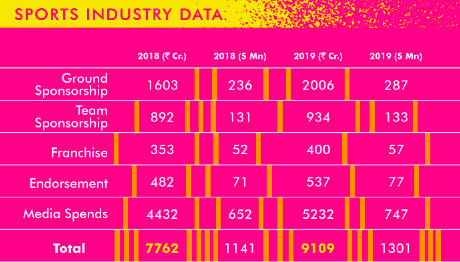
ESP Properties, the entertainment and sports division of GroupM India, released the 2020 report on sports sponsorship in India. Overall growth in sports sponsorship at a healthy 17 per cent where the sports sponsorship Industry crossed the INR 9000 crore mark in 2019.
The 2019 was the year for cricket and dominated the sports advertising sector unanimously. IPL and ICC World Cup gave a push in both, on-ground sponsorship and media spends. On-ground sponsorship grew by 25 per cent, for the first time, crossing INR 2000 crore mark. Overall industry upsurge was INR 1347 crore of which INR 800 crore was contributed by media spends alone growing at 18 per cent.
Said Vinit Karnik – Business Head, ESP Properties: “Indian sports industry is on an upward trajectory breaking new grounds year-on-year. While cricket proved its dominance in 2019, overall the last 5 years the industry has doubled its size. If we look further, we can see a strong CAGR of 12.8 per cent in the business of sports over the last 10 years, making it one of the strong pillars of the Indian economy. With the sports industry growing at 17 per cent in 2019, the momentum on sports with added thrust from the government provides a holistic opportunity for the sector. Initiatives like Khelo India and Fit India movement are drivers towards making India a truly sporting nation.”
Added Prasanth Kumar, CEO of GroupM South Asia: “Over the last decade, we have witnessed the growth of sports leagues and their gaining popularity across the country. The sports industry has been growing and has witnessed a significant upward shift in the overall ad spends. The passion and excitement that’s involved in this platform have only strengthened. We see more and diverse audience indulging with this platform. Many innovations and leverage of assets in this space are powerful opportunities. As we are unfolding another decade, we see this space to be providing powerful thrust for greater brand stories.”
The non-cricketing space was dominated by women athletes. Badminton queen P V Sindhu was the leading non-cricketing athlete in 2019 in terms of brand endorsements. While Sindhu added four brands to her portfolio, the most notable one among them was her tie-up with VISA that made her the first Indian athlete to endorse the financial services brand.
GroupM has announced the India rollout of its influencer marketing solution, Inca. Inca will connect brands to a wide network of publishers and influencers.
Prasanth Kumar
Said Prasanth Kumar, CEO, GroupM South Asia: “Influencer marketing is now a key element of the marketing mix, and brands today need to take advantage of potential associations and collaborations. Inca is the ideal tool to facilitate safe brand engagement across platforms. We are confident that this tool is the most effective method for Indian brands to reach their audiences with the precise impact they demand.”
Ratan Singh Rathore
Added Ratan Singh Rathore, Business Head of Inca India: ”The tastes and behaviours of Indian customers are changing rapidly as they consume content in a multi-platform, multi-device, data-cheap environment. In this fragmented media landscape, marketers are seeking innovative, relevant and brand-safe advertising solutions. The authenticity of influencer marketing makes it stand out as a highly effective brand solution. Inca’s AI driven content discovery technology, provides the quantitative intelligence to select and optimize influencers, predict outcomes and deliver efficient and effective workflow management. Inca helps clients develop user-generated or branded publisher content, which engages consumers and keeps them loyal to brands.”
It appears from GroupM’s This Year Next Year (TYNY) 2020 report that the Indian ad Industry is on a roller coaster ride in spite of the slowdown in certain sectors of the manufacturing industry and hits and misses in agriculture during 2019. Prasanth Kumar, CEO – Group M South Asia expects sustained and stable investment across the media in India in 2020.
GroupM predicted in TYNY 2019 that the World AdEx will grow by 3.67% from 2018 to 2019 and the Indian AdEx will grow by 14%, higher than the CAGR growth of the previous four years. In TYNY released last week, GroupM has estimated that world AdEx grew by 3.7% from 2018 to 2019, but Indian AdEx grew by only 9% against the earlier estimated growth of 14%. However, there was no comment on the drop of growth rate in the press release issued by Group M.
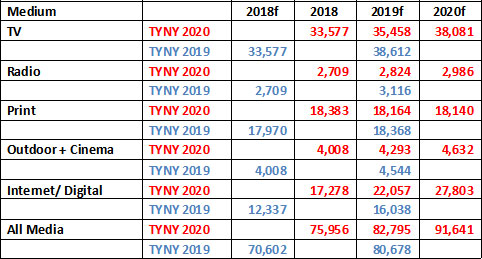
I initially thought that probably the drop in the growth rate of adspend was due to the slowdown in the industry, but a closer look at TYNY2019 and TYNY2020 statistics showed that upward revision of the estimate of the total adspend in India in 2018 led to lowering of the growth rate from 14% to 9%. A comparison of the two reports is shown in the following table.
Indian Adspend (INR crore)
It is interesting to note that the forecast for 2018 for Digital as shown in TYNY2019 was increased by 40% in actual adspends of 2018 shown in TYNY 2020. Estimate for Print was also increased marginally while all other estimates remained the same. These changes in Digital and Print adspends resulted in an overall increase of total ad spend from 70,602 crore to 75,956 crore in 2018. GroupM should have added an explanatory note in their press release to warn the users of TYNY about these changes in their estimates as reflected in TYNY 2019 and TYNY 2020.
As per TYNY 2019, India was 10th largest market in adspends in the world, the 3rd highest contributor to incremental global ad spends and the fastest growing major ad market in the world. In TYNY 2020, India continues to be the 3rd highest contributor to incremental global adspends and the fastest growing major ad market in the world and has come up to 8th position in the list of largest markets by ad spends by beating Canada and Australia. In 2020, adspends in India is predicted to grow by 10.9% against a global growth of 5.1% in adspends.
According to Kumar, Digital would garner 65% of incremental ad spend in India in 2020. Tushar Vyas, President Growth and Transformation – GroupM South Asia further commented: “There are multiple advancements happening in technology which is transforming digital advertising and other mediums. India being a diverse country, digital will keep growing, especially with the rise of content platforms and its availability in multiple languages powered by the growth of 3Vs (video, voice and vernacular)”.
In conclusion, I agree that Digital media has gained its own momentum of growth in India and most advertisers do not want to miss out on the opportunities offered by the new media. Slowdown in certain sectors of manufacturing industry is unlikely to affect the investment in digital advertising in particular which would be the engine of growth in ad spends in India in 2020 as predicted by TYNY 2020.
GroupM formally announced its advertising expenditure (AdEx) forecast for 2020. As per the GroupM futures report ‘This Year, Next Year’ (TYNY) 2020, India will continue to top the list as the fastest-growing major ad market in the world. TYNY forecasts India’s advertising investment to reach an estimated Rs. 91,641 crores this year. This represents an estimated growth of 10.7%, for the calendar year 2020.
India will continue to be the third-highest contributor to the incremental ad spends, only behind UK and USA while China drops to the fourth spot and the eight fastest-growing country with respect to ad spends across the globe.
Commenting on the TYNY 2020 report, Prasanth Kumar, CEO – GroupM South Asia said: “We expect the global AdEx to grow by 5.1%. The Indian media landscape is constantly evolving, will continue to witness the fastest growth of 10.7% to reach Rs 91,641 crores. While we expect sustained and stable investment across media in India, Digital to garner 65% of incremental ad spends in 2020. In 2020, India faces challenges and uncertainties across sectors just like other markets. However, this also brings opportunities for brands to innovate because of which we see an evolving media stack. This will be propelled by greater use of technology and better content across media.”
Digital secures #2 position as the most used media vehicle and is estimated to reach 30% of adspend in 2020 with growth coming from 3Vs (video, voice, vernacular-Indic) and advertising on e-commerce. The growth of digital is set to soar high because of changing consumer habits.
Added Tushar Vyas, President Growth and Transformation – GroupM South Asia: “There are multiple advancements happening in technology which is transforming digital advertising and other mediums. India being a diverse country, digital will keep growing, especially with the rise of content platforms and its availability in multiple languages powered by the growth of 3Vs. From a predominantly ‘at home’, ‘urban’, ‘English print’ & ‘TV’ consuming market, the Indian media consumer evolved to include ‘on the move’, ‘rural’ & ‘regional’ counterparts, experimented with digital media in the early 2010s’, adopted social media in middle of the decade and started consuming digital videos voraciously after 2016.”
Even with an overall slowdown in the global economy Indian media spends are expected to be between low to moderate in H1, with robust growth anticipated in H2 2020.
Said Sidharth Parashar, President – Investments and Pricing of GroupM India: “The format of print storytelling is changing but the content is still the strongest. With print media organizations undergoing transformation across India. Publication houses have invested heavily in promoting digital subscriptions and have started limiting access to digital versions of epapers. We believe that this would pave the way for newer business models. Print will continue to remain relevant to advertisers wanting to build credible brands. Television will continue to grow at a steady pace. This year, the growth rate for TV is estimated to be 7% and Radio is expected to grow at 6%. While cinema and OOH will grow at 15% and 6% respectively in 2020.”
OTT has seen a faster evolution in India, which is now complementing television. OTT hybrid models looking at both advertising and subscription will continue to be an effective model.
Speaking on the trends for the year, Ashwin Padmanabhan, President – Partnerships and Trading of GroupM India said: “While there are challenges and uncertainties in the market, it is a world of abundant opportunities in the content eco-system. This gives us vibrant options to reach and engage with consumers. It necessitates us to be agile, invest in new-age talent and technology while keeping an eye on the future. The key is to be always prepared while we are shaping the media landscape.”
Wavemaker has announced the appointment of Ajay Gupte as Chief Executive Officer for Wavemaker, South Asia. Gupte, who is currently COO of Wavemaker India, takes over from Kartik Sharma who steps down to pursue other opportunities in the industry.
Gupte will continue to be based out of Wavemaker Gurugram and will report into Prasanth Kumar, CEO – GroupM South Asia and Gordon Domlija, President Wavemaker Asia-Pacific and China CEO.
Said Prasanth Kumar, CEO – GroupM South Asia: “I would like to take this opportunity to thank Kartik for his contribution over the years and wish him all the very best.”
Commenting on Gupte’s appointment he added, “At GroupM we always believe in building on the hard work and passion of our people and it gives me great pleasure to see Ajay take over as the new CEO of Wavemaker South Asia. He comes with vast experience working in multiple markets and categories. He is a well-rounded professional, and I see him bring in distinctive and increasing value for our clients and the overall ecosystem. I am confident that he will continue to grow Wavemaker as an agency of the future.”
Added Domlija: “India is a hugely important market for Wavemaker, and we’ve got a very successful team here. I’ve gotten to know Ajay as a strong client and team leader, and I’m convinced he is the right choice to help Wavemaker to future sucesss and, ultimately, to keep looking for better ways to unlock growth for our clients, our agency and our people.”
Said Gupte: “I am humbled and very excited to take over the role of the CEO of Wavemaker South Asia. It is an exciting time for the Indian market as the Indian advertising industry is also having a global impact, and I see lots of opportunities for growth.”
Adspends in India will grow 12.6% in the year 2020, a slight increase from the 12.4% in the year 2019. This was part of the global ‘This Year Next Year’ report released by GroupM at a global level. It may be noted that GroupM presents its India-specific numbers every year in early February, which can hence be expected two months from now.
According to the numbers released, for India, the growth in television will be 11.1%, whereas for radio it will be 8%. The growth forecast numbers for newspapers and magazines are 1% and -10% respectively. While the growth for outdoor and cinema is pegged at 8.1%, that for internet will be 26.3%.
Prasanth Kumar
Said Prasanth Kumar, CEO, GroupM South Asia: In 2020, India faces challenges and uncertainties across sectors, just like other markets. However, this also brings opportunities for brands to innovate. This will be propelled by greater use of technology and better content across media.”
Meanwhile, here’s the rest of the report:
The global economy has weakened in 2019 and will remain similarly soft in 2020. By our calculations, based on Refinitiv data, the gross domestic product (GDP) of the countries we track in “This Year, Next Year” is growing by only +2.6% this year in real (inflation-adjusted) terms.
Growth in 2020 is expected to be similar (+2.5%), with only slightly faster growth (+2.8%) in 2021 and beyond. For reference, +2.5% would be the slowest pace of growth in any non-recession / non-recovery year over the past two decades. In nominal terms (including inflation), 2019 growth for these countries is expected to be +4.9%, down from growth of +5.8% in 2018 and +5.7% in 2017. 2020 looks somewhat similar to 2019, and marginal improvements follow in subsequent years.
Nominal growth rates are important to track because they are the most directly comparable figures to those with which marketers and media owners work in determining their own financial plans.
Personal consumption expenditures are holding up better. One factor that has probably helped sustain marketing growth so far this year is growth in personal consumption expenditures (PCE). As consumer spending represents more than half of all economic activity, PCE can be more important to monitor than GDP. Global growth in nominal PCE is holding up as well in 2019 as it did in 2018 at +5.5% in both years. Growth is expected to slow, but only modestly in the years ahead. Of course, changes in inflation levels diminish these figures, with expectations for real (inflation-adjusted) PCE growth at incrementally slower levels each year over the next five years.
Industrial production often correlates more tightly with advertising growth trends. Industrial production (IP) figures are another key set of metrics to monitor, as IP often correlates better with advertising activity than either GDP or PCE (manufacturers generally only make things for sale if they are planning to spend money on advertising them). Weighted against GDP in the markets captured here, we see pronounced weakness in 2019 and 2020 (+1.2% and +1.5%, respectively) relative to 2017 and 2018 levels (+3.5% and +3.1%, respectively). Recovery toward slightly higher levels is anticipated for 2021 and beyond.
Trade and other factors are key sources of uncertainty. As the Organisation for Economic Co-operation and Development (OECD) has pointed out, slowing global trade is clearly dragging on economic activity, and seemingly heightened geopolitical uncertainties are similarly unhelpful. All of this would worsen if the U.S. experienced a recession, although the U.S. economy has remained resilient, likely aided in part by low interest rates and corporate tax reductions, alongside a federal deficit of nearly $1 trillion during the most recent fiscal year. This was equivalent to more than a quarter of all government expenditures and nearly 5% of the overall economy, or more than double its recent trough in 2015.
Mean and median growth rates may tell different stories. We note the difference between mean and median growth rates, with larger economies expected to perform relatively better than smaller ones in the years ahead.
Global Advertising Growth Summary
In this environment, deceleration in advertising growth should be generally unsurprising. Global advertising, excluding U.S. political advertising (large enough to distort global growth rates by +/-1% each year), expanded by +5.7% in constant currency terms during 2018, capping the third year of better than +5% growth and the best year of the current economic cycle. However, 2019 appears set to grow nearly a percentage point slower at +4.8%, and growth is expected to slow by another percentage point in 2020 and 2021. We forecast +3.9% growth next year and +3.1% growth the following year. Growth is expected to range between +3–4% through 2024. Although much worse than recent years, we note that this would amount to a similar pace of growth to what was observed during 2012–2014. We estimate that the total global advertising market during 2020 will amount to $628 billion as we define advertising here, but would likely approach $700 billion on a broader definition that includes spending on direct mail and directories around the world.
Notably, a substantial share of global advertising is now accounted for by digital-first brands that are endemic to the internet. Based upon their securities filings, we can see that Alibaba, Alphabet, Amazon, Booking.com, eBay, Facebook, IAC, JD.com, Netflix and Uber are each now $1 billion+ advertisers, accounting for $36 billion in spending during 2018, up by a quarter over 2017 levels; growth in 2019 was presumably very similar. Adding a couple dozen companies from the next tier of comparable marketers would easily add tens of billions of dollars of additional activity. Combined, this small group of companies accounts for a majority of the world’s growth in spending on advertising. To the extent that these companies tend to take shares of consumer spending from others and do not directly cause the global economy to expand, at some point their growth converges with global averages, resulting in slowing growth in spending as well.
The median growth rate has exhibited sharper deceleration in 2019 than the mean. For the countries we have tracked with consistent data back to 1999, the median growth rate in 2018 was +5.2%. It is expected that 2019 will be +2.1%, followed by +2.7% growth in 2020, with generally slower growth than the weighted average. The difference between the mean and median highlights that growth is driven by a small number of large countries and that the typical small country is experiencing worse growth trends, bringing down the worldwide average. By contrast, median country growth was typically well above the mean as recently as 2013, reflecting a period where much of global advertising growth was driven by smaller countries. This maps to the aforementioned global economic trends.
The U.S. remains the largest global advertising market, with $246 billion in advertising as we define it here, and growing above global averages. With nearly 40% of the world’s total and a still-robust advertising market in 2020 and beyond (at +4–5% growth excluding directories, direct mail and political advertising), the U.S. is helping raise global averages. Our forecasts anticipate a slowing economy as well as the gradual maturation of the digital brands that have driven so much recent growth. On the basis described here, normalized U.S. advertising should slow from +7.6% in 2019 to +5.0% in 2020, +3.4% in 2021, and similar levels in subsequent years.
China’s $90 billion media market is maturing and beginning to slow, but is still more than two times the size of the number-three market, Japan. After many years of rapid growth, China is now solidly the world’s clear number-two market for advertising, with 16% of total media-owner ad revenue, nearly matching the country’s 17% share of global GDP. However, macroeconomic concerns—including issues referenced above and a general maturation of the Chinese advertising market—are weighing on growth
this year and beyond. We forecast growth of only +3.7% in 2019 and +1.4% in 2020. Similarly, low levels of growth are anticipated in subsequent years despite faster levels of economic expansion for the overall Chinese economy. Japan remains a solid number three, with 7% of global advertising ($41 billion in 2020) and 6% of GDP, but growth is expected to be tepid there as well; +1.7% growth in 2019 is expected to be followed by +1.8% in 2020, and closer to +1% in subsequent years.
The U.K. is still growing at a remarkably fast pace. Among larger advertising economies, the U.K. and the U.S. stand out for their healthy growth expectations. For the U.K., it is a feat made more remarkable given how much uncertainty has persisted over the past three years since the Brexit referendum. Five years ago, the U.K. was essentially tied with Germany as the number-four market for global advertising, but since that time the U.K. has grown by +44% while Germany has only expanded by 7%. The factors driving the U.K. are likely similar to those that have helped make the U.S. a strong market, including a substantial presence of digital brand spending as well as the expanding availability of ad inventory (in digital environments, primarily), which help make it possible for smaller marketers to use media. Although we do expect growth to taper off from the high-single-digit levels we have observed since 2014, solid mid-singles (+6.7% in 2020 and +5.5% in subsequent years) are now expected.
Germany and France are growing at below-global average rates; so is much of the rest of Europe. Brazil should be above average, while India is the world leader among larger media markets. Germany and France have certainly underperformed U.K. and U.S. levels of advertising growth in recent years, but remain in the number-five and number-six positions for now. France appears set to grow at a slightly faster pace than Germany, with a +2.8% five-year compound annual growth rate (CAGR) through 2024 for France versus a +1.6% CAGR for Germany. By 2024, Germany should still be the fifth-largest advertising market, but France will likely be overtaken in importance by both India and Brazil, currently number six and number seven, respectively. Brazil should grow at a solid +4–5% level through 2024 after a soft 2019 (we believe the ad market there grew by only +3.3% in 2019), but India should continue to be stellar, maintaining double-digit growth rates (we estimate +12–13% each year from 2020 to 2024, similar to 2019 levels). Of course, inflation is an issue for both of these countries, negating much of Brazil’s growth. However, in India the effect will only mean that real growth is in high-single digits rather than low doubles.
Canada and Australia are similarly sized markets, but they are growing in different directions. Canada and Australia round out the world’s $10 billion+ ad markets in 2019, with Canada expected to grow slightly faster over the next five years and growth likely largely tied to the health of its southern neighbor. Australia’s trends will likely differ, as we see at the present time with that country’s economy soft and facing a real risk of recession for the first time in decades. The Australian ad market was likely only stable in 2019 versus 2018 and probably grows only slightly in 2020, for a +2.0% gain expected next year. By contrast, Canada is expected to grow +5.0% in 2019, and should slow toward a high 3%+ growth level next year and in subsequent years. Overall around the world, 14 territories are expected to decline during 2019, with Italy the largest among them: We anticipate Italy will fall by -0.4%. Other large markets among this group include Mexico and Switzerland, which are expected to decline by -4.6% and -8.0%, respectively. Next year, fewer markets are expected to decline, with Switzerland the most significant among them
GroupM India, the media investment group of WPP, has announced the appointment of Sidharth Parashar as President – Investments and Pricing, GroupM India and Ashwin Padmanabhan as President – Partnerships and Trading, GroupM India. As part of this elevation, both Parashar and Padmanabhan will join the GroupM Executive Committee.
Said Prasanth Kumar, CEO of GroupM South Asia: “The elevation of both Sidharth and Ashwin is a testament of GroupM’s continued investment in its talent which has helped build a strong leadership pipeline, creating leaders to take our business into the future. In this ever-evolving integrated media ecosystem, we understand the importance of having leaders across key client focus areas like media investments and trading. Both Sidharth and Ashwin are astute leaders and I am confident that they will continue to drive client delight and expand GroupM’s reach across platforms.”
Prasanth Kumar
Both Parashar and Padmanabhan have been leading GroupM’s pricing-investment and partnerships trading practices over the years and they will take over their respective new roles effective this month (November 2019). Parashar has been with GroupM for over 15 years and Padmanabhan joined GroupM from Reliance Broadcast Network where, as the COO he led the network’s Radio and Television business. Both Parashar and Padmanabhan will continue to be based out of the GroupM’s Gurugram office and will report to Prasanth Kumar, CEO GroupM South Asia.





 Anupriya Acharya, CEO – South Asia, Publicis Groupe was elected President of Advertising Agencies Association of India (AAAI) for the year 2020-21 at its Annual General Body Meeting held in Mumbai on Monday. Ashish Bhasin, President of Advertising Agencies Association of India( AAAI), handed over charge to Acharya. Prasanth Kumar, CEO – South Asia, GroupM was unanimously elected Vice-President of the Association.
 Added Bhasin: “I have had the privilege to lead AAAI for two years as its president, I wish to thank all my fellow executive committee members for their wholehearted cooperation and valuable support. I would also like to congratulate Anupriya Acharya on her election as President. Anupriya has been a key member of the Indian media and advertising industry for a long time. I’m sure she will play a stellar role in taking forward the Association and its work. I wish her the very best for this role.”
 GroupM has announced that Ajay Mehta will Managing Director of Cinema (ITV) and OOH (Kinetic). Prior to this Mehta was MD of ITV. Mehta will also be joining the GroupM India Executive Committee (ExCo).
 ESP Properties, the entertainment and sports division of GroupM India, released the 2020 report on sports sponsorship in India. Overall growth in sports sponsorship at a healthy 17 per cent where the sports sponsorship Industry crossed the INR 9000 crore mark in 2019.


 It appears from GroupM’s This Year Next Year (TYNY) 2020 report that the Indian ad Industry is on a roller coaster ride in spite of the slowdown in certain sectors of the manufacturing industry and hits and misses in agriculture during 2019. Prasanth Kumar, CEO – Group M South Asia expects sustained and stable investment across the media in India in 2020.