Tag: PR

  • Amith Prabhu: When will there be a Cannes Lion Grand Prix for PR, by PR and of PR?

    By Amith Prabhu


    This is my customary, annual column focused on the Cannes Lion. I eagerly track and follow the Cannes Lions each year, ever since PR came to be included as a category a few years ago. Ever since, India has been represented on the jury by Prema Sagar in 2009, Veena Gidwani in 2010, Nandita Lakshmanan in 2011, Sunil Gautam in 2012, Dilip Cherian in 2013, Radhika Shapoorjee in 2014 and this year the original name was Ashwani Singla, who was replaced by Paresh Chaudhry. I’m hoping other PR pioneers like Madan Bahal, Bela Rajan, Archana Jain and Ameer Ismail are invited in the years to come. I listed these names for the record as well as for the singular purpose that the organisers know there are many more names to cover. If not, like a global power list that just came out last week, some critical names will get missed out because of limited knowledge about Indian PR that certain international editors possess.


    Finally, the grand prix went to a campaign entered a PR firm. This was MSLGroup New York office. I have high respect for this PR firm because the only time I was a client they were the consultancy on record and in my last consulting role before co-founding the PR school I was closely associated with this firm for most of 2014. Well, I was elated that MSL won it though Leo Burnett, the primary architect of this campaign #LikeAGirl for Always spared no effort to take ample credit for the work which no one has refuted. Interestingly, one of MSL’s senior executive who was on the jury also commented that he was aware of Leo Burnett’s contribution to the campaign. Well, the fact of the matter remains that this was a well-deserved win and the winner takes it all. Last year’s Grand Prix went to Creative Arts for the Chipotle campaign because they entered it and Edelman got credit for it. This year the campaign was entered by MSL and they won it. No dispute there.


    That brings me to the moot question. If the Cannes Lions is an advertising-led festival why is PR even there? It could possibly be because most PR firms are owned by one of the Big Four holding companies that owns most of the Top 20 advertising agencies. In that case there should be two sub-categories within the PR category. One for work created and therefore entered by PR firms and the other for work created and therefore entered by ad agencies. Then the post award bickering will not exist. I’m hoping there comes a time soon when there is no ad agency involved in the Grand Prix winning entry and the entire campaign and award belongs to the PR consultancy itself. Sharing and team work are great but then stealing the thunder is not done, after an award has been given away which is what the ad agency did very well.


    Now comes the real big question as to why not a single campaign from India-based PR firms made it to the shortlist. There were three campaigns that made it to the shortlist of 200 from India and they were from ad agencies which sends a bulk of the entries in this category. I have always being stressing on the high entrance fees of the Cannes Lions. An entry fee and the cost of packaging an entry is close to a monthly retainer that some clients pay. Then, comes the work in question. Do we do cutting edge work that is worthy of international recognition. I think we do but we fail to package it well, as always and miserably fail in sending them because of the cost involved.


    As the Cannes jury was being announced in April, India witnessed a fabulous campaign on Net Neutrality. As the jury was sitting to evaluate the entries, India witnessed one of the finest Public Relations campaigns of all time. The International Yoga Day. I have not seen another first time event getting the kind of talkabaility and free publicity that this event got. Unfortunately, they were not put together by an ad agency or a PR firm and they may never go to Cannes. I’m hoping I am wrong and they feature in the shortlist next year. These are surely Gold and Grand Prix material. Because they were simple ideas translated into magnificient campaigns.


    Well as we get on with another season of awards here’s opening three things change. A) There are more entries from India in the shortlist. That has only happened once. B) The Grand Prix winner is an idea completely planned and executed by a PR firm and the ad agency does not take credit. And C) India gets couple more good and credible awards. Sabre is great but there are no other of good standing where work can get recognized and rewarded.


    On that note I end with three cheers to MSLGROUP. For making history, no matter what their detractors say.


  • Siddhartha Mukherjee: PR = Jugaad + X + Y + Z…; X = Media Planning

    By Siddhartha Mukherjee


    It is not just Algebra. I believe this is a matter of bringing the “X Factor” into the Indian PR Industry.


    Our Public Relations Industry started and has been thriving on Jugaad. This silent army of PR professionals, certainly for the last two decades, has been quietly helping organisations and brands get “Exposure” in the news space across newspapers, magazines, TV channels, websites and social media. Their ‘Jugaad’ as relationship managers with journalists has actually helped many corporate entities enter India, settle well, understand the market and more importantly trigger the interplay of demand and supply.


    There is certainly no denying that Jugaad is a must! The economy and society that we belong to make it mandatory. However, in the last few years, this standalone art of Jugaad has been fortified with a crying need of science of planning and management of Public Relations.


    The good news is that PR is now getting equated with ROIs. ROIs are with reference to targets. Targets, in turn, have to be supported with Media Planning. In short, PR efforts are a waste if constructed without Media Planning. Whosoever’s objective it might be – the CEO’s set of ROIs, the CMO’s set of ROIs, that of HR, CFOs etc. – these can be achieved only when there is a clear plan, brief and media planning support.


    Why is Media Planning needed?

    – The cancer called EAV/AVE continues to kill and decay the industry. With more than two decades in use, this unit of measurement has not, in any way, been able to upgrade the stature of PR Agencies in the Client minds. Neither has it been able to pull funds for the service providers.

    – PR, like any other tool of Brand Communication, goes through the normal process of:

    o Input

    o Output  (ROI- 1)

    §  Exposure of your Brand and messaging in Media

    o Outcome

    §  Engagement of your Brand and messaging (ROI – 2)

    §  Conversion of your Brand within your Target Audience (ROI – 3)


    – CEO, CMOs and other Function Heads want us to speak the above language


    – Clients have started looking at us as Media Advisors and Partners. No Longer as Postmen or Liaison Officers. They want us to speak the language of Media Planning.


    Who should take charge of this?

    I have always believed that agencies are the catalysts to any change within the industry and especially, in a client’s mindset. At least that is what I have seen with the advertising industry and its agencies.


    Here, I must acknowledge that many of the PR agencies that I am in touch with, have already started this implementation. They are walking the talk! Owners, top management and their team members are, slowly though, imbibing the science of media planning.


    Are there symptoms of Change at the Ground Level?

    – PR Agency employees are moving beyond the Chakravyuh of databases like Publication List, Journalist and Editor List, Ad rate List, etc.


    – They are not only incorporating the topics of readership and circulation but also trying to understand how they are calculated.


    – They are trying to avoid the yardstick of EAV/AVEs


    – PR agencies are asking for smarter briefs stating clear and measurable expectations. PR agencies are working out even smarter deliverables in the client service contracts.


    PR agencies and our industry at large need the X factor. The definition of X factor, well, can be many. For the moment, media planning capabilities will add to or modify our industry’s existing personality.


    PR Agencies have the resource, bandwidth and very importantly, the proximity with the clients. Many have started this movement.


    The question is that when will they make it a viral, Industry wide movement?


    Siddhartha Mukherjee is a senior PR industry professional and currently Senior Vice President, Eikona – Earned Media Planning, Audit and Advisory. The views expressed here are his own.


  • Amith Prabhu: Brand Maggi – 20 years to build, 2 minutes to get destroyed!

    By Amith Prabhu


    I complete two years of writing this weekly column. I think this is now easily the longest running weekly column in India on Public Relations. Thank you for reading it and supporting me with feedback. No better way to start the third year of writing than with the focus on the ongoing crisis to have hit one of India’s most loved brands.


    I don’t think there is anyone who grew up in urban or semi urban India, now in their 20s, 30s and 40s and did not savour Maggi in its myriad forms. Maggi was part of every kitchen and has been a leader in the instant noodles category. The last few weeks have been dreadful for this much loved brand.


    Most of the damage has happened because the brand failed to communicate. There has been a ‘Promoted’ tweet that has been floating but nothing much else. And to think of it the real problem began in Barabanki 15 months ago which was resurrected recently.


    I wrote a column in December when Uber faced a crisis and the simple steps apply even to this crisis. What starts as a risk turns into an issue and then emerges as a crisis before becoming a disaster. The type of crisis Maggi is facing has been experienced by leaders in the past – Cadburys with worms and Pepsi and Coke with pesticides.


    The straightforward approach is to Be Alert, Admit the mistake, Apologise genuinely, Act fair, shun Arrogance, Advertise remedies, Accept criticism, Allow questions. Maggi’s silence has been deafening and confusing. Not sure if it is ignorance of crisis management principles, high confidence in the product and therefore arrogance or both.


    But this has hit the brand and the corporate parent very hard. No one ever died because of Maggi. But this episode makes it feel as if Maggi is a silent killer. There are various angles including conspiracy theories that competition may have played a trick or two. All that talk will keep happening until Nestle India takes control of the message and does a few things.


    The CEO needs to put out a two part video. One part where he is having a Maggi meal at home with family and at office with colleagues. The other part where he is talking about the confidence the company has in the product and its safety.


    The company needs to bring out front-page advertisements because the opportunity to enjoy earned media has gone away. These ads should run for a week educating consumers about the action being taken and the goodness of the product. With the kind of market share Maggi enjoyed and the revenues it brought in it would not be a bad idea for the global CEO to fly down and meet the authorities.


    It needs to use social media to interact smartly and there are several recent examples of cases where the brand custodians have defended products vigorously on the online medium. None of this is rocket science and it is surprising that Nestle has not taken the basic steps during a crisis. Maggi is a good example of how a brand takes twenty years to build and just two minutes to get destroyed.


    As I was writing this column over the weekend there was news that Nestle had hired a communications firm to help it in these days of crisis. It may be too little too late. Fortunately, Indians have a weak memory and easily forgive brands. There are groups already planning Maggi meet-ups to show solidarity to the instant nodle they grew up on. Time will tell what becomes of this iconic brand. In the meantime, other FMCG brands may do well in pulling their socks.


  • Siddhartha Mukherjee: Indian standalone PR Firms are fighting back!

    By Siddhartha Mukherjee


    There was a time when the advent of multinational PR firms into India was seen as bullish and a fresh breath of air! Clients became happy expecting “international standards”, “western learnings”, “professionalism”, “customisation”, “strategic inputs instead of tactical, table and chair management services” and so on. Which is why, paying a premium service fee did not receive too much of a resistance.


    As for the employee base, they expected better work environment, training and development, a respectable employee identity and fatter pay package.


    Well, the dust is settling down now. The air is clearing up! The reality on the ground is becoming kind-of visible. Basis the feedback I have received from various corporates and industry captains, who have worked with/for both multinational and Indian PR firms, it seems the desi players are fighting back and setting their own innovative standards.


    An eventual conclusion can also be that, if this trend continues, the core business advantage of deep pockets (allowing wait-and-watch patience), that multinational firms have been known to leverage upon, may not be a potent gamechanger any longer.


    Let us look at what the Indian PR firms are doing to fight this battle:

    a. “Dil Dhadakne Do” Zeal: In one of my previous articles, I had spoken about “It is time for India Principles”. Well, this is an interesting beginning! The very fact that Indian PR Firms have realised that “Zindagi Na Milegi Dobara” so “Dil Dhadakne Do” means a lot towards creating a mark in the global arena! The fact that Indian PR firms have started setting up international offices, getting invited to juries of international advertising and PR award functions is a wonderful pat on our back! The fact that they want to LIVE is by itself a great change! Indian PR Firms are wanting to relive life and set the Dhadkan!


    b. Transition of Management Philosophy: The sole proprietorship or mom-n-pop shop approach is dead! Phew! The core postman job of delivering press release copies from publication door to door is fast becoming a small fraction of PR Agency KRAs. Agency top management is no longer just the founder or owner but an array of thinktanks. They are expected to face, answer, guide and counsel the client top management with strategy and direction. Thinktanks from outside the industry – management consultants, auditors, economists, researchers, statisticians, etc – are being enrolled into the thinktank panels. Indian PR Firms have put on the thinking caps!


    c. Professionalism is taking a U-turn, towards Good: Before we take it otherwise, let me clarify that by professionalism, I simply mean basic hygiene factors like punctuality, quality of language (written and spoken), planning skills, creating client briefs, delivering on the expectations, reviews and appraisals and so on. Well, I am happy to see things changing… for the good. To start with, PR firm client servicing teams are reaching for meetings on time! Second, they come much better prepared. Third, they are well-read and have some perspective beyond just “news coverage”, “publication name”, “edition name” and “journalist name”. They have started talking about brand building – and it makes me excited as I write this) – and they are talking about matching their efforts with outputs and outcome. Indian PR firms are professing professionalism!


    d. Strategy & Customisation outweighing Template Culture: Clients are being treated with unexpected yet welcome pleasantries in the form of getting much more increased amount of customised strategic inputs which typically, at least perception-wise, has been the bastion of the multinational firms. Indian PR firms are setting high levels of innovative and out-of-the-box expectations within a client’s mind on what an ideal PR firm should do and deliver. It is no longer about tactical media relations skills. Clients have started realising that Indian PR firms have the inherent advantage of local ground knowledge. Second, Indian firms are (still) not bound by templates that many of the multinational firms are forced to follow because of diktats from the western headquarters. The Indian firms have had the advantage of fighting heterogeneous market situations for decades where templates were no remedy. This gives Indian PR firm thinktanks immense advantage setting expectations and delivering to them. India teaches you the art of living through instant improvisation! It seems, Indian PR Firms are faster and nimble footed!


    The decision is not final yet. The quarters and semis are being played currently. Who the winner will, probably, get decided in the next few years. Going by the trend, it is for sure that a client’s imagination about an ideal agency is set to undergo a sea change! The tide is taking a turn. Top-of-mind recall levels are drifting back – slowly though – towards Indian PR Firms.


    Siddhartha Mukherjee is a senior PR industry professional and currently Senior Vice President, Eikona – Earned Media Planning, Audit and Advisory. The views expressed here are his own.


  • Amith Prabhu: Why PR is never going to get its due for a long time?

    By Amith Prabhu


    I posted a tweet last week in the backdrop of the Net Neutrality discussion gripping urban India, stating “Good advice to the management by the new PR head. @Flipkart pulls out of Airtel Zero Rating. Now we can go back to shopping on Flipkart.”


    There were two objectives to posting this tweet. First, I was in the know of a new hire Flipkart had made and I knew the person was of a stature who could play the role of a counselor with the Bansal Boys to let better sense prevail. I also had read the news that Flipkart was relenting and supporting Net Neutrality (an issue that had led to lakhs of voices lending support to the issue). And I got to know from two people familiar with what transpired that the person indeed played a key role of advisor in a decision the promoters and investors had taken. Second, I am big believer that PR should get its due and we rarely give credit to this management function because of the crab mentality in the system. Hence, I was just saying what I did based on factual knowledge.


    Seconds after I posted the above tweet, two ‘veteran’ communications professionals who have been connected in the past with the company and the executive respectively, responded to the question. The first asked a question about how I knew that the person advised the management and the second said that I was dabbling in guess work. Well, this background is important for those who missed the twitter conversation. Because the larger points that were being missed was that – the PR function certainly had a role to play, something I was aware of and I was calling it out based on conversations I had with people familiar with the internal decision. In the midst of this, a senior journalist who neither knows who the executive is nor knows the promoters of the company personally decides to throw in his two bits and take the conversation to a different tangent taking away the credit being given to the new PR executive.


    Well, the two ‘veteran’ professionals have every right to say what they want to but in the process they were missing the opportunity to give PR its due. This is a regular feature where we do not go out of the way to participate in giving credit to a function that plays a strategic role in business. Why does this happen? That is a million rupee question. When will PR professionals learn to praise an achievement so that the profession gets the recognition it ought to get? This does not amount to mutual admiration. But peer recognition and there is a difference.


    Well, the same maybe the case with lawyers, advertising folks and management consultants but the PR consulting business is such a small world that everyone seems to know everyone. Yet, we do not see the bigger picture of giving fellow professionals the due. This maybe old school and a new generation of professionals is emerging which may change the outlook to each other. As an observer of the rapid changes taking place around and creating some of them myself, I’m positive that someday PR will get its due.


    I wanted to share this thought in today’s column because the background to all this is that in the past couple of weeks we have seen one of the biggest Public Relations campaigns which may never be referred to as a PR campaign. This is a campaign planned, executed and managed by ordinary citizens like you and me. The campaign has led to several business decisions of large corporates being impacted. It may not be like the Arab Rising event but has certainly had all the ingredients of a good campaign. People have put a lot at stake to take on large corporates in the fight for Net Neutrality. The battle is ongoing and on the look of it Public Relations is winning. But it will be referred to as citizen activism. Same thing by a different name.


  • Amith Prabhu: Has Public Relations lost its credibility?

    By Amith Prabhu


    This week, in Mumbai I’m co-hosting the first gathering of senior communicators. The half-day conclave hopes to become an annual feature by bringing together business leaders who share their thoughts on reputation management. Public Relations over the years has been referred to by different folks with different strokes.


    Some call it Public Engagement, some say it’s Public Communications, some call it Corporate Affairs or Corporate Communications, some others refer to it as Reputation Management or Strategic Communications. There are many other nomenclatures associated with the profession. But Public Relations, many think is no more as sexy as it used to be.


    In a recent twitter conversation on a different tangent, the consulting editor of Money Life (Veeresh Malik) raised a question that Public Relations in India had lost its credibility. [His response was – if PR was about real content told with style then why did it lose credibility?}. There were four others including me tagged to this thread. One of them (Prema Sagar) responded with a question – “Did it? And Malik responded saying Yes.


    My answer would be clearly NO. Public relations has not lost credibility. Just as a botched up surgery does not let surgeons lose their credibility. Public relations professionals who work with consultancies and in communications departments largely try and work within an ethical code that is unwritten but understood.


    There are certain stakeholders and certain professionals in Public Relations who will cross the line that leads to an incorrect perception. Public Relations has certainly failed in building its own reputation but that is less a problem of the profession and more a problem of competitors not coming together. The mediocre has always been given an upper hand because few think of the long term, rather focusing on the short term.


    I’m hoping the conclave aptly called ENGAGE gets professionals to engage with each other during and after the conclave to arrive at an outlook for the profession for the year ahead and the time to come. I hope senior folks both, who lead communications departments and lead PR firms evolve a system to make things better so people like Veeresh won’t live with a wrong perception that PR in India has lost its credibility.


    Maybe we need to start early and it’s never too late. We need to train professionals’ right. We need to accredit new and existing professionals. We need to get senior folks to talk more often and do a service to the profession. Because if we do not focus on the publics and the relationships around the eco-system of Public Relations we would only be leaving a messed up reputation of the profession for future generations.


  • Amith Prabhu: Time for more meaningful Engagement with the most important stakeholders

    By Amith Prabhu


    Without doubt the customers are the most important stakeholders of an organisation. But more often than not we forget our immediate customers who are internal and only focus on the end user. In communications consulting and inhouse communications management, the CEO for the corporate brand and the CMO for the product brand are invariably the key stakeholders – they are the primary customers of the counsel we offer.


    While inhouse leads and teams interact with the CEO or CMO, whichever the case maybe. And the consulting firm engages with the CEO and CMO either during a media training, or a media conference or a review meeting, we miss out on cross-learnings that a variety of this business leaders can offer to us collectively in the form of a forum of learning and exchange. A conclave style approach that outlines a futuristic outlook for the profession in the short term is missing.


    While events like Praxis are great ways to celebrate the profession and they attract professionals of all levels there is a need for another gathering that is introspective in nature. Wherein the real customer of the communications service spells out his or her experiences and expectations from counsel and support. This could also lead to the fraternity getting a general outlook for the year ahead, if held annually.


    The CXOs need to understand in an increased manner how Reputation Management which is called by different names is a management function and not just another vendor service, just because purchase departments get involved in procurement. An integration of ideas and an assimilation of thought process is definitely a need of the hour for mutual benefits. Where the corporate or brand leadership derives more out of the communications function and communications professionals – both inhouse and in consultancies benefit from the knowledge of the experienced leaders.


    That being said a possibility of organising a day-long annual conclave is on the anvil and may see the light of day before the next financial year begins. To make it easier to pull off, both in terms of budgets and logistics the plan is to host this in one of the three main metros. The format will be straightforward where a group of CEOs, followed by a group of CMOs and then a group of Chief Communications Officers share perspectives either through a panel discussion or through a short presentation.


    The audience will only be senior professionals from inhouse departments and consultancies. The rest of the fraternity can track the conclave through a webcast. The outcome will not only be great insights but also a white paper that guides investments in terms of training, hiring and planning for the year ahead.


    So here’s to another gathering that will help do PR for PR. The profession is getting its due. But it needs to happen in smarter and quicker ways.


  • Amith Prabhu: 15 people to watch out for in 2015

    By Amith Prabhu


    This should have ideally been the first column of the year but it is able to make it in the first month of the year, nevertheless. This is in my humble opinion the list of 15 people in consultancies and in-house in organisations to watch out for in 2015. Most of them donned new hats in the last 12 weeks and are in interesting profiles within their organisations.


    Valerie Pinto – One of India’s few employed female head honchos. By that I mean, most other women at the helm of large firms are founders (Prema, Nandita, Archana). But what makes Valerie stand out is that hers was one of the biggest movements in 2014 when she exited Perfect relations after a very long stint to join Weber Shandwick.


    Amit Misra and Chetan Mahajan – These two low profile gentlemen were in the limelight after the exit of Jaideep Shergill as they were appointed to co-lead the Publicis Groupe’s flagship PR firms in India. It will be interesting to see how Chetan and Amit take MSLGroup to the next level.


    Dilip Cherian and Bobby Kewalramani – Both these pioneers made news throughout 2014 for a proposed sale of Perfect Relations, a company they founded two decades ago from the house of a member of Parliament. One won’t be surprised if they sell out this year.


    Rakesh Thukral – Rakesh was appointed Edelman India’s first Indian CEO in October and continues to build on the legacy that Robert Holdheim leaves behind. 2015 will be interesting for this company in India which is the world’s leading firm in revenues as it consolidates some great wins and deals with the absence of two pillars of the Mumbai office – the late Allwyn Fernandes and Roger Darashah.


    Madan Bahal – Madan’s is a rags to riches story that very few know of. His 17 year old company is India’s number one firm in revenues. One needs to watch closely if Madan will be the first Indian PR firm that will make inorganic inroads into the Americas this year.


    Nikhil Dey – Having spent a decade at Genesis Burson Marsteller, it will be interesting to see how Nikhil under the guidance of Prema Sagar takes the WPP flagship firm to greater heights in the year ahead.


    Manish Kalghatgi – Manish is establishing himself as the aviation communications specialist. After stints at GVK managed Mumbai airport and GMR led Delhi Airport Manish moved to Jet Airways to lead its communications function. With Etihad infusing new lease of life into India’s iconic private airline one needs to see how they handle reputational issues in the months ahead.


    Chhavi Leekha – After a fair amount of time spent in traditional companies Chhavi began the new year by joining Uber Technologies to be the first Director of Communications to this start-up which is in great need of strategic communications support.


    Rohan Vyawaharkar – Rohan became Twitter India’s first head of corporate communications when he moved on from Red Bull late last year. How Rohan, a former journalist brings his learnings to this social networking company will be watched closely.


    Neha Mohanty – Neha will have a daunting task to build a stronger reputation for Air Asia after one of its aircrafts in another market crashed in the Java Sea in the last week of December. Instilling traveler confidence and positioning airline safety will be top on every airline’s agenda, especially those that have faced recent disasters.


    Paroma Roy Chowdhury – As Head of Communications at Google India, Paroma has one of the most challenging and interesting jobs. How Google continues to build on its strengths and conveys that will be important as it expands and grows through numerous ways.


    Sukanya Ghosh – This will be the first full year for the new CEO of Infosys. Handling global communications of the IT giant will be a herculean task after various phases it has gone through during the leadership changes. Sukanya is the only Bangalore based professional to feature in this list.


    Girish Huria – Girish made an exciting transition from Delhi to Mumbai late last year. A transition from Avian Media to eBay India to head the e-commerce portals India communications remit. In an age where Amazon and Flipkart are the flavor of the season positioning and promoting eBay will not be easy but Girish could be the right person for the job.


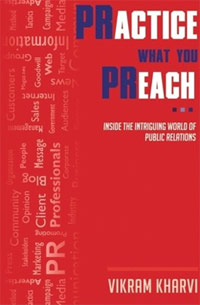
  • Amith Prabhu: A book to remember because the PRactice of PR in India has so few

    By Amith Prabhu


    Fellow public reputation management practitioner Vikram Kharvi has self-published his first book which is commendable. If I ran a reputation management school, I would prescribe it as a text book. The book is indeed a labour of love for the profession that the author displays by the loads.


    The book is a collection of twenty essays and each one ends with an interesting quote by a prominent author or thinker. Aptly titled PRactice what you PReach, the book is a peek into the intriguing world of public relations by a young professional who has worked both in-house and in a consultancy.


    It is a great read for professionals of all ages, from the student to the CEO of a PR firm, from an intern at a corporate communications department to the one heading it. There is something for everyone. The inaugural chapter on comparing our profession to the various facets of Lord Ganesha is very innovative.


    The book acts as a ready reckoner of tips and tricks for the profession. I like the fact that Vikram refers to PR companies as consultancies and not as agencies, which they are not. I also like the focus on PR as a practice rather than a mere profession. A practice makes it both an art and a science.


    The book shows that PR professionals can be creative if they apply their mind to being so. The 20 chapters are in an easy to ride format of seven to eight pages each on an average. I read the book in one go two consecutive flights and would recommend this to every professional as a must read.


    The book could have done with some more focus on editing to make it crisper but as a debut it is worthy of praise nevertheless.  Hats off to Vikram on this effort. May there be more books authored by you.


    The 160-page book is priced at Rs 300 and is available online at a discount. I wish more professionals attempt to write a book. After having compiled my columns into one earlier this year I don’t think it is a hard task. Go write yours!


  • Amith Prabhu: What to do when hit by a Reputation Crisis

    By Amith Prabhu


    There are at least 100 rapes taking place in a nation of 1.3 billion people every day. That is four an hour or one every 15 minutes. It is more like an epidemic and there seems to be no cure in sight. When a corporate oragnisation is involved or when a political organisation chooses to get involved in a big way, one out of 10000 rapes (that is once a quarter) gains national prominence. We saw this during the HP employee’s case in 2005 in Bengaluru and we saw it during the Nirbhaya incident in 2012 in Delhi.


    This week there has been outrage against Uber because the aggregator company did not do a police verification of drivers on its rolls and one of them from among 3000 was a rotten egg. He picked up a passenger and on the way to the destination raped her. What happened after that has really brought the company to its knees. A reputational crisis is not easy to deal with but it is possible to do the right things. A crisis is the final stage when a risk becomes an issue and then the issue becomes a crisis. Most organisations in India including international organisations operating in India do not invest in a playbook for RIC (risk, issue, crisis) management.


    While the flow is not rocket science the important part is in the activation. Here’s an eight-step guide to dealing with a crisis with maturity.


    Be Alert, Admit mistake, Apologise genuinely, Act fair, shun Arrogance, Advertise remedies, Accept criticism, Allow questions.


    Let me explain each of these:

    Be Alert: This involves a lot of listening and customer relationship management. This crisis could have been averted if Uber had taken the complaint from another customer a week earlier regarding the same criminal driver.


    Admit Mistake: As soon as the crisis got full blown the company should have admitted to its mistake rather than sharing a random statement which was full of legal language.


    Apologise genuinely: The apology that Uber gave did not seem like it cared. It was neither properly drafted nor well intentioned. Mentioning financial help in a statement of apology is never a good idea.


    Act fair: This is about not taking sides and calling a spade a spade. While Uber immediately delisted the driver they should have withdrawn the service till they could promise a deadline by which they would offer verified drivers. But before they could delay, the government decided to ban them.


    Shun Arrogance: The company has been in the news for wrong reasons internationally for the last few weeks and it has projected an image of being arrogant. Just the way Richard Branson rushed to the site of the crash of Virgin Galactic, the Uber CEO should have rushed to India


    Advertise Remedies: As a company with deep pockets the company should have released front page ads within 48 hours of the incident reassuring its customers about the steps it is taking to ensure safety.


    Accept criticism: There has been severe criticism but not a word to assuage feelings that have been hurt. This could have happened to anyone.


    Allow questions: Uber should have scheduled a press conference to address queries and answer doubts in people’s minds. But it has lost an opportunity unless it plans to do one soon.


    These steps can be applied to any crisis. But behind all this there needs to be a robust communication plan and flow. Hope other companies learn from this incident to deal with eventualities that are unexpected but possible.


  • Amith Prabhu: How about a dedicated school for Reputation Management?

    By Amith Prabhu


    There is a school for every subject, almost but for a subject that can be helpful for every sector there is none. We have a school for fisheries, for petroleum, for design, for architecture, for journalism, for ‘you name it’ and you will find it. But there is no school for reputation management – one of the few subjects that is both a science and an art.


    We keep hearing about the talent problem in every profession. Public Relations and Reputation Management – both inhouse and in consultancies do not have a talent problem but a problem of attracting and retaining good talent. If PR companies advise clients on employee engagement tactics and potential employee outreach programme why is it that PR companies are always struggling to find good people?


    I have said this in the past and the problem is about a vicious cycle. The only solution is to have a no=frills dedicated school that is affordable and teaches a small group of students the art and science of reputation management in the cost effective way. It is surprising that there is no school for the field.


    I’m not discounting the fact that there are communication institutes that offer a specialization but the good ones charge unrealistic fees and the not-so-good ones produce not-so-good talent. There needs to be a conscious effort of bridging this gap. PR firms and corporate communications professionals need to come together to jointly find a solution.


    The programme that is created needs to be world-class. The institute should have an offering that has to be rigorous yet smart in its methodology of teaching. Students need to do two out of the box internships and can choose to work in either a media house, a political party, a not-for-profit or a restaurant to learn the various facets of those organisations that come in handy in the world of reputation consulting. Taking up consulting projects during the programme is another important element that should not get missed out.


    Finding talent is never going to be hard because these days a lot of people without the right aptitude, attitude and qualification get into the profession and quickly realize the folly. But finding the right talent that makes an impact will always be hard unless they are caught young, moulded and inspired to approach the profession in a way that is rarely done.


    I’m sure people will come together to make this a possibility before it is too late. I’m already putting a blue print together to create one. I’m scouting for the right mentors, investors, partners to bring this alive. I’m sure well-intentioned veterans of the profession will put their best foot forward to make this happen.


    Amith Prabhu is a Public Reputation Management professional who focuses on communications for national politicians. In his free time, he plans and executes Praxis – the annual weekend summit for fellow professionals. He can be reached at @amithpr on Twitter


  • Amith Prabhu: Hiring journalists without training them is unfair to the profession and unjust to the individual

    By Amith Prabhu


    PR firms have always had journalists as part of their hiring plan. However, PR firms have not crafted training programmes to convert journalists to become advisors. I spoke to a handful of PR professionals who were former journalists and they work in about five different firms. They all confirmed that they were asked to swim in the deep from the word go and learn on the job.


    This is not just unfair to the individual but a disservice to the profession. Journalists need to unlearn being reporters and editors and fit into the shoes of planners and executors. A consulting job is very different from a journalism job. Firms need to realise that and create specific onboarding programmes for these precious hires. Journalists cannot merely be used as the golden goose who come with those media contacts and the mindset to create content. A PR job is much more than that.


    I believe every PR professional should have had a stint as a journalist. If I ever open a school for Public Reputation Management I would ensure all trainees do a compulsory stint of one month at a media outlet interning as a journalist. I would also think the reverse will hold good. To get students of journalism intern in a PR firm to understand what goes on in the life of a PR professional.


    Well, getting back to the focus of this post I wish associations of PR consulting companies create a programme for journalists who switch jobs to get into the public relations business. It should ideally be a two-week workshop that covers understanding campaign planning, the key elements of consulting and the role of an advisor besides learning the basics of reputation management in theory including making plans, evaluating campaigns and the like.


    If some firms already have such programme in place, hats off to them but as far as I know a specific programme does not exist. As firms expand and hire more journalists to be in consulting an content creation jobs with client servicing as part being mainstay it will be imperative to teach the new professionals how to swim before pushing them into the deep end. If not, our profession will remain mediocre. This is not because the new professionals are no good. In fact they are generally very bright but an investment in giving them a solid foundation is not an option but should be mandatory