
Tag: P&G

  • APPIES 2012: 100 best marketing campaigns to be presented LIVE

    By A Correspondent


    Fierce competition is expected at APPIES 2012 where 100 of the top marketing campaigns from 16 countries in Asia Pacific will vie for 10 Gold Medals. An annual two-day festival of the best marketing ideas, APPIES brings together the brightest minds in the industry from across 16 countries to celebrate excellence, network and exchange knowledge. Now in its third year, APPIES 2012 brings the audience up close and personal with some of the most compelling campaigns through its unique live presentation format.


    APPIES 2012 enables brand marketers/campaign creators to demonstrate their stellar ‘Show, Share and Sell’ skills, thanks to the unique ‘4-6-10’ format. Each presentation will begin with a 4-minute showreel video summarising the entire campaign, followed by a live 6-minute exposition of the campaign’s key highlights by the brand’s marketers/ campaign creators. Then comes the interactive 10-minute session where each campaign will be cross-examined by the judges and audience members.


    Building on last year’s list of campaigns by companies and brands such as P&G, Nestle, Pepsi, McDonald’s, Fonterra, Singapore Tourism Board, Bacardi, Adidas and Vodafone, APPIES 2012 will continue to showcase the best campaigns from various industries that span across highly-diverse markets in Asia Pacific region.


    The 100 selected marketing campaigns will cover a broad range of six product/service categories that include Consumer Durables, Consumer Services, Food & Beverage, Non-Food FMCG, Business Services and Government, Cultural, Social & Environmental campaigns.


    APPIES 2012 will also host special keynote sessions and panel discussions on The Future of Industry. Marit Kievit, Global Brand Director (Lux) at Unilever and Chris ter Steege, Director (Digital Integration), Integrated Marketing & Communications at Philips Asia Pacific have been announced as keynote speakers at APPIES 2012. With advisory and assessor panels comprising top marketers in the region, APPIES 2012 is designed to offer excellent networking and knowledge sharing opportunities for industry professionals.


    Marit Kievit is the Global Brand Director for Lux (Unilever). The multi-cultural team led by Marit has developed breakthrough and award-winning integrated campaigns. She was also a permanent member of Axe’s global brand team, setting the global innovation agenda for one of Unilever’s most successful brands. Most recently Marit joined the global leadership team for Lux as a global brand director, based out of Singapore.


    Chris Ter Steege is a communication professional with an obsession for innovation and creativity in marketing, brand communication, digital and social media, and leading the creation of impactful experiences through integrated communication strategies and tactics. With 10 years experience, Global to Local, B2B and B2C, at Philips, Chris now leads regional cross-sector digital programs in Asia Pacific, co-leads the region brand campaign, works with sector marketers to deliver award-winning campaigns, and manages the digital team in one of the most diverse and fastest growing regions in the world.


    Leanne Cutts is Vice President, Marketing for Kraft Foods Asia Pacific Region, based in Singapore. She is responsible for driving the growth of the gum, candy, and powdered beverages categories as well as leading consumer insights & analytics and driving marketing excellence in the region.


    The Institute of Advertising Singapore (IAS) was founded in 1990 with the aim to position Singapore as an internationally recognised “centre of excellence” with world class advertising professionals, international best practices and industry leading creative output. The IAS has several highly successful business platforms for the advertising and marketing communities to meet, collaborate and raise the standards of the industry as well as encourage continuous education. The IAS has also organised the Singapore International Advertising Congress since 1998.
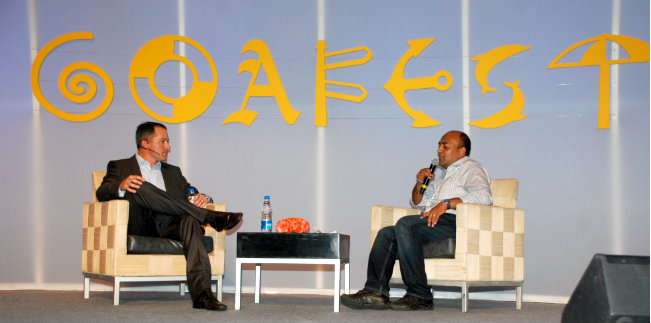
     

  • Day 1 @ the Dome: ‘Innovation is the magic of Ideas’


    By A Correspondent


    Goafest 2012 kicked off with the lighting of the lamp by the industry dignitaries, Mr Arvind Sharma, Chairman Goafest 2012; Mr Nagesh Alai, President, AAAI; Mr Shashi Sinha and Mr Ambi Parmeswaran, ED and CEO, Mumbai Draftfcb Ulka Advertising. Mr Sharma said that he was thrilled as Goafest 2012 over 3,000 participants, including representatives from Sri Lanka and Bangladesh.


    Mr Parmeswaran said that he was ecstatic about the event this year as there was a restructuring of knowledge sessions. Mr Sinha observed that with more metals and more categories at the awards than last year, more participants, representatives from foreign countries, exciting prices for the audience, Goafest 2012 is aiming to give participants an experience with qualitative improvement every year. And unlike previous years, presentations by speakers were followed by the Q&A sessions moderated by industry veterans.


    The first session, ‘Magical Ideas Come when You Harness the Power of Many People’, commenced with a flash mob from YouTube, taking everyone by surprise and perhaps sending a message that it was one way of using consumers to building your brand.


    Mr Lucas Watson, Global Vice President, YouTube spoke about how passionate consumers can help one build brands and how online videos can help even startups spread awareness and the reach needed in a very cost effective and efficient way. “Just get started online, you don’t have to be a big brand, all you have to do is gain trust among your consumers and you will be surprised how passionate people are to participate in the brands they love. The magic of YouTube is available for all to see, as it allows everyone to participate and that too in a cost efficient manner.”


    The first session was moderated by Mr N Rajaram of Airtel. When asked about the scope of co-existence between television and online videos, Mr Watson said: “Like many industries, we too are going through a transformation. There are brands which are afraid to disrupt their current mode of functioning and there are brands who want to try new and better ways of reaching out to their consumers. So I believe there will be some co-existence, nevertheless there will be winners and losers as well.”


    Gerson da Cunha, stage and film actor, social worker and author dedicated Ad Katha, a book that tracks the history of Indian advertising to the late Bal Mundkur, founder of Ulka. Mr da Cunha gave the audience a glimpse of the Indian advertising right since it started through the present day advertising. He also pointed out that advertising bloomed in India from print media and that in 1991 it even opened doors to the global economy.


    Mr Jonathan Mildenhall, Vice President, Global Advertising Strategy and Content Excellence, Coca-Cola spoke on the use of creativity and content and how Coca-Cola moved from creative excellence to content excellence. He also explained that there is a need to encourage consumers to express their stories and how a brand must move to dynamic storytelling. “A brands story must show that it’s committed to make world a better place. There is a need to converse and not just listen to our consumers but to create inspiration and provocation.”


    In the session moderated by Sanjay Behl, CEO, Reliance Digital, when asked about a marketer’s role in the future and the consequences of negative conversation on a brand, Mr Mildenhall said: “Brands have to be a lot more transparent, if you inspire good conversation, it manages itself and I believe good eventually wins over evil. Brands, therefore, need to rethink the creative story they are telling their consumers. A 30 second media spot is valuable and it should be a gateway for brands to reach higher grounds.”


    Mr Tim Love, CEO, APIMA and Vice Chairman, Omnicom Group spoke about ‘The Magic of Ideas- Our Language Impediment’. He was of the view that innovation is the magic of ideas and that language is a technology. Mr Love also pointed out that as internet penetrates further in India, language communication will be going to new heights.


    The session (all of them held at what’s called the ‘Dome’) on Language Impediment was moderated by Kainaz Guzdar of P&G. When asked for his suggestions on how marketers and advertisers can come up with great ideas on language impediments, Mr Love said that they will have to be more cognizant in language and respect the sensitivity of various people. He also said that ideas are best when communication is from one individual to another.


    Mr Charles Wright, MD of Wolff Olins shared his insights about how consultancies are equally important to creating and building brands. He spoke about how by combining rigour with magic, one can solve complex business problems and how a Wolff Olins experience of branding may be completely different from an advertising agency’s experience despite working on the same product or brand. “In order to build brands that succeed, it is important that one understands what is important to the customers. We are all living in a world of perception but branding is all about changing the way people behave, and simply making promises is not important but, delivering on those promises is far more important.” He added: “Design, as a language, can help change people from hating a particular brand to making them like the brand and then probably even love that brand.”

    Click here to view all Goafest 2012 stories


  • Swad of Success: Regional FMCG firms like Panjon, Bisk Farm, Mapro, raising funds to expand operations

    By Sagar Malviya


    After a gap of almost four years, TV commercial of the once popular Swad digestive candy hit the screens early this month. Swad, which is making a come back, is one of the brands owned by 48-year old Panjon, an Indore-based firm that sells candies to balm and toothpaste endorsed by Shammi Kapoor and Sonali Bendre in its glory days. The plan is to reach out to more states, expand product portfolio and grow sales ten-fold in two years.


    Panjon isn’t alone. Almost half a dozen smaller regional firms such as Bisk Farm, Mapro, Wagh Bakri and V-John, among others, are entering newer states, some advertising for the first time, while others planning to raise funds to survive a fresh salvo by large consumer goods companies that expanded into the turf of smaller rivals last year.


    “While our products are doing well in MP and UP, competition is also getting intense in these home markets,” admitted Atul Kothari, managing director at Panjon, which is in talks with a clutch of private investors to raise funds for expansion. “We are looking to enter Gujarat, Punjab, Haryana and Bihar this year,” he said. The company plans to add more than 1,400 distributors to its existing network of 600.


    So what exactly was the trigger? Well, for one, large FMCG firms have been aggressively reaching out to rural consumers through expanded distribution, which led to smaller regional players losing market share across segments in their core markets.


    Over the past couple of years, P&G has almost doubled its distribution reach and now has a direct reach of 1.3 million outlets, against HUL’s direct reach of 1.60 million outlets. Emami expanded reach by as much as 30 per cent primarily in rural areas, while HUL added more than 50,000 villages to its network just last year. Ditto, in the case of Dabur, which rolled out special rural focused sales initiatives across eight key states and widened reach in 71 high potential districts.


    However, the regional players are now plotting a counter attack, not just in their existing markets but also in newer states. The Rs 500-crore SAJ Food Products that dominatesEastern Indiawith its biscuit Bisk Farm is a case in point.


    “Last year, we entered Karnataka and are planning to reach Andhra Pradesh next month. We aim to have a national footprint by 2013,” saidVijay Singh,MDof Kolkata-based SAJ Food Products. He added that the firm has even discussed internally about coming with a public issue in the next two years.


    But it won’t be easy. And smaller rivals are aware of the fact that price competitiveness with national players would rather be futile with the latter having economies of scale. Hence, they are looking to cash on through their quality proposition rather than being price warriors.


    Maharashtra-based processed food firm Mapro Foods andGujarat’s tea company Wagh Bakri feel that they are better in terms of quality compared with rivals such as Hindustan Unilever. “Large players are very aggressive in terms of schemes and offers. But we believe that consumers want quality and not price-offs,” said Parag Desai, executive director of Wagh Bakri, that is looking to enterPunjaband Haryana.


    Some firms that already have an indirect reach nationally are also keen to distribute products directly and cut costs on intermediaries. Delhi-based Vi-John is reworking its distribution strategy by eliminating super-stockist and instead having selling agents in each state.


    “We are planning to add over 1,500 distributors and 70 stockists to have direct reach in western and southern markets,” said Vimal Pande, CEO of Vi-John Group, which has 30 stockists and 2,500 distributors.


    Modern trade is doing its bit too. “Regional brands need to build stronger consumer connect to keep their consumer franchise or they could expand distribution to add new consumers and grow base,” said Devendra Chawla, president – food and FMCG at Future Group.


    Source: The Economic Times

    Copyright © 2012, Bennett, Coleman & Co. Ltd. All Rights Reserved