Tag: P&G

  • BBDO Mumbai stars in Gunn Report 2016


    By A Correspondent


    The Gunn Report, the global index of creative excellence in advertising, has released its 2016 report summarising the overall performance of the advertising industry in the year January to December 2016 based on the results of 45 global, regional and national creative award contests. And BBDO Mumbai makes its debut on the list for Share The Load for P&G’s Ariel. The creative is at #39 with six points.


    Said Emma Wilkie, Managing Director of The Gunn Report: “The purpose of The Gunn Report is to give an objective overview of the best creative ideas, and who is behind them, based on the results of the most important creative awards from around the world. Overall, we have seen some wonderfully creative ideas shining through in 2016 with brand purpose a strong theme. Whilst previous winners still exhibit their greatness, new stars are rising up the ranks.”


    The Gunn Report identifies the most awarded and applauded work in the world each year and its creators.
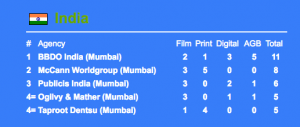
    India has retained its position of #13 amongst the top creative nations in the world. Other than BBDO India (the Mumbai office) which was on top, McCann Worldgroup Mumbai was second, Publicis India Mumbai followed in third while Ogilvy & Mather (Mumbai) and Taproot Dentsu (Mumbai) were on fourth place.


    Meanwhile, here are observations of The Gunn Report 2016 on its 2016 study:

    Agencies

     (1)   The 53 Most Awarded Agencies listed in the table are from a total of 17 different countries (versus 21 in 2015 but 17 in both 2014 and 2013).  The USA was the most represented with 14 Agencies in the table.  Followed by the UK with 6 Agencies; Germany (5); Spain (4); Argentina, Australia and Japan (3 each); Brazil, France, New Zealand, Sweden and UAE (2 each); India, Italy, Netherlands, Norway and Thailand (1 each).

    (2)   Only 8 Agencies in the whole world, who have demonstrated the highest level of consistency as well as excellence, have been in the Top 50 Agencies of The Gunn Report for each of the last 14 years in a row (in alphabetical order):

    AlmapBBDO (Sao Paulo)

    AMV BBDO (London)

    BBDO (New York)

    BETC (Paris)

    adam&eveDDB (London)

    Del Campo Saatchi & Saatchi (Buenos Aires)

    Dentsu (Tokyo)

    Wieden+Kennedy (Portland & New York)

    (3)   Eleven of the 53 Agencies made it into the table for the first time in 2016 (in alphabetical order):

     BBDO (Mumbai)

    David (Buenos Aires)

    FCB (Chicago)

    Grey (London)

    Impact BBDO (Dubai)

    Ingo (Stockholm)

    J. Walter Thompson (Amsterdam)

    McCann (New York)

    Publicis Italy (Milan)

    TBWA\Hakuhodo (Tokyo)

    Y&R New Zealand (Auckland)

    (4)   For the first time ever, two agencies from New Zealand are ranked in the top three: Colenso BBDO (Auckland) #2 and Y&R New Zealand (Auckland) #3=

    (5)   The Most Awarded Agency in the World is adam&eveDDB (London) with 49 points, up from second place in 2015. This is the 4th time they top the table, and are now officially the most successful creative Agency in the history of The Gunn Report (AlmapBBDO and Wieden+Kennedy USA have both won three times).  They were, by a large margin, the most awarded Agency in Film taking 3 of the top 6 spots in the Table for: Harvey Nichols Loyalty App ‘Shoplifters’ and John Lewis Home Insurance ‘Tiny Dancer’ in equal 3rd place; and John Lewis ‘The Man On The Moon’ in equal 6th place (as well as 14th in AGB and 8th equal overall). H&M ‘Becoming Beckham’ took 13th place in Film and further work for H&M, Harvey Nichols, Hertz Van Rentals, Skittles and SSE helped them to their #1 ranking in 2016.


    Agency Networks

    (1)   Three mini networks are ranked in the Top 20: Cheil Worldwide (which ranked for the first time in 2015) is now joined by BBH and Jung von Matt, both returning to the table after a one year absence.

    (2)   BBDO is the Most Awarded Agency Network for 11 straight years in a row. 253 points in 2016 is their highest score ever. Agencies in 26 countries contributed. Nine of their agencies are in the 50 Most Awarded Agencies in the World in 2016.

    (3)   McCann rank 2nd place up from 5th in 2016 scoring their highest points ever (138). Agencies from 19 countries contributed to their points.

    (4)   J. Walter Thompson up to 7th place (93 points) from 14th in 2015 – their best ranking since 2007.

    (5)   Grey in 8th place achieve their highest ever ranking in The Gunn Report and their highest ever points total (82)

    (6)   A disappointing year for MullenLowe & Partners (down to 16th place from 8th in 2015) and for Wieden+Kennedy (now in 15th place vs 7th in 2015)


    Advertisers

    (1)   Samsung tops the Advertisers table for the first time ever, making it the fourth brand in the 18 years of The Gunn Report to top the table. Samsung made it into the Top 25 Most Awarded Advertisers table for the first time in 2013, but have remained there since. Work from 10 countries contributed to them being ranked #1.

    (2)   Only 11 of the 32 most awarded Advertisers listed in 2016 appeared in this table the previous year.

    (3)   Making it onto the Most Awarded Advertisers table for the first time ever are: DB Export, Geico Insurance, Andes Beer, ING Financial Services, REI Outdoor Store, Lockheed Martin, Bonds Underwear, H&M, Edeka Supermarket, Hornbach DIY, S7 Airlines.

    (4)   Nike has dropped out of the top 10 Advertisers for the first time in Gunn Report history, now in at #12.

    (5)   Volkswagen dropped out of the top two in the Advertisers table for the first time in Gunn Report history to take 3rd place.

    (6)   Burger King returns to the Most Awarded Advertisers table after a five-year absence, mainly due to McWhopper sweeping the board coming top of two tables – Digital and All Gunns Blazing – as well as 2nd in Print/OOH. Whilst work from France also contributed to the Burger King total, Mc Whopper by Y&R New Zealand (Auckland) was the Most Awarded Campaign Across All Gunn Report Media in 2016

    (7)   In the Advertisers Consolidated Table (in top 25 for two or more years – at least once in the last five years – with work from two or more markets) Burger King returns and Getty Images, Netflix, Pedigree, Smart Car and Snickers are new arrivals.

    (8)   ING Financial Services and REI Outdoor Store both ranked #10= (with 19 points each) both got all their points from the strength on one campaign in different media channels: ‘The Next Rembrandt’ for ING and’#OptOutside’ for REI.


    Production Companies

    (1)   16 of the 28 Production companies in the table in 2016 were there in 2015, with the top five all making an appearance in the previous year.

    (2)   There are 3 newcomers: New Land in Stockholm, Anorak in Berlin, Geek Pictures in Tokyo

    (3)   Global spread of countries continues to flourish with 13 represented in 2016: Argentina, Australia, Brazil, Denmark, France, Germany, Japan, Mexico, Norway, Spain, Sweden, UK and USA – with a number of Production companies with multiple bases producing winning work from more than one of their locations.

    (4)   Most awarded Production Company, O Positive Films (New York, Santa Monica) topped the table for the first time. It was their 6th year in a row of being in the table. Their previous highest ranking at #5 was in 2015. Their most successful campaign was Curry’s PC World ‘Spare The Act’ with ‘Laptop’ ranked #2 most awarded commercial of 2016. Work for Snickers, Clorox and Foot Locker also contributed to their points


    Directors

    (1)   There is rarely any consistency in the Top 25 Directors table when compared with the previous year but 2016 was exceptionally volatile. It was the lowest winning total since the first year of The Gunn Report in 1999.

    (2)   Only four of the 27 Directors appearing in this year’s Table were there in 2015. Of the remaining 23, eight have made the Top 25 on at least one previous occasion and 15 were newcomers.

    (3)   The 27 Directors represented 13 countries between them – Argentina, Australia, Denmark, France, Germany, Japan, Mexico, Norway, Russia, Spain, Sweden, UK and USA.

    (4)   Top spot in the Directors table, with 16 points, went to David Shane for directing Jeff Goldblum’s wonderfully funny performance in the Currys PC World ‘Spare The Act’ campaign. ‘Laptop’ was the second most awarded commercial of the year and the entire campaign came in at 6th=.

     

  • L&K Saatchi & Saatchi conceptualises new Head & Shoulders campaign featuring Ranveer Singh

    By A Correspondent


    Head & Shoulders, P&G’s largest shampoo brand globally has launched a new campaign with brand ambassador Ranveer Singh. Conceptualised by L&K Saatchi & Saatchi, this integrated campaign aims to get India grooving to the #DandruffNahiChalega dance move, created by ace Bollywood choreographer and director Farah Khan.


    The TV and digital amplification featuring Ranveer Singh’s in four avatars brings to life the idea that perfect grooming means #DandruffNahiChalega.


    Delna Sethna

    Said Delna Sethna, Chief Creative Officer, L&K Saatchi & Saatchi: “Bad grooming habits (read dandruff) and hooking up are inversely proportionate to each other. Now you team this seemingly innocuous proposition with great creative and an actor like Ranveer who’s unafraid to try “anything” and you get one remarkably filmy campaign. That we’re launching in true blue Bollywood style – A trailer, foot-tapping naachgaana from Farah Khan and avatars of Ranveer that you best discover online!”


    Binu Ninan

    Added Binu Ninan, Associate Marketing Director, P&G (Hair care): “We have product level win and with a news as big as the Best Ever Head & Shoulders we wanted a campaign that will put the brand at the front and centre of the idea. So when L&K Saatchi came up with the idea built around a dandruff torture test dance move, we knew this is it! Also, having the country’s hottest young actor as the brand ambassador gave us the opportunity to not only talk benefit but also create a lot of conversation.”


    Priyanka Chatterjee

    “It’s a real integrated campaign with TV, print, outdoor and social media work seamlessly together to drive. We hope best-in-class participation and engagement with the brand. The idea is core to the brand benefit and as the leader, only H&S has to right to say #DandruffNahiChalega”, said Priyanka Chatterjee, Senior Vice President, L&K Saatchi & Saatchi. The campaign goes live from today (Sep 1)


  • Head & Shoulders unveils new cricket-inspired campaign

    By A Correspondent


    Head & Shoulders has launched a new campaign aimed at the cricket obsessed Indian guy. Created by L&K Saatchi & Saatchi, this cricket commentary-inspired campaign hopes to stand out in the clutter of cricket-style communication.


    The TVCs narrate the story of dandruff foiling a budding attraction at various situations, from a sangeet ceremony to a house party and even an elevator. Till H&S comes to the guy’s rescue and saves the day for him.


    Binu Ninan

    Binu Ninan, Brand Manager, P&G (Hair care) said, “H&S is a huge brand for P&G and we continue to be a favorite among Indian men. This time, we wanted a campaign that talks the brand message in the language of the H&S user and hence engages and connects with him, and what better than adding a little flavor of cricket. We have a holistic plan to drive this across relevant touch points.”


    Delna Sethna

    Talking on the inception of the idea, Delna Sethna, Chief Creative Officer, L&K Saatchi & Saatchi, says, “The biggest creative challenge was to be disruptive, yet be relevant. Boy meets girl… boy loses girl, thanks to dandruff… boy reunites with girl, thanks to H&S… All pretty linear till you need to add cricket in to the mix, but we managed to get it right.”


  • After 13 years as P&G MD, Shantanu Khosla, 55, quits

    By Sagar Malviya


    Procter & Gamble India’s managing director Shantanu Khosla is stepping down effective June 30, 2015, leaving behind a company that is struggling to grow its shares amid intense competition. The company announced his move on the BSE without elaborating on his replacement.

     

    The 55-year-old Khosla became part of P&G when it acquired Richardson Hindustan in 1985. In his tenure spanning nearly thirty years at P&G, Khosla led several business units around the globe. Later, in 2002, he took over the leadership of India operations of the company in June 2002. In 11 years under Khosla, P&G’s revenues have multiplied about six times at roughly 9,000 crore across three companies.


    Khosla, an IIT Bombay and IIM Kolkata alumnus, is leaving the company at a time when it has lost share in over two-thirds of its business, a struggle reminiscent of its parent company that has now put over 100 brands on the block to focus on core business.


    The Indian unit of world’s largest consumer products company ceded ground in products ranging from detergents, skin creams and shampoos to disposable razors and sanitary napkins. Experts said this resulted from P&G’s lack of innovation and focus on higher margins amid aggressive strategies adopted by its rivals to increase their market share.


    In the past two years, P&G has invested over Rs 2,000 crore in India, especially to set up manufacturing units to reduce dependence on pricier imports. However, big investments have taken a toll on its profitability, with the unlisted P&G Home Products, which houses laundry and shampoo brands, posting a loss of Rs 100 crore for 2013-14, on sales of Rs 5,381 crore.


    P&G in India including two subsidiaries, Procter & Gamble Health & Hygiene, which markets feminine hygiene brand Whisper and Vicks anti-cold balm; and Gillette India, maker of razors and other shaving products had annual revenues of Rs 9,274 crore during 2013-14.


    Source:The Economic Times

    Copyright © 2015, Bennett, Coleman & Co. Ltd.

    All Rights Reserved, Licensed to republish


  • P&G unveils new brand philosophy for SK-II

    By A Correspondent


    SK-II recently unveiled a new brand philosophy #ChangeDestiny with the launch of its biggest empowerment campaign to date. Developed by Leo Burnett teams in Singapore and Tokyo and shot by Indy8, the global launch film features acclaimed ballet dancer Misa Kuranaga. Holding the honor of being the first Asian to become Boston Ballet’s principle dancer, Kuranaga’s life story of defying the odds to achieve professional success takes centerstage in this inspiring video.

     

    Her story perfectly exemplifies the philosophy behind #ChangeDestiny, SK-II’s latest campaign to inspire women to change their own destiny, regardless of the little “dictators” in their life.


    Kylene Campos, associate marketing director, global SK-II shared, “A recent study we conducted found that long term use of SK-II proves that it is possible to beat skin’s risks posed by DNA to go beyond the skin women have been born with. This insight inspired the core idea for #ChangeDestiny – which is all about challenging the belief that destiny is set at birth and celebrating women who have gone beyond limitations to achieve success. More importantly, #ChangeDestiny –which is deeply rooted in SK-II’s product truth – is hopefully the beginning of a positive movement to inspire women around the world.”


    In this chapter of #ChangeDestiny, Misa shares the overwhelming challenges – or little “dictators” – she faced as she embarked on her career as a professional ballerina. Despite the immense challenges and rejection she faced, her grit and firm belief in taking control of her destiny contributed to her success.


    Speaking about the creative idea behind the campaign, Delara Lalwani, creative director, Leo Burnett Singapore said, “Until now, the skincare category has always focused on women’s insecurities, we wanted to change that. #ChangeDestiny was created to inspire women to take a different view of destiny – to remind them that destiny is in your hands, in the decisions you make and the chances you take. To bring this idea to life, we needed a real story of a woman who took charge of her destiny. After a global search, we found her in the Boston Ballet. Misa’s life story of struggles, the demons she had to face and how she overcame it all, left everyone in the room with a lump in their throats. We knew then we had to take this story to the world.”


    The #ChangeDestiny campaign aims to champion and inspire women to take control of their destiny – whether in life or in their skin. For 35 years, SK-II, with its iconic Facial Treatment Essence, has helped women take control of their skin destiny to unlock crystal clear skin, no matter the skin DNA potential or risks they were born with. As proven in the brand’s recent groundbreaking Skin Destiny Study, it is possible for women to go beyond their DNA limitations to change their skin destiny. Based on the study, loyal SK-II users had lasting crystal clear skin even in their 30s, 40s, or 50s regardless of the skin they were born with.


  • Delna Sethna Patel joins L&K Saatchi & Saatchi as CCO

    By A Correspondent


    Delna Sethna Patel has joined L&K Saatchi & Saatchi as Chief Creative Officer. She was until recently working with Leo Burnett where was Regional Creative Director on Brand Whisper.


    Ms Sethna Patel will focus on the P&G business, specifically: Head & Shoulders, Ariel, Olay and Pampers, according to a communique.


    On joining the agency she said: “I am looking forward to working with Anil and Praveen to grow business and push the creative envelope.”


    Said Anil S Nair, CEO and Managing Partner: “Delna is a kind of creative leader who brings the best out of everyone who works with her, irrespective of the department they work in. We are excited to have such an inspirational leader in our team.”


  • IPG’s big bet on India


    By Shambhavi Anand


    IPG is coming off a bad year with a significant decline in net income. What are the reasons for this? How’s 2014 looking?

    We did not achieve our goals and the primary reason for that were problems in Europe. We took a restructuring charge of $61 million to rightsize our cost profile. We also had some new business wins and expenses, and cost to pitch for new businesses ahead of revenues. Some of our agencies were not performing well. We took care of that in the restructuring so those were the reasons we could not deliver the margin we were looking for. The restructuring charge should give rise to $40 million benefits in 2014 and growth in the range of 3%-4%. We expect to expand margin by at least a 100 basis points.


    Michael I. Roth


    Michael I. Roth is Chairman and CEO of Interpublic, one of the world’s largest organizations of advertising and marketing services companies.  Prior to serving in his current role, Mr Roth was a member of the company’s Board of Directors.


    Since assuming leadership of Interpublic in 2005, Mr Roth is credited with righting the company’s financial course and moved to make it an industry leader by defining new models that provide value to clients in a rapidly-changing media and marketing environment.


    Prior to his current role, he was Chairman and CEO of The MONY Group Inc., a financial services holding company that provides a wide range of protection, asset accumulation and retail brokerage products and services through its member companies.


    A certified public accountant, Roth holds an L.L.M. degree from New York University Law School and a J.D. from Boston University Law School. He is a 1967 graduate of the City College of New York.


    Given the Indian economy has been sluggish for a while, how has that changed or affected IPG’s hopes?

    The fact that we brought our board of directors here even though there is a slowdown indicates how important India is. Every market is going through a slowdown but the opportunities India offers are immense. We wanted to send a message to everyone that India is important to us. It is our second largest market and some of our best brands Lowe, FCB and McCann are continuing to grow.


    How do your clients feel about India as an investment destination?

    We invested in three acquisitions in India – Interactive Avenues, End to End Marketing Solutions and Corporate Voice. They show the confidence we have in the future. Macro economic conditions affect the environment in every economy. But with the kind of growth we have had, we can work through difficulties. Even in tough situations India has grown at 5%-6%, which is good. In the United States growth is around 2%-3%.


    What’s your evaluation of your Indian operations? Are you looking at any further acquisitions?

    We have done very well here. Including the acquisitions our growth is somewhere around 70%. We bring all the IPG offerings to the table here in India. We are always looking for acquisitions in various markets. We want to hear from our agencies on what’s substantial on the horizon. For us digital and activation seem to be the two most important areas of interest. That is one of the reasons we came here. But please don’t ask me to name names.


    Would you care to address the speculation that a merger between WPP and IPG is imminent?

    There used to be speculation about IPG and Publicis too. But there is no need to do a transaction like that. We have all the global offerings and disciplines to be competitive. We don’t need capital. The only reason we would do something like that is when somebody put a compelling price for shareholders on the table.


    But no one has done that so far. How do you believe the Publicis Omnicom merger will affect the industry?

    Whenever a transaction of this kind happens it will take a long time to be integrated. In this case, it is taking a long time even to happen, and in the meantime there will be disruption. We are seeing recruiting opportunities. There are disruptions in a number of their offerings and we hope to be a beneficiary of that. Obviously, there will be conflict potential, although the transaction has not taken place yet, so we haven’t seen a lot of it. We don’t view it as a threat. Everyone thinks that their media offering will be big. But it will be as big as WPP and we have proved to be very effective against them. Not being so big that we can’t be flexible and responsive to clients needs and provide the human touch. The answer is I don’t go home and worry about it.


    How has IPG Mediabrands which is competing in many markets where the other media agencies have a bit of a headstart doing?

    In 2013, Mediabrands was our best performing asset. So that is a pretty good indication that they are doing well. We don’t give specific figures on the profitability of our agencies but clearly both in India and on a worldwide basis they are leading us on growth, revenue and margin expansion.


    Source:The Economic Times

    Copyright © 2014, Bennett, Coleman & Co. Ltd. All Rights Reserved

    Licensed to republish


  • Return of the global desis

    By Kala Vijayaraghavan & Ratna Bhushan


    Sanjiv Mehta, who took charge as MD and CEO of HUL early last month, has never worked in India before. But he has headed two countries and a region (north Africa and Middle-East) in his 21-year career in Unilever. Sources within Unilever say he specifically asked for an India posting.


    Like Mr Mehta, over half-a-dozen top-level executives from P&G, PepsiCo, Mondelez, Coke and Reckitt Benkiser have given up global roles to move back to India in the past six months.


    “India provides a unique leadership experience,” says Samik Basu, chief people officer, PepsiCo India. “It is a highly competitive and complex market and provides an opportunity to combine global learning with local resourcefulness.”


    Gautham Mukkavilli, CEO-beverages, and Chetan Mathur-controller, Pepsico India, both moved back to India from Dubai in mid-2012.


    At Coke, Venkatesh Kini spent three years at the beverage firm’s head office Atlanta as global vice-president for juices, before moving back to Gurgaon as deputy president, India and South West Asia.


    P&G’s Sonali Dhawan moved here as the India marketing leader after leadership roles in Singapore on hair care and more recently as the pet care marketing leader for Asia & Australia-New Zealand.


    So has Vivek Sunder, who has spent a decade outside India in various roles across Thailand, the UK and Singapore, before coming back here in a leadership role in the India sales & distribution team. At least three senior managers from Mondelez International – Arjun Bhowmik, Sid Mukherjee and Venkat Venepally – have also done the same.


    “The most exciting reason for me to come back was that the India business of Mondelez International has been growing at a rapid pace and is one of the key priority markets for the company,” says Arjun Bhowmik, director, expansion, Mondelez. “Also, I wanted to be closer to family and was keen that my daughter should complete her secondary education in India.”


    He worked in the Philippines, Thailand and Indonesia for over seven years. Industry watchers say even with a 6-7 % growth, India fares better than other developed markets.


    “Several managers who had moved straight into global roles are now keen to work in India,” says Rajesh Ramanathan, HR director of Mondelez India. “Those with developed markets exposure now want developing markets and India experience on their CVs.”


    In advertising, Leo Burnett’s Saurabh Varma and Lowe Lintas’ Vikas Mehta both moved back from Singapore.


    “India postings have become hot property since it is an exciting growth market and offers diversity of experience,” says Suchet Narain, MD, DRH International, a global executive search firm.


    “Global organisations are also happy to send their managers to markets such as India to ensure implementation of global best practises such as corporate governance, safety or environment issues.” Most managers have children studying abroad, so they move in with their spouse but may not necessarily stay here long term. India’s infrastructure still compares very badly with other cities globally. “But having India on their CV gives them that depth of experience,” he says.


    Several top managers such as Atul Singh of Coke and V Chandramouli of Cadbury who have been offered global postings are opting to remain in India. Gopal Vittal, former director of HUL’s home and personal care business, once seen as a top candidate for the CEO job, chose to opt out of a plum global posting and quit early last year. Vittal, officials close to the development say, was unwilling to move out of India. He now heads Bharti Airtel in India.


    Says Sameer Wadhawan, VP, HR, Coca-Cola India and South West Asia: “India is emerging as one of the nodal points of the world economy and one-fourth of the world’s population is centred in Asia. India can be an operational hub for global CEOs.” But not all executives want to come back home. “Many young executives in their late 30s or early 40s are still open to take diverse challenges in different countries,” says Sangeeta Pal, partner at search firm Transearch.


    Source:The Economic Times

    Copyright © 2013, Bennett, Coleman & Co. Ltd. All Rights Reserved

    Licensed to republish


  • What makes P&G’s India head Shantanu Khosla outlive peers


    By Kala VijayaRaghavan & Sagar Malviya


    The company he heads is coming off its worst financial year. Yet, an unfazed Shantanu Khosla wants to look back longer at how Procter & Gamble’s Indian operations have come along in its 24 years in the country, creating spaces for itself while going head on against the might of fellow multinational offsprings like Hindustan Unilever and Colgate-Palmolive.


    Just as well for him, for Mr Khosla has been at the helm of P&G India for the last 11 of those 24 years. Seen through the prism of P&G’s global template, Mr Khosla’s tenure, since 2002, is standard stuff. Seen through the prism of what’s happening in his neighbourhood, Mr Khosla is an outliver.


    Hindustan Unilever-P&G’s rival number one in india and against whom it is measured the most-has seen a change of guard four times since 2002.


    As has Colgate-Palmolive. As has Nestle. “The comparison (with HUL) pleases me because I know we are winning,” says Mr Khosla, managing director of the operation that posted combined revenues of Rs 7,561 crore in 2012-13. “In every category we have competed with HUL, we have grown. Ten to eleven years back, they were 20 times our size; today, they are three to four times.” And then, he fires a salvo. “Reliance has grown faster than HUL in the same period. So, is there a comparison?” But growth is one thing, profitable growth another. P&G’s speedy expansion has come at the cost of margins, especially in the last three years, when the quantum of losses posted by it- Rs 1,167 crore-wiped off all the profits it had made till then.


    A lament among industry observers is it’s not clear what P&G wants to do in emerging markets like India. They say its growth could have been faster given its parent’s size and product portfolio, its board of directors in India is aging, and is low on ideas and risk appetite, its strategy to opt for fewer stockists is puzzling. “P&G’s strength is top-end, high margin,” says Amin Babwani, a former senior sales and marketing official at HUL and now an independent consultant. “Hence, even if they become big, say, in the mid-priced detergent segment with the success of Tide, it will not meet their margin aspiration. It should leverage its global portfolio and quickly launch some of its big global brands in India.”


    P&G is upping the stakes in India. Its US parent has invested about Rs 2,000 crore in the last two years in its Indian arm to ramp up production and distribution, especially in relation to, who else, HUL. What makes that narrative more interesting is that, on October 1, HUL completed one of its regular successions, with Sanjiv Mehta stepping into the rather big shoes left behind by Nitin Paranjpe.


    Barely half a km away in Mumbai, at P&G, the footprints, as far as one can see, are those of only the indefatigable Mr Khosla. “Shantanu is like Sachin Tendulkar in the P&G system,” quips a senior company official, not wanting to be named.


    The Man

    The 53-year-old Mr Khosla says this is where he wants to be. “I love the job, I am learning everyday,” says the 53-year-old. “The consumer base in India is still underserved. And we have this young talent and leadership pipeline the P&G system consistently works on.”


    Mr Khosla heads all three P&G companies in India. There’s P&G Hygiene and Health Care (which makes Whisper and Vicks), Procter & Gamble Home Products (Ariel and Tide) and Gillette India (shaving products of the same name). Mr Khosla became a part of P&G when the Cincinnati-based company acquired Richardson Hindustan in 1985, in 1985. After leading several business units for it around the globe, he took charge of India in 2002.


    In 11 years under Mr Khosla, P&G’s revenues have multiplied about six times at Rs 7,561 crore. That’s faster than Colgate-Palmolive, Nestle and HUL, though the last name on the list has a significantly larger base. Personally, for Mr Khosla, it’s an unusually long stay in a Gen Y environment, where boards and CEOs are getting younger.


    “There is nothing unusual about it in the P&G system,” he says. “Over its 175 years of existence, P&G has had only 10-11 CEOs.” In India, before him came Gurcharan Das, David Thomas and Helmut Meixner.


    According to a senior company official, who did not want to be named, Mr Khosla has been refusing global positions that come with promotions. At present, in P&G’s global hierarchy, Mr Khosla is a vice-president. He reportedly has clout and commands respect for his leadership skills. “He could have been president-level talent any day, but he has chosen to be in India by choice,” says this official. In P&G, the president is a notch below chairman & CEO position.


    Declining to answer questions about global roles and older boards, Mr Khosla insists leadership development and succession planning is core to P&G’s culture. “I know who my successor will be as, with all positions within the P&G system,” he says. “Nothing happens by chance here. These are all pre-planned career decisions done with what is good for business and what is good for the employee. I am no exception.”


    The Company

    Departures from that template happen, even at the highest level. This March, the US parent brought AG Lafley-credited with the $57 billion acquisition of Gillette in 2005 and all of 66 years-out of retirement to be its chairman and CEO and revive growth. On a visit to India three months later, Mr Lafley admitted that P&G in India had fared better in categories where established FMCG was not strong, like women care, baby care, hair care and skin care.


    Part of the reason, he said, was because HUL had a headstart and FMCG talent. “It wasn’t until we were there for a decade or two that we began to hire some really good people out of universities, and we did acquire some good people with Richardson-Vicks and Gillette and other acquisitions,” he said in July. “But it is very hard when you haven’t been there for 100 years and you don’t have the reputation of HUL to hire the best.”


    Gautam Duggad, FMCG analyst at Motilal Oswal Securities, a brokerage, says comparing P&G with HUL is unfair. “Both have different histories,” he says. “HUL is a 100-year plus organization in India compared with P&G’s 20-odd years, of which, it has been aggressive only for the last 10 years.”


    Mr Duggad feels P&G is putting many pieces in place. “The losses are not worrying. It is the result of its investments in critical areas,” he says. “It is focused on long-term growth. Now, it is investing in critical areas: brands, distribution and infrastructure. For FMCG companies, management roles have marginal impact.


    Once the critical parameters are addressed, it is on auto pilot.” Ashok Chhabra, former P&G general counsel for Asia-Pacific & Australia says the company is guided by the consumer, not the competitor. “And Shantanu is driven by data and facts,” he adds. “He understands issues on the ground and is an excellent leader to guide P&G.” Mr Khosla says he maintains a 9 to 6, clear every mail in less than a minute, schedule. Mr Khosla, who is fond of gadgets and cars, meets as many colleagues he can, often seeking them out.


    “We have an open office, flexible work hours and are more virtual,” he says. Independent marketing consultant Kamini Banga gives a thumbs up to Mr Khosla. “A new entrant combating a large entrenched player is no mean feat, and what is essential is continuity and stability,” she says. “And if things are working well, it would hardly be prudent to bring change at the top and experiment with new strategies. As a challenger, Shantanu has brought stability and continuity while putting it squarely on the path to growth.”


    Source:The Economic Times

    Copyright © 2013, Bennett, Coleman & Co. Ltd. All Rights Reserved

    Licensed to republish


  • Colgate launches offensive to take on P&G’s Oral B toothpaste

    By Kala VijayaRaghavan & Sagar Malviya


    Last week, when Procter & Gamble launched Oral B, its first toothpaste in India, perhaps no one else was watching it more closely than Prabha Parameswaran, the MD of rival Colgate, also the market leader in the Rs 5,000-crore oral care market.


    Ms Parameswaran’s swift and no-holds-barred retort to the P&G threat has by all accounts left the latter overwhelmed in the market.


    A heap of 250-odd Colgate toothpaste packs greets customers at a leading supermarket in the suburbs of Mumbai. Almost each of the neatly stacked packs forming a mini-pyramid has either BOGO (buy one get one) printed on it or carries reduced price tags. Here and across 4.5 million retail outlets, Colgate is being a shameless bully, elbowing P&G out of any shelf space. It is throwing toothbrushes, pastes, and brand events and promotions with trade partners, and discounts, all to deny or delay giving P&G even a toehold. Such promotional intensity wasn’t there even two weeks ago.


    “Several large retailers haven’t even stocked P&G’s new toothpaste as the margins offered were lower than Colgate and GSK,” said two officials at leading supermarkets.


    This is already turning out to be a costly battle – Colgate has hiked its advertising and promotion spends by 31% during the first half of this calendar year.


    Devendra Chawla

    “There has been a new-found aggression in Colgate during the past year,” says Devendra Chawla, president-Food Bazaar at the Future Group.


    P&G India is hardly a wimp when it comes to a scrap for market share. The Cincinnati-headquartered company has had dozens of such brawls with arch rival Unilever in segments such as detergents, shampoo and skin creams. But this is the first time P&G is wrestling with Colgate.


    “Though it is still very early, our launch of Oral B toothpaste and initial plans are very much on track,” a P&G spokesperson said, responding to an email about the battle with Colgate. “We are very pleased with the response and support we are receiving from both our customers as well as the professional community.” Ms Parameswaran, 51, too is quite familiar with the exertions of such battles. Before she was elevated to the top job in India, she had fought P&G for over a decade at their home turf – the US – and more recently Mexico, where she was the marketing head until 2012. Colgate controls more than half the market and Ms Parameswaran is fiercely guarding every inch. In the months preceding P&G’s first toothpaste launch, she was hitting the roads, meeting dealers, distributors and trade partners, say sources in direct know of things. A media-shy Colgate declined comment. “Ms Parameswaran has fired up the organisation,” says a highly placed official privy to recent happenings within Colgate.


    Since she took charge in February 2012, Colgate’s market share has increased from 53.1% to 55%, its highest since 1998, and a rare instance of a market leader gaining new ground. In the same period, its stock has risen 41%, even as the BSE Sensex has gone up just 14%. “Colgate is like a well-oiled machine. What a very good leader can do with such a welloiled machine is what is happening now at Colgate,” says Abneesh Roy, associate director at Edelweiss Securities. “Usually, the market leader tends to protect share rather than drive further growth. Colgate has managed growth under Ms Parameswaran,” he adds. Roy, who had met Ms Parameswaran recently, says she comes across as an extremely savvy marketer with a curiosity to know what is happening in other categories.


    “Colgate has usually tended to do well under attack, earlier from Pepsodent and later from low-cost brands such as Anchor,” says Vikram Kaushik, ex-MD of Tata Sky. He was executive vice-president (marketing) at Colgate-Palmolive (India) in 2004. Ms Parameswaran has worked with Colgate for two decades. She started off with experiences across verticals including initiatives to revitalise its personal care business that included the launch of Palmolive Naturals soap, Palmolive Optims and the male toiletries and skin care equities. She moved to New York as associate director (global business development), oral care, in 1997, and was later the vice-president (marketing) for Colgate India between 2007 and 2009.


    Ms Parameswaran worked with Lintas India (now Lowe Lintas) before joining Colgate and had handled HUL campaigns, including ‘Zara sa Rin!’, ‘Dur ho ja meri nazron se!’ (for Wheel) and ‘Dhoondte reh jaoge!’ (for Surf Ultra). “I remember her then for her team leadership skills as well as witty sense of humour. She was extremely insightful,” says Pranesh Misra, chairman & MD, Brandscapes Worldwide. He had worked along with Ms Parameswaran in Lowe Lintas on HUL brands. “After years at Colgate in different geographies and roles, she has further sharpened her skills in marketing and business leadership,” he adds.


    (With inputs from Amit Bapna)


    Source:The Economic Times

    Copyright © 2013, Bennett, Coleman & Co. Ltd. All Rights Reserved

    Licensed to republish


  • Saatchi & Saatchi adds creative muscle with new hires

    By Amit Bapna


    The ‘Lovemarks’ agency Saatchi & Saatchi is buttressing its creative fortress. It has announced two new creative recruits – Anant Medepalli and Vihar Patkar as Creative Director and Associate Creative Director respectively. Alongside the agency has also moved the Creative Director on the P&G brand Mithun Mirji to Singapore for a newly created role of Regional Creative Director.


    Mr Mirji has been at Saatchi & Saatchi for a few years now and having worked at the agency has helped in forging a partnership with P&G and this has helped the agency get more responsibilities for work across the region. He said: “The experience helped when Saatchi & Saatchi decided to set up a Regional Hub in Singapore to partner with our P&G clients.”


    Mr Medepalli and Mr Patkar have both spent over 10 years in the business and have been associated with Saatchi & Saatchi in the past. Mr Medepalli returns to India after a stint at Leo Burnett, Nairobi while Mr Patkar worked at Saatchi from 2005 to 2008, followed by stints at Rediffusion Y&R and Salt Brand Solutions. The creative team at the agency is front-led by Ashutosh Karkhanis, Executive Creative Director and Ramanuj Shastry, Chief Creative Officer.


    Source: The Economic Times

    Copyright © 2012, Bennett, Coleman & Co. Ltd. All Rights Reserved


  • Can Facebook, the marketer’s online best friend ever become its ace salesman?

    By Delshad Irani & Ravi Balakrishnan


    In 2009, Facebook terminated the ‘Whopper Sacrifice’, Burger King’s social experiment cum marketing activation. Created by Crispin Porter Bogusky, the campaign’s premise was the more ties you sever the closer you get to your BK Whopper. The application as it turned out was a whopping success.


    Within a week 200,000 ‘friends’ were virtually burned out of existence from various lists. Facebook couldn’t handle the loss of those hard-earned friendships. Burger King, on the other hand, proved the point it set out to make – Americans sure do love their burgers. That same year, Swedish furniture giant Ikea spent practically nothing to create a campaign to promote its newest store.


    The agency Forsman & Bodenfors created a new Facebook account for the manager at the store in the city of Malmo and posted catalogue pictures of furnished rooms.


    Users could win furniture and other items in the photos if they beat their friends to the punch. All they needed to do was tag the pieces with their names first. Needless to say the prospect of first-to-tag-wins drove Facebookians crazy. The campaign was hassle-free, cheap and effective, just like the Scandinavian furniture it was advertising.


    Fast-forward to a few weeks ago. General Motors, the world’s fourth-largest advertiser and spender of $3.9 billion globally on advertising in 2010, haunted by questions related to effectiveness and ROI, pulled out its pretty penny, all $10 million of it, from Facebook’s paid-ad kitty just days before the social network’s stock went public.


    In addition to that sum, the automaker spends a reported $30 million on content creation for social media. These examples make Baccarat-crystal clear what we know already – you don’t have to pay big to make an impact via social media.


    In India, most marketers love talking about the worth of a campaign by the number of fans, or likes received on the most recent post. But even they are starting to ask a tricky question: what’s the real worth of their campaigns on Facebook? Worth more than a burger, eh?


    The site itself has been trying to tell advertisers that no longer will mere presence and innovative social media campaigns cut it. If they want scale, they’ll have to shell out the hard cash for offerings like “sponsored stories”, not to be confused with “sponsored ads”.


    For instance, products like Reach Generator guarantee that posts by a brand stand to be seen by 75 per cent of its fans every month or an estimated 50 per cent every week. Non users of the tool will have to settle for an average of only 16 per cent of fans viewing posts on a weekly basis. Not everyone’s buying though, believing that compelling content will win any day of the week.


    Anuradha Aggarwal, senior VP, brand communication and insights, Vodafone India said: “Since having high engagement scores is our goal, we focus on creating content on our Facebook page rather than on advertising. We focus on creating posts and apps to enable our 3.2 million fans to create conversations and experiences around the brand.”


    PepsiCo’s approach is to use a combination of both, posts/promotions on brand pages and display advertising. One of the cola maker’s prominent campaigns on the site was ‘Meet Messi in Miami’ where fans had to complete a series of tasks to win a chance to meet The Atomic Flea.


    During the 2011 ICC Cricket World Cup, Pepsi launched an online progamme as part of the ‘Change the Game’ campaign where fans could win a dream trip across the country for all India matches. The latter initiative was listed as one of the 19 best campaigns in the world by Facebook on their success stories blog, the only Indian effort to feature on the page.


    According to Homi Battiwalla, category director – colas, hydration and mango based beverages, PepsiCo India, it is too early to give a conclusive opinion on new advertising properties like sponsored stories and other offers. So the bottom line when it comes to the marketing on the social network is the game hasn’t quite changed. “The primary focus remains on organic content as we believe it results in better consumer connect,” said Mr Battiwalla.


    For automakers like Mahindra & Mahindra, Facebook is good for what it was born to do in the first place. Well, that and to spy on “old acquaintances”. According to Vivek Nayer, senior VP, marketing, automotive division, Mahindra & Mahindra: “Rather than looking at Facebook for advertising reach, we’ve leveraged it for what the platform is inherently good at; building communities. Today at 5 million, we are the largest automotive community on Facebook in India”


    In the case of Unilever, the company moved from almost accidentally stumbling on the power of the site – after noting a lot of action on its first Cornetto Luv Reels page long after the promotion was over – to it being a key pillar to the launch of Fruttare, its new range for the summer. Sapan Sharma, general manager – ice creams, Hindustan Unilever, said: “There’s an advertiser login where you get all the details. In the first 10 days of launch, 1.2 lakh fans signed up and there were 1.2 to 1.5 lakh conversations.”


    Arch-rival P&G is not lagging either. According to a company spokesperson: “In just less than two months, we have over 690,000 fans for our Thank You, Mom campaign. This makes it the largest, most engaged-with Thank You, Mom community globally.” For the launch of Olay’s premium skin care range, Olay Regenerist, a Facebook waiting list was created, with both fashion journalists and consumers signing up for an exclusive trial on the site; in less than three weeks, over 11,400 people had registered.


    But as the eight-year-old Facebook enters a new league as a listed company, it needs to, and rather urgently, scale its revenues to sync with its audience. Minute, often ineffective, right-rail ads aren’t exactly a juicy bone to dangle in front of existing and potential advertisers; thus the introduction of premium ads and better placement.


    According to Siddhart Rao, CEO of digital agency Webchutney, the sweet spot between organic and paid promotion is the one that will yield maximum benefit to brands looking to extract value from social media marketing platforms like Facebook. “One cannot work without the other,” he said.


    S Yesudas, managing director – Indian subcontinent, Vizeum, said: “I do not think all marketers know what to expect from the medium. The hurry to be on to the bandwagon gets them there. The fact that Facebook offers free advertising inventory for brands to test the medium gets overlooked. In my opinion, the medium can be successfully used to build relationships with the consumers.


    Targeting can be done based on profile information, relationship status, interest or based on certain words in profiles or status messages. But the truth is the brand communication will always compete with the updates, videos, etc from friends.”


    Indeed, it’s complicated; the relationship between advertisers and Facebook. Especially when one moves from the fluffy world of engagement to hard sales. Many retailers in the West like JC Penney, Gamestop and Gap pulled the shutters on their stores on Facebook this February.


    Chhaya Balachandran Aiyer – founder – MD, BC Web Wise said: “Ironically Wade

    Gerten, the founder of 8thBridge – the flower store that was responsible for the coinage of the term F-commerce as it was the first to open shop on Facebook for 1,800 Flowers – has admitted that sales never really materialised for their first or other F-outlets, adding that F-commerce deserved an F. Given the fact that F-commerce (Facebook commerce) has failed in the west for retailers, it appears that Facebook would be an engagement vehicle. Peer recommendation and product ratings are not integrated. Should it launch a brand intelligence tool which can be used by consumers – which exposes peer comments and recommendations that can be accessed by the FB community – then the ball game will change.”


    Venkat Mallik – president, Tribal DDB & Rapp India says Facebook’s ability to deliver sales impact has been a bit of a mixed bag: “There need to be more strong case studies demonstrating the sales or brand impact from the use of Facebook led engagement.”


    However while Facebook may not itself be a platform to sell it can impact sales according to some of its satisfied customers. Unilever’s Mr Sharma for instance believes there’s a definite co-relation between high levels of engagement and products sold.


    According to Carlton D’Silva, chief creative officer, Hungama Digital Media, “Opinions of family and friends matter when making purchase decisions decisions and Facebook activity will provide a lot of data to consumers, which can be leveraged in places where they make these decisions, causing a significant, if not direct impact on purchase behaviour.”


    “GM is slashing its advertising budgets by $ 2 billion, of this only $10 million or 0.5 per cent was on Facebook. They have also announced they won’t advertise on Super Bowl, either. Further, what should be noted is that GM has 8 million fans already. I am sure that they are going to continue with the engagement plans for acquired fans. It would be foolish to assume anything beyond, or assume Facebook has failed for GM, it would be just that advertising further is currently not the best bet in its media plan,” said Ms Aiyer


    The users of Facebook both on the agency and the marketer side each have their wishlist ready.


    “The analytics are available at a lag of 7 to 15 days; I’m sure it can come earlier. I’m sure there will be a time when we can talk to people from a specific city or market,” said Mr Sharma


    “They are hugely data rich. If in some way they get to using some of the data millions of people put in their hands on a minute to minute basis, sky will be the limit for them.This will surely come in with resistance from the users, unless they persuade them. They have to walk this path very carefully,” added Mr Yesudas.


    Most brands have a clear agenda from marketing spends on social media platforms like Facebook – greater outreach among target audiences through personalised interaction and engagement, leading to higher impact on conversions and sales.


    “It’s a perfectly reasonable expectation from a social communication platform with 900 million members,” said Mr Rao of Webchutney, “but whether brands invest enough thought, time, resources and action to engage audiences meaningfully is another question.” And one helluva question it is. Because for every whopper of a Scandinavian success story, there are at least a dozen marketing campaigns that have fallen flat on their face. So, ask not what you can do on Facebook but what Facebook can do for you.


    Source: The Economic Times
    Copyright © 2012, Bennett, Coleman & Co. Ltd. All Rights Reserved