One97 Communications Limited (OCL) that owns the brand Paytm which has been in the eye of a storm has launched a new print advertising campaign to reassure users and merchants that its QR, Soundbox and card machine will continue to work “today, tomorrow, and always”. Said a Paytm spokesperson: “As pioneers of QR code, soundbox and mobile payments in India, we have always been at the forefront of the digital revolution in India. With this ‘India’s every Paytm QR and Soundbox will keep working Today, Tomorrow, Always’ campaign, we aim to dispel any rumours, and confirm that our innovative devices will continue to empower merchant partners with seamless payments.”
Tag: Paytm
-
A musical extravaganza called "Van Heusen Metaplay" Van Heusen teams up with Paytm for PartyNite Metaverse
 By Our Staff
Van Heusen, power dressing brand from Aditya Birla Fashion and Retail Ltd (ABFRL), has teamed up with PartyNite Metaverse to create a virtual performance space for the musical extravaganza called “Van Heusen Metaplay”.
When Chai Met Toast, Indian Pop band will be performing at their first ever music concert in the Metaverse. Fans and Viewers can RSVP for the event on Paytm Insider, style their avatars with the latest collections and ensembles from Van Heusen and experience the infectious and melodies energy of the virtual concert.
Speaking about this unique event, Abhay Bahugune, Chief Operating Officer-Van Heusen, Aditya Birla Fashion & Retail Ltd. said: “As an ever-evolving fashion brand that has always been anchored in innovation, we have not only entered this virtual space of Metaverse, but have also started creating next-gen retail experiences, with an aim of tapping into newer and more dynamic forms of engagement with our consumers. Fashion in the metaverse is poised to emulate what we already see in day-to-day life; it’s engaging to dress-up avatars and use fashion as a form of self-expression and personal status. This musical concert is just the perfect amalgamation of Fashion, Music and cutting-edge technology that we would like to share with our discerning consumers. We are also the first ever fashion brand to enter the Metaverse in India with such an immersive experience.”
Rajat Ojha, CEO, Partynite Metaverse added: “This is a truly unique event where entertainment and fashion are coming together for the first time on Metaverse. We worked on very interesting landscapes to mount the concert, it had to be swanky and NextGen to match up with the essence of the band and at the same time we had to integrate the brand experience seamlessly, in a fun way. The virtual concert along with shopping will make for wholesome entertainment for the audiences. The audience is not just going to enjoy the concert, they’ll be completely part of it. The focus on the audience is like never before and that’ll set the stage for PartyNite in 2023”.
Varun Khare, Business Head, Paytm Insider said, “Whether it’s a live event or digital event, offering unique experiences for the audience is massively important and has been our core. This time too, we have left no stone unturned in curating this extraordinary event that bridges the gap between the physical and digital space to deliver a truly shared experience like no other. We are happy to partner with Van Heusen and PartyNite for this one of a kind music and fashion event.”
-
Much as he loves using it, Sanjeev Kotnala needs the payment platform needs an overhaul of its algorithms G Pay: The Good, Bad and Ugly…
By Sanjeev Kotnala
 Everyone has an option for digital payments. BharatPe, BHIM, UPI, PAYTM, GPay and many more mobile wallets. However, one of them becomes the default option. For me, it is Google Pay. GPay, in short. And, it may be true for others, but here I will speak of GPay and my love-hate relationship with it.
The Good
Okay, honestly, I have no major crib about GPay as the app works fine.
It allows me the liberty to scan any QR code and payment, and it works seamlessly.
GPay perfectly documents every transaction and ensures sharing them is smooth.
Rarely is there a problem with server busy or faulted payments.
I am a GPay fan and need no further motivation. Everything is just fine.
I am building homes at Indi-homes – collecting energies to complete the levels- not really interested in the first 2 Lakh home builders to earn anywhere between INR 11 to INR 111.
However, many friends and family members voiced these concerns about GPay; After sharing the Good part, I amplify their reactions below.
The Bad
However, I am irritated and frustrated with GPay.
I suppose they have the best of the listening and tracking ways of how I live and what I do. At least they have the financial transactions and intelligent algorithm other brands use.
Then, why does GPay in rewards keep me giving free membership and trial opportunities across brands? Okay! The trial is free for new users and subscribers. And Google would /should/could know I am a member of these services.
It keeps changing its picture capture games, from Diwali Cards to IPL to others. And I never get all the cards. GPay algorithms that deal me the cards ensure I get many cards but never the complete deck, which will allow me to go for the jackpot. G-pay then wants me to trade cards with my friends to complete the deck. Does GPay think I work for it or have time and energy for referring or inviting friends on the platform?
Most optimistic brands: GPay knows I am not interested, and I have not reacted for the last 20 times they have sent the free three-month membership. Optimistic GPay believes the 21st time I will change. So, with punctual clinical consistency, it regularly serves these reminder awards. And it then follows up with a notification that the useless, irrelevant, irritatingly frustrating awards option may expire.
GPay asks me to refer new possible customers. It also goads me to pay INR 1 to people in my contact list on joining the G-pay Brand Wagon. GPay knows I have never done that, and GPay knows none of my friends has ever given me the INTR 1 welcome gift. It knows it is futile to ask me again and again. But, the brand is optimistic that I will change first than its so-called personalised approach based on incredible self-learning algorithms?
The Ugly
I know I am not the luckiest guy on earth. But my luck is not so bad that I keep getting served ‘Better luck next time’ cards by GPay. Adding insult to injury, I must scratch the cards to uncover the message at every milestone. Every milestone promises a cashback up to INR 1000, and I thought Upto meant at least INR 1 to start with. However, the only thing it does is to ruin my day by telling me ‘Better Luck Next Time’. Or: Your Bad Luck is Kharraab!
In some 427 transactions of more than 3 lakh, I have won 233 cashback and some 50 ‘Better Luck Next Time’ cards. Don’t give me cash back- but don’t make me scratch a coupon to read this silly luck line.
Net-Net
I have become so comfortable with GPay that it’s the default option. However, from time to time, GPay sends me those messages and notifications, including ‘Better Luck Next Time”. Frankly, I am not interested, and it only ends up spoiling my whole consumer experience.
So, time for the platform to use its tech muscles to differentiate between consumers waiting, willing and wanting the freebee and who wants the app for its primary function- just to pay- nothing else.
-
Roll out a digital film Paytm & Dentsu partner for financial autonomy of women
By Our Staff
Paytm in association with Dentsu Impact has rolled out a campaign with a digital film. The film also takes forward Paytm’s belief to be an enabler for women’s financial autonomy.
Commenting on the campaign, Anupama Ramaswamy, National Creative Director & Managing Partner, Dentsu Impact said: “Giving it back, by paying it back makes the intent of this campaign palpable for both women and men. The New Year campaign demonstrates how it pays to challenge the conventions of how we think of finance and gender. And any challenge to the traditional way of accepting things makes the brand and the message it conveys modern and aspirational, striking a chord especially with a younger generation.”
-
Conceptualised by Ogilvy India Cadbury 5 Star launches first digital currency campaign
By Our Staff
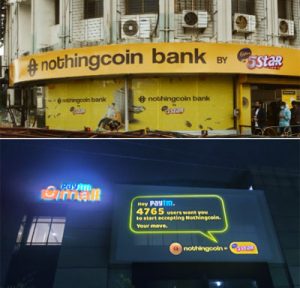 Cadbury 5 Star launches its first digital currency called ‘NothingCoin’, that gets mined while you do nothing. The brand has partnered with Paytm and Reliance JioMart for customers to redeem their earned ‘NothingCoins’.
Speaking about the campaign, Anil Viswanathan, Senior Director – Marketing, Mondelez India, said: “Gen Z today is in a constant hustle mode list – right from balancing their studies, finding a job, having an active social life to worrying about their investment plans. We truly feel they deserve some downtime and perhaps a much-needed digital detox. As a brand that has been at the heart of our country’s youth culture through innovative campaigns and quirky narratives, the introduction of NothingCoin is our attempt to inspire them to take a break in the most engaging and rewarding manner. This campaign reiterates Cadbury 5 Star’s brand persona of being witty and speaking in a language that excites the youth.”
Added Sukesh Nayak, Chief Creative Officer, Ogilvy India: “NothingCoin is an innovative engagement idea that’s witty, catchy and fun, just how a 5 Star idea should be. For the always-on generation, 5 Star’s NothingCoin is a smarter way to take a much-needed digital break, do nothing and yet get rewarded. And what made the idea zanier was opening an actual bank which encouraged people to mine NothingCoins by simply doing nothing.”
-
The lesson for India is to create products with features that suit our behaviour — be it ‘jugaad’ or ‘bachhat’, writes Bhuvi Gupta Chinese Lessons to make Bharat ‘Atmanirbhar’

By Bhuvi Gupta
 India-China relations have been in the news for all the wrong reasons for the most part of 2020. With 47 apps banned last week, the tally of banned apps now stands at 220. The latest announcement however made me contemplate how Chinese apps may have started off as clones of popular western apps but have innovated to serve the needs and culture of their Chinese users and become beacons of innovation, which are being copied by the West.
Irrespective of how localised globalised platforms (in other countries) try to be, the benefits of creating products nuanced to the people who will use them cannot be denied. The lesson for India hence becomes to create products with features, which suit our behaviour — be it ‘jugaad’ or ‘bachhat’. More than copying the west, I feel Indians apps should ape China, because we share more with its collectivistic culture than the individualistic culture of the west. Also noteworthy and ape-worthy is that Chinese apps have evolved to serve people who have leapfrogged the PC era directly to mobile, exactly like the majority of the Indian population have already and will in the future.
I am sharing some of the most ape-worthy strategies below.
The Micro-transaction Model
Isn’t it commonplace to have 10 tabs open on our browsers or a Kindle full of fabulous e-books, which you have lost interest in or are too busy for?
One of my strongest beliefs in the digital world where access to information is no longer an entry barrier is that attention is what will be valuable, because attention is in limited supply even if information isn’t.
With that central thought and taking into account the limited affordability of many Chinese people, China’s companies sell products like books and music streams in bite-sized manner. For example, China’s largest online/ e-book publishing company, Yuewen Group, sells books in capsules of 1000 words. This micro-transaction model is beneficial to both writers and readers, because writers end up selling more to readers who are on the fence about paying full price for a book they may or may not finish. In price-sensitive India, where value-for money is a key determinant for success, this can open the audience with limited affordability and accessibility who can choose to consume only that they continue to find value in.
The Cult of the SuperApp – Apps as Phone OS (Operating System)

Alipay’s homescreen could be mistaken for the homescreen of your phone Reams have been written about Tencent owned WeChat, which transitioned from a messaging app modeled on WhatsApp, to one that can order food; send money, book travel and much more. Wechat has 1 billion monthly active users and has spawned a multitude of copycats both within China and abroad. While super apps other than Wechat are common in China, Gojek in Indonesia, and PayTM in India are what have possibly come closest to replicating their breadth in other countries but are still far from penetrating the market to the extent that Chinese apps have.
SuperApps basically capitalise on their loyal user base and brand salience to share it across different survives. This in turn helps drive app traffic to retain mindshare and relevance. As a result of this bundling of apps, users never feel the need to go out of the app ecosystem and the app homescreen becomes the pseudo phone homescreen. For older generations who face a tough learning curve when it comes to technology, such apps are very useful. This is also one of the key reasons why superapps have been so successful in China. For the app, it is beneficial because it opens multiple revenue streams other than advertising. For example, today more than 80% of Wechat’s revenues come from transactions rather than advertising. It is a model that may just work very well with the recently launched WhatsApp Pay in India.
In India, the Covid-19 lockdown helped drive additional functionalities like grocery delivery features into Swiggy and Zomato, parcel delivery to Uber. However, posts lifting of lockdown these additional features have lost priority, which is unfortunate because this was just the beginning of a possible super app journey.
Path to Market
Understanding local customs is the USP for Indian founders. This is most often where MNCs who launch their products in India flail. Local doesn’t only mean language, etiquette, social norms; it extends beyond these to attitudes and quirks unique to Indian hardships and society.
In business terms, this can mean paying attention in app strategy to India’s love for discounts, value for money, a culture which doesn’t believe in credit, ‘jugaad’, cashbacks, the importance of family, arranged marriages, one device shared by a family or mostly by siblings, Bollywood and cricket etc. in addition to logo, design layout, and language etiquette. The latter matters, but ignores fundamental insights about customers that can drive adoption of new technology.

QR Codes for a Phygital world PayTM has used QR codes to drive digital transactions but scope for them to be leveraged a lot more remains
QR codes have been one of those digital features, which despite having been around for a long time have not been leveraged as much as they can be (with the exception of PayTM who has helped their cause). For the 700 million Indians who will come online directly to a 5G world, QR codes can be great way to help simplify the digital world — all QR codes require are a working camera and a data connection.
In China, QR codes are used extensively – as authentication stamps on goods often faked, as identity tags at workplaces, pet tags, as credit cards, on billboards… Applications are in fact endless and should be used extensively as the remaining 700 million Indian users whose technological learning curve will be steeper come online.
~ ~
While I am winding up my love letter to Chinese innovation here in my column today, I have only scratched the surface of what China is doing. At the core China is using every feature of the mobile device available to innovate. For e.g. QR codes use the camera as a data entry feature instead of a data collection feature. The lessons for Indian businesses are many and just waiting to be applied for large-scale success.
Bhuvi Gupta is a marketer with over 10 years across industries, of which the last six have been in Media & Entertainment. She has been a part of many launch marketing campaigns – specifically at the Times of India group, Republic TV and the latest in marketing a Bollywood film. She writes on A&M (mostly marketing, but often on advertising too) every other Tuesday. Her views here are personal. She tweets at @bhuvigupta3
-
Sachin Tendulkar to promote fantasy sports including cricket, kabaddi, football & basketball Paytm First Games announces Tendulkar as brand ambassador
By A Correspondent
It’s raining brand ambassador announcements these days. Digital financial services platform Paytm has announced that its subsidiary Paytm First Games (PFG) has roped in Sachin Tendulkar as its brand ambassador.
Said Sudhanshu Gupta, COO Paytm First Games: “Cricket is like a religion in the country which inspires over a billion people and fantasy sports takes the fan’s level of engagement to the next level where the user experiences the thrill of playing along with the athletes. As India’s homegrown gaming platform, our vision is to get the sports fans closer to the action with fantasy sports. Most of us have grown up watching the Master Blaster in action. With Sachin as a brand ambassador, we wish to inspire mobile gaming enthusiasts to experience fantasy sports which are about tactics, strategic planning and research.”
-
Encourages Indians to contribute for feeding the daily wage earners Paytm launches #NobodyGoesHungry ad campaign
By A Correspondent
Paytm has launched #NobodyGoesHungry campaign on social media to encourage fellow citizens to donate on the app and contribute to serve meals to daily wage earners in Noida, Mumbai, Bengaluru, Chennai and Hyderabad. As the campaign gains momentum, the company is targeting to distribute two million meals in the next few weeks.
Recently, Paytm partnered with KVN Foundation to serve meals to people who have lost their source of income due to the lockdown. The company is requesting everyone to support this initiative by logging on to their Paytm App and clicking on the ‘Feed My City’ tab to donate.
Said Siddharth Pandey, Vice President – Paytm: “As a responsible citizen of this country, we need to ensure that the ones who cannot fend for themselves do not go hungry during this lockdown. This initiative, as well as the social media campaign, is aimed at ensuring more people come forward and help those in need. Our campaign has struck the right chord with people and the overall response has been encouraging.”
-
The ad features Abhinav Kumar, Paytm’s Vice President, Product Marketing explaining the brand new product to the merchant partners Paytm’s brings back Abhinav ‘Trivago’ Kumar in new campaign
By A Correspondent
Paytm has rolled out a new digital ad targeting its 10 million-plus merchant base. Taking a different approach to promote its ‘All-In-One QR’ code and getting the messaging across to merchant partners, former Trivago face Abhinav Kumar who is now Paytm’s Vice President – Product Marketing, features in the advertisement.
The communication is targeted at merchants across the country who have had to grapple with setting up multiple displays and QR codes at their shops to accept payments via Paytm wallet, RuPay cards or through United Payments Interface-enabled apps. Said Kumar: “Modelling or appearing in ads has always been a fun gig for me. It is good that I have a recall value from my older ads which can be used for a better explanation of the new products and launches. I have always believed that employees are the best brand ambassadors for a company and a brand. They know more about the products and services offered by their company and are passionate about explaining and helping in delivering the right yet a simple message without too many distractions. The ‘All-In-One QR’; code enables merchants to accept unlimited payments directly into their bank accounts at 0 per cent fee.”
Added Jaskaran Kapany, Marketing Head, Paytm: “This campaign aims at highlighting the benefits of the ‘All-in-One QR’ proposition for our valued merchant partners across the country. We wanted to tell our Merchant partners that the Paytm ecosystem will always keep innovating and bringing out new products to bring in ease of doing day to day business. And all this at zero cost for them. The ad reinforces the fact that the All-in-One QR is a must-have business tool as it is only payment QR that allows merchants to accept payments from a slew of payment instruments and offers a world of unparalleled convenience to make their lives easier i.e single point of reconciliation, Digital Khatabook etc. We are confident that his clutter-cutting execution with a tongue-in-cheek and humorous take will resonate well amongst our Merchant partners”
-
Earlier this month, BCCI invited online bids for the title sponsorship rights for the BCCI organised domestic and international cricket matches Wavemaker, ESP Properties help Paytm bag BCCI title sponsorship
By A Correspondent
Wavemaker and ESP Properties, GroupM’s sports and entertainment marketing agency, have facilitated the renewal of the partnership between Paytm and BCCI for the title sponsorship rights for BCCI’s International and Domestic cricket matches at home from September 1, 2019 to March 31, 2023. Paytm first bagged the title sponsorship rights in 2015.
Earlier this month, BCCI invited online bids for the title sponsorship rights for the BCCI organised domestic and international cricket matches. BCCI confirmed that Paytm will be the title sponsor of all domestic series/events organised, managed and administered by BCCI and played in India, between 1st September 2019 and 31st March 2023.
Said Jaskaran Singh Kapany, Head- Marketing, Paytm: “We decided very early in our journey to partner with India cricket. Over the last few years, our association with the sport has given us a huge platform to be visible in front of half a billion Indian cricket fans. This has helped the brand immensely at various levels to build long term salience & stature. Paytm is a brand for the masses and continuing as the Title Sponsor of Cricket in India will help us bolster Paytm’s leadership position in the minds of millions of consumers, on the back of the most popular sport in the country.”
Said Kartik Sharma, CEO, Wavemaker – South Asia: “Partnering with ESP properties to help Paytm win BCCI title sponsorship rights for the second time in a row is a huge feat for all of us. It is our constant endeavour to offer best platforms to all our partners and help them grow along the journey.”
Added Vinit Karnik, Business Head, ESP Properties, GroupM India: “Paytm over the last four years has demonstrated its faith and commitment towards Indian Cricket. They understand & appreciate the potential of the game very well. Paytm and BCCI continuing their existing relationship will be huge win for both. The following that cricket gets in the sub-continent is at times more than any other sporting event across the planet and Paytm can continue to benefit from this. Earlier this year in ESP’s annual trends report we predicted that cricket would dominate the media and mind measure in 2019 and with such start to the new cricketing season we believe that this will only grow and improve over the next few months and years to come.”
-
PayTM was Client of the Year and Ogilvy bagged the Grand Effie for Star Plus Nayi Soch at Ad Club's Big Night for Effectiveness McCann wins big at Effies 2018

By A Correspondent
It was the Big Night for Effectiveness in advertising. The Advertising Club’s premier event for rewarding advertising effectiveness was held on Friday, January 5 in Mumbai. The venue was the usual – the lawns of the Taj Lands End, except this time there was lesser noise and hooting given the absence of the Mullen Lowe Lintas group. The agency did not officially enter the awards officially though some of its work did find its way.
But it would be unfair to say that Lowe’s absence saw IPG group sibling McCann rise. The agency did have some good work to showcase and although its tough to say what the final roster would’ve looked like had Lowe and all the Publicis Communications agencies participated – especially Leo Burnett which had bagged the Grand Effie last year.
Also, the margin with which McCann won over runner-up Ogilvy was significant.
Other than being runner-up in the final rankings, the agency also bagged the Grand Effie for work done on Star Plus’ NayiSoch campaign.
One 97 Communication Limited (PayTM) was adjudged as the Effie Client of the Year with long-time winner Hindustan Unilever coming second. Here the margin of win for the top rank was just 10
Speaking  about winning the  Effies, Vikram Sakhuja, President of The Advertising Club and Chairperson, EFFIEs  said: “With the bar raised higher year on year,  winning an Effie has become more competitive and rewarding. This year we are seeing a new Client of the Year and a new Agency of the Year. My congratulations to them and all the 93 winners.†Adding: “The four pillars of effectiveness are Strategy, Idea, Execution and Results. To win an Effie we are finding that Effectiveness in Advertising is getting increasingly medium agnostic. Accordingly, ideas are being brought to scale in a remarkable number of ways. The one area I would like to further challenge us all is in the description of results.â€
Elaborating on the entries. Mitrajit Bhattacharya, Co-chairperson, Effies 2018 said: “The Effies 2018 once again witnessed  patronage from industry veterans and category leaders , establishing its eminence  as a  coveted industry award that recognizes great ideas and superior execution. Effies2018 saw  the entire fraternity come together to laud and celebrate successful campaign stories that are  ahead of the curve on innovation and engagement.â€
EFFIE-2018-AGENCY-OF-THE-YEAR
EFFIE-2018-CLIENT-OF-THE-YEAR
EFFIE-2018-RESULTS
-
Masses show ‘patient restraint’ post-demonetisation, says Maxus study
The demonetisation of the Rs 500 and Rs 2000 currency notes at 8pm on the eve of the US election 2016 results by Prime Minister Narendra Modi was a surprise announcement that triggered a significant upward kink in social media chatter.
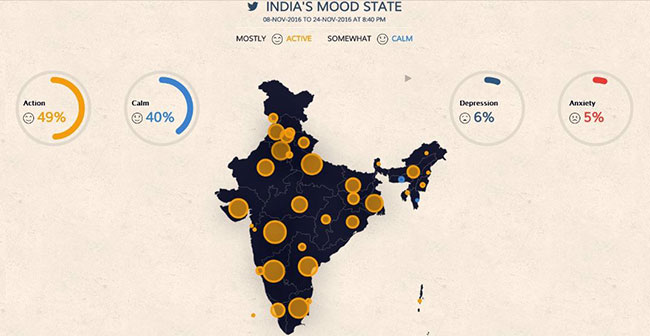
Maxus Kaleidoscope mapped the mood basis the location based Twitter and Instagram conversations in India between November 8 and 24 by when one had a clearer picture of the how the initial euphoria of the demonetisation panned out over time.
Location0based Tweets and Instagram Posts oscillated largely between Action oriented and Calm Moods in the fortnight since the demonetisation from an All India basis. Calm moods were dominant in the North Eastern states of Mizoram and Meghalaya as depicted in the map below.
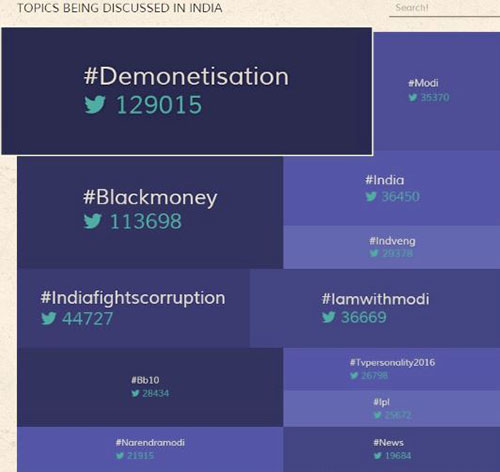
Nearly 5 lakh conversations on Twitter and Instagram made up the Top 10 trending topics. Demonetisation accounted for six of the Top 10 trending topics since the announcement of which the Prime Minister garnered half of the trending topics. #IamwithModi and #Modi were the topics that made up for 19% of the conversations within the top 10 trends. Cricket shared a bit of the spotlight from demonetization thanks to the ongoing England-India test series.
A total of 23 brands of were linked to the top 10 trending topics during the past fortnight. These brands factored in slightly over 30% of the total conversations of which PayTM (avg. 53% association) and SBI (avg. 16% association) carved out the larger part of the Brand Share of Conversation.
Samsung and Amazon also managed to gain a significant share of overall conversations however Samsung conversations were largely based on humorous conversations around the Samsung Galaxy Note and demonetisation of currency notes.
The Top 5 metros reflected similar patterns of Moods where Action dominated the moods however there were some days especially like November 17 in Delhi when the expression of Calm gave way to Action. Additionally Tamil Nadu showed a blip towards Anxiety on the November 18, 19 and 21 when subsequent announcements of the demonetisation easing by the government and news of the CM Ms. Jayalalithaa seemed to have driven up the specific mood.
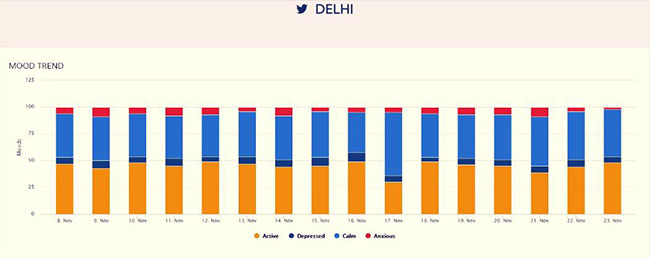
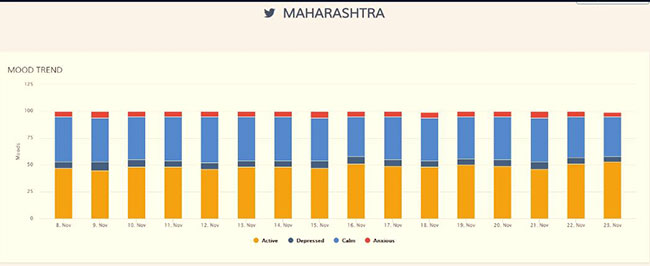
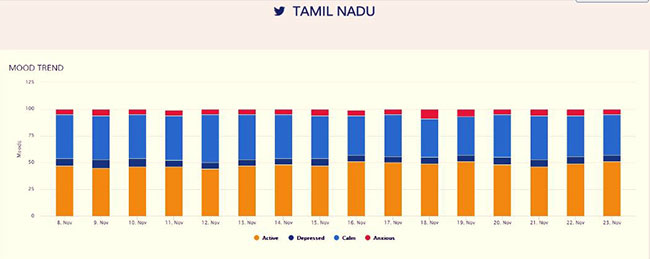
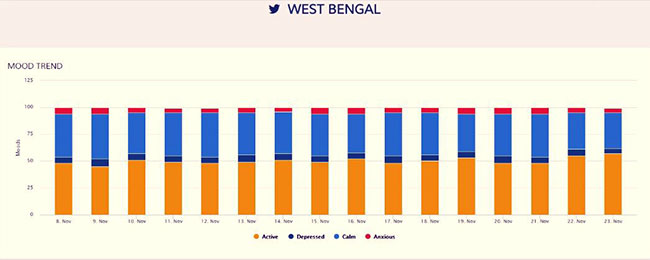
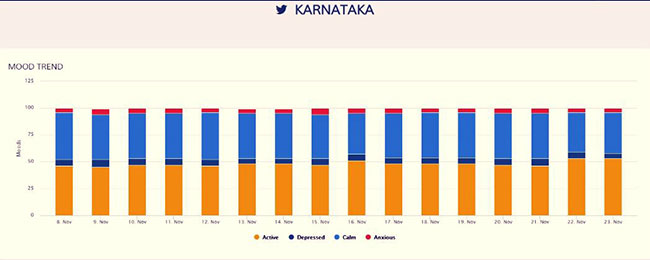
Overall, across the top cities in India there is a sense of patient restraint as the demonetisation moves on into the 3rd week and nears the critical end of the month period when cash flows really come into play.