
Tag: Paritosh Joshi

  • Paritosh Joshi: Independence and Free Media

    By Paritosh Joshi


    Constitutional Law is assumed to be arcane, dense and generally beyond the comprehension of anyone except the most learned of legal minds. And yet, some of the most soaring, inspiring expressions of humanity’s pursuit of a higher ideal, the greater good, a more just world are to be found there. Here are two splendid examples:


    “WE, THE PEOPLE OF INDIA, having solemnly resolved to constitute India into a SOVEREIGN SOCIALIST SECULAR DEMOCRATIC REPUBLIC and to secure to all its citizens:

    JUSTICE, social, economic and political;

    LIBERTY, of thought, expression, belief, faith and worship;

    EQUALITY of status and of opportunity;

    and to promote among them all

    FRATERNITY assuring the dignity of the individual and the unity and integrity of the Nation;

    IN OUR CONSTITUENT ASSEMBLY this twenty-sixth day of November, 1949,DO HEREBY ADOPT, ENACT AND GIVE TO OURSELVES THIS CONSTITUTION”.


    “Congress shall make no law respecting an establishment of religion, or prohibiting the free exercise thereof; or abridging the freedom of speech, or of the press; or the right of the people peaceably to assemble, and to petition the Government for a redress of grievances”.


    84 words in that first quotation, the Preamble to the Constitution of India (and it was only 82 before Indira Gandhi imposed ‘SOVEREIGN SOCIALIST’ upon it vide the Forty Second Constitution Amendment Bill, 1976) and a mere 45 in the second, the Second Amendment to the United States Constitution. Look at how emphatic both are on the matter of Free Speech.


    Why should this be so? Jurists aver that all other fundamental freedoms can be logically derived from Free Speech. Conversely, truncate Free Speech from the rights enjoyed by the citizens of a nation-state and you have an inevitable path to oppression and tyranny. The Scottish essayist, Thomas Carlyle in his book On Heroes and Her Worship cites the British Parliamentarian Edmund Burke as the progenitor of the phrase “Fourth Estate” to describe the Press. The quote that has passed into common usage is: “There were Three Estates in Parliament; but, in the Reporters’ Gallery yonder, there sat a Fourth Estate more important far than they all”. The importance of this Estate grows exponentially as private and state power expands in a rapidly growing Socio-Economy. By ensuring that the reader or viewer is kept abreast with the latest developments in the world around them and, in particular, calling out malfeasance, misdemeanour and mischief in high places, the media keep untrammelled might in check.


    How well are we inIndiadoing on this front?

    Not very, one has to say, with the greatest regret.


    Doordarshan, set up with an ambitious charter of achieving everything from “Catalyst for change”, “Promote National Integration” all the way through to  “Create values of appraisal of art and cultural heritage” has now been reduced to an anamic copy of private Hindi GE channels. So much for our much vaunted “Public Broadcasting System”.


    And have the private broadcasters covered themselves with glory? Let’s look at news in India’s most widely spoken language: Hindi. With a potential audience footprint running into several hundred million people, the genre must surely recognize its indispensable role in protecting the rights of this, often disadvantaged, class of viewers / citizens. What do they actually get? A puerile confection of tabloid sensationalism, GE quasi-reruns and an endless barrage of news pablum.


    Can we be hopeful that things can or will change? Yes. For the strangest reason.


    The promise of BARC to give us a wider and deeper understanding of the needs and interest of the television audience. And its other promise of shifting the inventory valuation from a relative currency (CPRP) to an absolute one (CPT). As broadcasters receive a more fair value for the product they sell, their need to be incessantly strident to get audiences or perish trying, will be replaced by greater sobriety and a renewed focus on creative quality.


    66th Independence Day Greetings to all my readers and their families!
     

  • Paritosh Joshi: 10 minutes ≠ 10 minutes

    By Paritosh Joshi


    “This time he has surely lost it”. “OK, I’m outta here”. “Back button”. Yes, I can see why my patient readers might one, or even all, of these reactions upon seeing the title of this week’s ramblings. And who could fault them. Those who have survived thus far, I beseech your indulgence for, let’s say, 10 minutes and it shall soon be clear.


    One of the most cited metrics of any medium is ‘Time Spent’. Newspapers boast about it. TV stations crow themselves hoarse over it. Even outdoor signage locations, hoarding sites for instance, invoke frequent traffic jams at a particular location as its virtuous attribute- after all it increases ‘Time Spent’.


    Unfortunately, not all 10 minutes are equal. A 10-minute journey interruption at Mahim Causeway is malodorous misery. A 10-minute gridlock at Red Road running through Calcutta’s much celebrated Maidan, on the other hand, is an opportunity to deep dive into the heart and mind of India’s oldest metropolis. The first would be marked by frayed tempers and terminally, perhaps irreparably damaged olfactory sensors. The latter would conceivably result in new knowledge about: the human condition, the mythic status accorded to Football in Calcutta and Indian Marxism.


    I get two business newspapers. I spend 10 minutes flipping the pages to pick up stories that will probably feature in the day’s conversations. Then I pick up the other one and go to the Edit and Op-Ed pages where I expect to, and always do find, thought pieces that will provide real grist to the intellectual mill. This too lasts 10 minutes but the two are of materially different character.


    Unfortunately, our audience measurement systems, no matter which medium they address, focus primarily on weight and very little on quality of engagement. This is hardly unique and not good reason to beat up on the systems or their providers, however. This is how they were all designed historically and the legacy isn’t easy to shake off.


    This is a short piece so I won’t get into much detail today but more will follow on what such systems might look like.


    Paritosh Joshi was until recently CEO, Star CJ. He has been a marketer, a mediaperson and on the Board/committees of various industry bodies. He can reached via his Twitter handle @paritoshZero


  • INMA 2012: ‘Industry needs currency that measures across platforms’


    By Shruti Pushkarna


    Basant Rathore
    If you are having trouble in viewing this video, see link

    Like Day 1, Day 2 of the 6th INMA annual South Asia conference also witnessed some interesting panel discussions pertaining to issues facing the news industry today.


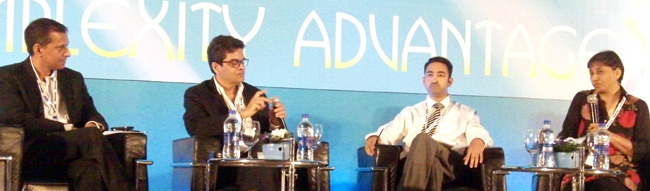
    The first half witnessed an engaging session on, ‘Increased Circulation, Dwindling Readership: Is It Time to Measure “Access”?’ The session was moderated by Lynn de Souza, Chairman & CEO, Lintas Media Group. The panelists included Paritosh Joshi, Independent Media Professional & Board Member of MRUC; LV Krishnan, CEO, TAM Media Research Pvt Ltd; and Basant Rathore, Vice President-Strategy, Brand and BD, Jagran Prakashan Ltd.


    The panel debated the need for new matrices of measurement which can complement the conventional audience measurement matrices, as today the audiences are increasingly becoming platform-agnostic.


    Ms de Souza said: “People seem to be very attached to these numbers. But while numbers are important, we need a currency that goes across platforms. We need to be able to measure new forms of readership. From circulation and readership, we need to change our metric to media access.”


    Lynn de Souza
    If you are having trouble in viewing this video, see link

    Mr Paritosh Joshi shared a similar view on the need to look beyond the primary level numbers which he felt are out of date. He said that there are two sorts of media consumption today, structured and unstructured. It is equally important to be able to measure and take into account unstructured media consumption. Just as there are enough screens available today and not just the traditional TV box, he said, the newspaper is not just in the traditional paper form, it is available in other forms across platforms.


    Mr L V Krishnan talked of two news aspects coming out in the digital world: “One is the increasing access which is changing things dramatically. The other is multiplicity of brands transiting between different mediums. For instance, a Bombay Times with Zoom or an ET Now with The Economic Times. The nature of one medium declining and the other growing will depend on what the creator of the brand wants to deliver via a particular medium.”


    While there was agreement on the importance of numbers and currency, the panelists also highlighted the need to move beyond the existing currency.


    Mr Basant Rathore of Jagran said: “Digitization has blurred not just geographical boundaries but also boundaries between mediums. Today we don’t have a clue of numbers in digital media, but they are definitely going to grow. If these can’t be measured, monetization becomes a problem. The advertisers know that the game is moving beyond the existing currency. The research we had till date was about currency but the advertisers are now talking about engagement.”


    Mr Joshi added: “The existing measurement systems are accused of fudging numbers. With the new IRS, even real time tracking of interviews is possible. It will be a like a core end satellite model and this will enable us to respond to changes that are happening in the environment. Earlier we looked at data in a cross-sectional slice but what’s of interest to an advertiser is what happens to a consumer through the day. With the new measurement matrices, we are thinking of capturing all digital research to get a horizontal longitudinal view of a consumer’s media movements.”


    The panel also agreed on the need for industry to be willing to adopt new matrices of measurement and to support measurement that looks beyond primary access numbers. Mr Rathore concluded: “Numbers will continue to be important because that’s the benchmark for trade to happen. But if you need to grow, it’s important to leverage the media brand across media platforms and so we need to know what’s happening across platforms. And that’s why we need to be open to the measurement of other metrics.”


  • Paritosh Joshi: Not another piece about the Ratings Battle

    By Paritosh Joshi


    You’ve already read enough of those so I’m not about to inflict one more upon you.


    However, if this week’s piece sounds like a lesson in elementary Economics, so be it. You were warned.


    Prices are not divinely ordained. As Adam Smith taught us, people enter a market when they wish to sell or buy goods or services. A process of negotiation follows. This depends at least as much on perception as it does on objective reality (whatever that is). An Alphonso orchard owner in Devrukh Taluka of Ratnagiri District believes that the output is plentiful, demand is scanty and he will be fortunate to sell his output at whatever price the Arhati (broker) offers him. You, in Delhi or Mumbai believe that unseasonal rains destroyed the crop, all good produce was immediately exported to grace the plates of Sheikh Al bin Mighty in wealthy Saudi and you must feel grateful for a dozen prized fruit at Rs1,000. So much for objective truth. The story can have a very different outcome if you add just one ingredient: inquiry. The orchard owner (who now owns a cell phone) calls up his office boy cousin in BKC who shares the street price in Mumbai… Yup, you can infer the rest.


    When people sell goods, they have the ability to warehouse their produce. I can sell my mangoes today or I can choose to hold on to them ’til tomorrow in the hope of a better price. When people sell a service, this is not possible. As a daily wage worker, I cannot carry forward my 10 hours of work from today and then do 20 hours for a higher realisation tomorrow. In general, therefore, services are far more perishable than goods. Their instant or near-instant perishability frequently translates to service providers being extremely vulnerable to extortionate price negotiations with buyers. This is where things begin to get really interesting. When the ‘perceived’ nature of a service becomes exceptionally rare, the price it commands becomes truly astronomical. A brilliant lawyer who wins suits for megacorporations and global telcos bills over a Million Dollars a week. We all pitch in, indirectly and sometimes directly, to pay a few exceptional, and exceptionally fortunate, cricketers eye-popping sums to bowl or bat. MJ, Elvis, Frank and Janis continue to weave musical (and commercial) magic from beyond the grave, their services having been warehoused to meet the needs of our hungry ears for years and years. Heck, even weight loss advisors called AM or VL pull down zillions to help you lose what you should never have gained. Most times, these incalculably precious eminences share a common secret sauce. Their raw material, which was admittedly of rare quality, has been honed and polished to a rich lustre by various players in the Media & Communications industry. They have in fact crafted the ‘perception’ of exceptional rarity that translates into astronomical price. They are the impresarios, the image-makers, artisans of myth, masters of smoke and mirrors. In a word, they are someone like you.


    If you were an extraterrestrial, say Ford Prefect, the galactic hitchhiker from Douglas Adams’s eponymously named trilogy in five parts, who happened to stumble upon the Indian M&C industry, what might you see? A bunch of talented creative minds building wonderful brand successes for their clients? Or a bunch of neurotic, insecure sales people unable to defend fair profit margins and constantly prostrating themselves before the extortionate buyer up the value chain from them?


    More likely the latter than the former, I have to say with the deepest regret.


    The very people who create images for their clients, thereby making them immune to the vagaries of elastic demand and endowing them with that ineffable je ne sais quoi, are the same people who have reduced their own business to a commodity-esque fish market.


    How did this come to pass? A friend worked for HTA Bangalore. Ivan Arthur, then NCD and already a legend of the industry, was visiting the office and decided to drop in on a Saturday morning. Said friend was toiling away getting press advert artwork pasted up in studio to hit material deadline for a Sunday Deccan Herald insertion. Ivan asked friend what she was doing in the office on the weekend. Friend meekly acknowledged demands of tyrant client who expected agency to be at his beck and call… around the clock. Ivan offered these three comments:

    Weekends are meant to regain the intellectual and emotional energy expended during the week, so that the professional can come back fresh and rarin’ to go on Monday.

    If you don’t respect yourself, why should anyone else?

    Abject surrender before the client is not only unjust to the agency; ultimately it is unjust to the client too.


    Read this metaphorically rather than literally and then address these questions to yourself. When the first agency offered to drop its commissions from 15 per cent of gross, (17.65 per cent of net billing) to some smaller number, the agency took a huge step back for the industry. When those commissions kept heading south for many years to come, a whole generation’s future in the industry was blighted by the long shadow of the small League of Damned Arbitrary gentlemen. I hasten to add that this kind of extortionate bullying of service providers was not just about agencies; the broadcasters succumbed to it too.


    No wonder then that as an industry, we have brought ourselves to this parlous place.


    We have cheapened ourselves.


    Paritosh Joshi was until recently CEO, Star CJ. He has been a marketer, a mediaperson and a key officebearer on industry bodies. He is Strategic Advisor, Ormax Media. He can reached via his Twitter handle @paritoshZero


  • Paritosh Joshi: How to make a really spectacular mistake

    By Paritosh Joshi


    In all our lives, there are tales of misadventure that we bury away deep and try our darndest to forget all about. Today it’s time to ferret out just such a story from the not so distant past and see if there’s something, anything, we might learn from it.


    The year was 2007. Private Television broadcasters were trapped in a financial vice. Costs were on a tear as good content: entertainment, sports or news, commanded big premia. Revenues crawled as new entrants into every genre constantly expanded advertising inventory and made price increases difficult. While advertising revenues were still growing, a lot of the increase was attributable to ever-laxer controls by broadcasters on advertising duration leading to flat, or even declining, yields. As an advertising sales person myself, back then, I asked for an analysis of Average Spot Rates (ASR), a very commonly used and easy to compute yield metric, across key genres and channels for the previous three years. My hypothesis, which proved agonizingly right, was that the bulk of revenue growth for channels was coming from selling more inventory and little or none from better ASR. Obviously, I wasn’t the only one seeking such analyses and soon the issue began to dominate all conversations between broadcasters.


    Here was what the broadcasters were seeing:

    • Television penetration was galloping along, adding up to 10 million new homes, up to 45 million viewers of age 4 and above, every year.
    • Cable penetration was growing by almost an identical figure, having moved up from under 30 million homes in 2005 to over 47 million in 2007.
    • GDP was up 9 per cent for 2007 over 2006 and maintaining healthy buoyancy.
    • Distribution revenues were not a source of any joy as platforms had begun to seek carriage fees to monetize the chronic scarcity of capacity on a decrepit analog network. In the meanwhile, TRAI was binding broadcasters hand and foot where it came to wholesale pricing of their content to platform operators.
    • Media agencies were relentlessly using the dreaded CPRP (Cost Per Rating Point) to pummel advertising prices down. Even category leading broadcasters were unable to exercise pricing power in the face of CPRP maths.
    • While more broadcasters constantly entered the market, the demand side represented by the media buying agencies was getting ever more consolidated. Already, the top two agencies controlled very nearly two-thirds of the advertising spend on TV between them. They had achieved this, primarily, on the back of their ability to extort low prices using their virtual oligopoly combined with the willingness to drop commission rates to low single digit percentages. While the standard terms of trade indicated a 15 per cent agency commission on TV advertising, the media majors were actually working on less than 5 per cent, passing on the spread as additional discount to the advertisers.


    It was clear to broadcasters that the situation could no longer be permitted to drift but what were they to do and how? A team of planners from across broadcasting organisations was asked to develop a recommendation. Everything had to be done with considerable secrecy, lest word get out and the project be stillborn. The plan was in. Voila! We would all, every last one of us, collectively impose a 25 per cent surcharge.


    Needless to add, the plan asked for way more resilience from broadcasters, particularly the small and vulnerable ones, than they could muster and in a classic predator-prey drama, they were arm-twisted on the pain of the death-of-a-thousand-cuts by M-this and M-that into abject capitulation. The plan unwound within 72 hours leaving a lot of us with unpleasantly puce visages. An awful mistake had been made. I could tell you the whole ugly story of who shafted whom, when and where but sadly, in a reversal of the trope, if I told you, someone would have to kill me.


    Now here is the really terrible story. Most everything that made the revenue story look grim in 2007 for broadcasters still looks exactly the same in 2012. Indeed worse in many cases, like for the anæmically bloated Hindi News genre for instance.


    What is the broadcast industry doing about it? Can something be done about it at all?


    First, until TV advertising is valued based on a relative, rather than absolute currency, pricing power will remain solidly with the buyers. Until we shift from the iniquitous CPRP to the universally accepted and economically fair CPT (Cost per Thousand contacts), this will not happen.


    Second, all stakeholders in the BARC (Broadcast Audience Research Council) process would be well advised to apply their might to moving it from idea to execution.


    Hmm. Someone will have to kill me after all.


  • Paritosh Joshi: _____________ Maketh A Man

    By Paritosh Joshi


    Surely, you are wondering why I chose to leave that first word blank when everyone knows the word that completes the aphorism?


    A Methuselah of our Media & Communications business came by a few years ago, when I was still gainfully employed and not a lily of the field, to talk about the media and their place in our lives. The conversation made an impression on me, abiding enough that I am compelled to develop it in today’s essay.


    Let me rewind to my early memories circa 1968.Kanpurhad no local English newspaper. The Times of India would ship theDelhi‘Dak’ Edition to our mofussil outpost. By the time the (now only of distant memory) Toofan Mail with her imposing steam locomotive growled intoKanpurstation with the precious newspaper, it would already be a day late. The news wasn’t yet stale, mind. After all, the only other source of news and current affairs we had, was the nightly bulletin on All India Radio delivered in the richly textured baritones of Jasdev Singh, Ashok Bajpai and their ilk. I must add that the scratchy Short Wave signals that our prized Murphy radio managed to extract from the ether made listening challenging at the best of times. Barring the most momentous of events and emergencies, the world beyond the nearest 10 kilometers was at least two days away. And it didn’t matter. Life, as we led it then, had little or nothing to do with the world beyond.


    Fast forward to 1977, nearly a whole decade later. We lived inNasikjust 175 kilometers fromBombay. Yes, in those days it was stillBombay.  Here was a city that offered not just one but TWO local (also local language) newspapers, Gavkari and Deshdoot. Times ofIndia,Bombay’s Dak edition would reach us the same day except it probably carried the previous day’s stories. There was still no television inNasik, so we still were served only by the stale newspaper and the highly expurgated radio. Not a lot had changed. Our lives continued to be led in the isolation and serenity of small townIndiaand, quite frankly, we didn’t think we were missing anything.


    Things began to change with the move toBombayin 1980. Suddenly, a television arrived at home. Black & White it may have been and only for a few hours of low fidelity transmission every day. And featuring exciting content such as missing people’s reports and Krishi Darshan, the farmers’ show, only occasionally spiced up with Chitrahar and Chhayageet. From consuming less than an hour’s worth of assorted media (perhaps half an hour each of radio and newspaper), our days now had at least another hour dedicated to TV.


    Television continued to grow. Print began to proliferate, not just in the form of a growing range of magazines, but also as a daily in the form of the afternoon or evening tabloid. Soon there was a Mid-Day fan and an Afternoon aficionado; an India Today enthusiast and a Week loyalist; a Stardust addict and a Filmfare feeder. Between all the diversity now available to them, many consumers were spending several hours a day just consuming all the options they were fond of.


    Cut to 2012. From perhaps 2 or 3 hours of exposure to various media a day, the modern urban Indian probably spends 4 or more hours a day consuming or in some way interacting with one medium or another. And it is no longer just urbanIndiaeither. DTH is available all over the country and a subscriber in the most remote hamlet has to just train its little antenna toward the sky to receive the latest content from around the world, a lot of it for free, in full digital video and Dolby Stereophonic Audio.


    People are defining themselves by the mix of content they consume.


    Can there be a segmentation approach that is based on shared commonalities AND uniquenesses in the way people consume the media?


    Which is why I left that heading blank.


    It really ought to read:


    Media maketh the man!


    Paritosh Joshi was until recently CEO, Star CJ. He has been a marketer, a mediaperson and a key officebearer on industry bodies. He is Strategic Advisor, Ormax Media. He can reached via his Twitter handle @paritoshZero


  • Paritosh Joshi: Everything I had to know, I heard it on my radio

    By Paritosh Joshi


    Three times this last week, radio has crept into my conversations, with three quite different people. Let me cite just one. We were talking about our preferences between playing music from our CD collection and dialing up a radio station. My guest was enthusiastic in his approbation for the radio, for a very simple reason too. “When you play music from your collection, you always know what’s coming up next,” he said, adding: “and what makes radio fun is it’s an endlessly unfolding sequence of surprises.”


    To which I would add that there is something rather relaxing about leaving the hard work of choosing what plays next to someone else, indeed someone else who is specialized in the art and craft of assembling and running through playlists.


    Got me thinking about radio, so it was the obvious next step to check out what the industry association offered up. Wasn’t hard to locate the website of the Association of Radio Operators for India (AROI). Promptly went there to discover – well, not a lot. Had to get something on the industry and thankfully, the good people at KPMG and FICCI had the latest “Indian Media & Entertainment Industry Report” available for download, which I swiftly proceeded to do. Here’s what I found.


    The Radio industry in 2012 is worth a mere Rs13 billion, ~ US $ 240 million and represents a mere 1.6 per cent of the overall industry of Rs 823 billion, ~ US $ 15 billion.


    In five years, it is projected to grow to Rs 29 billion, still just ~ US 540 million but representing a slightly more respectable 2 per cent of the overall pie. Evidently, this will require it to grow faster than the overall pace, which it is projected to do, clipping along at a 21 per cent CAGR even as the overall number doesn’t quite get to a 15 per cent CAGR.


    Dig deeper and you will find that a lot of the enthusiasm stems from FM Radio Phase III which will introduce private FM to as many as 227 new towns. So that is all it takes to make radio exciting, is it?


    Let’s take a look elsewhere and find out what radio is really about. A good place to start is any of these: Last.fm, “tunein.com” Radio or “shoutcast.com” Radio Directory. All of them are aggregators, like the portals of yore in some ways, which offer you an endless variety of radio stations from across the planet. An important aspect of what is on offer is the range of ‘genres’ by which the stations are classified. Here’s a list of the genres under the broad category, ‘Music’ on TuneIn:


    Adult Contemporary Country Hip Hop Rock Top 40-Pop
    Blues Decades Jazz Soul World
    Classical Easy Listening Oldies Spanish
    College Electronic-Dance Religious Specialty


    Just in case you might think this was a bewildering choice, I have news for you. ‘Sports’ offers a choice of 21 genres, including, trust me, ‘Fantasy League’.


    The point I’m making is quite simple really. Radio is all about precise choices and tightly defined audiences. Stations have an unapologetic and uncompromising commitment to their audiences and are only able to attract them because they stick to playlists that reflect the choices of their highly differentiated audience.


    What does the picture look like inIndia? Our earliest templates from what radio stations must sound like came from Akashvani, the one channel that catered to our teeming millions long before the brash youngsters arrived on the scene with FM Phase I.


    Akashvani was the ‘one size fits all’ / ‘any colour so long as it is black” radio station. From programming in two, even three, languages to carrying everything from mythologicals through adventure serials (anyone remember Inspector Eagle here?), to the News and various topical features, radio did everything – catered, as it were, to the lowest common denominator.


    Look at where we are now. Barring one station that chooses to play a purely Western playlist, all our major metros run a whole bunch of stations whose content is largely interchangeable, mainly because their music and even anchoring style – chatty, hip youngsters doing their clever, irreverent thing, are right out of a cookie cutter.


    Now before I get flamed out by radio folks pointing to the compulsions of recouping sizable licence costs, I must beg forgiveness and hide behind the defence of ignorance. What I do know, however, is this cannot possibly be the best way for radio to go forward.


    Radio must target tightly and then programme obsessively to that chosen audience. “Let me be just like everyone else” is not good marketing in any category, least of all radio. Keep in mind that radio will shift away from airwave frequencies to the Internet. That’s when the same-same (known, I believe, as Adult Contemporary) content will die anyway.


    I began by invoking Queen’s Radio Gaga and can’t help but quoting again from the same, wonderful song at the end.


    “You’ve yet to have your finest hour Radio – radio”


    Paritosh Joshi was until recently CEO, Star CJ. He has been a marketer, a mediaperson and a key officebearer on industry bodies. He is Strategic Advisor, Ormax Media. He can reached via his Twitter handle @paritoshZero
  • Paritosh Joshi: So you want a job in the Media?

    By Paritosh Joshi


    MBA from a leading business school in the American Midwest, two years with a boutique investment bank in Boston and then this young man lands up for a chat about what he needs to do to get a job in the media.


    It is still easy to think there is a clear demarcation that sets the media apart from the rest of the world. Aamir, Ashton, Arnab and Aishwarya are in the Media. (They don’t even need surnames to identify them). Media people ‘need no introduction’. Us grunts have nothing worth introducing and thus, don’t need to be introduced.


    Or is it so simple?


    There were the Media people but they were few and readily identified as such. M J Akbar dazzled us with his insight in columns for a newspaper he edited. Rajat Sharma put people into the dock, quite literally, as he hosted a talk show. Derek O’Brien got all of us furiously scratching our heads even as he quizzed school kids. Madhuri Dixit sent testosterone levels into orbit merely by counting from 1 to 13. And Lalu had to invoke Sridevi’s cheeks in search of a universally comprehensible metaphor for Bihar’s roads.


    Then Tim Berners-Lee came along and changed everything, although for years after he thought up hypertext in an obscure corner of CERN, we would scarcely have known it.


    By the late 90s, regular blokes discovered that it was possible to find a wider audience for their periodic rants on WWW than they previously could muster around a water cooler or in a cafe. The web log, then portmanteau-ed to weblog and finally truncated to blog was born either in 1995 or 1997 (you can find an interesting history here).


    Then blogger came along in 1999, bang in the heady days of the Dotcom Boom and setting up a blog became Luddite-proof. From the very beginning, the blogging community had a wide range of interests and capability. The largest majority would create an account in an idle moment never to visit it ever again. A few would invest time and effort in their posts and endeavour to reach out to an audience with regular, engaging updates. Remember that these were people operating far away from the conventional notion, but what they were doing was indisputably publishing.


    Everyman had just stormed Fortress Media.


    It began with the written word. Soon enough, authors had found ways of adding pictures to their words. And the web was becoming more clever all the time. It was able to transport not just text but sound and video too. Also, devices to record audio and video had started to shrink in price and size even as they got massively more powerful, thus putting near professional quality sound and image acquisition within reach. Events unfolded at a rapid pace thereafter. Amazon pioneered a lightweight handheld device for reading digital publications. The Kindle was a runaway success and for the first time, books could be self-published by anyone with a good idea and capable penmanship without ever being imprinted onto the dead-tree medium. Soundcloud allowed wannabe speakers, singers and instrumentalists to distribute their art and craft without surrendering themselves to the crafty gnomes of the music industry. Youtube opened doors for every standup comic, ballerina, burlesque queen and cute kitten to show off its talents on glorious Technicolor video.


    But wait, we were talking about an investment banker contemplating a career in the media. So what’s with this long riff about what we now refer to, rather condescendingly I might add, as User Generated Content?


    Well, it wasn’t just individuals that got inspired to start using the all new powers of WWW to talk to their “Audience”. Businesses of every stripe saw the opportunity too. To be rather more honest, what they saw was consumers – happy and irate, sounding off about their brand experiences in these wide open spaces and were left with little choice but to deal, for better or worse, with what they were getting. Surely we’ve all heard the now almost apocryphal story of Coca Cola’s attempt to take down a fan page on Facebook that spectacularly backfired? To the point where they had to pretty much say ‘Let bygones be bygones and let’s be friends’? (Moral: Don’t clobber, co-opt).


    You see what’s happening here. Companies and brands were becoming broadcasters and publishers.


    At no time before in the history of our human civilization has communication across every conventional fence and barrier been so easy, inexpensive and by implication pervasive or ubiquitous. And barring the rare exception, individuals and entities find it more productive to be participants in this endless feast of reason and flow of soul than mere mute spectators. There’s even a taxonomy to describe different levels of involvement with media: Paid media are, as the name suggests, those that you have to buy access to. Earned media are where the media voluntarily carry news or content about you. Finally, owned media are, again as evidenced by the name, those that you own and control. Who doesn’t want earned and owned media?


    And what was it that we were talking about when we began this ramble? Ah, yes. A job in the media.


    I told the young man, he could stop looking. After all, every job- FMCG, Banking, Automobiles, Telecommunication, <insert randomly chosen industry name here> eventually, was going to be a job in the Media.


    Paritosh Joshi was until recently CEO, Star CJ. He has been a marketer, a mediaperson and a key officebearer on industry bodies. He is Strategic Advisor, Ormax Media. He can reached via his Twitter handle @paritoshZero


  • Paritosh Joshi joins Ormax as Strategic Advisor

    By A Correspondent


    Paritosh Joshi, former CEO-Star CJ, will now be associated with media research and consulting firm Ormax Media as a Strategic Advisor. Mr Joshi recently decided to step away from the corporate world after a 27-year career that spanned from FMCG marketing and Commodity Trading to Perfumery and Broadcasting*.


    In his advisory role, Mr Joshi will engage with the research and business teams at Ormax Media across various aspects of their work. Speaking about the association, Shailesh Kapoor, CEO, Ormax Media, said: “I am delighted to announce that Paritosh has accepted our invitation to take up the role of Strategic Advisor. With his experience in the media business, as well as his close involvement in several industry initiatives, he will bring a unique and fresh perspective to the table, that will help us, and by implication, our valuable business partners’ community.”


    Speaking about his new role, Mr Joshi said: “Ormax Media are doing some path-breaking work in developing new metrics altogether for television and film industries. I have a deep interest in audience measurement, and this engagement is another way of delving into this vast landscape, even as I get to work alongside Shailesh and his splendid team.”


    Disclosure: Paritosh Joshi writes Media Matrix on MxMIndia.com every Thursday


  • Paritosh Joshi: Who will cast the first stone?

    By Paritosh Joshi


    You’ve got to give it to Aamir Khan. Any theme he raises through his cinema, and now his television show, instantly becomes the issue du jour. Dyslexia (Taare Zameen Par), rigid education practices (Three Idiots), anguish at the political establishment (Rang de basanti), morality of terrorism (Fanaa) and now in rapid fire succession the weekly episodes of Satyameva Jayate (everything from female foeticide to medical malpractice). If the worlds of the social media are anything to go by, people in the Media & Communications industry are particularly engaged in Aamir’s weekly broadsides. Minutes after the week’s episode goes on air at 11am on Sunday, Twitter is deluged with views and opinions agreeing, and less often disagreeing, with Mr. Khan.


    You would imagine, looking at the stridency of tone that characterizes a lot of the chatter, that we belong to an industry that has solid claim on the high moral ground. Does it?


    I became involved with the Advertising Standards Council of India (ASCI) about 6 years back. As a communication professional, I was conscious of the close and incessant scrutiny that our industry attracted and of the permanent Damocles’ Sword of statutory regulation that hung over it. The ASCI charter’s commitment to self-regulate resonated strongly with me and joining the Consumer Complaints Council, which gives force to the Self Regulatory Code of the ASCI, was a natural next step.


    If Awards Functions like the Abbys and Cannes are the Halls of Fame of the industry, CCC must qualify as its identification parade for the Rogues’ Gallery. Education institutions that claim their superiority, not based upon quality of education facilities they offer, but the acreage of their campus. Cooking oils that assure you of defence against cancer. Fairness potions promising enhanced employability. Malted beverages that deliver anything from height gain to better grades in the exams. A whole spectrum of beers and spirits veiled very thinly under guises of ‘Music CDs’, ‘Unique Events’, ‘Golf Equipment’ or ‘Soda’. Apparatuses that promise the benefits of a cardio workout by merely placing your feet in a harness and allowing them to shake about for a few minutes. Perfumes and deodorants that will instantly cause the user to become a sexual dynamo around whom people of the other gender experience spontaneous orgasms. Plastic beads and metal baubles that will ‘guard against the evil eye’, pacify irate planetary deities and result in a shower of wealth. Or in a particularly horrifying instance, a hospital that advertised radical hysterectomies as a permanent solution against pre-menstrual syndrome. We’ve seen them all.


    While some offenders are no-name businesses, the largest majority are big and prominent businesses that we all hold in high esteem. Indeed, we must look well beyond the brand owners to understand the circle of culpable accessories that enable the offending communication to reach the consumer. The creative work originates in an advertising agency. A marketing team approves it for release. A media agency sets up a media schedule. Multiple media outlets finally convey it to the consumer. In many cases, all the organisations that are involved through this value chain are members of the Advertising Standards Council by virtue of which they are presumably committed to the ASCI Code. While the complaint is made and upheld against the brand owner, the actual burden of guilt correctly lies with all the accessories that participated in the process.


    Interestingly, whenever the issue of legally dodgy, false, misleading or vulgar advertising crop in professional discourse, the ASCI is indicted forthwith, for its abject failure in bringing the perpetrators to book. Of recent days, the Ministry of Consumer Affairs has joined the chorus, promising a ‘National Consumer Protection Agency’ aka the other NCPA, to become the consumer’s paladin against advertising mischief. Apparently the phrase ‘Self-regulation’ is indecipherable to the average communication industry professional.


    Self-regulation begins by a body representing all stakeholders in a particular context agreeing to a code of ethical practice. This code is then widely shared with all stakeholders so that they may understand and assimilate its letter and spirit. Once this has been done, self-regulation transfers the burden of compliance upon the practitioner. The overseeing authority is not a policeman. It is a conscience keeper.


    This is an exhortation. A humble request. How clean is our own escutcheon before we pronounce moral judgment on all and sundry? Or as Aamir might say, “Apne ghirebaan mein jhaank kar dekha hai kabhi?”

    Paritosh Joshi was until recently CEO, Star CJ. He has been a marketer, a mediaperson and been a key officebearer on industry bodies. He can reached via his Twitter handle @paritoshZero

  • Paritosh Joshi: Unbundling the Living Room

    By Paritosh Joshi


    An erstwhile colleague was talking about the proliferation of the second television set. In her assessment, as many as 10% of all C&S homes now have more than one TV. Listen close. 10% of ~100 million homes. That’s 10 million multi-TV homes in the country. From 1 TV for every 5 viewers, the equation has changed sharply, for these 10 million homes to 1 TV for every 2.5 viewers. Evidently there will be consequences. (And as you shall soon see, it is even better (or worse) than that).


    Whether you look at Hindi, English or any of the languages in which TV is offered in India, there is a common architecture that defines the structure of the market. Three pillars hold it up: big and hefty General Entertainment, massive Sports (shared across language barriers by offerings only in two languages) and wildly proliferating News with lots of fragile strands. Since Sports really has no local identity, focused as it is on the national obsession with Cricket, and News offers no heft, the defining feature of TV in every language is GEC. Dig a little deeper and the content logic of the GEC genre starts to become evident.


    GECs got blueprinted by the late 1990s. Indeed, you could argue that the basic template was in place even long before that, in the form of Doordarshan. Homes had one TV. Most people in the family, barring the housewife, would be away from the home for educational or employment reasons for several hours a day. The family would only start to congregate in the Living Room from about 6 p.m. as the members returned from wherever the day’s chores had taken them. By 8ish, there was a full house and smart programmers would be offering up delights that everyone would lap up without discomfort or embarrassment. The stereotypical picture of the Great Indian Family sharing and bonding before the Great Indian Entertainment TV Channel would now be complete. It was almost hard to discern where the khandan on TV ended and the parivaar in the Living Room began.


    Anyone who lived through the late 90s and early years of this millennium will recall vividly, as the stentorian authority of Amitabh Bachchan delivering his signature ‘Namaskar! Aadab! Sat Sri Akal’ echoed through domestic hallways in over a half of our country, he would have everyone jostling to find their favourite spot before the TV dabba. Once said spot was secured, it would be squatted on until the day’s K serials and such wrapped up.


    While all Hindi channels picked up the simple formula of family values and ‘rona dhona’ very quickly- thereby making them all look like reduced sized copies of the industry’s 500 pound gorilla, the regional players weren’t far behind. The model was perfected in Hindi and swiftly exported to markets in all regional languages.


    In the meanwhile, India was getting more prosperous as the economy saw half a decade of near double-digit economic expansion. At the same time, the telecommunications revolution was well and truly upon us. Call rates for mobile telephony fell in a frenzied race to the bottom. Handsets started developing capabilities far beyond the basic voice and text and shedding the boring monochrome screen for a jazzed up colour display. More onboard memory with scope of incrementing it further by more and more capacious SD cards, faster processors and rendering engines that took blur and dullness out of the mobile desktop screen enabled altogether new consumption possibilities on the tiny (but also growing fast) cellphone screens. Other screens were entering the repertoire. A second TV was seen as a mark of upward mobility. Desktop computers were becoming indispensable particularly in middle class homes with school- or college-going youngsters.


    Sources of AV content were growing far beyond C&S TV with young, urban consumers discovering the forbidden joys of ‘torrents’ that had reawakened, in a new morph, the only recently exorcised Napster. And there were so many alternatives on where the content, thus secured, could be consumed. The second TV would often come attached to a DVD player, or even a gaming console both of which did a commendable job of playing content. Even the little mobile device in the pocketwas rapidly becoming powerful enough to store and play not just songs and clips, but long form entertainment sourced from friend and stranger.


    The tyranny of the compulsory assembly before the glowing siren in the Living Room was being challenged by sundry interlopers big and small that were leading an uprising of person specific content.


    Oblivious to these tectonic changes in the landscape, programmers and channel heads, with their heads still stuck firmly up their <scatology deleted> outmoded notions of the ‘One big, happy family’ continued to design and programme General Entertainment. “Hey, you can have a car of any colour you want”, they incanted, “so long as it is black”. But who was listening? The young ‘uns had already found shiny, sleek, colourful new rides that they could scoot away in.


    p.s. for Programmers and Channel Heads: You may not have noticed it yet, honey, but someone just unbundled the Living Room.


    Paritosh Joshi was until recently CEO, Star CJ. He has been a marketer, a mediaperson and a key officebearer on industry bodies. He can reached via the comments board below or his Twitter handle @paritoshZero.


  • Paritosh Joshi: Ratings & readerships must come with a Statutory Warning

    By Paritosh Joshi


    If you are reading this column with any professional interest, it is safe to assume you have done or been closely involved with one or more of the following things within the last year:

    • Sold media inventory
    • Bought media inventory
    • Planned a media schedule


    In any of these situations you would have to:

    • Define the target audience
    • Use widely used market research to assess and compare impact of the medium or media in consideration
    • Price the medium or media as a buyer or seller or assess its or their value for money for the advertiser’s planned media expenditure


    Inevitably, you would have to deal with television rating points, publication readerships, radio listenerships and the like. That’s where the fun begins.


    With the target audience.


    “Housewives SEC A and B, 5 lakh+ towns, UP,Bihar, Jharkhand”, one might say. “Men and Women, SEC A1, Top 6 metros” another might demand. Or even, “Women, SEC A1+, Mumbai and Delhi”. I have to add I am not inventing these, having heard them as specific asks or offers in situations I have been in close proximity to. To be sure, you could probably assign brands or media to all of them with not much effort. So far so good. It’s what happens next that makes no sense.


    Someone with access to the right research will actually produce numbers purportedly accurate to within a decimal point to size said target audience and the extent to which a medium or combination of media will reach it.


    This is bovine excrement, euphemistically speaking. Why, you ask?


    Because all media research is based on statistical sampling, not a person-by-person census of every reader, viewer or listener of show or medium. Statistical numbers are estimates. They work on the twin ideas that all large populations are distributed according to the Standard Normal Distribution, the good old Bell Curve that we are all familiar with. Put simply, the notion that in any large enough group, there are a few thin people, a few fat people and a lot of people of intermediate weight (thereby making you wonder what happened to all of us in the Media and Entertainment fraternity, or whether there’s also an ABnormal Distribution to explain it). And that if you were to draw an adequately large random sample from this normally distributed population, the sample would retain all the statistical characteristics of the population such as Mean and Standard Distribution.


    It can be shown that the minimum sample size required to ensure that the sample follows the behaviour of the parent population is 30. Samples of smaller size will exhibit asymmetries and other oddities of shape (things statisticians call measures of Skewness but never mind), that make them useless for drawing reasonable conclusions about their parent populations. As the sample available to extrapolate from becomes smaller, the error in extrapolation becomes larger, exponentially larger.


    Thereby bringing us back to the issue of ratings and readerships and such. Take readership and the Indian Readership Survey for a moment. About 67 per cent of India’s population of 1.2 billion, ~160 million households are represented by just over 2.5 lakh respondents. Put another way, every respondent represents nearly 1000 households. Things get even more interesting when you look at television metering.India’s 130 million (your guess is as good as mine on what the actual number is) are represented by ~8,000 meters.  Of course, TAM makes no claim to represent all India, so even if these 8,000 only represented the top 100 cities that have a 2011 population of 128 million or a population above the age of 4 of ~115 million people in over 20 million homes, there would still be only 1 meter in every 2,500 homes. We will get more generous and allow for the fact that TV penetration across the top 100 cities is 70 per cent. In other words out of 20 million total households, there are only 14 million TV homes. Even in this situation there is just 1 metered home in 2,000 TV owning homes.


    You see where this is going?


    As users slice and chop large aggregate populations and search for meaning in the samples that supposedly represent the segments thus generated, the available sample used to do the statistical prediction shrinks to a point where there is no predictive integrity within it. And yet, statistically naive people in every corner of our industry routinely use these frail foundations to build imposing edifices of brand and media transactions and planning.


    Then again, even the Taj Mahal is built on flimsy marshland that may eventually cause it to sink out of sight.


    So here’s the suggested Statutory Warning: “Irresponsible use of audience measurement may lead to impaired business diagnosis”.


    Paritosh Joshi was until recently CEO, Star CJ. He has been a marketer, a mediaperson and a key officebearer on industry bodies. He can reached via the comments board below or his Twitter handle @paritoshZero.