Tag: Ormax

  • The Rise & Rise of the IPL

    The Rise & Rise of the IPL

    Source: www.iplt20.com


    Shailesh KapoorThe 17th edition of the Indian Premier League kicks off tonight. To say that it’s the biggest media event in India by some margin will be stating the obvious. The gap between IPL and other big-ticket properties has only grown wider over the last decade.

    The stature of IPL is reflected in our new report, titled The Ormax Sports Audience Report: 2024. The sampling of IPL in the 612 million audience base of cricket in India is higher than that of the ICC World Cup, by a good six percentage points. The list of most-recalled sporting franchises in India (across sports) sees a clean sweep, with the 10 IPL teams taking the top 10 positions, ahead of Manchester United and Patna Pirates, which are the most-recalled leagues in football and kabaddi respectively.

    In its first few years, IPL faced its share of controversies. But in its second phase, the league has been able to put cricket first, and that has helped it move away from the erstwhile imagery of a flippant brand, towards building credibility as a talent platform. This shift is fundamental in nature, and has held IPL in good stead.

    IPL is now a way of life for those in the media industry. Till not too many years ago, there was a lot of chatter about how GECs should dodge the IPL googly. Now, everyone has a playbook of sorts, and it’s not a topic to lose sleep over, anymore.

    This year’s IPL will be held amid the political fervor around the General Elections. News-wise, IPL will play second fiddle. But in terms of monetisation and viewership, it will continue to stay at the top. The stronger franchises are profitable now, and BCCI continues to get richer with each edition. Yet, there’s ample room for growth, as fan bases are continuing to build, especially for franchises that have made late entries, or taken their time to get going.

    This year’s IPL will also see younger captains across most teams. The average age of the 10 captains this year is 30 years, which is three years younger than the 33 years average age in IPL 2023. The old guard is passing the baton to the new, and that’s always a good thing, especially in a talent platform like IPL.

    Amid all the excitement, the biggest highlight of this IPL is going to be the return of Rishabh Pant. The actor survived a near-fatal road accident in December 2022, and his incredible recovery over the last 14 months has been a miraculous one. How National Cricket Academy has helped Pant get back to match readiness against all odds is perhaps the best example of BCCI money being put to great use.

    Pant is leading the Delhi Capitals side, and their first match is scheduled for tomorrow afternoon, at Mohali. We can expect a roaring reception to a special talent, who first got noticed via the IPL itself, before making it big at the international stage. I won’t be surprised if he makes this IPL his very own, to announce a comeback we have all been waiting for. Game on!

  • Cinema: Mass Entertainment or Luxury Item?


    By Shailesh Kapoor


    Shailesh KapoorJust 22 million (or 2.2 crore). That’s the number of urban adults who watched three of more Hindi films in a theatre in 2022. Add kids and rural audience to it, and the number will still struggle to cross the 3 crore mark.


    This single data point, from our new report Ormax Cine Sense: 2023, brings a lot in perspective to how mass (or not) ‘Bollywood’ is. The equivalent of the 2.2 crore number was about 3.5 crore in the pre-pandemic years. It hovered around that mark pretty much through the period from 2013 to 2019, for which this data is available with us.


    In effect, we are talking about only about 2% of India’s population going to movie theatres to watch a Hindi film at least once in 3-4 months. The equivalent numbers for the four South languages will be known soon, and the all-India number may look closer to 6-7 cr, which is still less than 5% of India’s population. Movie-going is clearly not as mass as many believe it is.


    Over the last decade or so, the growth in box-office business has been fueled more by rising ticket prices than by footfalls. In effect, cinema-going habit has become more and more elusive. With a wide range of alternatives to watch movie content being available, including OTT and linear TV channels, there is very little incentive for an average Indian to visit a movie theatre. And once the habit is broken, it is a tough ask to reinstate it.


    It’s not as if films themselves are niche as a content type. Theatrical films routinely outperform high-profile OTT originals on streaming platforms. Despite being a huge theatrical success, Pathaan has managed viewership numbers like Amazon Prime Video’s biggest hit series in recent times, Farzi. And this is despite theatrical and paid streaming categories showing a sizeable audience overlap, to the extent of about 75%.


    Till a few years ago, there was a lot of talk about India being an “under-screened” market. But when most of India’s existing 9,000 odd screens are operating at less than 15% occupancy for at least 40 weeks in a year, opening new screens is not a prudent move.


    Outdoor entertainment, by its very nature, if a luxury item in the budget planning of most Indian families. A single trip to a theatre for a family of four can cost them most than annual subscription of three OTT apps. That’s why, the youth (15-30 years), driven by social needs, have been the dominant target group for Hindi film consumption since the multiplex era started about two decades ago. But even with India’s young population, the numbers are not sizeable.


    In what may almost seem like a contrarian view, I don’t see much of an issue here. If the Hindi film industry can come to terms with its premium positioning, they can go all out and target only the 2-3 crore people who really matter, and let others consume the content at their homes. This will lead to sharpening of focus at various levels. For example, you do not actually need traditional media to target these audience, almost all of whom are active on digital platforms. Or the entire debate about ticket prices will become irrelevant, once you identify a target audience who is willing to pay a premium for their outdoor entertainment.


    But that’s not to say that the content needs to be ‘elitist’ too. SS Rajamouli, Rohit Shetty, Sanjay Leela Bhansali and Rajkumar Hirani are the top four favourite directors for these 2 cr people. Escapism is still a dominant need that drives their decision to buy a movie ticket in the first place.


    With the exception of South India (which is the topic of another article for another day), movies are mass, but movie-going is not. It’s about time the industry gets comfortable with this idea.


  • Ormax Compass releases report on post-retirement expectations

    By Our Staff


    Consumer knowledge firm Ormax Compass released its report titled ‘Expectations of Post Retirement Life’ which delved into the minds of senior citizens from the Mumbai Metropolitan Region (MMR) to see how they imagined their retired lives. The study pointed out that in the MMR region by 2031, there would be 2.4 million senior citizens who will be living on their own. It further shows how retirees are relooking at their post-retirement plans in recent years.


    Among the notable findings of the study, senior citizens in MMR are prepared to live alone in a nuclear environment. Many respondents expressed their belief that they would probably be the last generation to provide care for their aging parents, and did not expect their children to take care of them during their old age. They believe that they themselves need to be prepared financially, physically and emotionally to take care of themselves. They are very pragmatic about this, and do not wish to be a burden on their children or family.


    Maharashtra with an estimated population of 125 million has an elderly population share of 11.7%, which is higher than the national average of 10%. It is projected to increase further, to reach a 15% share by 2031.


    The Indian 60+ population was increasing faster at 3.8% pa as against 2% pa previously. This is based on the 2011 census where the senior citizen number was estimated at 103 million, accounting for 8.6% of the total Indian population. By 2021, the number has increased to 139 million accounting for 10% of the total population. Life expectancy at birth in India was 69 years in 2014, expected to be 71 years in 2030 and is projected to increase up to 75 years by 2050.


    Said Priya Lobo, CEO at Ormax Compass: “Analysing the mindset of senior citizens in MMR could benefit in creating a congenial living environment. We observed a shift in senior citizens’ thinking and by the next decade, it may become a norm for elders to live on their own. Besides real estate, the Ormax Compass analysis should be beneficial for designing financial programs related to insurance and even plan corporate benefits for retiring employees. Senior citizens may not have been high focus for the realty sector as much as younger buyers. But today, the market seems to offer a big demand owing to the increase in base and changing mindsets.”


    The study also offers crucial cues for property and urban developers:

    – Medical facilities: 100% of senior-citizens surveyed, believe that easily accessible and reliable medical facilities are crucial. In the wake of the pandemic and the stress around emergency facilities, respondents believe that residential facilities in close proximity to hospitals and other emergency facilities are needed.

    – Track record: 90% of senior citizens surveyed, expect realtors to have a proven track record when it comes to development of realty projects. Observing a similar property and first-hand experiences are reassuring and likely to enable a positive decision.

    – Community living: 80% of respondents felt staying in a likeminded community is key, away from the hustle and bustle of city life but yet connected to Mumbai is what matters to them, when it comes to planning for a retirement abode.


    Respondents averred that a good living abode would help meet the best years of their lives ahead in a peaceful manner. While there were several expectations, the respondents also cited concerns such as the inability to find good, reliable domestic help for doing mundane chores or unseen disruptions to an otherwise peaceful and relaxing life.


    With rising income levels and relatively good health, a growing number of Indian senior citizens are now economically independent and willing to actively seek and choose to pay for facilities and services to fulfil their needs. Retired living communities will play an increasingly integral role in addressing these growing Active Ageing needs.


    The MMR region is home to several large government corporations like BARC, ONGC, RBI, HP, BP etc. Many of these corporations provide accommodation to their staff until retirement. Many of these employees are expected to retire soon. This makes it a good catchment area for retired living residences.


  • TV Industry Needs a Better Household Establishment Survey


    By Indrani Sen


    Indrani SenAs per the latest Performance Indicator Report (PIR) released by the Telecom Regulatory Authority of India (TRAI), subscription to the private DTH service continues to decline. A comparison between Q4 2021 and Q1 2022 shows a collective loss of 1.6 million paid active subscribers to DTH. It seems the various marketing initiatives introduced by the private DTH operators in 2021 have failed to arrest the slow and steady decline of the subscribers.

     

    The same TRAI report shows that the cumulative active pay subscriber base of the top 13 cable and HITS platforms rose Marginally from 4.58 crore to 4.59 crore in Q12022, while the subscriptions to some other smaller MSOs declined. On the whole, it can be said that there is a stagnation in the subscriptions to cable TVs.


    The dark horse in the arena of DTH operators is the DD Free Dish. According to various reports available, increase in number of channels available through DD Free Dish between 2017 and 2021 as well as addition of better-quality channels has doubled its subscribers from 22 million in 2017 to 43 million in 2022. Different Government sources have been claiming that DD Free Dish is the largest Dish operator in India covering more than 25% of the TV viewing households. The growth of users of DD Free Dish presents a totally different picture from the slow decline seen in the private DTH subscriptions. However, we have no clue regarding who are the users of DD Free Dish or what is their demographic profile. We often assume that the use of DD Free Dish is prevalent in the lower income groups in small towns or rural areas, but the actual penetration of DD Free Dish may be quite different from our assumptions.


    We need to take into account three additional factors for a complete understanding of the source of TV viewing in India. First is the rapid growth of the OTT market in India; the second is the growth of smart TV sets and the third is the partnership of the telecom operators with the OTT players which are providing the TV viewers with alternative platforms for viewing TV content.


    According to the Ormax OTT Audience Report 2021, the Indian OTT space has 353 million users and 96 million active paid subscribers. Most of the TV content is available today through various OTT platforms promoted by the TV Channels. The growth of internet and introduction of smart TV sets have eliminated the need for separate subscriptions to the TV content through Dish operators or Cable TV operators. So, the decline in direct subscription to TV through DTH or cable TV needs to be reviewed along with the growth in OTT subscription and smart TV sets by households.


    Today, all telecom operators offer free access to more than one OTT platforms along with their pre-paid and post-paid services. A typical telco-OTT partnership is an ideal example of a symbiotic relationship which allows both parties to benefit. The strategy enables the telecom operator to ensures customer retention and adoption and the OTT players to enlarge the viewership of their content.


    However, when we try to get an overview of TV viewership in India, we find that we do not have a complete understanding of the source of TV viewing. It is high time that research organisations provide the Media & Entertainment Industry with a Household Establishment Survey which indicates the type of TV subscription along with the ownership of TV, so that the users of the data get a clarity on the total picture. We have come a long way from the time when such household establishment surveys used to provide information on B&W and colour TV sets. We now need to know about the platform used for viewing TV contents, the type of TV set owned by the households as well as the type of subscriptions made by the household. Both BARC and MRUC should plan for household establishment surveys accordingly.


  • Gehraiyaan indeed: GEC Perception in a Deep Hole


    By Shailesh Kapoor


    Shailesh KapoorEarlier this month, the Deepika Padukone starrer Gehraiyaan released on Amazon Prime Video. Over the last two weeks, the film has been incessantly analysed, intellectualised and dissected by the critics and the audience alike. It’s a subject of social media posts, memes, op-eds, the works. The film has found such attention largely because of the stardom of its female lead. The same film with a lesser star would have only got as much notice as any of the more than 100 Hindi films that have released direct-to-OTT in India since early 2021.


    At an estimated audience (Ormax tracking) of 6.5 million on its first weekend in India, Gehraiyaan is by far the biggest Hindi film on Amazon Prime Video. In its first 10 days, the film has been watched (at least 30 minutes) by 13.6 million people in India alone. It may only amount to about 1% of India’s population, but it is a sizeable number from a streaming (paid) perspective.


    But here’s the thing: this number is less than the number of people who watch any of the Top 10 Hindi GEC shows everyday. Yet, there is no interest and conversation around the fiction content on Indian television anymore. There are fan clubs on social media alright, but outside of that, the general media chatter on GEC fiction is close to nothing.


    While Bollywood was always a media favourite because of the larger-than-life stardom it offers, there’s no such evident lure in the streaming category. Yet, even mid-range streaming shows, with no saleable faces, are being critiqued and discussed like mainstream content. But new GEC launches enjoy no such privileges. When did you last see a fiction GEC show trending on a social media platform?


    Conversations around the imminent demise of linear television continue. While these conversations borrow principles from the West, and have little grounding in India’s social reality, not getting any press at all is a genuine concern Indian television must deal with today. GECs still rely heavily on advertising revenues, and even as TV continues to deliver big viewership numbers, media trading conversations are shifting to digital with every passing quarter. TV channels cannot afford to be out of the news altogether. Even in the industry trade websites, much of TV conversations over the last couple of years have been about NTO and news ratings. Most such stories don’t have a positive ring to them.


    So, Indian television is not suffering from a viewership problem (at least not so far), but it definitely has a huge perception problem to deal with. Flaunting viewership numbers can help them circumvent this problem, but only till a certain point. It’s only human nature that brand managers and media planners like to associate with content and media they consume themselves, or see others around them consuming and talking about. The consumption had stopped many years ago, and now, even the conversation is dying.


    Can mass television come out of this hole? Or it must surrender to the ways of the digital age? The next few years will give us the answer.


  • Anupama: The Rare Hindi GEC Success Story


    By Shailesh Kapoor


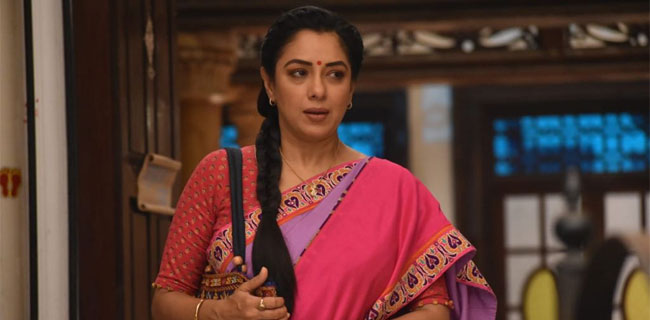
    Shailesh KapoorAmid all that’s wrong with the Hindi GEC category (and readers to this column will know that I have a long list), there is an occasional spark that brings some joy. After being the most-loved Hindi GEC character on Ormax Characters India Loves for 39 consecutive months (from July 2018), Jethalal from Sony Sab’s Taarak Mehta Ka Ooltah Chashmah passed on the top rank to Anupama, the titular character from Star Plus’ 2020 launch.


    Anupama, an adaptation of the Bangla show Sreemoyee on the same network, has been a runaway hit, achieving the unthinkable 4% rating mark in urban Hindi-speaking markets in recent months. In a category where a 2% rating is now considered an achievement (though Netflix’s Dhamaka tells you that you lose your job as a new anchor at 70% ratings, which is available live!), Anupama’s numbers have been exceptional. An average Anupama episode doesn’t rate much less than an IPL game, for example. And while IPL airs only 45 days a year, the show has managed to sustain this for several months, six days a week.


    With its multitude of well-etched characters, Anupama is one of the few well-written Hindi GEC shows currently on air. The storytelling is in broad strokes, but the characters and the conflicts are consistently engaging, and there’s enough entertainment on offer too in what is essentially a high-voltage drama of late.


    The casting and the performances are a notch above the operating level of the Hindi GEC category too. And the lead actress Rupali Ganguly has made the character very much her own, layering the portrayal with mannerisms that can possibly not be written on paper. It’s easy to guess that the show’s creative development process has managed to break away from the daily soap assembly line rut.


    If an OTT show would have even been half as good as Anupama, the press and the internet would have gone ballistic singing its praises. But GEC content earns no such respect in recent years. Not that the channels, including Star Plus, have anyone else to blame but themselves. They continue to diss their own category on air, an inexplicable thing to do. “Don’t act like a daily soap mother-in-law” and “There’s always a daily soap running in your house” are just two examples of dialogues (translated from Hindi) that you will hear in some of the top HGEC shows, including Anupama. When a category decides it can write a joke on itself, and the joke does not even come across as a joke but is taken in all seriousness by the audience, you know there’s a lot wrong at so many levels.


    Nevertheless, Anupama deserves even more love. It’s that rare sensible show that can potentially change some people’s perception about Hindi serials, only if it reached them. But the more important question is: Can there be more like it, or is Anupama a one-off? If there’s enough talent in the Hindi fiction television industry to pull off a show as interesting as Anupama, why are other shows so drab in comparison?


  • Indian Streaming Content: Boom or Bubble?


    By Shailesh Kapoor


    Shailesh Kapoor

    In a tough year for businesses in general, the growth of the streaming business in India has stood out as the big story of 2020. Last week, Disney+ reported that out of its 73.7 million paid subscribers worldwide, 18.3 million are from their Indian service Disney+ Hotstar. Even if one assumes that a fraction of this number will unsubscribe now that IPL is over, this is a staggering number, nonetheless. India is a market known for its reluctance to pay for content.

    The current SVOD (Subscription Video on Demand) consumer base is India is estimated at about 30-35 million people, and the average number of services subscribed to at about two, leading to an estimate of 60-70 million active paid subscriptions. Considering that every subscription is used by about three people on an average, that’s about 200 million (20 crore) SVOD consumers in India, a healthy number by any yardstick.

    An equally big growth story is emerging on the AVOD (Advertising Video on Demand) front. Catch-up television has been at the forefront of AVOD consumption in India for a few years now. But this year has seen original content springing up too, with MX Player, the leading AVOD platform, clocking huge numbers for its shows, especially Aashram, two seasons of which were released within a short period of time.

    And then, there’s film content too, which has got a major surge because of an extended period of theatres being closed and no major new releases announced even after they have re-opened. If we just consider national content (Hindi and Made-in-India English shows or films), the number of shows and films launched in 2020 have been upward of 200 already. The year may end at a number close to 250. If production had not been halted because of the lockdown, we may have seen a triple century being hit. And this does not include many low-profile YouTube shows that form a secondary content ecosystem online. In the streaming category, International content gets sizeable traction too. Add to that the activity at the regional front (Bangla platform Hoichoi and Telugu platform Aha have done very well), and it’s a buzzing category indeed.

    Now that’s a lot of content! In comparison, the Hindi GEC category launches about 80-100 new shows every year, and about a similar number of Hindi films release theatrically with at least some marketing push behind them.

    But how many of these 200 shows and films have actually done well? India does not have organised viewership measurement on the streaming category yet, and it may take some time before that happens. Platforms, understandably, are reluctant to share figures. We, at Ormax, are working on statistical estimate models to estimate viewership of shows (and a Top 5 list is released every week on Film Companion since September). But while we wait for that data to be built over a year, another yardstick for which more data is available is the likeability of the content itself. Of those who watched the show or the film, how many liked it enough to recommend it to someone they know?

    This data has been built at Ormax since the start of the streaming originals in 2015. Measured on a percentage (0-100) scale, Advocacy (likeability) of 60% of more suggests a positive response, while that of 70% or more indicates that the content has truly broken out. Only 27% of shows or films launched in 2020 met the 60+ benchmark. And only 12% crossed 70. These numbers are at par with TV and films content in India over the last 2-3 years.

    But the difference is when you can calculate the absolute number of shows or films that were “not liked” (below 60). That’s 150! Yes, let that sink in. 150 Indian streaming originals and films launched in 2020, in Hindi or English, received response that ranged to lukewarm acceptance to outright rejection.

    Production houses are enjoying this phase, when there is a lot of demand for content from the streaming platforms, and a lot of work is being commissioned. But the question that should be asked sooner than later is: Are the streaming platforms becoming a dumping ground for mediocre content? Content that would not have found its way in any other medium, such as television or theatrical?

    For every Scam 1992 or Mirzapur, there are half a dozen other shows that just don’t get any traction. All streaming platforms, without exception, take pride in the data that they own, and guard it jealously too. Why, then, should the success rate be a paltry 27% only?

    It is certain that 2021 will see a further surge in content production for the streaming category, especially because more films will be made with the intent of releasing directly on OTT. One hopes the strike rate improves too. Because content quality is as much a measure of success as anything else, especially if one has an eye on the long-term sustainable growth, which is needed to ensure 2020 doesn’t become just a bubble year.


  • Anupamaa: The Big Hindi GEC Breakthrough?

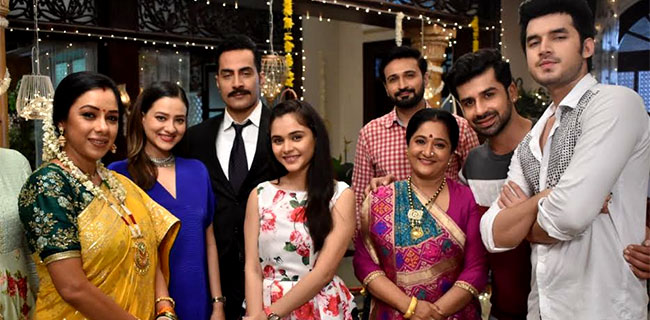
    A still from Anupamaa, the Star Plus show


    By Shailesh Kapoor


    Shailesh Kapoor

    While this weekly column has extensively covered the Hindi GEC category over the last eight years, pieces dedicated to a single show have been rare. If at all, they have been about a non-fiction show like KBC, or about a long-running fiction show like Balika Vadhu or Taarak Mehta Ka Ooltah Chashmah. Nothing launched since the start of this column in 2012 has been worthy enough for 500 words of its own. And those who follow this column regularly will know that the general sense of mediocrity that plagues Hindi GEC fiction content has been my pet peeve over the last 5-6 years.


    But here it is, a piece on a newly-launched fiction show that breaks through the mediocrity the category has learnt to unapologetically espouse over time. It’s the 10pm daily on Star Plus, and it goes by the name Anupamaa. An adaptation of a hit Star Jalsha show, Anupamaa was originally slated to launch in early 2020, but had to be deferred because of the lockdown. It was one of the first new shows to launch as things began to open up and shoots resumed July onwards. Less than three months into its tenure, Anupamaa is the top-rated show on Star Plus, more than 40% ahead of the next original show on the channel.


    Now that has happened before with some other shows too. But something a lot rarer happened this week. In the August report of Ormax Characters India Loves, a monthly character-popularity track for the Hindi GEC category, the protagonist Anupamaa has taken the second rank on the fiction list. Character popularity is the Holy Grail of GEC content. It takes months, sometimes years, for characters to build an emotional affinity with the audience. Entering the Top 5 within six months of launch is a huge achievement, and entering Top 2 within two months an unprecedented one.


    When I watched the show in its first week, my first reaction was: Wow, this looks so different from the rest of the genre. It was, in many ways, a reaction very similar to what I felt watching Balika Vadhu for the first time in 2008. Then, and even now, the Hindi GEC category has been guilty of a certain visual and thematic sameness that is omnipresent across shows, across channels. Some shows look ‘richer’ than others. But by and large, the protagonists are all in their early 20s, the costumes are fairly stock, the music largely similar too, the conflicts way too familiar, and the acting and the dialogue consistently mediocre.


    In that first viewing itself, Anupamaa seemed to belong to another space. Top performances grabbed my attention first. In particular, Rupali Ganguly as the female lead here is arguably one of the Top 3 stand-out Hindi GEC fiction performances in the last 20 years. The other distinctive feature, of course, was the age of the protagonist. In her mid-40s, Anupamaa is a mother of three grown-up children. That’s a life-stage a Hindi GEC female protagonist usually reaches five years into a show’s lifetime, after at least two leaps. Instantly, this separates the show from the rest of the lot, which are essentially romantic dramas played out in a family context. The writing seemed two notches higher than the category’s accepted level too, especially the dialogue.


    But as I started watching the show regularly, it seemed evident that this is that rare show that has a saga-like feel to it. After Balika Vadhu and Yeh Rishta Kya Kehlata Hai, no other show has a premise or a protagonist so fascinating that you know that you can do a long-running show around her, without losing the point and dragging the show meaninglessly. Already in the two months, the show has covered several social themes like patriarchy, parenting and class difference. It’s like the old days of reading a novel. The story can keep evolving, chapter by chapter, and enter different spaces. But the audience loves the protagonist(s) so much that they are always invested.


    Will Anupamaa manage that? Will it be one of the top shows in 2025 too? It’s, of course, too early to say that. But if there’s one show in the last decade that seems to have a strong foundation that longevity needs, this is it. The show’s name translates to “incomparable” in English. And unless the makers mess this one up, it holds the potential to live up to that translation over time.


    It could be a matter of introspection why such success came from a show from a regional market. Much like one can wonder why Bollywood can’t make its own Bahubali. But that’s another topic for another day.


  • Dil Bechara: Success of Serendipitous Proportions


    By Shailesh Kapoor


    Over the last seven weeks, following Sushant Singh Rajput’s death, allegedly by suicide, a murky Bollywood story has been playing out in the media. It started with a nepotism narrative, and has eventually snowballed into a larger controversy that’s an incoherent concoction of various sub-narratives, including nepotism, clique culture, allegations of a botched-up police investigation, celebrities using Rajput’s death to make their presence felt, and journalists using his death to get some primetime traction. There’s neither class nor grace in any of this, and one only wishes that chapter is resolved and closed soon within the legal framework.


    In the midst of all the mess, Rajput’s last film Dil Bechara dropped on Disney+ Hotstar last Friday. The film was originally scheduled for a theatrical release, but with theatres closed indefinitely, it has made its way to the audience via streaming, like many other Hindi films have, and will, in the next few weeks.


    Under normal circumstances, the film would have been a usual streaming release, getting its share of viewership based on its content and its credentials. But the events of the six weeks leading up to the film’s release are anything but “normal circumstances”. Disney+ Hotstar wisely decided to not put the film behind the paywall, hence opening it up to a wider AVOD audience base. While streaming platforms do not share numbers publically, our estimates suggest the film would easily be the most-sampled streaming content piece in India ever, with upwards of 50 million streamers accessing it. This number could be higher, closer to 75-80 million, and even more over the lifetime of the film. How much duration of the film they eventually sampled is another data point for which no estimates are currently available.


    In the Ormax OTT Audience Report: 2019, a research conducted in the second half of 2019, the estimated regular OTT Audience in India stood at 76.5 Million. This number would have increased significantly over the last year, especially because of the surge in OTT consumption during the long-running lockdown. And then, there is a wider audience base that are irregular OTT audience, who may come to watch that occasional ‘event’. And Dil Bechara is as ‘eventful’ as it can get on streaming.


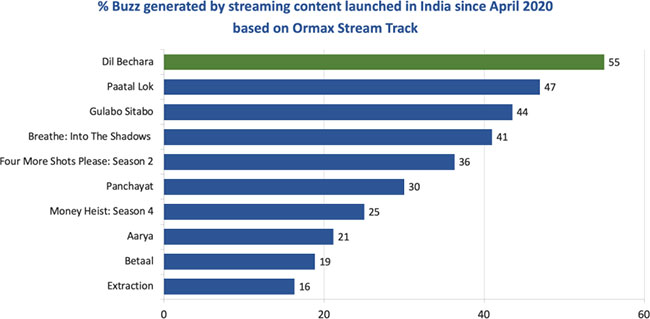
    Dil Bechara is not a usual romantic film either. ‘Death’ is a central element in the film’s story, and the emotions it generates in the last half hour get amplified several notches because of the context one is watching the film in. That has ensured that the film has generated both pre and post-viewing conversations. The chart below lists the Top 10 shows/ direct-to-OTT films launched in India since April 2020, based on the ‘buzz’ they generated in the week of their release. Dil Bechara’s takes the top position by some distance.


    There have been some silly media stories trying to convert the film’s estimated sampling into theatrical box =0office, by multiplying it with an average ticket price number. This cross-media mumbo-jumbo is so silly that inspires me to mathematically prove that if the Hindi GEC show Kundali Bhagya released in theatres in a movie spin-off, it will beat the collections of Bahubali 2, Avengers: Endgame and Dangal put together. There is no vaccine yet for media illiteracy, and journalists in some of the biggest publications in India can desperately do with some immunity.


    Like Ramayan earlier this year, Dil Bechara’s streaming performance is a serendipitous event in which the timing, more than anything else, contributed to an immensely successful outcome. Disney+ Hotstar would know, better than anyone else, that this cannot be replicated.


  • Ormax Media launches continuous poll to track approval rating of PM & CMs

    By A Correspondent


    Media consulting firm Ormax Media has announced the launch of The Ormax Prime Minister & Chief Minister Approval Rating. Based on continuous nationwide tracking across 22 states and one Union Territory, the polling tool covers 275+ cities and towns in India, with a monthly sample size of 12,000+. The Ormax Approval Rating, notes a communique, will be a through-the-year poll to track the public perception of the nation’s leadership and underscores that the tracking is being done independently by Ormax Media, with no affiliations to any media organisations or political parties.


    Shailesh Kapoor

    Speaking on the launch of the Ormax Approval Ratings, Shailesh Kapoor, CEO, Ormax Media, said: “Approval Ratings are a norm in many democracies in the West, including the US. Hence, it is surprising to note that there has been no continuous tracking on the public perception of the political leadership in India all these years. After piloting this project for many months since mid-2018, we are now ready to roll out these ratings in the public domain. In a country with many political opinions and biases, including in the media, credibility and political neutrality are the cornerstones on which this poll has been conceptualised. We will not be sharing any ratings by religion, caste or any other such variable that can take the discourse around these ratings away from actual governance.”


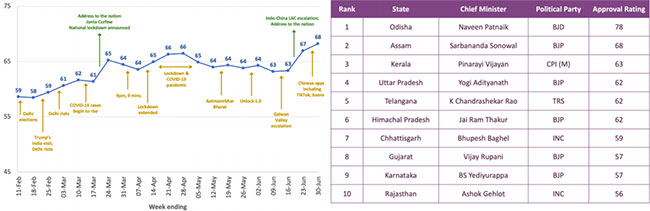
    Approval Rating is a measure out of 100 (%) of the proportion of eligible voters who approve of the governance of the Prime Minister or the Chief Minister of their state.. As per the first Ormax PM Approval Rating report released, Prime Minister Narendra Modi’s Approval Rating jumped from 59 in early February 2020 to 68 at the end of June 2020. The sharpest growth was seen in the week when the PM addresses the nation twice on either side of the Janta Curfew, announcing the three-week lockdown on March 24 in the second address. The Approval Rating saw a further jump in the second half of June in the aftermath of the escalation at the Galwan Valley. His popularity is the highest in Chhattisgarh, Jharkhand, Rajasthan, Himachal Pradesh, Bihar, Gujarat, Odisha and Goa, where he enjoys 71+ Approval Rating in June 2020.


    As per the track, Odisha Chief Minister Naveen Patnaik is by far the most popular Chief Minister across the 22 states covered currently with an Approval Rating of 78 in June 2020. Assam’s Sarbananda Sonowal and Kerala’s Pinarayi Vijayan rank second and third respectively.


  • The Big OTT Growth Story: Chapter 2


    This is the second in a series of columns by Shailesh Kapoor on the OTT Growth Story in India. Click here for Chapter 1.


    By Shailesh Kapoor


    It’s raining OTT show launches. Over the last few weeks, about two-three major and another five-six minor OTT shows have been launching every week. At this rate, the number of OTT shows that launch in 2019 will be higher than the Hindi GEC shows launched over a five-year period (2015-19). And you may not be wrong in believing that this is just the start, and things can only get more exciting from here.

    While the launch rate has accelerated significantly in 2019, it has been accompanied by a parallel improvement in the quality of content too. Till last year, among the many OTT shows that launched, only a couple would pass muster on quality. Most of the shows that won audience appreciation were from the TVF stable. ‘Quantity over quality’ seemed to be the OTT mantra.

    While that mantra continues to hold true for the second line of OTT players in 2019, there has been a significant jump in the quality of the top shows in 2019. If we look at the Ormax Advocacy Score (a measure out of 100 on how well-appreciated a show was among the audience who watched it), 2019 has some strong candidates in the reckoning.

    November 2018’s launch Mirzapur (Amazon Prime Video) continued to get audience appreciation early this year. Then came the deliciously compelling Delhi Crime (Netflix), which continues to grow its audience base till date, six months since it launched in March.

    The big success of the year, however, is a somewhat low-profile show Kota Factory (TVF). Presented in Black & White, this funny and insightful series on the student life in the education hub Kota has received widespread acclaim from young audiences, become the third-most liked Indian OTT show till date on the Ormax Advocacy scale, after Sacred Games (Season 1) and TVF Pitchers.

    Another potential top-end show dropped last night: Amazon Prime Video’s The Family Man. The unusually-textured spy thriller cum family drama stands apart from the dark and gritty world that shows like Sacred Games and Mirzapur espouse.

    However, all good things come with a word of caution. Almost 80% of OTT shows that have launched still have an Advocacy Score below 50, symptomatic of active audience dislike, even rejection. Many of these have been actively promoted by the respective platforms, indicating that the platform sensed good potential in them. So, even though the top-end has become stronger, the success rate may still be a mere 15-20%, or even lesser. Quantity may still be prevailing over quality after all.

    The Top 10 Hindi films of 2019 based on audience advocacy (word-of-mouth) average at a staggering Advocacy Score of 73. The equivalent number for the OTT category in 2019 is only 60, which is only a notch higher than the Hindi GEC category average of the year. And the Hindi GEC category has not exactly been in the pink of its health in recent times.

    A long tail of flop shows will continue to be churned out in a category where everyone wants a share of the pie. 2019 has been good so far in providing a strong top layer of quality content. This layer now needs to expand from three to four shows to 10-15 shows a year. And 2020 may just be the year to achieve that.


  • Dinshaw unveils new look & campaign

    By A Correspondent


    Nagpur-based Dinshaw’s Dairy Foods has unveiled a new brand architecture for all its products as well as an all-new campaign. Intradia World and Lokus Design have worked on the brand architecture for all products and the new packaging is based on research conducted by Ormax.


    Said Zervin Rana and Jamashp Bapuna of Dinshaw’s Dairy Foods: “The pre-packed cone format is one of the largest contributing formats in ice-creams and we selected brand ‘Dil-Hi-Toh’ as our offering in the segment to spearhead our consumer communication. The packaging re-design banked on interesting insight delivered by Ormax (Mumbai) and creative strategy came by triangulating mother Brand Dinshaw’s long-term vision, Brand Dil-Hi-Toh format specific consumer insights and the real-time consumer expectations.”


    Speaking on the strategy, Sanjeev Kotnala, founder, Intradia World said, “While developing their Summer 2017 strategy for ice-creams, Dinshaw’s looked at getting back to consumer celebration of togetherness moments with ice cream and to basics of ice-cream fundamentals. We decided to stay away from over-saturated use of seduction, overt enacted happiness and took on ‘Heartfelt Togetherness’ as the foundation. We were cautious of the fact that the name may overtly suggest romance, which is not the intention and hence believe that the creative agency, Curry Nation has done a great job”.


    Said Priti Nair, founder, Curry Nation: “We were very happy to get a decently focused brief that was not another ice-cream seduction or happiness approach. It allowed us to connect the brand in the real terms and work with the youth segment and connect with them in an emotional & engaging manner. The tag line ‘Dil Ki Dosti Pighalti Nahi’ works at multiple levels. Truly, truly happy to be associated with a brand that has been so much a part of our growing years. I still hum the Dinshaw’s ice cream yum yum…”


    RK Swamy is entrusted with the traditional media planning and buying focusing in it core markets of Maharashtra, Madhya Paradesh, Chattisgarh and AP / Telengana, where the brand enjoys high emotional connect and preference. Tonic Media is implementing the digital part of the activity