Tag: OOH

  • Metros, airports & entertainment centres fast becoming marketing hubs

    By Amit Bapna


    Sometime in May this year Samsung did a first ever-by rebranding one of the busiest airport terminals in theworld UK’s Heathrow Terminal 5 as ‘Terminal Samsung Galaxy S5’ to promote their latest flagship phone the Galaxy S5.


    Closer home in one of the busiest and richest commercial hubs of the country, the Gurgaon Rapid Metro opened its stations not just to commuters tired of dealing with the city’s famously whimsical rickshaws and time consuming traffic snarls, but to brands. The Cybercity station became IndusInd Bank Cybercity.


    Others on the metro line are MicroMax Moulsari Avenue, Vodafone Belvedre Towers and Airtel Phase 3. The just-launched Andheri – Ghatkopar corridor of the Mumbai Metro is also going to be marketer friendly. For advertisers, these ambient media vehicles represent a surge of opportunities both for branding and cold hard business, even if they are seemingly expensive.


    As per industry sources, the station naming rights for the rapid metro have been sold at anywhere upwards of ’30 lakh per month for a period of two to three years.


    Not content with painting the Cybercity station in brand colours and naming rights, IndusInd is also setting up a fully digitised branch-the bank’s first -inside the station premises.


    In addition, for a certain number of days, brand promotions can be done inside the station to engage commuters. As per Mohit Ganju, head – marketing & communication, IndusInd Bank “Gurgaon is one of our high priority markets and venues for a high decibel branding property is limited.


    The Rapid Metro was the best possible opportunity.” The brand plans to evaluate similar opportunities in other key markets.


    In the case of Vodafone which also has station naming rights, the tie-up fetches the telecom player exterior visibility at a prime location, retail business space on the platform,and an experiential marketing setup complete with interactive design elements.


    Explains Ronita Mitra, senior vice president, brand communication and insights, Vodafone India,”We neededto strengthen the brand in Delhi-NCR in an innovative way and Vodafone Metro station was a unapt fitment.”The brandhas kept the overall design theme around the key promise of Vodafone 3G of being ‘Faster. Smarter. Better’ which it claims dovetails into the many virtues of the metro rail system.


    While the brands get a medium for unique advertising opportunities, for the capital-intensive metro it provides quicker ways to monetise. It is a known fact that long periods of time are required to breakeven and globally metro services have started looking for nonfare revenue opportunities.


    Dubai Metro was the first project in the world to sell station-naming rights and others have followed suit. Two things that make metro branding stand out according to Aman Nanda, executive vice president, Times OOH are: most of the metro passengers are regular travellers andadvertisinghere givesbrandthe opportunity to communicate a story 365 days a year. Secondly, metro offers high dwell time – image captivated audience inside the metro station – who can be engaged, he adds.


    Sanjiv Rai, CEO & MD, Rapid Metro Gurgaon is very gung-ho about the potential of the medium having been a part of the Bombardier, the company that built and launched the Las Vegas Monorail as well as opened it up for branding.


    Drawing a comparison with the IPL, the biggest branding event in the country, he says IPL takes place for only around 45 days in a year and when compared the metro train is a 365-day daily phenomenon drawing in the crowds many times over. A permanent station branded is that much more powerful as a medium, he adds.


    Of course like any other marketing program, the key to a successful ambient media campaign is to choose the best media format available and combine it with effective message. Says Aneil Deepak, head of ideas, DDB Mudra “Branding is the easiest part. If you have spent that kind of money, you have to ride those investments.” The story starts the morning after the branding.


    This paradigm shift in ambient media is not restricted to airports and metros alone. The family entertainment centre brand KidZania is another instance of a disruptive ambient opportunity. Started in Mexico, the brand present across the globewithits 15centresandinIndiacurrently in Mumbai, emulates the workings of a real city and each experience zone represents industries fromthe real world like private services, public services, entertainment,automobile,retail, restaurants, factories, etc.


    According to Viraj Jit Singh, chief marketing officer, KidZania, “To build authenticity to the experience each zone or establishment is made in conjunction with the brand partners to bring brands, services and products to life.” Brands across categories are looking at utilising the ambience to match their product portfolio. Kellogg’s has established the first cereal factory for kids worldwide at KidZania that offers kids an excellent role playing platform to understand the journey which simple grains undergo to reach from the field to their cereal bowls.


    Shares Harpreet Singh Tibb, marketing director, Kellogg India, “This initiative has helped us demystify cereals to kids and their parents and establish the brand’s solidnutrition credentials.”


    Not just kiddie brands but other category brands like Yes Bank and Hyundai are also enthused about the inherent possibilities in the ambience of the kids zone.


    For instance Yes Bank has associated with KidZania to inculcate financial literacy in children and allow them to understand the value of money through a branch like set-up inside the centre. The auto brand Hyundai has established the first kids driving school and the dealership at KidZania premise, targeting the age group of 4-14 years, to introduce the young generation to safe and responsible driving.


    Rakesh Srivastava, senior vice president, sales and marketing, Hyundai,”while the school allows kids to learn the responsibilities of driving as well as road and traffic safety guidelines, at the car dealership kids can become an auto sales consultant, or a car designer.”


    With media convergence happening across platforms, consumers are moving from first circle of connectivity of traditional media options to the second circle of ambient OOH. Agrees and adds Haresh Nayak,managing director, Posterscope Group India, “The future really is in Ambient 2.0 which brings in connectivity and engagement with consumer through technology and digital platforms.”


    Source:The Economic Times

    Copyright © 2014, Bennett, Coleman & Co. Ltd. All Rights Reserved

    Licensed to republish

     

  • Milestone Media bags OOH mandate for Reliance Communications

    By A Correspondent


    Milestone Media, a division of Milestone Brandcom has won the OOH media mandate for Reliance Communication following a multi-agency pitch attended by seven large OOH agencies, that lasted over three rounds. Milestone Media will handle pan-India OOH media duties for the business. The agency triumphed over others on account of their comprehensive and inventive approach on creative thinking, category understanding strength, micro planning and efficient buying strength.


    Speaking on the alliance, Gurdeep Singh, CEO, Consumer Business, Reliance Communications Ltd, said, “Milestone Brandcom had a sound understanding of our business issues that we face in a dynamic category. Their pursuit for perfection, and professional attitude were appealing to RCOM while making the decision.”


    Nabendu Bhatacharyya, Founder & MD Milestone Brandcom Group said, “This is a noteworthy achievement for us at Milestone Media. Reliance is one of the biggest players in the Communications industry with a unparalleled legacy, offer us challenge to partner them in renewed strategy for future time. We look forward to working with the team and help them push boundaries by creating cutting edge work & contribute to R Com’s growth story”


  • Sunny times in 2014, say media agency bosses


    By Pritha Mitra Dasgupta


    Most media agencies predict a good year for the entire media sector in 2014 with television, radio, digital and out of home continuing to grow and print making a revival. The industry also expects media groups to continue consolidating across different formats this calendar, transforming the entire media buying business.


    Ashish Bhasin

    Ashish Bhasin, India chairman and South East Asia CEO at Aegis Group, said digital, out-of-home (OOH), rural and below-the-line (BTL) media will play a much bigger role this calendar. BTL refers to non-mass media promotions such as direct mail campaigns, telemarketing and trade shows. “There will be a clear shift from ATL (above-the-line) to BTL in client spends – a trend that has already started,” he said. “Print will hold its own, though focus may shift towards regional print,” he added.


    In 2014, media planners estimate television will grow by 15-18 per cent, print by 8-10 per cent, and digital media by 30 per cent. In 2013, the media sector is estimated to have grown 7-8 per cent. CVL Srinivas, CEO at GroupM South Asia, pointed out that India is one of the few markets where print continues to be a dominant medium, garnering nearly 40 per cent of the total advertising spend. “Media buyers will look for long-term deals that secure inventory at a certain price coupled with shorter-term opportunistic buys. Content will emerge as a new currency on TV,” he said. Mr Srinivas said clients will increasingly opt for integrated media solutions spanning digital and offline against the current majority practice of treating digital as a standalone medium.


    Boosting this trend will be the consolidation drive of media groups. Mr Bhasin of Aegis said more and more media owners will consolidate in print, TV, OOH, cinema and in radio, putting pressure on smaller and weaker players. “Media buying will… transform into weaving messaging into content the consumer loves, across formats,” he said.


    The general elections are expected to provide the biggest impetus to media industry, with print emerging the biggest benefactor. “The general elections will definitely be a huge boost to the advertising industry in 2014.


    Nandini Dias

    Expectations are that between television, print and radio there will be an additional advertising money of approximately Rs 1,000 crore,” Nandini Dias, CEO at Lodestar Universal, said. Print medium is expected to consume at least 65 per cent of this money. “Since print is more segmented and has more depth, there are various kinds of ads which are put out on print,” a senior media planner said. “There are poll results, classifieds, information of candidates, ads on party manifestos and so on. So print garners the bulk of the advertising election spends,” he said.


    The person said television is mostly used for umbrella campaigns and the medium captures about 25 per cent of the total advertising spends. And radio is about 10 per cent. According to industry estimates, Congress is expected to spend Rs 500 crore, BJP Rs 300 crore, and all the other parties together Rs 200-300 crore.


    The newly introduced cap on television ads – a channel can air a maximum of 12 minutes of ads for every one hour of broadcasting – too is expected to help print media. Some media planners are, meanwhile, sceptical about the industry’s prospects in 2014. Debraj Tripathy, MD at Mediacom India, said he expected 2014 to be a more difficult year than 2013, as overall economic condition has not improved.


    Gautam Kiyawat

    “It may get little better around the elections. But the second half of the year will be really challenging.” Gautam Kiyawat, CEO at Madison Media Group, said: “The first half of 2014 will continue to be soft as marketers are conserving money for the first quarter.”


    Source:The Economic Times

    Copyright © 2013, Bennett, Coleman & Co. Ltd. All Rights Reserved

    Licensed to republish

     

  • Blackberry’s Fall/Winter collection goes aggressive on OOH

    By A Correspondent


    Blackberry’s Fall-Winter collection has unveiled a campaign across premium sites in malls, airports and other upmarket locations of Mumbai, Delhi, Hyderabad, Ahmedabad and Bengaluru.


    The campaign highlights the quality of clothing that Blackberry’s is known for and a mix of media including billboards, unipoles, mall facades and airport media has been used in the campaign.


    Talking about the campaign, Ajay Pradhan, National Marketing Manager for Blackberry’s, shared his feedback on the OOH campaign. “We wanted this to be a high impact campaign, one with not just maximum visibility but also one that would be long-term. A high-end clothing and fashion brand needs to capture the consumer’s attention constantly adding to its aspirational value. What better way to do this than splash hoardings in vibrant shopping locations in the metros?”


    One of the unique features of the campaign which will last until end-December 2013 is the use of the portrait unipoles at the Hyderabad International Airport.


  • Outdoor adspends grow 8% in H1 FY 2013: Laqshya research

    By A Correspondent


    Outdoor Advertising ad revenues have grown 11% in the first quarter and by 4 percent in the second quarter of 2013 over the corresponding period of 2012 making it a total of 8% growth for the H1 fiscal 2013 over 2012. These numbers were revealed by the Laqshya Media Group research wing which conducted the research.


    According to a communiqué from Laqshya Media, the good news is that despite the lingering economic uncertainty OOH continues to grow which is an excellent sign for advertisers who want to reach out to people with billboards, bus shelters, huge gantries, foot-over bridges, and any other outdoor vehicles. The industry going by this analysis has every reason to be optimistic.


    The sector-wise analysis is as follows:

    – Real Estate upped OOH investments most rapidly as compared to any other sector making it the most dynamic category for the first half of 2013. Spends grew by 51% as compared to H1 of 2012. The realty players from Mumbai and Delhi have been spending heavily in traditional OOH, whereas South India-based players are also actively visible in premium ambient media like airports.

    – Education Sector with large focus on Q1 dominates the other category spends though its spends have reduced compared to H1 of 2012.

    – In the Media & Entertainment category, TV channels particularly the GECs hold a substantial pie in the OOH share of spends.

    – Jewellery Brands like Tanishq has been spending heavily along with south based brands like Malabar and Kalyan on their store launch across various towns using OOH to create awareness. There has been a 28% rise in their spends observed this year as compared to H1 2012.

    – Many other sectors slightly exceeded their spends in the first half this year as compared to last year making the overall OOH share of spends bigger and thus creating an 8% growth as compared to last year. Categories like banking, mobile handsets, airline operators, housing finance, life insurance, retail (particularly the Innerwear Segment) and healthcare saw greater growth as compared to last year’s first half.

    – Two-wheelers emerged as one of the most active spenders in the first half of 2013 as compared to the same time last year 2012, registering a growth of at least 50%. Brands like Hero Motocorp, Bajaj and Honda have captured the roads with larger than life displays for their two-wheelers.

    – The first half of this fiscal year 2013 also saw a decrease in spends by the top OOH spenders like automobiles (four wheelers) and mobile services.


    Commenting on the statistics and trend, Atul Shrivastava, COO, Laqshya Media Group said, “The overall OOH pie has grown 8% this year as compared to same period last year. There has been a moderate growth in various other sectors but OOH that has traditionally thrived on automobiles and mobile services took a hit. Big players in the Four Wheeler category like Hyundai and Tata Motors-owned Jaguar Land Rover have been successfully banking on OOH long term sites to create brand salience. The only spike observed in the category was during the brand launch of Honda Amaze and Chevrolet Sail.”


    The evident growth in both quarters Q1 and Q2 of 2013 as compared to the same period of 2012 reflects the progress the industry has made, adds the communiqué.


  • OMI is now Laqshya Solutions

    By A Correspondent


    The Laqshya Media Group has announced that its agency division Outdoor Media Integrated (OMI) will now be called Laqshya Solutions. The decision is effective today (Nov 1, 2013).


    This announcement has been made in the wake of the restructuring made at Laqshya Media Group, adds a communique, adding: “The new name has been created to bring about a better synergy among the various group divisions and OMI too will be able to get inherent advantage of Brand Laqshya, which has emerged as a leading, credible brand name in OOH Industry. The division will continue to work with and service its several clients across different verticals.”


    Talking about the change in name and logo, Alok Jalan, Managing Director, The Laqshya Group, said: “We’ve identified OOH, Activation and Advertising as the verticals for our growth agenda. While our Solutions division is the largest vertical, its identity has been different from other divisions. This needed to be changed and that’s what we’ve done. The new name and logo also are more in sync with the rest of the Laqshya Group verticals.”


    Atul Shrivastava, COO of the Laqshya Group, said, “There was a need for OMI to get directly identified as Laqshya group outfit. We are pleased that the decision has been taken in this regard.  Over the next few years, we hope to work with some of the best Indian and international brands, offering them cutting-edge, innovative OOH media campaigns through the Laqshya Solutions division. We are excited about the new look and name the division now has.”


  • Cadbury’s sweet interlude with Digital


    By Shephali Bhatt


    Hamilton Holt was right after all – nothing worthwhile comes easily. Which is why if you wanted a Cadbury Bournville back in 2008, you couldn’t just buy it, you had to ‘earn it’.


    It was the campaign that spurred the first big relaunch for the brand which had spent years as a niche product. Some even attributed its continued existence to sentimental reasons: Bournville is named after the site of the first large Cadbury factory and model village. In its revamped avatar, it aimed to appeal to sophisticated adults craving a premium dark chocolate experience. Set in an idyllic European milieu, the launch spot had a quintessentially British journalist bragging about owning a bar of Bournville who gets abducted by a giant bird because he hadn’t “earned” it. With 85% of the marketing spend on TV and the rest on print and OOH, the launch campaign ran for 15-16 weeks a year for three years until it was time to focus on the ingredients that went into making a Bournville.


    The focus of the campaign turned to all those cocoa beans that never became a Bournville, because that was a prerogative of ‘Original Ghana Cocoa beans’ only. “The idea was to build awareness and generate trials for the brand. These campaigns helped establish Bournville as a premium chocolate with an international appeal and a distinct proposition,” says Anil Viswanathan, VP – chocolates category, Cadbury India.


    It was around 2011-12 that the brand started exploring the digital platform and allocated 30% of its marketing budget to the medium. This was followed by a tie-up with Warner Bros around the release of The Dark Knight Rises. “While movie promotions don’t last more than 10 days, conversations around a movie start a month in advance,” notes Shekhar Banerjee, Senior VP and head of Pinnacle at Madison (the media agency that handles Cadbury). Capitalizing on the conversation around the biggest release of last year, the agency created an augmented reality based motion sensing game – The Bean Hunt. The winner won a free trip for two to Warner Bros Movie World in Australia. This was coupled with activity on YouTube (videos with trivia around the Batman franchise) and Facebook. It led to an addition of 6.5 lakh users on the social networking site within a month and the interaction figures soared by 4000%. It was enough to convince the brand to take a huge punt on the medium.


    Starting 2013, Bournville has set digital as its lead, accounting for 60% of its annual budget. TV remains the second with close to 30% with the rest allocated to OOH. Viswanathan explains that Bournville’s current TG (SEC A, between the age group of 19-30) is an audience that uses social media as the primary vehicle to maintain and extend their networks. The shift will help the brand by being present where its target audience is, and will help the brand building exercise by riding on leading trends.


    In March this year, Bournville launched a Cranberry variant, only on digital, and reached out to 26 million unique users. The campaign involved multiple videos created by Ogilvy India, the creative agency on the brand, which were only run online. “Today, Cranberry has a recall of 23% which is higher than the other variants of Bournville that existed in the market for years,” asserts Banerjee.


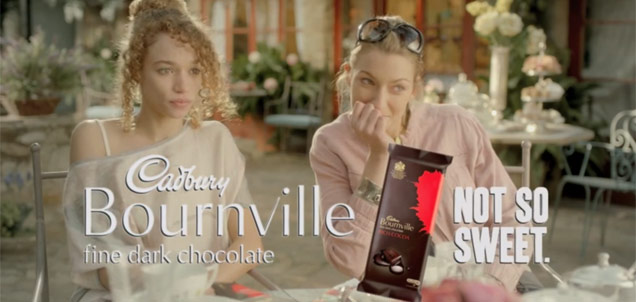
    Bournville’s current campaign ‘not so sweet’ (NSS) is an attempt to retire ‘have you earned it’. It’s tongue-in-cheek, it’s cheeky and aspires to align the brand with young adults who like their not so sweet dark chocolate. The exclusive launch of this campaign on digital media has led to an increase in brand conversation by 800%. Along with the ad film that shuns the overtly sweet, there’s a Twitter campaign called ‘Tape a Tweet’ that allows users to throw overtly sweet situations at the brand on Twitter where they promptly get converted into one minute videos. The 9-person strong digital team at Pinnacle has built analytics that quantify the ROI of social media on its two brand metrics for digital-engagement levels and conversation association of NSS. They like to call them social GRP.


    In addition, they’ve classified their target audience into digital clusters to help draft a better content strategy for the brand. Experts say that 60% of the brand’s marketing budget would be close to Rs 12 crore. “With that kind of money and a significant reach, Bournville will stand out,” Harshil Karia, co-founder and online strategist at Foxymoron points out. Since no other brand in the category is that prevalent in the medium, it gives Bournville the maximum share of voice, he adds. Normally, it takes a period of three years for advertising on this medium to reflect on sales. It will be interesting to see how Bournville’s transition from traditional to digital pays off in the long run.


    Source:The Economic Times

    Copyright © 2013, Bennett, Coleman & Co. Ltd. All Rights Reserved

    Licensed to republish

     

  • P V Narayanamoorthy joins OOH analytics firm Proof of Performance Data Services

    Media agency veteran P V Narayanamoorthy has been appointed Director at Proof of Performance Data Services (PoP), leading out-of-home analytics firm. Mr Narayanamoorthy will spearhead the technology-based analytics platform which PoP has created for measurement methodology and accountability in the outdoor media business.   He will be advise advertisers on outdoor spends and how efficacy can be maintained and enhanced in outdoor media utilization.

     

    Mr Narayanamoorthy has already conceptualized and implemented a metric called ‘The Visibility Index’ for PoP provides vital info on “hitherto untracked metrics like visibility distance and time for which a particular asset is visible”, notes a communique.


    Speaking on the occasion, Harjaap Singh Mann, Founder CEO and Managing Director, PoP said “Mr Moorthy is  considered an institution in the media planning space and his prowess is unparalleled and universally acknowledged by peers. We are sure it would be a new chapter of success for POP and are glad that he has joined us in our endeavor to revolutionize the OOH industry.”


    In his career spanning more than 35 years in media and advertising, Narayanamoorthy has worked with several advertising agencies including Clarion Advertising, Ogilvy Benson & Mather, RK Swamy, Ulka Advertising and McCann Erickson. His last assignment was with Carat where he worked across the Asia Pacific region spanning 13 countries. He was a member of the regional board with responsibility for new business, strategy, tool development, training and research.


  • Travel, good for people and business

    By A Correspondent


    Growing inspiration and increasing disposable income have given rise to outbound tourism of India. An estimated 50 million Indians are set to travel overseas by 2020. The widespread market of discerning Indian travellers has caught the attention of several international tourism boards, cruises, airlines and allied services. Therefore, to grab the interest of Indian travellers this summer, tourism companies are aggressively promoting their destination and services in India via outdoor advertising.


    Global Advertisers recently provided hoardings across Mumbai for the OOH campaigns of Australia.com, Star Cruises and Maldives Airlines. With the aim of creating awareness about their destinations, activities and itinerary, the team at Global Advertisers have pinned down large size billboards at specific locations in Mumbai. Heavy traffic junctions, corporate areas, western express highway (Mumbai), populated residential areas are some of the hot spots for these campaigns.


    Sanjeev Gupta, MD, Global Advertisers, said, “We are delighted to see the response from these campaigns for our clients. Promoting international destination in Indian requires deep understanding of Indian travellers and their mindset. Therefore, we painstakingly researched on the locations, size of the hoardings, angles and their positioning for our clients.”


  • Star World to showcase Packed to the Rafters digitally ahead of TV launch next week

    By A Correspondent


    Star World is all set to air Packed to the Rafters for the first time in India. Packed to the Rafters’ is an Australian drama series which revolves around the story of the Rafter family, who are fighting different problems of life together.


    To make the show more relatable to the audience, Star World got Karan Johar as the face of its campaign. The channel launched a six week on-air campaign with him. And the channel has unleashed robust print, digital, DTH, cinema, radio and OOH campaign given the launch next week.


    In keeping with the growing importance of the digital platform, the channel will be hosting a Web Premiere across the Star World website (www.starworld.in/PTTR) and other social networking sites to give the viewers an experience of the show before it goes on air. Star World will be taking such initiatives up for key shows to create reach and buzz. The digital premiere will be held today (November 30) before its official launch on the channel on December 4.


    Subsequently, each of the episodes of the show will be available to be streamed and viewed on the Star World web and WAP platforms after it telecast on air. A tie-up with Vodafone will ensure viewers can catch up on the key moments of the show at their convenience.


    Commenting on the show, Rasika Tyagi, Senior VP, English Programming, Star India said, “From our Hindi and Regional GECs, one of the biggest learnings is that viewers seek life lessons from the daily soaps they watch. The issues faced by the Star World audience, the English speaking, urban Indian youth, is quite myriad and they don’t get to see shows which reflect their life on TV. Our audience will be able to resonate with the issues faced by the characters in Packed to the Rafters and emulate the way they resolve the conflicts.”


    Commenting on the digital catch-up service, Rasika Tyagi said, “When we go for consumer home visits, we get a reality check on how content is being viewed by the youth today. They want to watch a show at their convenience – anywhere, at any time. So, we as content providers have to gear up to share our content across platforms, on internet or on mobile.”


  • Suresh Balakrishna now also CEO of Lintas Outdoor

    Suresh Balakrishnan

    IPG Mediabrands has announced the appointment of Suresh Balakrishna as CEO of Lintas Initiative Outdoor. The leadership responsibilities of all the OOH businesses of IPG Mediabrands will now report to Suresh Balakrishna, with immediate effect, according to the official communique.


    Mr Balakrishna, a media veteran with over 25 years of publishing, brand building and media agency experience, had rejoined Lintas Media Group in January this year to roll out and lead BPN, the third agency network of IPG Mediabrands.


    He will be handling this assignment in addition to his current responsibilities as CEO of BPN India.


    Hemanth Shah, Managing Director of the company resigned a month ago and will be with the organisation till the end of August. His next destination is not known. He joined the company two years ago from Times OOH.


    Some of the leading OOH businesses in IPG Mediabrands include Nokia, Hindustan Unilever, Union Bank ofIndia, Coca Cola, Tata Consultancy Services, Expedia, Citibank, Monte Carlo etc.


    For the record, Lintas Initiative Outdoor has 22 offices around India.


  • The Anchor: Rajesh Mehta on 5 highs for a marketer winning a Gold at Cannes

    By Rajesh Mehta


    1.  Winner at a global level:

    It was a campaign that was conceptualized and visualized by the team and received laurels globally. The appreciation that we received was absolutely exciting. The admiration that we got withWestern Unionwining at such a global platform was thrilling for our entire team.


    2. Not expected from financial services:

    Western Unionmoney transfer, being a financial services company, is associated as the category from which cutting edge creative work is not expected. But to break the standard belief that the category can also be innovative was an achievement in itself. The entireWestern Unionmarketing team, along with McCann (creative agency), worked together to develop the campaign, that enabled us to cut through the clutter.


    3. It’s a Gold:

    There couldn’t be a better feeling than winning a Gold at the Cannes. And apart from that, it was the first Gold win forIndiaat the Cannes 2012. Western Union accomplished two victories with one Award – won the Gold at Cannes and the first gold forIndiafor 2012. There couldn’t be a greater feeling for us than winning these accolades in one night.


    4. Befitting to theWestern Unionbrand:

    As a marketer, it is a thrill to know that the ad campaign has captured the essence of the brand and has reached out to the right audience. The win at Cannes not only proves the creativity behind the campaign but the spot on messaging captured through it. The out-of-the-box thought process of our creative agency, along with theWestern Union’s internal marketing team’s insights, made this campaign an award winning one.


    5. Stood out among all the entries:

    For all of us, standing out in a crowd matters more than anything else and that’s exactly what we achieved with this win. There were 4,843 entries from 87 countries sent this year in the OOH Category which was higher than last year. This clearly indicates thatWestern Union’s win of the Cannes Lion Gold stood out and it certainly speaks volumes about the brand.


    Rajesh Mehta is Director-Marketing, Western Union India