Tag: OOH

  • OOH is moving to the centre of media planning!


    Just as many digital agencies are becoming full-service to cater to specific categories, Kinetic Worldwide Global CEO Mauricio Sabogal believes a leader in the Out-of-Home (OOH) space, like his organisation, must also go beyond the brief to grow its business. Especially when it comes to high-potential customers in the luxury, travel and banking sectors.


    Even before you took charge at Kinetic, you headed BPN at IPG Mediabrands and are hence familiar with the Indian market. How do you find we’ve changed over the years?

    It is fantastic how it’s evolved. India is a challenging market in the developing world, and you can see how technology has changed the way the country interacts with the rest of the world. When you come to India, you see a kind of energy, you see people presenting new ideas, new possibilities to create different capabilities for our business. I think that’s a big evolution in the country.


    In terms of the out-of-home business, while there is talk about how it is gaining ground, the GroupM report says it is just 5.8 per cent of mediaspends. Isn’t that too little for a large organisation like yours to be playing with?

    First, I have to say that Kinetic is the largest OOH buyer worldwide, so for us it’s a meaningful number. However, yes, you are right. The number is still small but it all depends on how it is interpreted. If you talk about static OOH, perhaps that’s the number. But when you define the scope of OOH according to what is reaching people on the go, that’s different because it involves mobile investment, social media, digital OOH and even interaction with other media because OOH is today becoming the centre of media planning.


    So which means that obviously Kinetic will be doing a lot of what other WPP group agencies are engaged in with on-the-go advertising?

    We are trendsetters, so I think all agencies are moving towards what we are doing. We were the first to propose that OOH is moving to the centre of media planning; we deal with partnerships that allow us to interact static billboards with mobile phones.. . Our competitors are following us and I am glad to hear about that because that’s what we have to do in the industry in order to grow it and position out-of-home really as moving to the centre of the media planner.


    But some of these competitors are possibly within the group itself, and doing similar things…

    I do not think we have a competitor within the group. We have an agency that complements the job we do. Or we complement their job, because they are bigger than us and we provide services to them. However, it all depends on how you approach your own business. There is a possibility of some media OOH specialists trying to create different work, to amplify OOH offerings.


    You mentioned that mediaspends are going to now revolve around the entire OOH business, and we’ve seen digital agencies becoming full-service in recent years. Do you see Kinetic becoming a full-service agency too?

    For some categories, yes, like digital agencies becoming full-service agencies for specific categories. Categories like travel and banking are high-potential categories for us to sell a full service because they are focusing on OOH and people on the go. Most luxury, travel and banking clients are on the go, so those categories are becoming attractive for us to manage in a full-service way. It doesn’t mean we will replace the work big media agencies are doing, but for certain categories, yes, that’s the idea.


    So the creative and media buying will be done by Kinetic, as against existing creative and media agencies?

    Sometimes, yes. Creativity comes from different services, and we also propose to provide services for all markets, which includes really good creativity, since we have that capability at the moment in India


    Kinetic has been there in India for a while, and you now have a new India head. What are your plans for India, and your targets for him?

    There are very big targets. Suresh is a very well-known professional in India. I know him from my previous job too, so we have worked together before. I know how aggressive he is in the market or how good he is in growing the business. There is no better person to lead the evolution of Kinetic than Suresh, and I am confident that he will achieve all the big targets we have for him.


    There is a sentiment that in the OOH business, that there is no yardstick to measure the efficacy of advertising etc, and expectations from a large network like Kinetic, which is a part of the WPP group, is that it will invest more on measurement systems and such. So what are you doing towards that?

    We are doing a lot. We are testing different methodologies, investing in data, research and analytics. We are even testing satellite technologies to measure audiences, partnering with telephone companies to get data to measure all this etc. The issue is agreement with the industry. We cannot continue having 10 different ways to measure OOH. We have to get the best information and agree on a methodology like in any other medium that will professionalise our industry and make advertisers invest with more confident.


    Professionalise?

    The more data we have, and the better the understanding of our currency, enables more professional dialogue between advertisers, agencies and media vendors.


    People say the OOH business is disorganised and there is some corruption. Do you agree, and how would you improve the situation and change this perception?

    It’s a perception and it depends on the different companies and their ways to manage regional products. At Kinetic, we follow compliance strictly… none of the companies are as strict about following compliance protocols.


    This interview first appeared in dna of brands on April 18, 2016

     

  • Anita Bose joins Madison Media Plus as COO

    By A Correspondent


    Madison Media has announced the appointment of Anita Bose as its Delhi office head. Bose joins the agency from today (January 4) as COO, Madison Media Plus and will be responsible for driving the Delhi office and servicing its existing clients.


    Bose is a seasoned media agency professional with a rich and diverse media experience of over 20 years, of which she has spent 13 years at WPP media/GroupM agencies (Business Director at Mindshare, General Manager on Team LG and General Manager, MEC North). She has also worked for StarcomMediaVest as Exec Vice President of Vivaki Exchange and FCB Ulka and McCann Erickson. She regularly teaches at management institutes and is a Guest Faculty at Indian Institute of Mass  Communication.


    Said Vikram Sakhuja, Group CEO, Madison Media & OOH on the appointment, “I am delighted that Anita Bose will be leading Madison’s Delhi office. I have known her to be a very able administrator with a consistent track record of delivering Client delight. Today, business cycles have shortened, Brand plans are more fluid, and the media environment is in a much greater flux. A person like Anita has the unique skills to lend stability to chaos. I look forward to Madison Media Plus rising to new heights under her leadership.”


    Added Bose: “It is an honour to be associated with Madison Media and  work with accomplished industry veterans like Vikram Sakhuja and  Sam Balsara together. I am looking forward to empower the Delhi team so that we become an unbeatable winning team – committed & united, driven by client and industry needs – known to provide services that set industry standards.”


  • Ajay Kakar & Vikram Sakhuja to head Effies 2015

    By A Correspondent


    The Advertising Club announced the appointment of Ajay Kakar as Chairperson and Vikram Sakhuja as Co-chair for this year’s Effies Awards. The event will be held in Mumbai on January 15, 2016.


    In its 15th year, Effies will celebrate not only the advertising agency behind the campaign, but also the client.  Commenting on their appointment, Raj Nayak, President of The Advertising Club and CEO, Colors said, “The Effies is an institution by itself giving due recognition to campaigns that engage consumers thereby furthering a brand’s promise and proposition. I would like to congratulate Ajay Kakar and Vikram Sakhuja for this new project that they will be leading. The entire advertising community looks forward to the Effies and I am certain that they will strengthen its credibility within the industry.”


    Ajay Kakar

    Speaking on his appointment as the Chairperson, Ajay Kakar, Chief Marketing Officer, Aditya Birla Group – Financial Services said, “Over the past four  years that I have chaired the Effies, I have seen a growing support and participation. Every year has broken the record entries and number of participating agencies, from the previous year.‎ I believe this demonstrates the underlying need and demand for marketing campaigns that are not only creative, but more importantly, work for the brand and business. And I am confident that this year’s Effies will again beat last year’s record. And be even bigger and better.”


    Vikram Sakhuja

    Adding further, Co-chair Vikram Sakhuja, Group CEO, Madison Media & OOH, said, “For me it is imperative for advertising to drive demand and strengthen brand value. It is therefore an honour to be part of the Effies which is the undisputed champion of effectiveness in India and worldwide.”


    Earlier this year, Messrs Kakar and Sakhuja were also inducted as the new officebearers of The Advertising Club. While Sakhuja was elected as Secretary, Kakar was elected as Joint Secretary.


  • Zoom undertakes high-decibel promotional activity to promote channel

    By A Correspondent


    Close on the heels of its new brand overhaul and fresh content line-up, Zoom recently adopted a high visibility 360 marketing campaign that uses rich mix of media targeting key demographics in focus markets. As part of its marketing initiative, it has wrapped up an entire air-conditioned train – both, exterior and interior – on the Mumbai Metro line with the channel’s logo, ad creatives and colours. In addition, Zoom also put up over 200 hoardings across Mumbai, Delhi and Bangalore at prominent, high traffic zones and has activated a print campaign across 37 cities.
     

    Shantanu Gangane, Head of Marketing – Times Now, ET Now & Zoom at Times Television Network said, “Bollywood is a big driver of our content mix. Zoom is recognized for providing an authentic, credible connect with Bollywood. Bollywood always towers over popular imagination; it has epic scale, and is truly larger than life. And our OOH campaign too promises to be unique and showcase innovation, our idea was to make Zoom’s marketing communication visually striking keeping in line with the complete brand overhaul and a change in the look and feel of the brand. We saw the sleek and ultra-modern Mumbai Metro train service as a great brand fit for the content and personality of Zoom, which delivers the most premium audiences to brands and advertisers.  So it is be-fitting that our brand Zoom literally rides a metro train.”


    Five creatives for the visually striking OOH campaign were conceptualized and designed keeping in mind Zoom’s brand keywords, youth-focus and trendy content line-up by Famous Innovations. They feature the channel’s brand ambassador – Kangana Ranaut.


    During the re-launch of the brand, the week saw innovations in trade media helping Zoom capture a high share of voice using high impact innovations in both offline and online media. Zoom designed a song and a music video which was shot by legendary international director, Harvey Brown, who specialized in larger than life musicals to amplify its brand messaging. A song was also recorded, composed by Sachin- Jigar, and sung by Anuskha Manchanda. The video, titled Hotel Zoom was unveiled on the launch day across platforms and to drive engagement on social media. The song is being promoted heavily on television, radio, social media and is also live on all pan-India telecom operators by way of Caller Ring Back Tones (CRBTs).


    Additionally, digital media saw countdowns, live tweets, a live telecast of the launch event via Periscope, content promotions across all platforms leading to Zoom announcement trending nationally on Twitter. The hash tag for the campaign #TurnOnZoom received over 250 million impressions on Social media while more than 40,000 tweets were generated within a short-span of three weeks. There were around 6 million interactions on social media during this period. The channel, in order to engage with the internet-savvy generation, also ran a contest wherein the users were requested to sing and record Zoom Anthem on Dubsmash and post the video on Twitter, to win iPhone6.


    As for radio, Zoom tied up with radio stations in 13 cities. These radio channels played Zoom Anthem regularly for the mentioned period.


  • OOH in the times of Digital


    We may skip the occasional YouTube ad and attend to some chores while the television commercial is on, but Out-Of-Home advertising is one form of promotional activity we cannot avoid. It is right there whether we are on our way to work, out for a party or even when we are driving away for a holiday. In this interview at the Outdoor Advertising Convention 2015 last month, Amit Sarkar, Chief Operating Officer, Kinetic India talks about the growth of OOH in India and what lies ahead.


    Can you give us a broad idea of how OOH has been growing over the years in India especially at a time when there’s so much buzz about digital.

    Anything that is new will always have a buzz. So digital has been growing at a larger pace because it is a new evolution of media format. And a large part of digital is growing because you look at the age groups which are digitised, they are our larger consumers today. If you look at the larger shifts from consumer-centric age groups, young people are more prone to digital. OOH has been growing at a logical pace, 5 percent, 4.5 percent, except for last year towards the end of the second quarter when elections happened and we saw a lot of money in OOH. I think that’s an interim situation which actually took the pie to about 10-12 percent growth last year. But, if you have to keep that out of the event of normal spending pattern, I think we grew about 4.5-5 percent.


    So would you say that this digital buzz has stolen the thunder of OOH and other mediums as well?

    I really don’t buy that story, because when digital was not there, OOH still grew at the same pace. Which means OOH has its own independent challenges of growth and decline. Digital is something that is new, so obviously there is a perception that that is pulling out more monies. I can tell you with assurance that digital has pulled money out from television and they would be having the same sort of concern which OOH may have. I think OOH’s problem is independent of whether digital or mobile advertising is going out or not. And these are very uniquely positioned over the last one decade that we have been seen in OOH as a business. It’s very independent. I mean OOH doesn’t grow because of larger logical reasons like we have become pretty format-driven, we have regulation problems, different cities and different municipal corporations and revenues from OOH is different. While there is tremendous opportunity, but a slow pace of growth is largely to be blamed in the way media has been consumed, and also position perception. If you look at it, it’s more of positioning.


    What is the difference in the growth of OOH in a metro like Mumbai versus a Tier 2 or a Tier 3 city?

    If you look at it, about 75-80 percent of consumption today is all in the urban cities. While Tier2, Tier3 is extremely growing and that’s because of any other reasons of all businesses.
    If you see telecom as a category, these are pockets that are growing too. If you look at FMCG as a category, these are pockets that are growing too. New acquisitions have been drying up in our own cities. So OOH thereis more an evolved format, better environment, but if we look at core OOH in terms of visibility perspective, Tier2, Tier3 and Tier4 towns are the ones which provide us business. Because more as we progress, when you look at rural India where there is a lot of purchasing ability for people who are just farmers in the context of it. Gradually when their behavioural pattern changes in the way they consume something from a media format perspective, OOH in those markets will evolve, but need wise, there is tremendous potential. I have seen double digit growth inside that 5 percent, coming only from Tier 2 and Tier 3 towns.


    Does that have anything to do with the fact that internet penetration is also slightly lower in a Tier 2, Tier 3 city compared with a metro?

    I think they are two independent points, but all independent points from a consumer’s perspective have a correlation, which means more internet penetration, more exposure, therefor more knowledge clearly, more aptitude towards media. So similarly, just take an example I would say, if you would have looked at a city like Mysore about 10 years back, till the time Infosys actually made a game-changer there and all of us know that Mysore is great for Mysore palace. Today if you look at a lot of people who have migrated to Mysore, from Bangalore and other large cities, your consumption pattern of that particular city has changed. Your real estate prices have gone up. Almost everything around it is a newer ecosystem. That proves ability and OOH would actually work with it.


    Measurement in OOH, unlike digital and other mediums, it still a weak point. In your opinion what is the best way to tackle this?

    Every media format has its own challenges. Not to say digital for clicks could be measureable, because clicking and getting absolute time to consume an advertisement are two different things. Just because of clicks, it doesn’t mean that your attention towards an advertisement in digital is great. OOH has challenges of currency and ROI. But the reason for it is also that it is more difficult to measure OOH because of the nature of the business, the geographical spread, the immense amount of unorganized formats across different markets. If you look at television, you would actually take a smaller sample size to determine what will be your viewership pattern. In OOH every market works differently, vendors are different, formats are different, cultures, languages are different. Just to give you an example, in Karnataka if you ever do OOH, you have to actually put a sign of the creative in the local language. Without that you will not be able to display. The same thing is not really applicable in Delhi. So it has perennial challenges, however to build a currency, it has to have industry initiative and investments have to come in. So that’s the larger challenge. There’s no trial. There has been trial for the last 10 years that I know of, but everytime you progressed. So I’m hopeful it will happen sometime tomorrow, and it has to happen, otherwise the trade matrix will die. I mean our margins are shrinking, investments are not coming in, regulations are a challenge. You have to have a modelling of ROI which will move you fast. In closed environments like the airports and malls, it’s still addressable, because you can assure walk ins, profile a TG, it’s a closed environment you know how things are. It becomes very difficult on roadsides, on larger platforms.


    In this perspective do you think it’s good to have competition between mediums, or do you think that all need to work in synchronisation to ensure sales for the brand?

    OOH all of us realise has become more environment-driven. So whether it is an experience to be combined with digital, social, or anything to do with word-of-mouth as well, which amplifies it to a larger extent is OOH. So, just because digital and OOH can combine together to give a larger proliferation, it may not be a right story, all forms of media, together form an OOH ecosystem today. And that’s where the importance and the opportunity lies.


    From the perspective of your clients, what are the spends on OOH versus other mediums?

    On an average 5-6 percent. Some categories actually would be more spendthrift. So telecom is high spendthrift in OOH, FMCG to an extent yes, but largely on an average it is about 5-6 percent.


    So according to you is that fine, or should clients allocate a larger portion of the budget to OOH?

    OOH is the most seen medium according to TGI consistently for years together. But if you look at commitments of budgets, it’s still very vague, because at the end of the day everyone needs to understand what is an ROI. I’m not debating the fact that every media ROI is absolutely correct, but it is the time we have a matrix and if we keep on selling OOH in the way it is positioned today, there are challenges. So from the way I look at it, OOH has to shift from its current positioning. So that proposition becomes robust and therefore currency will still matter, but what will matter more is experience with consumers. And that will actually drive it.


  • ‘Social media is the right partner for OOH’


    Digital has led to the explosion of Out-of-Home advertising in recent times. At the Outdoor Advertising Convention 2015 held last week, Mauricio Sabogal, Global CEO, Kinetic Worldwide, highlighted some  key trends in OOH and tells MxMIndia why this format works best in conjunction with other media.


    From a global perspective, how has OOH been doing?

    Out-of-home (OOH) has been growing a lot in the last five years, especially because of the explosion of digital out-of-home. Luckily, digital OOH is not coming out of the static OOH, so that means we are expanding the offer as a platform. While digital is eating in the budgets of traditional media, like television or print, OOH is becoming a real complement for digital advertising. We believe OOH is playing a central role in media planning, helping to activate and amplify measures through digital assets.


    India seems to be doing fairly well in OOH…

    I think because of geography, the difficulty in advertising and the penetration of other mediums in rural areas and small towns. OOH provides a real value for advertisers in this kind of environment. It is indeed difficult for the advertising industry to access the entire population. So in those environments, OOH works well.


    What trends do you see in OOH in India vis-à-vis the rest of the world?

    The biggest challenge in India is fragmentation. It’s the complexity in the markets, in terms of how to approach the population, and it’s a very complex market in terms of OOH as well. However, that challenge gives us the possibility to offer more value to our clients because of the need of an agency to integrate all the assets around, and create value for the business within the complexity. I see really good growth in India, especially because digital OOH is just starting, so in the coming years we can expect to see trends that we see in other markets.


    There’s so much competition between mediums. A person travelling in a car has his/her mobile phone, tablet, perhaps even laptop on, and might miss the billboard s/he passes. So how can one grab attention with an OOH ad?

    If you employ creative measures, you’ll get the attention. When you have competing screens, the advantage we have is the connection that OOH has with a mobile phone. The more interaction we offer with the mobile phone, the easier for the consumer to assimilate the measures and be engaged by the creativity in OOH.


    So is it one or the other, or it is necessary for mediums to complement each other for a brand to effectively pass on its message?

    OOH is becoming the centre of media planning. It’s the least fragmented, and offers the possibility to reach people in an easy way – particularly since mobile penetration is not yet that good, with [the reach of] smartphones beginning to expand. Also, OOH can be activated by the digital asset by default, especially through a partnership with social media which allows us to amplify the measures.


    While the number of smartphones in India may be large, the usage is still at a nascent stage…

    Not necessarily. OOH works depending on the situation. And in countries like India, the value that OOH offers in different towns and cities, is exactly how it is happening by country as well, depending on its development. In Korea, like in Singapore or the UK, the use and value of OOH is totally different, and the interaction that OOH allows is also totally different. That’s why specialised agencies matter; they understand the consumer and the local conditions and create the right plan for the right geography and culture. So no matter the difference in terms of development or technology, agencies are the ones provide the role that OOH plays in different spectrums.


    Among your clients, how do they look at OOH versus other media?

    I don’t think clients prefer mediums. It’s strategic planning matters that matters, and it depends on the conditions, the measures that need to be transmitted, the objective of the communication towards different mediums etc. When you are doing strategic planning, you are no longer rethinking in specific media; you are thinking of strategies to reach and engage the consumer. I’m not saying that the client prefers one or the other, I’m saying there are campaigns where OOH matters or where OOH is used in a better way than others. As I said earlier, creativity matters. Sometimes what is important is how creative the message is, and how we’re going to transmit that message depending on the medium and the amplification required.


    So would you say that OOH is stealing budgets from other media?

    At this point, I don’t see that. We are not stealing budgets from traditional media. When you see the trends, digital is taking most of the budget. However, the connection between digital and OOH is allowing us to take those budgets and put them into our sector. I believe the expansion of OOH is going to come from traditional media rather than digital, or more from expansion of our sector.


    Are the spends on OOH in India in line with elsewhere in the world?

    When you see advertisement invest by country, out of 100 per cent, about five to seven is on OOH, and that’s not different in India. The distribution of advertising shows that OOH represents between four and five per cent in India — a little less than in developed countries. What I hope is in the coming years, digital OOH helps us increase that percentage in the advertising expenditure.


    There is no definite way to determine how many eyeballs a particular OOH ad has grabbed. Do you think the lack of measurement parameters is a downer for the sector?

    Measurement has been very difficult for OOH. First, because it’s expensive and second, because of fragmentation. It’s difficult to put all the vendors together to create a trustworthy index. However, with the data available from cellphones and social media, we are using different methodologies to allow us to find the real impact of OOH and compare that with what digital is producing. Digital has a lot of data to track and measure effectiveness. So we are looking at the same data for how to measure OOH. The advantage is that once we are connected with social media, we can measure the effectiveness through social media data.


    Are you saying there ought to be some synchronisation between OOH and other forms?

    Totally. Social media, for me, is the right partner for OOH. While the latter provides the creativity, the idea, execution and amplification comes from social media. We have plenty of cases to show that OOH in combination with social media provides fantastic results.


    With OOH being essentially a one-way medium, how do you make sure your ads will help lead to sales?

    I disagree that it is one-way. It is changing, and today, with interaction with the mobile phone, OOH is becoming a two-way communication tool. Secondly, the value that OOH provides has different models. We are using econometrics to measure RoI and effectiveness in OOH. In fact, one of our companies is creating dynamic placing based on econometric modelling to allow us to place the advertising based on what the model suggests, and be more efficient and measure RoI for advertisers.


    Lastly, what trends do you forecast for OOH?

    The key trend is that OOH is moving towards the centre of media planning, while TV is moving out. I believe that OOH is the least fragmented, and giving us an advantage over digital, because in most countries, mobile penetration is poor. Also, the connection between the mobile phone and OOH creates a certainty for advertisers to reach people on-the-go.


  • Northpoint & Dentsu launch 6-month PG in OOH

    By A Correspondent


    Given the technological metamorphosis that out-of-home (OOH) is currently witnessing, it has emerged as one of the fastest growing segments in the Marketing Communications industry.


    This is good news for the industry and also for the young job seeking community, for which, the sector has opened up lucrative career opportunities. Consequently, with much room to maneuver for ambitious youngsters, Dentsu Aegis Network and Northpoint have announced the launch of the ‘Post Graduate Program in Out Of Home Advertising (The PGP-OOHA) program. The PGP-OOHA program is being conducted by Northpoint Centre of Learning, a Management Resource Development Centre, located in Khandala, in collaboration with the leading out-of-home agencies – Posterscope India and Milestone Brandcom.


    Designed to develop future managers, the Out of Home Advertising course is a 6-month fast-track post graduate career program. It is designed to give a thorough working knowledge of Out of Home Advertising & Communications including retail, rural and experiential and how they are all inter-related.  The course comprises modules, research projects and workshops followed by an internship with Posterscope and Milestone Brandcom. A strong emphasis will be laid on student performance evaluation through projects and practical assignments and research done by the students. While the entire semester will provide a comprehensive perspective of Out Of Home Advertising and communications, the latter part will be project-based with hands-on production and execution experiences.


    As part of the program, professionals from the industry will join senior executives from Posterscope and Milestone Brandcom to deliver the course to the students. This certificate program will run over six months and will include 90 days of campus study and 90 days of field and in-company internships.


    Prem Mehta

    Prem Mehta, Chairman, Northpoint Centre of Learning said, “The launch of this program is another step in keeping with Northpoint’s mission to prepare young graduates for careers in specialized areas of business.  Once again, Northpoint has tied up with the leaders in the OOH industry to ensure relevance of training content, training by industry professionals and substantial field and on-job internships to prepare job-ready managers.”


    Ashish Bhasin

    Talking about the career prospects, Ashish Bhasin, Chairman & CEO South Asia Dentsu Aegis Network, Chairman Posterscope and psLive – Asia Pacific said, “Today, Dentsu Aegis Network is amongst the fastest growing communications groups in India and understand the need of trained talent that the industry currently needs. Therefore, we are committed to developing professional talent for the industry as a partner on this program.” Dentsu Aegis Network will consider all successful candidates for final placement.


  • Posterscope creates OOH campaign for Goodricke’s Roasted

    By A Correspondent


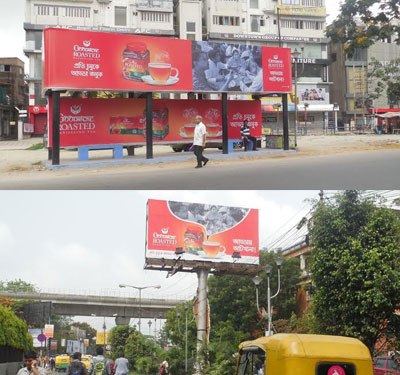
    In a bid to give boost to the soulful adda-culture better, Goodricke has taken to the Outdoor-route for the first time to promote their highest selling Brand – Roasted – amongst masses as the most sought after Darjeeling Tea brand in the country.


     

    Outdoor being the only medium of communication here, crafting the campaign strategy was a huge challenge for Posterscope. Since ‘adda’ was at the apex of the campaign brief, the primary target of the campaign was to target consumers at those touchpoints where mass-gatherings happen.


    Since people can gather, mingle and gossip anywhere, identifying requisite OOH spots near those areas using multimedia options was the key task that Posterscope took up as part of its client-campaign strategy. The touchpoints needed to cater to all age groups. Therefore, apart from using main media Billboards, different formats such as metro signages, island branding, Glass facad, BQS were used for the campaign. The campaign was rolled out in 2 phases wherein the initial burst was for a 30-day-period, which was then followed up with a sustenance campaign for next 30 days further. In between, there were quite a few filler phases conducted which were of short durations in a bid to give a time-boost to the campaign during the monthly buying cycles.


    The whole campaign strategy has been to position ‘Roasted’ as an ‘Adda Starter’ among the masses and influence the buyer’s purchasing decisions, which is then tilted towards Brand Roasted. Supporting the next two phases of the strategic road map, Hyperspace, the Retail Solution division under the Posterscope umbrella, mapped all their retail counters under general trade. Here, a retail audit was conducted to know the exact visibility challenges and consecutive solutions were given in terms of visibility enhancements at those stores; also customized executions were carried out to increase the Brand recall at loose-tea counters under general trade.


    Commenting on this campaign, Vikram Sungh Gulia, Senior General Goodricke Group Ltd., said; “When it came to the positioning of Kolkata’s No.1 Darjeeling Tea, we wanted Roasted to truly speak of the spirit in which it is bought, made and consumed in most households in this city. The two things that truly define the spirit of this city and its old world charm are, tea and adda. Both being complementary, in etiquette, in habit and in practice. For years, it has been a custom in this City of Joy, to sit and discuss politics, cinema and life in general, over a cup of tea. In the mornings before everyone goes to work, in the evenings when everyone comes back from work and several times in between. These tea sessions are almost always accompanied by an adda.”


    Haresh Nayak

    Haresh Nayak, Managing Director – Posterscope India said, “It gives us immense pleasure to be their preferred agency when it comes to providing outdoor solution and optimisation. The media strategy was aligned to ensure that the campaign matches the means of communication across all platform, be it outdoor or retail, within the consumer ecosystem. A very scientific method was put into the media planning, considering the brand value and insight and took great care in formulating and executing a plan that would create a powerful impact across the target group.”


  • Post rebranding, ACT Fibernet undertakes massive outdoor promotion activity

    By A Correspondent


    ACT Broadband, now ACT Fibernet, the fourth largest internet service provider in the country, undertook a high decibel, three-month OOH campaign to promote the company’s new brand identity. The campaign, executed in Bangalore, Chennai and Hyderabad, is designed to introduce the new brand name to consumers, and also to project the ‘fastest’ internet service that the company offers to users.


    The campaign has been deployed on various properties available in different cities that include hoardings, metro pillars and BMTC bus panels in Bangalore. The company maintains that the objective was to make each and every household in the target cities aware of the ACT Fibernet brand through one media or the other.


    Commenting on the OOH campaign, Bala Malladi, CEO, ACT Group, said, “OOH is part of a 360 degree campaign that we are executing to announce the launch of our new brand – ACT Fibernet. The campaign has been designed keeping in mind two key objectives – to announce the brand change from ACT Broadband to ACT Fibernet and to establish the positioning of the new brand, which is “incredibly fast” internet. Lending further credibility to the brand positioning and the messaging is our newly launched portfolio of incredibly high speed plans in the range of 20 to 80 Mbps.”


    With an aim to break the clutter, the activations have been rolled out in extremely novel and unique ways. The key touch-points covered as part of the activation engage college students, working professionals at corporate parks and shoppers at malls. Another unique feature of the activations was the digital integration which amplified the participation and overall effect of the campaign multi-fold.


  • Dentsu OOH firm Milestone Brandcom

    By A Correspondent


    Dentsu Aegis Network has announced the acquisition of Milestone Brandcom, the leading Out-of-Home (OOH) agency by taking a majority share in the firm. With the acquisition of Milestone Brandcom, combined with Posterscope – Dentsu Aegis Network’s global outdoor media agency – Dentsu Aegis Network gains much clout in the Indian OOH space in terms of quality and volume.


    Founded in October 2009 and led by founder and managing director Nabendu Bhattacharyya, Milestone Brandcom has more than 100 active clients across a wide range of industries, and provide a full service comprehensive OOH offering which includes an event promotion activation division, rural OOH activation, retail and digital OOH division. Milestone Brandcom recently launched the ‘Milestone Optimizer’, a powerful tool which optimises OOH media plans by tracking 25,000 sites across India and providing Gross Impression Points of an OOH campaign, a first in India.


    Nabendu Bhattacharyya will continue as CEO and Managing Director of Milestone Brandcom, reporting to Ashish Bhasin, Chairman and CEO of Dentsu Aegis Network South Asia.


    Said Mr Bhattacharyya: “We are thrilled to join hands with the Dentsu Aegis Network and my entire team and I are looking forward to taking Milestone Brandcom to even greater heights. Being a part of a dynamic global group like Dentsu Aegis Network will help us be stronger together. OOH will become more and more important in India and we are confident that as market leaders we will be at the forefront of this progress.”


    Said Nick Waters, CEO of Dentsu Aegis Network Asia Pacific: “Milestone Brandcom is a highly awarded and well respected agency in India. This acquisition marks another significant step as we build a high quality and scaled group in India.  We welcome Nabendu and the team to the company.”


    Added Mr Bhasin: “Milestone Brandcom is not only a market leader but also a pioneer of several developments in the OOH industry in India. Posterscope was already amongst India’s fastest growing brands. This investment now establishes clear leadership for us in this very important medium, making us the leader in the OOH and OOH Retail space in India. We believe that OOH will play an increasingly important role for clients in years to come so we are delighted to be able to offer clients a market leading service.”


  • Six Inches unveils OOH campaign for Philip Capital

    Philip Capital has launched an innovative OOH campaign titled ‘Talk to Philip’. With the improving domestic economic outlook, equity markets gaining positively and speculation the that markets would move higher in 2014 with enhanced corporate performance, supportive government in Delhi and healthy global growth the Philip Capital campaign reflects the positive outlook in the stock market and urges investors to ride it.


    Executed by Six Inches Communication, an integrated communication agency, the objective behind this campaign is to establish Phillip Capital as a trusted financial partner when it comes to investments. The campaign was conducted as the rising market is making investors positive and Philip Capital wanted to connect with them.


    The campaign looks different with its stunning visuals and highly appealing illustrations that convey a bull market. With minimal content, it appeals investors who intend to ride this bullish market. OOH is the only medium for this campaign as it has proved a right choice for Philip Capital in last two years.


    Vineet Bhatnagar, Country Head, Philip Capital said, “Our latest campaign brings out the positivity in the market and also reflects investors’ confidence. Besides, it also showcases Phillip Capital as a trusted advisor for investors. Over past 2 years, OOH medium has given good response and visibility to our brand. This time again we chose OOH for our latest campaign, needless to say the campaign overall feel also required a large format.”


  • Milestone Brandcom launches Milestone Optimizer

    By A Correspondent


    Milestone Brandcom has launched a ground-breaking audience measurement eco-system labelled ‘Milestone Optimizer’. Milestone Optimizer will cover 35 cities to provide an exhausted knowledge bank of opportunities and scope for planning in the outdoor advertising space. The optimizer introduces a new measurement matrix Gross Impression Points (GIP) for the OOH Medium. GIP Or Gross Impression Points definitively measures the reach and frequency of an OOH campaign giving it a holistic planning solution.


    The intensive web based tool is an industry first built on technology and scientific data collated over the years that will help marketers, media planners and buyers make superior and cost effective outreach to consumers. Giving a more wholesome look on media planning by providing factual data collected on traffic count, consumer behaviour and segmentation, the Milestone Optimizer provides accountability at time when most agencies refer to instincts rather than science. Milestone Brandcom has invested over 5 crore rupees in developing this apparatus and has covered top 10 towns in India which account for 75 per cent OOH advertising spends. The cities include Delhi, Mumbai, Bangalore, Hyderabad, Kolkatta, Pune, Ahmedabad, Lucknow and Ludhiana.


    Nabendu Bhattacharya

    Nabendu Bhattacharya, MD & Founder Milestone Brandcom said, “The Milestone Optimizer is a culmination of countless hours of hard work, research and scientific planning by our team. We have invested a great deal in the tool in an attempt to make OOH planning a lot more organised and scientific in the industry. Through the use of the Optimizer, brands will soon grasp the scope in this 1900 Crore INR sector and understand how underutilized it is in the country. The GIP measurement matrix is a complete scientific measurement solution that will redefine the OOH Industry. This is another benchmark in Milestone Brandcom’s journey”


    The Milestone Optimizer provides reach and frequency of different modes of OOH advertising through Gross Impression Points (GIP) that can also be compared with the more conventional forms of advertising such as print, TV and radio. It allows one to evaluate category benchmarking and market threshold level of activity giving a whole new dimension to media planning. It is combination of the latest technology and years of experience.


    The Milestone Optimizer tool was developed with the support of Industry veterans, media owners, marketing and brand managers across categories and brands. IRS iLAP (Hansa Research); TGI (IMRB Research), Traffic Study (Gfk Mode); Technology Partner (Unikov Technologies) are few of credible databases used in developing a robust scientific planning OOH Tool.