Tag: Nestlé

  • Nestle replaces Maggi ads with Nescafe & KitKat commercials, to lose about Rs 10 crore

    By Pritha Mitra Dasgupta & Shramana Ganguly


    Nestle India stands to lose advertising inventory of about  Rs 10 crore due to Maggi recall despite its move to air commercials of Nescafe or KitKat in all advertisement slots booked for the instant noodles brand, broadcasters and media planners say.


    “The channels have been told to subtly replace Maggi ads with Nescafe and KitKat commercials,” a senior media planner said. “But despite this attempt to recover as much inventory possible, Nestle will have to let go of advertising inventory worth  Rs 8-10 crore,” the person said on the condition of anonymity.


    On Saturday, Nestle notified broadcasters and other media houses in India to stop publishing Maggi ads from Sunday. While the Swiss company has stopped digital advertising for the brand as well, it is using various social media platforms liberally to sell its side of the story to Indian consumers.


    A Nestle India spokesperson said that while the firm has taken action to stop Maggi ads, “you may see a few since changing the programming pipeline could take a little longer”.


    Nestle is one of the biggest advertisers in India, spending over  Rs 400 crore on advertising a year. Its ad spend on Maggi brand alone is estimated at over Rs 150 crore, according to industry insiders.


    Publicis Worldwide is Maggi’s creative agency, while Zenith-Optimedia handles the brand’s media buying and selling activities. The digital mandate of Maggi is handled by GroupM’s Maxus. Sources in these agencies said that Nestle stopped airing Maggi Oat Masala noodle commercial featuring actor Madhuri Dixit right after the scandal broke.


    In February, Maggi had launched a campaign, ‘Khushiyon Ki Recipe’, which was on air till Saturday despite Food Safety and Standards Authority of India (FSSAI) dismissal of Nestle’s defence about the brand embroiled in controversy over excessive lead content and mislabelling on MSG.


    Nestle has now instructed channels to take these commercials off air.


    Meanwhile, Ahmedabad-based Consumer Education Research Centre (CERC) is contemplating legal action to push Nestle to do corrective advertising across print and television space.


    “Considering Nestle advertisements have been misleading the consumers, they ought to engage in corrective advertising to tell the consumer in as many words about what is factually correct,” said Pritee Shah, chief general manager at CERC and a member of an inter-ministerial monitoring committee for misleading advertisements under the ministry of consumer affairs.


    G Gurucharan, additional secretary (consumer affairs), too, had recently stated that Nestle could be asked to put out corrective advertisements.


    Shah said that considering Nestle has been misleading the consumer about the health aspect of Maggi, it should redo its commercials. In addition to lead and MSG, the firm needs to clarify that one helping of Maggi is not equivalent to three chapatis as claimed by one of its ads, he said.


    Source:The Economic Times

    Copyright © 2015, Bennett, Coleman & Co. Ltd. All Rights Reserved

    Licensed to republish
     

  • Nestle India enters into an agreement with Magic Bus India Foundation

    By A Correspondent


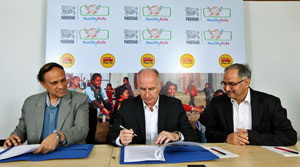
    Nestlé India has recently signed an agreement with Magic Bus India Foundation. This initiative is on the lines of the Nestlé Healthy Kids Global Programme that focuses on providing nutrition and health awareness to adolescents.


     

    The programme will reach out to 50,000 students aged between 10–17 years through government schools. The cities, where the programme will be running for a year, include Delhi, Mumbai, Chennai, Bangalore and Hyderabad. Magic Bus, which works on breaking the poverty cycle, one child at a time, will create a curriculum based on Sports for Development (S4D) approach, imparting knowledge about nutrition and a healthy, active lifestyle.


    Speaking on this occasion, Etienne Benet, Managing Director, Nestlé India Limited, said, “Being a leading Nutrition, Health and Wellness (NHW) company, Nestlé India intends to enhance the quality of life by creating awareness regarding nutritional health. In line with the already operational Nestlé Healthy Kids Global Programme, we intend to reach out to adolescents across metros in India.”


    The Nestlé Healthy Kids Global Programme is adapted in India to create and raise awareness regarding good nutritional practices. Added Benet, “The partnership between Nestlé India and Magic Bus, will promote healthy eating habits amongst children in government schools, basis food availability and accessibility in cities.”


    Commenting on the partnership, Sanjay Khajuria, Senior Vice President, Corporate Affairs, Nestlé India said, “In India, we have done an assessment of nutritional needs in the community and want to create and raise awareness regarding good nutritional practices amongst children and adolescents. Through the Magic Bus partnership, Nestlé India will reach out to over 50,000 less privileged children in five metros within the span of a year.”


    Pratik Kumar, CEO, Magic Bus India Foundation added, “There is a strong synergy in the commitment towards better health and wellness of both the partners. Along with sensitising parents and teachers, this program will steer adolescent children in marginalised communities towards a life with better awareness and improved life skills, in the journey from childhood to livelihood.”


    For the Nestlé Healthy Kids Programme, Magic Bus will create and customise its existing curriculum into three major buckets with the objective of raising awareness on ‘Nutrition and Health’, ‘Getting Active’ and ‘Hygiene and Sanitation’ amongst children in government schools. It will identify and train youth mentors who will be responsible for implementing the sessions in these schools and train them to deliver the curriculum on the ground. The programme also intends to ensure that girls and boys get equal opportunities to play and learn. An awareness drive for gender sensitisation will form an integral part of the programme.


  • Rishad Tobaccowala: Why Nestle’s “Share Your Goodness” is more than Good

    Rishad Tobaccowala

    By Rishad Tobaccowala


    Nestle has hit a nerve with its latest “Share Your Goodness” campaign. This series of heartwarming ads has emotionally resonated with millions of people in India, as well as a larger set of the global population via social/online media.


    If you haven’t seen the campaign yet, I’d encourage you to check it out. The first commercial is Adoption and the second Dabbawala.


    I share this campaign because it’s a great example of next generation storytelling and its message has resonated with many, largely because the campaign leveraged a number of new media tricks – from online video with extended versions to smart search optimization and seeding its own hash tag #ShareYourGoodness to enable sharing and discovery.

     

    But the campaign is a success for more reasons than just great storytelling and new media tricks. So why did this campaign succeed and what can we learn from it as global marketers? The lessons are surprisingly less about digital technology and more about analog humanity.


    1. Storytelling is critical: Both executions, particularly Adoption, is a well-honed story – a story with humanity that leaves enough unsaid that the viewer brings their own experiences into the experience and therefore it becomes more engaging.


    2. Human insights are key: The core insight is really about how food is central to human bonding and social experience. In both commercials, food serves as a bridge, a connection, an expression of love and understanding between siblings, husband and wife and just people.


    3. Smart marketers own the category benefit: Food is an effective way to share our goodness. This is the underlying emotional benefit of food, besides its ability to sustain us physically. By linking Nestle to this underlying category benefit, Nestle looks bigger, more purposeful and more relevant to life than just being a food manufacturer.


    4. Break The Mould: Somewhere a client or a series of clients made some bold calls. First, they decided to launch the campaign online. Second, they approved story lines where the brand is the hero without the product being the hero or appearing all over the story. Third, they approved scripts that took on out of the ordinary topics. And finally, they understood that we live in a connected world and had their agencies seed, enable and leverage sharing.


    5. Recognize  and leverage the power of new media: Many marketers see digital and new media – even today in India and often around the world – as an after thought, an add-on or something one does to claim it is in the plan. The reality is that in places like India, which is the second largest market for Facebook with 100 million users (also Twitter’s and Linked In’s second largest market) and a highly mobile (soon in India 250 million smart phones), new media is as much media as old media and can allow for far more flexibility to create and distribute an idea. Why not start with the idea first and then determine the media rather than starting with the :30 or the print ad?


    International appeal

    The underlying insight of human goodness linked to sharing food, combined with the realization that the digital world allows one the room to tell a story which can then be shared and edited for other media, is so big that I believe this campaign has an appeal for international audiences, making it possible to leverage this effort across the globe.


    In a connected world, the best ideas can come from everywhere and the Internet is global!


    Marketers and agencies need to realize that some of the old arts (storytelling, insights, understanding category benefits) and pure client and agency guts are very critical. So is the ability to seamlessly leverage old and new media in ways that get people not only to be viewers, but be part of the media distribution plan.


    Rishad Tobaccowala is a senior thoughleader in digital media and advertising. He works with the Publicis Groupe and is chair for Digitas, LBi, Razorfish for Publicis Groupe.


  • Higher smartphone use rings in FMCG mobile ad growth

    By Samidha Sharma


    Consumer goods companies upped their media spends on the mobile platform in the past one year as smartphone penetration, coupled with a spurt in data usage, grew exponentially in the country. InMobi, a mobile advertising network, said spends by FMCG companies, which are clubbed as traditional advertisers, grew 175 per cent on its network last year. Similarly, Vserv.mobi, another mobile ad network, registered a 300 per cent increase in ad dollars while Vuclip, a mobile-focused aggregator of video content, saw its FMCG clients double their ad spends in 2013.


    In India, FMCG saw a high uptake in the last two quarters of 2013, as five major advertisers including ITC, Reckitt Benckiser, HUL, Mondelez and Nestle ran more than 30 campaigns at a reasonably good scale as opposed to 2012 where only one consumer goods company utilized mobile effectively, said Dippak Khurana, CEO & co-founder of Vserv.mobi.


    Buoyed by a slew of mobile-only content, the Indian mobile advertising market is estimated to reach Rs 2,800 crore by 2016 from a mere Rs 180 crore according to estimates by Avendus Capital, a Mumbai-based financial advisory firm. The Indian advertising industry is pegged at around Rs 28,000 crore with FMCG as the biggest contributor on mediums such as television and print as well.


    “With the growth of mobile solutions companies, apps and other mobile technologies, we have seen FMCG advertisers tap the mobile in a big way over the past year. With over 800 million mobile subscribers, these advertisers targeting rural consumers find the medium extremely effective as mobile reaches even the remotest geographies,” said Basabdutta Chowdhury, CEO of Platinum Media, a division of Madison, which buys media for FMCG majors like P&G, Marico and Godrej.


    What is significant is that India could currently have as much as 50 per cent or more mobile-only internet users, much above the global number, making the medium an attractive one for even traditional advertisers.


    Consumer products companies are increasingly adopting a mobile-first strategy. Our growth has come from engagements with more than half of the top 25 FMCG brands, including a partnership with Unilever, said Atul Satija, VP & MD (Asia-Pacific and Japan) at InMobi.


    Source:The Economic Times

    Copyright © 2014, Bennett, Coleman & Co. Ltd. All Rights Reserved

    Licensed to republish


  • FMCGs brace for a weak monsoon

    By Ratna Bhushan & Sagar Malviya


    Consumer goods companies are busy firming up contingency plans to stem any decline in volume sales in case a deficit in monsoon rainfall hit crop yields, escalate food prices and impact consumer spend.


    Companies such as Dabur and Parle Products said they will delay price increases, emphasise on low-priced packs of Rs2, 5 and 10, explore new value price points and step up promotions to prevent possible downtrading, or consumers switching to cheaper products, in case of a crisis.


    “If there’s a monsoon deficit, we would obviously look at protecting volumes,” said Sunil Duggal, CEO of Dabur, which makes Vatika shampoo and Babool toothpaste.


    “Contingency plans could include a combination of things like putting off price increases, accelerating focus on smaller packs and allocating more spends on consumer promotions, depending on where the deficit is,” he added.


    BK Rao, general manager at top biscuits maker Parle Products said the maker of Parle-G, Monaco and Hide & Seek biscuits will focus on smaller price points if the situation is bad.


    The monsoon has revived significantly in the past week to reduce total deficit in the country so far to 22 per cent from 31 per cent and accelerated crop planting. But crop yields may still be lower as rainfall has been uneven, with some regions, including parts of Karnataka and Maharashtra, remaining practically dry for three weeks. Economists warn that food prices may rise sharply if rainfall weakens again.


    FMCG companies have been bucking the overall slowdown in the economy and posting an average 15 per cent growth, but a weak monsoon could change it.


    “A weak monsoon will naturally reflect on costs and we will have to work around that. The industry will feel the impact around September-October,” said Chitranjan Dar, divisional chief executive of tobacco-to-chips maker ITC Foods.


    While impact of inflation on the premium urban rich is not very significant, mid-rung and rural demand is strongly linked to the monsoons. Thus, top FMCG firm Hindustan Unilever, Dabur and biscuit maker Britannia, which have large rural presence, could be hurt more than Nestle and GlaxoSmithKline Consumer, which have an urban focus for their products, say experts.


    Analysts say consumer goods companies tend to push ‘magic price points’ of Rs2, 3, 5 and 10 in an inflationary scenario to minimise any negative impact on discretionary spends. Such low-unit packs account for over 25-30 per cent sales of makers of shampoos, hair dyes, biscuits and snack foods.


    Also, with local competition always posing a threat, established players would have to step up volume discounts and consumer promotions in a weak monsoon scenario. A significant 70 per cent of low unit packs are sold through kirana shops (mom and pop stores).


    “Small SKUs and distribution expansion may save the day. Downtrading too would be arrested at the small-pack level,” Shirish Pardeshi, executive director and co-head, research, at financial services firm Anand Rathi Securities, wrote in an investor note two weeks back. “Rural expansion of distribution (for example, HUL’s Project Shakti and Emami’s Swadesh initiatives – both aimed at accelerating expansion in rural markets) would help arrest drop in consumption,” the note said.


    Some analysts, however, believe the impact of a weak monsoon will be limited on rural consumption because dependence on agricultural income has been declining. “Our discussions with rural trade and consumers have always highlighted that one bad monsoon does not result in consumption declining. Instead, it leads to trade credit terms becoming more onerous in rural India,” Ambit Capital’s Anand Mour wrote in a report.


    Some companies such as Marico, maker of Saffola edible oil, say they would wait for some more time before start worrying about monsoon. “The June-July period is too early to take any decision. We will have to wait for August to check the monsoon trend and get a clearer picture,” said Marico CEO Saugata Gupta.


    Source: The Economic Times

    Copyright © 2012, Bennett, Coleman & Co. Ltd. All Rights Reserved


  • FMCGs like HUL, Dabur, Godrej, Marico on consumption-driven growth

    By A Correspondent


    India’s fast-moving consumer goods, or the FMCG sector, has been able to weather the impact of an economic slowdown and rising input costs yet another quarter, as firms led by HUL beat street expectations both on top line and bottom line growth.


    A study of the aggregate financial performance of the leading 10 FMCG companies over the past eight quarters shows that the industry has grown at an average 16-21 per cent in the past two years with average operating margins being 22 per cent.


    Very few other industries can boast of having such a performance track record. “The consumer sector typically is the last and the least to suffer during a slowdown,” said Manoj Menon, senior analyst at Kotak Institutional Equities.


    Most companies are reaping the benefits of the direct distribution expansion mostly in rural India. HUL, for instance, has tripled its rural penetration in the last couple of years. Sales from modern trade have also been a strong growth driver for companies. Marico has posted a growth of over 45 per cent in revenues from its rural and modern trade businesses during FY12.


    The quarter to March performance of FMCG companies like HUL, Dabur, Godrej Consumer Products, Marico, Asian Paints, GSK Consumer Healthcare, Procter & Gamble Hygiene and Healthcare and Jubilant Foodworks is also a reflection of consumption-driven growth.


    Half of HUL’s 20 per cent revenue growth during the March quarter was volume driven. Dabur’s domestic sales rose 19.2 per cent with volumes rising 9.5 per cent. Godrej Consumer Products logged 30 per cent sales in soaps in India – 17 per cent of which was volume-driven. Asian Paints registered 29 per cent growth in its revenues from domestic business, of which 15 per cent was volume growth.


    The company had raised prices by close to 12 per cent on its portfolio during the quarter. Jubilant Foodworks, owner of the Dominos Pizza franchise in India, reported 26 per cent same store growth, which was almost entirely volume-driven despite the company raising its menu prices by 10 per cent. Marico has been able to achieve a 17 per cent volume growth for the March quarter from a total revenue growth of 23 per cent for the quarter.


    GSK Consumer Healthcare registered 14.5 per cent increase in net sales – 7 per cent of which was driven by volume growth and the rest through higher realisations on account of price increases. Nestle was probably the only company to have a largely value-driven revenue growth of 13 per cent during the March quarter.


    Exceptional value growth always carries the risk of hurting volumes. Till now, most FMCG companies have been able to perform well while balancing between volume and value growth. “Over the long run, we see consumer demand being resilient,” Nitin Paranjpe, chief executive officer of HUL, had said at the press conference following the company’s results. According to Mr Paranjpe, the secular trend of consumers is towards uptrading rather than downtrading.


    “The demand for consumer goods is relatively inelastic compared to that of other products,” explained Milind Sarwate, group chief financial officer, Marico. An earlier ETIG analysis of the growth in revenues and profits of leading FMCG companies revealed that companies registered a much faster growth in revenues and profits during periods of high inflation (in 1994-98 and again from 2006 till date) compared with periods of low inflation (1999-2005).


    “During an inflationary period, there is a likely market share gain for organised players from the unorganised regional players,” Mr Menon explained. Larger firms enjoy economies of scale on account of bulk buying and higher pricing power on their reputed brands.


    The ET FMCG Index has a price to earnings multiple of 36 against the Sensex P/E of 16.1. Stocks of Godrej Consumer Products and Asian Paints hit a new high ahead of the companies’ result announcements. Stocks of HUL, Marico, Dabur, Glaxosmithkline Consumer Healthcare and Jubilant Foodworks are hovering near record high levels.


    However, their current valuations are still lower than their all-time record levels. In case the broader economy is sluggish, analysts fear that the going may not be good for the sector in the coming quarters. “Moderation is very much on the anvil,” cautioned Mr Menon. For now, FMCG companies continue to live up to their reputation of being a defensive investment play.


    Source: The Economic Times

    Copyright © 2012, Bennett, Coleman & Co. Ltd. All Rights Reserved


  • APPIES 2012: 100 best marketing campaigns to be presented LIVE

    By A Correspondent


    Fierce competition is expected at APPIES 2012 where 100 of the top marketing campaigns from 16 countries in Asia Pacific will vie for 10 Gold Medals. An annual two-day festival of the best marketing ideas, APPIES brings together the brightest minds in the industry from across 16 countries to celebrate excellence, network and exchange knowledge. Now in its third year, APPIES 2012 brings the audience up close and personal with some of the most compelling campaigns through its unique live presentation format.


    APPIES 2012 enables brand marketers/campaign creators to demonstrate their stellar ‘Show, Share and Sell’ skills, thanks to the unique ‘4-6-10’ format. Each presentation will begin with a 4-minute showreel video summarising the entire campaign, followed by a live 6-minute exposition of the campaign’s key highlights by the brand’s marketers/ campaign creators. Then comes the interactive 10-minute session where each campaign will be cross-examined by the judges and audience members.


    Building on last year’s list of campaigns by companies and brands such as P&G, Nestle, Pepsi, McDonald’s, Fonterra, Singapore Tourism Board, Bacardi, Adidas and Vodafone, APPIES 2012 will continue to showcase the best campaigns from various industries that span across highly-diverse markets in Asia Pacific region.


    The 100 selected marketing campaigns will cover a broad range of six product/service categories that include Consumer Durables, Consumer Services, Food & Beverage, Non-Food FMCG, Business Services and Government, Cultural, Social & Environmental campaigns.


    APPIES 2012 will also host special keynote sessions and panel discussions on The Future of Industry. Marit Kievit, Global Brand Director (Lux) at Unilever and Chris ter Steege, Director (Digital Integration), Integrated Marketing & Communications at Philips Asia Pacific have been announced as keynote speakers at APPIES 2012. With advisory and assessor panels comprising top marketers in the region, APPIES 2012 is designed to offer excellent networking and knowledge sharing opportunities for industry professionals.


    Marit Kievit is the Global Brand Director for Lux (Unilever). The multi-cultural team led by Marit has developed breakthrough and award-winning integrated campaigns. She was also a permanent member of Axe’s global brand team, setting the global innovation agenda for one of Unilever’s most successful brands. Most recently Marit joined the global leadership team for Lux as a global brand director, based out of Singapore.


    Chris Ter Steege is a communication professional with an obsession for innovation and creativity in marketing, brand communication, digital and social media, and leading the creation of impactful experiences through integrated communication strategies and tactics. With 10 years experience, Global to Local, B2B and B2C, at Philips, Chris now leads regional cross-sector digital programs in Asia Pacific, co-leads the region brand campaign, works with sector marketers to deliver award-winning campaigns, and manages the digital team in one of the most diverse and fastest growing regions in the world.


    Leanne Cutts is Vice President, Marketing for Kraft Foods Asia Pacific Region, based in Singapore. She is responsible for driving the growth of the gum, candy, and powdered beverages categories as well as leading consumer insights & analytics and driving marketing excellence in the region.


    The Institute of Advertising Singapore (IAS) was founded in 1990 with the aim to position Singapore as an internationally recognised “centre of excellence” with world class advertising professionals, international best practices and industry leading creative output. The IAS has several highly successful business platforms for the advertising and marketing communities to meet, collaborate and raise the standards of the industry as well as encourage continuous education. The IAS has also organised the Singapore International Advertising Congress since 1998.


  • The Anchor: Sanjeev Singhai on 6 reasons how brands benefit by specific ad solutions

    By Sanjeev Singhai


    1) Advertising informs and educates

    Advertising delivers news around the brand to consumer. explains how brand is the best fit around taste, value for money or lifestyle that the consumer is looking at, thus making it easy for consumer to make the purchase decision. It can also be used to explain complex product feature or clarify consumer doubts around the brand or raise awareness among consumers about the new variety or categories of products and services that the brand has to offer.


    2) Advertising differentiates

    With advertising, brands can rationally differentiate themselves by highlighting their unique selling points which makes it stand different from other brands, making it easier for a consumer to make a purchase decision.  It also stimulates competition in the marketplace and allows space for the category to grow.


    3) Advertising persuades to purchase

    Advertising aims at persuading the potential customers, impacting their intention to purchase the product. Advertising attracts attention towards a product, and by sharing its unique features, advantage and benefits, creates desire to have the same and finally induces consumers to visit the market and purchase the same. Advertising has psychological impact on consumers. It influences the buying decisions of consumers.


    4) Advertising drives sales

    Advertising not only creates an emotional connect between consumer and the brand but can also be used to support the sales promotion efforts of the brand, allowing it to make positive contribution in sales promotion. Thus advertising help brand contribute to company’s growth and profitability.


    5) Advertising creates demand (drives trial)

    Advertising spreads information and encourages consumers to ‘try’ new products. Such advertising leads to product trials, thereby leading to creation of new demand. Various promotions are offered to consumers in the initial period giving them an inertia to try the new product and generate positive response which helps in creating new demand from non-users and build a relationship with brands.


    6) Advertising helps brand reinforcement

    Advertising helps in reinforcing brand’s name and image to the public, which can be part of a long-term marketing strategy. For example, when Nestle produces an ad for Aata Maggie, it is not only telling the benefits of that product but is also keeping the Maggie brand live in the minds of consumers, which can also help the sales of its other products. Advertising help build brand image with distinct personality of the product. Advertising builds brand image and this develops consumer loyalty towards a specific brand.


    Sanjeev Singhai is Business Director – Indian Sub Continent, Buchanan GroupIndia


  • Can flavoured & frozen yogurt replace the good ol’ dahi?

    By Preethi Chamikutty


    Dahi that went abroad and came back. That’s how Swati Jain chooses to describe the latest flavour of the season: frozen and flavoured yoghurt.


    “Flavoured is just a nomenclature,” said the head of marketing at Danone India, which recently forayed into the frozen category after debuting with the flavoured variety. Danone isn’t the only brand taking this more contemporary form of good old curd, or dahi, pan-India. Go Dahi, a frozen yogurt brand launched by Parag Milk Foods two years back, is now available in Mumbai, Pune and Bengaluru.


    And it has plans to enter North India. So what about east India then?


    “Kolkata already has mishti doi!” says Devendra Shah, chairman, Parag Milk Foods very matter-of-factly. He goes on to say mishti doi is quite entrenched in West Bengal and making consumers there switch to frozen/flavoured yoghurt could be difficult.


    It’s not just Kolkata that has a local variant of curd; Maharashtra has shrikand, Punjab lassi, Kerala taire and Tamilians still swear by curd rice.


    Flavoured and frozen yogurt is a new food category to India, just two years young. The market for yoghurt of all types, including flavoured, frozen and regular curd, is pegged at almost Rs2,500 crore by euromonitor International – and one that grew 35 per cent in 2011.


    Clamouring for a scoop of the action are a clutch of brands, from Parag Milk Foods’ Go and Amul Flaavyo of the Gujarat Cooperative Milk Marketing Federation (GCMMF); to Nestle Real Fruit Yoghurt, Mother Dairy Yoghurt and Danone Cremix Yoghurt. The second set in this space include retails brands like Cocoberry, Red Mango, Kiwi Kiss and Yogurberry which sell flavoured/frozen yoghurt through exclusive outlets that only stock the respective brands.


    Most non-retail brands are using modern trade, institutions, college, school and office canteens, airlines, five-star hotels and independent kiosks to reach out to its potential consumers. Danone is also looking at kirana stores to reach customers and Jain says they provide Danone coolers to shops for stocking products. The target customers are young, urban and health-conscious people. Ms Jain of Danone points out: “Women tend to pick it up more than men, as psychographically they are more health conscious than men.”


    Adds GCMMF managing director, RS Sodhi: “This is a new product category being adopted by middle and upper middle class people who are health-conscious.” Nestle is trying to position its yoghurt as an ‘anytime nourishing snack.’ Kumaran Nowuram, general manager – dairy, Nestle India, says: ” Consumers consider flavoured yoghurt a western concept and, as they do not quite understand it, there really is no specific consumption pattern yet.” Nestle Real Fruit yoghurt has been available in the market for the past few years and the brand will soon add Junior Daheez (for children) and Fruit Daheez to its portfolio.


    These are still early days of trial and error. For instance, Go has withdrawn its banana variant for lack of adoption. Mango, strawberry and pineapple variants, which are common to all brands, are finding takers. Mother Dairy also has yoghurt in raspberry, blueberry and plum flavours.


    Munish Soni, DGM marketing at Mother Dairy’s dairy products division, says blueberry is quite popular among its customers. The retail brands have a larger range of flavours – as many as eight in the case of Cocoberry. Cocoberry also offers the largest pack size of 300 gm and even provides the option of home-delivery. Go, says Shah, will soon launch a 400 gm pack.


    The way forward clearly is to grab share from other snacks and desserts. Ina Dawer, research analyst at euromonitor International, says: “Frozen yogurt has already started to replace ice cream to a certain extent. Consumers have also already started to look at it not only as a healthy snack but also as a healthy replacement for meals.”


    Companies tying up with corporates to target office employees, adds Dawer, will also help in increasing consumption by making it a quick, convenient and healthy substitute for meals. “I will not be surprised if frozen yogurt sees growth of 70-80 per cent each year over the next two years,” predicts Dawer.


    There are a few obstacles to such robust growth. The lack of adequate cold chain infrastructure is the biggest roadblock, which restricts distribution to cities and towns away from the manufacturing facilities. This also makes building loyalty difficult as consumers tend to lap up whichever brand they can get their hands on. Says Suman Srivastava, cofounder of Marketing Unplugged, a brand consultancy: “While there are a number of brands in the space, someday I eat one brand and the next day I pick up another. This may be because not all outlets are stocking all brands.” Srivastava also thinks for the category to become bigger there has to lot of innovation: “When Britannia showed its cheese as equivalent to a glass of milk, it was unique way to position the product. Similarly if brands are able to create some parallels for frozen/flavoured yoghurt that could help increase adoption,” he says.


    Source: The economic Times

    Copyright © 2012, Bennett, Coleman & Co. Ltd. All Rights Reserved


  • Young urban users and modern trade boost demand for premium FMCG products

    By A Correspondent


    Makers of packaged food and personal care products are increasingly focusing on premium products as rising aspirations of young urban consumers and widening reach of modern trade help boost demand for high-value, high-margin products.

    Contribution of premium items is growing in most FMCG categories, giving a breather to marketers fighting rising input costs and slowing overall demand, particularly in rural areas.

    “Consumers are moving from value-added products to products that offer value benefits,” said Shirish Pardeshi, executive director and co-head, research, at Anand Rathi Securities.

    Big retailers play a key role in increasing demand for premium products within a category, by helping companies directly engage with consumers.

    Future Group, the country’s largest retailer, has reported premiumisation in the last several quarters. “Consumers are upgrading and there is not much impact of the external economic scenario,” said Devendra Chawla, president, Future group food and FMCG businesses.

    Mr Chawla said the trend of premiumisation is high in categories like soaps – the premium variants (priced above Rs 35 per soap bar) accounts for 40 per cent of sales at Big Bazaar – biscuits and detergents.

    Premium cream biscuits and cookies are growing 20-25 per cent a year, double the pace of mass variety Glucose and Marie biscuits, according to Parle Products, the country’s largest biscuit maker.

    Contribution of Glucose and Marie to the biscuit market has slipped to around 55 per cent from 65 per cent in the past one year, according to B Krishna Rao, group product manager of Parle Products.


    SUPERMARKET DRIVE

    Modern retail has been the saving grace for FMCG companies that had warned of slower growth this fiscal, more so after they had to resort to multiple price hikes of up to 15 per cent due to increases in commodity costs and pressures on margins.

    Retailers such as Future Group and Spencer’s Retail have reported rise in average purchase size of most product segments, confirming the premium drive.

    Anand Mour and Shariq Merchant, analysts with financial services firm Ambit Capital, wrote in a report in January that growth is moderating in rural India, but aspirational consumption of young urbanites is driving premiumisation. Expansion of modern retail, which accounts for less than 10 per cent of the country’s Rs2 lakh crore retail market, will facilitate this premium drive.

    A recent Nielsen study expects Indian shoppers to increase spending on FMCG at modern retail to $5 billion, or about Rs24,700 crore, by 2015 from $1.8 billion, or Rs8,900, in 2011.


    NEW PRODUCTS

    “Absolute price is no longer the only consideration, the price benefit equation is what needs to be managed,” says Jayant Kapre, president of McVitie’s India, a subsidiary of British confectionery firm United Biscuits. The firm has rolled out a premium range of McVitie’s Hob Nobs biscuits.

    Now Nestle is expected to launch a chocolate dessert called Fudge priced at Rs200, according to industry insiders. GSK has launched Horlicks Gold at a 30 per cent premium and within six months it has generated sales equal to 3 per cent of the more than Rs1,500-crore flagship brand. Marico, Dabur and ITC are all gung-ho about such products.


    Source:The Economic Times

    Copyright © 2012, Bennett, Coleman & Co. Ltd. All Rights Reserved


  • Delegates from 15 countries to attend ad:tech New Delhi 2012

    By A Correspondent


    With less than ten days remaining, ad:tech, the world’s No.1 digital marketing, media and advertising event, is on its way to be oversubscribed again. ad:tech New Delhi 2012 has been registering an unprecedented number of entries from delegates, exhibitors and sponsors from all over the world, to make it even larger than last year.


    The event is being held over three days instead of two days as last year, and has an agenda full of insightful keynotes, panel discussions, workshops and networking opportunities. To be held between February 22 and 24 at Hotel Leela Kempinski Gurgaon, the first day of this conference and exhibition will be dedicated to in-depth master-classes on social media and search techniques for marketing professionals.


    The Master Classes will comprise of a hands-on, interactive workshop to provide in-depth learning on developing a web presence, digital brand building, SEO 2.0, evolution of technologies in PPC, social media monitoring, and imbibing search and social into an organization’s DNA. Leading experts from Google, Communicate2, Simplogy, Quova and Value Pitch will be conducting sessions during these pre-registered master classes.


    Rammohan Sundaram, Event Chairman, ad:techIndiaand Founder, CEO & Managing Director, Networkplay Media Pvt. Ltd. said: “This year is going to be a big game-changer forIndiain the digital marketing arena, and ad:tech is proud to be at the forefront in bringing the very best of minds together on one platform. We have global digital heads of top brands like Nestle and Pepsi are among the over 90 expert speakers fromIndia, APAC and the world.”


    Commenting on the people coming down to India to attend ad:tech, Mr Rammohan said: “Apart from India, we already have confirmations from delegates and speakers of as many as 15 countries, including USA, UK, Singapore, Australia, Japan, Indonesia, Singapore and Korea”.


    As the largest gathering of online marketers, the event also promises to showcase leading Indian and global brands, including Pepsi, Coca-Cola, Nestle, Hindustan Unilever Limited, Facebook, Dell, FordIndia, IBM, Nokia, Sony Entertainment Television, Bharti Airtel, LG Electronics, MTV, Linkedin, Homeshop18, Godrej Appliances, comScore, Ogilvy, Avaya, mydala.com, Yatra.com, Kotak Mahindra Group, Tata Teleservices, MotorExchange, and Domino’s Pizza.


    Mr Rammohan said: “We see a renewed energy among brands this year. Such an unprecedented response from brands puts to rest any doubt on the future of digital media in India, and proves that digital is the new arena where real marketing wars will be fought, and probably much sooner than we expect.”


    Besides the master classes, this year’s ad:tech will also feature an exclusive exhibition area for start-up companies in the digital space, which is almost full booked already.


    ad:tech, world’s No. 1 digital marketing ,media & advertising event made its successful debut inIndiain April 2011, withNew Delhi being the first city to host the two day event. With 10 shows in 7 countries, ad:tech has been providing media, marketing and technology professionals with the tools and techniques required to succeed in a changing digital world for over a decade.


  • Nestle India rolls out the Nescafe Plan

    By A Correspondent


    Nestle India has announced the implementation of the Nescafe Plan in India. Nescafe Plan is a global initiative by Nestle S.A. to bring under one umbrella the company’s commitment on coffee farming, production and consumption which will help Nestle to further optimize its coffee supply chain.


    To start the roll out of the Nescafe Plan in India, the first Nescafe coffee demo farm and training centre was inaugurated in Kodagu District of Karnataka by Mr. Jawaid Akhtar, I.A.S, Chairman, Coffee Board of India, Mr. Nandu Nandkishore, Nestle executive Vice President and Zone Director for Asia, Oceania, Africa and the Middle east, and Mr. Antonio Helio Waszyk, Chairman & Managing Director, Nestle India.


    This first coffee ‘demonstration’ farm in India will help farmers improve quality, productivity and sustainability. The company is assisting coffee farmers in the states of Karnataka, Kerala and Tamil Nadu to develop their agricultural practices as demand for soluble coffee grows in the country. Furthermore, Nestle research and development teams aim to provide farmers with high-yielding, disease resistant plantlets suitable for Indian conditions.


    Through the initiative, the company seeks to source coffee sustainably by working closely with Indian coffee farmers and ensuring competitive prices, transparency and traceability.


    Mr. Jawaid Akhtar, I.A.S, Chairman of the Coffee Board of India, said: “I am happy that the nescafe Plan is being launched in India. It will provide coffee farmers with technology and best practices for sustainable production of high quality coffee and also benefit them with improved access to markets.”


    During the event, a group of 20 farmers who have been trained under the Nescafe Plan were felicitated. While releasing the training manual ‘Nescafe Better Training Practices’, Mr. Nandkishore, Nestle executive Vice President and Zone Director for Asia, Oceania, Africa and the Middle east, said: “Nescafe is the world’s leading coffee brand. The Nescafe Plan demonstrates our commitment to working with thousands of farmers around the world, including in India, to provide training and technical assistance.”


    In recent years Nestle India has been doing extensive work to improve penetration of its Nescafe instant coffee amongst consumers and expand the market. The Nescafe Plan is important to ensure that the business is sustainable and that the coffee farmers also benefit. It reflects Nestle’s business philosophy that it must create value for its shareholders as well as the communities where it operates.


    Mr. A Helio Waszyk, Chairman and Managing Director, Nestle India said: “Indian coffee is currently amongst the best in the world and we would like to use our own expertise in coffee to help it retain its excellence in the future as well. In the Nescafe Plan our team will work with coffee farmers as well as other experts to combine the traditional wisdom with the benefits of modern science to make coffee farming more sustainable.”


    Currently The Coffee Board of India assists in research, development, extension, quality checks, market information and the domestic and external promotion of coffee from India. Nestle India agronomists will also work with coffee farmers and train them on how they can further improve the productivity and quality of coffee in a sustainable and efficient manner.