Tag: Nestlé

  • Confronting the Crisis of Credibility & Trust

    Confronting the Crisis of Credibility & Trust

    Kunal SinhaOnce again, a brand that is a household name has let its users down. Except that the duplicity is remarkable.


    A recent report released by Swiss NGO Public Eye and the International Baby Food Action Network (IBFAN) revealed stark differences in the sugar content of Nestle’s baby products across various nations.


    The investigation, which evaluated around 150 baby products from different countries, alleges that Nestle’s products in South Asian (including India), African and Latin American markets contain significantly higher sugar levels than those in Europe. Brands like Cerelac and Nido contained more sugar by as much as 2.7 gm per serving in India and 5 gm in Thailand– compared to developed nations in the West.


    The medical evidence against sugar is clear. Added sugars should not be given to infants, toddlers or very young children because they don’t need it. They get their sugar from natural sources and lactose in their mother’s milk for the first 24 months of their lives. There is a risk that infants will become addicted to sugary foods, which will impact their health from an early age.


    But the same Nestlé’s India operation was ranked joint first in the second India Access to Nutrition Spotlight Index 2020. The index is purported to be an independent national assessment to measure the contribution of India’s largest food and beverage manufacturers toward meeting the health and nutrition needs of Indian consumers.


    In its citation, the ranking states that some of Nestlé India’s strengths include its overall nutrition governance and management systems that are comprehensive with a clear accountability structure, its pledge to reduce fat, salt and sugar in its products, its commitment to address the affordability of its nutritious products and its responsible marketing policies.


    Would you trust the Access to Nutrition Index?


    In Indonesia, Aqua, a bottled water brand made by French consumer goods giant Danone, recently topped a new ranking of Indonesia’s biggest plastic polluters.


    Sungai Watch, a Bali-based environmental non-profit that deploys river barriers all over Indonesia to stop plastic debris from leaking into the ocean, studied the trash they had collected. The non-profit audited 537,189 pieces of rubbish collected from 268 river barriers in Bali and East Java last year, and published the data in its 2023 Impact Report.


    It found Aqua-branded single-use water bottles to be by far the most commonly littered items, followed by products made by Indonesian consumer goods firms Wings Group and Indofood.


    Now, Aqua was the first Indonesian company to be certified by B Lab, a London-headquartered certification scheme which rewards “beneficial corporations”, or B Corps, based on their social and environmental impact. Aqua attained B Corp status in 2018 and was re-certified in 2021. How reliable and authentic would that certification be, in the light of the Sungai Watch report, especially since B Lab has faced scrutiny in recent months for helping companies greenwash their record?


    Trust is ever so important to us

    Trust is a major determinant in all aspects of our life. We seek it in our families, in our neighbourhoods, in our workplace, in the sporting field. Trust is never absolute but is based on situations, memories, experience, contract, perception, emotions.


    From personal relationships, to trade and commerce, politics, society, everything is based on trust.


    Trust is a brain’s neural response based on certain stimuli, both internal as well as external as well as certain mnemonic associations developed over years. Trust is vital to any transaction. Without trust there can be no relationship, institution or nation.


    The impact of trust goes deep. Gartner studies suggest that 81% of customer are not willing to engage with business or make purchases from brands they do not trust. What’s more, 89% of customers say they would end their relationship with a brand if it violates their trust. According to PwC’s 2023 Trust Survey, 92% of business leaders, 92% of consumers and 94% of employees agree that organisations have a responsibility to manage that trust.


    How did we lose trust?

    By definition, trust is as human and messy as the very humans who earn it or lose it. Today, there’s a gaping chasm of societal trust – a “trust deficit,” defined as when there is more distrust than trust between two or more people.


    One would have thought that the Information Age and the widespread rise of different media would eliminate some of this trust deficit. In truth, it has only amplified the problem. Personal agenda, partisanship and bias have clouded dissemination of news and information.


    Opinion has become interchangeable with fact. Fake news, manipulated information (aural, written or video) and coloured views are so common that it is difficult to decipher the real from the unreal. Trust deficit in media explores the lower depths every minute.


    According to futurist Alvin Toffler, “We are increasing the sophistication of deception faster than the technology of verification. The consequence of that is the end of truth. The dark side of the information technology explosion is that it will breed a population that believes nothing, and perhaps even more dangerous, a population ready to believe only one ‘truth’ fanatically and willing to kill for it.”


    Brands and mistrust

    In today’s consumer landscape, trust has become a precious commodity. Scepticism and cynicism are on the rise, leading to a decline in consumer trust across industries. From data breaches to misleading advertising, consumers have become increasingly wary of brands and their intentions. The prevalence of fake reviews is a real problem in the retail world and has further eroded consumer trust. High-profile data breaches and privacy scandals have shaken consumer confidence. Instances where personal data has been mishandled, misused or compromised have resulted in a loss of trust in brands across various sectors.


    Trust is lowest among Gen Z consumers, among whom only 28% trust the brands they do business with. A study from Deloitte shows that consumer trust in a brand can decline by as much as 144% when a customer believes a company is using AI.


    But iconic brands like Aqua and Nestle regularly show up in annual, high-level trust surveys. While it seems intuitive that large, long-dominant brands with the most customers would also be the most trusted, a study found that many household-name brands fell below benchmark trust scores in many industries (figure 1)—indicating that brand recognition is not synonymous with trust.
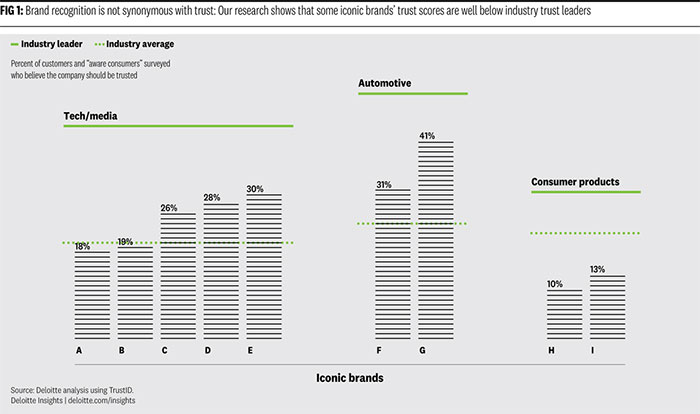


    Consumers say that brands’ attempts to engage with them often go wrong when they lack relevance (76 percent) or authenticity (51 percent).


    Regaining brand trust

    While the erosion of trust in recent years presents challenges, brands can regain confidence by prioritizing transparency, authenticity and accountability.


    The need for trust is on the rise. Globally, 71% of people say that it is more important to trust the brands they buy/use today than in the past. (Edelman Trust Barometer 2023).


    By valuing customer privacy, being transparent in communications and practices, aligning with genuine social causes, and consistently delivering quality and value, brands can rebuild trust and establish lasting relationships with consumers. In the era of distrust, brands that proactively address these issues will stand out as beacons of trust, gaining a competitive edge and fostering loyalty in the hearts and minds of their customers.


    But most importantly, they need to be reminded that consumer is not a moron. They are babies who deserve care, not addiction, a plastic-free world, not beaches and playgrounds littered with bottles.


    Kunal Sinha is a senior strategy and foresights executive based in Jakarta, Indonesia. He is the author of several books including The Future of India’s Rural Markets and Raw – Pervasive Creativity in Asia. He writes for MxMIndia every other Monday. His views here are personal.

  • Bisleri and the Chimera of the Tata Group


    With apologies to none at all

    By Vikas Mehta


    Vikas MehtaChimera is a fire-breathing female monster with a lion’s head, a goat’s body and a serpent’s tail. A thing which is hoped for but is illusory.


     

    One of the big news of the week was Bisleri being up for sale and for all practical purposes Tata Consumer Product seemed to be the obvious suitor. The reasoning for Tata being the best suitor for Bisleri is the story of Chimera.


    I say obvious as the reaction and reasoning of the deal was more from the heart than sound business logic. A leading business daily which actually carried an interview with Ramesh Chauhan, the promoter of the brand (who incidentally, never confirmed the deal but just said that it’s in the works and Tata’s could be the destination for Bisleri), spoke about how the brand has had many suitors in the past but the promoter was holding off as he wanted someone who can nurture and grow the brand and Tata therefore is a natural fit.


    Does that mean that other suitors like Reliance Retail, Nestle and Danone which were mentioned, will not nurture and grow the brand? Or it meant that others will acquire the brand to kill it so that their small brands will thrive and grow? Or maybe reading between the lines meant that given the Tata’s reputation to be a business house with a heart of gold and who care about their employees they will translate the same empathy on to the brand?


    Frankly, I find this sort of conjecture and reasoning defying all logic. Business is about bottom line, financials, growth, shareholder value and return on investment. Sure, the social side of business is important but at the end of the day a business has to justify its investment in terms of returns. And growing a brand, making it more profitable will be the objective of most businesses.


    Both Danone and Nestle have a presence in the premium segment of bottled water. Exactly like Tata Consumer Product which has Himalayan and Tata Copper Plus as premium offerings. So, for any one of them, Bisleri can be a great acquisition with a presence in the economy segment. And the legacy plus the momentum of the brand will ensure that any suitor amongst the three, be it Tata or Danone or Nestle will hit the ground running with this acquisition. More so, as the current management team will continue to oversee the brand in the near future. So, I cannot figure out why only Tata can nurture and grow it. It is obvious that Tatas reputation of being a fair, just company is colouring the assessment of the suitors.


    Let’s also look at Reliance Retail. With Jiomart operational in more than 200 cities in India and Reliance Fresh retail presence being equally strong along with the much-touted acquisition of about 800 Future Group stores, RR is a great bet for Bisleri. RR is looking at private labels and has already nurtured Good Life in groceries, Snactac in snacks, Trikaya in fresh farm produce amongst others, while shopping for likes of Campa to add to its inhouse portfolio. Bisleri would seem to be an ideal addition to the same. And RR can make the brand much more visible in its own stores, websites and apps. Private labels give retaliers more margin and a brand like Bisleri would be a huge asset for RR. Why would the company not want to grow and nurture it? Seems its reputation of being sharply business oriented and its absence in the public mind for its charity work or its social side has made it unsuitable.


    Tata also has Big Basket and given the success of Fresho and BB Royal, Tatas would also be raring to acquire Bisleri. But BB is a standalone and is not a part of Tata Consumer Products. And Tatas track record in integration has not been too good in the past. The superapp Tata Neu is struggling. The consumer feedback and the app performance has been bumpy. So, the recent track record of Tata is not at all encouraging. Therefore, it seems illogical in assuming that Tata can nurture and grow the brand and others cannot.


    It is also not a coincidence that many marketing experts and gurus have suddenly started talking about sustainable packaging format for Bisleri. That is the Tata effect. Tata is a good, kind-hearted, responsible company. So, if it acquires Bisleri it must look at sustainable package. I find it strange, nay amusing, that suddenly with Tata in the news people have started worrying about Bisleri packaging. More than Tata, shouldn’t it be the responsibility of long time players like Nestle and Danone to be made more accountable for finding a sustainable packaging solution for bottled water? And shouldn’t the issue be more specific than just pinning category responsibility? For example, with the government already banning the use of one-time plastic should the marketing community not be asking for bottled water players like Bisleri to stop producing one time use 200 ml bottles? That’s a more practical approach than starting to expect Tata to wave a magic wand once they buy the brand.


    Getting back to growing and nurturing, let’s look at the track record of Bisleri. For a brand which has been in the Indian market, with the current promoter for more than five decades, the brand has hardly innovated, remaining more or less a one product brand. It could have for example, entered adjacent categories like fruit juices or health drinks. It therefore sounds downright hypocritical to hear the promoter wanting to sell the brand to a company which is a good fit because it will grow and nurture a brand.


    In my opinion, Tatas being a good fit for Bisleri is a very tenuous link. At best it is an attempt to appropriate the halo of the Tata name to raise the brand value of Bisleri so that the promoters can get a better valuation and in a worst case scenario it is desperately hoping that the deal with Tata will go through at the current estimated valuation as the others may not be willing to pay the asking price. The deal may well go through but the chimera that has been raised will obscure the real reason of the deal having gone through.


    Vikas Mehta is a Dehradun-based business strategy consultant and educator. He writes on MxMIndia every other Monday. His views here are personal


  • No KitKat break. Zenith retains massive Nestle media biz

    By Our Staff


    There are some who would’ve hoped that Nestlé  India would practise what the adline of its bestselling brand Kit Kat preaches: ‘Life Hai. Kit Kat break banta hai’. But no such break in its Media AOR relationship. The Publicis Groupe-owned media agency Zenith India has been retained as Nestle’s agency of record. The business, notes a communique, was won in a highly competitive multi-agency pitch which began in April this year.


    Zenith has been handling Nestlé’s media planning and buying business, across all segments since all of 17 years. It was appointed as the packaged goods company’s AoR back in 2005. The mandate includes the full range of duties – that’s offline media, online media, commerce, SEO and analytics.


    Said Jai Lala, CEO of Zenith India: “We are delighted that Nestlé has once again chosen us as their media partner and it’s a clear endorsement of our strong ROI approach and ability to deliver marketing excellence and innovation. The retention is testament to the rock-solid working relationship we share with Nestlé and indeed we are proud of the industry-leading work we’ve produced for them over the course of many years. Zenith has deep and inherent understanding of Nestlé’s business needs and the strategic direction of its brands. Our teams were able to demonstrate unique insights, integrated approaches and data-driven decision -making. We look forward to harnessing the best of our capabilities, talent, technology and partnerships and helping Nestlé build even more powerful consumer connections.”


  • Zenith appoints Priyanka Kapur as Vice President

    By Our Staff


    Priyanka Kapur
    Priyanka Kapur

    Zenith India has appointed Priyanka Kapur as Vice President to lead its Nestlé business. She will be responsible for media planning, relationship management and supervising the complete and integrated offering for the client. Her key focus will be on strategy, digital transformation, data, analytics, implementation and buying.


    A postgraduate from NMIMS, Kapur has over 18 years of rich experience in media and marketing. Her last assignment was with Lodestar UM for almost 10 years as Connections Lead for its key client Coca-Cola. Her role involved spearheading the strategic planning product across portfolio brands and in crafting solutions, connecting brands to consumers. She was also responsible for research, insights and staying updated on the latest consumer trends and building them seamlessly into  solutions for brands.


    Announcing the appointment, Jai Lala, CEO, Zenith India said: “I am delighted to have Priyanka on-board.  Priyanka’s diverse work experience in the field of media and strategic approach towards the  business will help provide impactful and effective solutions to our clients, in an evolving media landscape.”


    Added Kapur: “I am really excited about Zenith’s unique ROI plus and digital-first approach that delivers maximum business results for clients. Also, I am delighted to be part of  Publicis Groupe and look forward to the PowerOfOne advantage.”


  • Nestlé partners with media entities to create inspiring brand narratives

    By A Correspondent


    Nestlé is partnering with India’s top media companies to produce inventive and creative brand solutions, through a first-of-its-kind initiative called Media Hive. Some of the big-league media and entertainment firms that participated in the Media Hive included Times Of India, Star, Zee, Viacom18, The Hindu, Big FM, Radio City and Arre.


    The focus was on immersive solutions that put media as the centre-piece of communications. This landmark initiative was the collaborative effort of Zenith & Nestlé.


    As many as 19 briefs came from Nestlé brands such as KitKat, Maggi, Munch, Polo, Nescafe, Milkmaid, Ceregro, Milky Bar etc to 42 media partners. Around, 354 ideas were generated in total. The Nestlé brand teams, after careful consideration shortlisted 72 ideas which were presented at the Media Hive event in New Delhi.


    Media Hive included the top leadership of Nestlé and Publicis Media. The inaugural address was by Suresh Narayanan, Chairman and Managing Director of Nestlé.


    Said Rashi Goel, Director Communications at Nestlé: “Nestlé was looking for inspiring media narratives for its brands that go far beyond the 30-seconder. Through Media Hive, we have paved the way for a new era of moving, compelling and evocative brand experiences which captivate and involve consumers. The powerful ideas generated in the Media Hive, will bring alive our brands in subtle yet, engaging ways. This is an entirely new approach to energising our brand stories and we thank Zenith for this very successful partnership.”


    Added Tanmay Mohanty, Group CEO at Zenith India & Head Of Global Partnerships at Publicis Media India: “Attention is a scarce resource today. In this context, there is a real need for enriching, long-lasting media experiences. Efforts that appeal to people’s emotional sensibilities. Media Hive brought many such striking, impactful ideas to the fore where brands can be introduced in non-intrusive ways. Though Media Hive, we are also to trying to evolve and grow the larger eco-system.”


  • Nestlé looks to educate Indians via AskNestlé.in

    By A Correspondent


    Nestlé India has launched its latest corporate campaign that attempts to further its credentials as a nutrition expert. AskNestlé is a mobile-first website that revolutionises how parents feed, and cook for their children up to 12 years of age.


    Speaking on the roll-out of the campaign, Rashi Goel, VP Consumer Communications, Nestlé India said: “We believe that to ensure holistic growth, it is important for parents to imbibe the right knowledge and best practices to help their children inculcate the right nutritional habits. With our knowledge and expertise in the space of food and nutrition, we believe that with this platform we will be able to provide authentic and reliable information to parents. We are proud to say that the TVCs bring to life the exact essence of the thought behind the website.”


    Added Alok Lall, Executive Director, McCann Worldgroup and India Head of Advertising, McCann Erickson: “Children are inquisitive by nature and as parents sometimes we get stumped by the questions and riddles they ask. The corporate campaign, ‘AskNestlé’, is an initiative that has been developed to address the concerns and questions raised in the space of the food, health and nutrition. The campaign showcases how relationships of children have evolved with adults around them and how adults are also feeling the need to stay updated to tackle all the questions that children corner them with. The AskNestlé campaign uses light hearted banter and engaging content, to deliver the message about the holistic bouquet of services.”

  • Nestle partners with Elephant for breakfast range

    By A Correspondent


    Nestle partnered with Pune-based Elephant for the design strategy and packaging for its just-launched breakfast range NesPlus.


    Said Ashwini Deshpande, Co-founder, Director, Elephant: “Indian have some very peculiar breakfast habits and preferences. What sets this range apart is the fact that it remains crunchy even inside milk. Since the cereals shelves are dominated with multinational and national brands already, this exercise was about creating new category codes while keeping Nestle equity enhanced”


    The design team at Elephant brought out the multi-sensorial consumption experience by using a combination of custom illustrations with product photographs. A clean hierarchy with rays connoting the morning mood and colours mirroring the flavours, the range has been designed with flexibility to add more formats and variants, notes a communique from Elephant.


  • Sigh. Zenith retains Nestle


    By A Correspondent


    So what is an essentially account retention move doing as the lead story on MxMIndia today? Because one, it’s our biggest story of the day. And two, we are committed to tracking the media agency business beyond just news on movements. But, most importantly, it means a lot for Zenith (earlier called Zenith Optimedia)… it is Zenith’s biggest account in India, estimated to be in the region of Rs 650 crore annually.


    Leading chocolate-to-beverage conglomerate Nestlé India has retained Zenith as its Agency on Record for its media business. Recently Nestle had also consolidated its Nutrition digital marketing business with Zenith and DigitasLBi.


    The FMCG major called for a review after five years in November 2017 which saw some leading media groups from across the country participate. Zenith was appointed as Nestlé’s media agency in 2005 and has been handling the company’s media duties since, across business segments.


    Said Tanmay Mohanty, Group CEO, Zenith India says, “Nestlé is Zenith’s flagship account and we have had this relationship for more than a decade. We are super delighted that the client has once again handpicked us and it is a clear endorsement of Zenith’s competency and ability to deliver.”


    In India, Zenith’s key clients include Nestlé, Parle Products,   Micromax, Toyota, ZTE Mobile, Honeywell Air Purifiers, H&M, Singapore Tourism Board, Fox Networks, BASF and Singapore Airlines among others.


  • Zenith helps create Twitter campaign for Nestle

    By A Correspondent


    Media agency network Zenith and Nestlé India’s in-house content studio managed by HyperCollective have created a Twitter-based campaign called #UntrendLikeHotHeads for Maggi Hotheads, a new Maggi noodles variant in four flavours.


    The campaign urged consumers to break free from popular trends and display their original, unique selves. They could post on an activity which sets them apart from popular trends. The gratification lay in the fact that Maggi Hotheads made people trend on Twitter.


    Tanmay Mohanty

    Said Tanmay Mohanty, Group CEO, Zenith India: “We are delighted to be at the forefront of this innovative and exciting campaign.  #UntrendLikeHotHeads hits the mark because it is fun, quirky, engaging and resonates with the Indian youth. There is an instant connect with the Maggi  Hotheads brand, also known for its distinct positioning and taste.  The campaign is a resounding success. It has sparked off viral conversations, amplified brand messaging, and generated rich insights. #Untrend has significantly added to the followership and popularity of Maggi  Hotheads.”


    Added Taranjeet Singh, Country Director, Twitter India: “Our endeavour has always been to create enriching experiences for brands to connect with their fans on Twitter. Nestle’s #UntrendLikeHotHeads is a breakthrough idea, the collaboration saw extraordinary participation on the platform and enabled Maggi to be what’s happening on Twitter. We look forward to working closely to be part of more of such creative, strategic partnerships.”


  • Is Nestle really part of India’s fabric for a century?


    By Pritha Mitra Dasgupta


    The latest corporate campaign from Nestle created by Prasoon Joshi, executive chairman, McCann Worldgroup Asia Pacific is visually impressive in its sepia tones and transition from pre-Independence to the 21st century. But ad folks and even consumers are taking the film with a bag full of salt. Their grouse: while Nestle claims it’s been a part of “country’s fabric for more than a 100 years”, many regard it more as silent spectator than active participant.


    In the almost 92-second clip, the Swiss multinational food and beverage company packs in historic milestones in India’s journey like independence, India’s World Cup victory, its first space mission and so on. Nestle which set foot in India in 1912 features some of its marquee products like Nescafe, Milkmaid, KitKat, Maggi Masala and so on. But it’s opted to drop its famous Maggi noodles which, as you are probably aware, has been pulled from the market and is still under a cloud.


    There has been some appreciation but the critiques have also been flying thick and fast. The most common one is that of appropriation: the belief that Nestle was nowhere near as embedded into the life of India as it claims to be. And that the one product that was ubiquitous does not make an appearance in the film.


    An agency CEO who opts to remain anonymous points out: several brands can claim to have rightfully played a role in the transformation of India: Amul, Air India, Colgate, Dettol, Parle G and Lifebuoy. But when it comes to Nestle, he says, “The film is desperately trying its best to be part of the Indian subtext and culture, forcefully creating situations and conversations, which don’t connect. It is a tall claim. The basket has brands which cannot claim to be serving and being part of the nation for 100 years!”


    Manish Bhatt, founder and director at Scarecrow believes the film is good but stops short of being Nestle’s best: “When you talk about brands being part of a country’s fabric then you instantly think of Coca Cola and the United States or Milo in Malaysia. You will find Santa Claus holding a Coke bottle. So only when a brand plays such a grand role in the everyday life of consumers and becomes part of their being, can it make such a claim.”


    It’s also aroused the ire of Joe Public who are either rendered inarticulate by rage or weren’t particularly articulate to start with. A typical complaint reads as follows: “Fresh cow’s milk better option. Nice Ad but believe me can’t trust Nestlé (sic) I feel like a culprit as I used to give my daughter Maggi on Sundays.I never knew was feeding her lead n MSG.” Another reads: “Nestle should b ban (sic) for 100 yrs as it has betrayed 100 years of faith of indian people.”


    To its credit, Nestle doesn’t believe in merely basking in the admiration of the people who like the film and is engaging even with its critics: a strategy that was missing around the time the Maggi crisis was brewing. In response to the first comment, it provides an update that clarifies its stance on the MSG issue. In response to the second, it replies with “This film is not about specific products or brands, but about Nestlé’s understanding of India’s culture and how we have been a part of the country’s fabric for more than a 100 years. While the Hon’ble Bombay High Court has lifted the FSSAI ban order on Maggi Noodles, the process of fresh tests mandated by them at select accredited labs is still underway, and we have taken a conscious decision not to use the Maggi Noodles pack-shot in the film until the process is complete.”


    Nestle also takes times out to address the critiques of the industry at large. Managing director, Suresh Narayanan points out, “Nestlé has developed deep bonds of good will, trust and relationship with millions of consumers and participated actively in Indian society at large. The corporate film has been developed to communicate the rich heritage of Nestlé in India and how its relationship has been built over the years with commitment, understanding, passion and dedication towards quality. It is an acknowledgement of our gratitude in being part of Indian consumer’s lives, epitomised by some significant historic moments since Independence.”


    He points to Nestle’s factory in Moga set up in 1961 which pioneered the dairy business and began contributing significantly to the development of the district in Punjab. He says, “We have successfully touched the lives of 100,000 famers who supply milk to us. Today with 8 factories across the country, our staff strength of more than 7000 people has 99.7 per cent Indians working dayin and day-out to deliver on our promise of quality and safe products.”


    The film serves a second purpose that neither Nestle nor its critics are articulating: an attempt to position the firm as distinct from its flagship products. Maggi and Milkmaid are famous brands in India, Nestle perhaps, not as much. And so an attempt to build Nestle as a distinct, trustworthy entity, one that could brave the storms that may momentarily sink a flagship or two. But of course, the jury is out on whether this film is enough to make that happen.


    Source:The Economic Times

    Copyright © 2015, Bennett, Coleman & Co. Ltd. All Rights Reserved

    Licensed to republish


  • Can the new Nestle CEO restore confidence in Maggi?


    By Kala Vijayraghavan & Ratna Bhushan


    More than allegedly selling Maggi with excessive lead content or mislabelling packs, perhaps Nestle India’s biggest transgression in the run-up to the noodles hitting the fan in early June may well have been the inadequate communication with government and regulators. Small wonder, then, Suresh Narayanan, the 55-year-old Indian managing director at Nestle India, who’s been brought in to douse the fire, talks about “stepping up engagement with the government.” This, of course, will be in addition to taking “all necessary steps to engage with the consumer,” and the “first task” of getting “Nestle as an organisation to regain its self-confidence.”


    Narayanan’s predecessor, Etienne Benet who took over in October 2013, replaced another expat, Antonio Helio Waszyk. To be sure, Nestle India has almost always had expat CEOs since it began operations in the country over a century ago; and Narayanan is the first Indian in that role, although he has come in from an overseas Nestle outpost (the Philippines).


    Having an Indian at the helm is doubtless good for perception, credibility and communication, with regulators, consumers and even employees, reckon human resource experts. Says R Suresh, founder of RGF Executive Search: “Some European companies tend to have a mindset that expats should be at the helm of the company. But for Nestle India, which wants to get Maggi up and going, an Indian as CEO is a great decision.” D Shivakumar, chairman of PepsiCo, feels two strengths of Narayanan will come to fore at Nestle India. “He excels at customer management and boosting the morale of those who work with him.”


    The new CEO, though, will be the first one to remind you that he does not have “a magic wand,” and the journey back to normalcy promises to be a long, winding one. Nestle posted its first loss in over three decades for the April-June 2015 quarter (of Rs 64.4 crore compared to a net profit Rs 288 crore in the corresponding quarter a year ago), thanks to the disruption in the instant noodles business. Consider what Maggi is up against: the 30-year-old brand with over 75 per cent market share has disappeared from shelves, virtually overnight. The national food regulator has banned sale of Maggi noodles nationally citing excessive lead levels, more than the permissible quantity of 2.5 parts per million; mislabelling on packs which declared ‘no added MSG (monosodium glutamate, a controversial flavour enhancer); and for selling Maggi oats masala noodles without product approval. Nestle has insisted that neither its noodles nor pasta contain added MSG, adding that many packaged foods contain hydrolysed groundnut protein, onion powder and wheat flour, all of which contain glutamate. The matter is in the courts.


    For its part, the top brass at Nestle stresses that Narayanan has not been airdropped just because of his nationality, although being Indian has its advantages. Says Wang Ling Martello, executive vice president, Nestle SA, head of Zone Asia, Oceania and Africa: “Suresh is Indian, knows the market here, can hit the ground running. But when I scanned the world, I did not look for nationality. I looked for the skillsets… We don’t pick people depending on nationalities,” she says.


    A former CEO at a multinational consumer goods company points out that an Indian in the hot seat is also good for PR – a front Nestle hasn’t emerged smelling of roses not just in India but globally too. In 2010, for instance, the Swiss MNC found itself at the receiving end of flak from environment group Greenpeace – and consequently on social media – which accused it of not heeding a cry to stop buying palm oil from an Indonesian company that was allegedly consciously destroying Indonesian forests. Nestle was duly slammed on social media for its apparent arrogance.


    When the Maggi crisis broke in June, fingers were similarly pointed at Nestle India for living in denial, not communicating with consumers and a poor attempt at countering the criticisms on social media. The former CEO at the MNC says Nestle culturally has had condescending attitude towards the marketplace. “This is a world where leadership and brands have to be humble —to admit that, yes, we made mistakes, we will rectify them, and move on”.


    “It is a tough one to resolve. Nestle allowed too much delay and let doubts creep into consumers’ minds, who have moved on to rearrange life around new habits. The company failed to present a different story. It will not be easy for Suresh even as an Indian to fix the damage,” says Santosh Desai, MD & CEO, Futurebrands, a brand management and marketing consulting firm.


    Rajeev Bakshi, a former CEO at PepsiCo India, reckons that more than winning over the consumer, Narayanan’s biggest challenge is to win over the government. “This is not an attack from third party, unlike when Pepsi was attacked by an NGO.” In 2010, the Centre for Science and Environment had alleged that leading food brands including PepsiCo’s Lays, McDonald’s, KFC and, yes, Maggi, were guilty of “large scale misbranding and misinformation.” But today the government is the protagonist. “Nestle can’t afford to take an adversarial role here. They have to align and collaborate with the government,” says Bakshi, now managing director of wholesaler Metro Cash & Carry India.


    Fifty-five-year-old Narayanan, who began his career with Hindustan Unilever, doubtless has his toughest mandate yet. “Deep down in my gut, the words that come to me are, we shall overcome… we (employees, colleagues, associates) can rebuild brick by brick, together.”


    They’ll need plenty of help from government and consumer.


    Source:The Economic Times

    Copyright © 2015, Bennett, Coleman & Co. Ltd. All Rights Reserved

    Licensed to republish


  • Nestle ropes in US lobbyist APCO to tone down Maggi backlash

    By Shramana Ganguly


    Nestle has appointed American lobbying giant APCO Worldwide to help overcome the widespread backlash against its flagship Maggi brand of instant noodles in India and create a positive opinion among different stakeholders, a person privy to the development said.


    APCO, which doubles as a public relations agency and boasts of clients ranging from dictators to global investment banks, is best known in India for helping Gujarat change its post-2002 riots image to present itself as an investment hub, or ‘Indian Davos’, since 2009.


    It was APCO that organised and ideated Nestle’s first media conference on Friday after the ‘lead in noodle’ controversy broke almost a fortnight ago, said the person quoted earlier.


    The Swiss food giant was under flak for not communicating enough with stakeholders and consumers even as several state governments started banning Maggi.


    Nestle did not respond to a mail pertaining to its association with APCO as of press time on Friday. Sukanti Ghosh, managing director at APCO Worldwide’s India operations, said, “We do not talk about clients.”


    From its headquarters in Washington, APCO has long influenced many hot-button political and economic debates that roiled the US and the world. It fire-fought “medical” crisis for Merck & Co’s scandal involving Vioxx, the arthritis drug that killed thousands before it was withdrawn, and Kazakhstan president Nursultan Nazarbayev hired it to extricate himself from a four-year-long dispute with his former son-in-law Rakhat Aliyev.


    APCO stepped into India in 2006 and muscled out a raft of PR companies to win the contract to promote Vibrant Gujarat, the showpiece investment meeting of the then chief minister Narendra Modi, in 2009. Over the two successive summits it handled, APCO transformed Vibrant Gujarat from a modest show to a major event with the likes of the US, UK, Netherlands, Canada, Australia, Singapore, South Africa and Japan coming in as partners.


    In 2013, APCO handled crisis for Johnson & Johnson when the brand faced flak for unacceptable contents in its baby powder in the Indian market. A year hence, the brand came out with advertisements in leading newspapers that even smelt of its distinctive baby powder. “That is how APCO firefights,” said a former APCO executive. It also serves Dow Corning, Walt Disney, Mastercard, Cairn, Welspun and Facebook in India.


    On its website, APCO says, “Defending the brands, markets and reputations you have worked so hard to create is critical for continued business success. Let us show you how we can help protect your permission to operate by anticipating and mitigating risks while staying true to your values and brand.”


    Nestle will not want more than that as the firm took Maggi off the shelves in the country on Friday.


    Source:The Economic Times

    Copyright © 2015, Bennett, Coleman & Co. Ltd. All Rights Reserved

    Licensed to republish