Tag: MxMIndia Annual

  • What Ticks for Indian Consumers/ Women- Monica Patnaik and Josy Paul

    Continuing with our extracts from the second edition of the MxMIndia Annual, we present contributions by Monica Patnaik and Josy Paul.


    Stay authentic, stay local


    By Monica Patnaik


    As a radio station in tier 2 and tier 3 cities of India, one cannot afford to miss out on women consumers. Even today, a majority of radio listenership comes from housewives who switch to radio while performing their household duties or in leisure during the day time.


    Yes, there is another segment of women listeners apart from the housewives – the working class women. But, I think if we talk about sheer numbers, I’m sure the number of housewives listening to radio in tier 2 and tier 3 cities is bigger than the working class women – who often switch to radio when travelling. And most often they use their mobile phones to switch to radio.


    The ideal strategy to ensure brand recall or loyalty among women is to offer them fresh content and by keeping them engaged in conversations. Our RJs discuss common issues women face and try to address them with innovative ideas. For working women, issues such as striking work and life balance is an important aspect apart from other interest areas such as food, travel and of course, music.


    I confess…


    By Josy Paul


    I have a confession to make.

    I confess I may have been sleepwalking.

    I may have ignored the obvious.

    I look around me and I see women creating change everywhere… and yet I don’t see enough of it in my writing.

    I see women leading organizations – be it in business, government or the nation.

    And yet I don’t see… I don’t see enough of that great action reflecting in my advertising.

    I see my wife mobilizing friends, neighbours and local MLAs to build parks and fight to keep our lanes clean and safe.

    And yet I do not see… for I don’t see enough of it in my ideas.

    I confess I need to be more sensitive to the world around me… specially to the gender issue.

    I don’t need a national awakening or a violent reaction to re-focus my attention to the truth about women.


    We also engage with them using social media networks – Facebook and Twitter being the most active platforms. Though women are not the only target audience, they are very much part of the mix. We also see a lot of listenership from men, especially during the evening time. But, their listenership is limited in terms of time spent.


    Unlike metros where one tends to spend more time in traveling from one place to the other, that unfortunately in small cities is very, very short. Having said that, I think radio stations in local regions are doing a far better engagement job than national players.


    That is because the regional FM players are able to offer content in local languages or in the local flavour. Speaking of the content offering, one must find the right mix of content for the local listeners. If the content is local and authentic, consumers will relate to the brand and one-toone engagement with them will become that much more easier.


    I have grown up seeing brands portraying women as powerful influencers and change agents.

    I have seen Lalitaji in ‘Surf ‘.

    I have noticed the strong working woman in ‘Whirlpool’ with her ability to manage a happy household.

    I am inspired by the activist lady in the ad for A-one ‘Kadak’ chai – done in early 2000.

    I love reading Femina’s woman of substance. We have seen the changing face of Indian women in the new Bournvita mom. She is so progressive and hyper-competitive.

    Or the changing relationships between mother-in-law and daughter-in-law in the ads done by Star Plus. Or the bindaas young women in the Fastrack commercials. It urges us to move on and stay cool.

    I know you and I have seen the change, and it is good.

    I confess I am proud of our work for Gillette… our movement idea ‘Women Against Lazy Stubble’. It proved that women can influence men’s stubble.

    Or our new work for Visa Cards where a young lady officer uses her Visa Debit card to further the cause of women’s education – in a remote village in Rajasthan.

    I realize that these examples represent some of the stronger and more realistic feminine images of Indian advertising.

    And yet I confess… that I may be unconsciously discriminating, marginalizing and labelling women.

    I know I am responsible, and influential, and have the power to change things… and I am trying.

    I have one last confession to make.

    I don’t think this is only a woman’s issue, it’s a larger sensitivity issue. It is about being sensitive to all things that are marginalized, ignored and discriminated. It is about being sensitive to all things human.

    I confess I am evolving in my effort to be more aware.

    Along with our enlightened clients we are trying to create a new reality, where brands evolve with deeper sensitivity.

    Where freedom, equality and inclusion are part of greater growth and a better world.

    I confess, we are trying to create a world where there are more acts, and not just ads. This is my confession, my prayer, my pledge.


    Tomorrow: Wednesday, October 8: Teens – Rohit Ohri and Ferzad Palia

     

  • What Ticks for Indian Consumers/ Men- Haresh Nayak and Vikram Raichura

    Continuing with our extracts from the second edition of the MxMIndia Annual, we present contributions by Haresh Nayak and Vikram Raichura.


    Men in the new OOH ecosystem!!’


    By Haresh Nayak


    Advertising companies spend a lot of time, money and man power trying to figure out the best ways to target their ads to the right people, whether it’s children, teenagers, men or women. But does it really work to target ads toward a certain gender? As it turns out, it depends on the advertisement.


    Advertising to men, used to be as simple as buying few hoardings in commercial areas or on mode of travel. Even though both attract large audiences, men’s interests have broadened. We live in a world changing at a dramatic pace! Posterscope Group in India is pioneering OOH that drives the new OOH ecosystem.


    They’re more involved with the family, visiting malls, cinemas, travel, clubs, sports etc. OCS (world’s largest out-of-home consumer survey) a Posterscope initiative, throws some interesting insights on men and their OOH behaviour:


    Engaging men consumers via mobile phones and tablets


    By Vikram Raichura


    Men! Men! Men! Men! Manly… men men men… Hardly anyone is alien to this catchy tune of ‘Two and a Half Men’ and the antics of Charlie Sheen’s sensuous free-wheeling lifestyle in the sitcom. Truth be told, we men love to flaunt our distinct charisma and flair everyplace we trod. Through the clothes we wear, the things we say and the possessions we flash. This spree of ours has come a long way since our stone-age days and though much has changed in our appearances and habits, not much so in our tastes and pursuits.


    Then we hunted for food now we hunt food joints, then we wandered now we explore, then we chased women now… well you know. Then we carried tools now we got gadgets and the best of all -The mobile! The gadget wakes us up, plans our day, gets us information and keeps us connected 24×7. Needless to say, we rely greatly on our smart phones and tablets for day-to-day tasks. Mobiles have proved to be a hot platform for mass engagement and brands have shifted their base quickly.


    a) Mobile technology: a shrunken device that now provides a host of services while you are out-of-home!

    b) A rising sense of health consciousness: healthy food and workouts are a way of life everyday!

    c) Constant lookout for fulfilling career: are diminishing boundaries of cities and countries!

    d) Emotional connect with sports: cricket is religion of India!


    All the above are creating newer ways to connect and engage with the male audience in India!!! OOH is all about people and places. Today outdoor advertising has transformed into OOH and has provided new touch points involving the consumer.


    In fact this convergence is removing the barrier between platforms, channels and between discipline and is creating an empowered connected consumer that’s engaging with brands on his own terms within this new OOH ecosystem.


    Now you do remember a good looking girl asking you to give a missed call just to get a call back from her, of course you do. It was one of the best mass engagement strategy adopted by a leading Men’s deodorant brand that received whooping response through missed calls. The action was complete with each caller receiving a recorded call in that girl’s voice promoting the product. Now which man won’t appreciate it? Probably none. Moving ahead, the boom of Android and Windows platform, brought us an array of applications.


    There’s an application for almost anything and everything. Right from banking, navigation, ticket booking, bill payments to what shirt to wear and how to tie a knot. Male oriented apps of dressing, grooming, styling all the way to counting rounds of drinks are highly in vogue. Games have always held our fancy since childhood days and they still do keep that kid off the leash virtually. Gaming is super cool over mobile & tablets with likes of Asphalt, Temple Run and hundred others.


    There’s one for every mood, affinity and like (Candy Crush is loved by men too, seriously). Interestingly, movies are cashing on the opportunity with this one too. It comes as no surprise that Dhoom franchise’s game built for promotion and engagement of their third film has fetched 1,000,000+ downloads. That’s big! Mobiles have been keeping us busy through Music, Movies, Social Networking and are unarguably the best communication device ever. And it’s just getting better with.. Beep beep.. wait a sec, it’s a picture of my kids enjoying at park captured by my wife. How beautiful. See mobile’s got a way of engaging every male with their unique interests.


    Tomorrow: Tuesday, October 7: Women– Monica Patnaik and Josy Paul

  • What Ticks for Indian Consumers/ Children – Amit Tripathi

    Continuing with our extracts from the second edition of the MxMIndia Annual, we present a contribution by Amit Tripathi. This is the concluding contribution from the ‘Children’ section of the Annual.


    The new kid on the block


    By Amit Tripathi


    Children represent arguably the most important demographic for brands. Not just because of their own purchasing power, but the sheer influence that they have on the buying decisions of their parents. Not to mention, that these are the adult consumers of the future.


    I often speak to my clients about how my son (all but 8 years), beats me hands down in Angry Birds or Temple Run, or is able to figure out a new game or app faster than I can. Most of the people I end up talking to, concur that they witness the same trend around their homes as well. This often makes me ponder what is it that differentiates this generation from ours; after all we invented the tools they use. And herein lies the answer. While we invented the tools and adapted to them, the child of today is born into the era of the digital devices. The digital divide which most people struggle to bridge, is simply the environment that the children are today born into.


    The child today is exposed to smart-phones, smart TVs, smart tablets, literally a smart world. While the debate on the negative side effects can be left to another day, but the fact stays, that the generation today is born into a connected world and the way they consume content and engage is radically different from the generation all but 10 years ago.


    As a result the industry spends on marketing to this generation is not just booming, but also undergoing a radical shift. The tools of a decade ago are redundant today and most brands are struggling to keep pace with this new kid on the block.


    Parents today, are willing to invest more on their kids because of trends such as smaller family size, dual incomes, and couples postponing having children later in life, but most importantly, the guilt of paucity of time for children results in parents splurging them with material goods as a replacement for time spent.


    Age-old marketing approaches are relevant today too, but with a modern day twists. One of the oldest and best strategies is “Pester Power”. Brands can rely on making the kid pester the mom into buying rather than going to the mom herself. Get a child hooked onto your brand by ‘gamification’ or a smart device storytelling and you will have a customer who will be forced to buy your product every time a child sees the brand in a store.


    Secondly, marketers must marry psychology with marketing. To actively market to children, given the fast paced changing environment, a brand must know what makes the child tick. With the help of analytics and research trends, brands can establish a pattern of child’s developmental, emotional and social needs at different ages. Using this research that analyses a child’s behaviour and usage pattern, a brand can establish a marketing strategy that fits into this pattern.


    Third, the seeds of brand recognition can be planted in a young mind rather easily by a brand at this age than later. Brand loyalties can be established as early as age two and by the time a kid heads off to school they can easily recognise brands and logos. What fast food and toy companies have been cultivating brand recognition in kids for years, it is now that banks and auto companies have entered the fray. Take for example Kotak Bank with its Junior Account and Skoda with the Teddy activation, have clearly targeted children with their latest campaigns.


    Fourth, establishing “Peer Pressure”. Peer Pressure coupled with Pester Power can be a lethal sword in the arsenal of a brand. The idea is to find the coolest kid in a community and have them associate with your brand, simply wear the brand tee shirt, carry brand water bottle, school bags, pencil kits, caps, etc. The trick is to ensure that the market is seeded with these surrogates judiciously. Once a group of kids latches on to these, they have a snowballing effect on the brand.


    Fifth, the tabs and phones. This is one of the largest and biggest engagement mediums for children today. Often taking up the mothers device to play songs, click pictures, play games, etc. This device is also often used by parents to keep the child at bay when they are engrossed with work. Hence, building a strong engagement using this device and working towards building brand engagement with the child at this time, is worth the weight in gold. The smart devices have today built the most personal medium that can take a brand to the child in the most personal of ways.


    In summary, while television still remains the most dominating medium to engage with children, that is changing rapidly with more mediums trying to eat into its marketshare. New formats of engagement using technology and devices are becoming order of the day, and the new kid on the block is adapting to these at an alarming pace. Marketers can use these advancements in technology to analyse patterns and create newer patterns of engagement with these children thus working towards becoming the brand that is not recognised but also sought after.


    – The author is the Chief Executive Ideator at IDEATELABS, one of the leading Digital Marketing organisations in India. Works with more than 100 brands focussed on providing new age solutions to age old marketing challenges. Follow him on Twitter: @Amit_ Tripathis.


    Tomorrow: Wednesday, October 1: Family – Vikram Sakhuja and Mayank Shah


  • What Ticks for Indian Consumers/ Teens – Anil Nair and Rajan Narayan

    Continuing with our extracts from the second edition of the MxMIndia Annual, we present contributions by Anil Nair and Rajan Narayan


    How young are you?


    By Anil Nair


    Great advertising should always draw inspiration from the society and at its best help in shaping it. In a young country like ours, it is even more imperative that we must practice this than merely preach it. Many brands fall prey to the trap of typifying the youth and convert their advertising campaigns into pontification campaigns. For a generation that is shaped by smartphones and social media networks, life has gone a long way ahead than what the 40-somethings who are creating advertising campaigns to ‘target’ the young can ever comprehend.


    And I must admit that I belong to that section who is struggling to understand the young and be relevant to them. Having said that I have, in all humility, made an attempt to study them through conversations without bias and here are my few pointers on how to connect better with the young adults. Invite: Campaigns at best should be an invitation to participate in a conversation. Once they give you the permission you can have a deep conversation which can lead to a long term relationship.


    So out goes propositions and benefit statements and in comes dialogues, point of views and sharing. Involve: The golden rule in making the connections is to talk less about yourselves (brands) and more about themselves. Challenge them, provoke them but don’t you dare decide what is good for them or suggest a solution to their problems. Though they may outwardly appear confused they know their way out of the confusion.


    ‘Education is a tool to achieve social distinction and not knowledge’


    By Rajan Narayan


    Americans understand their teenagers well. This is visible in their popular culture – books, TV serials, Hollywood and their advertising. We Indians on the other hand also understand the American teen well; this is also visible in our popular culture – Bollywood and ads! The 2012 film ‘Student of the Year’ is an indication of this malady. Switch on any music channel and watch ads portraying Indian teens rapping, playing basketball, beach volleyball and performing Broadway or Rock in their college campuses.


    Seriously, how many of us did this in our college years? Maybe 5 per cent did this in some select uptown colleges in metro cities but the rest who spent the major part of their teen years in small towns across India, know how different it was and continues to be till today. Reality is that few brands in India have really tried to understand the Indian teen and develop genuine insight based communication to engage them. Here are some realities we need to understand about Indian teens…


    1. ‘Teens’ are not a homogeneous set of people. In fact besides boy and girl teen being very different, early teens differ from late teens as chalk from cheese. E.g. the mother could be the decision maker for the choice of beverage for an early teen and decide that a cola is not permissible. But for the late teen the competitive set may include stronger spirits!


    So when you talk to them mind not just the language but the content too. Inspire: Youth are not all about fun and frolic and short-term views. Many brands are guilty of understanding them only superficially. The youth have a latent sense of purpose in their lives. The real challenge is to understand it and convert the latent purpose into a felt one. Here’s where campaigns like ‘Jaago re’ and ‘Idea’ (earlier campaigns) have hit the bulls eye.


    I believe the single biggest reason for the success of our “Hum mein hain Hero” campaign is this insight. The above three are not the holy grail of effective advertising but mere guiding principles of connecting with young adults effectively. But more than all of them, I believe that brands and their custodians need to unlearn a lot and fundamentally alter the basic construct to be relevant to the youth of today.


    A new vocabulary needs to be learned and a new method of engaging needs to be adapted. If the brand at its core has changed itself to connect with the youth then advertising has to just communicate that truth. The result will be a deep and mutually beneficial relation for a long, long time.


    2. Ambitious, career and future focussed. Indian teens may excel in competitive test but this leaves no scope for general interest pursuits, making them poor conversationalists. Education is a tool to achieve social distinction and not knowledge.


    3. Strong familial attachment and a conservative home environment. The ‘rebel teen’ is a miniscule minority. Strong family bonds ensure Indian teens are mostly wellbehaved at home and respect their elders. The mother-daughter relationship here is unique as the mother is often the girl’s best friend.


    4. India has the dubious distinction of having the maximum number of youth suicides. This is a culmination of the pressure built in the teen years of having to be at the top of the academic heap, failure to do so sometimes lead to a huge drop in self-worth resulting in suicides. Brands that understand these nuances and address teen issues and angst as well as work to gain parental approval stand to benefit hugely.


    Tomorrow: Tuesday, September 30: Children – Amit Tripathi


  • What Ticks for Indian Consumers/ Women – Anita Nayyar and Vikkas Nowal

    Continuing with our extracts from the second edition of the MxMIndia Annual, we present contributions by Anita Nayyar and Vikkas Nowal


    ‘Though easy to target, women audiences are also most vulnerable’


    By Anita Nayyar


    Irrespective of gender and age, to target audiences is and will always be a great challenge for media professionals. Women with their natural tendency towards media consumption, wherein viewing TV tops the list, have been easy to target as compared to male audiences who are constantly on the move and consume less TV.


    However, here the easy target (prey) for advertisers is the most vulnerable housewife. Learning through years of work on trying to reach this audience as a media professional is that they are the ones that are reached out to most efficiently. In media parlance, the CPRP’s are not high in female audiences. While, the housewife is glued to ‘Balika Vadhu’, it is not necessary that the working women who has lesser time to spend in front of the screen, also does the same.


    Many a traits in working women are common with working men in terms of media consumption though not necessary the same genre. Both of them travel, read, surf and use gadgets. While men are known to have affinity for sports, movies and music, working women may be more skewed towards movies and music and not as much sports. Hence, the mistake most of us media planners make is to treat women as females, 25+ etc and do not effectively use the filter of “working”.


    ‘Look at giving clients big bang for their bucks’


    By Vikkas Nowal


    Like any other form of media, simple logic dictates that OOH’s effectiveness in reaching a certain audience is dependent on how it is used. And for that we need to understand the nature of the beast. History has shown that OOH is predominantly for the big boys (the expenses and logistics involved) and hence has become the medium to establish three ‘A’s – authority, authenticity & awareness.


    The key aspect of OOH is its sheer physical size, which gives this medium the capability to dominate the most dominant element of nature – the sky. It is not confined by the boundaries of a television or a newspaper and hence can appear larger than life, if the intention is to do so. By now, it should be clear that targeting women by choosing OOH sites, which are located around nodes of higher female skew, is simple logic. But the understanding of its true effectiveness comes a step after that, as we contextualize the brand message with the nature of the medium.


    For instance, ask yourself – which product or service categories, targeted at women need the highest value for all three A’s – cosmetics, fashion, health & wellness ( for self or for the family), financial and perhaps all brands targeted at kids come to mind – women aren’t adopting your brand unless it has first penetrated television to capture their emotion (women spend more time on television than men in the country), print to capture their rationale, and finally OOH to establish authority, authenticity and reenforce awareness.


    Being one myself, I realize that it’s been some time since I watched ‘Balika Vadhu’ or for that matter ‘Bigg Boss’ for one is home only around 8:30pm late for ‘Balika Vadhu’ and early for the ‘Bigg Boss’ fighting. So one prefers some bit of recent news, it is great to admire the guts of Arnab Goswami or watch ‘The Hangover’ or a ‘Bhaag Milka Bhaag’ post dinner. Also, while Femina and Cosmopolitan are doing their best to entice the women audience for some time now they are sensitive to the reading appetite of the working women and have fairly included them as a subset of the large women universe.


    There is affinity towards specific consumption of reading material and the same is carefully provided. Meow did try that in the radio domain. While there may be enough research to prove that working women being a subset of the women universe do consume the same media and genre, it is the affinity towards a certain genre which is important and engages her the most. So it is important to look at women beyond just a woman!!!.


    And this is just a bird’s eye view of the subject matter, we can very easily start slicing away demographic segments of women by age and markets and start micro contextualizing brands to the medium. But since the market is still unorganized and a lot of processes still need to be put in place, we are aggressively working and looking forward to giving our client the biggest bang for their buck.


    Next: Monday, September 29: Teens – Anil Nair and Rajan Narayan


  • What Ticks for Indian Consumers/ Men – Pranesh Misra and Anisha Motwani

    Continuing with our extracts from the second edition of the MxMIndia Annual, we present contributions by Pranesh Misra and Anisha Motwani


    ‘Metrosexual male is here to stay’


    By Pranesh Misra


    Traditionally, men were “hunters” who would hunt to feed their families. With this physical acumen men became the natural “warriors” during the Middle Ages until the last millennium. The need for physicality still prevailed during the 20th century – the industrial age – when men occupied a dominant share of the blue collar jobs. With the emergence of Information Age, physicality was no longer a key requirement to “hunt” in the new urban jungle.


    Women, armed with quality education and knowledge, were happy to stake their claim in this space and succeeded. This led to a blurring of gender lines, with women thinking, feeling and behaving more like men. So, how is this affecting the male role-model? Men have to adapt more “feminine” traits to survive in the new world.


    The new world is not looking for warriors but feeling, caring, thinking leaders. So, men have to start thinking, feeling and behaving more like women. This change in men is already visible when we look at them as consumers. Twenty years back, men surreptitiously started to use look-good products like skin creams and perfumes from their wives’ closets.


    But then, with the launch of brands like Fair & Handsome, they came out of the closet. Most personal product brands began to spout special ranges “For Men”. Twenty years back, the Primary Grocery Shopper would mean the housewife. Not anymore. More men each year are becoming the primary grocery shoppers of their households.


    ‘Marketers are looking at men as the hot new potential segment


    By Anisha Motwani


    If you look at India with all its disparities and regional differences, it’s very difficult to make a sweeping generalization that men have evolved. Rape, dowry, honour killing and preference for a male child – we have enough and more evidence to suggest that men haven’t moved an inch as far in the past many decades. But when you look at urban cities in parts, both small towns and metros, you see a different picture.


    Evolution by definition means, a better way to survive and adapt to the changing environment. When this changing environment involves more women working, financially independent, aspiring for all kinds of careers, I’d say that certain men have adapted faster to this than others. And those who have, are better; the rest, just bitter. Today more and more fathers are as thrilled to have a daughter, as they would be, with a son.


    There is no difference in treatment, when it comes to giving the girl child the best education, securing her future or providing her all the material comforts. The fact that many companies have begun allowing men to take paternity leaves is a telling sign of men’s involvement in the household. While a stay-at-home dad is not a reality yet, men have evolved from being only an economic provider to also an emotional one.


    They have begun to be more sensitive to the needs of their spouses and families, more so in nuclear families. While every man hasn’t turned a proud cook yet, it is heartening to see rising male interest in cooking being promoted through shows like ‘MasterChef India’. Even with the latest ‘Junior MasterChef ’ season, to see young boys actively engaged and bragging about foods and kitchen tools, is a sign of an evolving society.


    If the trends in the West are any indication, this role transition will accelerate in the future. And this could have a phenomenal impact in the way we market grocery products in future. Should we be talking only to women anymore? Metrosexual male is here to stay. He will spend money on himself for looking good and feeling great.


    No wonder the lifestyle products are all gearing up to this opportunity, as is evident in the emergence of exclusive designs for men in garments and fashion accessories. Perhaps, if David Ogilvy was writing his piece today, he would start with the catchy headline: “The consumer is not a moron; he is your husband!”


    Today, if you were to visit any hypermarket/ supermarket on a weekend, you’d discover a lot of men accompanying their spouses, kids for household shopping. So for categories like personal care or packaged food, they obviously are worth looking at. On a different note, men have made notable strides on the personal grooming front. Marketers are looking at men as the hot new potential segment to go after. Emami, which claims to have a 58 per cent share of men’s fairness cream market, is gunning for a 30 per cent increase in sales of its Fair & Handsome brand.


    Most personal care brands targeting men are innovating and spicing up products with extra features like sweat control, sun prevention, oil control and dark spot reduction. Even five years ago, who would have thought that men cared for these features? One fitness brand alone, Talwalkars, is present in 70 cities, with over 1,32,000 members. Madura Fashion and Lifestyle depends primarily on men to keep its apparel brands going.


    Marketers are looking at men as the hot new potential segment to go after. Given that men are more on the move, are as social as women, and are digitally connected, there are enough opportunities to reach and engage them – that marketers are leveraging


    Tomorrow: Friday, September 26: Women – Anita Nayyar and Vikkas Nowal


  • What Ticks for Indian Consumers/ Family – Apurva Purohit and Shalini Rawla

    Continuing with our extracts from the second edition of the MxMIndia Annual, we present contributions by Apurva Purohit and Shalini Rawla


    ‘FM gives voice to the aspirations of the youth’


    By Apurva Purohit


    FM radio when it first started in the country, took everyone by storm. For a generation used to the ponderous and archaic language used by AIR announcers, the songs that played without any logical flow, the sudden and abrupt changes in programming on air; FM with its peppy tone and manner, mood creating playlists and vibrancy of packaging was like a breath of fresh air.


    All of us took to it like a duck to water and hey presto, the long boring traffic jams had a pleasant companion joining us to make the journey that much less tedious! And no one accepted FM as much as the youth of India. For them, not only did it speak the lingo they were comfortable with, but more importantly it gave them a voice to air their opinions they were dying to tell the world, a place to let out all those bottled feelings and even to announce their love to that special person or share the breaking of their heart with the RJ who had become such an important part of their lives.


    It was solace for the lonely, an ‘adda’ for the gregarious and an undemanding companion for the busy housewife as she went about doing her chores. And as often a best friend does, radio became an integral part of every man and woman’s daily life, weaving itself so seamlessly into the day that today they often do not even remember that it is around! Thus to say that FM needs to attract more youth to compete with other media is incorrect.


    Oh Yes, Abhi! Really?


    By Shalini Rawla


    Millennial youth as a cohort is not such a mystery really. Born circa 1990 they have grown up in front of us. We can see how they behave. We know what makes them laugh and cry. Sometimes we lament about them as their employers. Sometimes we are happy for them as parents. But when it comes to marketing to them, we feel at sea even as experts. We kind of know they are the ‘here and now’ generation, restless and impatient for immediate results, but is that really who they are?


    The millennial’s back story

    We all know that kids these days grow older, younger. So what an adult of my generation learnt at, say, age ten, a five year old in the new generation would already be aware of. They take to computers and smart phones as naturally as fish to water. By this logic, when the millennials became first time voting adults and employees, they should have been behaving like they are already in their thirties. Herein lies the dichotomy.


    The millennial youth of today may be technologically ahead of its parental generation, but they are behind them by several decades in emotional maturity. It is as if this cohort has unanimously decided to push all other traditional milestones of ‘settling down’ or taking on newer responsibilities to a decade later. So they are choosing a career late, marrying late, starting a family even later and so on.


    It continues to have the second highest time spent with it after TV and this time is only going up with the increased usage of FM through the mobile phone. Yes, its reach needs to expand and that can only come when the policy -paralyzed current government (or a new one at the center) finally allows FM to enter the hundreds of towns which still await that long delayed nod to the Phase 3 policy! For the youth, FM is not only a platform that gives voice to their desires and aspirations, it is also a commentary on what they think and do.


    It picks up the nuances of what a city feels and the local problems that plague a locality or a suburb. It celebrates the cricket that is played in the gully’s of a mohalla, the aarti that has been happening for the last 50 years in the next street and the garba that gets played at the chaar-raasta. In that sense, it is a medium that belongs to the youth of India as much as a reflection of who they are. Beyond that nothing more is required.


    They are more comfortable with technology than their parents thanks to the liberalization of our economy – a time when the millennial generation and their parents both got exposed to technology almost at the same time. The younger, more curious and flexible minds adapted to technology faster than the oldies. In fact, the two generations discovered and experienced more things together as against the previous generations where the parents were looked upon as teachers – their guiding light – a part they played beautifully. There was very little that the previous generation’s kids knew more about or learnt much before their parents.


    Experience junkies

    Our ‘millennial’ economy and technology is responsible for democratizing knowledge and breaking the traditional patriarchal and hierarchical structures. When the parents were experiencing their maiden trip abroad, so were their millennial kids.


    The millennial generation was fed on scores of such new experiences. Parents felt dutybound to give to their child ‘the best of everything new’ – something they vicariously enjoyed when the kids shared those experiences with them. And somewhere around this time, Facebook happened. Discovering and sharing became the millennial generation’s DNA and their parents forever lost their venerated top position in the family totem pole.


    The millennial’s life goals

    They want to earn money – lots of it. And they want it now. They know the end but have not figured the means to that end yet. They are celebrity struck. They want to dress up like them and wear brands they wear. Their parents indulged them so far. Now that they are working, they want to live the same lifestyle without asking their parents for money. They jump jobs for money. In that sense they are more risk taking. They do not feel they must secure one job before quitting their current job. They do not feel that many jobs in a short span would show badly on their resumes. After all, all stints tot up to a variety of experiences. A job is a means to an end of gaining another experience. A job gives them their right to stay out of home for longer hours. It is a like a date. You have to experience all kinds before you settle on the one you really, really like.


    Width of experience is more important than depth in any one subject. To them knowledge and intelligence are inter-changeable terms. That is why they consider experience more important than education. Most of them believe that it is important to get some work experience after graduation before deciding which subject to major in for further education.


    Millennial’s social quotient

    Twitter is not a medium where they can show off or see others like them. They prefer to post visuals than 140 characters of text. They want to be famous in their contact list and change their profile pictures often. The number of likes and comments they get is a measure of their popularity and how much influence they have on others. They feel power begets money and fame and hence consider these ‘likes’ as symbols of power and influence. Yet, they know their virtual power is of no use without their friends. They value relationships over individuality. Egos have very little role in a team of millennials. They like to participate as a team member than be seen as the lone performer. Give them a relevant cause, and see them rally around it. Together they can make it happen. The solo angry young man wanting to change the system has given way to a collective power that wants to change the system by being in the system. Yes, most millennials want to participate in effective governance and joining politics is not something they are dead against. It is another route to influencing others by wielding their power. So don’t be surprised if most of them have already put in their efforts voluntarily in NGOs to help the oppressed. The share generation is willing to share their time, effort and money for the socially oppressed and the physically challenged.


    Oh no! Abhi nahi

    There is no urgency to divide life into key milestones like their parents did. Today, the journey is different, where the goal is the experience not necessarily the destination. Now is for the new. Later is for things that are passe – job, accomplishments, acquisitions, marriage and parenting. Think of the future only in the future. Commitment is not the ultimate goal, experience is. If that is construed as being confused, so be it. Use confusion as a badge – a leverage to explain your delayed maturity. You live only once. So enjoy each experience. Life is not a linear journey of responsibilities but a kaleidoscope of experiences. You have not lived a full life until you have experienced everything – the good, the bad, the ugly. No need to shut old doors and open new ones. Leave all doors open – you never know when you may need to pass through them again. Don’t burn bridges with anyone as success comes only with the help of others. Networking is the corner stone for a life full of meaningful experiences.


    The beta youth

    Millennials are fascinated when they get involved with “work in progress”, living in a beta world, they’re exhilarated by the challenge to participate and create collaboratively. They’re used to curating their own content– reusing, remixing, repurposing– and they’re empowered by discovering things on their own. They change quickly and don’t let attachments hold them back because for them, it’s about living in the present with no illusion with what the future will hold.


    – The complete version of this article by Ms Shalini Rawla can be accessed at: http://www.mxmindia.com/2014/ 03/from-themxm- annual-2014-oh-yes-abhi-really.


    Tomorrow: Thursday, September 25: Men – Pranesh Misra and Anisha Motwani


  • What Ticks for Indian Consumers/ Children – Ashwin Padmanabhan and Divya Radhakrishnan

    Continuing with our extracts from the second edition of the MxMIndia Annual, we present contributions by Ashwin Padmanabhan and Divya Radhakrishnan


    ‘Marketers should be aware of the changing dynamics of kids in India’


    By Ashwin Padmanabhan


    According to Census 2011, the total number of children in India is 164.5 million, roughly about 30 per cent of India’s total population. Given this statistic, it is inevitable that companies will target kids – using various tools and strategies (most common in the marketplace being pester power and peer pressure) to sell their products and services. Also, today’s kids are tomorrow’s consumers, employees and community members. Kids between the age bracket 4-12 and 12-18 have a higher affinity for radio than the older consumer segments.


    They love to turn the radio on their mobile phones (yes, most kids do own mobile phones and even tablets today) and listen to RJs, they do like music and they absolutely love it when they get a chance to come on air and speak about things they like, about their school/college lives, best friends and hang out places etc. Radio stations that have come up with initiatives engaging with kids have invariably got a good response – depending on the popularity of the station.


    Advertisers targeting kids are aware that radio is an effective medium than television when it comes to engaging with kids. To give you an example, Birla Sun Life Insurance launched a campaign with us on Children’s Day. The initiative was called ‘Not Jobs but Passions’. We encouraged kids to share their passions with us and the shortlisted entries were given a chance to become radio professionals for a day (on Nov 14, Children’s Day) in Mumbai, Delhi, Kolkata and Chennai.


    Engaging kids – busting a myth


    By Divya Radhakrishnan


    All along, in every forum kids have been defined by a parameter called age and sometimes filtered through gender in some categories But, what was classically defined as 4-14 years is actually two different worlds and two different identities in the span of 10 years. It therefore is very important to define focus and be true to it. The core of this group is the 8-14 year old who is very different from the 4-7. The 8-14 seeks to be able to differentiate themselves through achievement of any sorts… academic or otherwise.


    Junior Indian Idol as much an inspiration as coming first in class is. Under pressure from teachers, parents and peers to prove their mettle. Any source that makes this journey smooth is sought for actively. They adulate the source that empowers them to do so more so if the tools of “Amazement” and “Wonderness” is used. If they are left wide-eyed and gaping, they embrace it immediately. If there is any such role model who helps them explore, keeps them engaged and entertain them, then they are immediately lapped up.


    As a result of their quicker adaptability to technology, they are “Young” but want to be treated as “Adult” and hence “The new Young adult”. They therefore wish to be included in: choice making – gadgets, vacations, weekends, and solving day to day challenges through technology of which very often they make better masters than their adults.


    It is observed that kids love mythological content and consume a lot of that on TV. We did Ramayana on radio and invited kids to enact various characters of the Ramayana. The initiative was carried out by kids, for the kids and of course the parents were also involved. Children are often friendly, highly observant and aware of their surroundings, spontaneous and quick to respond. They enjoy talking to people and do not have inhibitions. They posses talent that sometimes parents are not aware of. For kids to express their talent in front of the world, we initiated the Big Junior RJ Hunt.


    The property got tremendous response from both – kids at the consumer end and advertisers at the business end. While you engage with kids on radio, one should also not miss out on digital media as kids spend a lot of time on social networks, games on mobile and PC, interactive websites etc. Last but not the least – today’s kids are much smarter.


    We must treat them as adults and not as kids. They are knowledgeable, they have an opinion and possess a far greater understanding of technology, products and services available in the market place. Marketers should be aware of the changing dynamics of kids in India and tweak their strategies accordingly.


    Their contact points range from kids TV, select shows on GECs, internet, apps on tablets, some print of the variety where learning meets fun.


    To quote the Smarties campaign, “Smarties have the answers” would capture the essence of the new “Young adults”. So to engage with this lot, marketers need:


    # Agility, the learning curve is very sharp and adaptability is swift as they have nothing to unlearn


    # Drop prototyping as the evolution is rapid


    # Adopt heroes quickly and be open to drop them as quickly


    # Innovative media planning as they are very impatient


    # Have the skill to assess promotions so need to exercise caution


    # Beware of typecasting so that the other group is put away, eg for boys only


    # Draw the line between entertainment and education spaces to communicate


    # Avoid single window syndrome – strategies based on kids at home.


    Tomorrow: Wednesday, September 24: Family – Apurva Purohit and Shalini Rawla


  • What Ticks for Indian Consumers/ Teens – Kiran Khalap and Siddhartha Mukherjee

    Continuing with our extracts from the second edition of the MxMIndia Annual, we present contributions by Kiran Khalap and Siddhartha Mukherjee


    Engaging teens in Middle India: 2014 to 2020′


    By Kiran Khalap


    In 1993-94, when I had just shifted roles in Clarion Advertising from National Creative Director to NCD and General Manager of the Mumbai office, we had the privilege of having Dr Pradeep Kakkar (UCal; Wharton School, Cornell, Columbia World Bank) on board as COO.


    Clarion needed some thought leadership ideas, and Pradeep proposed using the Delphi technique to predict the future of Indian society (and hence mass media communications).


    He roped in some of the finest brains in marketing, anthropology, research and HR and distilled their responses (remember that none of them knew who the others were) to two simple questions, “What was the biggest change in the last decade?” and “What effect will it have on the next?” into two simple answers, “TV” and “Social unrest.”


    Earlier, feature films also sold dreams but they were ‘bought’ in the darkness of a cinema hall, where disbelief was easy to suspend. In the 90s, TV screens brought the dreams into the living rooms of middle class homes. Result? A seething anger against less qualified ‘other’ Indians making it big…and social unrest as the safety valve that let off this subterranean anger.


    Youth relations start with listening


    By Siddhartha Mukherjee


    At a time when India continues to bask under the feat of housing the largest population of garam khoon (read: youth) demography, what very few communicators or marketers talk about, however, is the complexity of relating with this public segment.


    The reasons are basic yet prominent challenges for all of us custodians – marketers, researchers, social observers, policymakers, politicians, educationists…and even parents.


    Does the youth listen?
    Ask a parent or even an (senior) employer, the answer will be an emphatic NO! Quite a cliché now! Well, if they don’t listen, we certainly can. Youth wants to be heard. Generations on, youth has reacted at the drop of a hat and always been the catalyst of a reaction! However, the question that arises here is that how often do Public Relations professionals spend time on actual listening? Today, there are some amazing mechanisms and research methodologies that offer interesting amenities for us to listen. As marketers or communicators, well before we push out our messages, we should make it compulsory to listen to every action or reaction of the youth. For a firm, long term Youth Relations campaign, brand stakeholders need to be clear on a) How often they should listen? b) Is listening holistic? c) Should listening be in spurts or continuous?


    As I sit down to do the impossible and possibly foolhardy task of trying to predict the next five years in an era of nanosecond change, I am struck by the almost total reliability of that earlier Delphi prediction. Instead of five wise men to predict, let me invite you to three different windows to the future.


    Window One: The past is prologue, said William Shakespeare. Our past influences what we value in the future. My father’s past included living under the Portuguese in Goa, so he valued political freedom above all else. My past included a nation that was considered poor (“Where in Ethiopia is India?” was a question asked in the US), so I value economic certainty.


    What is the past of the teenager in 2014? A nation that is at the centre of the worldstage because of its ‘soft power’: India is exporting yoga, Bollywood films and dances, Indian weddings, sarees, English fiction, software engineers, VCs…so this teenager is most likely to value his own freedom of expression rather than the rest of the world’s!


    Window Two: What else will middle India value in the next five years? Thankfully, I have research rather than grey hair to support what I say. In 2011, Chlorophyll was asked to adapt an online group dating US brand to India. Our initial hunches were proved right by research in middle India: the ‘night’ in the brand name was guaranteed to scare away teenage girls; ‘dating’ was unknown and ‘group dating’ sounded terribly confusing and risque;-)


    What was most welcome instead was an opportunity to meet new people for new experiences! That is what middle India wanted: new experiences. Just as the TV of the 90s had created a need for new opportunities, the web of the 21st century had created an inexhaustible thirst for new experiences from around the world: a wonderland etched in pixels by photographs, opinions, objects, stories, self-made films…


    Window Three: When Chlorophyll worked on defining a telecom brand, one of the big insights we got validated the one from Window One: in middle India, the mobile phone is the every teenager’s secret door to a bigger, starrier, exciting global neighbourhood. Far away from her grungy surroundings and most important, totally shielded from the prying eyes of her parents! Between 2011 and 2013, the biggest change in India has been the web: smart phone-based web access overtook PC-based web access in May 2012!


    India is about to reach the magical 10 per cent figure of smartphones as a percentage of overall phones in numbers. Apparently, in other emerging markets, after 10 per cent, the conversion goes ballistic. Smartphones are growing at 150 per cent because 85 per cent of the market is still feature phones, whose owners are upgrading at a furious pace.


    To every individual who owns a Smartphone, Facebook and Tumblr and Instagram and Pinterest (80 per cent are women; why? search me!) and Twitter are doors to an ever-expanding universe where your opinion is published and responded to! This is a genuine high…like an online bungee jump, especially if you are in a small town!


    Now come closer and put your face against all three windows to the future simultaneously (yes, it is possible to do such things in a thought experiment!) and tell me what you see. That’s right: accessibility to a world of infinite new experiences from all over the world…specifically, experiences that allow selfexpression. Any brand that facilitates this need will be able to engage middle-India. If you are a brand that can thrive in Mumbai you don’t need to engage Middle India.


    Why do I say that? Out of a total of 204 countries on earth, only the first 60 have a population higher than Mumbai (1.6 official; 2 crore plus unofficial)! But if you are a brand that dreams of a market of billions, your path to middle Indian teenagers goes through the smartphone and begins with a platform where the teenager is the hero! No, there is no shortcut.


    Youth’s opinion

    What makes it interesting for brand stakeholders is that for youth, no opinion is permanent or long term for that matter. It can be changed, moulded or influenced. They are one of the few demographies that traverse through multiple touchpoints…right from the time they wake up till they sleep at night. Which is why, what can make brand stakeholders overcome this challenge is by constantly listening to them.


    Media consumption

    Well, rarely do we come across visuals where a youth is static, literally motionless (not fidgeting…), paying attention to one thing at a time. An exact depiction of this is when he is asked to, expected to or required to read. The reality is that the youth has drifted far, far away from consuming print. If at all Print, best if the brand’s communications is largely through pictorials. That primarily leaves us with TV channels, Radio, Online or Experiential.


    Today’s youth will be tomorrow’s revenue and GDP generators for marketers and the economy. Might as well focus on them and keep telling them your brand story…starting now. However, for that, you have to constantly listen to them to realize what kind of story they want to be told and how! The PR industry can do wonders with Youth Relations for their clients…the question is how many of us start with “Listening”?


    Tomorrow: Tuesday, September 23: Children – Ashwin Padmanabhan and Divya Radhakrishnan


  • What Ticks for Indian Consumers/ Women – Raj Nayak and Sathyamurthy Namakkal

    Continuing with our extracts from the second edition of the MxMIndia Annual, we present contributions by Raj Nayak and Sathyamurthy Namakkal


    ‘You can engage with women through content’ 


    By Raj Nayak


    There is absolutely no doubt that women today form a critical mass for GECs. But if you look at the television viewing audience, we’re still primarily a single TV household country despite urban India undergoing a paradigm shift in its preferences. So whilst there is a skew towards women, it’s not that women viewership is 90 per cent and male viewership just 10 per cent. It’s a 55- 45 ratio. But, the remote control is in the hands of women.


    It’s the truth, unless when it comes to major sporting events and news, the remote control, invariably is with women. So how do you engage with women? It has to be with content. The way we have structured our channel is – our fiction programming primarily targets women, exception to the rule being ’24’. And that’s not true for us only; it’s true for all GECs. Fiction, to a large extent targets women.


    The womeniya of today


    By Sathyamurthy Namakkal


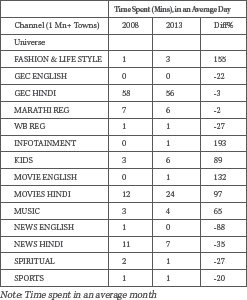
    A comparison of current media consumption habits with those about five years ago, of women in HSM markets, reveals the following interesting trends:


    • She continues to spend substantial time watching her serials and soaps on TV.

    • However, she has begun topping it up with other content on TV like reality shows, infotainment programmes, music etc.

    • Her time spent watching kids programmes has gone up substantially, indicating that she wants to spend more time accompanying her kids watch their favourite programmes…

    • Watching news on TV, be it in English or the regional languages, has come down. However, her time spent reading newspapers and magazines has marginally increased by 5- 8 minutes a day.

    • Also, more women are reading newspapers and magazines, especially special interest magazines on health, lifestyle etc. She has begun to spend more time watching sports content on TV.

    • Percentage of urban women accessing internet at home has tripled in the last six years.

    • On the other hand, the rural counterpart continues to spend more time watching TV and reading magazines.


    What a non-fiction entity does for you is it brings different kinds of audiences to the channel…like it brings in a lot of young audience, primarily male and of course, even women love to watch non-fiction shows. Not that they only watch fiction. We engage with our audiences off-air at times by engaging in doing tactical stuff; things like branding a lady’s compartment train and similar such initiatives. For GECs, if you’re doing off-air promotion, you have to go mass, you cannot segregate too much unlike channels that air premium content.


    So in our strategy, women are very much part of that mass. Another point to note here is that women are ever-evolving – they’re changing. For instance, if you go to Dadar railway station in Mumbai, you will find men buying vegetables. A few years back when I was selling a news channel, I happened to discuss with a marketing head of a bank. They said we want to target women, why should we do it with a news channel? The fact is that women have evolved.


    Today, women have a bank account, they too buy cars, they hold credit cards etc. So the definition of women has changed completely. Women have come of age, they have evolved. So when you’re a mass platform and when you have a skew for a particular target segment, you got to have a mix because you can’t run a GEC channel with only women as your target audience. Coming back to the moot point, you have to cater to a wider audience. You can’t narrow down and say – this is the audience. If you have compelling content, the time slot doesn’t matter.


    So, what does this changing trend tell us – women today, want to be an integral part of the society, and more importantly, her family wants to be “well informed”. This is probably her way of interacting better with her male counterparts. She no longer wants to be restricted to her own zone but wants to liberate herself and play an increasing and improved role. This of course is helped in no mean measure by the plethora of media options now available to her.


    Next: Monday, September 22: Teens – Kiran Khalap and Siddhartha Mukherjee


  • What Ticks for Indian Consumers/ Men – Rahul Kansal and Meenakshi Menon

    Continuing with our extracts from the second edition of the MxMIndia Annual, we present contributions by Rahul Kansal and Meenakshi Menon


    ‘Men have always been a critical segment for any newspaper’ 


    By Rahul Kansal


    The Times of India (TOI) is a newspaper that is read by all consumer segments – men, women, young adults, senior citizens and even kids/students for that matter. If I were to choose one consumer segment which has a higher affinity for the brand – that segment would be men.


    That, however, does not mean women, kids or young adults do not read the Times of India. If you look at kids as a segment, they’re always hungry for knowledge; they want to he heard, they have an opinion and their opinion is based on a lot of reading which they do at schools, colleges, even on the internet while they are home. Most kids also have access to smart-phones today, so that allows them to stay connected 24×7. So yes, kids are an important segment for a newspaper.


    Engaging men: A challenge for Indian media


    By Meenakshi Menon


    As any woman will tell you engaging men is easy. Keeping them engaged is tough. Keeping them engaged and involved is near impossible. What women know intuitively is what media has discovered much to its dismay.


    Sports and News have always been the two broad genres that delivered more males than females. But these two genres were not happy with missing out on the FMCG money! So what did they do? Look at IPL; it is less cricket and more entertainment. In a desire to get large numbers of the female audiences hooked onto cricket, content was modified. Mandira Bedi and her noodle straps became the main draw for female audiences.


    Talking about men, they’ve always been a critical segment for any newspaper. In most households, even today, men shoulder the responsibilities of the family – be it income generation, financial planning and security. We have seen a rise in the advertising (in the newspaper) coming from brands that cater to men and that is evident from the number of real estate and financial services ads in the newspaper. How do we engage with our readers on a day-to-day basis? One way of doing that is by making optimum use of media platforms. Print, yes. But also digital. I feel newspapers have a distinct advantage over television.


    That is it allows you to create the necessary buzz/impact for a product launch or a major announcement which a company intends to make to the public at large. This, we offer clients via clutter-breaking innovations. Once these innovations are out in the market, we take it online and really get the people talking about it on Twitter, Facebook, Whatsapp etc. We have done quite a lot of innovations in the past and in all the cases clients have got a terrific response.


    That’s what TOI delivers. Social media, I believe, does a far better job of building the brand’s prestige than any other medium. And as we all know, everybody is on social media today. At TOI, we try to strike a conversation with our readers across media platforms. In the next six years, I think there will be more brands that would go print plus digital as their core marketing strategy.


    If she can become a cricket commentator, I can jolly well join her was the mantra. What started out as a strategy to get the girls has in my opinion backfired because it started boring the boys! The very first IPL delivered a 25+ male audience of 23 million (average of all matches), with the 6th IPL this was 19.53 million. It could be that some men decided to stay away because sports is about guts and glory not waxed chest and manicured eyebrows! The attempt to widen the appeal of IPL and bring in female/family audiences has had some subtle but dramatic impact on male audiences.


    The kind of advertising you see on IPL has also changed dramatically. The FMCG brigade is not just present but is moving into a dominant position. You are as likely to see ads for sanitary towels as you are for condoms. Test cricket on the other hand is still a male bastion and the environment is not yet sullied with “Family/ Female” product advertising. Which is why male audiences are still engaged and involved in cricket while IPL is now family tamasha, and thus its ability to engage and involve male audiences is on the decline.


    F1 and Tennis on the other hand continue to be male dominated sporting events. These have been able to attract female audiences but in relatively smaller numbers. Globally sports has been a great way of delivering involved male audiences but in India our desperate need to be all things to all people has ended in moving the only sport that we view as a country into a family drama! If you think I am being cynical take a look at our news channels. From promoting movies to fashion houses, tete-a-tete’s with film stars and astrological forecast for the day – everything to bring in the women.


    Why is it that our media owners need to soap up every genre? When was the last time you saw a film starlet on a promo tour on BBC, CNN or Al Jazeera? Here again it has been a desire to tap into ad dollars. The appeasement policy of the media has resulted in a situation where genre/channel character is so diffused that very soon every man in this country would prefer to watch the soaps on the GEC channels. In fact the GECs with their new programming strategies are now going to grab the male audiences so women you would end up seeing a lot more men in your TV neighborhood!.


    Tomorrow: Friday, September 19:  Women – Raj Nayak and Sathyamurthy Namakkal


  • What Ticks for Indian Consumers/ Family – Dr MG Parmeswaran and Anuj Poddar

    Continuing with our extracts from the second edition of the MxMIndia Annual, we present contributions by Dr MG Parmeswaran and Anuj Poddar


    Realisation among consumers would continue to grow


    By Dr. M G Parameswaran


    The definition of family in India is changing and it would continue to change. Single biggest change is that women now have a more forceful presence in the family and they are becoming increasingly articulate. If one looks at broad numbers, percentage of working women in urban India in SEC A, B might not have dramatically increased but the role that they play in the family has changed dramatically. From being housewives, they have now become home managers. They handle a lot of finances and many other things.


    It can, to a large extent be attributed to the fact that women are getting better educated. As a large percentage of women in SEC A, B, C become graduates, they tend to have a bigger voice in how the family is going to be run, what stream of education the child should follow and so on.


    As for nuclear families, we always had them. If we look at our cultural history, the eldest son tended to stay in the house, while the younger ones moved out. The trend is far more obvious now, to the extent that number of families with three generations staying together seems to be coming down. Interestingly, what one also notices is that while the son, his wife and children are moving into a new house, they tend to stay within a kilometre or so of the parents house.


    Regional has to be more contemporary


    By Anuj Poddar


    adly, regional entertainment is falling S into the trap of the same TRP battle we are seeing in the Hindi GEC space. There is too much of focus on GRPs for my liking. The focus needs to be more on innovating, on creativity, and while you do that – it’s about being relevant and connected to the regional audience. The biggest USP of regional is that it is able to connect with its audience far better than Hindi.


    Culturally and socially, it is so much closer to its audience than Hindi. I think Hindi is the lowest common denominator as far as content is concerned because it appeals to so many different people. It is more mass, it is national in a way that everybody watches it. But regional isn’t mass. It isn’t made for everybody. It is made for a certain audience, therefore, the focus is that much better.


    You know your audience so much better as against a mass audience that you cater to in Hindi entertainment. That allows regional to do things that national or Hindi television can never think of. We have seen a lot of regional content being picked by Hindi GECs. But, we haven’t seen that happening – from Hindi to regional. And I do not think it will happen as a big trend in the future.


    Rural vs. Urban

    In rural India, one needs to look at R1, R2 differently from R3, R4. R1, R2 which is the upper 20 per cent of the rural society is quite similar to urban society. Women are educated and they want to educate their children. They use modern gadgets like DVD players, mobile phones etc. But if you go to R3, R4, the lower part of the rural society, which is probably 70 per cent of rural India, the woman is still in a ghunghat and lives in a controlled and suppressed environment, which might take some more time to change.


    In rural India, there are still some attitudinal differences in terms of how a girl child should be treated vis-à-vis how a boy child should be treated, what is the right profession for a girl, what kind of education she should have etc.


    One thing that integrates all the segments of society whether in urban and rural India is intense belief in spirituality and religion.


    India as a collective or an individualistic society

    Hofstede had done a lot of work on individualism, collectivism and power distance. He had surmised that societies like the Indian and Chinese ones are a lot more collectivist in approach as compared to Europe, which is far more individualistic.


    In my view, in one or two generations we would not move from being a collective society to an individualistic society. In India, even today, when one goes for interviews, questions about where one hails from and father’s profession etc are quite common. While in the US, questions about one’s family are never asked in an interview. These things are deeply ingrained in our psyche and they would not change in a hurry.


    Purchase decisions

    Teenagers have always been more individualistic, and it is not only about purchase decisions. However, as far as big purchase decisions are concerned like which car or TV to buy, everyone in the family gets involved. In fact, when it comes to technology products, it is the younger individuals in the family that have a point of view. For instance, when buying a laptop for the home or upgrading a mobile phone, the teenager’s opinion is sought. A fair amount of collective decision making happens.


    Evolution of the Indian consumer

    The Indian consumer has swung from one end of the choice behaviour to the other. Twenty years ago, there was a very limited choice of products – probably one or two brand of cars, two-wheelers and television sets. Today the choice is dramatic, be it cars, two wheelers, music systems, mobile phones, readymade garments or any other product category. Therefore, in many categories consumers behave like a child in the candy store. They want to sample almost everything, and also get swayed by the options available.


    Today, there is a fair amount of realisation among consumers that if it is a foreign brand it does not necessarily mean it is better. This realisation would continue to grow. Also, the consumers are becoming far more balanced in their decision making and do not want to buy every new product in the market. Good thing is that they ask a number of questions before buying a product.


    The fastest changing consumer group

    Young women in the age group of 18-19 to 25, in my view, is the most dramatically changing demographic in this country. As they are continuously evolving, they are the most difficult to reach as well. To communicate with them, to establish a dialogue with them is quite a challenge. Unlike 25 to 45 year old women who can be largely reached through television, this particular target group is far more multimedia oriented. Whether it is digital, TV, print, radio – there is a huge gamut of media that they consume.


    Changing consumer expectations

    Indian consumers are becoming a lot more knowledgeable and demanding. They are willing to pay more as long as marketers are willing to offer better quality and service. If marketers just want to charge more and offer poor quality and service, they are in trouble. Indian consumers are very value conscious, so marketers need to balance value with service and quality. Some marketers and brands hit the sweet spot and attain dramatic results, while some others tend to fail.


    Are marketers future-ready?

    Consumers are changing at a faster pace than marketers overall. Marketers tend to underestimate consumer. They say the consumer will not pay five rupees for a biscuit, or two rupees for a candy, but maybe the consumer will. Marketers tend to underestimate the limits to which they can push the consumer to buy. At the same time, there is issue of realistically balancing what marketers can offer to the consumers.


    Social media is another front where marketers need to keep pace with consumers, and not everyone is doing so. Consumers, especially of premium product categories, post things on social media and create a lot of negative word of mouth. Every company should track social media buzz – it is free consumer feedback, free market research.


    Companies need to understand what consumers are saying about their brand, about their competitors. Consumer is evolving in many ways. While some marketers will be able to keep pace with the evolving consumer, some will not be able to do so. They will probably continue to see the consumer through yesterday’s eyes. 21 – (As told to Ritu Midha)


    That’s where I believe regional entertainment has an edge over Hindi. For me, if regional has to evolve in the next five years, it has to be more contemporary. Just because it is regional, doesn’t mean it cannot be contemporary or modern.


    So today, sufi music is not classical old sufi music, it has evolved to some extent and has started to appeal to a lot many audience that were not fans of sufi music. So the evolution has to happen in terms of the way it is presented – more contemporary and modern which cuts across genders and demographics. As regional broadcasters, we have to look at that rather than just concentrating on ratings every week.


    Yes, budgets in regional media are lesser than the budgets in Hindi entertainment, but I don’t think it’s a big constraint. We have seen the budgets in regional entertainment increase in the past two to three years. They are not as smaller or tighter as they were three years back. And people associated with regional entertainment understand that.


    The creative talent in regional understand that they have a far better chance to succeed in regional than in Hindi entertainment where there are more pressures and expectations. Because in Hindi, you are either super-hit or flop. The scope of experimentation is minimal as stakes are higher. On the other hand, regional allows you to settle down and experiment as the stakes are relatively lower.


    Tomorrow: Thursday, September 18:  Men – Ajay Kakar and Manish Kalra