Tag: Mumbai Mirror

  • #Mirrored! | Ranjona Banerji: That familiar feeling of sadness… on Mumbai Mirror’s closure as a daily

    By Ranjona Banerji


    The news that Bennett Coleman had shut down the daily edition of the very popular Mumbai Mirror newspaper spread through the community and the outside world like wildfire. For many of us, who have been through shutting downs, the familiar feeling of sadness plus cynicism at promises about an online presence and weekend paper. It’s not just about a good journal being lost, but also the inevitable job losses in this awful environment where opportunities have drastically shrunk. Others pointed out the long record that the group had of closing down both brands and editions.

    For many readers and this is the only heartening bit, there was sorrow and anger that a much-loved newspaper was on its way out. As of now, Mumbai Mirror goes weekly, Pune shuts down completely and there appears to be confusion over the Ahmedabad and Bangalore editions.

    In the 15 years that it has been around, Mumbai Mirror showcased the best traditions of being the “second” newspaper. It not just complemented the more “venerable” Times of India that it was circulated with, it was also bolder, fresher and often practised better journalism. Stories which the main paper was too cowardly to take up could be found in Mirror editions. It thus carved a niche for itself in the minds of readers and established itself as the first newspaper for many.

    Much credit to this must go to editor Meenal Baghel, who steered the Mirror strategy to success, together with her teams and the resident editors of local editions. Some credit must also go, elliptically perhaps, to Mid-Day, where Baghel also worked very successfully. Mid-Day as Mumbai’s after tabloid had honed the fine art of taking the news of the day and presented it from other angles, which the morning dailies would miss or ignore. This talent brought Mid-Day great success in its heyday under the Ansaris.

    (Disclaimer: I worked for many years in Mid-Day, though not at the same time as Meenal.)

    Mumbai Mirror, also a morning paper and essentially an appendage to The Times of India, did not treat itself as an appendage at all. It carved out its own niche, readership and identity which was replicated across India. Within the community, it was understood that Mirror launched as competition to DNA. Having worked at DNA in its early days, it is true that Mirror provided stiff competition because of its treatment of stories and its strong focus on city issues. But without competition there is complacency and whatever makes you work harder has to be applauded.

    I can only hope that Bennett Coleman keeps to its promises of a “strong digital presence” and a weekly paper. As I have argued several times in these columns, the future of paper is limited. And journalism does not suffer by going online. In fact as we have seen, several news sites have outdone traditional print media as far as outstanding and courageous journalism are concerned.

    The reasons given by Bennett Coleman for this decision however are very very interesting. The pandemic has been blamed, obviously. The import duty on newsprint – one more stick with which to punish dissent wielded by the Modi government – has also been blamed. But the note issued by the management also mentions this: “the long-held hope of a stimulus not materialising and the Indian economy now officially in recession”.

    This is a strong criticism of the Modi government’s handling of India’s economy and it has not come from journalists. But from the group itself.

    Sadly however, as we saw farewell to a great newspaper, we know that the same group’s Times Now will carry on with its third-rate approximation of journalism and continue to spread hatred and sectarianism. The very anti-thesis if you will of what Mumbai Mirror demonstrated in its short but illustrious life.

    Ranjona Banerji is a senior journalist and columnist. Her column ‘Freaking News’ appears on Tuesdays and Fridays, but sometimes on other days as well. Her views here are personal

  • Dr Bhaskar Das: Every Strategy has an Expiry Date


    By A Correspondent


     In early 2005, when it was clear to the big bosses at the Old Lady of Boribunder that Hindustan Times and DNA were set to launch in Mumbai, there was much concern about the future of the Empire. While HT may still be this North India superpower, the paper had turned stylish and had some great writers and people at the helm.


    The bigger worry was DNA, short for Daily News & Analysis. It was being set up in a jv of the Dainik Bhaskar group and Zee. Bhaskar had essayed huge success in Gujarat with Divya Bhaskar and the Zee TV group chairman Subhash Chandra is a tough fighter and was keen on extending his domination to print. Plus there was Pradeep Guha, the former Times of India bossman who knew it all. And had a point to prove. When Guha moved to Zee, there was much talk of his trust lieutenant and second-in-command Dr Bhaskar Das also moving with him. But his bosses – Samir and Vineet Jain – held him back.


    Das suggested the flanking strategy to the Jains, and get the newbies battle it out with Mirror first. The gambit worked, and Mirror in Mumbai was a profitable venture in three-odd years. The circulation was large thanks to the fact it went free with The Times of India. The going was good, business-wise and editorially, though it had achieved its purpose.


    The Agarwals sold their stake in DNA to Chandra at Zee, and the paper finally folded up a year-odd back. HT could weather the onslaught, but it was a never a close #2 in Mumbai amongst broadsheets. Mid-Day, which was once #2 in Mumbai, suffered through the fight among the big ones.


    Post the announcement of The Times of India group on Saturday to close Mumbai Mirror as a daily, we asked Dr Bhaskar Das (BD) a few questions as part of the Das ka Dum series. We couldn’t help not asking him many questions on the development as part of the questions for the week. He was after all the boss of the project. We then thought it would be good to carry the entire Q&A together, and add a couple of more questions.


    Even if state this ourselves, we think it makes for a great interview, and he’s been reasonably candid. There’s a wee bit written between the lines, but then that’s BD for you. Enjoy.


    If the Print Media were to look at itself in the Mirror, what would it see? A self that’s Deflated, Defeated and Dead?


    None of them, according to me. Naysayers or doomsday predictors might agree with your observation. I am not oblivious to the emotional aspect of the reflection in the mirror. But in business, as in life, recalibration of the forward journey is a constant imperative. Learnings happen when one cleans up the mirror first before cleaning one’s face only. A deep introspection followed by a resilient approach would engender a realisation that death is the beginning of life and life is the beginning of death. Accordingly, new roadmap would emerge.


    Your sentiments on the closure of Mumbai Mirror, the daily, since you headed the team and started it all. In fact I am told you thought of the idea…


    What sentiments? � The company started a project. I was an incidental steward. When one is (in this case me) lovingly detached, launch or closure is part of a continuum, as in life. The pragmatism of business and its strategy compels an organisation to take a decision which might have to be revoked in future when the landscape changes. For business process continuity and for conservation of finite resources, an organisation has to choose an alternative from amongst multiple choices in an altered landscape.  After all, any  strategy is ultimately  a cascade of choices. Hence emotion has no legitimate space in such a decision-making. An engrossed passion helps a rational decision get wings. For the concerned daily, the dominant sentiment at that relevant time was perhaps like that. Hence an individual sentiment doesn’t matter.


    Does the closure of the Mumbai Mirror as a daily augur sad times for the newspaper industry. After all this is an offering from the #1 newspaper group in the country/ continent/ world, and operates in Mumbai, one of the most important advertising markets on land?


    As if this is the first time a publication has been shut. Every strategy has an expiry date. The publication had served a strategic purpose perhaps at that relevant time. Changing times need new strategy to navigate the operating environment. So I can presume the group has enough in its arsenal to leverage in the most important advertising market of India. From the outside it might look as a dystopian development. But it can be a precursor to a ‘manthan’ too. Who knows? As an incorrigible optimist , I think so.


    Our heart goes out to the employees engaged by newspapers, esp those who aren’t shared resources. With jobs not easily available what would you recommend to people who are set to be displaced?


    I can empathise with this question. I really have no answer to this. Sometimes silence is important to respect emotions. I can only pray for their well-being. The employees created a fantastic brand. They will do well anywhere. I am convinced.


    There are sentiments that BCCL should have absorbed the losses and grow the brand. Your thoughts.


    Theoretically, everything is possible. But how do I simulate a probabilistic answer without having any access to the compulsions that led to this decision? The only point that I can make is that the print sector itself is under dual threat  of format obsolescence and Covid-led tepid business headwind, and hence, even a supposedly deep-pocketed organisation  may not have the luxury of  taking  decisions that are unrelated to the basic tenets of commercial viability.


    As an academic in marketing, would you say that the existence or longevity of a product or service that’s set up essentially to combat competition is always in suspect?


    Not necessarily. INS Vikrant was also useful once upon a time. Then it got replaced by a more state-of-the-art aircraft carrier. Besides, strategic imperatives change. A market-facing organisation has to continuously readjust its gear depending on the terrain change and organisational priorities. Hence any deterministic prediction on this matter is as reliable as any decision that is predicated dominantly on convenient sampling.


    Do your responses really reflect your true emotions? Or are you just being politically correct?


    Political and correctness are oxymoronish terms, to my mind. I am neither political nor  claiming to be correct in my answers. May be my answers are not fitting into an expected paradigm of response. Then you should first decide if you want a rational answer or an emotional one. I am sure you would prefer the former.

  • #Mirrored! | Times of India Group Statement on Mumbai Mirror closure as a daily

    By A Correspondent


    This is the communique and statement issued by The Times of India group via its PR agency on Saturday, December 5. A revised statement was issued on Sunday, December 6. The text below is the revised statement. The text in italics is what has been changed in the revision.


    “Fifteen years ago, the ‘city that never sleeps’ had a new and good reason for staying awake – and for waking up, when it did manage to get some sleep: Mumbai Mirror. Feisty and fearless, energetic and enthusiastic, playful yet punchy, it lived up to its name from the day it was born, mirroring Mumbai in all its myriad moods. It was as local as Mumbai’s locals – the lifeblood that keeps the city on track and moving. The paper became such an integral part of the reader’s life, driving the narrative of the city, that it was decided to extend the experience to Bengaluru, Pune and Ahmedabad.


    “Sadly, just as the pandemic, lockdown and unprecedented economic crisis have laid low many great ideas and initiatives before they could fully take root, they came as a body blow for the still-young brand. Not only has the newspaper industry been among the hardest-hit in terms of revenues, it has been weighed down by an import duty that has added to newsprint costs. With the long-held hope of a stimulus for the newspaper industry as represented by the Indian Newspaper Industry (INS) not materializing and the economy now officially in recession, it is with a heavy heart that the group has decided to cease publication of Mirror in Pune and relaunch Mumbai Mirror as a weekly. They will, however, continue to have a strong digital presence.


    “The group in a statement said, “Following months of discussions and deliberations, we have made this extremely difficult and painful decision to recalibrate our portfolio of publications. We truly value the contribution of our journalists and other staff towards building such a strong brand in a relatively short time, and thank them for their hard work and great effort.”


  • #Mirrored! | Our battle is to out-think Times of India. Meenal Baghel interview in MxM in July 2012

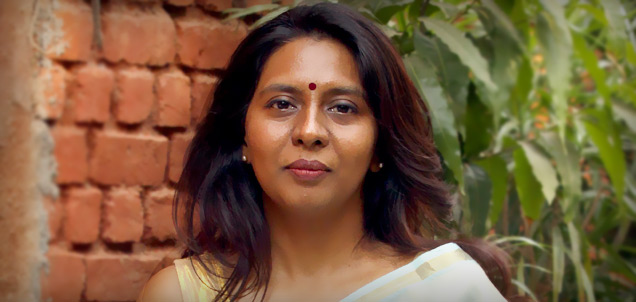
    Meenal Baghel
    Meenal Baghel

    By A Correspondent

    On July 25, 2012, senior journalist and adperson Anil Thakraney had interviewed Mirror Editor Meenal Baghel.

    Given the announcement of the closure of the the bran as a daily newspaper in Mumbai and Pune, a re-read of the interview is a must. Here’s the link: https://www.mxmindia.com/2012/07/our-battle-is-to-out-think-toi-meenal-baghel/


  • Mumbai Mirror to shut. To turn into a weekly + digital. Pune Mirror to shut completely

    By A Correspondent
    The creative of one of the ads in a Mumbai Mirror campaign released in September 2019

    If you thought the Indian print media was experiencing the ‘achche din’, pause for a bit. On the afternoon of Saturday, December 5, Mumbai Mirror announced it will shut operations as a daily. Will turn into a weekly, plus a digital presence.Pune Mirror will shut completely.

    The staff has been spoken with. Needless to say, they are shattered. If The Times of India group could be taking this drastic step, then what about the small players?

    Here’s a statement issued by The Times of India Group regarding the Mirror publications in Mumbai & Pune.
    The Statement:

    “Fifteen years ago, the ‘city that never sleeps’ had a new and good reason for staying awake – and for waking up, when it did manage to get some sleep: Mumbai Mirror. Feisty and fearless, energetic and enthusiastic, playful yet punchy, it lived up to its name from the day it was born, mirroring Mumbai in all its myriad moods. It was as local as Mumbai’s locals – the lifeblood that keeps the city on track and moving. The paper became such an integral part of the reader’s life, driving the narrative of the city, that it was decided to extend the experience to Bengaluru, Pune and Ahmedabad.”

    “Sadly, just as the pandemic, lockdown and unprecedented economic crisis have laid low many great ideas and initiatives before they could fully take root, they came as a body blow for the still-young brand. Not only has the newspaper industry been among the hardest-hit in terms of revenues, it has been weighed down by an import duty that has added to newsprint costs. With the long-held hope of a stimulus not materialising and the Indian economy now officially in recession, it is with a heavy heart that the group has decided to cease publication of Mirror in Pune and relaunch Mumbai Mirror as a weekly. They will, however, continue to have a strong digital presence.”

    The statement said further: “Following months of discussions and deliberations, we have made this extremely difficult and painful decision to recalibrate our portfolio of publications. We truly value the contribution of our journalists and other staff towards building such a strong brand in a relatively short time, and thank them for their hard work and great effort.”

  • One More Nail in Journalism’s Coffin

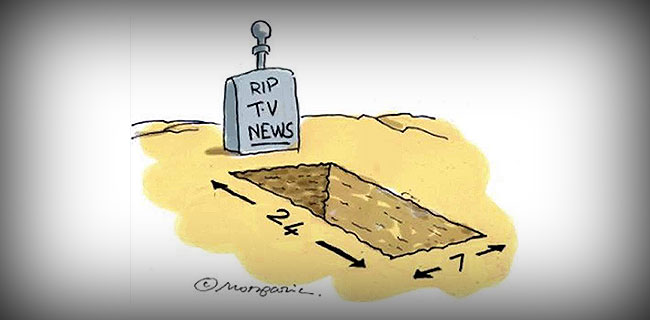
    Cartoon by Hemant Morparia in Mumbai Mirror, September 2020. Republished with the permission of the artist-commentator


    By Ranjona Banerji


    Several leading film production houses have filed a suit in the Delhi High Court against the television channel Times Now and its two “star” faces, Rahul Shivshankar and Navika Kumar and propaganda channel Republic TV and its star Arnab Goswami, as well as one Pradeep Bhandari also with that channel.

    The case is about “irresponsible reporting” in the context of the death of actor Sushant Singh Rajput and the damage done to the film industry with constant derogatory references to it.

    https://www.ndtv.com/india-news/top-bollywood-filmmakers-go-to-delhi-high-court-against- irresponsible-reporting-by-certain-media-houses-2308968


    Actress Rhea Chakraborty, who has been extensively vilified by several television channels and was jailed as a result of this malicious campaign against her, in the same Rajput coverage, has filed a case against her neighbour for lying to these television channels. Her lawyer, Satish Maneshinde, has also mentioned legal action against media outlets which went after Chakraborty.

    https://scroll.in/latest/975624/sushant-singh-rajput-case-rhea-chakraborty-files-complaint- against-neighbour-for-misleading-probe#:~:text=Actor%20Rhea%20Chakraborty%20has%20filed,Hindustan%20Times%20reporte d%20on%20Monday.&text=Chakraborty%20in%20her%20complaint%20to,statement%20was%2 0%E2%80%9Cutterly%20false%E2%80%9D.

    https://www.theprevalentindia.com/legal-action-will-be-taken-against-media-house-who-tried-to- spoil-rheas-image-says-lawyer-satish-maneshinde/

    In any other universe, except that of Indian television, I would have sided with the channels. But most of them and all of them at some point or the other, have no or very little association with journalism as it is understood. Not even the worst yellow, gutter, ambulance-chasing, tabloid journalism of the past can compare to what these television channels do.

    And thus, this bit of petulant outrage from Shivshankar of Times Now on Twitter, in response to the film industry case, is nothing short of hilarious: “Cases against journalists of Times Now that have only sought justice for those who are wronged are a bad precedent. The mighty may think they can weaken the resolve of the fearless but they are wrong.”

    The problem starts with the third word of the tweet and just escalates from there. Neither Shivshankar nor Kumar are journalists now, whatever they may or may not have been earlier. They are rabble rousers who are into amateur dramatics. Justice is not the domain of the media in the same sense that it is for investigative agencies and courts. The media’s role is to ask questions, yes, and that begins with those in power. Times Now only questions governments which are not made up of the leading party of the Central government. So that’s its first massive failure. And the very question of this imaginary “justice” in the face of all evidence, not all of which journalists have access to whatever they may claim, is also up in the air.

    And much worse was the deliberate targeting of a young woman to get increased viewership every night. On what basis was Chakraborty made their scapegoat other than some accusations by Rajput’s estranged parents and a vindictive actress who had no connection with Rajput at all? Where was this great “justice” then? And what is “fearless” about attacking Chakraborty? That was nothing but the basest instincts of misogyny and patriarchy.

    Is there anyone that these television channels have not blamed for the death of Rajput, except perhaps themselves? Maybe they should have promoted his movies better, without taking any money from him, and thus made his life happier and richer?

    As for Republic TV and Goswami, what else would anyone expect of them? From the time the channel launched it has been a BJP propaganda medium and Goswami has revelled in the role, gaining more and more supporters as he shouted into cameras year after year. Shivshankar is but a poor imitation of his master and Kumar of course was trained by Goswami.

    It is possible that nothing will come of this case. It is possible that behind the scenes negotiations will happen furiously. But it is also true that Times Now, when Goswami worked there, had a 100 crore defamation case slapped on it by Justice PB Sawant. Because the channel used his photograph in a provident fund scam case involving another judge, PK Samanta. Sawant asked for an apology, did not get that, Goswami ducked reconciliation meetings and so Sawant filed a case. Sawant was assigned the damages, the Supreme Court refused to stay the damages and Goswami apologised.

    The freedom of press does not include making mistakes and then refusing to acknowledge and apologise for them. The case against media credibility gets built up by channels like Times Now and Republic TV – and the rest including India Today, Aaj Tak, CNN-News18 and the rest when it comes to Rajput and Chakraborty – and journalists who actually fulfil their mandate have to deal with public anger and distrust.

    The damage that these channels have done to journalism is dangerous. I do not know a single journalist who agrees with the vilification of Chakraborty and the frenzied coverage and finger-pointing done by these channels after Rajput’s death.

    One more nail in journalism’s coffin.


    Ranjona Banerji is a senior journalist and commentator. She writes for MxMIndia every Tuesday and Friday. Her views here are personal. She can be reached via Twitter at @ranjona


  • Durga Raghunath & Rohit Saran join Times Internet

    By A Correspondent


    Durga Raghunath
    Rohit Saran

    Times Internet has announced the appointment of Durga Raghunath and Rohit Saran to lead its digital properties.


    Raghunath has been named Digital Head of Times of India, Mirror Brands (Mumbai Mirror, Pune Mirror, Bangalore Mirror and Ahmedabad Mirror), Newspoint, Gadgets Now and Etimes. She was until recently SVP Growth at Zomato (Dec 2018-Aug 2020) and was previously Founder and CEO of Firstpost and Network18 Digital (2010-14). She has also been CEO, Indian Express Digital (Dec 2017-Dec 2018) and Co-founder and CEO of Juggernaut Books (Sep 2015- Aug 2017).


    Meanwhile, Rohit Saran has been named Chief Editor of Times Internet.  He was previously the managing editor for The Times of India (Print) and Executive Editor of The Economic Times (Print). He has held senior editorial positions at the India Today Group where he was Executive Editor of India Today and Editor of Business Today. He also edited The Khaleej Times in Dubai. He was also Editor of the South Asian edition of Harvard Business Review and Scientific American.


    Speaking on the announcement, Gautam Sinha, CEO, Times Internet said: “We are excited about our next stage of technology-led relationships with users, content producers and advertisers. Durga’s entrepreneurial energy and experience, and Rohit’s broad editorial exposure and deep understanding make us believe we can set and achieve audacious goals over the next five years. Both senior leaders would report to Times Internet COO Mr. Puneet Gupt.”


  • Mother-of-all-slip-ups as Mumbai Mirror publishes matrimonial ad praising ‘Hindu’

    By A Correspondent


    Given that we aren’t quite in the market for either a groom or a bride, we normally give the matrimonial ads in the various papers a miss. But when we were alerted about it later in the evening, we couldn’t help laughing out loud. Well, actually it was more of rolling on the floor laughing out loud. Or ROFLOL, in whatsapp-ese.


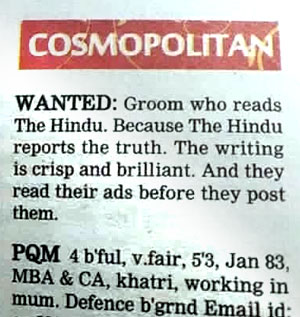
    So there was this matrimonial ad on Page 39 of Mumbai Mirror yesterday (Sunday, June 7), under the Cosmpolitan sub-headed. It started with:  “WANTED: Groom who reads The Hindu.”


    It was okay until then, but it later became evident that someone in the Times of India classified sales room has been had. Read this: “Because The Hindu reports the truth. The writing is crisp and brilliant.”


    It was clear that this is someone from a rival publication’s dirty tricks department. We’ve heard that the winds of change are blowing at the Mount Road MahaVishnu (as the Hindu is known, given its HQ is located on Mount Road in Chennai and it’s revered much by readers and all constituents), but we are not sure if the Hindu could take a joke to this level.


    Or it could be some other competitor, who will now use this as a testimony of the standards that it follows.


    Or it could be from someone within the system out to crucify and embarrass the biggie heading the matrimonials department.But the last line in that ad is what will really hurt Bennett, Coleman and Company Limited hard, and make everyone in that organisation hand his/her head in shame. “And they read their ads before they post them.”


    Read the entire ad again: “WANTED: Groom who reads The Hindu. Because The Hindu reports the truth. The writing is crisp and brilliant. And they read their ads before they post them.”


    In Bambaiyya, in the typical ‘tapori language of Mumbai’, one would say: “Poora, khol diya, bhai”. Or “Ijjat ka royal falooda banayaa”. Indeed.


    An important gatekeeping lesson for not just the folks at BCCL, but in every newsroom in the country. Watch that classified ad before  it’s published!


    Meanwhile, even though ideally some heads ought to roll for what’s happened, we would urge the BCCL management to handle this with care. And if you are going to sack/transfer the juniormost employee for this, ensure that his/her biggest boss also gets the same treatment.


    Uff, did we say a bit too much? Kya?

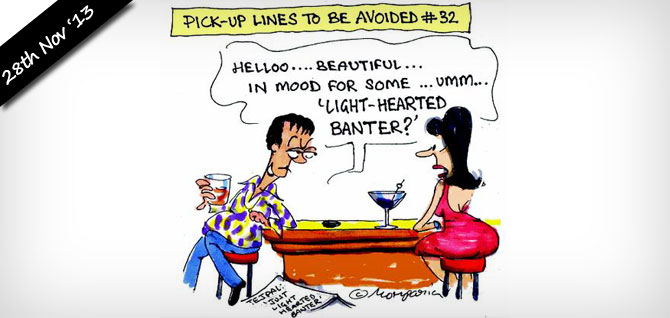
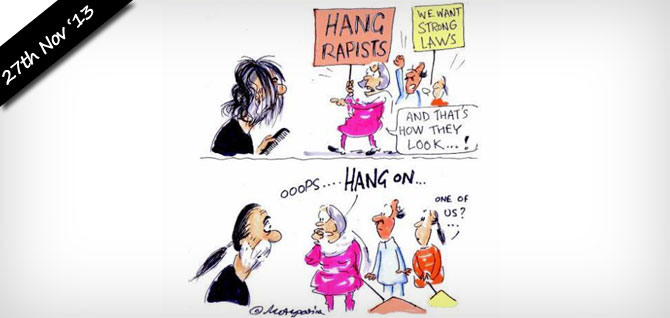
  • Tooning Tarun Tejpal’s Toxic Tale + Jaldi 5 with Hemant Morparia


    There’s been a lot spoken and written about the young journalist being subjected to sexual assault (rape as per the law). Many mails have been leaked, some officially released. Many statements have been made. And there’s been the resignation later from managing editor Shoma Chaudhury earlier today (Nov 28).


    We present here five cartoons by Hemant Morparia, one of India’s best known editorial cartoonists, who draws a daily pocket cartoon for Mumbai Mirror and group publications. These, according to us, tell give us a view that’s sharper and thought-provoking than a lot that we’ve heard and read so far.


    There’s also a Jaldi 5 Q&A with him alongside  the toons.


    Jaldi 5 with Hemant Morparia: The seedy is not necessarily as Sleazy as the Mainstream can be
     

    Hemant Morparia is one of India’s best known editorial cartoonists. Other than a daily pocket for Mumbai Mirror, he toons for various Indian and international publications. When he not drawing, he’s into photography, travelling, archery and assorted reading. He’s also a radiologist and sonologist at Mumbai’s Breach Candy Hospital.


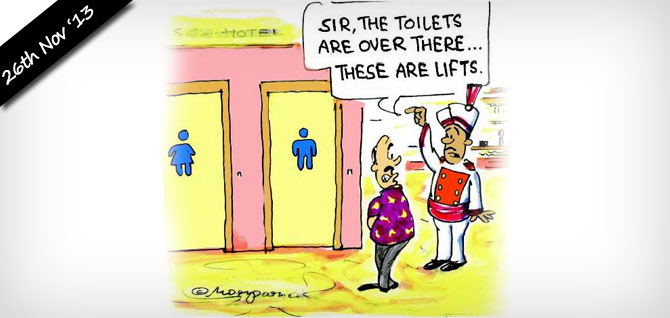
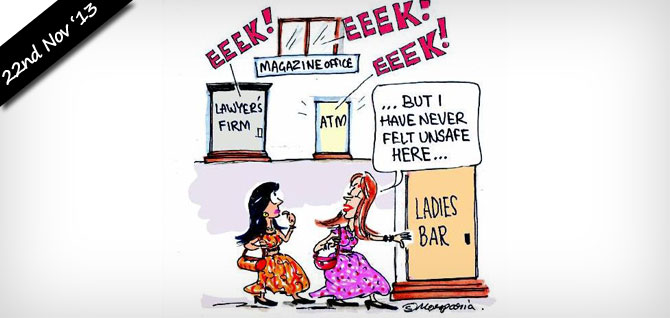
    01. They’re funny, but given the nature of the event, you can’t really laugh on viewing the five toons you have drawn thus far on the Tarun Tejpal episode. The one on the ladies bar is perhaps the most telling comment on the state of safety.

    That is my favourite of the lot. Sort of speaks my view that the seedy is not necessarily as sleazy as the mainstream can be. It’s hypocrisy that makes one think so.


    02. What happened to the young journalist is reprehensible. But what made things worse was that the assailant was allegedly her boss, someone who has been revered in journalistic and activist circles. From the point of view of an observer of news events, do you think this possibly rates as one of the worst acts of the powerful in our country in recent times?

    That jobs and promotions could be linked to ‘giving in’ is equivalent to trafficking by the perpetrator. One is making an employee a whore, by force – so it’s a grave crime. I have no problems with consensual encounters without professional inducement or threat.


    03. Would you now see people doubting all the rich, powerful and famous. As in when you meet Editor X and Y, will you now be asking yourself whether he (or even she) could be in indulging in such acts?

    This is as old as time. Nothing shocking here. All humans are potentially capable of depravity anyway imho.


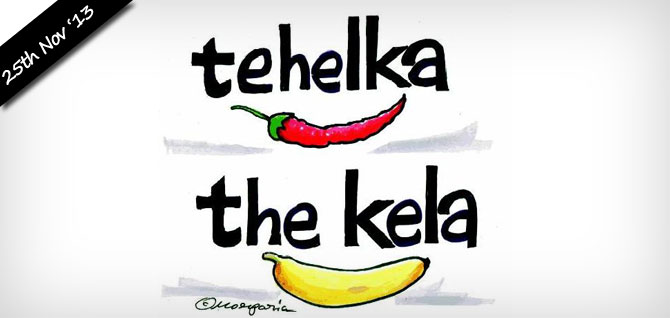
    04. Many well-known cartoonists and commentators have been muted in their response on this episode.  Possibly because they know him? Didn’t you feel the same? No more invites to Thinkfests? If you had been drawing for Tehelka, would you have done the same?

    The test for any commentator is how he sticks to his point of view honestly, without fear or favour. Personal equations colouring views will be the beginning of the end for him.


    4a. You attended the first Thinkfest. Regret having attended that? If invited, and if organized by the same set of people, will you attend it?

    There’s no reason to regret. I won’t attend in future. Probably won’t exist in future, anyway.


    05. On a lighter note, Do you really think there could be a day in India when we’ll have separate elevators for men and women?

    Ha ha! Someone commented on Twitter that such already exist in Saudi Arabia. Well, it would be safer for both sexes you know. The decent male, due to the pervading issues connected to some bad apples of his gender, is a beleaguered creature today. In this charged atmosphere, false accusations could rise too.


    Reproduced here with permission from Hemant Morparia. All cartoons published in Mumbai Mirror on dates mentioned along with the cartoons. 


  • Sebastian ‘Saby’ D’Souza: I want to erase 26/11 from my memory (alert: some explicit pictures)

    Sebastian ‘Saby’ D’Souza

    By Fatema Rajkotwala


    Five years ago, the city of Mumbai was under siege for three days when terrorists infiltrated the city’s pride and pulsating locations of the Chhatrapati Shivaji Terminus, the Taj Mahal and the Oberoi hotels, the Leopold Cafe and Nariman House at Colaba. While citizens and residents grasped what was the sudden reality, Sebastian D’Souza, then senior photographer with Mumbai Mirror ran out to the train station armed with nothing more than his Nikon camera and lenses.


    Today, five years later, Saby, as he is known in the fraternity and to friends, is far from willing to reminiscence on the incident that brought him much fame and glory. His close-up photograph of Ajmal Kasab, the sole survivor among the terrorists that day, was circulated, flashed and reused by media across the world. “Yes, I made a big name and was praised by all. The photographs were used by the media all over,” he says. “But I wish I had never done it. You’re on the field at that time. It’s crazy. I cannot explain it.”


    Saby was contacted and applauded by the global media for the considerable risk he undertook in documenting the event. “The western media praised and appreciated my work and contribution. They recognised the effort and said they would be honoured to have such a person in their country. Life in India is cheap. Nobody cares. If I had died that day, it would’ve been a very bitter truth for my family. The Indian government, Chief Minister Ashok Chavan, gave me a house but it is a disputed structure. This is the second time this has happened. Earlier I was given a house by Mr Sharad Pawar. If not by the person sanctioning it, you get cheated during the paperwork all the way. I am retired now and I still live on rent.”


    Even though the senior photojournalists shared some of his photographs he had taken, he says he would rather not remember or reminisce the events of the evening of November 26,. “I want to erase the event from my memory completely. I wish it had never happened. I didn’t do it for fame or money. It is not an event worth remembering anyway. I want to forget it ever happened and put it past me.”


  • Ranjona Banerji: Why HT scores in Mumbai

    By Ranjona Banerji


    For Mumbai, The Times of India has to be the primary English newspaper. But seven years ago, a very serious challenge was mounted by the Hindustan Times and DNA. For at least five of those seven years, DNA was well ahead of Hindustan Times in circulation and readership and for a while, even had the Old Lady of Boribunder worried. But since then, Hindustan Times has overtaken DNA and left it behind as a third contender. The difference between the two papers is not much in terms of numbers – a few thousand copies, not hundred thousands – but it represents how much DNA has lost, its recent rise in IRS calculations notwithstanding. I’m not counting Mumbai Mirror in this race since it is not a standalone newspaper.


    So far it has seemed that DNA’s loss was HT’s gain – through no major effort of its own. But lately, HT’s efforts to make a niche for itself seem to be paying off. Unable to compete with the TOI for blanket coverage of city news – and severely hampered by the no-poaching pact between their managements – HT had specialised in packaging and focused campaigns. Now it seems to be taking a surer route – re-introducing the city to its readers.


    Monday’s newspaper has an excellent exploration of changing trends in the Girgaum area by senior journalist Smruti Koppikar. It’s good to see Ayaz Memon’s insightful and incisive column on “So Bo” (how I hate that phrase!) back in HT, shifted to Monday’s city pages from its earlier Sunday slot. HT Cafe is clearly trying to be less PR-driven than its competitors and ruffling a few feathers with its stories. And HT sports section – although this has little to do with Mumbai – is one of the better ones.


    That leaves HT’s edit page, which for my money is too skewed towards India’s TV stars and has far too little analysis or informed opinion – in my humble opinion!


    There are many ways for a newspaper to gain ground and many of those have to do with circulation, branding and management. But for editors, you have to grab the hearts and minds and HT Mumbai seems to be working that out for itself after seven years.


    **


    Mohd Junaid Ansari asks in what passes for the humour column on The Times of India’s edit page: “Aren’t we all a little bit in love with Hina Rabbani”. This takes off from the gossip that Pakistan foreign minister is involved in a love affair with the Pakistan president’s son and putative heir, Bilawal Bhutto Zardari.


    Attractive as Rabbani is, I would contend that only men and lesbians are likely to be in love with Rabanni. Even accounting for female foeticide, dowry deaths and accounting for same-sex selections, roughly half the human race might prefer to not to be in love with a woman. Some might even pick Bilawal over Rabani. We do count you know, even in a male-dominated world!


    **


    Arvind Kejriwal and Prashant Bhushan and other members of the new un-named political party and what’s left of India Against Corruption are bound to be disappointed with the media’s reaction to their allegations against Congress president Sonia Gandhi’s son-in-law Robert Vadra.


    Although TV has given the story playtime, newspapers have been tepid. The main reason is the allegations are unsubstantiated and it requires some work to find out just how the connections between Vadra and DLF work. It looks as if Kejriwal and friends just threw a pebble into the pond to see how many ripples it would create.


    Now instead of taking it further, the anti-corruption crusader and politician is encouraging people in Delhi to break the law.


    Ranjona Banerji is a senior journalist and commentator based in Mumbai. She is also Contributing Editor, MxMIndia


  • Our battle is to out-think TOI: Meenal Baghel


    Meenal Baghel is the founder and Editor-in-Chief of Mirror, the nation’s most sprightly newspaper. Mumbai Mirror was launched seven years ago, and today the paper has editions in Pune, Bangalore and Ahmedabad. A part of the Times group, Mumbai Mirror boasts of a fantastic circulation of nearly 600,000 copies, and it’s become the city’s favourite compact paper.


    Meenal relives the journey with us, and speaks candidly about the many challenges she’s faced along the way. We also discuss her first book, ‘Death in Mumbai’, which received wide critical acclaim.


    I did a stint with Mumbai Mirror some years ago, and this gave me a chance to watch her in action. Meenal can be a demanding editor, she can be impatient, she can be tough. While these qualities don’t endear her to some, they have played a huge part in her success. I have to say she’s the most passionate editor I have worked with.


    By Anil Thakraney


    It’s been seven years editing Mirror. How’s the journey been? Tell me the highs and the lows.

    The high obviously has been to see the paper become an important part of Bombay. We have been successful in forging an emotional connect with the readers, which is very important. We get an enormous number of people calling in with stories. And we’ve routinely broken a lot of stories, so those are the big highs. The low is that the paper is still a bit inconsistent. You know, when we started the paper, it used to be called Mumbai Error. I wish we had a cleaner start in terms of the paper being more finished. But it’s been a sort of work in progress. We have learnt a number of journalistic lessons along the way because the market has changed, the reader has changed. For instance, when we were at Mid-Day, you could get away with a lot of things. But in this day and age, you can’t.


    Give me an example

    Like sometimes when, just to break the monotony, you put an entertainment story on the front page, there is a backlash. People now expect a more serious newspaper, it’s something different from what I had envisaged. But that’s also because there’s so much of entertainment everywhere that people don’t want more of it.


    One story you regret

    We ran the FIR of the TISS girl who was raped. That was a mistake. Because the details in the FIR were very graphic on what had transpired. And you realize that you may have ended up titillating. I regret that story, we got terrible feedback for it and we apologized for it.
     

    “I don’t think journalism offers enough challenges to the really bright people any longer.”

    I still see a number of typos in Mirror. Is this an un-lickable problem?

    I think there is a very real problem with journalism today, and it’s not only limited to Mirror. The problem is that the deskies is a disappearing breed. And it’s going to be a big challenge over the next few years. Also, there are very real problems we are facing, and these are going to change the profession drastically. It’s so rare to find people who want to come into journalism because they want to be journalists. For example, when you ask people, ‘Who edited this copy?’. Invariably the response will be: ‘I looked at it/I glanced at it/I skimmed through it.’ Another thing is I don’t think journalism offers enough challenges to the really bright people any longer. There is an attrition problem across aboard. People want to try out various things. When you and I were growing up, it was about sticking to a profession, a career path, and that no longer holds true. People now have the advantage of taking breaks, taking gap years, studying, etc. The journalism hours don’t allow too much of a personal life. And I think HR, owners, publishers, editors need to take all these things into account.


    Is the passion for journalism diminishing in young India?

    I think the important thing now is personal growth and personal life. That has taken precedence over wanting to change the country.


    What was Vineet Jain’s brief to you when you signed up for Mirror?

    His brief was very clear. He said it should be a smart paper and that it should be different from the Times of India. And because it’s a compact size, there are elements of a tabloid that you can incorporate. In fact, when we started the paper, there were a lot of conflicting opinions, so I was a little tentative in the beginning. And then one day he called me and asked why was I so tentative. He said, “I have given you this brief, just stick to it. And don’t be apologetic about it.” So that was wonderful.


    You think this country is ready for a Brit style tabloid?

    No. Though it’s very interesting because everybody is trying to incorporate the tabloid elements, but you can’t be openly unabashed about it. We are not ready for it. For instance, look at the responses Dr Vatsa’s column gets.


    Guess it’s a tightrope walk. You want to be tabloidy, and still have to be aware the nation isn’t ready

    Yes. Sometimes in the newsroom we think we can do a story, but when we see the backlash the next day, we start being more careful by censoring ourselves.


    And the problem is if you play safe and cut down on controversy, you get dangerously close to the TOI

    Yes. So what we try and do is this: I always say our competition is the Times of India. Because we go with the TOI. Now the TOI has massive width, they do like sixty stories at an average. So our battle is to out-think the TOI, in the sense that ‘this is what they will do, so let’s do something different’. We can get away with some naughty things that they can’t.


    Lots of court cases?

    Actually they’ve come down, ever since we’ve become safer. (Smiles.) But there’s also a lot of frivolous litigation, which is easily dealt with.


    More editions in the offing?

    At the moment, no.


    And for Mumbai Mirror, are you still as hands-on as ever?

    See, I am out for lunch with you! (Laughs) But yes, I like being hands-on. There are times when I can breathe down people’s necks. But I am trying to back off a little now that we have a very competent senior team. I also realize that people should be given more space, but it’s difficult. (Laughs.)

     

    “The TOI has lots of products that come with it, but everyone doesn’t necessarily read all of them, right?”

    Meenal, the perception is that Mirror benefits a lot from being the TOI’s free paper. Without that advantage, your circulation would be nowhere close.

    I am lucky and I won’t question my luck. We have a great readership, thanks to the TOI. But then you have to capitalize on that luck, you still have to deliver a good product. The TOI has lots of products that come with it, but everyone doesn’t necessarily read all of them, right?


    If you were a standalone paper, how much circulation do you think you’d lose?

    I guess we’d retain 60%. Because Mirror has become a genuine commuter’s paper. You have to travel in the train to see how many people carry it. It started off as a guilty pleasure, which people didn’t want to acknowledge they were reading, but they were all reading. But over time it has also become a lively paper. And that can’t be said about too many other papers in town. And people like that.


    Would you say Mid-Day was your training ground?

    Absolutely. I had always worked with broadsheets before that – Pioneer, Asian Age and The Indian Express. So when I joined Mid-Day, for a while it was like, where the hell have I landed? This is not how journalism is done. For the first six months I had no idea what I was doing. But I was in a senior job and I was getting paid an X amount, and I must tell you I HATE giving up. And then one day I went for a walk and said to myself the paper won’t change because of me, there was a reason why this paper was so beloved in Bombay. And that was the Eureka moment for me. I decided to try and understand it rather than look down upon it. And that changed things. I must say I learnt a lot from Aakar Patel (the then editor of Mid-Day). I learnt a lot from what the paper did on Page 1 and on headlining.


    One Indian print editor you most admire.

    I owe everything I learnt in journalism to MJ Akbar. About writing, about making pages, about what not to do, etc.


    It’s been seven years at Mirror. Don’t you feel the itch? Isn’t it tiring to do the same thing day in and day out?

    I keep wondering why nobody else offers me a job! I am joking, of course. Which is why doing the book was wonderful for me. It gave me a chance to step back and follow a story that had been fascinating me. And it was extended journalism. I have always felt when the number of days you feel bad about what you do exceeds the number of days you feel good, you should quit. I haven’t reached there. And there’s always something exciting happening.


    Being a hard-edged journalist, how do you reconcile with something like Medianet?

    That’s easy, because we don’t have Medianet in Mirror.


    But it’s there in your group.

    It doesn’t affect my life, so I don’t care about it.


    You aren’t asked to carry plugs?

    No. And it’s one of the things that has pleasantly surprised me. They have maintained the Chinese wall from the start.


    They have left you alone?

    Yes. And there’s another reason. Mirror is a small paper in the group, so it’s not necessarily the focus. We are a small cog in comparison.


    Have you ever been asked to drop a story?

    (Pauses) Not drop a story. I think what one learns over a period of time is that you have to pick your battles. I’ll give you an example: If there’s an entertainment story which is coming right ahead of the Filmfare awards, where somebody is going to be performing, and I have a damaging story on that person, would I delay it by a few days? Yes, I would.


    There used to be intense rivalry between the Independent and the TOI. Is it the same with you?

    Not rivalry, but there is great competition. When the TOI does something, and we’ve missed it, I give my reporters hell. And I am sure JoJo (Jaideep Bose) does the same when we get something.


    “Mid-Day killed itself. And I feel really bad. I feel bad that what was such a robust paper is no longer that.”

    You’ve pretty much killed Mid-Day. Feels good?

    The paper killed itself. And I feel really bad. I feel bad that what was such a robust paper is no longer that. We all worked very hard out there. We worked our asses off at Mid-Day and we used to take great pride in the paper being so robust, that it was second only to the TOI.


    What would you do if you were editing Mid-Day today?

    I’ll bring in more energy. What’s going for Mirror despite the inconsistency is that it’s never dull. And dullness in journalism is a cardinal error. Especially if you are a tabloid.


    Let’s shift to your book, ‘Death in Mumbai’. Does Meenal think Maria Susairaj got away lightly?

    I must tell you I ended up liking her quite a bit. I feel that she is a manipulative woman and that she may be a tease. But that’s not a crime, there are a lot of women like that out there. Did she kill or abet the killing? I don’t think so. She was in love with Emile Jerome, she really wanted to marry him. But he wasn’t committing to her. When he killed this guy, it was, in her mind, like his commitment to her.


    When you started writing, was there something you had decided you won’t do in the book?

    The only thing I told myself is to not be judgmental. Because someone else’s idea of morality could be different from mine. Like, I started out with a certain view of Maria but it became something else.


    In fact, that was the only criticism I read about the book. As a journalist, readers expected you give us your own view. Perhaps as the epilogue.

    There were genuine difficulties. Something happened in a room where there were only three people. One guy is dead and two are in jail. There is only so much information I had. And I genuinely did not want to play judge.


    You have always kept a very low profile. Marketing the book must have been tough.

    (Laughs.) It was! It was terrible. The only time you would see me on television was on things that were related to the book. Otherwise I wouldn’t be caught dead going on TV.


    Any more books coming up?

    I would like to write more books, but I love this job too much. Ideally I’d like to do both. But I haven’t thought of another subject so far. Might be interesting to write fiction.


    Would you like to edit the TOI?

    No. I think it would be fun to edit a broadsheet, but I don’t think I am ready to edit the Times. It’s the biggest paper in the country, it requires a greater understanding of business, politics… and I don’t think I am ready for it. Also, it requires certain people skills which I perhaps don’t have.


    Don’t rate yourself high on people skills?

    I think I am very good. But I need to be more patient. I can be impatient and that’s a serious shortcoming.


    You are 43. Don’t want to marry?

    It’s too late now (Laughs).


    Is it important to be single to edit a high pressure daily? Is it a price one pays?

    Sure. It’s a price a lot of women, more than men, have to pay for any high pressure job. It’s unfortunate, but it’s a fact. I may have been married, but it would have been very difficult with children.


    Photographs: Fotocorp