Tag: Mukesh Ambani

  • M&E set to boom with Reliance Jio-led data thrust


    By A Correspondent


    It’s the last mile that matters. And it didn’t need any rocket science to appreciate that telecos will rule the next wave of media and entertainment across the world. But it needed the combination of vision and moneypower that Reliance Industries Chairman Mukesh Ambani has to realise the dreams of Prime Minister Narendra Modi’s dream of a digital India.


    If you think we’ve turned symapathisers for either Reliance Industries or the ruling dispensation, let’s put it down loud and clear: we haven’t. However, we can’t deny that the September 1 announcement at the RIL AGM, announcing the launch of Reliance Jio is perhaps the most significant development in not just telecom, but also media and entertainment in recent years.


    Ambani’s move of making voice and roaming free of cost is a masterstroke. For the real battle is in data. As he said, it’s going to be datagiri from now on. Right now though, as he hinted in his address, he is experiencing some dadagiri from some other players in terms of voice interconnect.


    The Jio Welcome Offer will be effective from September 5.  As part of the Jio Welcome Offer, users will have access to unlimited LTE data and national voice, video and messaging services along with the full bouquet of Jio applications and conten, free-of-cost up to December 31, 2016. The company has filed its tariff plans with the Telecom Regulatory Authority of India (“TRAI”).


    Ambani announced that domestic voice calls to any network across the country would be free for Jio subscribers even beyond the Jio Welcome Offer. Domestic roaming services would also not be charged separately. Average data prices would be around Rs. 50 per GB, which would be amongst the lowest in the world.


    The digital services business has been rolled out pan-India. In addition to fixed and wireless broadband connectivity offering voice and data services on an all-IP network, Jio will also offer end-to-end solutions that address the entire value chain across various digital services in key domains such as education, healthcare, security, communication, financial services, government-citizen interfaces and entertainment.

    Ambani spoke about the five fundamental pillars of the Jio ecosystem: (i) best quality

    broadband network with the highest capacity; (ii) A world of affordable, cutting-edge devices;

    (iii) Compelling applications and content; (iv) Superior digital service experiences; and

    (v) Affordable and simple tariffs.

    Ambani said that the key brand values for Jio included affordable, high quality and abundant data; connected intelligence; smart, simple and secure services; and bringing people together.

    He also announced the setting up of the Jio Digital India Start-up Fund. Jio will work on creating Jio Digital Entrepreneurship Hubs in key cities and towns of India. The Jio Digital India Startup Fund has set aside Rs 5000 crore to be invested over the next five years.

    AGM presentation slides


  • It’s Only IBD for Only Vimal


    For a generation that grew up in the early years of television advertising, Only Vimal is a campaign that’s etched deep in memory.  While India was always known for its textiles industry, it was Only Vimal – created by Reliance Group founder Dhirubhai Ambani – that became its most iconic brand.


    Last week we reported that IBD, a Percept company, had bagged the strategic and creative mandate for ‘Only Vimal’. And, the road to the finish line was not at all easy. IBD was in the race with some of the biggest names in the industry.


    “In the final round, we were fighting with RK Swamy. For a very long time, it had handled the biggest textile brand Raymonds and obviously would have been the prime contender to handled this account too. For us, to be able to upstage them and win this brand was a matter of great pride and satisfaction. I believe, the strategy and all was very bang-on but our edge was the differentiated positioning we talked about, the technological positioning and the creative execution we brought in to place. That is where things went in our favour,” said Rahul Gupta, Managing Director, IBD.


    The rechristened Vimal – ‘Only Vimal’,  was one of the first textile brands to make a massive consumer impact pan-India. A Mukesh Ambani-promoted Reliance Industries’ (Reliance) textile division, Only Vimal is also one of the first major retail chain of stores to be set up across the country. IBD will be responsible for repositioning and revitalising the brand image.


    One of the most important things while preparing a pitch is the brief that is given to an agency by a client. Speaking to us on the brief, Gupta said, “The whole essence of Vimal was that- it was one of the most prized brands once upon a time. Over a period of time, Reliance moved on to bigger and better things and different areas of business. So, to a certain extent the textile division of Reliance Industries’ was kind-of put on the backburner. But it continued to do decent business for a period of time.”


    “Obviously, it lost the lustre of a brand it was in the 80s. So, very clearly, the task in hand was to re-stage this brand and make it relevant for the new India, for the younger India. The young India does not know the value of the Vimal brand. Our task is to re-stage the brand, so that today it is seen as a premium brand. The youth of today should understand the iconic status of this brand.” Gupta added.


    MxMIndia previewed the television campaign which will be launched today (Aug 16). In the commercial, the focus has been given more on the fabric and the qualities of the clothing material. But since the brand’s target is the youth of India, why shoot the film in a foreign location? “We did a lot of research and psychographic studies and we realised that the youth of today though rooted in India have a very global aspiration. Today’s market is all about the youth. We wanted to focus on the youth and the youth of today is all about action. Yes, there aesthetic and creative reasons why it is important to shoot the film in an international setting. It allows you a nice backdrop; ultimately it is a fashion brand and aesthetics, style etc. do play a big role in communicating the style quotient of the brand. But apart from that it is also to give a global value to this brand,” explained Gupta.


    When it comes to fashion brands, more often than not we see the clichéd concept of how wearing the brand can make one a winner or achieve the impossible in life. “Everybody followed conventional wisdom in terms of advertising where you talked more about achievement or being good-looking, it was all focused on personality. It was us who took these fabrics and decided to position the brand of fabrics as a brand which offers technologically superior fabrics that will aide people in their lives, especially the man of action. The youth of today is on-the-go and need something which will help them. It was time for change and today everything has changed. If Vimal needs to come back and become a market leader, it needs to have its own voice,” said the Gupta.


    On the marketing front, a 360-degree strategy has been agreed upon but is there any special plan was the most used and enquired about platform ‘Digital’? “We already are working very extensively on social media platform. We have taken a lot inventory on YouTube, so we are doing all those standard digital efforts as it is. But we are also planning a lot of engagement activities which you will see and is very effective in getting across this new position and new fabrics to work on innovative little digital program,” added Gupta.


  • Reliance Industries issues advisory to its employees; asks them to not drink and drive

    By Devina Sengupta & Baiju Kalesh


    “If you’re planning to drink alcohol, also plan how to get home without having to drive yourself.” This is a fairly unusual advice for a company circular, but a high-profile car crash involving a women employee has forced Reliance Industries to issue an elaborate advisory to its about 25,000 employees on the perils of drunk driving and other inappropriate behaviour.


    A mail sent on June 12, hours after chairman Mukesh Ambani addressed its shareholders, RIL advised employees to ensure that those in an inebriated state are not allowed to drive.


    The advisory comes in the wake of relentless media coverage of an accident involving Janhavi Gadkar, who works in RIL’s legal unit, in the early hours on June 9. RIL alerted the Bombay Stock Exchange on June 13 that the senior executive with whom Gadkar had been drinking on the eveing of June 8 was its Chief Financial Officer Alok Agarwal.


    Agarwal was summoned by the Mumbai Police as a witness in the case. Gadkar is in judicial custody after her Audi crashed into a taxi on Mumbai’s freeway causing two deaths.


    According to reports, she had been drinking with colleagues the previous evening, first at the hotel Marine Plaza and later with a senior RIL executive at another pub, the Irish House.


    The drinking episode at the Irish House was first reported on June 11. For good measure, the advisory also warned against conduct that is “indicative of personal indiscretion” or is “socially unacceptable.” It also warned employees against breaking any law such as those on possession of undeclared foreign exchange, narcotics and prohibited wildlife items.


    Much of the advisory is on perils on drunk driving. “A large proportion of all drunk driving crashes occur within three miles of the start of the journey,” the mail said. “Don’t offer an alcoholic drink to someone you know is planning to drive.” The mail also asked employees to ask themselves at all times whether their conduct befits “a cultured, mature and socially responsible adult”. “It also must be kept in mind that while major lapses of law and social behaviour are usually prevented, very often seemingly minor mistakes can and do result in improper conduct.”


    “The advisory is self explanatory. Suffice to say by way of context it is a reminder of existing policy,” said an RIL spokesman


    ‘RIGHT THING TO DO’

    Human resources consultants say the company has done the right thing if the circular is a reaction to the crash.


    “If it is a reaction to the crash then it is the right thing to do for the company and employees need to be sent a strong message that the organisation will not tolerate any such behaviour,” says Nirmala Menon, founder of Interweave Consulting, a diversity and inclusion solutions company.


    “‘Firms should send out the message that they will take action if any safety measure is breached by their employees.” The RIL mail underlined the importance of using “sound judgment and demonstrate a serious sense of responsibility and maturity all the times and in official as well as personal capacities.” It also frowns upon “loud and irresponsible behaviour in public” which caused discomfort and embarrassment to others.


    Employees were reminded that the legal blood alcohol limit in India is 30 millilitres under the Motor Vehicles Act. But Gadkar’s blood samples showed it was thrice the permissible count, the police have alleged. Other business groups may also follow suit. Tyre-to-power transmission company RPG group plans to remind its employees about the perils of drunk driving through video message in July.


    Source:The Economic Times

    Copyright © 2015, Bennett, Coleman & Co. Ltd. All Rights Reserved

    Licensed to republish


  • Epic isn’t a GEC, don’t subject it to standards that GECs have: Mahesh Samat


     At 9pm primetime today (November 19), when you otherwise tune into your favourite soap or reality show or news, well, hour, there’s a new channel going to be born. Epic. What has set a lot of attention on the channel is the nature of its content and the people backing the initiative.


    Spearheaded by Mahesh Samat, Managing Director, Epic Television Networks Pvt. Ltd., this is the first genre specific Hindi entertainment channel that will showcase content based on Indian history, mythology and folklore in a uniquely contemporary format. Industrialists Mukesh Ambani and Anand Mahindra and impresario and restaurateur Rohit Khattar are co-promoters of the venture company.   The programming line-up has a mix of fiction and narrative non-fiction shows, short-form content as well as films at launch.


    Excerpts from an interview with Mahesh Samat by Shivani Jain for MxMIndia…


    There is already a glut of channels in the market telecasting a wide gamut of programmes in the general entertainment and infotainment space. Do you think there is still room for a channel dedicated exclusively to Indian history and mythology?

    Yes, we found that the few mythological and historical programmes being telecast currently have a huge following. This, in fact, was the genesis of Epic. Our relationship with our history and mythology is in our DNA. We are emotionally connected with it, more than any other country. So this opportunity was waiting to happen.


    It has taken you’ll a long time to launch the channel. The announcement was made a year back. Was this due to issues on clearances from the government, or…

    The issues with the previous government and approvals have been well-documented. I don’t want to spend too much time discussing that. The new government has been really helpful. We have got our approvals. And we are moving on.


    … or was it the programming. Did that delay the launch?

    There is no doubt that programming does take time. But the delay was due to some unavoidable extraneous circumstances. The main thing is Digitization has improved and viewers have become more attuned to different kinds of content.


    All TV channels needs deep pockets, but a channel like Epic needs super deep ones given the nature of your content. How has the journey been for you so far?

    I think we are trying a whole different model of television. We have to remove the current, existing models and get into new age. We had a business plan and we are with the business plan. We’ve had promoters who are very supportive.


    And some very high-profile promoters indeed. How has it been working with Messrs Ambani and Mahindra?

    There are actually three promoters. Mr Rohit Khattar is the person who is involved more directly with the business. He is the chairman of Epic. Mr Anand Mahindra and Mr Mukesh Ambani are relatively less involved. So we work with all three. Rohit being the chairman is more involved.


    And how participative are the three?

    It is varying degrees of involvement. Obviously, they are very busy people. Their involvement is limited to that extent. By the way, both Rohit and Anand are old film buffs. Rohit has the largest collection of film memorabilia which had gone to Venice and a couple of other places. And Anand himself is an undergraduate in films. His subject in Harvard was films, if I am not mistaken. They all have a passion for it. But operationally, Rohit was the one most involved.


    When do you see the channel breaking even?

    Sorry, we don’t disclose those figures. I think we are on track with the business plan.


    What about viewership? Given the emphasis on getting the right ratings, what are your expectations on viewership?

    I am very clear that we are not a general entertainment channel. So we should not be subjected to the standards and discussions that GECs have. Our reach will be lower, our ratings will be lower because it is a certain genre, a certain…


    A certain niche…

    No, it is not niche. I don’t like the word ‘niche’ because niche makes it too small. Let’s start looking at a third word which is ‘segmented’ which looks at a chunk of the market, but not the whole market.


    What has been the feedback from advertisers thus far?

    I think they are all very interested. Given that it’s a new concept, they understand the positioning, the story of differentiation, the story of segmentation.


    You have come from Walt Disney, which is a totally different world?

    Really, is it? So if you step back and see…Disney is a brand, a brand for kids. What we are trying to do here is become a brand in history and mythology entertainment. I think all my experiences of building brands over the last few years are proving to be useful here.


    So did it require a lot of reorientation on your part?

    I don’t think so. It’s an area I am familiar with – media and entertainment. Hopefully, our programmes succeed and become brands. If you look at global examples of channels like Discovery, Disney, even AXN, Comedy Central, you see examples of brands being set which are by genre type of content. And that’s what we are doing here.


    Tell us a little about your flagship programmes or driver shows?

    They are all flagship programmes. We have Siyasat, DharamKshetra, Daanav Hunters, Adrishya, Ekaant, Raja Rasoi aur Anya Kahaniyaan. We also have a couple of comedies. For instance, we have Javed Jafri taking a light look at the films of the 1970s and ’80s. Watch them all on Epic.


  • Jio mere lal! Mukesh Ambani’s son Akash joins RIL; begins at telecom arm

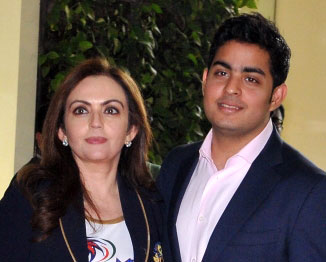
    Akash Ambani with mother and Reliance Foundation chairperson Nita Ambani at the IPL auctions on February 13… Fotocorp

    By Rajeev Jayaswal & Chaitali Chakravarty


    Thirty-two years ago, Dhirubhai Ambani’s son Mukesh joined the company his father had founded. Now, Chairman Mukesh Ambani’s son Akash has joined Reliance Industries Ltd, starting at its telecom unit at a critical time. He’s involved in finalising the go-to-market strategy of the ambitious 4G telecom venture, said two persons aware of the development.


    “He comes to office regularly and sits in review meetings with his father and Manoj Modi. He is also working closely with Reliance Jio Infocomm’s Group President Sandip Das. The company doesn’t want to talk about it because he is new to the business and learning the ropes,” said one of those cited above.


    It is learnt that Akash, who was also seen at the IPL players’ auction last week along with mother Nita Ambani, is working with Mr Das in preparing a comprehensive plan for Reliance Jio that will include strategies for customer acquisition, service, call centres and related issues.


    According to one of the persons cited above, Mukesh Ambani is keen that his son sits through all critical meetings of Reliance Jio because he feels this would be the best education for him. The elder Ambani learnt the fundamentals of the group’s flagship petrochemicals business by shadowing his father, the late Dhirubhai Ambani, at every meeting and at every juncture that decisions were taken.


    Mukesh Ambani joined RIL in 1981 at the age of 24 and went on to set up India’s biggest refinery at Jamnagar in Gujarat. He was also responsible for setting up the group’s telecom venture and had an ambitious vision of where he wanted to go with it. But the unit became part of younger brother Anil Ambani’s businesses following a split between them. A subsequent rapprochement between the brothers meant the older brother could reenter the business that he felt so strongly about.


    An RIL spokesman did not respond to repeated requests for comment on the younger Ambani’s induction. Akash Ambani, 22, who pursued undergraduate studies at Brown University in the US, returned to India last year to intern in the family business. His twin sister Isha, a graduate from Yale, is likely to join the Reliance Foundation, which houses the group’s schools and hospital ventures, said a person aware of the plans. Their younger brother, Anant, is pursuing higher studies in the US.


    People familiar with the inner workings of the company say Mr Modi is one of Akash’s key mentors. Mr Modi, 55, was Mukesh Ambani’s classmate at engineering college and is a hands-on operations person.


    Regarded by many as Mr Ambani’s closest associate, Mr Modi played a large role in setting up the Hazira petrochemicals complex, the Jamnagar refinery, the first telecom business, Reliance Retail and now the 4G rollout. The 4G project provides the right opportunity for the younger Ambani to learn the basics of setting up a venture from scratch, said some of those cited above.


    RIL, which is said to have aggressive plans to roll out a nationwide voice and data network to rival that of the incumbents, bid around Rs 11,000 crore for spectrum in auctions that ended last week. Reliance Jio, a subsidiary of RIL, is the first telecom operator to hold a pan-India unified licence, which means it can offer all telecom services everywhere in India.


    The initiation of Akash into the telecom venture seems to be a conscious decision on the part of Mukesh Ambani because the business combines both the need for innovation and taps into the aspirations of the younger generation. Akash is part of a venture that has grown rapidly from less than 700 professionals a year ago to over 3,000 employees. Reliance Industries as a whole is a powerhouse with a net profit of Rs 21,003 crore and total assets in excess of Rs 318,500 crore.


    Ambani junior is often seen in the Reliance Corporate Park located at Ghansoli in Navi Mumbai, people said. The plush corporate office, popularly known as RCP, was built about four years ago and houses almost all the RIL businesses. RCP also has an office for Ambani senior, although he usually functions from Maker IV in Nariman Point. Akash’s RCP office is in the same building as that of the chairman’s office, they said.


    Much will depend on how Reliance’s long-anticipated telecom plans unfold. Bharti, Vodafone and Idea will fight hard to make sure the new entrant doesn’t hurt their business.


    The younger Ambani has been given the ideal platform from which to launch himself and make a mark as the first member of the third generation of a family that has transformed India’s business history in the past half-century.


    Source:The Economic Times

    Copyright © 2014, Bennett, Coleman & Co. Ltd. All Rights Reserved

    Licensed to republish

     

  • Why (& How) Reliance Retail is expanding in a slow market


    By Kala Vijayraghavan


    From a quarterly basis, the brass of Reliance Retail, led by Mukesh Ambani’s lieutenant Manoj Modi, now assembles for review meetings on a monthly basis. The frequency of meetings might have changed, the modesty hasn’t: the presentations still make no mention of how competitors are faring.


    Judging by what Reliance Retail did in the last quarter, the numbers for which it announced on January 17, and what others retailers did, it need not have. For now at least. The retail landscape in India is strewn with the remains of expansions gone awry (Future Group), or a victim of anxiety (Walmart) or put on hold (Croma, from the Tata stable). Amid all this, in the September to December quarter, Reliance Retail found a new gear.


    Giving into religious sentiment, it shut down all its Delight stores, which stocked non-vegetarian food products. But, across other formats, it averaged five new stores every six days. The expansion helped it increase revenues 38 per cent, which though is below the 50 per cent target it has set for itself for the next three to four years to grow to a $6.5-8 billion (Rs 40,000-60,000 crore) entity.


    The Rs 10,800 crore Reliance Retail, which is currently a subsidiary of Reliance Industries, is also inching closer to profitability. At the results announcement, Reliance Group CFO Alok Agarwal said that the company had reported its first quarterly profit at an operating level, of Rs 106 crore. It’s still a long haul to turn profitable at the net level, and sustain it from quarter to quarter, but Reliance has its tail up.


    Among the Indian groups in this business, Reliance was among the last to enter, about seven to eight years on, in 2006, backed with a deep war chest from its rich parent.


    BS Nagesh, vice-chairman of Shoppers Stop, one of the early entrants, says that evolutionary difference is showing up. “Everybody is consolidating their learnings and getting into cautious growth,” he says.


    Adds Kishore Biyani, CEO of Future Group: “It is a tough, mature market, and retailers will have to work out ways to find new growth opportunities.” Mr Nagesh, whose company competes with Reliance in several formats, adds that store addition is not the only metric of expansion. “I do not see an unusual aggression in Reliance Retail,” he says.


    “Addition of one store a day may not be significant in comparison. For instance, Reliance adding one store a day of 3,000 sq ft and a HyperCity (the hypermarket arm of Shoppers Stop) setting up a 100,000 sq ft store in a couple of months.”


    Harminder Sahni, founder of Wazir Advisors, a retail consultancy, points out that most retailers have had to deal with distractions—of retiring debt, of raising funding, of rules and propriety, of profitability, of online competition. “It (Reliance) is not a distracted player,” he says. “It has just focused on doing retail. It has been going rock steady, it hasn’t dropped formats frequently and it is focused on supply chain the way no other player has done in India.”


    According to a Reliance spokesperson, there’s a momentum building. This, he adds, is essentially the outcome of the company, after a period of trial and error and on reaching some scale, being surer of what it wants to become and how it wants to reach there.


    While Reliance has not dropped too many formats, it has shifted from big stores only to include small stores, from fresh-food only to overall foods. The format portfolio of Reliance shows that, since March 2013, the big store expansions have come in gadgets and consumer durables (Reliance Digital, up from 139 stores to 212) and in garments (Reliance Trends, 448 to 508).


    Now, says the Reliance spokesperson, the stickiness is more than ever. “Today, everybody inside knows what the business is about,” he says. “It is now a more anchored strategy.” “It has worked out an interesting mix of diversified categories,” says Kumar Rajgopalan president of Retail Association of India, a grouping of Indian retailers of which Reliance is not a member. “It is learning lessons fast and is able to create scale at a more rapid pace.”


    Reliance’s mainstay remains its value offerings. These include Reliance Fresh (neighbourhood stores) and Reliance Market (wholesale stores). Unlike some retailers, Reliance is not vacating the neighbourhood supermarket space, especially in the top 15 cities. “At least 25-30 per cent of the grocery business in top metros comes from hypermarkets,” says Abneesh Roy, associate director, Edelweiss Securities, a brokerage.


    The long term in mind, Reliance is challenging this narrative. “As markets mature, customers will opt for grocery shopping in neighbourhood supermarkets, which ties in with our cluster strategy of catering to middle-class and upper middle class consumers in the top 15 cities,” says Damodar Mall, chief strategy officer, value retail, Reliance.


    “Supermarkets in a catchment area ups the customer service quotient in the neighbourhood and everybody upgrades accordingly.” Reliance Market, its wholesale stores catering to smaller retailers and business establishments, is emerging as a useful hedge to its neighbourhood stores. It opened its first wholesale store in Ahmedabad, in September 2011. Now, it has 15 such stores, including six in the last three months: in Anand, Bengaluruangalore, Chennai, Faridabad, Guntur and Mumbai. “These are cash guzzlers and only the Reliance Group has the ability to stay put,” says Mr Roy of Edelweiss.


    Bijou Kurien, former chief executive and president (lifestyle), Reliance Retail, feels the challenge for the company will be to create new markets beyond the top 80-90 cities. “All the good markets and stores have been covered in the first phase,” he says. “In smaller potential markets or smaller towns, it is not easy to change deeprooted habits of consumers easily.”


    According to Mr Kurien, one challenge before Reliance is to create a pipeline of differentiated offerings, which it is trying to do. At Reliance Digital, for example, Reliance is trying to take responsibility of installation and after-sales service from manufacturers.


    So, it is training about thousands of electricians to handle televisions, refrigerators, mobiles and washing machines, among other things. “We have committed huge investments there,” says the Reliance spokesperson. “Will it get us immediate returns? It will not, but it will secure our future customer.”


    As Reliance gets surer of more pieces in the business, the kind of people it wants is also changing: from those who will build the business to those who will run the business. In the kind of people it has sought, Reliance has gone through three phases.


    The first phase, between 2006 and 2009, comprised retail veterans who had proven themselves in building businesses: late Raghu Pillai came from Pantaloons, Bijou Kurien from Titan Industries, Rajeev Karwal from Electrolux, Sanjeev Asthana from Cargill, Gunendar Kapur from Unilever Nigeria. The second phase, from 2009, revolved around expats with rich operating experience in global retailers.


    Leading them was Gwyn Sundhagul, who came from Tesco Thailand. In 2011, Sundhagul was replaced by two senior officials from Walmart China: Rob Cissell and Shawn Gray. The third phase is currently underway. In this, the focus is on neither high-profile stars nor expats. It’s on people who build processes. “We don’t want stars,” says the Reliance spokesperson. “We want experts who can build sound systems and processes that don’t hinge on one person.”


    The very nature of the retail business, says Sahni, does not allow for a fancy rank and file. “It is all about trading in somebody’s brands, not about creating networks and building brands,” he adds. “After power, utilities and ACs, not much can be done on an 8 per cent margin. I, therefore, discourage MBAs with high expectations from retail.”


    The new mindset is empowering officials at the middle and lower levels, and creating interesting possibilities for them. “Shop-floor attendants are today store managers or cluster managers,” says the Reliance spokesperson. “The focus is on decentralising the operating side and consolidating at the category level.” One part of Reliance Retail that draws even the competition’s envy is its supply chain. It’s the most expansive among retailers in India, commanding clout, for example, while sourcing fruits and vegetables directly from farmers.


    Industry officials say any retailer, Indian or foreign, will need at least three years to build something of this scale and intricacy in diary products and fresh foods. “We have invested in systems and processes ahead of its time,” claims the Reliance spokesperson. “When the market is ready, we will be is prepared to do that well.” At the moment, it is gaining at the expense of others. “The competitive intensity is lessening,” says Roy of Edelweiss.


    “Other players are cutting down expansion plans.” Mark Ashman, CEO of HyperCity, which is taking a gradual expansion path, feels different models work for different groups. “Some try to achieve it through scale and therefore push expansions,” he says. “We have been focused on refining the model in our big-box retail strategy by driving higher-margin categories. We may have fewer stores, but those would be more profitable.”


    At Reliance, the diktat from the group at the top that does the monthly review is: all formats have to be profitable by mid-2014. Parent Reliance Industries has so far invested about Rs 6,000 crore in the retail business. After a period of hesitancy and doubt, followed by a period of rebuilding and consolidation, the retail business appears to be beginning to look more like how Reliance businesses have been known to look.


    Source:The Economic Times


    Copyright © 2014, Bennett, Coleman & Co. Ltd. All Rights Reserved


    Licensed to republish


  • Reliance Retail to turn hypermarkets into wholesale stores, to court kirana shops

    By Rasul Bailay


    Mukesh Ambani’s Reliance Retail is converting some of its big hypermarkets into wholesale cash-and-carry stores, in an apparent sign of modern retail’s inability to effectively take on neighbourhood stores in India.


    The Reliance Mart hypermarket in Bhopal’s Aashima Mall is currently under renovation and getting refitted to be reopened in February in a new avatar, as a cash-and-carry store.


    This 44,000-sq-ft hypermarket is among Reliance’s big-box stores, including one in Ludhiana and another in Aurangabad, that are being converted into cash-and-carry formats.


    The company has realised that in some locations, low-frills wholesale stores have better prospects of making money sooner than consumer-centric hypermarkets, which have wide margins but also are more expensive to operate, two people with knowledge of the development said on condition of anonymity


    So, in order to convert the adversaries – the mom-and-pop stores in this case – into allies, Reliance is adopting a simple strategy: It is courting them.


    In the cash-and-carry format, companies sell to bulk buyers, such as neighbourhood or kirana stores, who are their members. Reliance is setting up its wholesale stores in places where the concentration of kiranas is high as it is easier to make them customers than competing with them. The business also offers huge potential.


    Industry experts estimate cash and carry in India to become a $22-billion (about Rs 1.4-lakh crore) annual opportunity by 2017, and the market leader in the segment is expected to corner $4 billion to $5 billion of this. The main rival for modern cash-andcarry stores in India is “wholesale retailers” – thousands of small retailers crowded into large markets, such as the Sadar Bazar in Delhi.


    “Reliance Retail continues to evaluate its offerings and realign them in specific locations in order to establish sustainable relevance of the business with the consumer ecosystem,” a Reliance Retail spokesman said in an e-mailed reply to queries on the company’s plans on its cashand-carry business. In the traditional retail segment, the going hasn’t been smooth for organised players.


    Over the past five years, Reliance Retail, Aditya Birla Retail, Spencer’s Retail and others shuttered hundreds of smaller convenience stores to focus on expanding big boxes as the smaller stores faced direct competition from kirana stores.


    But hypermarkets, generally spread over 40,000 sqft to 60,000 sqft, come with their own set of challenges, such as high cost structure associated with a large number of staff, look and feel of the store as well as logistical cost that ultimately eat into overall profitability On the other hand, cash-and-carry business generates much higher volumes – as customers buy in bulk, albeit at low margins – with smaller operational cost. Cash-and-carry stores can be low-frills in terms of look and feel and ambience, and they save on logistical costs as companies and distributors would supply merchandizes directly to these stores.


    Generally, Reliance Markets, as Reliance’s wholesale stores are called, allows only bulk buyers through memberships.


    But the store at Bhopal’s Aashima Mall is also likely to sell to consumers apart from traditional kirana stores even after it is turned into a Reliance Market, according to Ashish Jain, marketing manager of the company that owns and runs the mall. “Since it is in a mall with a heavy consumer footfall, it will also cater to consumers,” he said.


    Reliance, in fact, is undertaking an aggressive plan to expand its cashand-carry chain. It entered this business with a store in Ahmedabad in 2011 and the pilot was tested for the next one-and-a-half years before opening another one in Bangalore. In the past nine months, however, Reliance has opened about a dozen cashand-carry stores. Plans are also afoot to make an upcoming store at Mohali in Punjab, which was originally planned to be a Reliance Mart, into a wholesale store as well, one of the persons cited earlier said. In comparison, Germany-based Metro AG, a pure cash-and-carry player that has so far opened 17 stores in India since its entry into the country a decade ago.


    An industry analyst said converting a hypermarket into the cash-and-carry format may not work in some cases. Hypermarkets and cash-and-carry stores are two entirely different formats with different demands and economies, Amitabh Mall, partner at Boston Consulting Group, said.


    “Converting any hypermarkets into cash-and-carry has to negate the disadvantages of lower margin at the cash-and-carry with the high rentals (of the existing hypermarkets),” Mr Mall said. “That is the equation someone needs to solve. It could work in some cases and may not in others. So it’s a mixed answer.”
    One of the anonymous persons cited above said Reliance has plans to convert many more hypermarkets into cash-and-carry in the coming months. However, Reliance denied this and said the conversion is limited and selective.


    Further, as a conscious approach, locations and stores are identified as opportunities for the entire retail business and the precise format or offering is finalised after due consideration of the consumer demography,” the company spokesman said.


    Source:The Economic Times

    Copyright © 2013, Bennett, Coleman & Co. Ltd. All Rights Reserved

    Licensed to republish



  • Murdoch, Mukesh team up for football league

    By Ratna Bhushan & Ravi Teja Sharma


    Mukesh Ambani

    Rupert Murdoch and Mukesh Ambani will join hands to spearhead a plan, one of the most ambitious yet, to make football a major television sport in cricket-crazy India.


    Mr Murdoch’s Star India has picked up a one-third stake in a company jointly owned by Mr Ambani’s Reliance Industries and IMG that’s set to launch an Indian Premier League-style football tournament starting January, a move that may just work, experts said.


    This follows similar attempts to popularize sports other than cricket – like the Premier Hockey League and Indian Badminton League – but it’s the first time a major broadcaster has taken a stake in such a venture. Star is paying Rs 2,000 crore in a deal that includes equity and broadcast rights for 10 years.


    “Having Star on board as a partner strengthens our efforts and commitment to propel Indian football to its rightful place. We see the launch of the football league as the realiation of a dream of billion plus Indians to experience the most cherished game globally in new ways,” said Nita M Ambani, Mukesh’s wife and chairperson of IMG-Reliance. The Ambanis are already prominent in sports as owners of the Mumbai Indians IPL team.


    IMG-Reliance acquired commercial and marketing rights for football in India in 2010 from the All India Football Federation for Rs 700 crore to be paid over the 15-year period of the deal. The deal included starting a new football league.


    Star India initially considered just a 10-year broadcast deal for the as-yet-unnamed, three-month-long league before deciding to buy a stake in it. The deal is on the lines of the state television broadcaster CCTV partnering IMG for a 10-year rights deal for the Chinese Super League.


    “India is hungry for its second sport. Our attempt is to bring an unparalleled football experience to our viewers,” said Uday Shankar, chief executive officer of Star India. “We want to put India on the global map.” Mr Shankar has been instrumental in Star’s India strategy of investing heavily in sports, which he sees as the next biggest generator of viewership and revenue after entertainment.


    Each of the eight teams in the football league will have 22 players, with 10 of them from overseas, eight from India and four from the local area under 23. The eight cities are Mumbai, Chennai, Kolkata, Kochi, Goa, Delhi, Pune and Bangalore. Bidding for the franchises will take place at the end of this month. Bollywood actor Shah Rukh Khan and cricketers MS Dhoni and Sourav Ganguly have shown interest in bidding for the city teams.


    Though AIFF runs many tournaments, including Nehru Cup, Federation Cup and the revamped National Football League, now called I-League, football hasn’t been able to get anywhere near the fan following that cricket has. But things could change, experts said.


    “That Star is making this aggressive foray is a good thing for sport and for television,” said Sam Balsara, chairman and managing director at top media buying firm Madison World. “If large investments come into football, it could create another culture of sport in the country instead of only cricket.”


    European football clubs also see potential in the country, especially going by the growing following for the English Premier League as well as tournaments in other countries. Viewership numbers for cricket and football aren’t that far apart, although the gulf in advertising rates is much wider, since the bulk of this is for overseas soccer. In 2011, there were 83 million TV viewers for football in India, compared with 122 million for cricket. Between 2005 and 2009, the audience for football in India rose 60%, according to TAM Media Research.


    Arsenal recently signed a deal to open official Arsenal Soccer Schools across India. Liverpool Football Club is setting up a residential football coaching academy to develop players up to age 18. Real Madrid Foundation has set up a social and sports academy in Kolkata. The world soccer federation Fifa itself has shown interest in developing the sport in India.


    Source:The Economic Times

    Copyright © 2013, Bennett, Coleman & Co. Ltd. All Rights Reserved

    Licensed to republish


  • Mukesh Ambani joins Anand Mahindra to back ‘Epic TV’

    By Arijit Barman & Nandini Raghavendra


    Anand Mahindra

    After Anand Mahindra, it’s the turn of India’s richest billionaire Mukesh Ambani to once again turn a venture capitalist and back a new media venture that is due to go on air mid-August.


    “Epic TV” – a niche entertainment pay channel will be India’s first to showcase genre specific content related to history, folklore and mythology. Set up in October 2012, Epic Television Network is being led by Mahesh Samat, former managing director of Walt Disney Company who left the multi-national last year after a four year stint.


    Mukesh Ambani

    But interestingly, through this investment Mr Mahindra and Mr Ambani each have a 25.8% stake in the company and together have financial control. Even though the quantum of their investments and other financial details are not yet disclosed, according to industry sources there is an initial commitment of Rs 100 crore from the group of  “angel investors.” The amount can increase going forward depending on the business and expansion plans. Mr Samat himself has a 48.5% stake in the venture, as per the company’s filing with the Registrar of Companies (RoC).


    A Reliance spokesperson confirmed the development but said the investment by Mr Ambani is “in his personal capacity.” The investment in Epic TV is routed through Reliance Ports and Terminal Ltd, one of Mr Ambani’s personal companies. Mr Mahesh Samat, Managing Director, Epic Television Network refused to comment about his investors.


    Mr Samat in an earlier interaction had said a group of four investors has been instrumental in propping up his unique start-up but refused to divulge specific details. Only the name of Mr Mahindra became public last month. Even though Mr Mahindra or Mr Ambani are neither present in Epic’s board, senior M&M executives Rohit Khattar and Zhooben Bhiwandiwala are going to be the representatives.


    The focus on niche content to be a clutter breaker is what attracted Mahindra at first who subsequently roped in his close friend Mr Ambani to support Epic, said people closely following the developments.  While Mahindra is known for his passion for the liberal arts and had studied film-making at Harvard, Mr Ambani himself is also a movie and entertainment buff. “This is a lucrative investment. Epic will create a new genre altogether and  post-digitization, the scope of pay TV will also grow exponentially, ” said an RIL executive.


    “The idea is to be entertaining. Be episodic and build characters, actually investigate our past, create characters set in history to help us understand our history better and yet be entertaining,” explained Mr Samat. He however is clear that Epic will not be a general entertainment channel (GEC) like Star Plus or Colors. Industry sources add that around six shows have already been commissioned and one of the period shows is based on a Sherlock Holmes like sleuth set in the backdrop of Mughal India.


    Currently Mr Samat’s focus is on creating intellectual property for Epic and then leveraging the IP into verticals like publishing, live events, theatre as well as syndication. While the channel is the first offering, the investors are open to adding other channels, though not in the areas of news, music or youth.


    Analysts see this move as part of a larger trend of primetime corporate newsmakers bankrolling media ventures – news and entertainment – themselves. “Corporate India is actually no stranger to owning media, especially news organisations. That history may have been chequered but their aborted experiments is hardly desisting anybody anymore. Smart CEOs and savvy industrial houses think this is the opportune time to tweak their strategies to relook at the sector either through personal investments or strategic corporate diversifications. In a growing economy with rising discretionary spending, the evolving media and entertainment sector is grabbing unprecedented business eyeballs,” quipped an investment banker, specialising in M&As in this space, on condition of anonymity.


    The road to profitability will come only from clearly segmenting the industry and in finding a niche. Thus Mr Mahindra’s existing venture Mumbai Mantra is scouting for opportunities to create niche content and also at infrastructure that will be like an intersection between media and lifestyle. Mr Mahindra’s family is also involved in several publishing ventures.


    Just like his younger brother Anil, Mukesh Ambani too via several of his promoter group entities has made several media investments, like Rajya Sabha MP of the Congress and a junior minister with the planning and parliamentary affairs portfolios, Rajeev Shukla and his wife Anurradha Prasad’s BAG Group companies. In the past his name had also cropped up as a potential investor behind Peter Mukerjea’s entertainment venture INX News and INX Media. But last year, Ambani’s flagship Reliance Industries hit the headlines after agreeing to fund a transaction that resulted in a sizeable stake for itself in a company controlling two of the industry’s largest businesses, the Network 18 Group and the Hyderabad-based Eenadu Group of Ramoji Rao.


    Source:The Economic Times

    Copyright © 2013, Bennett, Coleman & Co. Ltd. All Rights Reserved

    Licensed to republish


  • Anil Thakraney: Ambani needs solid PR

    By Anil Thakraney


    Mukeshbhai is the first Indian private citizen to be gifted with Z+ security cover. Naturally, this has got the entire media (including the social media) up in arms. Very quickly, in order to dilute the backlash, it was announced that the multi-billionaire will pick up the tab. Smart move that, it has temporarily silenced the cribbers. And the bill, which is likely to be about Rs 15 lakhs a month, is less than loose change for our tagda industrialist. This is the amount Nitaben might tip the Antilla staffers each month. So that’s the end of that, one would imagine.


    The unanswered question is this: Is it incorrect for an industrialist to demand security cover if his life has been threatened by hard-core terrorists? In Ambani’s case, a threat letter was delivered at his office, this has been confirmed by the police. Incidentally, I must say it appears odd that the Indian Mujahidin guys would send out an advance warning, that’s not been their modus operandi so far. Be that as it may, the deadly letter did arrive, and therefore the security cover. But why is everyone so upset? Is Ambani’s life less important than all those undeserving politicians who enjoy Z+ cover, and make us, the tax payers, pay for it? Obviously that’s not the case. The man’s a global business leader, his life is as important as any other powerful person. So then what gives?


    The problem, according to me, is two-fold. First, the bad, bad timing. The security cover has been granted just when women are on the streets in Delhi, crying out for protection from rapists and molesters. Now this sounds bloody unfair. Does the government value the life of a businessman more than that of the aam aurat? Had Ambani been given protection before December 16, 2012, there may have been less outrage.


    The other, bigger problem is Ambani’s shoddy public image. He’s not perceived to be a socially conscious industrialist… in fact, his popular image is that of a selfish, self serving, hard-edged dhandhewala. Although his wife hangs out with deprived kids at the IPL matches, that hasn’t changed the image. And that monstrosity called Antilla isn’t helping matters at all. A billion people from a third world nation can’t understand why a family of four needs 27 floors to live in. So it’s actually an image issue, and it’s strange that with all his astounding wealth Mukeshbhai hasn’t been able to hire kickass PR agents (not Ms Niira Radia, she’s an image breaker!), who can swing a little public goodwill into his assets column. I think more than Z+ commandos, our man needs A+ spin doctors.


    ***


    PS: Another superb ad by Stella Artois, fantastic lateral thinking. Goes swimmingly with the punch line: Reassuringly Expensive.


    Link: http://www.youtube.com/watch?v=iDkJVIsDRaE


  • Kishore Biyani not to sell stake in Big Bazaar & Food Bazaar chains

    By Chaitali Chakravarty


    Retail magnate Kishore Biyani said that he is not in talks with anybody to sell stake in Big Bazaar and Food Bazaar chains because his Future Group has sorted out its debt crisis after three back-to-back deals in the past one month.


    “We are not in discussions with anybody. I don’t want to divest my core retail business now. I want to run it,” Mr Biyani told ET. “Our debt levels are very comfortable and divestment, if any, will only be in non-core assets,” the Future Group chief said.


    In recent weeks, the retail industry has been abuzz with speculation that the Future Group was in talks with India’s richest man Mukesh Ambani to sell stake in its flagship Big Bazaar hypermarket network, which contributes almost 65 per cent of revenues of Pantaloon Retail (India) Ltd, the listed entity of Future Group.


    Reliance Industries operates a nationwide network of retail chains under Reliance Retail and Mr Ambani sees this segment as one of the engines of future growth for the conglomerate.


    A Reliance Industries spokesman denied any negotiations with Biyani. “We deny that Reliance Industries has ever been in talks with Future Group or Mr Kishore Biyani for any stake sale,” he said.


    A person aware of developments in Future Group, however, said Reliance Retail and Future Group had explored the possibility of a partnership about three months ago. But the talks did not proceed because the AV Birla Group moved faster and agreed to buy Pantaloons department chain, helping Future Group improve its precarious financial situation.


    “At that time the priority was to bring money into the company and the Pantaloons deal addressed that issue,” the person said.


    The Future Group, which has been in an aggressive expansion mode, ran into a crisis with consolidated debt of Rs7,800 crore that weighed on its profitability. Pantaloon Retail has been spending more than Rs100 crore in interest over each of the past three quarters. This started to pinch as consumer spending slowed. That was when Mr Biyani started looking to sell assets to pare debt.


    Last month, the Future Group sold a majority stake in Pantaloons department chain to AV Birla Group’s Aditya Birla Nuvo for Rs1,600 crore that included Rs800 crore of debt transfer.


    Then, last week, the Future Group announced sale of its 53.67per cent stake in Future Capital Holdings to US-based private equity firm Warburg Pincus for Rs4,250 crore, which included Rs450 crore of cash payout and Rs3,800 crore of debt transfer. Pantaloon Retail also raised Rs 200 crore through a preferential share allotment last week.


    “In the past one month, Biyani has managed to reduce his debt by Rs 6,000 crore. Now, he is in no hurry to sell any of his core businesses,” the person close to Future Group said. A senior official of a rival retailer, however, said Mr Biyani will ultimately get a partner for his value chain. “The only question is if he will tie up with an Indian company or wait for foreign direct investment to be allowed in the sector so he can find an international partner,” the person said.


    Meanwhile, Mr Biyani plans to sell more non-core assets in a bid to make the Bombay Stock Exchange-listed Pantaloon Retail debt-free by March 2013.


    He plans to raise Rs1,650 crore by October by offloading shares in his insurance and stationery joint ventures, the consumer electronics chain and home furnishing network. This would include raising Rs1,000 crore by divesting stake in Future Generali insurance. This will help prune Pantaloon Retail’s standalone debt, which stood at about Rs5,500 crore at the end of March.


    The group also plans to shed 40 per cent stake in the electronics retailing business eZone when it merges it with Noida-based InTarvo Technologies, which specialises in providing technical support to large corporations and retailers. InTarvo could not be contacted for comment despite repeated attempts.


    Mr Biyani also plans to sell a minority stake in home furnishing and do-it-yourself chain Home Town network for about Rs 300 crore in the next two months.


    He said his group’s May deal to cede controlling stake in Pantaloons chain to AV Birla Group was a one-off transaction. The company will only sell minority stakes in any future deals in its core retailing business and will maintain majority stake in such ventures, he said.


    Mr Biyani added that he doesn’t want to touch Future Value Retail, which operates Big Bazaar and Food Bazaar, as the group’s debt situation can be controlled.


    The only way he wants to touch Big Bazaar is by undertaking some tweaking in the profitable 150-strong chain by introducing improved services and consumer-centric approaches, underscoring with a new tagline ‘Aapki Sewa Mein’ (or, ‘At Your Service’). Big Bazaar is changing its tagline months after it adopted ‘New India’s New Bazaar’.


    Source: The Economic Times
    Copyright © 2012, Bennett, Coleman & Co. Ltd. All Rights Reserved


  • Anil Thakraney: Why I shall duck the IPL

    By Anil Thakraney


    Like every year, this year too I shall give that circus called the IPL a quiet miss. As far as I am concerned, this is anything but cricket. It’s actually one huge outdoor party, where the Page 3 types and other minor celebs get to shake a leg in front of cheering masses. Not my idea of a relaxed evening. I’d prefer to watch Crime Patrol and Balika Vadhu. As usual. Though I have to admit I will, very reluctantly, drop by now and then. Only because I am a paid writer and can’t shut myself out of anything. Not even trash.


    Anyways, here are my big problems with this tamasha:

    Because there have been such dubious results in some of the matches in the earlier seasons, you have to wonder if the IPL isn’t a hot-bed for match fixing. Let me put it this way: I would be entirely surprised if the tournament turns out to be all clean. Good story for tabloids in India. A massive expose crying out to happen.


    Because the IPL has become a VRS scheme for retired cricketers. A pension plan for the old, burnt-out boys. Ex-players like Ganguly are an embarrassment to watch. And Dravid, in this format, fits in as nicely as I fit into a Page 3 bash. Not really interested in watching this joke.


    Because the tournament is infested with controversies. Not a single thing about the IPL sounds aboveboard. Right from the dodgy auctioning process to team ownership issues to the TV rights scandal to allegations of money laundering… there are rats lurking everywhere under the glitzy red carpet. Who on earth would want to waste time on such an incredible tournament.


    Because there is an almost zero regional flavour in each team. I still cannot bring myself to support the Mumbai team, most of the players continue to be from other regions. Ditto for other teams. Just to give you one example: Dhoni is as far removed from Chennai as Gorakhpuri flicks are from Amma’s DVD collection. So there is no real passion for the game. It’s time pass at best.


    Because it’s no fun watching Neetaben and her chubby boys jumping and dancing post the match. I suspect their own (now ex) team captain, Sachin Tendulkar, gets pretty scandalized by their shenanigans. Maybe that’s why he opted out of captaincy. So that ben hugs Bhajji instead.


    [youtube width=”400″ height=”200″]http://www.youtube.com/watch?v=fLzsKm7sEG0[/youtube]

    Because the IPL is anything but cricket.


    ***


    PS: Haha. A real cool ad from Axe. On how to keep pace with a totally flirty girlfriend. So much more fun than all those silly ads that feature women chasing the Axe man around. And a super script too!