Tag: Mukesh Ambani

  • It’s never too much in the Modi Era


    By Shailesh Kapoor


    Shailesh KapoorIf you haven’t realised it by now, the first half of 2024 is the perfect time to do so. That there is no such thing as ‘Too much Modi’. We are into the second week of the new year, and the Prime Minister has been in the news every single day.


    It started off with his Lakshadweep snorkeling adventure, which stirred up an unexpected, somewhat silly, controversy. Maldives found itself at the receiving end, though they have their own politicians to blame for saying the wrong things, and choosing the worst possible timing to say them too!


    This week, the Prime Minister is on a development tour of sorts. After a well-marketed Gujarat tour, where Mukesh Ambani showered praises on the Prime Minister, Modi is in Mumbai today to inaugurate the Atal Setu, India’s longest sea bridge.


    Next week, the focus will shift to the mega event on January 22 in Ayodhya, where the Ram Mandir will be inaugurated. The guest list (or the absence of names from it) has been making headlines anyway, and we can expect Mon, Jan 22 to be one of the biggest news days in modern Indian history.


    We are already in the pre-election season, and post Ayodhya, the campaign trails and the rhetoric will gain momentum, and we can expect another 4-5 months of headlines dominated by politics, and indeed by its favorite face.


    That Prime Minister Modi has been the mass media’s favorite is well-known by now. But in recent weeks, even the digital media platforms, which have often been critical of the Modi government, have found it hard to resist covering him on almost a daily basis.


    One of the offshoots of the Prime Minister’s media coverage is that it has made news more inclusive for female audiences and the youth. For many years, older men (30+ years) were seen as the core TG of political news in India. However, PM Modi brings with him a ‘fan base’, much like a film or a series franchise would. ‘What did Modi say today?’ is often a topic of discussion in recent years between housewives in small-town India. No surprise, then, that our ratings-hungry news channels cannot stop talking about him.


    Many political experts believe that barring a last-minute surprise, PM Modi is all set to come back for a third term. Modern India hasn’t seen a national leader of such longevity. There has been no Prime Minister to hold the office for 15 years at a stretch since Jawaharlal Nehru (1947-1964). Not even Indira Gandhi.


    We are already in the ‘Modi era’, and a win later this year will extend it by at least another five years. An era that’s defined by a personality, and also by the media’s whole-hearted endorsement of it.


  • He’s back! Uday Shankar teams up with James Murdoch to invest Rs 13.5kcr in Viacom18

    By Our Staff


    It’s official. Reliance and Viacom18 have announced a strategic partnership with Bodhi Tree Systems, which is a platform of James Murdoch’s Lupa Systems and Uday Shankar, to form one of the largest TV and digital streaming companies in India.

    Bodhi Tree Systems is leading a fund raise with a consortium of investors to invest Rs 13,500 crore in Viacom18, to jointly build India’s leading entertainment platform and pioneer the Indian media landscape’s transformation to a “streaming-first” approach. Viacom18 owns and operates the suite of Colors TV channels and OTT platform, Voot.

    Reliance Projects & Property Management Services Limited, a wholly-owned subsidiary of Reliance Industries which has significant presence in television, OTT, distribution, content creation, and production services, will invest Rs 1,645 crore. In addition, the popular JioCinema OTT app will be transferred to Viacom18. Paramount Global (formerly known as ViacomCBS), a leading global media and entertainment company which owns CBS, Showtime Networks, Paramount Pictures, Nickelodeon, MTV, Comedy Central, BET, Paramount+ and Pluto TV will continue as a shareholder of Viacom18 and will continue to supply Viacom18 its premium global content.

    Bodhi Tree Systems, a newly formed platform between Lupa Systems Founder and CEO James Murdoch and Uday Shankar, the former president of The Walt Disney Company Asia Pacific and former Chairman of Star and Disney India, will leverage the partners’ shared track record of building iconic businesses and shaping the media landscape in India and globally. Qatar Investment Authority (QIA), the sovereign wealth fund of the State of Qatar, is an investor in Bodhi Tree Systems.

    Speaking about the partnership, Mukesh D Ambani, Chairman & Managing Director of Reliance Industries, said, “James and Uday’s track record is unmatched. For over two decades, they have played an undeniable role in shaping the media ecosystem in India, Asia, and around the world. We are very excited to partner with Bodhi Tree and lead India’s transition to a streaming-first media market. We are committed to bringing the best media and entertainment services for Indian customers through this partnership.”

    Added Murdoch and Shankar: “We could not be more pleased to announce our new partnership. Our ambition is to leverage technology advances, particularly in mobile, to provide meaningful solutions to meet everyday media and entertainment needs at scale. We seek to reshape the entertainment experience across more than 1 billion screens.”

    The transaction is expected to close within six months and is subject to closing conditions and requisite approvals.

    Cyril Amarchand Mangaldas and Khaitan & Co provided legal advisory and documentation support to RPPMSL and Viacom18. PWC and BDO provided independent valuation of the Jio Cinema business and Viacom18; Citi and HSBC acted as financial advisors to TV18 and RPPMSL respectively. AZB & Partners was the legal advisor to Bodhi Tree while EY provided diligence services to Bodhi Tree. JSA was the legal advisor to Paramount Global.


  • Not News, Capitulation


    By Ranjona Banerji


    Ranjona BanerjiWith election season upon us, India’s media has happily settled into the usual routine of pitting this politician against the next. This is fine, as far as it goes. Part and parcel of the general job.


    However, what you will not get a sense of is how much else is happening around us that drastically affects these state elections, or, conversely, how these state elections may well affect our political future as a republic.


    The top of that list has to be the Covid-19 pandemic. That election rallies are on hold because of the extent of the spread of the third wave underlines our topmost crisis. For the media to get Covid fatigue would be disastrous. This must be our priority, whether the extent of the infectiousness or government policy. Over and over again, we find the media falling in with the government line of the number of vaccinations given without taking into consideration India’s population of 1.3 billion. This would be obvious to a Class X student but apparently not to the bulk of the Indian media.


    Although vaccinations are being done, the number of options pending approval and the international variations which have to jump through innumerable hoops which Indian vaccines were not made to do has to be kept under close observation.


    Allied to the pandemic are its effects, the economy being the main one. And in spite of high inflation rates, low manufacturing rates, increasing joblessness, some because of government incompetence and others because of the pandemic, we still seem happy to parrot and repeat government publicity without adequately countering it.


    There is anger in India and frustration: https://www.livemint.com/news/india/huge-protests-over-railways-exam-train-vandalised-bogie-set-on-fire-10-updates-11643207686896.html


    How has the media handled this? With more Modi government propaganda, of course.


    The enormous hoopla around Republic Day this year, the removal of Mahatma Gandhi’s favourite hymn Abide with Me, the extinguishing of the Amar Jawan Jyoti, the appropriation of Netaji Subhas Bose point to the second enormous crisis facing India now. The RSS-led Modi government is clearly relentless in its plan to bulldoze India’s history, both contemporary and old, and replace it with an imaginary Hindu-centric fantasy tale.


    That the media should be culpable in this will be our biggest shame; and yet.


    Rather than question the government, media outlets are full of RSS-BJP stooges from “historians”, former Armed Forces personnel, and right-wing propagandists supporting and applauding every Modi government move.


    It remains a small group of media houses, usually independent and digital, which stand firm in their commitment to journalism:

    https://thewire.in/government/bose-hologram-rajpat-projects-modi-high-tech


    This explains why the constant attack on religious minorities and the socially and developmentally vulnerable remains under-reported in the Indian media. And even worse, some media outlets have no qualms about increasing hatred through their programmes. A section of journalists and prominent people took on the channel News18, owned by Mukesh Ambani and still in partnership with CNN, for its Islamophobia:

    “Sponsoring hate is business for Mukesh Ambani”: India’s richest man faces backlash after News18 TV found promoting Islamophobia


    This is nothing new for News18 or indeed for most Indian news channels. It is by such means that the fact of being Muslim will become anathema to Hindus in India. The upsurge in attacks on Christians and the constant attacks on Sikhs as the farmers’ protest against Modi’s farm laws began all point to a very frightening direction.


    But we are in election mode. Therefore, BJP candidates being chased out of villages and the constituencies with get minimal media coverage. And the various arms of the government’s harassment tools like the Enforcement Directorate, Central Bureau of Investigation and so on being let loose on opposition politicians will get constant exposure.


    This is not news. This is capitulation.


    Ranjona Banerji is a senior journalist and commentator. She writes on MxMIndia every Tuesday and Friday. Her views here are personal.


  • Mukesh & Nita Ambani top IIHB power couples survey

    By Our Staff


    Newly-weds Katrina Kaif and Vicky Kaushal clocked in at No 9 in the annual Power Couples survey released by the Indian Institute of Human Brands (IIHB) in Mumbai. The Ambanis of Reliance, Mukesh and Nita, topped the rankings with a 94% score followed by Deepika Padukone and Ranveer Singh) who scored 86% taking second place, while Indian captain Virat Kohli  and his actor wife Anushka Sharma got a 79% score for third place. The survey covered a sample size of 1362 respondents (M=761, F=601) spread nationally, in the age group 25-40 years.


    Said Dr Sandeep Goyal, Chief Mentor, IIHB: “The last time around we did not include any corporates or business couples in our list. But the research team at IIHB felt that the rankings should include Power Couples from all walks of life; hence business couples were added this time around to the list, and they seem to have done very well in the rankings. Last year DeepVeer and Virushka were neck & neck in the rankings,” adding: “The inclusion of couples beyond films/entertainment and sports has made the Power Couples list more comprehensive and more representative.We also included a large list of celebrities from the South too – Dhanush & Aishwarya, Jyothika-Suriya, Namrata Shirodkar-Mahesh Babu:, Sneha-Prasanna, Samantha Ruth Prabhu-Naga Chaitanya:, Bhavna-Naveen, Ambareesh & Sumalatha, Ajith & Shalini, Khushboo & Sundar C, Hahadh Fazil & Nazriya Nazim, Suhasini & Maniratnam, Vijay & Sangeetha – but in an all-India sample none of them made the Top 20, though in the South most of them beat the national celebrity couples.”


  • Sweet news on Sankranti. Uday Shankar joins James Murdoch to grow Lupa Systems

    By Our Staff


    So where’s Uday Shankar going? That was the question everyone seemed to ask when he announced his decision to move from Star/Disney last year? But the two big rumours were him joining former Star India owners – the Murdochs and Mukesh Ambani’s Jio.

    Some meetings with the Jio bosses are said to have happened, but we know we haven’t heard the last on this from the Reliance Industries headquarters.

    In the meantime, Shankar took charge as the FICCI big boss, and we do know that he wouldn’t have assumed that position without something major that we was going to be doing.

    So here’s News #1:

    CEO James Murdoch and and the former Chairman and CEO of Star India and President of Walt Disney Asia Pacific, have announced that they are forming a new venture to explore technology and media opportunities in emerging markets.

    The new partnership reunites Murdoch and Shankar, who worked together building Star India into the region’s largest media company, prior to its sale as part of the merger of 21st Century Fox and The Walt Disney Company.  Star now reaches 600m+ viewers every week and operates Hotstar, Asia’s leading OTT platform.

    Said Murdoch in a statement: “After two decades of working in India and the region, at Star and more recently at Lupa Systems, it’s great to be entering into a renewed partnership with Uday.  Our collaborations over the years have been immensely rewarding for consumers, our various shareholders, and our colleagues. I’m very pleased to be renewing that partnership now.  As connectivity continues to accelerate and expand across South Asia and the whole region, new opportunities for innovation, across consumer sectors, will multiply.”

    And this is what Shankar said: “James and I enjoyed a great partnership at Star and I am enormously excited to be in partnership with him again.  At Star, we had the great benefit of working with the best and brightest Indian talent, combined with global vision and a desire to disrupt the old order. Digital Technology promises to transform the lives of many millions of people in this part of the world and I have every confidence that we can harness technology, enterprise, and tremendous talent to create a great business that is also great for society.”

    The communique misspelt Shankar’s name as Shakar, which perhaps is appropriate. Shakar is Sugar in Hindi, and this is a sweet piece of news for media watchers in India.

    “Lupa Systems set up its India presence less than two years ago and has already created a promising portfolio of technology investments. Partnering with Uday, to build ambitiously for the long term, will take us to another level,” said Nitin Kukreja, Managing Director of Lupa Systems India. Kukreja, if one remembers, was with Star India/Disney and was the boss of Star Sports.

    What’s News #2. Like you, we too are waiting.


  • 9 Days to go for IAA World Congress


    By A Correspondent


    All reads lead to Kochi for India’s marketing services and media fraternity as the country plays host to some of the biggest names in the business. For the three-day IAA World Congress being held from February 20 to 22.


    From Mukesh Ambani, the Congress’s chairman of the governing council and Reliance Industries CMD and Unilever’s Paul Polman to actor Amitabh Bachchan and tennis great Andre Agassi… they are all set to be there. IAA has announced an impressive line-up of 40-odd speakers for the three day, each of which will see an evening entertainment event. On Day 1, Mathrubhumi has a cultural evening – with the lights, sounds and taste of Kerala. On Day 2, there is a fashion evening with Manish Malhotra and Lubna Adams helming what’s going to happen on the ramp and on Day 3, there’s a Bollywood night.


    IAA Global President Srinivasan K Swamy is gung-ho about the conference and says: “Whoever is not coming is likely to miss out on some great content.”


    Work on the IAA World Congress has been on for around a year. Adds Swamy: “We’ve been working for 7-9 months now. Before that we’ve been planning for another 6 months. So, it’s been more than a year now. But, the last seven months has been serious engagement.”


    Swamy has some leading professionals as part of the Governing Council as well as the Steering Committee.


    IAA World Congress Website: https://www.iaaworldcongress.org/

    Speakers: https://iaaworldcongress.org/speakers/

    Agenda: https://iaaworldcongress.org/agenda/


  • Need to be ready for digital abundance: Mukesh Ambani


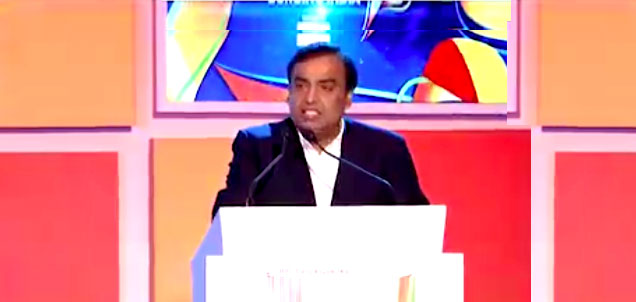
    Given the key influence Mukesh Ambani, Chairman and Managing Director, Reliance Industries has on the Indian media, we publish here his speech at the Republic TV Summit on Wednesday, October 19.


    Distinguished Guests, Ladies and Gentlemen, I am honoured and privileged to be addressing the First Republic Summit today.


    Arnab, your Republic TV is less than two years old. Yours must be one of the most successful media startups in the world. It’s not easy to be so successful so quickly in the media business. You have proved that Arnab Goswami, a professional entrepreneur, with purpose, passion, sincerity and commitment backed by a talented team, can be successful in this new India. You are an inspiration to every young entrepreneur. My warm congratulations to you, Arnab and your team. And wish you even more successes in the future.


    Dear Friends, The name ‘Republic’ has a profound meaning. It means that the Praja are the new Raja. Digital Technologies have empowered the Praja in ways that have no precedence in human history. Before the advent of Digital Technologies, the so-called mass media was essentially without the masses. The masses were passive consumers of media. Now the masses have become both producers and owners of media.


    Look at Social Media. Its very name connotes that it belongs to Society as a whole. I believe that Digital is the greatest friend of Democracy. Let me explain why. The old media model was ‘From Few to the Many’. The new media model is ‘From Many to Many’ and ‘From Anywhere to Everywhere’. In other words, media in the digital age is “OF THE PEOPLE, BY THE PEOPLE, AND FOR THE PEOPLE” in the true sense of the term. And this trend will continue and become more mature in the future. When Digital and Democracy work together, their combined power will produce a prosperous India – a Dhanwan Bharat.


    Friends, I congratulate the inaugural Republic Summit for choosing ‘Surging India’ as its theme. This theme is as timely as it is appropriate.


    Today’s India is surging ahead on the back of technology. I can say with confidence that if there is one place in the world where the transformative power of digitisation is breaking new ground every day, it is India. India’s digital transformation is unmatched and unprecedented. In less than 24 months, India has taken a leadership position from being 155th in the world in mobile data to number 1. And the impact of this unprecedented growth can be seen across all digital domains.


    Over the next two decades, I can confidently say – that India shall be leading the world and shall contribute the next wave of global economic growth. Friends, Let me tell you why I am so optimistic about India’s potential… Not just optimistic, I am actually convinced. Earlier, the world had witnessed three industrial revolutions. The first was powered by coal and steam. The second was fuelled by electricity and oil. And the third used electronics and information technology.


    During the first two revolutions, India languished on the fringes. It started playing catch-up in the computer-driven Third Industrial Revolution. The Fourth Industrial Revolution is now upon us. It is marked by a fusion of technologies straddling the physical, digital and biological worlds.


    Data is the foundation of this revolution. This revolution will be driven by data and will be defined by humanism. India is already generating significant quantum of data. I can say with confidence that India has a chance of not just participating in the Fourth Industrial Revolution, but also leading it.


    And I say this because of three main reasons: First, The India of today is remarkably different from the India of yesterday The India of today is a very young nation – 63% of our 1.3 billion population are aged below 35. India’s vast tech-savvy young population is its key strength.


    Just imagine the kind of connected intelligence India can create if the power of a billion-plus minds is combined! Our nation is more vibrant and ambitious than ever before on the back of its youthful energy and enterprise.


    Second, India is a democracy and is run on the model of equitable and inclusive growth with a society-wide culture of empathy. And India is openly embracing the digital technologies of tomorrow. With a world-class digital infrastructure in place, each one of the 1.3 billion people of India can now productively participate in the Fourth Industrial Revolution. We can solve the biggest unsolved problems facing humanity right here in India.


    Third, India is a rich and fertile ground for entrepreneurship. It has already succeeded in creating a healthy ecosystem to nurture entrepreneurs, especially young entrepreneurs. Most significantly, India has emerged as the fastest growing start-up base worldwide. Today, the nation is home to the third largest number of technology-driven start-ups in the world. Never before has India witnessed such an explosion of entrepreneurial spirit. Friends, How can India rise to its full potential, to its destined eminence?


    There are five major areas, which India needs to focus on and embrace: First, we need to prepare ourselves for a period of information and digital abundance. All Indians will have access to massive computing on the cloud, and access to all information on the planet. Jio is determined to connect everyone and everything, everywhere – always at the highest quality and the most affordable price. I am proud to say that, instead of a digital divide, India today is digitally united. All 1.3 billion connected minds are going to accelerate the future. Digital platforms make it possible for many consumers to be entrepreneurs at the same time. Imagine a force of 1.3 billion networked consumers and entrepreneurs having access to all knowledge and all computational power they want at an extremely affordable price. Every single aspect of our lives – the way we earn our living, we entertain or conduct our businesses – will undergo a massive transformation… not in 100 years…. not in 50 years… but within the next few decades. Early adopters will have the opportunity to leapfrog competition, and create unprecedented societal value.


    Second, we need to adapt ourselves to the scorching pace of innovation and learn to collaborate on scale. All the new technologies are accelerating in speed, rate and power. You could be an expert in any one, but it’s the convergence of two, three or four of these that’s transforming existing ways of working. Which means, collaborations will become both a necessity and a requirement for success. You may have a brilliant idea that has the potential to disrupt an industry.


    We need to quickly transform the idea into a breakthrough innovation. And in order to do that, you have to master the art of collaborating with your peers anywhere in the world. In the digital world, none of us is as smart as all of us put together. Third, we have to shift from a system of time-bound education to a mode of continuous learning.


    Now, it is both possible and necessary to reorient education for the new kinds of productive and creative opportunities. We have to groom our children to be digitally-savvy right from school. Schools should train students in ‘the four C-s’ – critical thinking, communication, collaboration and creativity. These are the skills required to build the foundation for a sustained leadership in the digital age for India. Within a single generation, we can empower and enrich our vast and young human resources to give India a competitive edge in the world.


    The Fourth major task is closely linked to the third. It is to ensure that new and disruptive technologies create more employment opportunities than they take away. I have no doubt that they will. However, there is a lot of apprehension on this score. And these very apprehensions could resist or delay digital transformation of our societies. That would be a mistake. Therefore, governments, businesses and civil society organisations should put together an ecosystem for massive upskilling of our workforce.


    Significantly, most of the upskilling can happen on digital platforms. And the fifth area of focus is in Data Ownership. . In this new world, data is the new oil. And data is the new wealth. India’s data must be controlled and owned by Indian people ─ and not by corporates, especially global corporations. The Supreme Court of India has mandated that data privacy is sacrosanct. Therefore, for India to succeed in this data-driven revolution, necessary steps will have to be taken to migrate the control and ownership of Indian data back to India ─ in other words, Indian wealth back to India. Data colonisation is as bad as the previous forms of colonisation. Similarly, data freedom is as precious as the freedom we won in 1947.


    Friends, today, we have the opportunity to digitally reinvent all sectors of our economy – be it financial services, commerce, manufacturing, agriculture, arts and crafts, education and healthcare.


    India can leapfrog competition and lead the world in each of these sectors. Let me focus on three important sectors ─ agriculture, education and healthcare. First, I have chosen agriculture because we cannot ignore the reality of underdevelopment in rural India.


    Over 60% of Indians still live in villages. And by 2050, there will be 300 million more Indians to feed. Today, our average farm yields are only about 20-30 % of the best global yields. We can substantially increase the income of the farmers by encouraging adoption of technologies for water conservation, soil management, precision farming and waste reduction. There is both a pressing need, and a golden opportunity, to create a digital green revolution – an evergreen revolution.


    I am sure that if we combine digital technology tools with the innate knowledge and wisdom of Indian farmers, we can usher in an evergreen revolution. The second big digital opportunity is in education. India’s youth is our biggest asset. But we need good quality education for all to make them a productive asset.


    We need digital tools and innovations to break geographical, social, language and economic barriers. 58,000 colleges, over 700 universities and 19 lakh schools in India will be digitally connected, with Jio playing a leadership role. Any student, even in a remote village, can have access to the best teachers and the latest knowledge in the world. AI-based smart assistants can bring personalised learning adapted to the needs of each student. And this can overcome the gaps and constraints of classroom education —– like any age, any time and any subject learning in any language.


    Thirdly, healthcare is a basic human right of every Indian. The purpose is to ensure affordable and quality healthcare to all, which is both a national necessity and a national responsibility. For the first time in history, this has become possible because of digital technologies – accessible even in remote locations.


    Today, constraints of budget, physical infrastructure and trained personnel make it difficult to deliver quality healthcare to India’s large and growing population. India can overcome these constraints by adopting digital tools and innovations.


    As in education, the best doctors and best diagnostic facilities can become accessible to all citizens anywhere in the country. India can design a path-breaking and affordable healthcare system that will be a model for the rest of the world. Similar disruptive and scale opportunities exist in India in virtually every domain.


    Friends, Let me quote our Prime Minister Shri Narendra Modi : “India’s contribution towards the Fourth Industrial Revolution would leave the world stunned.” These words will be prophetic. Across the world, the digital era is dispelling despair and bringing new hope. I can safely predict that, from now on, every new generation of Indians will live a better, longer and more-fulfilling life – than the previous generation. India must embrace this digital fourth industrial revolution with a new mind-set to create a bright and prosperous future for our nation.


    As a nation we must rise to this occasion. The climb is difficult. The challenges are many. And the goal cannot be achieved by any one person, one enterprise or by any single government. All of us – 1.3 billion Indians will have to work together with a single purpose to realise this. We must have a partnership among all sections of society to realize this potential in the shortest possible time. Collectively, let us commit ourselves today to work together to make Surging India a reality. And make it Irreversible. And make it Unstoppable. And may God bless us as we embark on this most exciting new era in India’s history. Thank you.


  • IAA Leadership Awards to be held on July 27 in Mumbai

    By A Correspondent


    The IAA Leadership Awards, now in its sixth edition will be presented in Mumbai at the St. Regis Hotel on July 27, 2018.


    Rajiv Dube, Director of Corporate Services, Aditya Birla Group will chair the Jury that will recognise marketers in major categories.


    The jury members for this flagship award for marketers include R Ramakrishnan, Vice Chairman & Joint MD and Group CEO – Polycab and Karthi Marshan, Marketing Head, Kotak Mahindra Group amongst others.


    Said Ramesh Narayan President India Chapter of the International Advertising Association (IAA): “The IAA Leadership Awards have, over the last five years, been acknowledged as the gold standard of marketing awards.”


    Along with the awards for the top marketers of the year, a special committee of the IAA will decide on who will get the iconic Business leader of the Year (last year Mukesh Ambani personally accepted it and the year before that Kumar Mangalam Birla accepted it), Editor of the Year, CEO of the Year (Creative and Media Agency), News Anchor of the Year and Brand Ambassador of the Year.


  • RIL appoints Jyoti Deshpande to head M&E biz, acquires stake in Eros

    By A Correspondent


    Reliance Industries Limited and Eros International PLC have announced that RIL, through a subsidiary, has agreed to subscribe to a 5%  equity stake in the NYSE-listed Eros at a price of USD15 per share, which represents an 18% premium to last closing price. The transaction is subject to customary regulatory and other approvals.


    Furthermore, RIL and Eros International Media Limited (“Eros India”) announced that they have agreed to partner in India to jointly produce and consolidate content from across India. The parties will equally invest up to Rs 1,000 crores in aggregate (approximately USD150 million) to produce and acquire Indian films and digital originals across all languages.


    In addition, it was announced that Ms. Jyoti Deshpande, Group CEO and MD of Eros will be stepping down from her executive role after more than 17 years in Eros and move on to head the Media and Entertainment business at RIL as President of the Chairman’s Office. Deshpande will start her role at RIL from April 2018, but will continue to remain as a Non-Executive Director on the Board of Eros. Mr. Kishore Lulla will resume his position of Group Chairman and CEO of Eros.


    In her new role at RIL, Deshpande will lead the company’s initiatives in Media and Entertainment to organically build and grow businesses around the content ecosystem such as Broadcasting, Films, Sports, Music, Digital, Gaming, Animation etc., as well as integrate RIL’s existing media investments such as Viacom and Balaji Telefilms with a view to build, scale and consolidate the fragmented USD 20 billion Indian M&E sector.


    Said Mukesh Ambani, Chairman & Managing Director, RIL, in a statement: “We are pleased to join hands with Eros, as it will bring further synergies into our plans, making for a win-win partnership. We are delighted to welcome Ms. Jyoti Deshpande into the Reliance family and believe that she will not only give wings to our plans but also play a pivotal role in transforming the sector.”


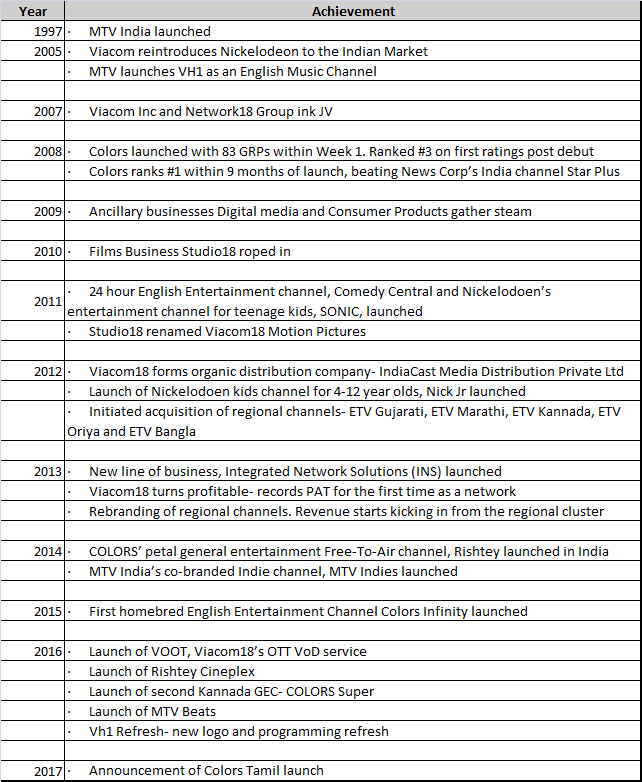
  • It’s a Perfect 10 for Viacom18!


    By A Correspondent


    On November 6, 2017, Viacom18 completed a decade of existence. And to celebrate the occasion, a mother-of-all-celebrations was held at Mumbai’s National Sports Complex of India on Friday.


    Reliance Industries Chairman and Managing Director Mukesh Ambani was in attendance. As were upwards of 4000 members of the media and entertainment fraternity. Ambani spoke after Viacom18 Group CEO Sudhanshu Vats addressed the gathering. A gesture that received many accolades also saw many moved was Ambani thanking Network18 and Television18 founder Raghav Bahl, the folks at Viacom and the founding team. And given that every ex-staffer was invited to the party, the statement received a huge round of applause. In his speech, Ambani promised devoting more time from his busy schedule to Viacom18. That’s a birthday gift from me, he said while underscoring the potential for the entertainment sector in the digital age.


    Earlier, Vats said:: “In my mind, we are a 10-year-young future-focused organisation that continuously challenges status quo. Unlike legacy players we have often entered new areas much later and yet carved out a distinctive identity for ourselves. We are proud of our ability to nurture and manage a multi-brand, multi-platform and multilingual network while growing at a blistering pace and fostering a winning culture based on a shared set of values. 10 years ago it would have been hard to imagine that a three=channel, Rs 80crore network would mushroom into a profitable full-play Rs 3100crore media powerhouse that has spread its wings across 80 countries. That said, our journey has only just begun. Kudos to our team for creating magic time and again for our fans and audiences.”


    To mark the occasion, Viacom18 unveiled its corporate brand film titled ‘Open New Worlds’. On the occasion of the tenth anniversary, the group also announced two major developments – Colors Tamil will be launched in February 2018 while OTT platform Voot’s subscription-based premium offering will be launched by mid-2018. In keeping with its focus on regional entertainment, the network plans to offer digital original regional content on Voot and dial up its thrust on regional movies as well. The network is also aggressively dialing up its play in the kids ecosystem, where from just television content, it has now taken its homegrown characters to the silver screen, to millions of digital screens via Voot Kids, merchandising and even to live experiences. Viacom18 also announced its latest social change campaign, in partnership with The Nudge Project, to provide livelihood training and job placements to underprivileged youth, through residential programmes. Viacom18 has also started a crowdfunding initiative through Milaap.org so that likeminded citizens can contribute to this cause.


    Open New Worlds, notes a communique, articulates the reason the brand exists in the lives of people, brought alive through Viacom18’s decade-long engagement with over 500+ million  Indians. The brand film, conceptualised by Leo Burnett Orchard and produced by Offroad Films, explores how Viacom18 has been encouraging everyday Indians to explore possibilities, push their own boundaries, embrace opportunities and challenge norms. The narrative of the film is carried forward through a melodious title track sung by celebrated singer Jubin Nautiyal.


    A decade ago, Viacom18 was formed as an equal joint venture between global entertainment giant Viacom Inc. and  Network18, with three channels – Nick, MTV and Vh1. The network launched its marquee GEC Colors in July 2008 that raced to occupy the #1 rank within nine months of launch. The rest as they say is history.


    The Viacom18 Story:

  • IAA Leadership Awards presented


    By A Correspondent


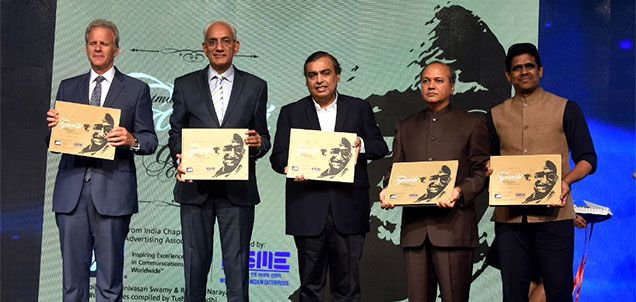
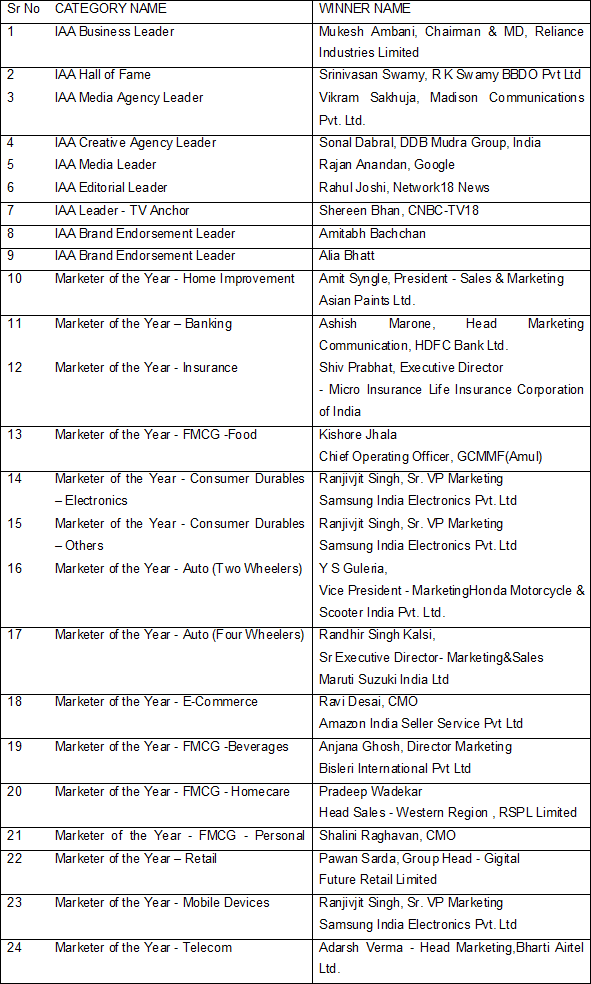
    It was the big night of the International Advertising Association India Chapter. The fifth edition of the IAA Leadership Awards took place in Mumbai with Reliance Industries Chairman and MD Mukesh Ambani and Deputy Minister of the diplomacy, PM’s office, Government of Israel, Dr Michael Oren in attendance


    Former IAA India president and Chairman and Managing Director, RK Swamy BBDO Srinivasan Swamy was inducted into the IAA Hall of Fame Award.  The IAA Media Agency Leader and Creative Agency Leader Award went to Vikram Sakhuja, Madison Communications Pvt. Ltd. and Sonal Dabral, DDB Mudra Group, India respectively.  The IAA Media Leader Award went to Rajan Anandan, Google while Mukesh Ambani, Chairman & MD of Reliance Industries, was adjudged as the IAA Business Leader of the Year.


    Rahul Joshi of  Network18 News was awarded the IAA Editorial Leader award and Shereen Bhan, CNBC-TV18 received the IAA Leader – TV Anchor of the year.  The Brand Endorsement Leader awards went to Amitabh Bachchan and Alia Bhatt.


    On being awarded the Business Leader of the Year award, Mukesh Ambani, Chairman & MD of Reliance Industries said, “On behalf of all of us at Reliance Industries, we would like to thank the jury and IAA for this recognition. I believe leadership is about setting new standards as demonstrated by our team at Jio. India was 155th in mobile broadband rankings in the world when we launched Jio but in a year, it became number 1 in the world. India is becoming a mobile first country and this is the future of our young nation.”


    Commenting on the occasion, Ramesh Narayan, newly elected President of IAA said, “We are privileged to have Shri Mukesh Ambani and Dy. Minister of Diplomacy, PM’s Office, Government of Israel Michael Orren with us. IAA Leadership Awards 2017 has been a memorable event thanks to the distinguished guests, esteemed jury and an exhaustive list of quantitative and qualitative parameters that have helped recognise outstanding campaigns and we have cherished our partnership with Colors.”


    Speaking of his maiden visit to India, Deputy Minister of the Diplomacy, PM’s office, Government of Israel, Dr. Michael Oren, said “India is revered, respected and loved by the people of Israel.  Both countries are the cradle of great civilisations and religions. I can think of no two countries in the world that have had a greater impact on history and art. I would like to extend an invite to every Indian to visit Israel and experience our love for India and our hospitality.”


    Speaking about Colors association with the awards, Raj Nayak, COO, Viacom18 Media Pvt Ltd said, “We have been associated with the IAA Leadership Awards since inception and are happy to see it grow in size and stature year after year. As a leader in the media and entertainment space, we feel privileged to partner with The International Advertising Association in recognising and rewarding leaders in our country.”


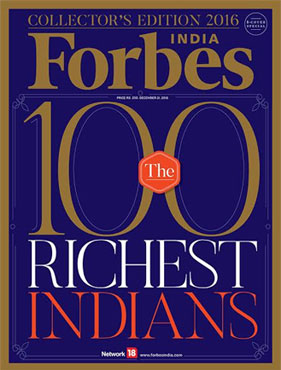
  • Samir/Vineet Jain family gallops ahead in Forbes Richest 100 list

    By A Correspondent


    It’s that time of the year when the Forbes India Rich List is released. The magazine volume, that’s scheduled to hit shopshelves today, has already revealed some numbers. That Mukesh Ambani continues to be the richest. And Acharya Balkrishna, the brain behind the slew of products bearing the Patanjali brand name, is in the Top 50, at #48.


    So how do our media biggies fare?


    We got some advance data from the magazine, and we learnt that there are just three whose primary source of wealth is in the media (or so we presume).


    They are Subhash Chandra (at #18), the Jain Family at #36 and Kalanithi Maran at #40. Interestingly, and as per our headline, the Jain Family – Samir and Vineet Jain’s family – has moved from #57 to #36.


    The others in the table below have investments in media but that’s not the primary source of wealth.


    2016 (in billion dollars) Rank 2016 2015 (in billion dollars) Rank 2015
    Mukesh Ambani

    22.7

    1

    18.9

    1

    Hinduja Bros

    15.2

    3

    14.8

    4

    Subhash Chandra

    5.6

    18

    4.8

    18

    Anil Ambani

    3.4

    32

    2.9

    29

    Jain Family

    3.2

    36

    1.85

    57

    Kalanithi Maran

    2.9

    40

    2.6

    32

    Rajan Raheja

    2.55

    45

    2.04

    46

    Anand Mahindra

    1.42

    90

    1.12

    99

    Sanjiv Goenka

    1.4

    91

    1.17

    97