Tag: Mindshare

  • Indian Amrita Randhawa to head Mindshare China

    By A Correspondent


    Mindshare veteran and regional Client Leader Amrita Randhawa has been appointed President, Mindshare China. Ms Randhawa will report jointly to Bessie Lee, GroupM China CEO, and Ashutosh Srivastava, Mindshare CEO of Global Emerging Markets and Chairman for Asia Pacific.


    Based out of Shanghai, Ms Randhawa will lead the agency’s China operations across Shanghai, Beijing and Guangzhou, working alongside the agency’s clients and leadership team to drive the agency forward in the market. Prior to taking on this new role, she had overseen regional and global client relationships including Nestlé, PepsiCo, Yum!, L’Oréal on both a Mindshare and WPP level.


    “Amrita is one of the brightest and most effective managers in our network. Her strategic thinking along with her tenacity and experience in the China market will give Mindshare and its clients an unparalleled advantage,” said Mr Lee.


    When asked about her plans for the agency, Ms Randhawa said, “I am delighted to return to the Mindshare China family. This is a market that continually excites, challenges and sets new norms for the media industry. We have a talented and passionate team powered by the Mindshare advantage of innovation and technology. I look forward to working with them to deliver powerful ideas, seamless execution and financial value to our clients’ business.”


    Said Mr Srivastava, “We’ve been lucky to have someone of Amrita’s caliber as a trusted advisor to key Mindshare clients across Asia Pacific, and she’s the right person to drive the agency forward in one of our most critical markets.”


    Ms Randhawa who has worked in India at Mudra, Mindshare and Starcom graduate from MICA in 2000 and earlier studied at Delhi University’s Kamala Nehru College and Air Force Bal Bharati School (Source: Linkedin profile).


    Additional to Ms Randhawa’s appointment, Mindshare also announces two other promotions.  Linda Lin, currently Vice President, Mindshare China, will be the agency’s new Chief Operating Officer, reporting to Ms Randhawa. She’ll continue to focus on streamlining the agency’s operations; managing key commercial functions and will continue to drive the agency’s work forward with critical international and domestic Chinese accounts.


    Karl Cluck, currently Chief Strategy Officer for China, will become the Chief Strategy Officer for Mindshare, North Asia. His remit will expand to include Japan, Korea, Taiwan and Hong Kong in addition to his current responsibilities in China. He will report to Deepika Nikhilender, Leader for Business Planning, Mindshare Asia Pacific, and will continue to be based in Shanghai.


    “With these appointments, I feel we have a best-in-class team to ensure Mindshare remains one of the most respected and valued strategic communications agencies in China – delivering the best thinking, solutions and value to our clients,” said Mr Srivastava. All appointments are effective January 1, 2013.


  • No resting easy on laurels: Ravi Rao


    By Johnson Napier


    There’s some magic mantra that seems to be driving the team at Mindshare India to be at their performing best. How else would one explain the endless series of notches in their awards belt? After emerging No 1 agency at the Emvies this year, Mindshare India has gone on to win another big accolade – Media Agency of the Year at Spikes Asia 2012.


    MxMIndia spoke to the man behind the agency churning out the dream run, Ravi Rao, Leader, South Asia for Mindshare. While he admits to the agency throwing up some spectacular work it would in no way mean resting easy on the laurels. There’s a bigger challenge that lies ahead for the agency, he affirms. Excerpts:


    Mindshare Mumbai is on a roll again on the awards front. You’ve just bagged the all-important Media Agency of the Year accolade at Spikes Asia. What was it that brought the tide in your favour?

    We are extremely delighted to have won the accolade; and to win it for a client like HUL is a double delight. If you analyse, we had 5 shortlists and they were spread across three of our brands. More importantly, all three brands went on to win some award at Spikes, which is terrific for us. I would credit the showing to the all-round performance of the team.


    The big takeaways that emerge from our performance at Spikes this year are: firstly, all of the brands are local by stature – other than Rin – so that’s a big booster for us. Very simply, the power of an idea to push it through and get us an award is something that is very unique and has also helped the brand awareness as well as volume share in the process. Most importantly, it is the combination of every single media playing a role and each one delivering and creating synergies to bring the best out of the results. In a way, if I again look at the tally and say that we won against several competitors across the region also gives us a sense of bearing in terms of where we are today.


    What it also means is that we need to continue to deliver similar if not better work for our clients. It is a challenge that we want to continuously keep pushing ourselves against. No doubt the competition is getting tougher but we will have to adjust ourselves and up the single point of call that we have in Mindshare.


    By winning this accolade, have you pipped other notable contenders (from Mindshare) across Asia to the tag of being the best in the space?

    I think it is a matter of structuring how to get out real ideas. It is an idea that has to be behind an insight that works very well for the brand and land it properly. I think that is the key element in getting an award. We managed to do that well. The interesting part is yes, it has been a windfall for us this year but we do not want to rest easy on our laurels and want to keep pushing our boundaries even further.


    Are you disappointed with some entries not managing to make the cut in terms of a win?

    What we realised is that there are certain other entries that we thought were worthy of an award but somehow didn’t make the call. For example, if we look at the Emvies in terms of the wins that we’ve had and at the others too…I guess the parameters change and it’s important that you really look at how best you can reach the audience in a different way. As a country, we still have some way to go in terms of one, the content and secondly, in terms of the format of presentation which is also very critical. But all said and done, we are in the learning phase and will only get better and better as we move ahead.


    What significance does a creative award like Spikes Asia hold for a media agency like Mindshare India?

    Winning at Spikes is a big accolade for us but we do not want to take it easy because yes, there were a great set of campaigns that collectively made it work for us this time but what it requires is that we need to excel in a similar way across every single campaign and client that we cater to. It means that we want to keep doing better all the time and it’s only going to be a bigger challenge for us in the future. So while we would definitely relish the wins we want to fold our sleeves and get back to doing some great work in the future.


    Do you see HUL emerging a hot contender for the Client of the Year title in the future?

    As I see it, it is a systematic way of shoring up everything in the process. In my mind, it is an intense but healthy competition and all it does is bring the best out of every single team – whether from the agency or client’s side. We will surely give everyone a run as we go along as much as the competition is going to do and it is only going to get more intense as we move ahead.


    What would be the next big focus area for Mindshare India as you move forward?

    One area that we really want to look at is Cannes. It is the single biggest aim that we have going forward. The other thing for us is to make great campaigns that have a high ROI. By doing this, we even want to look at other areas like winning awards with IPA. Those are the targets that we have. We are working towards that goal and time will tell.


  • Mindshare leads in Emvies 2012 shortlist

    By A Correspondent


    The twelfth edition of the Emvies could well see media agency major Mindshare walk away with the numero uno slot. The agency has managed 27 from the 126 shortlists announced, followed by 19 from Maxus. Pinnacle has 15 entries and Lodestar UM has 13.


    This year, organiser Ad Club Bombay has introduced the following new categories/changes at the Emvies: Media Client of the Year, Best Ongoing Media Campaign & Young Emvie of the Year has been introduced as three new categories.  Display and Video has been added as additional sub-categories under Best Media Innovation – Digital.


    The Emvies were introduced by the Advertising Club Bombay to honour measurable and significant contributions in the field of media. This year, the event will be held in Mumbai on Monday, September 3, 2012 while the second round of judging will happen on August 23 to 25.


  • Fourtifying media & brands with research


    By Meghna Sharma


    In today’s world where there are plenty of brands for consumers to choose from, an in-depth knowledge about the target audience is as much as a necessity as breathing for any brand to become successful. Research now plays an increasingly important role in a brand’s lifeline.


    Entertainment industry today is growing at a fast pace and with number of options available to the TG, the brands need to know what will make the TG choose them over others.


    Ormax Media, a media & entertainment research and consulting firm, entered the industry four years ago (July 28, 2008) with a motto of helping brands understand and retain not only their target groups, but also help them grow in their respective fields.


    Clients Speak
    Raj Nayak, CEO, Colors

    Raj Nayak

    Ormax Media has opted for a very focused media research approach, which was a definite need gap for the industry, especially TV. Ormax has managed to capitalise on this opportunity with their innovative and robust tools specifically designed to cater to these needs. At Colors we have always had a research-oriented approach towards content development. In that context, we have been working with Ormax Media since the very beginning (interestingly both Colors and Ormax Media came into existence around the same time!).


    It has been a fruitful association so far, and I would believe this to be true for both the parties. While working on some really interesting projects together, there has been a lot of learning that has enabled us to know our viewers even better. An effective promo creative measurement tool, which builds in the crazy timelines of the creative getting ready and it hitting on-air, is something which I feel is still a need gap at this point of time. Keeping in line with their record for building research tools which have catered to the needs of the industry, this is one area where we see tremendous potential for Ormax.

    ____________________________________


    Chandramohan Puppala, business head, Saam TV

    Earlier, most of the companies used to rely on gut feelings or follow TAM to get an idea about what their audience wants. However, one couldn’t predict the change in trends or know their TG’s mindsets. It was a big challenge for channels, especially regional channels, to know their viewers. It was an even bigger challenge for regional channels, where Hindi was also the majority language. For instance, in Maharashtra, Hindi is also spoken by people. Also, in smaller markets, no matter how the sampling is done, choices differ from region to region. Hence, when research entered the entertainment industry, it helped channels to have a direct connect with the audience and guided them on how they can change their course to gain the most.


    Ormax Media adapts very quickly to what the clients’ want and provide a customized research which enhances their role among their TG.

    ____________________________________


    Ashit Kukian, COO and president, Radio City

    Ashit Kukian

    For any industry today, research is an important element. However, it is important for an organization to be very clear about what they want as an end result. The brief we gave to Ormax and their own learnings have made it a win-win situation for both. The inputs we get from research are visible in the results. So, as the industry gets more mature, there is going to be a robust growth in the field of research as well.

    ____________________________________


    Jai Lala, principal partner, Mindshare

    Jai Lala

    Since there is no syndicated data available, there can be a lot of fangs to it, especially in the television industry. Take sports broadcasting for instance, there are a lot of ground partners, so it is a complicated process. Hence, research helps us to understand the market and how to maximize from an event. Last year, for IPL we had done a joint research with Ormax Media and it was quite fruitful for us.

    ____________________________________


    Atul Phadnis, founder and CEO, What’s On India

    Atul Phadnis

    Ormax Media is spearheaded by people like Shailesh Kapoor who have practical knowledge about channels. So, it gives the organization an uncanny ability to know what the key questions are which need to be answered. This helps them to not only know what a channel wants, but also how the research must be conducted. Also, the organization offers customized and structural services which have helped the industry grow.


    As the firm celebrates its four years of existence, MxMIndia spoke to the founders to get an insight on how research has evolved over the years and how the journey has been for Ormax Media so far…

     

    Vispy Doctor

    “Till a few years ago, the phrase ‘consumer knowledge’, which is our prime derivable, wasn’t a common phenomenon. When we went to media clients in the entertainment space, for many of them research was a new thought.  So, we had to explain how it could help them create better products which will help them grow,” recalled Vispy Doctor, founder and managing director, Ormax Media.


    Over four years, Ormax Media has worked with 76 leading media and entertainment brands as business partners. In the first year, it focused on television, and GECs in particular. In the second year, the focus was expanded to other television genres as well as radio. In the third year, Bollywood became the priority. And now, at the end of the fourth year, the organization is set to offer unique and relevant offerings.

     

    Shailesh Kapoor

    Elaborating on Ormax’s four years, Shailesh Kapoor, CEO said: “The first four years of Ormax Media have been very eventful and successful. We have received great support from the media & entertainment industry, especially in our endeavour to create unique research products and approach entertainment research in ways that are unconventional and challenging, but also result oriented.”


    Growth matters

    The entertainment industry has its pros and cons and one of the biggest ‘cons’ of the industry is that it comes with a fairly low success rate – as low as 15 per cent. Therefore, the organization hopes to help the industry increase its success rate, even if by a small percentage.


    “Since we have been able to explain it to our clients, they have appreciated and accepted the concept of research. Hence, our growth has been fairly steep, and I can say that we are growing at a fairly high rate of 75-80 per cent, as we add more and more partners in our kitty,” said Mr Doctor.


    According to Mr Kapoor, the television industry has its cyclical changes, but is in a fairly stable state, vis-a-vis what it would have been 5-6 years ago. However, he does add that the definition of “stable” in television is very different from that in packaged goods and other sectors.


    As for the film industry, it is in an evolution stage, much like what the TV industry was in the late 90s and early 2000s. And one can see exciting times ahead for Bollywood, especially in research, where it has seen growing acceptance year-on-year.


    As far as Radio is concerned, it hinges a lot on the Phase 3 licenses. “Media & entertainment is a growing business, and research will continue to become more and more important as the market matures. We are all set for the challenges ahead,” Mr Kapoor added.


    Procedure: Easy or difficult?

    The organization offers a number of research products for various sectors of the entertainment industry. The list includes broadcast television networks, radio networks, film studios, newspapers, media agencies, DTH service providers, digital entertainment companies and production houses.


    So, when asked how difficult or easy the research procedure is for each variant, Mr Kapoor explained: “The larger GECs are the easier ones, as they are far more professional and they understand the value of research. Whereas in the more touchy-feely areas like films and creative companies, it becomes a little difficult as it is more about sentiments. However, it is difficult to rate them as it might be easier to work for a GEC, it might be more interesting for a film.”


    He added: “As a good service company, it becomes our job to orient ourselves to the client’s needs, but without compromising on the research rigor and correctness. That’s the balance that may be easy or tough. But it’s a part of our job.”


    A correct sample size plays is essential for any research to become successful and come out with results which will benefit the researcher. So how does the organization choose its sample?


    “For every client, the TG might different so we have to be careful about what attributes are they looking for in a sample size. For example, for a serial, it might be cultural overtones. So, how that serial is perceived in a city like Mumbai will be very different from how it is perceived in a small town like Indore. And if we are able to find this difference and collate preferences, it will help the channels,” explained Mr Doctor.


    Expansion plans

    The organization’s focus is to consolidate through new clients and repeat business. It now has 21 products for various sectors and plans to entirely focus on these products and getting them to become bigger and better in their own right. Also, it plans to target media agencies and advertisers through products like Celebritix, which was launched on July 25.


    “I’m often told that whichever channel you go to, Ormax gets mentioned in conversations consistently. We have a young team which made this happen. Four years ago, I would have bargained for much lesser. But again, this is only the start, and we know that we can achieve a lot more than what we have so far…” said Mr Kapoor.

     

  • Mindshare continues to be India’s #1 media agency, Madison is at #2: RECMA billings report

    By A Correspndent


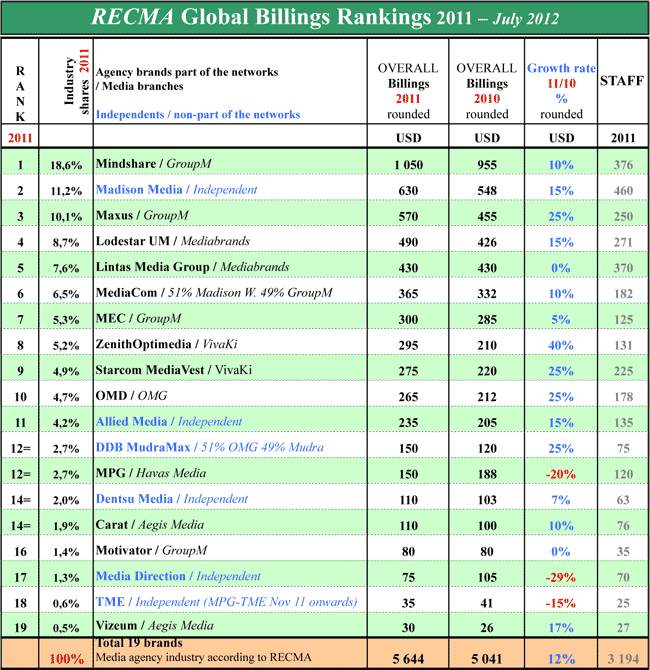
    The much-regarded billings report for India has been released by RECMA. The Indian media agency business grew 12 percent in 2011 with a total billings of US$ 5644 million.


    Group M’s Mindshare media agency tops RECMA’s India billings report for 2011 with US$ 1055million, growing 10 percent over its 2010 billings. Madison Media is second 630mn, growing 15 percent. Maxus, Loderstar UM and Lintas Media Group are rank third, fourth and fifth respectively.


    ZenithOptimedia saw the highest growth with 40 percent over the previous year, as per the RECMA report. At least three agencies saw a degrowth. Media Direction went down 29 percent, MPG down 20 percent and TME dropped 15 percent.


    The combined billings of Dentsu and Aegis agencies Carat and Vizeum would put the new entity at #11 with US$ 250 million.


    Last week, MxMIndia had reported RECMA’s global billings data and rankings (see Link: http://www.mxmindia.com/2012/07/starcom-tops-recmas-global-billings-rankings-omd-is-2/).


  • Singaporeans prefer accessing Net from mobiles over stationary PCs: Mindshare

    From the MxM Infodesk


    Consumers in Singapore have a clear preference for accessing the Internet from a mobile device over a PC or other stationary computer. This is the prominent finding from a study that Mindshare has released of the latest round of the GroupM 3D Survey, which surveyed almost 2,200 consumers. 3D is the only scale agency survey that looks at brands, media touch points and consumer attitudes in a single study.


    3D is GroupM’s proprietary research study. It is the most comprehensive single source study in Singapore, covering brand relationships, social dynamics (based on attitude statements) and media consumption in the context of total brand communications. These three dimensions are the essence of 3D.


    The survey in Singapore covers 2,189 respondents aged 15 to 54 years, and also includes an additional 300 affluent respondents (with personal income above 6,000 Singapore dollars).


  • Mindshare wins pitch for Legoland Malaysia

    By A Correspondent


    Legoland Malaysia has appointed Mindshare following a media planning and buying pitch involving four agencies. The first Legoland theme park in Asia is set to officially open in Johor’s Iskandar development region on September 15. The park will be operated by Merlin Entertainments Group, the world’s 2nd largest visitor attraction operator.

     

    The business will be run out of Singapore, and the S$296 million theme park will feature 7 themed areas over 76 acres with more than 40 family friendly interactive rides, shows and attractions.


    “Mindshare won the pitch by being able to bring to the table not just a comprehensive plan, but an understanding of our brand uniqueness. In today’s landscape it’s vital for agencies to stay on top of trends that help brands be effective and cost efficient,” said Thilakavathy Munusamy, Director of Sales & Marketing, Legoland Malaysia.

     

    Mr Munusamy added: “Our selection process was grueling and Mindshare demonstrated the best ability to serve a brand like Legoland.”


    Renee Tan will be the regional director for the business, and she and her Singapore-based team will work with Mindshare Malaysia. “We are very excited about handling this launch and adding the brand Legoland to our portfolio,” Mr Tan said.


    Speaking about the appointment, Mindshare Singapore, Managing Director Leela Nair said: “We are honoured and thrilled to be working with Legoland Malaysia. They are a unique business, and Lego itself celebrates original thinking. This is the perfect partnership for us, and we look forward to delivering break-through results for Legoland.”


  • Mindshare & Google launch ‘Mobile Garage’

    By A Correspondent


    Mindshare and Google have announced the launch of ‘Mobile Garage’, a unique venture designed to use Google’s best in class mobile expertise to supercharge the use of mobile by Mindshare’s global client base.


    Mobile Garage will see the setting up of mobilehubs around the globe – initially New York, London and Singapore – where Mindshare clients will gain access via dedicated teams to mobile strategists and product experts. The hubs will consist of a mix of Mindshare and Google employees and will work across all aspects of the mobile eco-system, from search optimisation and app development, to strategy, planning and creative optimization.

    Nick Emery, CEO Mindshare Worldwide said: ‘We designed Mindshare to be open source and to work with the best partners for the benefit of our clients. It’s about trial, experimentation and speed to re-design our business. Working with Google on mobile will give our clients a competitive advantage in a key battleground both now and for the future.”


    Mobile Garage will give Mindshare clients a unique advantage in the race to harness the growing global trend of mobile device usage. Mobile search traffic has increased 400 per cent over the past 2 years, and its potential goes even further. The GSMA, the industry body for mobile operators, and research company Machina, predict there will be 24 billion connected devices by 2020 creating an industry worth $4.5 trillion and covering innovations such as connected cars, building automation and traffic management. In addition the venture will also give Mindshare clients competitive advantage in emerging markets, with KPCB’s Mary Meeker recently showing that mobile internet usage had surpassed desktop internet usage in India.

    Matt Brittin, VP, Sales and Operations, Northern and Central Europe at Google said: “We have adopted a ‘mobile first’ philosophy at Google to keep pace with the rapid acceleration in consumer mobile usage. We are delighted to team up with Mindshare on a similar strategy for their clients. Mindshare have already shown strong momentum in the mobile marketing space, and have a great opportunity to lead their clients to win on mobile in the future.”


    Mobile Garage will complement Mindshare’s existing relationship with WPP’s mobile agencies Joule and H-Art.


  • Life OK and SAB: The see-saw continues…

    By Meghna Sharma


    In India there is no dearth of television channels. The competition is only growing and the race to lead in the TRP race is heating up. In the past few weeks, the two channels which seen an increase in their TRPs are Life OK and SAB TV which have been fighting for the fifth spot in the TRPs race.



     

    Life OK, the newest entrance in the GEC genre from the Star India stable, was launched in December last year. The network renamed and re-launched their youth-oriented channel Star One with new tagline ‘cherishing what you have’.


    On the contrary, SAB TV has been around for over a decade now but has gone through various transformations. In March 2005, SAB TV was acquired by Sony Entertainment Television and was transformed into a youth-centric channel. In June 2008, the channel announced that it would return to its roots by being repositioned as a comedy-centric channel.


    So what does the race for TRPs mean for the two channels and do they pose a threat to other GECs? MxMIndia spoke to a few media planners to see what is the future of the GECs and what shape will this ‘war’ take.


    According to the latest TAM data, in week 24, SAB TV has toppled Life OK and regained No 5 position. Whereas, last week (week 23), Life OK was the fifth most watched GEC.


    Sundeep Nagpal

    Sundeep Nagpal, founder director, Stratagem Media feels that these are momentary fluctuations and cannot be contributed to anything per se. “These channels have a small base; therefore, even a single factor can affect the ratings of the show – positively or negatively – depending on how it did on a particular week. Hence, I don’t think we should be alarmed by such fluctuations. And they won’t be able to impact the top 4 slots.”


    The two channels have positioned themselves differently, too. SAB TV is a comedy-centric channel which portrays itself has a family channel, whereas Life OK has shows full of melodrama like other GECs.


    Janardhan Pandey, associate vice-president, DDB Mudra Max feels that the two cannot impact each other drastically. “SAB has its own set of audience which won’t get influenced by other GECs and vice-versa. They will continue to do well in their own categories; the fluctuation between the two is possible but they don’t have the same hold as other GECs do. They still have a long way to go.”


    Jai Lala

    On the other hand, Priti Murthy, national director – Insights, Maxus, feels that though these channels might be still small fish, they cannot be ignored entirely. “Like these two channels, even number two and three slots have been fluctuating for a while now. So, slot five and six can create an impact too. One cannot rule out the possibility of them gaining to higher positions in the future if they come up with new and better content.”


    On the channels growth, Mindshare’s principal partner, Jai Lala feels that the two channels have grown since Imagine TV, a Turner International India Pvt Ltd entity, was shut down earlier this year. “The shutdown of Imagine TV has benefited these two who are now turning out to be competitors. However, they still have a small base compared to others and unless and until they cross the 200+ threshold, I don’t think that they can or will affect the channels like Star or Zee or Sony which have been ruling the top slots in the TRP race for a long period of time.”


    Uday Mohan

    “While these channels are doing well they have a long way to go in terms of reaching the numbers of the mainline GECs. They still don’t have the kind of appointment viewing that the mainline GECs generate….they might eat into the shares of other frequency channels but will not threaten GECs, at least not immediately,” added Uday Mohan, executive director – North, MPG.


    Most experts believe that there is nothing to be alarmed about the two channels see-sawing. What they do feel is that both the incumbent SAB and challenger Life OK will have to work harder if they want to reach the top slots.


  • Mindshare launches CORE

    By A Correspondent


    Mindshare, the global media network, together with a roster of best in class technology and data partners has created CORE – a first of its kind user-centric and open source data-driven marketing intelligence platform that empowers both analysts and non-technical users to make informed marketing spend, audience targeting and creative optimisation decisions across all touch points in real-time.


    Nick Emery, CEO, Mindshare Worldwide said: “We have invested heavily in developing CORE because we believe it is the future of marketing. We are bringing together state of the art technology providers to truly deliver real time business and media data.  Everyone claims this with some empty dashboard, we are doing it. It’s a step change for our industry and I’m proud that we are leading the charge.”


    CORE enables marketers to mix their business intelligence (CRM, sales and supply chain) data with an integrated single source of marketing intelligence. This single source contains media channel spend and performance data; social data; paid and owned media audience data; in-stream data; third party (household expenditure / demographic/online behaviours and so on) data and real-time trading data. When mixed with the business intelligence, this reveals consumer actions and insight at a granular level, eradicating the guesswork, latency and siloed nature of marketing-spend decision making.


    Steve Plimsoll, CTO, Mindshare Worldwide and CORE project leader said: “By leveraging insight and requirements from across Mindshare’s global network and client base in the design and the cherry picking the global best in class technology and data providers for the development we’ve been able to create an enviable solution that delivers institutional marketing intelligence across all aspects of the marketing ecosystem, be they above or below the line, product or consumer centric. Gone are the traditional data silos / black boxes and the need for complicated coding or middle men (IT) historically needed for marketing professionals to access or ask questions of the data. Data now truly is at their fingertips.”


    CORE’s single source data stream is created by bringing together all the media data and consumer insight capabilities of Mindshare and the leading global third party data enhancement services, to create an always-on data resource, which when mixed with brand held data, delivers actionable insights to marketers in real-time.


    Sandeep Pandey, Principal Partner, Consulting, Analytics & Intelligence, Mindshare India said: “Data analytics have assumed the status of a strategic tool over the last few years and a meaningful analytics exercise involves the generation of insights through data modeling. To me, half the battle is won if you have robust consumer knowledge from disparate sources of data and CORE is built to facilitate exactly that for our clients. Indian businesses are increasingly adopting analytics in their processes to improve efficiency and profits and we believe CORE would help us achieve that.”


    Having already proved itself in initial client testing CORE is now ready for deployment to Mindshare clients across the world.


  • Games on, but GECs not worried


    By Meghna Sharma


    The UEFA Euro Cup has made the Europeans forget all about the economic crisis; London, along with the whole world, is eagerly waiting for the world’s biggest sporting event – the Olympics – to begin. The world is buzzed about the various sporting events coming up in the next few months.


    Sports, around the globe, generate a major interest and channels – sports or otherwise – fight each other out for viewership and advertisements, and brands try to out-do each other through advertisements and activations to leave a mark on the public’s mind.


    The last event of such a stature in India was the recently concluded IPL which saw the entertainment channels fighting for eyeballs. With the next three-four months choc-o-bloc with sporting events, MxMIndia takes a look at how channels in the country are gearing up.


    Event Period Channel
    UEFA Euro Cup June 8- July 1 Neo Prime
    Wimbledon June 25-July 8 Star Sports
    India-SL series July 22- Aug 7 Ten Cricket
    Olympics July 27-Aug 12 DD/ESPN or Star Sports

    Time to worry?

    According to the media planners, for GECs and other channels, there is nothing to worry about. “Non-cricket fare is still appealing to a small niche segment and hence, its popularity is not reflected in ratings. India in the months of Jul-Aug has always been a moderate performer and not as high profile as some others and so this will also not have a major impact,” feels Shubha George, COO -South Asia, MEC.


    Suresh Balakrishnan

    And she is not alone. Suresh Balakrishnan, CEO, Brand Programming Network, agreed with her and added that though cricket is more than a sport in India, even IPL, which has both cricket as well as entertainment and was telecast at primetime, hasn’t been able to affect channels, especially the GECs in the recent past. “Lately, IPL has been able to get a rating of 2-3 which has hardly affected any GECs, so I’m sure other sports won’t matter to them at all. However, there is no denying the fact that viewership for other sports is increasing in the country. And major events might be able to at least reach the ratings which cricket gets, in the coming years.”


    Mr Balakrishnan, however, feels that sports channels don’t have much to worry about as there are many male-focussed brands which help them generate enough ad revenue. “Having said that, I also feel that channels showing sports other than cricket know that recovering money isn’t an easy task,” he added.


    The television behaviour showcases the interest of the masses which obviously tilts towards popular entertainment channels. However, most media planners agree that sports viewership is growing in the country and soon things might change but until then channels will have to make do with what they have/get.


    Amin Lakhani

    Amin Lakhani, principal partner, Mindshare said: “All leading newspapers and news channels have special coverage of important events, take Euro Cup for instance, but how much of it is being converted into viewership or readership? Even then, that hasn’t deferred them from covering the events because they know that, though tiny, there is a loyal following. Even brands are doing activations for sports which are gaining popularity in other sectors apart from Sec A&B – Pepsi is doing activations for football.”


    Business as usual

    Akash Chawla

    Entertainment channels continue to enjoy the largest share in the viewership pie. Although, they continue to compete with each other, when it comes to other genres, nothing has been able to write them off.


    Akash Chawla, Zee Entertainment Enterprise (ZEEL) marketing head – national channels, said: “Just like IPL, we are ready to combat any other sporting event. Our programming strategy does not depend on these events.”


    “For us, it will be business as usual. The channel is backed with strong and fresh content for its viewers, irrespective of the programming on competing genres,” said Hemal Jhaveri, general manager, Movies Ok.


    Hemal Jhaveri

    Other genres which focus on the same target audience as the sports channels are youth and news. But many in these genres believe that such sporting events don’t affect their viewership. Nikhil Gandhi, executive director, youth channels, media networks, Disney UTV claimed that most of the sporting events attract a majority viewership of urban youth, whereas they, as channels, focus on the HSM belt which includes 62 cities. Hence, such sporting events won’t affect their viewership.


    A broadcast veteran from a Delhi-based news channel too felt that news channels give enough coverage to the various sporting events, so there is no question that the events might eat into their viewership pie. He said that though both cater to the same TG, they are different genres and people might shift between the two, if needed.


    Nikhil Gandhi

    On the other hand, Neo Prime, the sports channel which is currently telecasting UEFA Euro Cup 2012, is aware of the competition within and between other genres and risk involved, but is still optimistic. “Sports is still a male-dominated genre, whereas other genres (read GECs) enjoy female viewership. But during big events, there are chances of a shift in the remote control. Sports do get eyeballs. And as for the advertisements, the brands which advertise on sports channels are different from the ones in GECs or other channels. Hence, nothing overlaps each other,” said Prasana Krishnan, COO, Neo Sports Broadcast.


    Prasana Krishnan

    Hopefully, as said by various media personalities, sports other than cricket in the coming years will be able to generate same interest among Indian citizens across sections and help sports channel to boom and enter the main TRP race as well.


     Imaging: Rafiq, Pictures courtesy: London2012.com


  • Mindshare expands global social media footprint with senior hires

    Igor Beuker

    By A Correspondent


    Mindshare, the global media network, has expanded its social media footprint around the world, integrating Amsterdam-based SocialMedia8 into the agency and hiring its founder Igor Beuker as Mindshare’s first Global Chief Social Officer, whilst simultaneously hiring social agency M80’s managing director, Mark Evans as Mindshare North America’s new social lead.


    Nick Emery, CEO, Mindshare Worldwide said:  “There is a lot of talk in this space and few experts, even fewer who can translate what they do into integrated business plans for progressive clients. We are putting our money where our mouth is when it comes to social media. Both Igor and Mark bring with them a wealth of experience in actioning both effective and creative solutions.”


    SocialMedia8, which specialises in acquiring, managing and extracting value from social fans and followers, will add social commerce, social TV, social gaming, social search and social CRM capabilities to Mindshare’s growing portfolio of social media services.


    Igor Beuker, Global Chief Social Officer, Mindshare said: “In this new role as c-level officer I look forward to helping drive the broad social agenda for Mindshare clients. I am very excited to oversee Mindshare’s social media marketing strategy and services at both global and local levels.”


    Mr Beuker will take up the newly created role with immediate effect, reporting to Norm Johnston, Global Digital Leader at Mindshare Worldwide. He was previously chief marketing officer at Scoot, TeliaSonera and Telefonica O2. He also founded community agency LaComunidad and social video metrics firm ViralTracker, before setting up SocialMedia8.


    In North America Mark Evans, managing director at M80 has been appointed as Managing Director, Social Team at Mindshare North America. Mr Evans will head social media campaigns for the agency’s North American-based clients. He comes to Mindshare with deep digital and social media experience, including serving as Vice President, Digital, at Catapult Marketing and Digital Brand Director at Euro RSCG prior to joining M80.


    Mark Evans, Managing Director, Social Team at Mindshare North America said: “”Incorporating social expertise within our scope of services allows us to deliver smarter, digital communication solutions. From insights to strategies, activation and analysis, this approach will allow us to deliver greater value for our clients. And, this will lead to better user experiences for their audiences.”