Tag: Micromax

  • Bhuvi Gupta: On Fesive sales, Micromax & Hooked by Nir Eyal

    Bhuvi GuptaBy Bhuvi Gupta


    Today’s column is a bit different from my usual deep dive into a single topic, with some thoughts from my notepad about things that have caught my eye in the last fortnight.


    2020 has been strange, to say the least, and I, like most, have been awaiting the festival season to celebrate and feel some joy. A sentiment shared by the corporate sector, which depends on this quarter for their profits, but this year, it’s depending on it for minimising losses. The initial reports are showing signs of recovery and buoying positive sentiment. According to data from Redseer Consulting, the first week of festive sales conducted in the last fortnight has seen an increase of 51% in Gross Merchandise Value  (from $2.7 billion in 2019 to $4.1 billion). While this is partly also fuelled by offline consumption moving online, the economy is heaving a sigh of relief.


    Micromax’s Comeback

    You might have seen Micromax’s relaunch campaign helmed by the CEO, Rahul Sharma.  With more than half a million people yet to go online in India, combined with the high replacement rates for smartphone for people, the smartphone categpry is and will be on fire for the coming decade at least. Every year the festive e-commerce sales also depend on smartphone sales with the category contributing upwards of 40% to the GMV. Coming back to Micromax, India’s Number 1 homegrown smartphone brand, in the relaunch video (link – https://www.youtube.com/watch?v=aRo69b1wTNg), Rahul Sharma plays all the cards which are sure to strike a chord in the average Indian’s heart – he talks about being a middle class boy who took a loan of 3 lakh from his father to launch Micromax, but with the onslaught of Chinese smartphone makers stumbled, and lost his way, vision and subsequently market share. He touches on the ‘Make in India’ call to rouse audiences to buy the new series aptly titled ‘In’


    The problem of course is that the story, while compelling omits certain points Micromax built its market share on the back of great marketing.  It took China-manufactured phones and branded them as Micromax devices. As a result, because of a lack of R&D, the after-sales service and support was negligible – a weak point which all the China mobile behemoths took full advantage of to wipe out market share (and rightly so, after-sales service is crucial for an essential device like a phone). He also forgets to mention his marriage to Bollywood/ Kollywood/ Tollywood star Asin, which makes his description of the middle-class boy-next-door a little hard to stomach, as these descriptors no longer hold true.


    While the majority of the market is oblivious to these facts, and these points will work, I am sure it will give competition to the Chinese behemoths which control the smartphone market for a large part today.


    Hooked by Nir Eyal

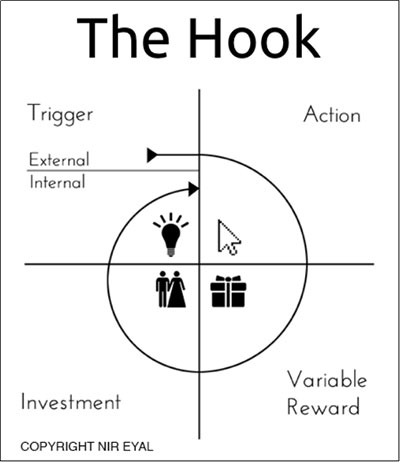
    The advent of the internet has brought with it great changes in marketing in the last decade. A key differential of the digital evolution as compared to the TV evolution is how understanding consumer behaviour has become easier. This in turn has lead to building products, which fit target audiences better. The concept is beautifully explained in my latest read, ‘Hooked’ by Nir Eyal.


    Eyal has explained the consumption process through a four step model – a internal trigger like a frisson of anxiety or external trigger such as an ad, which leads us to the action of logging into social media like Facebook or Twitter, which through previous interaction, we know will reward us by showing us our posts which has been liked, or content which is of interest to us, thereby assuaging our anxiety.


    Such feedback loops help in establishing habits, which make these products so addictive. The fourth quadrant which focuses on ‘Investment’ explains why such habits are so hard to break – users invest time and build a community of friends and followers which feeds these feedback loops and creates stickiness to the platform.


    While the book focuses on digital products like Facebook, the concepts can be applied to other industries and products. All in all a great read on understanding consumer behaviour and psychology.


    That’s all from me today. Do share if you have read ‘Hooked’ or whether I have inspired you to pick up a copy.


    Bhuvi Gupta is a marketer with over 10 years across industries, of which the last six have been in Media & Entertainment. She has been a part of many launch marketing campaigns – specifically at the Times of India group, Republic TV and the latest in marketing a Bollywood film. She will write on A&M (mostly marketing, but often on advertising too) every other Tuesday. Her views here are personal. She tweets at @bhuvigupta3


  • It’s Mera Bharat Mahaan for Micromax


    By Prabhakar Mundkur


    In light of the Tanishq controversy, the new Micromax commercial provides an interesting counterpoint.


    The larger  truth that I am missing in all the marketing discussions on Tanishq is that ‘brand purpose’ came about because Millennials and Gen X in the West were looking for authenticity, honesty and purpose in brands.  In other words, they were looking for brands to mirror their own feelings and their higher purpose.  And this higher purpose took the form of say ‘Real Beauty’ for Dove as a proof of authenticity or the higher purpose took on a higher social responsibility to support some cause: sexism, racism (for us it is casteism), climate change, sustainability, poverty, domestic abuse, climate change and a host of other causes.


    I don’t know if the big brands have done a study of what this greater social responsibility might mean for Millennials and Gen X in India. I don’t think it is any of those that I mentioned for the Western audiences above.


    But the important point here is a that it is not marketing directors who sit in their ivory tower offices and determine brand purpose or the language a brand speaks. For brand purpose to be real, it must coincide with the people’s aspirations. Just as an example if the higher purpose of our targets in the country is to prevent “love-jihad” they may want to see brands that reflect that higher purpose. And Tanishq’s higher purpose was at odds with the higher purpose of a section of the public that engaged in the destruction of their commercial.


    After all, brands are not allowed to have a purpose that excludes the people it is talking to unless it wants to be altruistic or idealistic, which I am sure is not what Tanishq wants to be.


    Moving on, I found a useful counterpoint in this Micromax commercial.


    https://m.youtube.com/watch?v=aRo69b1wTNg


    The commercial essentially announces that they are back in the game after having taken a beating at the hands of the several Chinese mobile handsets in the market.


    In its ‘come back’ commercial appropriately titled ‘Micromax is Back’, the brand touches all the hot spots of the new Indian. Look at the various subtle inflections.  The story of an Indian entrepreneur who came from the ‘gullys’  of middle class India after borrowing Rs 3 lakh from his father.  A brand that was the No 1 brand in India and in the top ten brands in the world.  Stirring the new sense of ‘nationalism’ in the Indian.


    Then look at the skillful way in which the brand provokes anger against China by saying he was put down by Chinese brands. And that too in his own country? Oh, the injustice of it all!


    Then invoking the border conflict with China, invoking the Prime Minister were all briiliant strokes in a campaign that reeks of Made in India.  And to cap it all the new series being marketed by the marketers is ‘IN’. Another stroke of brilliance to use the first two letters of the country name. What could be more Indian, more desi that?


    Now go back to the Tanishq commercial and think for yourself whether it invoked the right feelings in the target audience. Or did it provoke mob anger by touching on a raw nerve that people are most sensitive about.


    For me this is a case study that brands cannot speak a language that does not strike the right chords among the people. Brands can’t hold beliefs that are in insolation without consulting the people they are talking to. Brands need the permission of the people before they speak.


    We have a choice now.  Either conform to the feelings of the new India that has been emerging for the last six years or continue to live in the past.


    Lofty ideals for brands must be examined in the light of the current mood of the nation.


    Prabhakar Mundkur is a veteran advertising professional and commentator. And also a musician. He has worked across geographies. His views here are personal


  • Tata is still India’s Most Trusted


    By A Correspondent


    Every year, leading valuation and strategy consultancy Brand Finance values the brands of thousands of the world’s biggest companies. MxMIndia has carried a few of these rankings in the past. And now there is: India’s 100 most valuable brands as featured in the Brand Finance India 100.View the full list of India’s 100 most valuable brands here


    Here’s a summary from Brand Finance:

    A brand’s strength is assessed (based on factors such as marketing investment, familiarity, preference, sustainability and margins) to determine what proportion of a business’s revenue is contributed by the brand. This proportion is projected into perpetuity and discounted to determine the brand’s value.


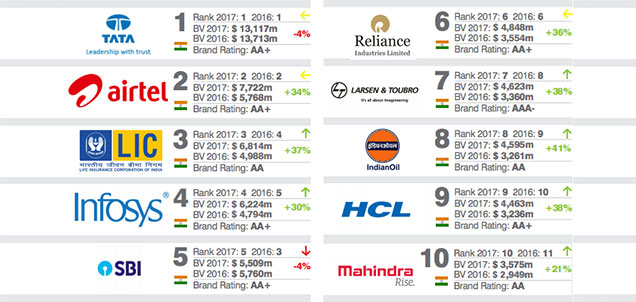
    Strong brand value growth characterises the 2017 Brand Finance India 100. The total value of India’s top brands has increased 15% this year, ahead of the global average of 11%. 68 of India’s 100 most valuable brands have grown in value this year, with 54 of those enjoying double-digit year-to-year percentage growth. There are however some notable exceptions, including India’s most valuable brand, Tata, which fell to US$13.1 billion from last year’s US$13.7 billion.


    There has already been intense speculation as to whether brand value has fallen due to Tata’s boardroom drama. In Brand Finance’s view this is emphatically not the case. Tata’s Brand Strength Index score in fact improved significantly this year and its brand rating was upgraded from A+ to AA+. Corrective action has been taken quickly and the stakeholders at large have not been significantly affected.


    Brand Finance’s CEO David Haigh comments, “The brand value drop of 4% is clearly not positive, however it is a lesser decline than between 2015 and 2016, when brand value fell 11%. Tata is present in a number of industries in which operating conditions are very challenging for all participants. In this context the slight decline can be seen as a stabilisation in challenging times. As Tata’s new chairman, Natarajan Chandrasekaran, settles in and attempts to streamline the conglomerate’s activities, we expect Tata to return to brand value growth soon.”


    IT services brands continue to be one of India’s great success stories, dominating not just the national rankings but the international rankings of their sector too. All of India’s major IT services brands have grown in value this year, including TCS within the overall Tata portfolio. Even as other Indian brands perform strongly, IT services brands are managing to improve their national ranks. Infosys is up from 5th to 4th, HCL from 10th to 9th and Wipro from 12th to 11th.


    The biggest improvement in rankings however comes from Indigo Airlines which is up from 95th last year to 62nd now. India’s biggest airline recently announced the addition of 35 new routes and increasing frequency on existing ones.


    At the opposite end of the scale, the iconic Taj Hotels brand has fallen 14 places to 93rd with brand value dropping below US$300 million. Like so many other hotel brands it has been hit by the impact of technology, with aggregator sites creating pricing pressure and Airbnb introducing competition.


    This year’s fastest falling brand is Micromax. The tech firm has lost 39% of its brand value and nearly fallen out of the Top 100, placing 95th. Micromax is struggling to compete following the influx of strong Chinese mobile brands such as Oppo and Vivo into the Indian market in the last couple of years.


    ITC is India’s most powerful brand. It is India’s only AAA rated brand, with a Brand Strength Index score of 86.  ITC has been expanding its strategic presence, beyond tobacco, for over a decade. In the last four to five years it has become a formidable competitor in the food and beverage, personal care, apparel and stationery sectors, challenging incumbents that have dominated those industries for over a century. This broad spectrum of excellence is making ITC a household name across India and contributing to the brand’s strength.


    Mahindra, a stalwart of Indian enterprise has re-entered the top ten this year, after posting healthy growth in its flagship automotive division and strengthening its presence in SAARC countries. Mahindra’s agricultural division and its tractors business are well-established strengths while more recent initiatives such as crop-care solutions, seed distribution and power solutions through Mahindra Powerol are poised to accelerate growth. This year brand value is up 21% to US$3.6 billion.


  • Micromax aims to leave a mark in latest campaign for Canvas 6

    By A Correspondent


    Micromax has launched a new campaign promoting its new product launch – Canvas 6. The Canvas 6 is Micromax’s first smartphone to be equipped with a fingerprint sensor making each smartphone highly personal, protected and easily un-lockable making it the perfect option for the new age evolved users.


    With digital medium becoming increasingly critical and important for Micromax to connect with its consumers, a digital campaign has been rolled out to put across the compelling features of the smartphone. The digital campaign is based on the insight that young individuals today strive to leave a unique mark in the world. The hyper-social youth today aims not only to achieve their goals but also create a long lasting and visible impact with their hard work and dedication.


    Micromax along with its production house Sniper have come up with a refreshing digital campaign which showcases today’s millennials as individuals who don’t want to give up and are willing to push themselves to succeed and the new Canvas 6 is a smartphone designed specifically for them. The digital Canvas 6 film depicts a series of individuals writhing in their struggle to achieve what they set out to. The film talks about embarking on the less travelled path is never easy, however, one’s determination to triumph over the challenges such as the fear of failure drives them to push through, break barriers and succeed and leave their mark on the world. The campaign uses the thumbs and eventually the fingerprints as symbols of each individual’s identity. The fingerprint motif seamlessly ties each of the individuals to the product’s key features – its finger print sensor.


    Commenting on the campaign, Shubhajit Sen, Chief Marketing Officer, Micromax Informatics said, “At Micromax, we believe in redefining the smartphone experience and the introduction of new Canvas 6, brings to life our vision of Micromax 3.0, as we are re-emphasizing our commitment to bold, fearless innovation that meets the needs of our ever demanding consumers. With Canvas 6 we are offering our consumers a premium device that sports fingerprint sensor for great security and personalisation, full metal body for great looks and great specification and functionality with unique service offerings through ‘Around’. Our new digital campaign ‘leave your mark’ ties in well with the features of the smartphone as well as bring alive Micromax’s new brand philosophy of “Nuts.Guts.Glory”


    Commenting on the campaign, Chahna Rupani, SVP & Executive Producer, Sniper says, “We wanted to conceptualize a video for Canvas 6 that seamlessly married the brand’s philosophy with its new feature, the fingerprint sensor as well as connect with its consumers- the young and hyper social beings. The challenge was to present the quality of this feature subtly and aesthetically for it to resonate with the uncommon individual. So instead of casting actors, we chose real artists from varied underground art movements as they strive to leave their mark through their unique expressions.”


    Commenting on the campaign, Rahul Marwaha, EVP, Interactive Avenues said, “We see an emerging trend in the Video consumption as far as the digital realm goes. ‘Leave Your Mark’ is a digital TVC that echoes the real-life stories of today’s youth. With Micromax going through a brand makeover, we made sure the new philosophy is communicated in a seamless manner.”


  • Micromax 3.0 – the first global 360 degree campaign unveiled

    By A Correspondent


    Creativeland Asia redesigns the logo identity, crafts the philosopy and creates a compelling integrated TV led campaign


    On the back of its corporate, brand and product refresh, Micromax Informatics has launched its new 360 degree marketing campaign that articulates its new brand philosophy -‘Nuts. Guts. Glory’. Micromax partnered with Creativeland Asia earlier this year to infuse fresh, re-energized and global approach to take the brand to the next level as it embarks on its next phase of growth with Micromax 3.0.


    The new brand philosophy is a re-expression of Micromax’s DNA that underscores its pioneering status as company that has challenged accepted notions and brought market leading innovations to connect millions of Indians. The new brand identity presents Micromax as a company that is bolder, modern, agile and armed with a winning attitude to take on the global smart devices market.


    The ‘Nuts. Guts. Glory’ campaign is more than just to unveil the new logo; it’s about unveiling the new cultural change underway at Micromax. It’s also a reflection of an exceptional tale of its fearless founders who were nuts to dream big, had the guts to go about realizing the dream, and have found glory doing it. From being a backend software company to becoming one of the top ten mobile phone manufacturers in the world, is a story packed with sheer audacity.


    Commenting on the brand refresh and the new TVC, Shubhajit Sen, Chief Marketing Officer, Micromax Informatics said “As we start the new journey, Micromax 3.0, we needed to signal the change to consumers. Our new logo, new philosophy, new campaign is to signal the change -new yet familiar and authentic. Our new logo is an evolution from the existing Micromax punch but a much more modernised version keeping in mind the global design language that appeals to the youth across the globe. Our vision is to consolidate our leadership position further and this change exemplifies the same. Our DNA, our culture is fit for the inspiring future that we are building for the brand. The new brand philosophy re-articulates our disruption in a fresh and authentic manner that resonates perfectly with the global youth. Hence, the new TVC truly exemplifies the how Nutsy we have been; the guts we have shown in the past 9 years and the glory we have achieved through our compelling journey”


    He added that “Creativeland has demonstrated a great understanding and passion along with a clear vision and articulation to help enhance our consumer connect and create some unconventional campaigns as we begin our next growth phase and expand into newer territories.”


    As the company started the new journey, Micromax 3.0, the new campaign is to showcase the metamorphosis to consumers. Hence, the TVC brazenly talks about the company’s journey till now, its message for naysayers and haters, its bold innovations, its unabashed confidence and the reiteration that they have just begun. Micromax has roped in some of the biggest talents in the world for the TVC. The film is directed by Mikon Van Gastel and cinematographed by Dan Mindel, the famed DOP of Star Wars, Star Trek and Mission Impossible III for the compelling TV campaign.


    Commenting on the brand refresh and the new TVC by Sajan Raj Kurup, Founder and Creative Chairman, Creativeland Asia said “Micromax is about to embark on its greatest journey. The journey to bring Micromax  even more closer to the hearts of the consumers as they foray to create a ‘wow factor’ around one of the world’s biggest handset brands. And helping them on this journey has been one of the more exciting assignments I have worked on at Creativeland. The global refresh straddles evolving its identity, articulating its philosophy, crafting an integrated campaign and putting in place a roadmap for the future.


    The TVC brazenly talks about the company’s journey till now, its message for naysayers and haters, its bold innovations, its unabashed confidence and the reiteration that they have just begun.”


  • It’s for ‘Like Minded People’, says Micromax of Canvas 5

    By A Correspondent


    Micromax has launched its latest flagship smartphone Canvas 5 that brings forth the ‘best of all-in-one’ proposition to the new age consumers. The new smartphone brings together an aesthetically appealing phone without compromising on other features such as power, battery, screen size and resolution, and camera, making it the ‘Complete Smartphone’ for an evolved user.


    To put across the compelling features of the smartphone, the communication for its TVC campaign is based on the insight that youngsters today are making multiple choices in everyday life as a ‘default’. They are not happy with what’s a given and always want more. They want a career and fun and a balanced life and to make an impact on the world. This behavior is visible in everyday choices they make while shopping, eating out and other leisure activities. This generation always wants more out of life at any given point.


    Micromax along with its production House ‘Like Minded People’ have come up with an exciting TVC which showcases how today’s ‘AND generation’ don’t want to give anything up, and  the new Canvas 5 is a smartphone designed for them, as it comes with exciting features.


    Commenting on the campaign, Shubhajit Sen, CMO, Micromax Informatics said, “Micromax has always been a frontrunner when it comes to breaking barriers with our innovative product offerings for the new age consumers. The new 4G enabled Canvas 5 smartphone, with its best in class features, is a game changer in the smartphone space targeting those who don’t want to compromise and are keen to experience the new levels of multi-tasking and superb performance. Taking this ahead, our campaign is aimed at targeting the same socially active youth or the ‘AND Generation’ who wants to maintain a fine balance between entertainment, productivity and connectivity.”


  • Micromax initiative to accelerate smartphone adoption

    By A Correspondent


    To accelerate the smartphone adoption in the country, Micromax Informatics launched a 360 degree marketing campaign to encourage the 70 million new age consumers using feature phones to switch to smartphones. With a strong portfolio, the company is committed to deliver value to the consumers by focusing on three key levers: faster internet connectivity, large display, speedy processors at extremely affordable price points. To take its message to the nook and corner of the country and reach out to the first time smartphone users, the company has roped in popular stand-up comedian Kapil Sharma for North and the Bahubali sensation, Rana Daggubati for South. The two stars will be seen in a series of films that give very tangible, easy to comprehend benefits of switching to a Micromax smartphone.


    Currently, the Indian mobile market is dominated by feature phones with smartphone penetration at just about 15 per cent. Micromax has identified three core barriers hindering the faster smartphone adoption which include the total cost owning the smartphone and data packages, hesitancy around using touchscreen and an evolved Android experience and English language UI making it difficult for consumers to make the shift. Based on these insights, Micromax, has developed a full business initiative comprising key components such as affordable devices with big screen size, regional language support, customized data package and a fully developed customer education program– including printed material, digital content available over phone in local languages to empower first time users of smartphone to set up and use basic functions like email, social networking and other basic utilities.


    In line with this, Micromax’s new Bolt series phones offer big screen experience and cuts across various price points to suit the pockets of diverse consumer sets with models like Bolt S302: ₹ 3199/-, Bolt D303: ₹ 3199/-, Bolt Q331: ₹ 4999/- and Bolt Q338: ₹ 6499/-. All the Bolt series smartphones will now come pre-loaded with Firstouch, a patented translator functionality app that will help people translate from English to their local languages and vice versa and access apps in App Bazaar in their preferred language. Additionally, Micromax Bolt customers can also opt for either free WhatsApp or avail talk time worth Rs. 40 per month on Airtel for the first five months. Micromax has also initiated a tech buddy program which includes trained retail representatives and customer care executives across 850 Micromax service centres to help consumers in seamless transition. To take the message across the length and breadth of the country, a 360 degree marketing campaign has been launched to promote the entire initiative and explain the benefits of making the switch to smartphones with Micromax Bolt range.


    Commenting on the launch of the new campaign, Shubhajit Sen, CMO, Micromax Informatics, said, “Around 70-80 million Indians convert from their feature phones to smartphones every year and more and more consumers will use a smartphone for their initial computing and Internet needs leapfrogging the PC and laptop generation. We believe that smartphones will play a significant role in meeting PM’s ‘Digital India’ vision to connect the next billion. Micromax, being a front runner in the sub 7.5k mass segment handsets, has taken a step ahead in its philosophy of democratizing technology to the masses and has come up with a special program to enable the consumers to take the next technological leap towards the smartphones from feature phones.”


    “WhatsApp is excited to partner with Micromax as it continues to offer affordable innovations that enable connectivity. With over 900 million active users around the world and India being an important part of that, we remain focused on helping people communicate in a way that has become a part of everyday life. We are pleased to be working together with Micromax in this unique offering so that people in India can stay connected with their friends and family both in India and abroad,” said, Brian Acton, Co-Founder of WhatsApp.


    The entire campaign is designed to make the consumers more comfortable to approach Micromax to hand-hold them through all the apprehensions and inhibitions of using a smartphone for the first time. The campaign will act as a trigger for the consumers to be connected to their friends and family in a better way. The TVC campaign is conceptualized by Lowe Lintas Delhi, and includes a series of three films, each shot with Kapil Sharma and Rana Daggubati. The communication, in a very tongue-in-cheek manner, talks about Micromax differentiators that come with switching to the Micromax Bolt Smartphone range, which are – free data for use on WhatsApp, regional languages, affordability and big screen. The TVCs will showcase both the brand ambassadors in a double role which is a first for both of them.


  • Tata most valuable brand, Flipkart and Micromax in top 100: Brand Finance India 100 study

    By Kala Vijayraghavan


    Tata remains the country’s industrial titan, this year its brand value exceeded US$15 billion for the first time. Brand value was a little slow this year however, with a 4 per cent  increase on 2014. Tata is the world’s 65th most valuable brand. Tata is India’s leading brand by a long way on almost every measure. It is the only truly global megabrand originating in India, but there is a new generation of Indian brands following in Tata’s footsteps.


    The Brand Finance India 100, released on Friday, is an annual study conducted by leading brand valuation consultancy Brand Finance. India’s biggest brands are put to the test and evaluated to determine which are the most powerful and most valuable. Among the top 10 includes Tata followed by SBI, LIC, Airtel, Reliance, Indian Oil, Infosys, L&T, HCL and ONGC.


    Twenty per cent  of the brands in this year’s Brand Finance India 100 are new entries. They come from a wide range of sectors; E-commerce, Pharmaceuticals, Automobiles, Telecoms, Heavy Engineering and Banking. This bodes well for the success of Indian industry and demonstrates a growing competitiveness, though established, top-ranked companies will now have to pay ever closer attention to the value of their brands. Continued investment in customer relationships, technology, advertising and brand strategy will be imperative to stay on top.


    Commenting on the results, Brand Finance India’s Ajimon Francis stated, “There is increasing competition for places in the Top 100. Emerging sectors like E-commerce, telecommunications, technology companies, banking services are particularly competitive. Staying in the premier league of brands will require a world beating product or service, differentiation and a strong vision and mission, including a strong ethical stance. Royal Enfield, Flipkart, Micromax and Sun Pharma are all potentially world beating powerhouse brands.”


    Source:The Economic Times

    Copyright © 2015, Bennett, Coleman & Co. Ltd. All Rights Reserved

    Licensed to republish


  • Gaurav Kackar appointed Head of Brand Marketing at Micromax

    By A Correspondent


    Gaurav Kackar

    Gaurav Kackar has been recently appointed as the Head of Brand Marketing for Micromax Informatics. At Micromax, he is responsible for pan India Brand Development, Management and Marketing Communications for the company’s online and offline platforms.


    Prior to Micromax, he was Associate Director- Brand at MTS (Sistema Shyam Teleservices Ltd) and had served as the key resource to accentuate the successful journey of the brand creating various award winning campaigns, brand assets and consumer engagement platforms in the last six years. Before that he spent four years with Idea Cellular where apart from ATL, BTL he was involved with big tickets properties like IIFA, IPL, Idea Rocks India and Idea Jalsa. He’s spent over 14 years working on different brands and various facets of brand management.


    Having worked in different industries starting from Airlines to financial sector to telecom his unique ability to blend creative vision with popular culture and inclusive teamwork have resulted in some of the most disruptive and category defining consumer facing work.


  • Big Star for a Big Launch


    With a thickness of 5.1mm end-to-end and weighing a mere 97 grams, the Canvas Sliver 5 is being billed as the world’s slimmest and lightest 4G smartphone, Micromax announced revealing its innovative TVC starring Hugh Jackman last Friday. This is reportedly one of Micromax’s biggest marketing campaigns. Shubhajit Sen, Chief Marketing Officer, Micromax tells Dyanne Coelho the kind of work that went into it, why Hugh Jackman is back and how the new product grabbed more eyeballs than anticipated.


    It was launched last week with much fanfare. Tell us more on the marketing campaign for the Canvas Sliver 5?

    We started working on this campaign about a couple of months back or little more than that. It was an absolutely brilliant product. It is the world’s slimmest and the world’s lightest phone and of course it had a lot of other features packed into that product. As a marketing team we really wanted to focus on the differentiating factor, and that quality was about how slim this product is. So that was the brief that was given to our agency [Mullen Lowe Lintas]. One thing that was clear was that we wanted to focus on this differentiating quality, we wanted to target the urban youth with this product, and we wanted to do that focusing on this one differentiating quality of the product. And we wanted to create a sort of bigger than life advertising campaign because it was not just about selling this particular model, but we wanted the campaign to have a similar rub-off on the entire brand equity.


    The phone has got some rave first-look reviews. How much of the success of a product like a cellular phone would you attribute to smart advertising with a celebrity in it to the product itself and distribution?

    I mean obviously it becomes a talking point, but it’s true across categories, advertising is just part of a larger communications system. And all niches of our communication story and reach program have to work in corals with each other for the success of the product. So just as an example, we got fantastic reviews and a lot of buzz created when we did our press conference to announce the launch of the product and there the focus was not so much the marketing campaign, which took off much later. There the focus was just the product and frankly we got incredibly good reviews at that point. So we threw the advertising campaign per se as part of a larger communications strategy, but the important thing obviously for everything is to talk to each other and not be at cross purposes.


    It’s been a huge blitz, possibly your biggest ever. Right?

    I’ve been in this organisation for five months and this has been the biggest for me but Micromax has been totally aggressive with some campaigns in the past. When we launched our canvas range that was huge. So we’ve had multiple campaigns in the past which have had similar scale, and I just get the feeling that this particular campaign has broken with a bang and it is just getting noticed a lot which feels good for me, but from a pure investment perspective it has stuff which is of equal stature of the past.


    Could you give an indicator of your spends on this campaign?

    I wouldn’t know completely, but the number that kind of jumps out of my mind is our TV spends is not going to be more than 40 percent. There’s a lot of outdoor and print which is going out, a lot of digital. Digital will be at least 20-25 percent of the total marketing budget.


    And vis-a-vis your annual marketing budget?

    For us we start the year with April, and so far this is the biggest one. I won’t rule out the possibility of us doing something of this scale again in the coming months. But a lot of that depends on the kind of innovative product we bring out, because this is genuinely a world’s first, and we are very, very proud to have this product. If we get something great with this kind of engineering, we would absolutely spend this kind of budget.


    Micromax has been a heavy investor in cricket. Wouldn’t a launch like this have been better around a cricket tournament?

    I don’t think we want to breakthrough innovation based on marketing as such. When we launched we looked around to find what the biggest sporting event was and it was Wimbledon. So I think it’s better to find what are the different sporting events at the time of launch rather than plan our launch around it. So I think it makes sense to figure out what are the big sporting events at the time when you have a launch, rather than planning your launch around the event. For this marketing campaign we associated with Wimbledon, which was the biggest sporting event in our opinion.


    So how and why Hugh Jackman?Micromax’s second time with him?

     Hugh Jackman’s association with Micromax has been fantastic so far. It was before my time (at Micromax) that we got Jackman on board, and I’ve been seeing data and research and frankly the impact of this association on Micromax has been tremendous without question and it just took the Micromax brand to a very different level in terms of being seen as a global brand rather than just as an Indian brand and making it premium and upmarket and aspirational. So that was the original strategy and I know that it’s played out really well. What’s also happened is that one of the things that is strongly associated with Micromax is now Hugh Jackman, which is why we kind of extended our relationship with him. And then we were kind og thinking about how do we make the next advertising campaign, and we of course had this product that was coming in the pipeline, and we said this is the perfect time to have the next campaign with Hugh. The only difference I would say is in the comparison between the ways we used Hugh Jackman in the first versus the second. In the first one, I think a lot of association was between Hugh Jackman and Micromax the brand, and the second we said that we’ve got that bit established, how Hugh Jackman can introduce this path-breaking product. So if you see the advertising that we’ve developed, frankly this advertising would not have been possible if we didn’t have this phone.


    There are enough action heroes in India too.  So why him?Or does it help having an international, ‘gora’ star like Jackman for a product like a smartphone?

    We don’t make those choices and frankly to a large extent, we’ve been associated with Akshay Kumar in the past. So there is absolutely nothing about using just foreign or international stars versus Indian stars. So I don’t think that was the decision point. The point was that our association with Hugh Jackman was very strong in the consumer’s mind. Also a lot of Indians (actors) tend to be used by multiple brands, so in that sense there’s a little bit of confusion sometimes, but Hugh Jackman as far as I can tell only endorses Micromax.


    So is this contract for Jackman for a year like the last one?

    We’ve just kind-of reworked the contract and this will run through 2015. I don’t really want to get into it because that’s a relationship between Hugh Jackman and Micromax, but we at least have him through the calendar year 2015.


    You’ve of course retained your Indian creative agency Lowe Lintas for this?

    Yeah, they’ve been coming up with some really great communication, and they are our exclusive creative agency.


    The obvious measurement of the success of a blitz is in the sales? How have you done so far since you announced it and unveiled on Friday?

    We measure success on two different levels. One is the impact it has on the overall brand and the equity of Micromax and the second is obviously how many products it sells. Those are the two ultimate measures of outcome, and our specific measures are obviously how does the brand equity move, what is happening right now on our Google search patterns, how many enquiries our distributors are getting, etc. So then we have a number of individual measureable parameters to see the impact. The new product is just hitting the shelves, it’s been about four days, but the kind of interest levels and excitement that we’re getting from our distribution channels has been absolutely fantastic. It has been good in terms of placing the product, visibility and getting support. Also while it is very early, there is a spike on our Google search patterns as the measure of consumer interest has been phenomenal. The number of times the TVC has been seen on YouTube has been awesome and much better than what we had anticipated.


    Do you find a positive rub-off on the sales of your other products too?

    Absolutely.We are anticipating this to happen also as part of our 4G range of products. We are betting big on 4G. We have another product called Knight2which is also a 4G product, very slim, not as slim as this, but we absolutely anticipate a halo effect on similar products in the portfolio.


    Micromax may be having a fair number of premium handsets, but the early image of a ‘massy’ brand has stuck. Are you happy with that?

    I personally don’t accept that concept, the issue being one of equity. My judgment is that it has been a bit more of a business model issue because until recently our portfolio in the premium segment for Micromax has not been very strong. But now we have two or three new models that we’ve launched in the last two or three months, which are in the mid-premium segment, and frankly they’re doing really well. And because our portfolio was not very strong, our distribution perspectives we were not focusing on the mid-premium segment. So that was a chicken-and-egg kind of a situation. I think as we build a portfolio of more premium products, the distribution also changes itself to also gear for a more premium distribution kind of a thing. You’ll see that our market share dramatically improved in that segment, so my hypothesis is that it’s not an equity issue, but more a portfolio issue.


    For someone who has spent over two decades in healthcare giant like GSK, and since you’ve moved to Micromax just in February this year, how’s the transition been?

    Nothing like anything, but I think both in their categories can learn a lot from each other. There’s a sense of dynamicism, there is a sense of entrepreneurship. A lot of the stuff that happens in this industry I think is run by pure dominance of genius as was the thought out strategy, because that’s what the industry is like. I think what this industry can benefit probably from my previous experience, is in some of the areas to have a base line of processes and beta-driven decisions. So the challenge that I’ve kind of put myself through is to get the right balance between intuition and genius which exists in the system but a little bit of process and though-out decision which would give a great balance to it.


    We know comparisons are incorrect to make, but personally, which do you find more challenging?

    I think they’re different challenges. It really is like trying to compare apples and oranges. I’ve been here for five months and I don’t think I’ve got myself thinking, oh this is how I would have thought if I was in my previous industry, because the category is different, the consumers are different. In the old industry, the FMCG industry, there is a degree of stability; technology tends to be less frequently changing. There is less disruption that happens with the consumers and consumers are kind of attuned to our particular product, as well as there is stability in the distribution channel. Whereas if you look at this industry, frankly the consumers can’t predict what they want, because they don’t know what technology is coming. The technology itself is changing differently everyday and in a pretty erratic manner if that’s the word. And with the whole e-commerce thing happening things are changing. So the past is a very poor predictor of the future in this industry, whereas it is a very good predictor in the FMCG industry. The big difference as a result of that is I think FMCG industry I would characterise it as batch marketing, which is you do a campaign then you take some time off see  how that’s doing before you start working on the next campaign. You take a month, two months off between two campaigns. In this category, every day I have to put something out on digital, every day I have to track what’s happening with competition, so it’s a continuous marketing effect. These are the two differences, but it’s like comparing apples and oranges.

     

  • Language of love takes a new spin with Micromax Unite 3

    By A Correspondent


    Language will no longer be a communication barrier on ones mobile phone as one can express oneself in the language that they are most comfortable in while browsing or chatting as Micromax recently announced the launch of Micromax Unite 3 with 10 regional languages and the feature of transliteration and translation with just a swipe.


    Micromax Unite was first launched in May 2014 with a TVC which brought forth the happiness of using your mother tongue. This was depicted metaphorically by showing individuals from different parts of the country, proudly displaying flags in their regional language. Unite series has been the highest selling devices of Micromax.


    Taking the same legacy forward, Lowe Lintas and Partners along with Micromax has conceptualized the campaign for Micromax Unite 3. Micromax Unite 3 comes with a unique feature which helps you translate and share your language. The basis of the communication is that the sweetest language of all is your own mother tongue. And Micromax now encourages you to share that sweetness with everyone around. Therefore, various sweets particular to a specific region was used as an analogy for different Indian languages specific. We see people celebrating the sweetness of their language by eating and sharing sweets of their own native region with each other.


    Shubhajit Sen, Chief Marketing Officer, Micromax said, “We are excited with the launch of Unite 3 the latest model of our most successful phone- Unite 2 that sold over 2 million units. We have a full marketing program for Unite 3 to make it an even bigger success. This program includes a TVC that is built on the premise that consumers express their feelings best in the sweetest of languages-mother tongue, but the unique translation feature of Unite 3 allows them to share their thoughts with the world in English with just a swipe. With the launch of Unite 3, our aim is to take localization of language to the next level by serving the unique needs of the Indian consumers across multiple markets, creating a powerful medium for them to interact and engage in their preferred language.”


    Shayondeep Pal – Executive Creative Director, Lowe Lintas said, “Every Indian language is sweet. The idea, therefore, was how we can celebrate the sweetness of our language through physical demonstration of people enjoying Mithai. When you eat sweets, the words that you speak reflect the sweetness of the language you speak. And how we can spread this “mithaas” by sharing sweets of our region with others.”


    The TVC is held together by a beautiful song, the lyrics of which celebrate the sweetness of each and every regional language


  • New promotional campaign for Micromax Canvas Selfie unveiled

    By A Correspondent


    One always clicks selfies when they are dressed up which makes the final photograph look great. But what about instances when one isn’t really looking their best and still want to share a selfie. The Micromax Canvas Selfie with its in-built beauty tools, enables one to set the camera to smoothen your skin, slim your face, enhance your eyes and even apply make-up to look glamourous instantly and in every picture.


    Micromax and Lowe Lintas have come up with an exciting TVC which showcases how a girl can carry her style and beauty entourage in her phone and get instantly glamorous. The TVC has been strung together with a mesmerising track that captures the magic on-screen.


    Commenting on the new TVC, Shubhajit Sen, Chief Marketing Officer, Micromax Informatics said “With the selfie rage already running strong, people today take and retake pictures of themselves until it mirrors perfection and what they want the world to see them as. Keeping this in mind, we have created our latest smartphone, Canvas Selfie- with 13 MP front and rear camera and in-built beauty editing tools to give the consumers that perfect selfie. Capturing this thought and the unique Selfie features of the smartphone in our new TVC, we have tried to portray how a girl can glam up herself anywhere and anytime by just using the amazing beauty tools of Canvas Selfie. Through this product and our new TVC campaign, we are targeting the untapped women consumers who want to look good in a dull and mundane days of their life as well”


    Commenting on the new TVC, Shayondeep Pal, Executive creative director, Lowe Lintas said, “The idea was to do an interesting demo film. Imagine there are people residing inside the phone who do all sorts of beauty treatments – an army of stylists who make sure you look good every time you shoot a selfie. The inside of the phone is an artist’s imagination rather than a world of chips, motherboards and circuits.’’


    The smartphone comes with inbuilt beauty tools in the camera application like Eye Enhancement which makes eyes bigger and brighter; Face slimming which helps give you high cheek bone effect & rid you of the double chin; Skin Smoothening which helps remove all the blemishes; Teeth Whitening for perfectly white shiny teeth; Remove Oil to get rid of the oil patches and one can also add make up effects like mascara, eye-shadow, blush & lip gloss.