Tag: MIB

  • MIB to launch Centralised Monitoring System for encrypted signals

    By A Correspondent


    In a major initiative to monitor the progress of digitization and to ensure the mandatory adherence of transmitting digital encrypted signals by Multi System Operators (MSOs), the Ministry of Information and Broadcasting is in the process of installing a Centralised Monitoring System to keep a tab on the encryption of channels by MSOs. The Centralised Monitoring System will be able to detect those MSOs which do not carry the mandated encrypted signals. MSOs are required to carry encrypted signals of TV channels in areas where digitization has been implemented as mandated by Section 4A of Cable Television Networks (Regulation) Act, 1995. Transmission or re-transmission of unencrypted signals would amount to violation of the terms and conditions.


    For the above purpose, a web based pilot project for the DAS monitoring system installed at Bangalore is undergoing field trials. Once implemented, it will enable the ministry to keep a watch on the implementation of DAS by all the MSO licensees through this system. To start with, this system will help the users to centrally acquire, log, analyze and prepare reports on the status of DAS parameters like total number/name of channels, encryption status etc of cable TV signals of head end of each registered MSO across the country in real time. This system can be augmented in future for content monitoring of the cable TV channels at local levels. It is expected that the system will also evolve as an alternative indicator of television viewing by consumers.


  • MIB seeks TRAI recommendations on local channels

    By A Correspondent


    The Ministry of I&B has sought the recommendations of TRAI regarding issues relating to transmission of local channels or ground based channels operated at the level of cable TV operator/MSOs. In its reference to TRAI, the ministry has sought to know whether there was a need to put in place a comprehensive set of provisions for local channels to cover issues related to registration mechanism, including eligibility requirements, fee, terms and conditions to be provided for such channels, including the definition of local or ground based channels and their area of operation.


    The ministry has also sought views on the issue of transmission of local channels at LCO level in the DAS regime. TRAI in its recommendations dated July 25 2008 had recommended that LCOs shall be permitted to transmit their ground based channels. However, in the current DAS regime only digital addressable signals can be carried out on the cable network, which is generated at the MSO head-end. MIB has also requested the TRAI to state whether there was a case for putting a cap on the total number of ground based channels operated by a single MSO/cable operator.


    The TRAI has also been asked to examine whether there is a need to prescribe separate eligibility criteria for cable operators transmitting local news and current affairs channels at their level. Specific recommendations have been sought with regard to eligibility criteria, terms and conditions including foreign investment levels, net-worth criteria and requirement of security clearance etc. for such channels.


    The need for putting in place a regulatory framework for local channels being operated at the level of cable TV operators, which has been engaging the attention of the MIB for some time, has assumed greater significance in view of the digitization of cable TV being implemented in the entire country in a phased time-bound manner. At present, cable TV operators/MSOs are transmitting local news, videos and other locally developed content as separate televisions channels in addition to broadcaster-owned satellite channels. These local channels are currently not subject to a regulatory framework unlike private satellite TV channels permitted under the uplinking/downlinking guidelines of the ministry. As a result, local channels continue to mushroom all over the country without having registration /license.


    Since the area/jurisdiction within which the programme generated at the level of the cable operators can be transmitted has not been defined in the Cable Television Networks (Regulation) Act, 1995, it is possible for LCOs and MSOs operating at the local levels to broadcast local channels over a larger geographical area, ie at Regional/State/National level, by transmitting the same content over their entire network. Instances have been brought to the notice of the ministry that some cable operators are also venturing into transmission of local channels over a wider geographical area which includes inter-state and intra state transmission by sharing the same content with others on their network. In such a scenario, local channels are basically operating as State/Regional/National channels like permitted private satellite TV channels, without getting any permission. The intent of allowing cable operators to generate and transmit local programmes is to keep the local people informed of relevant local issues. According to the MIB, this intent is not fulfilled when LCOs and MSOs start networking of the content to cover a larger geographical area. Given the present state of technological advancement, the tendency to network content in a larger geographical area has gained strength.


  • No TAM data release today as MIB ask withholding news channel numbers for 2-3 days

    By A Correspondent


    There will be no release of data from TAM Media research today, as the Minister Manish Tewari-led information and broadcasting ministry has urged TAM to withhold release of data of news channels by two or three days.

    Late last night, TAM issued the following statement: “At the request of the I&B Ministry, the Government of India, and in concurrence with IBF, AAAI & ISA, we are delaying the data release to Thursday/Friday.The reason for doing so is that  the Government of India has requested us to withhold release of News channels data by two or three days.  The industry is meeting with the ministry to take a decision. Thank you for your cooperation.”


  • MIB on ‘fastway’ to cleanse systems: Seeks TRAI view to avoid MSO/LCO monopolies

    By A Correspondent


    The Manish Tewari-led information and broadcasting ministry appears to be on a fast track to check on monopolistic practices in the cable business. And in the process, the heat is on Punjab’s Fastway Transmission which has a near-monopoly in the State and has strong linkages with the Deputy Chief Minister Sukhbir Singh Badal.


    After asking TRAI to offer its views on government-ownership in broadcast, the ministry has sought views of the TRAI on the measures to prevent monopolistic operations by MSOs and LCOs. It has requested TRAI to provide its recommendations under Section 11 (1) (a) on the following:


    “In order to ensure fair competition, improved quality of service, and equity, should any restriction be imposed on MSOs/LCOs to prevent monopolies/accumulation of interest? If yes, what restrictions should be imposed and what should be the form, nature and scope of such restrictions?


    Accordingly, amendments required in the Cable Television Networks (Regulation) 1995 Act and Rules framed there under may also be suggested.”


    Multi System Operators (MSOs) and Local Cable Operators (LCOs) are required to be registered with local Post Offices to be able to operate in the permitted areas of registration, adds a communique from the ministry. However as per recent amendments in the Cable Television Networks (Regulation) Amendment Rules 2012, it has become mandatory for MSOs to get registration from the Ministry of Information and Broadcasting to operate in those areas which are notified for analogue switch off.


    The communique further adds that it has been observed that the cable TV distribution is virtually monopolized in some States as operation of the entire cable TV network is dominated by a single entity in that State. At present, there are no restrictions on the issue of accumulation of interest in terms of market share in a City, District, State or country by individual MSOs and LCOs in the Cable Sector. MSOs and LCOs are free to operate in any area(s) of their choice after obtaining registration from the Ministry. It is felt that such monopolies may not be in the interest of consumers and may have serious implications in terms of competition, pricing and healthy growth of cable TV sector in that market.


    Earlier, the Ministry had made a reference to TRAI on May 16, 2012 to examine and recommend measures to address issues of cross-media restrictions and safeguards. With this reference, the issues of monopolies in the broadcasting sector in the most comprehensive sense is set to get addressed by TRAI.


  • MIB asks TRAI view on Central/State govt entry in cable

    By A Correspondent


    The Ministry of I&B has sought the recommendation of Telecom Regulatory Authority of India (TRAI) regarding the entry of central / state governments and their entities into the broadcasting sector.


    The ministry made this reference recently as the issue of granting permission to a state government or its organs to run cable TV networks has been drawing its attention from time to time with particular reference to the TRAI recommendations restricting such entities to enter into broadcasting and distribution activities. The ministry has received also requests from central government ministry and from several state governments in the past, a communique said.


    The ministry has sought the views of TRAI regarding the entry of the following entities in the broadcasting sector:


    (i) Central Government Ministries and Departments / Central Government owned companies / Central Government undertakings / Joint venture of the Central Government and the private sector / Central Government funded entities.


    (ii) State Government Departments/ State Government owned companies / State Government Undertakings / Joint venture of the State Government and the private sector / State Government funded entities.


    In its recommendations on “Issues relating to entry of certain entities into Broadcasting and Distribution activities” dated November 12, 2008, the TRAI was of the view that a state government and its organs may not be permitted to enter into broadcasting and distribution activities.


    As per extant policy guidelines for uplinking and downlinking of television channels, an applicant seeking permission to set up an uplinking Hub / Teleport or Uplink/downlink a TV Channel should be a company registered in India under the Companies Act,1956 irrespective of its management control. This assumes significance in view of significant growth in the broadcasting sector wherein the number of TV channels and cable connections in India have grown exponentially.


  • Only 59% (&not 87%) digitization achieved!


    By Pradyuman Maheshwari


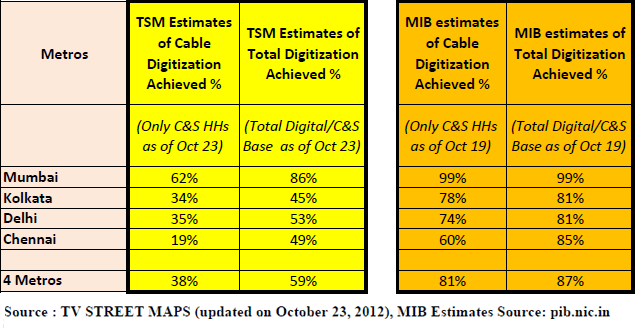
    Only 59 per cent of digitization has been achieved in the four metro as per the first ever independent survey of the extent of digitization in the four metros was conducted by Television Street Maps for MxMIndia. This number is in sharp variance to the claim made by the Ministry of Information and Broadcasting that 87% of the four metro was digitized.


    The figures for the four metros tell the story:


    For Cable & DTH:

    Mumbai: 86% (Govt: 99%)

    Delhi: 45% (81%)

    Kolkata: 53% (81%)

    Chennai: 49% (85%)

    The gap grows when you look at the achievement of digitization only in cable homes.


    Mumbai: 62% (Govt: 99%)

    Delhi: 34% (78%)

    Kolkata: 35% (74%)

    Chennai: 19% (60%)


    On Tuesday, we made a clarion call to the mandarins of the Ministry of Information and Broadcasting urging them to put an end of this charade of make-believe numbers of digitization.


    MxMIndia strongly believes that digitization is THE ONLY way in which the broadcast business can survive and thrive. For too long there has been much confusion amongst stakeholders. With half-baked regulations and guidelines, certain sections of the ecosystem were getting away with unethical practices.


    India has been among the most happening markets in the global broadcast business. Most of the world’s media superpowers are here. What was needed was some order in the business. Which digitization was going to bring in this, as it happened internationally. Unfortunately, the government has appeared to have missed  a trick in its attempt to execute this.


    The Sunset Date for the switch from analogue to digital transmission in the four metros was first fixed as June 30, 2012.  Then it was shifted at the last-minute to October 31.  When this writer mentioned that even that date looks tough to achieve, there were many in the industry who said that the momentum will build eventually.


    Although MxMIndia had been running a series starting 100 days to the June 30 deadline, we didn’t look at digitization in a big way until there 50 days left for November 1. But soon after interacting with all stakeholders, we figured that none of the numbers on the extent of digitization achieved that were being dished out could be believed.


    Jaldi 5 with Joydip Kapadia: Data based on ground-level info + professional & expert assumptions
     

    The government claimed an 87% achievement of digitization while the study conducted for MxMIndia by Television Street Maps showed this achievement to be only 59%. While this figure is for cable and DTH homes, that in cable homes alone is a low 38% as against the I&B ministry claim of 81%. MxMIndia spoke to Joydip Kapadia, Business Head, Television Street Maps on the issue:01. There is a huge variance between the TSM study figures of 59 per cent total digitization as against 87 per cent which the government is quoting. Why do you think do we have this huge difference between the two figures?

    I wouldn’t be in a position to comment on the numbers quoted in other studies. After all, whether its the authorities or TSM or other third parties releasing info about the ground, we all have to resort to diverse methodologies and assumptions. Sometimes the estimates of individual studies could vary due to the underlying assumptions considered. These assumptions work at multiple levels – each or all of these assumptions levels could influence the end result. For instance, differences in defining the areas within the city, definition of Digital TV (including or excluding DTH), total cable homes in a city extrapolated from census and other sources – are just some of the places where assumptions taken upstream within the analysis could produce variations in numbers coming out downstream – at the end of the analysis. All I can say is that our data is based on information obtained from the ground overlaid with our professional and expert assumptions.


    02. By your estimates how much do you see the 59 per cent grow to by October 31?

    It’s difficult to predict given the scale of the initiative and the number of players and variable involved. I wouldn’t like to hazard a guess.


    03. Would you see broadcasters lose out because of the delay (given more carriage fees, the delay in transparency, but then assured reach)

    We have actually not looked at these aspects so I wouldn’t like to say anything on that.


    04. Is there any one thing that you would like to see being done right if there’s a delay in the date and/or for the digitization for the rest of the country?

    We are not direct stakeholders in this and cannot offer any advice in this regard.


    05. 05. Do you think it would be prudent for the government to push the digitization date in the four metros by another three months?

    The math for all stakeholders comes down to what is the overall target to achieve vis-a-vis the seeding pace of the industry to reach that target. If that Math adds up then great, else the verdict would be to budget for greater time.


    It is then that we commissioned Television Street Maps (TSM),  India’s largest and widest channel distribution monitoring service covering over 1500 headends across  675+ cities/towns, to conduct this study. TSM placement monitoring data is provided on a weekly basis to its clients who include names such as Indiacast, One Alliance, Viacom18, MSM, Star, UTV, etc. Besides providing distribution monitoring for analogue and digital for Class-1 towns, TSM has recently started providing distribution monitoring for LC1 towns as well as Digital Track, a system to analyse Digital offerings of MSOs and DTH companies.


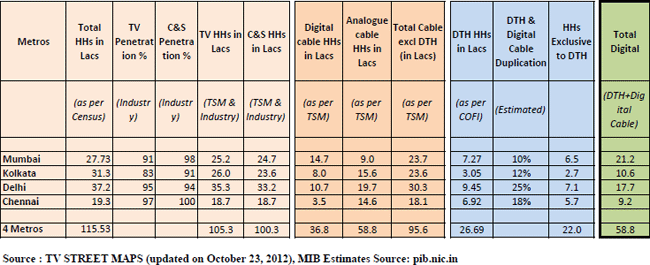
    Over the last two years, TSM has been tracking cable headends on a daily basis and reporting on a weekly level in almost a cable census style – covering every headend for the geographies it represents. While the data provided here are just the toplines we intend to provide detailed insights to our client on DAS. (see box: Jaldi 5 interview with TSM Business Head Joydip Kapadia: Data based on ground-level info + professional & expert assumptions ).


    Methodology of Data Capture:

    Over the last two years, TSM has been capturing TV channel distribution on a daily basis – the expanse of which is now a staggering 1500 headends across 675+ towns. This daily activity has been augmented since August 2012 for the four metros to capture the movement from analogue to digital at a more granular level. This augmentation/ expansion has been done using extensive ground intelligence and multiple verifications due to the criticality of the data. To ensure correctness of the data, more frequent scans were done in the last few days. The current release is for the ground situation as on October 23, 2012.


    The ground info on Analogue versus Digital has been layered with metro universes data collated from census and other third party sources to ultimately validate and put together the digital penetration data for the 4 metros.


    The sharp variance in the numbers as per the TSM survey and those put out by the government is reason for worry. But this is precisely what led MxMIndia to commissioning this study. No one really believes the numbers that are being put out by the government though MxMIndia, like other media, has been publishing these.


    MxM View

    MxMIndia recommends that the government act in a mature way on the issue. While a delay will mean a loss of face, it’s better to schedule for a time when 100 percent digitization is truly achieved. At the time of writing, we’ve heard of rumours that the government may well announce a delay by two months. We would urge the government to not look at December 31 as the Sunset Date. There is a fair amount of special programming on television planned on that day and the government would be well advised to look at a date like January 31.


    However, while doing so, it must get assurances from the governments in West Bengal and Tamil Nadu on compliance. The government must also meet all stakeholders to ensure that everyone is on the same page and is working towards the greater common good. It may be a good idea for it to appoint a full-time Officer on Special Duty for digitization. Either someone from its ranks, or pulled from the industry.


    A note of caution: there is a general election coming up in 2014, possibly earlier. Elections have been lost due to grave national issues and teary ones like onion prices. If there’s any mess-up with digitization, the government can ill-afford a crisis where the masses won’t get to watch their favourite shows on telly. Then, the cry will surely be: alag chahiye!



  • Set-top boxes consume lesser power than CFLs: MIB

    By A Correspondent


    Dismissing apprehensions that Set Top Boxes (STBs) consume lot of electricity, the I&B ministry has released a communique saying that the cable STBs consumes 20 watts of power. As the four metros approach the digitisation deadline of November1, the communique asserted, “It has been wrongly informed that the cable STBs consumes 20 watts of power.” The ministry has also released the table informing about the power rating of various Cable STBs of different makes, and it seems apparent from the table that a cable STB consumes only about 8 watts of power.


    Table 1: Power rating of cable Set Top Boxes of different makes

    STBs Make & Model

    Power consumption (Watts)1

    Active mode

    Standby mode

    Den Entertainment Networks

    Skyworth 7000

    8

    7

    Skyworth 7600

    8

    7

    Skyworth 7631

    8

    7

    DigiCable

    Indieon LDCA 1000

    5.4

    4.5

    Changhong C8899C0

    7.5

    6.9

    Skyworth C371N EN

    10

    8

    IMCL

    SD STB

    12

    10

    MyBox

    7.5

    6.9

    Hathway Datacom

    Skyworth 9000

    8

    7

    HUMA ND-1200C

    15

    5

    WWIL

    Handon 1002C

    6.5

    5.8

    Handon 1041C

    6.5

    5.8

    Arion 5012S

    7.5

    6.9

    Changhong C8899C0

    7.5

    6.9

    MyBox

    7.5

    6.9

    1 Source: Product leaflets of manufacturers


    Power consumption of different electrical household items is indicated in Table 2 below.


    Table 2: Power consumption by different household appliances

    Consumer Devices

    Model

    Power Consumption (Watts)2

    Fridge 210 Liters

    270

    Cooler (Desert) Bajaj DC 2012

    200

    Television Sony KV-SZ292M88 CRT – 29″

    138

    Television LG 14D7RBA CRT

    80

    Television Sony KLV 20S400A LCD

    60

    Television Sony KDL 26EX550 LCD

    50

    Fan Crompton Greaves – 56″

    80

    Fan Orient 32 – Table Fan

    70

    PC (Computer) HP V185E

    60

    PC (Computer) Monitor – 17″

    80

    Light Bulb Incandescent

    100

    DVD Player Sony BDP S350

    26

    Light Fluorescent Tube

    50

    Light CFL

    10

    STB Average for Cable TV

    8

    2 Source: Product leaflets of manufacturers and NPCL website


    The information issued by I&B ministry also clears that even on a standby mode, the STB would consumer less power. “Thus, cable STBs consume very nominal electricity to the tune of 5-6 units in a month which is insignificant in comparison with the electricity consumed by other electric appliances in a house,” said the release.


  • The Anchor: 5 reasons why Digitization may not happen even by Oct 31

    By Pradyuman Maheshwari


    It was unfortunate to see broadcasters forced to change their business projections and content strategies when digitization was less than a month away from the scheduled dates in June. And, now, the information one seems to be getting from the ground in the four metros is that the October 31 deadline also may not be met with.


    1. Momentum is lost: TAM CEO LV Krishnan said this in an interview to me last week. The urgency to go in for set-top boxes and the momentum that existed in April and May has been lost.

    2. The masses will wait and watch. Making it mandatory for cable operators and MSOs responsible for giving info is of no use. It’s the public – you and me – who have to be motivated enough to buy the box and go digital.  Don’t be surprised if the conversions fail  to pick up till the last week…

    3. Analogue will not vanish in the lower strata: TAM may not measure these homes in the four metros, but that’s not really a concern for lakhs of families who can’t afford a set-top box and the revised tariff.And just as it’s impossible to control petty crime, I don’t think the government will be able to nab the pirates in the metros.

    4. Old set-tops offer < 500 channels: Remember, the true pleasures of digitization will be felt only when you can watch those obscure television channels… Jewelry Television, may be. Or Create, a channel that shows D-I-Y and assorted instructional programming. Regrettably, many of those who embraced digital early own set-top boxes that may not be able to accommodate 500 without a tweak

    5. MIB must lead from the front: Any significant process for change must be led from the front and with the minister, her deputies and the secretariat on the ground. Are they doing it? No visible signs yet.