Tag: MIB

  • I&B intervention gives ASCI more teeth to curb ads that violate guidelines

    By A Correspondent


    In a recent development, the Ministry of Information and Broadcasting (MIB) has ordered broadcasters not to air advertisements that have been found in violation of the Advertising Standards Council of India’s (ASCI) code and not complying with the decision of its Consumer Complaints Council (CCC). While deliberating on the complaints received in ASCI, the CCC observed that many of the teleshopping advertisements made unsubstantiated claims & violated the provision of code for self-regulation as well as provisions under Drug & Magic Remedies (Objectionable Advertisements) Act, 1954. MIB has in its Advisory compiled a list of these ads and asked broadcasters not to carry them in their respective channels and to ensure strict compliance of the advertising code in the Cable Television Networks Act (CTN).


    The CTN code and rules state that ‘no advertisement which violates the code of self-regulation in advertising, as adopted by ASCI for public exhibition in India, from time to time, shall be carried in the cable service’. Therefore, the ASCI decisions are not just bound for compliance by advertisers but also by TV channels.


    Partha Rakshit

    Partha Rakshit, Chairman, ASCI shared, “This is another feather in the cap of ASCI, in its efforts to make advertising more responsible. We were finding that some advertisers on TV channels, especially Tele Shopping Networks, were not complying with the ASCI decisions. We submitted the list to the Inter Ministerial Committee (IMC) of the MIB for their consideration. Based on that, IMC observed that any violation of ASCI code also violates the Advertising Code enshrined in the CTN Act and its rules. In short, IMC has directed that advertisements found to violate the ASCI code cannot be carried on TV channels.”


  • #FF14 Day 1: Issues abound but collective stand will help boost industry morale

    By a correspondent


    Starting off from where the inaugural session left, the session on ‘De-bottlenecking the regulatory hurdles’ on Day 1 of FICCI Frames 2014 saw the panelists touch upon grave issues facing the industry and how the government could play an integral role in allaying the fears of all the stakeholders concerned.


    The panelists for the session comprised Bimal Julka, Secretary, Ministry of Information & Broadcasting, Government of India, Uday Shankar, CEO, Star India, Sudhanshu Vats, Group CEO, Viacom18 Media Pvt. Ltd, Punit Goenka, CEO, Zee Entertainment Enterprises Ltd, Rahul Johri, Sr VP & GM, South Asia, Discovery Networks and  Ajit Pai, Commissioner, FCC, USA. The session was moderated by Vikram Chandra, Group CEO, NDTV.


    Taking the opportunity to open up, Uday Shankar began by saying that the regulatory scenario in India was very diverse in its approach with some sectors being over-regulated while the others were under-regulated. “Lack of clarity on the intent of a regulation is something that is of concern. It has to be aligned with goals that have been set by the society”, said Mr. Shankar. He went on to highlight other issues that needed industry attention including the 10+2 ad cap provision and also the just introduced aggregator policy for stakeholders.


    Sudhanshu Vats presented a few indicators of his own as he said that there was a need to have a purpose to regulate. This, he said, could be achieved by having multiplicity of choice, have the need to operate like a free market and have adequate transparency and data. Adding further he said that the other essential needs were clarity, accountability and foresight.


    Rahul Johri pitched in by saying that there was indeed a need to have clarity on where the industry was headed on the issue of regulation and finding out what the core objective is. “We have regulated ourselves very well but there are too many regulations being imposed right now and we need to find a way to tackle them systematically. The aim should be to regulate well for the future of India.”


    Left to defend his turf, Shri Bimal Julka did a decent job of pacifying the panel as he said that it was a collaborative effort and that the responsibility rests with all stakeholders to get the job done. “Whatever the issues, we can agree in cohesion that it is the viewer towards whom our efforts have to be directed. Thus keeping such interests of the viewer in mind, the policies are framed with the intention of achieving inclusive growth,” he asserted.


    On the several impending problems facing stakeholders, Shri Julka said that the focus by the government was to throw open the field for a healthy discussion amongst all players so that they could arrive at an amicable solution. Mr. Julka asserted that despite the problems the digitization exercise was showing positive results as well including the carriage fees reporting a downward slide and more transparency being bought into the system.


    Mr Julka went on to add that the challenge would be to complete the phase 3 & 4 schedule of digitization and only after that could the issues of subscription versus carriage fee be resolved. But he cautioned that the stakeholders also had a role to play including deciding on how to make their content standout amongst a plethora of options facing the viewer.


    Sudhanshu Vats went to the extent of saying that there was no need to have a licensing system except for the spectrum allocation and that even if there is a licensing system there needs to be a fixed timeframe to address that. He added that things will be clear once the entire digitization exercise is complete but prior to that it was important that the industry take a hard look on addressability factor of digitization.


  • Time to call Minster’s bluff. 6.5/10 performance by UPA-run I&B ministry


    By Pradyuman Maheshwari


    It’s perhaps unfair to damn only Information and Broadcasting Minister Manish Tewari for his performance. Successive occupants of that office – under various regimes – have made a mess of things over the years. Right from the time of BV Keskar, the first mantri who banned Hindi film songs on Vividh Bharati to occupants such as LK Advani, IK Gujral and Sushma Swaraj who didn’t do much for the sector. Ministers like Priyaranjan Dasmunshi and Anand Sharma were on war with many broadcasters and Ambika Soni was by far the best of them all though the digitization execution process was messed up when she was at the helm.


    Earlier this week, as part of the Bharat Nirman series of ads, the DAVP inserted an ad making several claims under the headline “Empowering People Through A Liberal Information Order”.


    I think it’s important that someone were to call the minister and ministry’s bluff. The text in italics is my response to the points made in the ad.

    • Several policies issued and implemented for the liberalization of Print Media Sector in last 10 years

    Is it? Like? Save appeasing the sector with DAVP ad hikes, there’s precious little done 

    • Television industry grew from Rs 18,300 crore in 2006 to Rs 50,140 crore in 2014

    This would have happened any which way. No marks for the UPA 

    • Total number of TV channels increased from 130 in 2014 to 788 in 2014

    Again no credit to UPA for this. In fact, the government has been sitting on many applications and approvals over the last few months 

    • 3 Crore Set-Top Boxes installed in the first two phases of digitization

    Yes, Digitization is an achievement of the government. But look at what happened with it? Chennai is not fully digitized. Kolkata faced several hiccups. Phase 2 is nearly 90 percent, which is heartening 

    • New policy guidelines for Television Rating Agencies issued in 2014

    One is not very sure whether the government should be getting into policing television audience measurement. That should be left for the industry. Thankfully, the government hasn’t got into IRS or advising ad duration on radio and column centimetres/ad-edit ratio in print 

    • New policy guidelines issued for Headend in the Sky (HITS) Broadcasting Services and Internet Protocol Television (IPTV)

    It is fine to issue guidelines, but an IPTV, for instance, has been a non-starter. And HITS is just about a nice acronym 

    • Radio industry grew from Rs 600 crore in 2006 to Rs 1540 crore in 2014

    Would’ve grown more had news been allowed. Isn’t it ironic that all and sundry can start news channels – on satellite and cable – and our radio folks aren’t trusted? 

    • 245 FM channels in 85 cities since 2005. In the next phase 839 channels proposed in 294 cities

    Phase III? Ha ha ha ha ha ha ha ha ha ha ha ha ha ha. Phase III has become a joke. We’ve heard about it just so often. Even the Mumbai Metro would’ve started, but our government would be sitting on the papers. 

    • Community radio stations increased from 64 in 2009 to 163 in 2014

    For a country of a billion-plus people, 163 community radio stations is an apology. Not enough done to evangelise it.

    • Foreign Direct Investment for five segments of broadcasting sector revised in 2012

    And what about news? So FDI can be upped in critical segments like telecom, but not so in news. Just why?


    • Overhaul of the Cinematograph Act, 1952 by Justice Mudgal Committee

    Some welcome steps here? Implemented? 

    • National Media Centre with ultra modern facilities inaugurated

    No point having just one in Central Delhi. The Central Telegraph Offices in various cities which had press rooms should’ve been upgraded too. News journalists exist in other parts of the country too, Mr Minsiter! 

    • National Museum of Indian Cinema being set up in Mumbai

    Better late than never… but would’ve been nicer to coincide with 100 years of cinema.


    What the ad doesn’t tell us is the several things the government hasn’t been able to achieve. Make Doordarshan an independent and top quality pubcaster like the BBC, for instance. Some attempts to improve DD News were nullified by interference in newsroom operations.


    Ever since Manish Tewari has taken charge as the Minister, he has waxed eloquent on the paradoxes of the industry qua (his favourite word) exigencies of the business. He has even tried to police the cable trade on ownership issues since the networks in his home state of Punjab are managed by his political rivals.


    The government has tried its best to keep the issue of self-regulation issues alive by scaring the news media on and off. Under the pretext of protecting the interests of consumers, the 10+2 ad cap was introduced which saw much resistance from news broadcasters.


    The government hasn’t been able to do much on Paid News. Newspapers still carry paid content with or without disclaimers in fine print.


    So how would you rate the last 10 years of the UPA-run I&B Ministry? I would give it a 6 on 10. Okay, let’s make it 6.5, because it could’ve even gotten worse.


  • As time ticks on measurement guidelines, will TAM take MIB to court?

    By A Correspondent


    With the government guidelines notified on January 16, the time’s literally ticking for TAM and the entire prevailing broadcast ecosystem.


    Thanks to the persistent demands of broadcasters – especially those representing news channels – to police TAM, the Ministry of Information and Broadcasting has been on an overdrive on the issue of measurement guidelines. The perception created is that news channels are required to sensationalise to score high ratings and the government, in its effort to to keep newswallahs happy and in check in an election year, is on an overdrive. How the ratings scenario will change in the new BARC-administered regime beats us, but what we do learn is that existing player TAM is contemplating taking the Ministry of Information and Broadcasting to court.


    The plea will most likely be that it cannot comply with the requirements on ownership within 30 days so it needs to be given time. The advertisers, media agencies and select advertisers too believe that a measurement-free regime will be counter-productive. Some advertisers in fact believe a measurement blackout will force them to review their spends on television.


    According to the grapevine, TAM’s co-owners had some concerns on taking the Court route. Nielsen, we were told, was averse to litigation, while Kantar wanted it. Both Nielsen and WPP, the owners of Kantar, have steady businesses in India and there’s a concern on how taking on the government could impact its relations with the government. Industry veterans though site several instances when relations with government hasn’t been impacted by legal tangles.


    Meanwhile, even as you read this, BARC has convened a press conference in Mumbai to make some significant announcements – possibly the name of the vendor – Mediametrie or Nielsen.


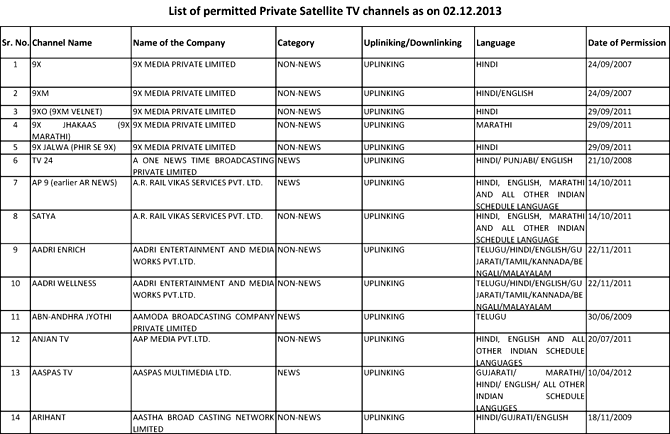
  • Vital Stats: Status of Permitted Private Satellite TV Channels in India as on Dec 2

    This is the status of permitted private satellite TV channels in India as on December 2, 2013 as per the Ministry of Information and Broadcasting, Government of India


    Permitted Satellite TV Channels in India: 784

    News and Current Affairs Channels: 389

    Non-news and Current Affairs Channels: 395

    TV Channels permitted for uplink from India and also to downlink into India: 693 (News: 373, Non-news: 320)

    TV Channels permitted for uplink from India and not permitted to downlink in India: 31 (News: 4, Non-news: 27)

    TV Channels permitted to only downlink into India (uplinked from abroad): 91 (News: 16, Non-news: 75)


  • Pre-poll sop? I&B ministry grants interim 19% hike in DAVP rates of print media

    By A Correspondent


    You will not read this interpretation in any newspaper. Nor will any news channel discuss this in its various panel discussions. Perhaps social media may. But you never know. For, it’s seen as a sop to newspapers ahead of the elections – the rest of the State elections to be held this month and next and the 2014 general elections. The Ministry of Information and Broadcasting has granted an interim hike of 19 percent in DAVP rates for the print media with effect from October 15, 2013.


    The rate card decided by the 6th Rate Structure Committee (RSC) was valid till October 14 and even though a 7th RSC was constituted by the MIB on May 31, 2013, the recommendations haven’t come in so far. According to a communiqué, the ministry has received a number of representation from various stakeholders and DAVP for grant of immediate interim relief in the Print Media Rate Card of DAVP pending revision of rate card on the basis of recommendations of 7th RSC.


    Accordingly, a proposal for grant of an interim hike was considered by the MIB in consultation with Ministry of Finance and the Election Commission of India. All stakeholders have been to cooperate with the Rate Structure Committee so that its recommendations may be finalized at the earliest.


  • TRAI recommendations on guidelines for TV rating agencies

    The Telecom Regulatory Authority of India (TRAI) has released its guidelines for television rating agencies.


    The Ministry of Information and Broadcasting (MIB) had asked requested TRAI to provide its recommendations on issues related to guidelines/ accreditation mechanism for accreditation of television rating agencies in the country.


    Accordingly, TRAI issued a Consultation Paper on “Guidelines/Accreditation Mechanism for Television Rating Agencies in India” on April 17, 2013, seeking comments/views of the stakeholders. Open House discussions were also held on July 1, 2013. Based on comments received in the consultation process and its own analysis, the Authority has finalised its recommendations. The salient features of the recommendations are:


    i. The Authority supports self-regulation of television ratings through an industry-led body like Broadcast Audience Research Council (BARC).

    ii. To ensure that the shortcomings of the present system are addressed guidelines have been recommended.

    iii. Any agency meeting the eligibility conditions can apply and get registered with MIB for doing the rating work.

    iv. MIB to notify the guidelines for regulating the television rating agencies based on TRAI’s recommendations, within two months.

    v. All rating agencies are required to comply with the guidelines.

    vi. Guidelines to cover registration, eligibility norms, cross-holding, methodology, complaint redressal, sale & use of ratings, audit, disclosure, reporting requirements and penal provisions.

    vii. The number of panel homes for collecting television viewership data will be a minimum of 20,000; to be set up within 6 months of the guidelines coming into force. Thereafter, the number of panel homes shall be increased by 10,000 every year until panel size reaches 50,000.

    viii. The panel homes to be selected from a pool of households, selected through an establishment survey which shall be at least 10 times the number of panel homes for audience measurement.

    ix. Voluntary code of conduct by the industry for maintaining secrecy and privacy of the panel homes.

    x. Restrictions on ‘substantial equity holding of 10% or more’ between rating agencies and broadcasters/advertisers/ advertising agencies.

    xi. The rating agency to set up an effective complaint redressal system.

    xii. Data/reports generated by the rating agency to be made available, on paid basis, to all interested stakeholders in a transparent and equitable manner.

    xiii. The rating agency to get its entire methodology/processes audited internally on quarterly basis and through an independent auditor annually. All audit reports to be put on the website of the rating agency.

    xiv. Penal provisions for non-compliance of guidelines including financial penalty from Rs 10 lakh to Rs1 crore and cancellation of registration.

    xv. Six months time given to the existing rating agency to comply with the guidelines.


    Notes a communiqué: “Since 2008, the authority has been giving its recommendations/ clarifications on implementing a reliable and transparent television rating system. For over four years little to no progress has been made by the industry and MIB, in implementing the Authority’s recommendations aimed at institutionalizing a credible and transparent rating system. Since policy intent has not been translated into action for too long, the timeframe for implementation has now become a critical factor. Guidelines are designed to correct the aberrations in the existing system and prevent it from deteriorating further. Early implementation of guidelines, therefore, has become a necessity. As sector regulator responsible for overall development of the sector, the Authority cannot be a mute spectator to continued inaction and may suo motu intervene in larger public interest.”


    The full text of the recommendations is available on TRAI’s website at: http://www.trai.gov.in/WriteReadData/Recommendation/ Documents/FINALReco%2011Sept2013.pdf

     

  • Jaldi karo! MIB asks TRAI & Press Council to expedite comments on foreign investment limits

    By  A Correspondent


    The Ministry of Information and Broadcasting has requested TRAI once again to expedite its comments on the reference made earlier to the body regarding foreign investment limits in the Broadcasting Sector. In its communication to TRAI, the ministry has sought comments regarding the paper prepared by the Ministry of Finance relating to revision in existing FDI caps in the broadcasting sector. The paper had been forwarded to TRAI seeking its recommendations under Section 11(1)(a)(ii) & (iv) of the TRAI Act, 1997, which pertains to the terms and conditions of license to a service provider and measures to facilitate competition and promote efficiency in the operation of telecommunication services to facilitate growth in such services.


    In a similar separate communication, the ministry has requested the Press Council of India to expedite its advice on the existing sectoral caps of FDI in the print media, under Section 13 of PCI Act, 1978. The advice has been sought in view of the communication received from the Ministry of Finance which aims to review policy of sectoral caps of FDI in the print media. Section 13 authorizes PCI to express its opinion in regard to any matter referred to it by the central government.


    The paper proposes to raise the existing FDI cap of 26% which is through FIPB route to 49% through automatic route in the news sector. In the non-news sector, the existing FDI cap is 100% through FIPB route which has been proposed to be 100% through automatic route without the requirement of FIPB’s approval.


  • MIB seeks TRAI & Press Council views on FDI cap in TV & print

    By A Correspondent


    In response to the draft consultation paper of the Ministry of Finance on FDI caps in the Print and Broadcasting Sector, the Information & Broadcasting Ministry has sought the recommendations of TRAI for issues related to the broadcasting sector and has sought the comments of the Press Council of India for matters concerning the print media.


    As the process of consultations with both TRAI and PCI would take time, the ministry has communicated to Department of Industrial Policy and Promotion (DIPP) that the existing limits of FDI caps and entry routes in the print and broadcasting sectors may continue and status quo in the interim be maintained as prescribed in the consolidated FDI Policy 2013.


    Earlier, on receipt of the draft consultation paper on FDI Caps, the ministry undertook comprehensive consultations with stakeholders in the print and broadcasting sectors to elicit their views on the issues concerned. During the consultations, divergent views emerged leading to the issues remaining inconclusive. It may be pointed out that while the Indian Newspaper Society (INS) has sought additional time to give its comments, the News Broadcasters Association (NBA) has not furnished its comments till date. In view of the given position, the Ministry has felt that the matter be referred to TRAI and PCI for seeking their comments.


    According to a communique, since TRAI is the regulator for broadcasting and cable services, as in the past, it  needs to be consulted on account of the likely impact of the proposal is expected to have on the Broadcasting Sector as a whole. In September 2012, the foreign investment limits of various segments in broadcasting sector were revised based on TRAI recommendations. TRAI had gone through the due process of consultations with the stakeholders before it made its recommendations.


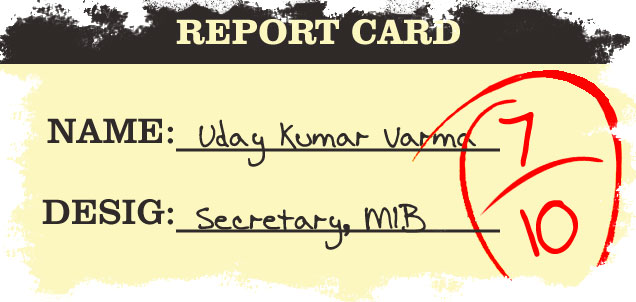
  • Mediaah! Report Card on Uday Kumar Varma’s tenure as I&B Secretary: 7/10


    By Pradyuman Maheshwari


    Uday Kumar Varma

    In October 2011, when Uday Kumar Varma had just been appointed Secretary in the Information and Broadcasting ministry there was much hope from the ace bureaucrat. He didn’t just have sound experience in the administration, but he also had spent a good time in the MIB.


    So he would be plug-and-play given the little time he would need to learn the nuances of the ministry.


    However, it’s one thing to be Special Secretary and another to be ‘the’ Secretary, especially when you know your stint is going to last two-odd years and you will be retiring after the tenure.


    MxMIndia had carried an article as a part of the Anchor with the headline: 5 Things the New I&B Secretary Uday Kumar Varma must do (see link: http://www.mxmindia.com/2011/10/the-anchor-5-things-new-ib-secretary-uday-kumar-varma-must-do/).


    There was a five-point tasklist. Here are the headlines:

    #1 Ensure new digitization announcement is implemented on time.

    #2 Must let self-regulators rule.

    #3 Should ensure paid contentwallahs are punished.

    #4 Push for news on FM Radio.

    #5 Empower government media – Doordarshan and All India Radio.


    I am not going to factor in #2, 3 and 5 here, because in a two-year stint there’s not much that you can expect any Secretary to achieve.


    Phase 3 of the FM radio regime has still not taken off and one can’t see independent news happening in a hurry on FM radio. It requires someone who believes in the medim to push these through with missionary zeal in what’s clearly a non-priority sector.


    Varmaji made the regular noise on self-regulation, measurement and paid content, the kind one expects from a Secretary.


    But it’s with digitization that the former Secretary has received the maximum bouquets and brickbats. At the outset, he deserves all the credit for digitization finally seeing the light of day. When the minister changed less than a week before first phase was scheduled to happen,  it was Shri Varma and his team’s conviction that ensured it takes place.


    But what happened before Phase 1 of digitization was effected was deplorable. The readiness numbers that the ministry declared were in sharp variance with the ground reality.


    It was Varma & Co’s resolve and understanding that the hiccups are inevitable is what led to the digitization been effected. Phase 2 was also pushed through, with its own share of problems, but by then the Secretary knew that it’s not switch-off-switch-on game. Every phase will have its own sub-phases.


    Had it been just the effecting of digitization, Varma would’ve got an 11 on 10, but the fact that the initial process had its share of big problems and that one had huge expectations from him given his knowledge of the functioning of the ministry, we give him a score of 7/10.


  • TRAI seeks views on TV ratings guidelines, accreditation

    By A Correspondent


    The Telecom Regulatory Authority of India (TRAI) has released a consultation paper on ‘Guidelines/Accreditation Mechanism for Television Rating Agencies in India’. The Minisgtry of Information and Broadcasting MIB has sought TRAI’s recommendations for laying down comprehensive guidelines and an accreditation mechanism for TRP (Television Rating Points) rating agencies in India to ensure transparency and accountability in the rating system.


    A release from the TRAI said that since TRP ratings indicate the popularity of a channel or a programme and assists advertisers, broadcasters and advertising agencies in making business decisions. Better ratings would promote a programme/channel while poor ratings will discourage a programme/channel or content. Incorrect ratings will lead to production of content which may not be really popular while good content and programmes may be left out. Therefore, there is a need to have an accurate measurement and representative television ratings for the programmes.


    The importance of a credible, transparent and representative television audience measurement system is recognized the world over. At present television rating in India is being done by only one agency and issues related to credibility and transparency of the ratings services in India has been raised by certain stakeholders.


    The key issues discussed in the consultation paper pertain to:

    Establishing an accreditation mechanism for the rating agency

    Methodology of audience measurement

    Sample size

    Secrecy of sample homes

    Cross holding between rating agencies and their users

    Complaint redressal

    Sale and use of ratings

    Disclosure and reporting requirement

    Audit competition in rating services


    Written comments are invited from the stakeholders by May 9, and counter-comments by May 16.


  • Digitization reaches 67% in Phase II cities: MIB

    By A Correspondent


    Fresh data from the Ministry of Information and Broadcasting states that 67 percent of the digitization target has been achieved in the 38 cities which are set for digitization by March 31. According to DTH operators and MSOs, a total of 108 lakh Set Top Boxes (STBs) have already been installed in Phase-II cities against the target of 1.60 crore, registering overall achievement of over 67 percent digitization.


    Hyderabad, Amritsar, Chandigarh and Allahabad have achieved nearly 100 percent digitization, according to the MIB, and 75 percent digitization has been achieved in eight cities – Jodhpur, Thane, Aurangabad, Jaipur, Pune, Faridabad, Nashik, and Ghaziabad.


    Analysis of the data further reveals that out of 38 cities to be digitized in Phase II, 28 cities have achieved more than 50 percent digitization individually.


    The ministry has also stepped up the public awareness campaign to sensitize consumers on the benefits of digitization, through print and electronic media. Both All India Radio and private FM broadcasters are airing radio jingles, the ministry has brought out a print advertisement in all 38 cities in the respective regional languages, SMS campaign is under way, and television channels have been frequently running video spots, blackout advertisements and scrolls.


    Meanwhile, the Indian Broadcasting Foundation (IBF) has reiterated its commitment to television broadcasting digitization. As mandated by the Ministry of Information & Broadcasting under the Cable Television Network Amendment Ordinance 2011, for the 38 cities notified in the Phase II sequence of the digitization roll out, television broadcasters will comprehensively switch off all analogue signals from midnight Sunday, March 31.


    The IBF board has stressed that such a move is necessary to smoothen the transition from analogue to digital cable TV. IBF members have been running regular awareness campaigns to educate consumers on the various benefits of digitization. Some of these benefits include better picture and sound quality, enhanced services such as high definition, video on demand content and eventually, higher quality content. In addition, digitization will also enable viewers to choose and pay for only those channels they want, rather than pick from packages with fixed prices. Digitization will also bring about greater transparency between broadcasters, cable operators and consumers.


    Man Jit Singh

    IBF President Man Jit Singh said, “IBF and its members are committed to the successful implementation of digitization in India. Our awareness campaign has received very good response. We are confident that the successful implementation of DAS-II will tremendously improve the quality of television content and consequent viewership in the country.”