Tag: M&E

  • M&E to cross Rs 2tn by 2020: FICCI-EY report


    By A Correspondent


    FICCI-Frames 2018 took off on Sunday evening with I&B Minister Smriti Irani as Chief Guest. As part of the inaugural session, the annual M&E industry report, this time presented by the team at Ernst & Young (EY). The venue this year is the Grand Hyatt in Santacruz East, away from the Renaissance at Powai where Frames has been happening for 16 of the 18 editions.


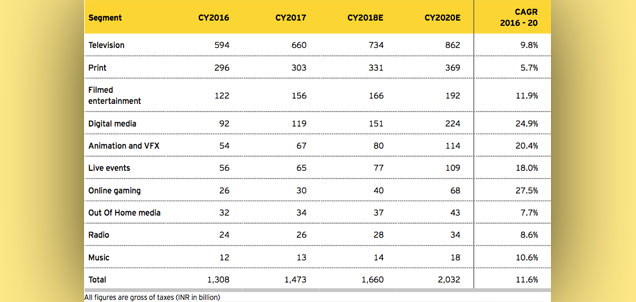
    Back to the report: the Indian Media and Entertainment (M&E) sector reached almost INR1.5 trillion (US$22.7 billion) in 2017, a growth of around 13% over 2016. With its current trajectory, it is expect to cross INR2 trillion (US$31 billion) by 2020, at a CAGR of 11.6%. The digital segment-led growth, demonstrating that advertising budgets are in line with the changing content consumption patterns The  FICC-EY report is appropriately titled ‘Re-imagining India’s M&E sector’ and captures key key insights from the Indian M&E sector.


    The M&E sector continues to grow at a rate faster than the GDP growth rate, reflecting the growing disposable income led by stable economic growth and changing demographics. The report states that subscription growth outpaced advertising growth in 2017 but advertising will continue to grow till 2020 led by digital advertising. The report estimates that approximately 1.5 million consumers in India today are digital only and would not normally use traditional media. It is expected that this customer base will to grow to ~4 million by 2020 generating significant digital subscription revenues of approximately 20 billion. Going forward, micropayments, enabled through the Unified Payment Interface (UPI) and Bharat Interface for Money (BHIM) platforms developed by the National Payments Corporation of India (NPCI) will further accelerate subscription revenues for entertainment content.


    Said Farokh Balsara, Partner and M&E Leader, EY India:  “Indian M&E sector reached INR1.5 trillion in 2017 led by digital. With digital subscribers expected to reach 20 million by 2020, has Indian M&E reached its digital tipping point? We now need to re-imagine the future of  Indian M&E sector.”


    Added Ashish Pherwani, Partner and M&E Advisor Leader, EY India: “Growth in 2017 was led by the digital, film & animation & VFX segments. We expect sectors like digital and gaming to grow between 2 to 3 times by 2020.”


    Key findings

    :: Television:
    The TV industry grew from INR594 billion to INR660 billion in 2017, a growth of 11.2% (9.8% net of taxes). Advertising grew to INR267 billion while distribution grew to INR393 billion. Advertising comprised 40% of revenues, while distribution was 60% of total revenues. At a broadcaster level, however, subscription revenues (including international subscription) made up approximately 28% of revenues.

    Key insights– While advertising is 41% of the total revenues today, the report expects it to grow to 43% by 2020. There are over 30% households in India which are yet to get television screens, but being at the bottom of the pyramid, these households will tend to move towards first towards free and sachet products.


    :: Print:
    Print accounted for the second largest share of the Indian M&E sector, growing at 3% to reach INR303 billion in 2017. Print media is estimated to grow at an overall CAGR of approximately 7% till 2020 with vernacular at 8%-9% and English slightly slower. This growth is expected despite the FDI limit remaining unchanged at 26% and therefore, restricting access to foreign print players and the imposition of GST at 5% on the advertising revenues of the print industry for the first time in history. While magazines contributed 4.3% to the total print segment, the segment was at largely status quo with not many significant new launches in 2017.

    Key insights– Today, 98% of readers read dailies and 20% read magazines. Reader base is 395 million, or 38% of the population. Readership has grown by 110 million over the last 3 years. Rural (52%) reader base is larger than urban (48%). 44% of children (aged 12 to 17 years) read a newspaper or magazine. Magazines have a higher readership in urban areas (57%) as compared to rural areas (43%).


    :: Films:
    The Indian film segment grew 27% in 2017 on the back of box office growth – both domestic and international – coupled with increased revenues from sale of satellite and digital rights. All sub-segments, with the exception of home video grew and the film segment reached INR156 billion in 2017.The Hindi films comprise the majority component of the Indian film segment. They contribute almost 40% of the net domestic box office (BO) collections annually, despite comprising only 17% of the films made. Films in 29 other Indian languages account for approximately 75% of the films released but they contribute approximately 50% to the annual domestic box office collections. Hollywood and international films comprise the balance. The top 50 films contributed approximately 97.75% of the total net box office collection. Box office collections of the top 50 films grew by 11.60% in 2017.

    Key Insights: Regional movies drove the growth in number of releases in 2017. Screen count increased from 9,481 in 2016 to 9,530 in 2017. Number of Hindi movies crossing the INR1 billion mark was highest in 2017 in the past 5 years. From 31 movies in 2016, Hindi dubbed movies increased more than 3 times to 96 in 2017.


    :: Digital media:

    Digital media has grown significantly over the past few years, and continues to lead the growth charts on advertising. Subscription revenues are emerging and are expected to make their presence felt by 2020. In 2017, digital media grew 29.4% (27.8% net of the impact of GST) on the back of a 28.8% growth in advertising and a 50% growth in subscription. Subscription, which was just 3.3% of total digital revenues in 2016, is expected to grow to 9% by 2020.

    Key insights: 250 million people viewed videos online in 2017 and expected to double to 500 million by 2020. Around 40% of total mobile traffic came from the consumption of video services in 2015. This figure is expected to touch 72% by 2020. 93% of time spent on digital videos is in Hindi and other regional languages. OTT subscription in India is expected to touch INR20 billion by 2020.

    M&A in M&E


    The Indian M&E sector witnessed a relatively new trend in deal activity with emerging segments such as gaming and digital gaining momentum, while the deal activity in the traditional media segments was slower. The slowdown can be partially attributed to challenges faced by the advertising segments of the industry due to demonetisation and GST. Overall, the number of transactions in the M&E sector decreased from 56 deals in 2016 to 40 deals in 2017. Further, the total deal value was also lower at US$1,261 million in 2017 compared to US$2,863 million in 2016.


    The entire report can be accessed at here



  • Media Partners Asia report reveals promising growth of M&E sector

    By A Correspondent


    The TV, film and video production sector in Asia is set to enter a new cycle of growth, according to a new report from Media Partners Asia (MPA), as economic development and evolving distribution ecosystems stoke competition and demand for better shows, as well as more varied formats and approaches.


    MPA’s Video Content Dynamics, published recently, reviews industry supply, demand and key drivers across India, Korea and five markets in Southeast Asia (Indonesia, Malaysia, the Philippines, Thailand and Vietnam) on free, pay and OTT platforms. The report breaks out ratings performance, economics and key players by genre (drama, movies, news, sports, kids and factual), as well as theatrical performance for local and international films.


    TV is the dominant viewing platform in these markets. However, as more people get access to affordable high-speed broadband, quality content as well as proactive channel management are becoming increasingly important for incumbent broadcasters, MPA analysts noted.


    “Online video is gaining traction in key emerging markets, as broadband speeds increase and connection costs come down,” said Steve Laslocky, VP, Research & Consulting, Media Partners Asia. “Leading broadcasters are rolling out ad-supported catch-up services while subscription online video services (local, regional and global) are gaining traction with premium Asian content as well as domestic and Hollywood movies. More than ever, a healthy local production ecosystem is a vital component of a healthy TV market.”


    Korean content remains the gold standard for production in Asia, expanding beyond drama and film to become a genre in its own right. Costs are increasing in Korea’s highly competitive domestic marketplace, where profits are challenging. At the same time, demand and pricing power in MPA-surveyed markets continue to rise across both TV and online video, helping sustain Korea’s leadership position.

    Future growth prospects and the relative health of local production varies across the seven markets covered by MPA’s Asia Video Content Dynamics report. Broadcasters that rely heavily on in-house teams, as seen in Malaysia and the Philippines for example, risk stifling ideas and competition. On the other hand, too many third-party studios competing for work can squeeze margins. This trend, seen in India’s TV industry, leaves little money to reinvest and develop local production for the opportunities and challenges ahead.


    Indonesia stands out as a relatively healthy ecosystem among Asian growth markets. Southeast Asia’s largest economy comprises comparatively few major production houses, often operating with backing from one of the country’s major TV groups. Production costs are relatively low, while the free-to-air ad market remains buoyant, providing good returns for popular shows. This bodes well for the future development of Indonesian content.


    By contrast, the environment for production in India is almost the opposite. The rollout of digital TV is dramatically expanding viewer choices for hundreds of millions of homes in the sub-continent, while opening up opportunities to develop premium and more targeted content. However, intense competition for TV revenues between hundreds of local production houses has driven margins to 15 per cent and below, making it difficult to capitalize on these changes.


    Multiple genres are fueling consumption on free, pay and OTT services. Local dramas, however, remain the most important ratings driver across much of the region, despite concerns about stale storylines.


    Movies also tend to rate well on TV, especially in countries with a strong domestic film industry. This is especially evident in India as well as Indonesia and the Philippines, the two markets in Southeast Asia with the largest box office and where local films also have the highest share of revenue.


    Sports, meanwhile, is a high-profile and high-rating but ultimately event-driven genre. Many international marquee events are aired late at night, limiting viewership, underscoring the importance of local tournaments. Monetization for some local sports, such as football in Malaysia, still lags international franchises however, despite high ratings.


    Contrary to common perception, sports is not a major audience contributor on pay-TV, while the popularity of recent Hollywood movies on pay-TV varies by market. Kids content, meanwhile, is a leading pay-TV genre in Indonesia (50 per cent audience share) and the Philippines (22 per cent).


    Some OTT platforms are starting to compete on early windows for Asian content, although not on Hollywood movies, where studios can still command high prices from premium pay channels and pay-TV operators across most markets. This will likely change over time.


    Investment in local content and original productions for the OTT window, meanwhile, is growing rapidly in India and slowly expanding across Southeast Asia. In markets such as Indonesia, local movies, dramas and series are boosting consumption across regional SVOD services.


    Monetization for ad-supported services however, with the exception of YouTube, is proving to be a challenge. As online video gains scale in the region, industry standards for comparable viewing data will be crucial to further growing online video advertising outside of the YouTube ecosystem.


  • Achche Din for M&E


    By Ajay Shah


    India is expected to become the third largest economy in the world by 2030 — after the US and China — and the GDP per capita is expected to grow from $1600 to $4,500 by 2030. As seen globally, an increase in the GDP per capita increases the proportion of the M&E industry’s contribution to the GDP. With a triple fold increase in GDP over the next 15 years, the M&E industry’s contribution to the GDP is expected to increase significantly. But this isn’t all. Here are eight reasons the country will be an attractive destination for M&E investments —


    1. Currently, the Indian M&E industry is growing at a CAGR of 13-14 per cent per year which is almost twice that of the global media industry. Despite the faster growth, advertising spends, which drive growth in M&E industry, as a percentage of GDP is 0.4 per cent, which is significantly lower than developed markets (0.7- 1 per cent). Over time, the M&E sector will witness increasing ad spends as a proportion of the GDP


    2. With over half a billion people under the age of 25, India is witnessing a rise in disposable incomes. Increasing income levels have also led to increasing spend on M&E, as evident from the fast growth of multiplexes  and the success of various sporting leagues in the last five years


    3. Compared to the most developed markets, India is a unique market with traditional media and digital media segments growing simultaneously. Traditional media is expected to continue on the growth trajectory because of the under-penetration of media segments in Tier II and III cities


    4. Several government initiatives, like the digitisation of Cable TV, Phase III auctions of FM spectrum and increase in FDI limits, will aid the growth of traditional media


    5. India is the second-largest internet market after China, with over 300 million internet users. Additionally, government thrust on the Digital India campaign will significantly increase internet penetration in the next decade, thus expanding the digital media opportunity


    6. The mobile subscriber base of 900 million users, sub-$100 smartphones, and one of the lowest data cost globally, is expected to drive a surge in mobile data traffic from 88 TB/Month in 2014, to 1,100 TB/Month by 2019


    7. With existing internet penetration lower than 25 per cent, India is already among the Top Five online video markets globally, in terms of viewership, and is expected to be the second largest market by 2017. As internet penetration increases, India will become one of the most important M&E markets


    8. Currently, investors are interested in TV distribution, cinema exhibition and digital media sub-segments, and we expect this trend to continue for the next few years


    Ajay Shah is Partner and Leader, Deal Advisory, Media and Entertainment at EY (Ernst & Young). Last week, EY released its 12th Media and Entertainment Capital Confidence Barometer


  • FICCI Frames turns 15, 2014 edition to focus on how M&E influences social change

    By A Correspondent


    The Federation of Indian Chambers of Commerce and Industry (FICCI) has announced the 15th edition of its annual Frames convention for the media and entertainment industry.


    FICCI Frames 2014 will be held from March 12 to 14, 2014 in Powai, Mumbai. Nearly 2000 Indian and 600 foreign delegates are expected to attend. The theme of Frames 2014 is “Media and Entertainment: Transforming Lives” highlighting the role of media and entertainment as a vehicle for social change (*See Disclosure).


    The convention will discuss reforms and regulatory endeavours along with working on ideas on socially meaningful and quality content. The inaugural keynote will be by FCC Commissioner Ajit Pai who will touch upon content in the regulatory landscape in the US. Raghav Bahl, Controlling Shareholder and Managing Director of the TV 18 Group will make the theme keynote address on Media and Entertainment as  a Vehicle for Social and Economic Change.  Aroon Purie , Chairman India Today Group,  will deliver the keynote on Print Industry: Surviving All Odds in the Digital Era. Justin Osofsky, VP – Media Partnerships, Facebook will talk on ‘Establishing Social Networks as the Primary Online Forum for Public Conversations ‘.


    Apart from the core theme, Frames 2014 will focus on key avenues for monetising the sector such as Talking Numbers: Hard Facts about M &E’s Economic Contribution; TV 3.1: Content, Strategies and the Future of Broadcast; De-bottlenecking the Regulatory Hurdles, The Changing Dynamics of the Film Exhibition Landscape.


    Stakeholders and thought leaders such as Uday Shankar, CEO, Star India and Chairman FICCI Entertainment committee, Karan Johar, Chairman , Ficci Frames, Punit Goenka, MD & CEO , Zee Entertainment, Sudhanshu Vats, Group CEO Viacom 18, Mathieu Bejot, Executive Director, TV France International, Roger Fisk, Presidential PR Guru from President Obama’s electoral campaign; Jim Egan, CEO, BBC Global News, Andrew Lack, Chairman, the Bloomberg Group; Bill Livek , CEO, Rentrak,  Kim Dalton, Chairman, Asian Animation Summit; Hiromichi Masuda, Vice Chairman Business Committee, The Association of Japanese Animations,Todd Miller, the CEO of Celestial Tiger Entertainment, a Lionsgate joint venture and former head of Sony Pictures Television, are slated to speak at Frames 2014.


    Frames 2014 has been planned with some off-the-cuff sessions to broaden the conventional boundaries of the summit. Sessions such as “Internet & Democracy: Interloper or Catalyst?”, “The Film that Changed My Life” and “The Indian Electronic News Media: On Fine Balance?” will be held.


    A discussion specific to attracting the influx of private equity for the sector has been planned and film funding is a subject which will be deliberated upon. A Producers’ Masterclass wherein producers like Andy Paterson and Guneet Monga will discuss the overarching role of a producer in taking a film from start to finish. Masterclasses with acclaimed Hollywood VFX supervisors such as George Murphy , Oscar winner and Chief Creative Officer, Reliance Media works , Jon Cowley and Ben Murray  of Prime focus world are also in the offing. The cinema exhibition sector will be dealt with at the “Cinema Advertising & Alternative Models: The Changing Dynamics of the Film Exhibition Landscape” session. Creative sessions on “The Past Present and Future of Good Cinema: Film-making for a Cause” and “Cuts so Deep: Are we Sacrificing Creativity at the Altar of Morality” will focus on ‘meaningful cinematic content’.


    Australia is the partner country and Karnataka the “Partner State” at FICCI Frames 2014. Srivatsa Krishna , Secretary, Deptartment of IT , BT & S and T , Govt. Of Karnataka will touch upon how Karnataka has been doing much to promote growth and development of its M&E industry


    An innovative feature of this year’s edition of Frames will be the FICCI-Ink Salon, an exclusive by-invite only daily hour-long session with speakers from the Indian part of TED talks. The BAF award show and networking evenings will as usual be the hallmarks of the after-hours.


    *Disclosure: MxMIndia is a Media Partner of FICCI Frames 2014


  • Uday Shankar is new Chairman of FICCI’s M&E Committee

    By A Correspondent


    Uday Shankar

    The Federation of Indian Chambers of Commercie and Industry has announced the appointment of Star India CEO Uday Shankar as Chairman of its Media & Entertainment Committee. The position was held earlier by film-maker Yash Chopra who passed away in October this year. Mr Shankar will be supported by film-makers Ramesh Sippy and Karan Johar as Co-Chair of the Committee.


    Man Jit singh

    Mr Man Jit Singh, CEO, Multi Screen Media, will now be the new Chairman of the FICCI Broadcast Forum, a position held by Mr Shankar.


    On taking over as the Chairmanship, Mr. Shankar said that he would work with all industry stakeholders closely to formulate an agenda for sustained growth of the burgeoning entertainment sector and keep up regular and meaningful dialogue with policy-makers.


  • End of Digital Beginning for M&E: PwC


    From the MxM Infodesk


    Digital migration is increasingly playing out differently across the various segments and geographies of the entertainment and media industry, says leading consulting firm Pricewaterhouse Coopers’s Global Entertainment and Media Outlook 2012-2016. Despite ongoing economic uncertainty, the past year has seen global sales of tablets and smart devices reach record levels once again, underlining the growing revenue opportunities from digital delivery of media and entertainment (M&E) content and advertising to increasingly connected, and particularly mobile, consumers.


    According to PwC’s annual Global Entertainment and Media Outlook 2012-2016, released yesterday (June 12), digital opportunities are now well understood by media companies, advertising agencies and advertisers themselves: the industry is approaching the ‘end of the digital beginning’ as rising comfort levels with digital mean that it is becoming business-as-usual. Although the ‘fog’ experienced in the past few years around strategic options is lifting, there is more to be done: today’s challenge is in the implementation of those digital strategies.


    A world of difference

    PwC believes that though the focus may still be on digital migration, challenges for M&E companies differ according to diverging market pictures across segments and geographies. Tipping points and contrasting market development rates highlighted by this year’s Outlook data and analysis show:


    • Global media and entertainment spending on digital advertising and consumer formats increased by 17.6 percent in 2011 compared with only a 0.6 percent rise in non-digital spending. Digital’s share of total spend will grow from 28 percent in 2011 to 37.5 percent in 2016, and digital spending will account for 67 percent of total M&E spending growth to 2016.
    • Digital maturity varies widely at a segment level. For example, global spending on digital recorded music formats will overtake physical distribution in 2015, reaching 55 percent of total revenues in 2016. And global spending on online and wireless video games will overtake console and PC games revenues in 2013. By contrast, the digital component of consumer magazines will account for only 10.4 percent of spending by 2016, up from 3.1 percent in 2011.
    • Global spending on music rose 1.3 percent in 2011, the first gain in many years, thanks to growth in the concert and music festival market and a slower decline in recorded music. Rises in digital music spending mean that overall, global spending on recorded music will finally begin to increase in 2013.
    • Mobile internet access subscriber numbers, a key driver of digital spending, will more than double during the next five years to 2.9 billion by 2016, of which almost 1 billion will be in China. In India, mobile internet subscribers will increase from a low base at a compound annual rate of 50.8 percent to 2016, making it the fastest growth market for mobile internet in the world.
    • By 2016, global mobile internet advertising revenues of $24.5 billion will grow at 36.5 percent compounded annually, to almost match the size of the classified internet advertising market. However, paid search at $78.1 billion and banner/display at $46.6 billion will retain the lion’s share of the market in 2016. China’s mobile internet advertising market will grow at a compound rate of 68.4 percent to reach $6.2 billion in 2016, making it the second largest market in the world behind the United States at $9.4 billion.
    • The newspaper publishing segment illustrates diverging trends across mature and growth economies. There will be ongoing declines in some territories such as the United States (declining 1.4 percent compounded annually to 2016, and expected to be worth 43.8 percent less in 2016 than 2007), but strong growth in countries where the digital infrastructure is less mature, such as Argentina (11.9 percent growth compounded annually to 2016), Indonesia (11.2 percent), and India (9.6 percent).
    • France passed the United Kingdom and Germany in 2011 to become the second largest TV subscriptions market in the world behind the United States, driven by a 76 percent rise in IPTV households. In the TV advertising segment, spending in Russia surged by 20.2 percent in 2011; by 2016, Russia will overtake the UK, Germany, Italy, and France to become the largest TV advertising market in EMEA (Europe, Middle East and Africa).
    • In the worldwide filmed entertainment market, over-the-top/streaming services will grow at a 21.0 percent CAGR to $11 billion in 2016, and will overtake spending through TV subscription providers in 2012.


    Said Marcel Fenez, Global Leader, Entertainment & Media, PwC: “The various segments of the M&E sector are at different stages of digital development, but they are all embracing digital to meet the ever-changing demands of consumers effectively and profitably. Media and entertainment companies have reached what we’re calling the ‘end of the digital beginning’: they’ve made the commitment to a digital future, and are now striving to make the necessary changes to their products, distribution and organisations.”


    Reshaping and retooling for life in the digital new normal

    According to the Outlook, the challenge now for M&E companies in a world where digital is established as ‘business as usual’ – and in those markets where the infrastructure is suitably developed to support digital distribution and consumption – is to focus on planning out and executing their digital strategies. Uncertainty in past years triggered by digital migration is giving way to a sharper focus on identifying, choosing and executing the business models, organizational structures and skill sets to harness new consumer behaviours and deliver rising future value.


    • A finger on the consumer’s pulse
      M&E companies need more than ever to understand consumer behaviours and motivations in order to engage with and immerse consumers in their connected, multi-screen environment. Data analytics tools are required to mine the mass of customer data, however the development of such tools may be triggering consumer fears over risks to their privacy. PwC believes that avoiding this will require a shift of industry mindset from ‘customer ownership’, towards facilitating a position where the customer is ‘in control’.Companies will find that giving consumers more control over how their personal data is used may deliver higher benefits back to consumers, encouraging them to volunteer even more information, as well as providing better value for advertisers and higher rewards for media owners. Businesses need to aim for a win-win model in which the medium, the advertiser and the consumer all collaborate and benefit. Ultimately, the only person who ‘owns’ the customer – and the customer’s data – is the customer him or herself.


    • New roles emerge across the M&E value chain
      M&E companies need to identify the role or roles they will occupy as new structures emerge across the digital value chain, and work collaboratively with other providers with complementary capabilities.


    According to the Outlook, these roles could include:

    • acting as the online destination or physical auditorium that hosts the customer experience (the ‘venue’)
    • aggregating and filtering consumers’ content requirements (the ‘community curator’)
    • providing exclusive content (the ‘content monopoliser’)
    • being the ‘device developer’
    • acting as the consumer’s trusted content companion across devices (the ‘digital services champion’)
    • being the third-party specialist supporting experimentation, innovation and execution (the ‘ideas generator’)


    For creative and media agencies, the rise of unpaid or earned media reflects an innovative new fusion of advertising, content and analytics, and presents an opportunity for sweeping change in their roles and business models. Advancing socialization is feeding into the widely-accepted concept among agencies and advertisers of “bought, owned and earned” advertising. A fourth category is emerging — “managed” advertising, (the orchestrated use of social media, such as engagement via bloggers). Everything that agencies do for their clients now has an embedded digital component and agencies are directing clients’ attention toward output measures such as earned/unpaid media reach, and purchasing intentions.


    There are therefore opportunities for agencies to act as digital marketing and brand consultants, guiding their clients with insights into opportunities around the aggregation of data, socialization and content – particularly as the historical distinction between traditional and digital disappears.


    • Benefits of reorganizing around digital
      To date, many M&E businesses have developed digital as an adjacent operating group, with separate infrastructure, solutions and staff. But in the ‘new normal’, PwC believes that companies need to move away from this siloed approach, instead embedding and integrating their digital operations into the main enterprise, and driving improvements in three key areas: profitability, by reducing operational costs through common platforms and integrated business processes; scalability, gaining greater agility to grow and flex the business; and innovation, through integration, automation and talent.To realise these benefits, companies will have to tackle challenges around rights, royalties and piracy – areas where many M&E companies are often burdened by rigid, complex, bespoke legacy systems There are additional issues in leading and marshalling the talent and culture of innovation, needed to make digital implementation a reality, particularly in meeting the distinctive employment needs and expectations of the Millennial generation.

      Added Mr Fenez: In the face of sweeping change and uncertainty, the M&E industry has spent the past few years seeking effective business and operating models for the new world, through a cycle of constant experimentation, ongoing innovation and targeted analysis of the results. This will continue. But with digital now at the core of business-as- usual, PwC believes that experimentation and execution are no longer sequential but will proceed in parallel, enabling M&E companies to press ahead into the ‘new normal’ with confidence.”

      “We’ve reached the point at which talking specifically about ‘digital’ increasingly misses the point. As digital becomes the standard, its rising penetration ceases to be a topic for discussion in itself. What matters now is how companies capitalise on it and operate within it,” he said


    The Pricewaterhouse Coopers Outlook for Entertainment and Media 2012-2016 can be purchased at www.pwc.com/outlook.


  • This is a carefully considered business decision: Siddharth Jain

    It wasn’t an easy day at office for Siddharth Jain, Managing Director- South Asia at Turner International India Private Limited. Mr Jain, who had assumed his current role in November last year, took time off to respond to MxMIndia’s questions in an emailed interaction.


    What exactly happened… there were promos running for forthcoming shows and then this announcement of pulling down curtains?

    This is a carefully considered business decision based on performance of the channel. We invested substantially and put all possible resources behind Imagine TV throughout. As in any other business, the investments were directly linked to reaching a certain performance benchmark. However, in the two years, Imagine did not grow or perform as per expectations and as a result, Turner made the carefully-considered decision to cease operations of the channel.


    Did you consider selling the channel (a la 9X)?

    We worked incredibly hard to exhaust all options to avoid cessation of business operations.


    This is the second GEC from the Turner stable that has failed. But your other channels are doing well, with Pogo hitting an all-time high recently. Will Turner try its hand at another GEC or is it quits for now?

    Absolutely. Turner remains fully committed to future investments and long-term participation in India. Having been pioneers in the Indian M&E space in international news and kids’ entertainment, Turner currently operates some of the strongest media brands in India. POGO is indeed doing very well, being the Number one channel in the kids’ TV genre for the last six months (as per TAM). Turner will continue to be leaders in the media and entertainment industry and to explore expansion opportunities in this key priority market for Turner.


    What happens to the team and staff of Imagine? Anyone being retained or moved to other businesses?

    Turner will retain some employees for a transition period and some others are being offered permanent roles within other Turner channels to fill current vacancies.


    For the other Imagine employees getting impacted, Turner has set up an HR outplacement service which will provide advice on how to write a better CV, interviewing techniques and other job hunting skills. We will also introduce the employees to recruitment consultants, HR professionals from other media organizations and facilitate their new job search. Our focus is to ensure the closure is executed in a fair and appropriate manner for all of them and in full compliance with all legal requirements, employment terms and company policies. We will use our best endeavours to make this as smooth a transition as possible for them.


    The integration exercise that Turner carried out in May 2011 didn’t seem go down well with a few key personnel exiting the company eventually. In hindsight, was that what triggered the channel’s downfall?

    The two are not related in any way. Integration really helped in getting better operational efficiencies between Imagine and our other networks. While exits happened in the last one year, if you look across the industry it is in the normal course of any GEC. There is not one person or one department that was responsible but a number of factors that led to the channel not delivering consistent ratings that were required to sustain the business and continued investment.


    Why wasn’t there a suitable replacement to Sameer Nair post his exit?

    We are not in a position to comment on Mr Nair.


    Are there any plans for your library of programming? And what happens to the programmes signed up?

    As of today, we cease all business operations of Imagine TV. The closure is a complicated process as we are ensuring fulfillment of all our business commitments to advertisers, distributors, production houses and other partners.


    As you look back, do you think it was an unwise decision to buy Imagine from NDTV? And would it have been better for you to have launched an all-new channel so that it doesn’t come with the baggage of an unsuccessful channel?

    The acquisition of Imagine was a wholly appropriate, strategic and extensively-considered decision.