Tag: M&E

  • 2022 Priorities for CMOs


    By Our Staff


    In the EY-FICCI report for 2022 which was released with much fanfare on Monday, we found an interesting two-pager on the Priorities for Chief Marketing Officers for the year 2022. The entire EY-FICCI 2022 M&E report is available at https://assets.ey.com/content/dam/ey-sites/ey-com/en_in/topics/media-and-entertainment/2022/ey-ficci-m-and-e-report-tuning-into-consumer.pdf and the content below is on Pages 251 and 252


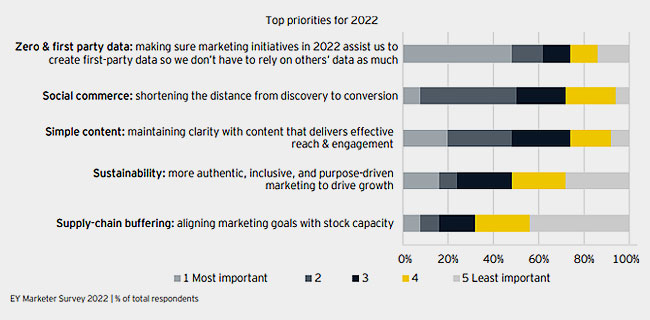
    Zero and first-party data is by far the most important priority for 2022


    • Most Important amongst marketer priorities for 2022 was creating zero and I irst-party data to enable efficient targeting of consumers, particularly given the challenges posed by cookie-less advertising and data privacy regulations

    :: Suggestion 1: Create a fair value exchange for your consumers

    :: Suggestion 2: Step up interactivity and gamification


    • Social Commerce has become an effective way to reduce the time between discovery and conversion and marketers need to understand its nuances and implement social sales channels for their brands at scale

    :: Suggestion 1: Create automatic bot check-outs

    :: Suggestion 2: Maximise role of influencers, tracking their Rol


    • Interestingly, many respondents identified effective content (and its ability to build reach and engagement) as a key priority for 2021

    :: Suggestion 1: Make content purposeful and personalised, based not on what people are searching for, but why

    :: Suggestion 2: Challenge yourself to think about the way stories are being presented [voice, video, visual via mobile and social], while keeping the art of storytelling alive [the heart of the message]


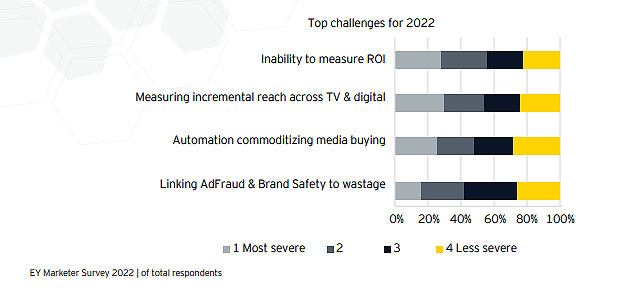
    Inability to measure ROI continues to be most severe challenge for marketers


    • Despite the overload of data generated by digital media, respondents identified measurement of marketing Rol as their number one challenge for 2022

    :: Suggestion 1: Build SMART (specific, measurable, achievable, relevant, time-bound) objectives to justify investments in full-funnel marketing, linked to clear KPls and use evolved attribution models

    :: Suggestion 2: Designate independent, objective owners of the Rol tracking technologies and processes


    • The lack of a common metric across TV and digital campaigns has most markets evaluating their campaign performances separately, and this led to concerns on the genuine incremental reach provided by digital to TV campaigns:

    :: Suggestion 1: Invest in modeling that provides directional guidance on investment strategies

    :: Suggestion 2: Build ways to collect deterministic data sets (actual households or individuals associated with an ad exposure) as a reliable way to control frequency


    Over 70% of respondents had ad fraud management in their top 3 challenges for 2022; yet the problem of linking adfraud and brand safety to wastage is seen as least severe amongst marketer problems. In there, lies an opportunity that must be addressed by the industry at large

    :: Suggestion 1: Continuously detect and protect against fraudulent traffic; boosting standards of measuring digital effectiveness

    :: Suggestion 2: Certify platforms that can demonstrate a proven ability to prevent fraud

  • M&E revenue to rebound 27% next fiscal


    By Our Staff

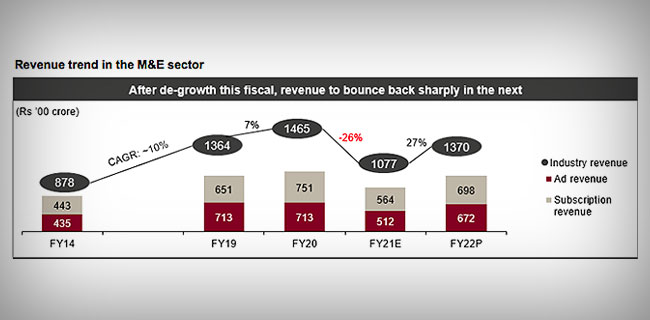
    Revenue of India’s media and entertainment (M&E) sector should script a strong 27% rebound to ~Rs 1.37 lakh crore in fiscal 2022, after contracting ~26% this fiscal. Optically, the de-growth this fiscal and growth expectation next fiscal may sum up to a full rebound. But that won’t be true because the 27% growth will be on a much lower base. Industry revenue next fiscal will still be lower than that in fiscal 2020 (refer to Chart above).

    The time to bounce-back to pre-pandemic levels will be relatively shorter for segments such as digital and television (TV), while print, films, outdoor, and radio would take longer

    Credit profiles of large media companies would be unaffected due to strong balance sheets, liquidity and the revenue rebound, while mid-sized and small ones could see stress, an analysis of over 80 of them rated by Crisil Ratings shows.

    Said Nitesh Jain, Director, Crisil qually to the overall M&E sector’s topline, but since the former correlates strongly with economic growth, the pandemic has had a bigger impact on it. Next fiscal, with strong economic rebound on the cards, ad revenue should grow 31% on-year and subscription revenue ~24%.”

    The TV segment – contributing around half of the sector’s topline – has recovered fully and will report healthy growth next fiscal. Ad revenue saw a sharp contraction initially, but recovered swiftly thereafter, aided by airing of new content, sports events such as the Indian Premier League and a buoyant festive season.

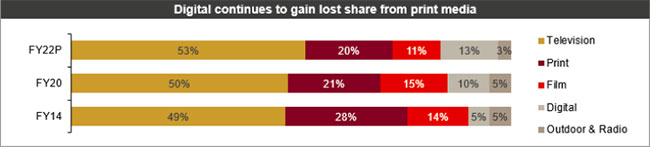
    As for subscriptions, TV was resilient even during the peak of pandemic as people remained indoors. The print segment – contributing a fifth of the M&E sector topline – is recovering, though at a much slower pace, and should be able to rebound fully only by the end of next fiscal. Print is losing share in ad revenue mainly to the digital segment (refer to chart 2. Circulation too, especially for English language, could see a loss of 8-10%, because of increased preference for e-papers in metros.

    However, print companies are rebooting their cost structure and accelerating digital adoption to stay relevant. Films – contributing a sixth to the sector topline – is one of the most impacted segment. But occupancies in theatres should improve with the vaccination rollout and a strong pipeline of content. However, this segment is likely to remain impacted even next fiscal due to social distancing norms and fear of closed spaces.

    Other traditional media – radio and outdoor – are seeing persisting pain, and will likely take much longer to recover (Radio and outdoor segments don’t have any subscription revenue). This is because commuting as well as ad budgets for micro, small and medium enterprises – the key drivers for these segments – will remain restricted even in fiscal 2022.

    Added Rakshit Kachhal, Associate Director, Crisil Ratings Ltd: “Digital has emerged as the medium of choice. The pandemic accelerated adoption of over-the-top (OTT) platforms, online gaming, e-commerce, e-learning, e-papers and online news platforms. This has meant the focus of advertisers has shifted from traditional to digital media. We expect the digital segment revenue to grow 14-16% annually over the medium term. Its share of M&E sector revenue is expected to double to ~20% by fiscal 2024 compared with last fiscal.”

    Given the sharp impact on revenue, cash accruals this fiscal will weaken for all M&E companies except TV distributors. Credit profiles of the large companies are cushioned by strong balance sheets (with most of them net debt-free), while those of small and mid-sized media companies have weakened. More downgrades among the latter led to the Crisil Ratings’ credit ratio (upgrades to downgrades) for the sector sliding to 0.33 in the first nine months of the current fiscal from 0.75 in fiscal 2020.

    Liquidity pressure may intensify for them if recovery in ad revenue is delayed. That said, there is a silver lining to this cloud, too. M&E companies have adopted aggressive cost rationalisation initiatives. Besides, the pandemic-led change in consumer behaviour has accelerated monetisation opportunities for these players through integration of digital media into their traditional businesses. Some of these aspects can lead to structural changes in business models of the M&E sector over the longer term.

  • Digital video share @ 15%, 2 years ahead of forecasts: BCG-CII


    Boston Consulting Group (BCG) and Confederation of Indian Industry (CII) have unveiled a report, ‘Lights, Camera, Action…and the Show Goes On’. The report seeks to evaluate the impact of 2020 on the Media and Entertainment industry and highlights key imperatives for increasing the industry’s resilience in the face of adversity. Said K Madhavan, Chairman, CII National Committee on Media & Entertainment and Managing Director, Star & Disney India: “The pandemic outbreak created many unique challenges to the Media & Entertainment sector. It was commendable to see the entire industry rise to the occasion to engage and entertain millions of viewers while they were confined at home. It’s the sheer willpower and persistence showcased by the stakeholders that have helped convert adversities into opportunities.”


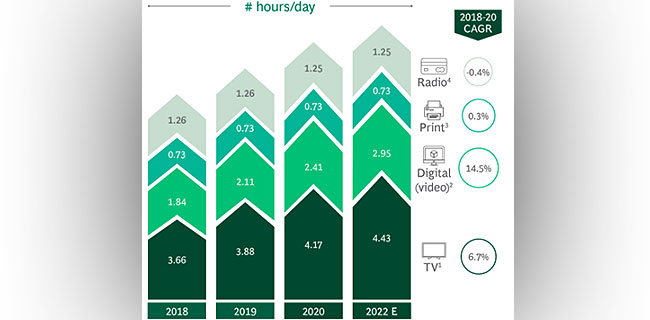
    According to the report, 2020 has seen a massive surge in TV and smartphone video viewership during the weeks of lockdown and beyond as people spent more time at home, and OTT witnessed its presence increase in Tier 2-4 cities due to the high quality, original, and local content marketed using free trials. Covid-19 has had a major impact on how we consume content, both in-home and outside and some of these will have long term implications for the industry. Added Mandeep Kohli, Partner, Boston Consulting Group India: “India continues its unique multimodal growth. TV consumption surged ~40% during lockdown due to an increase in non-prime time viewing. Smartphone video consumption is up as well, with a 50-60% increase in subscribers over last year. Going forward we expect the digital trend to intensify, OTT adoption to continue rising, and the emergence of new business models better suited to the new reality. The share of digital in advertising will also continue to grow, having reached 15% in 2020, a full 2 years before its pre-Covid forecast.”


    Said Kanchan Samtani, Managing Director & Partner, Boston Consulting Group India: “Recent developments such as the resumption of operations and recovery of ad campaigns has resulted in optimism in the industry” explains


    One of the major themes in this year’s report is the potential economic impact that the Media & Entertainment industry can create. This is especially important in the context of the ambitious GDP target of $5 trillion that has been set by the government. The report demonstrates how in economies such as South Korea, the Media & Entertainment industry form a large and growing part of GDP due to concerted efforts by stakeholders to take Korean culture global. The report also highlights opportunities in attractive parts of the value chain such as Visual Effects and Animation, and also calls out imperatives that will need to be acted upon to seize these opportunities. “Countries are developing media hubs to drive impact of M&E – Spain has setup a content city in Madrid to tap into the growing global demand for Spanish content. This gives a boost not only to the M&E industry but also to the tourism and India should aspire to do the same. Continued focus on customer value, increasing our presence in areas such as VFX and animation, and concerted investment in skilling and technology can lay the groundwork needed to help Indian M&E achieve greater heights,” said Samtani.


  • M&E expected to grow at CAGR of 10.1%: PwC


    By A Correspondent


    According to PwC’s Global Entertainment & Media Outlook 2020-2024, the Indian M&E industry’s long-term outlook remains robust as it is expected to grow at 10.1% CAGR to reach 55 billion USD by 2024. A K-shaped bifurcated recovery is on the horizon in which sectors like OTT, internet advertising, video/games/e-sports, and music and podcasts are expected to spearhead growth in the industry. Globally, Digital revenue is expected to contribute 60% to the total E&M revenue by 2020, alone.


    In terms of individual segment market size as a percentage of total E&M revenue, OTT video in India is expected to see the largest gain and reach 5.2% by 2024, closely followed by internet advertising. Segments like advertising and those dependent on physical locations are likely to be further impacted in a negative manner whereas digital E&M spending will increasingly be regarded as a non-discretionary expense. While globally, newspapers and magazines are dropping the free online model and starting to ask readers to pay for quality content online, digital paywalls are yet to become commonplace in India. Furthermore, while India will remain the world’s biggest cinema market in admission terms, cinema revenue in India will contract at a -2.6% CAGR to total US$1.5bn over the next 5 years.


    Said Rajib Basu, Partner & Leader – Entertainment & Media, PwC India: “We find ourselves in extraordinary times, and the pandemic has accelerated ongoing shifts in consumers’ behaviour, pulling forward digital disruption and reaching industry tipping points that wouldn’t otherwise have been reached in the next few years. Our research shows that India will be the fastest growing entertainment and media market globally in terms of pure consumer revenue. Coming out of Covid-19, a K-shaped bifurcated recovery  is expected in which some sectors rise while others fall. Over the next five years, the outlook remains highly positive for digital led segments such as OTT, Internet Advertising, Online Gaming and Music & Podcasts that were perfectly positioned to meet consumers where they are in 2020 – predominantly at home and online,” adding: “However, companies simultaneously have to prepare to meet them where they will be two years from now. They will need to build and maintain direct-to-consumer relationships, offer enough differentiation or scale to compete, and unlock greater value using the right technologies. This is a unique window of opportunity for E&M businesses to transform and make themselves more resilient and relevant for the future.”


    Top 4 segments to advance rapidly:

    1. OTT Video: India holds the most potential of any market in the world and its breakneck rate of growth will see total OTT video revenue overtake South Korea, Germany and Australia to jump to being the sixth-largest market in 2024. Subscription video on demand will be the prime driver of revenue, increasing at a 30.7% CAGR from US$708mn in 2019 to US$2.7bn in 2024. OTT video growth is coming from both inside and outside the home as Internet-connected devices proliferate as the new ‘at-home’ environment has led to the rise of direct-to-consumer apps, local ‘bite-sized’ entertainment platforms and user-generated content (UGC) formats

    2. Internet Advertising: India is now the sixth-largest Internet advertising market in the Asia Pacific region. Mobile will be the primary driver of revenue in the Internet advertising market revenue due to increased data affordability, new mobile-first formats, ability to measure, and strategic targeting. Nonetheless, from a global perspective, Internet advertising in India remains underdeveloped and has massive headroom for growth

    3. Video, Games & E-sports: Gaming and e-sports are capitalizing on the need to bring live experiences into the home in more personalized and more engaging ways. E-sports represented less than 1% of overall market in 2019, but has become one of the fastest growing segments today with a projected 33% CAGR by 2024. However, despite surging growth and enormous potential, the sector tackles with the biggest challenge of low levels of app monetisation

    4. Music, Radio & Podcasts: Podcast industry was already experiencing rapid growth prior to the COVID-19 outbreak. Fuelled by the uptake of music-streaming brands, the overall space is expected to grow at a 13.5% CAGR, to total revenue of nearly US$1.7bn in 2024. India will also see strong increase at a 30.4% CAGR in its monthly podcast listener base over the next five years, supported by entry of foreign players and original content on topics including news, society and culture


    As the industry navigates into the post-pandemic world, one can witness new opportunities for capturing growth:

    > Players bolster subscription offerings – With consumers increasingly paying a monthly fee to access a library of entertainment content, such as films, music, content, fitness etc., media and entertainment industry players are catching on to the value of subscription based models to bring in business. Optimising revenue mix or pricing models to emerge more resilient and capture a bigger share of the wallet will be the focus


    > Physical events look for digital alternatives – Another opportunity made more compelling by the pandemic is bringing live experiences into the home in a more personalized and engaging manner. Digital spaces—e-commerce platforms, virtual event spaces, gaming channels, podcasts—are evolving into powerful new platforms for marketing. Creating new content propositions will help realise new revenue streams


    > OTT will thrive in 2020 as cinema and traditional TV degrow – OTT sector will directly benefit from the closure of cinemas, as some film studios choose to fast-track new releases to home video platforms. Since OTT platforms offer convenience and accessibility to consumers who are likely to hold on to their new habits of streaming ‘at home’, global SVOD revenue may overtake box office spend very soon


    > Landmark acquisitions are out; buying growth and cash flows are in.  – As companies look for ways to navigate barriers, strategic investments & alliances in search of scale and growth will be crucial to determine success in the E&M media industry

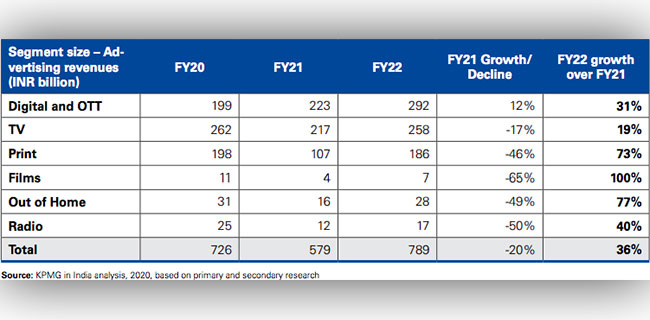
  • M&E to rebound by FY22, notes KPMG


    By A Correspondent


    On Wednesday, on the last day of the second quarter of FY 2020-21, KPMG in India launched the twelfth edition of its Media and Entertainment (M&E) Report, titled ‘A year off script: Time for resilience’. It examines the performance of the M&E sector in “particularly challenging” period that prevails.


    Notes a communique: “India was already experiencing a slowdown in economic activity even prior to the outbreak of COVID-19 in March, and the onset of the global pandemic and ensuing lockdown dealt a severe blow to the Indian economy. The M&E sector has been affected but to varying degrees: outdoor entertainment formats (films and events) and traditional media (print and TV to some extent) have been badly impacted as people stayed indoors and advertising spends dried up. Digital advertising, OTT and gaming fared much better, with massive spikes in digital consumption during the lockdown across geographies and socio-economic classes. Digital advertising spends are now set to overtake those on TV by FY21, which is an important milestone and turning point in the evolution of M&E in India.


    Said Satya Easwaran, Partner and Head, Technology, Media and Telecom, KPMG in India: “The distinction among segments of M&E has become more pronounced with the experience of the lockdown. Marketing spend has moved perceptibly towards digital media and away from traditional segments like print, radio and to some extent TV. A greater reliance on subscription and other paid options as well as the development of a credible digital business model is going to be inevitable for these traditional media segments.”


    Added Girish Menon, Partner and Head, Media and Entertainment:  “There will be a deeper integration of digital technology across the M&E value chain – from content production to distribution. Technology adoption could however face some challenges in terms of skill development and the shift to a digital-first mindset but will result in operational cost savings and potentially lower lead times over the longer term.”


    According to the report, the M&E sector should recover to its current levels and post a 33 per cent growth in FY22 (following a contraction of 20 per cent in FY21), which still implies a loss of around two years of growth. The two areas that offer encouragement are the continued economic growth of Bharat and the universal acceleration of digital adoption among users across geographies and SECs. As per our revised estimates, India could be home to a billion digital users by 2028 rather than the earlier projected 2030 timeline. There have been several structural changes to digital behaviour on account of the experience of the lockdown resulting in a new homogeneity among users, and it is our belief that many of these changes will translate into a more democratic and sophisticated digital citizenry within the country.


  • MxM Open Classroom: Digital Marketing


    Why MxM Open Classroom: Upskill yourself!, That’s what one is told so as to make the extended lockdown work for us. But while doing one of the hundreds of free or paid courses sounds easy, in realit,  it isn’t. And going through the tests and quizzes that are contained in them can be quite daunting. Starting this week, we start a series of ‘open classroom’ sessions. Each week, we will have a five-part series – Monday through Friday that will tackle an important area of the media marketing services domain. We kick off our series with a focus on Digital Marketing with Bhuvi Gupta, a marketing specialist who has


    The HOWs and WHYs of making trends

     

    By Bhuvi Gupta


    According to a FICCI EY report, the Indian Media and Entertainment (M&E) sector grew 9% to reach INR 1.8 trillion in 2019.


    The rapid spread of mobile access is helping the growth of the digital media industry. With a population of 1.3 billion, 688 million internet subscribers and nearly 400 million smartphone users, quantitatively, India already has high numbers but also has high potential for growth. This means that the digital media industry which grew 31% to reach INR 221 billion in 2019 will continue growing and industry experts expect it to grow at 23% CAGR to reach INR 414 billion by 2022. Digital advertising grew 24% to INR 192 billion and is expected to follow a similar growth trajectory. As digital penetration increases, more advertising budgets will get diverted to digital, especially because digital advertising is easier to measure and to finely tailor target audiences.


    The biggest challenge with digital is the evolving landscape – changing algorithms of popular platforms, newer applications of Augmented Reality, new platforms with niche demographics (like Helo, ShareChat, Likee, Bigo), and newer forms of advertising like influencer marketing to only name a few. This makes it difficult to allocate digital budgets effectively because the ‘how’ of being effective is constantly in flux.


    This series is in a sense a cheat sheet to understand digital advertising better and to ease navigating this evolving landscape. In each article, we will evaluate how to best create virality by leveraging popular digital platforms. Key focus platforms will be Instagram, TikTok and Facebook, chosen because of the reach, they garner.


    To kickoff the series we focus on the objective of many if not most campaigns – ‘Virality’. Making a campaign ‘viral’ is the holy grail by which campaigns are measured & many awards given, today.


    Marketers know that in spite of how topical and relevant the communication it is impossible to guarantee campaign virality because there are too many variables.  However, what is attainable is ensuring that a campaign ‘trends’.


    The key difference between a campaign ‘trending’ and it ‘going viral’ are in longevity and organic reach. While a trend may last for a short period of time, may be paid for and limited to a particular target audience, a campaign going viral implies that it has had the longevity of a few days, substantial word of mouth and a high recall value that has surpassed its initial targeting. Hence, while all viral campaigns, trend, not all trending campaigns go viral. With the right strategy it is possible to make a quality campaign trend, which may be the push it needs to achieve virality.


    A quality campaign is one, which while espousing product benefits, is topical and evokes a strong emotional response so that it is prompts the viewer to share it to enable word of mouth. An easy test to determine shareability is to ensure that the messaging is entertaining, inspiring or informative or a combination of the three.


    Here are Five ways to make a quality campaign ‘trend’–


    I. Choosing 1 or 2 focus platforms

    Today every social media platform has a key age and socio-economic demographic. Depending on the messaging, the brand, and campaign budgets focus platforms should be defined. It is wise not to focus on more than two, even if budgets permit. Successful campaigns will spillover organically to other platforms, anyhow.  For e.g. in 2019, Pepsi used TikTok as their primary platform for promoting their new brand anthem with the tagline ‘Har Ghoont mein Swag’. The campaign anthem was sung by 2019’s most popular Bollywood Punjabi singer, ‘Baadshah’ and the music video starred popular Bollywood youth icons & social media influencers, Tiger Shroff & Disha Patani. TikTok was was aligned to the brand’s mass & youth focused targeting. The campaign was a huge success, with 240+ million views and over 15,000 user-generated videos within 24 hours of its launch. The campaign also naturally spilled over to Instagram, where it received 20+ million views. The campaign remains one of TikTok’s most successful brand campaigns in India.


    II. Challenges

    A campaign which requires the consumer to engage will automatically have higher recall value & will also allow for the network effect which will help it to trend organically. The messaging of the campaign is key to how it can have a challenge component.


    Challenges are especially relevant for TikTok, and Instagram. Hashtag challenges form a key component of TikTok and challenges typically trend for a week. Hence, hosting challenges aligned to brand campaigns on TikTok can help a campaign achieve virality.  Currently, a Challenge trending on both TikTok & Instagram is the #PassTheBrushChallenge, where different women, pass a makeup brush to each other while showing before & after images of themselves wearing makeup. The challenge has not been initiated by any brand, but has gone viral with different kinds of iterations being produced, including a male version with a hairbrush!


    III. Hashtags –

    A hashtag, which can be the campaign tagline in entirety or a part of it is a key component of a trending campaign, as it is an easy identifier when the post gets shared, or mentioned. A hash tag is easy to understand, catchy, and related to the brand. It should ideally be not more than 3-4 words, have a verb, and either the brand name or a keyword from the catch phrase.


    Hashtags are vital for discovery on Twitter& TikTok, while they serve as identifiers on Instagram, Facebook & YouTube. Along with the key campaign hashtag, it is advisable to use other aligned & popular hashtags with which the content can be discovered.


    For e.g. in the Pepsi ‘Har Ghoont mein Swag’ campaign the key hashtag used was the same as the tagline, #HarGhoontMeinSwag along with #SwagStepChallenge. The campaign was followed up by a follow up campaign, with a new single called ‘Swag Se Solo’ sung by 2019’s breakout Bollywood singer, Tanishk Bagchi, released in February 2020. This campaign used the hashtag #SwagSeSolo and re-used the hashtag #SwagStepChallenge.


    IV. Influencer Marketing –


    Today, to break the clutter, it is crucial to invest a part of advertising budget on influencer marketing. Influencers enjoy loyal fanbases, and due to their relatibility, are often more trustworthy and credible than celebrities. Targeting influencers aligned to target audiences can help get exponential reach and engagement.


    However, influencers per platform need to be defined because each platform has different influencers in the same niche. A beauty influencer on TikTok may not  enjoy the same following on Instagram & YouTube, and hence can not be used for a campaign with Instagram as the primary social media platform.


    Influencer marketing works on all platforms, but is especially relevant on TikTok, Instagram and YouTube. It is especially effective for marketing new launches. Popular mobile phone brands often leverage influencer marketing while marketing their new launches – One Plus, gets influencers across industries to post videos highlighting the USP of the new launch. Google hosts parties with photo booths and gourmet food and, gifts influencers the latest ‘Pixel’ device. Photos of the party get shared on social media by all the attending influencers, thereby successfully creating a buzz.  One of the most successful examples of influencer marketing remains the selfie taken by Ellen DeGeneres at the2014 Oscar ceremony  (sponsored by Samsung) where Hollywood’s A listers posed for a selfie taken with a Samsung Galaxy Note 3. What remains ‘Note’-worthy is that the picture, which was shared, was not of the selfie but that of the stars taking the selfie so that the ‘Samsung’ logo was prominently displayed.


    V. Digital Advertising –

    For platforms such as Facebook, and now Instagram, which have attained maturity in their life cycle, the competition for organic reach is high. Hence, using advertising for discovery and amplification is necessary for virality. To enable speedier discovery it is advisable to use advertising on TikTok as well. Digital advertising used in conjunction with the above strategies, on the chosen platform (s) can effectively amplify the campaign. While it will definitely help a campaign to trend, it can often serve as a tipping point for creating virality.


    The gulf between a trend and virality is deep and often, a trending campaign that reaches relevant audiences is sufficient to earn ROI and achieve the brands marketing objectives. Virality is very often a vanity metric, which helps the brand create widespread awareness like traditional ATL marketing but may not aid in creating actual consumer intent.


    Bhuvi Gupta is a marketeer with over a decade of work experience, of which the last six have been in the media & entertainment industry. She has been a part of many launch marketing campaigns with experiences at the Times of India group, Republic TV and the latest in marketing a Bollywood film
     

  • Dark Days Ahead for Adspends


    By Indrani Sen


    Last week, KPMG released a report titled “Covid-19: The Many Shades of a Crisis” trying to provide stakeholders in media and entertainment a perspective of the effects of Covid-19 on M&E sector (https://home.kpmg/content/dam/kpmg/in/pdf/2020/04/the-many-shades-of-a-crisis-covid-19.pdf).
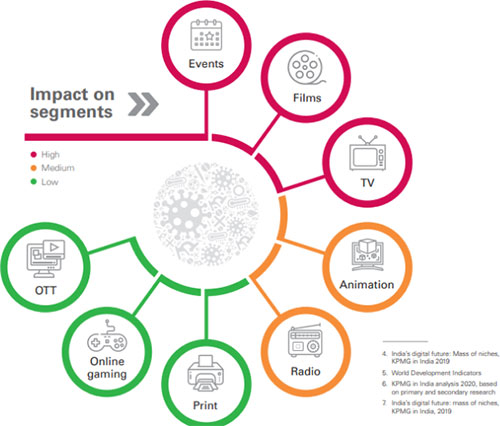
     

    The report reviews three alternative scenarios related to the overall performance of Indian economy. The first scenario assumes that the spread of covid-19 would be largely contained by April-May and Indian economy could grow in the range of 5.3-5.7% in FY21. The second scenario assumes that under the shadow of a global recession with a containment of spread of the virus in India, the country could witness 4-4.5% growth for FY21. The third scenario assumes a proliferation of the virus in India accompanied by a global recession, GDP growth could fall below 3%. However, the report does not throw any light on how the three alternative scenarios may affect the M&E sector in different ways.


    The title “The many shades of a crisis” relates to how Covid-19 has affected the different segments in the M&E sector. The graphical presentation of their assessment (shown below) raises some doubts regarding the parameters used for making the assessment, particularly in relation to traditional media where print has been shown as having low impact against television having medium impact.


    Source: KPMG Report “COVID 19: The many shades of a crisis”


    While BARC data is showing a week-on-week increase in TV consumption, at the same time there is de-growth of advertising revenue leading to slowing down of monetisation with additional crisis of production of new content /episodes of the serials. KPMG has predicted for TV “slow ad spend recovery in medium term with long term risk due to digital competition”.

    On the other hand, KPMG has predicted “a new lease of life” for print riding on the credibility of the printed words against proliferation of fake news in social media and has advised print media to “leverage positive consumer segment and build strong digital products to capture the opportunity”. This advisory ignores the current scenario related to printing and distribution of hard copies of newspapers and the various hurdles which they may face in recovering their circulation and readership post COVID 19. It is difficult to agree with KPMG’s views that the impact of COVID 19 will be less on print than on television.


    Animation sector also has been hit severely as work from home poses a challenge to implementation of the tools and techniques which are difficult to access from home of the individual illustrators. High fixed costs and high investment costs of the animation sector clubbed with cancellation/ postponement of contracts have created a serious cash flow crisis.


    The impact on radio also has been quite high as there is a loss of listenership due to lack of travel and work from home. Many advertising campaigns on FM radio are linked with activation and events at various social gatherings which have been as badly affected as the events sector. KPMG agrees that ad spends on radio will take time to recover and assures that demand for timely localised content should remain high even after the recovery from the virus. Given the restriction on production of news content by FM radio, they can do very little to satisfy the demand for timely localised content during lockdown and after removal of lockdown.


    KPMG shows that Events and film sectors have been badly affected due to social distancing and the OTT and gaming sectors have gained riding on the additional time spent by people at home. KPMG predicts footfalls in cinemas may take a while to return to normalcy and live events may also take longer time to recover as consumers emerge gradually from the social distancing mode. Both OTT and gaming can benefit if the growth in current consumption can be converted to habitual activity.


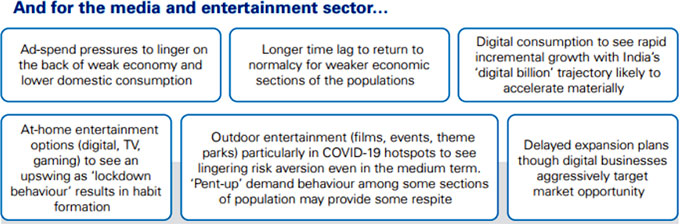
    Summing up, the KPMG report provides the following insights for the M&E sector:


    Source: KPMG Report “COVID 19: The many shades of a crisis”


    The above themes will play across the M&E value chain impacting supply chain, consumption and monetisation. KPMG apprehends that the gap between India and Bharat in consumption of various goods and services may widen due to the reverse migration from urban areas to rural areas as a result of lockdown and halt in all economic activities. Remote collaboration for creative ideation and scripting may last beyond COVID 19 altering the supply chain management of content creation permanently. Finally as far as monetisation is concerned, KPMG predicts longer timelines for ad spend recovery as the economy would continue to be under stress even after the virus is contained. The slowing down of the economy would have adverse impact on key advertisers in FMCG, auto, e-commerce etc. and they might take longer time to restore their ad spends to the level before the pandemic struck India.


  • Reinvent! M&E execs underscore need to survive tech disruption


    By A Correspondent


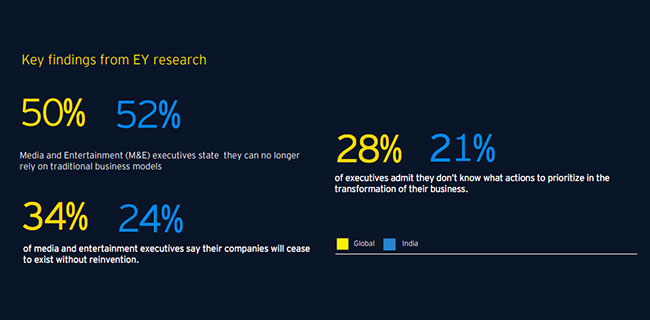
    Faced with multiple evolving and disruptive forces, 52% of executives say they can no longer rely on traditional business models if they are to remain future relevant, according to EY’s report titled, ‘How are media and entertainment businesses reinventing in an age of transformation?’. The report by EY (consulting firm Ernst & Young now refers itself as EY) analyses the views of leading media and entertainment companies and their executives to reveal catalysts, strategies and actions that are reshaping business transformation in a dynamic industry.


    The survey further highlights a sense of perplexity among M&E businesses, with 28% indicating the need to reinvigorate their business, without thorough knowledge of what aspects to prioritise. Due to a plethora of options available to invest in digital tools, one in five executives are unclear on how to prioritize their digital investments. The dilemma of whether to focus on content production for immediate gains as against building direct to customer and platform and data capabilities were cited as key points of contention.


    Said Ashish Pherwani, Partner, Media & Entertainment Leader, EY India: “With fast-paced transformations in business models and revenue streams, media and entertainment companies that otherwise are optimistic about change, are facing a challenge to determine a starting point. While there is no single path to reinvention, businesses are prioritizing direct to customer relationships, platformmatic ad sales and community subscription models, to wade through the waves of technological disruption.”


    The report states that one in two Indian executives felt the pressure to maximize short term results as a barrier to developing innovative business models which also reflected in the findings where just one in three Indian executives believe in upskilling of their existing workforce. 24% of Indian executives felt that their companies would cease to exist without innovation, demonstrating their confidence that traditional media will survive in the future.


    The survey also reveals three ambitions that M&E companies across subsectors are prioritizing above all else:

    :: Pursuing operational excellence and agility is the industry’s top transformation ambition

    Executives believe that simplification is the hallmark of the new operating model. 67% of the executives prioritise consolidation of internal segments to streamline the business, while 50% of executives identify de-layering management and increasing spans of control for remaining executives to be prominent.


    :: Rebooting innovation strategy and approach

    With 48% of executives feeling the pressure to maximize short-term results as a barrier to innovation, balancing sustained success against long-term vision requires a structured approach. 34% of executives see incubators within the core of the business, as a driver of innovation.


    :: Accelerating talent and skills development

    33% of the M&E executives cite upskilling of the existing workforce as the key to talent development highlights the growing imperative to foster continuous learning. To remain relevant, workers need to migrate up the value chain, reinventing themselves and continually improving their capabilities.


    For info: How are media and entertainment businesses reinventing in an age of transformation? is based on a survey of 350 global media and entertainment executives including 29 from India. It takes a representative view of companies by scale, geography and industry subsector. For each question and unless otherwise stated, executives were asked to select their top three responses from a predefined list of options. For example, a response of 50% means it was selected as one of the top three answers by half of respondents.

  • A Wishlist from the New Decade


    This is the sixth (and the last) in a series of decade-ender lists in this column. The previous lists:

    The most-defining Hindi TV shows of the decade

    The most-defining Hindi films of the decade

    The most successful OTT brands of the decade

    The most successful TV channels of the decade

    The most important emerging trends of the decade


    By Shailesh Kapoor


    It’s only 17 days old, but 0.46% of the new decade is already over. Last week, I wrote about the important trends that emerged in the Indian Media & Entertainment space over the last decade. While writing that, I wondered: Can we even begin to imagine what an equivalent list will look like in Jan 2030, for the 2020-2029 decade? That would certainly be ambitious, almost foolhardy, to attempt. But a more realistic exercise would be to list what one would wish from the new decade.

    So here are five things, in no particular order, that I wish happen to the Media & Entertainment industry in India in the coming decade. And hopefully, in the early parts of it.


    A Regulation-Free TV Regime

    The new decade has started with more chaos on an issue that’s been artificially manufactured and then incessantly fueled by Government of India and its agencies. After the New Tariff Order (NTO), there’s NTO 2.0, and the arbitrary TRAI guidelines continue to get more bizarre by the day. Interference of the government in private television has been an irksome factor the TV industry has learnt to live with over the years. But this time, they have rightly taken TRAI to the court.

    There’s little argument in favor of price regulation in a category that offers the best value-for-money compared to any other form of entertainment available. By subjectively questioning the price points every now and then, TRAI continues to baffle us. In a free market, the consumer will dictate the ideal price points. Channels have the option of being free-to-air, and eventually, the market will find segments and niches that are willing to pay a lot more or a lot less than the median.

    I hope we are not discussing NTO 8.0 in 2030. But something tells me that we may just be doing that!


    Better Marketing Quality

    The quality of marketing in the Media & Entertainment industry is arguably poorer than most other sectors. While the creative output (trailers, posters et al) may range from very good to very poor, the real bone of contention I have is with their aversion to strategic marketing. Very few media brands or products approach marketing in the classical FMCG way. Marketing objectives are too transitional and tactical, and almost never strategic. Ironically, the industry, especially some companies in the television space, is fairly good at content strategy. But marketing strategy approaches being used are highly nascent, and have almost a college-project-like feel to them. Be it television’s unidimensional obsession with the ratings data or film producer’s obsession with following the standard marketing template being used for almost all films now, there’s jadedness around.

    The silver lining is that there are a few companies and professionals who recognise this, and are consciously working on changing the marketing rules of this sector. More power to them in the new decade!


    An Oscar, Maybe?

    The Indian Oscars story over the last 18 years has been a dodgy one. After Lagaan won a nomination, and lost to a tough competitor, there hasn’t been much to show by the way of Oscar nominations, let alone an award. There is no need to be obsessed with the Oscars, some argue. While that’s correct, not being able to feature in the top international films for 18 years in a row is a worrying comment on the quality of cinema being produced in India, when benchmarked globally. Our theatrical business has been stable over the last decade, and India remains one of the few countries whose cinema has managed to stay strong despite the Hollywood superhero invasion. Surely, we can do better in terms of our global representation.


    OTT Measurement

    The OTT content factory has flourished in the last three-four years. In April 2017, BARC India announced its digital measurement initiative. After multiple delays, the initiative seems to have lost prominence now, and doesn’t seem to be in sight anytime soon. The absence of a consolidated digital measurement metric can be a deterrent in the growth of the AVOD business, which relies on advertising, in the coming years. Even from a content perspective, absence of clear knowledge on what’s working and what’s not can only hamper the quality of content being churned out. In the current scenario, no one else except BARC India seems to be in the pole position to make this happen. Hope they have this high on their priority list.


    Better News: Wishful?

    Traditionally, there have always been news platforms that are pro- or anti-establishment. But now, we have right-aligned and left-aligned news platforms (currently, the former enjoys a clear majority), and the masks are off too. Ideological colouring of news is extremely worrying in today’s times, when news consumption and its impact is at an all-time high. In the early half of the last decade, television news saw the emergence of the debates format. News got louder first, and then got ideologically colored too, and in no subtle way on either count. Arnab Goswami, the flagbearer of this decadence, is probably the most impactful television celebrity of the last decade, along with Kapil Sharma. The new decade needs to find its own Arnab. One who’s more assertive than loud, and more conscientious than coloured.


  • The Most Important Emerging Trends of the Decade


    This is the fifth in a series of six decade-ender lists in this column by Shailesh Kapoor.


    The previous lists:

    The most-defining Hindi TV shows of the decade

    The most-defining Hindi films of the decade

    The most successful OTT brands of the decade

    The most successful TV channels of the decade


    By Shailesh Kapoor


    The decade that went by was unmistakably eventful for the media & entertainment industry. But isn’t that true for every decade, and for most industries? Ten years is a long time, especially given the pace at which technology is evolving, and there are bound to be fundamental shifts in how a category is perceived, consumed and transacted.

    Here are the five most significant trends that emerged in the last decade in the media & entertainment business, in no particular order. While a lot happened on the back-end, such as the launch of BARC India or the introduction of NTO, the trends here have been identified from a consumer perspective, leaving out the B2B shifts the decade may have seen.


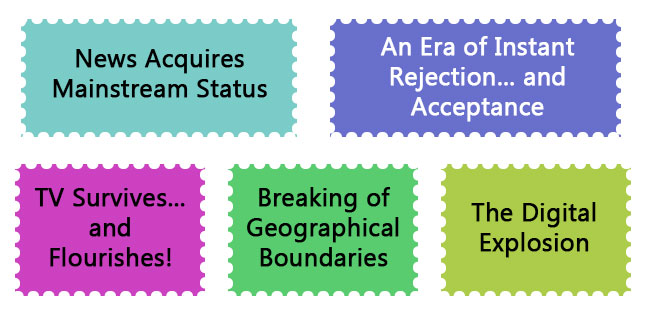
    The Digital Explosion

    Perhaps the most significant shift the decade saw was the rise of the digital media, first in the form of social media and YouTube, and then via the OTT category in the second half of the decade. The presence of unlimited and ever-growing content options online (including television catch-up) had various levels of impact on consumer behaviour and taste. The exposure to genres and languages increased, leading to wider acceptance of different forms of content, including that from the West, at a mainstream level. The digital growth also put increasing pressure on other media, such as TV and films, to up their game, lest they should lose audience to a new-age media option. Eventually, digital has managed to co-exist with other media. TV viewing time has not gone down, and box office has not degrown, over this decade. But digital content has opened up a new realm of possibilities for content creators and consumers alike, the true potential of which may be realised only in the coming decade.


    Breaking of Geographical Boundaries

    While television continued to be culture and language-driven, we saw the breaking of geographical boundaries in films and digital content in this decade. The prime example, of course, is the Bahubali franchise. Who would have predicted at the start of the decade that the biggest ‘Hindi film’ of the decade will be a Telugu film dubbed in Hindi, without any Bollywood actors in it! Hollywood continued to get stronger too, with certain years showing unreal levels of growth in the Indian market, in the range of 25-40%. Marvel Cinematic Universe is probably the strongest entertainment brand in India today, and that itself is a testimony to how geographies matter less today than ever before. All international and regional content did not cut through, but Indian audience latched on to culture-neutral content, especially in the action and adventure genres, from around the world.


    TV Survives… and Flourishes!

    Fallacious, unresearched and over-simplistic arguments around cord cutting and the imminent death of television have gone on for too long now. The truth is: Television is here to stay, at least in India. And that’s not just because India is a mass country with so many small towns and villages that it will take a few years for digital content to truly penetrate. Television’s ‘survival’ story in India is one about culture and values, than about content. Television is the only form of media consumption that’s done almost entirely at a family level in India. Fearful of their children slowly disassociating themselves from all things traditional and cultural, parents have turned to religion and television to keep the family bonding and identity alive. In fact, the arrival of digital content, which is essentially consumed solo, has further amplified the power of television as a collective medium for the entire family. Which is why even the most affluent Indian households have decided not to have a second TV in their house, and at 4-5% only, India’s multi-TV penetration is negligible.


    News Acquires Mainstream Status

    From being as a males-only, North India-skewed genre, news acquired a more mainstream and ‘mass’ status this decade. While comparing viewership over decades is problematic because of the constant changes in the ratings universe, the growth of news ratings at the time of marquee events has been consistent and very noticeable. Women audience have warmed up to watching primetime news to some extent, and hence, in many families, news has emerged as a legit option for 9pm or 10pm family viewing. A large part of this change can be attributed to the change in the political regime in the country in 2014, and the political and ideological polarisation that has followed. The rise of digital news, too, has fueled an overall acceptance of news content across media. And for all the flak they face, news channels have made news more accessible, even if it is via making it ‘entertaining’.


    An Era of Instant Rejection… and Acceptance

    Social media had come in towards the end of the last decade. But its true power was felt this decade. Rejection or acceptance of a new piece of content, such as a film or a series on the internet or television, would earlier be an organic process, lasting upto weeks. Today, it can be a matter of hours before the word spreads around. There is no place to hide for mediocre content, especially as consumers are spoilt for choices, and have ready access to opinions and reviews all the time. Films like Thugs Of Hindostan and Kalank sank within a day of their release. This digital-fueled trend puts increasing pressure on content creators and distributors to raise the bar, or be left behind. The shelf life of content itself has reduced significantly, and even the best content has a window of a few weeks to get its audience. ‘Now’ is everything! And that’s not necessarily a good thing, but that’s a topic for another day.


  • Das ka Dum with Dr Bhaskar Das: When will the achhe din happen in Indian M&E?

    On the second working day of this rather short post-Diwali week, here’s a question uppermost in our minds. If you wish to access the archives, please go to the Das Ka Dum tab on the website’s top navigation bar.


    Q. According to you (given your market intelligence and inferences), for the M&E sector, kya achhe din aane waale hain?


    A. What is achhe din for the M&E segment? I presume your answer would be when monetisation would be facile? No inter-category/ format migration of attention and cash would happen? No rightsizing will happen? Double-digit growth would accrue to all leading  media companies, if not all, et al? Imagine ships are constructed to be anchored in the shore. As a result, no ship would get drowned.


    But is predictable and favourable wind the only indicator of acche din? I differ. I find that the M&E industry is going through the best of times. Technology and consumer culture are together tectonically shifting the topography of competitiveness. In this journey, headwinds might queer some pitches but when one remains perpetually paranoid and permanently in a beta state, one develops  agility, excitement and resilience during  navigation. Now if that’s not acche din, what can it be? Instability is the new stability.

  • A Billion Opportunities


    By A Correspondent


    The world is keenly looking at the Indian media and entertainment (M&E) market given the potential of growth. There is of course fair reason: According to consulting firm EY (aka Ernst & Young), with a “population of more than a 1.3 billion people, India represents a massive market for media and entertainment (M&E) companies, with very positive growth fundamentals across virtually every type of media.”


    Said John Harrison, EY Global Media & Entertainment Leader: International expansion is critical for global media and entertainment (M&E) companies seeking to build scale, tap new audiences and enhance competitive positioning. Those looking to seize the upside of growth should set their sights on India. With more than a billion consumers and a favourable macro backdrop, India offers a massive opportunity across almost every type of media.


    In a report released globally in late June 2019 titled ‘How a billion screens can turn India into a media and entertainment powerhouse’, the EY M&E team has reflected on the state and potential of M&E in India. “India’s M&E market is strategically interesting to global players seeking to monetize content and capture growth upside, either as a participant via licensing or other commercial arrangements, or as an outright owner through an in-bound acquisition or organic investment approach. Advertising, the lifeline of India’s M&E industry, remains among the lowest in terms of spend as a percentage of GDP, signaling upside potential. In addition to a myriad of digital outlets, India has more than 850 TV channels and over 17,000 newspapers, making it one of the most diverse and vibrant media markets globally. The country is also at an inflection point in wireless broadband connectivity and infrastructure that, combined with its GDP growth and young demographics, offer new opportunities.”


    Click here for the full report