Tag: Mathrubhumi

  • Mathrubhumi wins big at Pepper Creative Awards 2018

    By A Correspondent


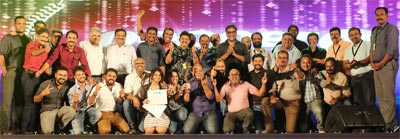
    The Mathrubhumi Group bagged the highest tally of 16 metals and Advertiser of the Year recognition at the 12th edition of Pepper Creative Awards 2018. The awards is jointly organised by Advertising Club Cochin and Pepper Creative Awards Trust, at Le Meridian, Kochi. With 4 Gold, 7 silver, 5 bronze and 1 finalist wins, Mathrubhumi brought home 16 metals, under its various brands.

     

    The awards night was graced by industry veterans R Balki and Prathap Suthanplus Dinesh Swamy – Chief Creative Officer, Liqvd Asia.


    Commenting of the occasion, M V Shreyams, Kumar, Joint Managing Director, Mathrubhumi said: “It’s been an overwhelming experience to witness win for the group on such a grand industry platform. I congratulate my team for demonstrating such high quality work across such a wide category range. We hope to get more acclaimed recognitions in the years to come”


  • Mathrubhumi International Festival of Letters to celebrate literature in Kerala

    By A Correspondent


    Trivandrum will soon host one of the largest and polyphonic cultural events in Kerala. Mathrubhumi International Festival of Letters will bring together over 150 international and Indian writers with sessions devoted to divergent topics, trends, ideas and genres ranging from fiction, poetry, nonfiction, politics, environment, travel and cinema prominently. Some of the  writers coming  for Mathrubhumi International Festival of Letters Include Oksana Zabuzho, Shashi Tharoor, William Dalrymple, BigaoChuol, Deepak Unnikrishnan, Felicia Yap, Kurkov, Mohammed Hanif, Andrei Kurkov, Balachandran Chullikad, Raghu Rai etc.


    Festival Committee Chairman M P Veerendra Kumar said: “Mathrubhumi wishes to transform the Mathrubhumi festival of Letters in to a strong and powerful cultural platform in the world where serious discussions happen around literature. What envision this enterprise as a cultural rendezvous that will spark off new thoughts and writings.”


    The festival directors of MBIFL include writer-editor C P Surendran, Senior Journalist Sebin Iqbal and Mathrubhumi Executive Editor P I Rajeev.


  • Mathrubhumi awarded ‘Best International Publisher’ award in Sharjah Intl Book Fair

    By A Correspondent​


    Kerala’s leading media conglomerate Mathrubhumi bagged the Best International Publisher Award at 36th edition of Sharjah International Book Fair. The group became the first Indian media house to win this prestigious title.


    The award by received by M V Shreyams Kumar, Joint Managing Director, Mathrubhumi Printing & Publishing Co Ltd from Sharjah ruler and supreme council member his Sheikh. Sultan bin Muhammad Al Qasimi at the inaugural session of SIBF.


    Speaking on the occasion, Shreyams Kumar said, “It’s an honour to receive such a prestigious accolade at this time as mathrubhumi just marked its 94th birthday. It’s a great privilege that we have received the award from the ruler who has high regards and fondness for books. The award is a recipient of efforts and hard work put in by our team”.


  • Indrani Sen: Celebrating with Print

    By Indrani Sen


    It has become fashionable among professionals in the media and advertising industry to denounce print media and debate how long it is going to survive in India against the onslaught of digital media. However, the reality seems to show a different picture at the beginning of this festive season. Yesterday’s Times of India, Delhi edition had 100+ pages including 45 full-page commercial ads. The “Cover on Cover” concept has probably created a record with the TOI masthead and front page news starting from page 10 after 9 full page ads!

    If the advertisers are willing to pump in so much of their advertising budgets on Print media during the festive season, we can write off the prophecy of Print Dying in India in near future. The question of arresting the decline in the rate of growth of revenue is a challenge which will keep on haunting the Indian Print media, but it will take many more years before the growth becomes negative.

    The festive season kicks off with Ganesh Chaturthi in Maharashtra and Onam in Kerala among some other regional festivals across India. This year, Mathrubhumi launched a campaign with integrated media solutions around Onam and reaped benefits both in terms of readership and revenue. (http://www.mxmindia.com/2017/08/mathrubhumi-offers-unique-integrated-media-solutions-for-brands-in-kerala/). Apart from the English newspapers, it seems that regional newspapers in most of the states are also doing well during this festive season. In West Bengal where Durga Puja rituals commence from September 26ty, decent ad traffic has been showing in all the Bengali newspapers apart from the English newspapers.

    Recently, we held a Communication Summit at Symbiosis Institute of Media & Communication, Pune, where we invited speakers from the industry to share “Stories from the Field” with our students. Among other speakers, we had invited Basant Rathore, Senior VP, Strategy, Business Development & Brand at Jagran Prakashan Ltd. The “Stories from the Field” shared by Rathore were a great learning experience for our students as well as faculty. I, personally, have decided to research more on Indian regional newspapers and to document reasons behind their phenomenal success.

    Ever since I have started writing this column in mxmindia.com, I have written only three articles on print media. Exactly two years back, on September 28, 2015, I wrote a piece “Why our Print Majors must come out of their Comfort Zones?” which was followed by “The Seismic Shift” on February 1, 2016 and”Indian Magazine Industry needs to look beyond Print” on March 6, 2017. I might have touched on print media in other articles which were not exclusively on the print media.

    We will be able to assess the total spend of festive advertising in print and its performance in comparison with other media after the Adex for the festive seasons get published. In the meantime, let us celebrate this festive season with Print!


  • Tasks before Rajat Sharma as head of the News Broadcasters Association


    By A Correspondent

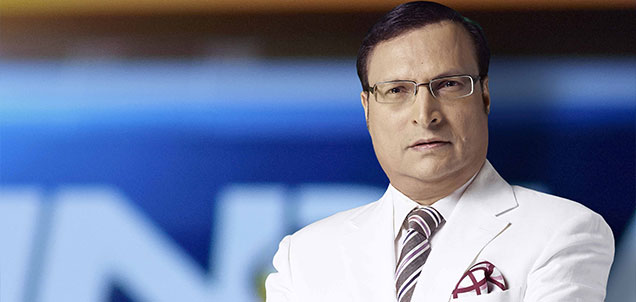
    Veteran journalist and Chairman and Editor-in-Chief of India TV Rajat Sharma was elected President of the News Broadcasters Association for 2017-18. This happened at the NBA Board Meeting soon after the 10th Annual General Meeting (AGM). Sharma was also President of the NBA from 2014 to 2016. Last year, ABP News Network MD and CEO Ashok Venkatramani was elected President and later India Today Group CEO Ashish Bagga took on that role. Both Venkatramani and Bagga quit their respective organisations while being President.


    MV Shreyams Kumar
    Anurradha Prasad

    Meanwhile, MV Shreyams Kumar, Joint Managing Director, Mathrubhumi Printing & Publishing has been elected Vice President and Anurradha Prasad, Chairperson-cum-Managing Director, News24 Broadcast India Ltd is the Honorary Treasurer.


    Said Sharma in a statement: “I thank all members for electing me as the President of the NBA. As President, I hereby take the opportunity to reassure members that we shall walk together in bringing in more credibility and independence to the news broadcasting industry.I shall put in my best efforts to make the fraternity more accepting of our contemporaries, striving for healthy competition.”


    Other members of the NBA Board are: M.K. Anand, Managing Director & Chief Executive Officer  – Times Network – Bennett, Coleman & Co. Ltd, K.V.L. Narayan Rao, Group CEO & Executive Vice Chairperson NDTV Group, Rahul Joshi, CEO News & Group Editor-in-Charge, TV18 Broadcast Ltd, Rajiv Singh, Executive Director & COO – Zee Media Corporation Ltd, Avinash Pandey, Chief Operating Officer -  ABP News Network Pvt. Ltd and I Venkat, Director, Eenadu Television Pvt. Ltd.


    In most industry associations, unless there is a very specific reason for the move, it’s the Vice President who takes on the President’s role in the next election. Interestingly, MK Anand was Vice President for 2016-17 and was likely to have taken over as President, so the move to elect Sharma is noteworthy.


    Sharma, it was rumoured, was unhappy with the earlier dispensation of the NBA and had in fact even skipped some Board meetings. A few months back, the NBA had advised its members in the English news space to opt out of the BARC ratings if they felt aggrieved by the BARC decision to publish the Republic TV numbers despite requests to BARC to not publish it. At that juncture, MxMIndia believed that the NBA took an incorrect decision and we wondered why the various NBA Board members who had no direct interest in English news television didn’t object to the NBA advisory. We later learned that Sharma and a few others were not party to the NBA decision, so perhaps our original comment was unfair on him.


    Rajat Sharma and his team of officebearers of the NBA have a job on hand, given the way the business has been growing. Here’s a partial list of tasks before them:

    1. Landing Page and Dual LCNs: While there has been a settlement on the dual LCN issue, many channels have invested big monies on netting better viewership thanks to deals on landing pages. It is important to have an NBA policy on the issue and a very clear advisory needs to be issued in this regard
    2. Self-Regulation on News Channels: While each channel can have its own editorial policy and it should be free to align itself with a political formation or ideology, the role of the self-regulator becomes critical, as very often guests on shows feel truly aggrieved because they are damned on live nightly news
    3. BARC numbers: There has been some discussion whether the weekly ratings issued by BARC should be made more infrequent – perhaps fortnight or even monthly as the sample size of news television-watchers is very low
    4. Given that the stakes are very high for every channel, it’s important that efforts are taken for the greater common good of the fraternity. Employee welfare and safety of journalists is critical.
    5. The biggest threat to news television is from digital. News videos are now freely accessed on the Web, via apps and even on Twitter and Facebook. Sharma and his team need to look at integrating their broadcast and digital operations to work together and forge ahead.


  • Mathrubhumi offers new integrated solutions

    By A Correspondent


    With Onam on the anvil (note: MxMIndia launched on Onam Day in 2011), Mathrubhumi has launched a campaign on integrated media solutions.


    A series of print ads have appeared on trade publications, but these ads in phonetic Malayalam. Readers were prompted to know what the gibberish looking questions meant via QR codes or to key in a link. Each QR code or link threw up a tongue-in-cheek film of Malayalees and their Onam purchase decisions and ended with a call to action to explore Mathrubhumi Groups custom integrated offerings.


    Said Kamal Krishnan PS, National Head – Integrated Media solutions, Mathrubhumi Group: “Media planners are bombarded with exaggerated claims of market coverage during festive season by all major media houses. We as a group, wanted to bring attention to what we can deliver through integrated efforts to help our clients achieve their festive goals in Kerala. Integration is the need of the hour to deliver desired responses to advertising by optimizing the strengths from within the group.”


    Commenting on the campaign, Francis Thomas, Creative Director, Maitri Advertising Works said: “The challenging brief to disrupt the traditional approach and to extend the experience of integration was exciting. The narratives, based on the idea Malayalees will be buying what they see in various Mathrubhumi brands, is conveyed through subtle insightful humor about Malayalees but with strong conviction”.


  • HUL/PHD, Colors & Jagran lead Indian charge of 5 Golds at Montreux Festival

    By A Correspondent

    The road to Cannes, it is said, starts from Montreux. Montreux Festival is a precursor to Cannes as it happens in April and every year many Cannes aspirants test their work at Montreux. Several Montreux winners in the past have gone on to win at Cannes.

    Indian companies and creative agencies struck five golds and sixteen finalists at the Golden Award Montreux Festival this year in Switzerland.

    PHD won a Gold and five finalists for HUL brands while Viacom 18 won a Gold and three Finalists. Jagran Prakashan did well with a Gold and 3 Finalists. Tree Design and  Mathrubhumi won a Gold and Finalist each. Other Indian winners were Living Foods channel (two finalists) and Dainik Bhaskar Publication-one finalist award.

    The Montreux Festival Switzerland Jury: From left: Ajay Chandwani Percept India and Brand Engagement Consultant; Barbara Aparo fashion.tv Vienna; Mark Chalmers Virtue,Vice London; Milka Pogliani Italy ,Harry Betke, Festival Organizer Austria, Christian Orth, Merck Frankfurt; Olivier Teepe Cloudfactory Amsterdam; Jorg Borgwardt Norman Vale, New York; Petra Staudenmaier, Global Marketing Director, Lindt Chocolate

    BBDO New York, BETC Paris and Heimat Berling Germany were the most awarded agencies with six Gold medals each at the Montreux Festival 2017. BBDO’s Golds were for Snickers, AT&T, Lowe’s, Sandy Hook. BETC were awarded for their creations for Evian, Canal+, Air France, Addict Aide, Leroy Merlin. Heimat received Golds for their work for Hornbach, FDP and Otto.

    This year, the Golden Award of Montreux received more than 3,400 entries from 38 countries. Results are on goldenawardmontreux.com. As is their tradition, Golden Award Montreux Festival only awards Golds and Finalists with no Silvers and Bronzes.


    The  Montreux  International Jury  for 2017 this year included. Carolyn Davis BBDO New York; Olivier Teepe Cloudfactory Amsterdam; Ajay Chandwani Percept India and Brand Engagement Consultant; Davide Boscacci Leo Burnett Turin; Mark Chalmers Virtue,Vice London; Conor Brady Critical Mass New York; Jérôme Gonfond Les Gaulois Paris; Philippe Pinel Romance Agency Paris; Jim Hilson AMV BBDO London; Frank Bodin Havas Worldwide Switzerland; Jorg Borgwardt Norman Vale New York; Barbara Aparo fashion.tv Vienna; Christian Orth Merck Frankfurt; Lothaire Burg ARTE TV, France and Milka Pogliani Consultant Italy .

    HUL and PHD won a Gold in Best Use of Mobile for their work “Kheloge toh jeetoge” ,Colors program “ Shakti Ek Astitva” won a Gold in Best Use of Integrated Media, Tree Design’s Print ad for The Heritage School won a Gold in the Non-Profit Category, Jagran Prakashan won a Gold in the Best Use of Print Media for “A newspaper invests in the future of the country” while Mathrubhumi won a Gold for their Corporate Film “Yatra”.

    Finalist winners of PHD/HUL were for Sunlight, Baby Dove, Rin Career Academy, Online campaign Readyforlife and “Kheloge toh jeetoge” in Digital/Interactive,Direct Marketing and Mixed Media categories.

    Colors won three Finalists in Humor (IIFA 2016) Special Effects (Naagin Season 2), Campaign (Big Boss Season 10). Jagran Publication won three Finalist Awards in Direct Marketing and Media Promotion for Young Editor, Crowdsourcing and Jagran Film Festival.

    Living Foods won two Finalist Awards in Posters and TV Promotion Categories. Dainik Bhaskar won a Finalist in Events category, Tree Design’s brochure for PVR Cinemas won a Finalist and Mathrubhumi’s film Aarogyamasika won a Finalist in Corporate Image category.

    Commenting on the success of Indian companies, Ajay Chandwani Director Percept and Brand Engagement Consultant who was on the International Jury at Montreux said: ” India has been steadily climbing up on the international festival performance in the last few years. Montreux Festival Switzerland has been witnessing a significant rise in participation from India and this year’s haul of 5 Golds and 16 Finalists is India’s best performance yet. It’s also heartening to note the Golds and Finalists from India were in varied Categories like Digital, Mobile, Direct, Design, Print and Film. It is now a matter of time when India will create its own culture of advertising like Brazil, Japan or Thailand.”

  • Mathrubhumi’s reality check initiative in Kerala receives good response

    By A Correspondent


    Every year, come April 01, numerous brands across the world try to humor their consumers with bone-tickling campaigns. This year, Mathrubhumi, Kerala’s popular newspaper, through their classified pages apprehended that, the people of Kerala (like all Indians) aren’t made fools of only on April 1. It happens, every day, of every month and often for years.
     

    When Mathrubhumi did a check, they concluded that every year, the State Government of Kerala announces numerous projects and public benefit programs with great fanfare. Yet, apart from an announcement, the projects never take off and get wasted away for years and decades. One can easily find such projects in plenty across the length and breadth of Kerala.


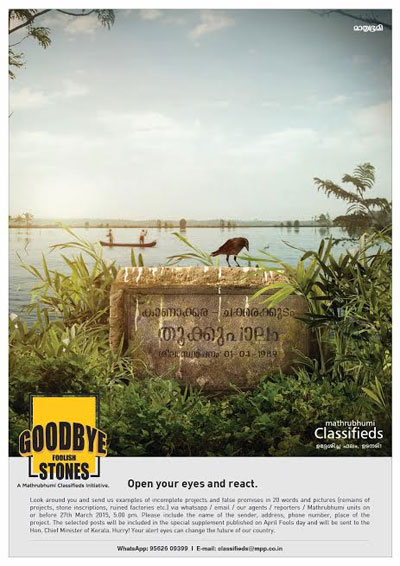
    This apathy by the government made Mathrubhumi Classifieds turn the tables and celebrate April fool’s Day, with a powerful message to the people and the Government. The brand along with the Kochi office of DDB Mudra South and East launched an interactive print campaign- Goodbye foolish stones starting 19th March 2015


    The creative of the print campaign showed foundation stones of largely publicized government projects. These foundation stones were the first and last step of the developments. There has been no progress made on these schemes after their inauguration. Even as everything around it is in a state of absolute decay and ruin, the foundation stone stands – a stark reminder of outright government indifference.


    The copy of the ads appealed the readers to ‘open their eyes and react’. A call of action was generated where in the readers were requested to act as citizen journalists and share instances of such neglect by the government through pictures, emails, WhatsApp, or by contacting the Mathrubhumi’s agents and reporters. The response was overwhelming. The publication received over 1000 claims in just three days. The brand conducted its own unbiased enquiry and investigated every claim.


    After collecting all the true claims, the newspaper carried a special supplement named- ‘open their eyes and react’ on April fool’s Day mentioning all the verified instances sent by alert, socially conscious citizens of Kerala. This supplement was specially shared with the Chief Minister of the state.


    The campaign was well received and people’s response showed that they are tired of being fooled. Mathrubhumi Classifieds gave common people a platform to put the blunt reality and truth in front of government’s eyes and inform them that the people are watchful and are not to be made a fool of.


    Quoting on the campaign, Jayakrishnan N, Cluster Head, Mathrubhumi said, “April Fool’s Day, is an occasion for real and virtual pranks predominantly played by the youth. This year, we decided to participate not just by playing the prank but bringing to light the pranks that are played on people by politicians for ages. Mathrubhumi wanted to connect with the younger audiences using classifieds by elevating the conversations beyond the paradigm of transactions. The campaign has been instrumental in helping us to that.”


    Commenting on the campaign, Dominic Savio, Vice President, DDB Mudra South and East- Kochi said, “The Mathrubhumi Classifieds campaign resulted in people enthusiastically owning the campaign, besides contributing to a greater good towards the society and creating an impact. It was overwhelming to see people integrating the campaign with their own social media channels delivering maximum reach for the campaign.”


  • IRS 2012Q1: Downward is the way for Language publications

    By A Correspondent


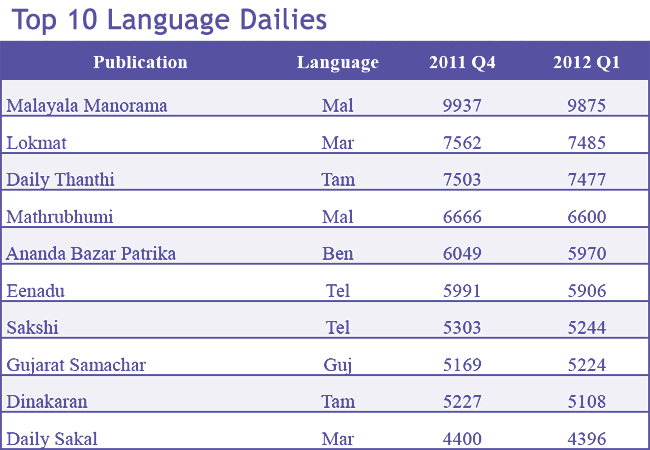
    Maybe it’s the shortage of ideas or lack of opportunities but language readership is certainly not seeing the best of times inIndia. Of the top 10 Language dailies to have made it to the list, just one newspaper – Gujarat Samachar – has seen growth; nine others have seen a decline in 2012Q2 readership over 2011Q1. Gujarat Samachar with an AIR of 5,224 is marginally better than its AIR number of 2011Q4 at 5,169.


    Leading the charts at the top is Malayala Manorama which has recorded an AIR of 9,875 as against an AIR of 9,937. Marathi daily Lokmat follows next with an AIR figure of 7,485 as against 7,562 it reported last quarter. Tamil daily Daily Thanthi is next with an AIR of 7,477 as against 7,503 recorded in 2011Q4. Mathrubhumi follows next with an AIR of 6,600, Ananda Bazar Patrika with 5,970, Eenadu with an AIR of 5,906, Sakshi with an AIR of 5,244, Gujarat Samachar with 5,224, Dinakaran with an AIR of 5,108 and Daily Sakal with an AIR of 4,396.


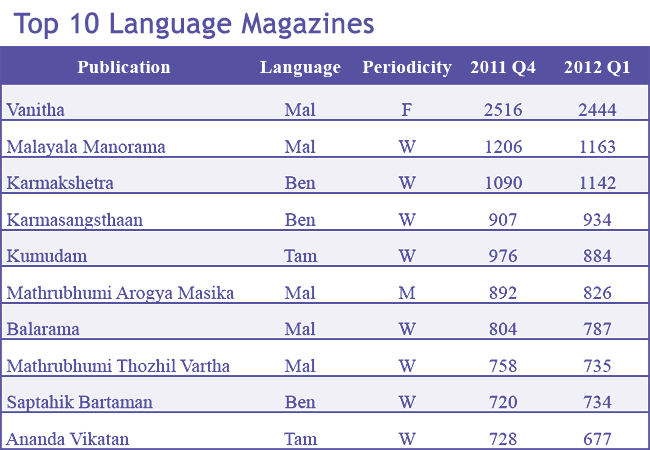
    Where magazines are concerned, three out of ten have shown marginal growth while seven have seen a decline. Vanitha leads at the top with an AIR of 2,444 followed by Malayala Manorama with an AIR of 1,163. Karmakshetra is third with an AIR of 1,142 while Karmasangsthaan is fourth with 934. Kumudam is fifth with an AIR of 884 while Mathrubhumi Arogya Masika is sixth with 826. Balarama follows with an AIR of 787 while Mathrubhumi Thozhil Vartha is next with an AIR of 735. Saptahik Bartaman is ninth with an AIR of 734 while Ananda Vikatan wraps up the list with an AIR of 677.


    Explaining the trend, Dinesh Rathore, Vice President, MediaVest Worldwide said: “As for language dailies and magazines seeing a decline, I think they have reached a saturation point; there is only so much that they can grow by. The percentage of people who speak Tamil or Malayalam in states other than their hometown is not that much, so there is not much enthusiasm by these players to launch editions in other states.”


    (AIR numbers; all figures in ‘000)


    (AIR numbers; all figures in ‘000)


  • Stagnancy stages a comeback in IRS 2012Q1


    By A Correspondent


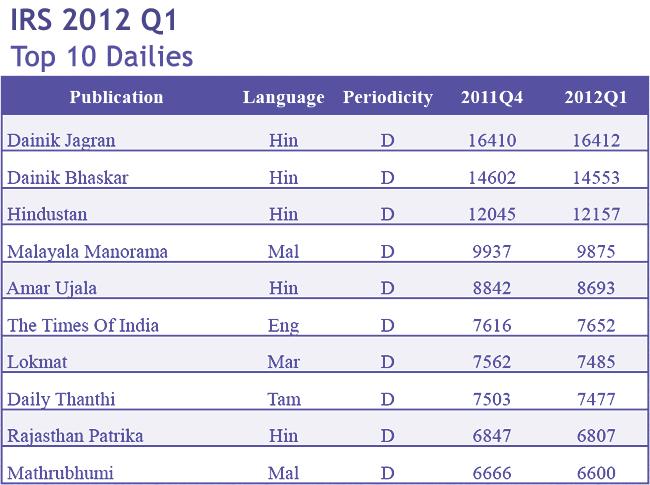
    The IRS 2012 Q1 readership results released by MRUC and Hansa has nothing new to tell but the obvious tale of the apparent rise in numbers of a few publications and the decline in readership of a majority of players. Going by the Average Issue Readership norm, in the Top 10 dailies there has been no change in the pecking order of the top performers but the readership of 7 out of 10 dailies has seen a marginal decline. Of the ten publications, five are Hindi in origin, two are in Malayalam, and one each in Tamil, English and Marathi.


    Emerging a frontrunner once again, Dainik Jagran manages to hold its forte showing slight readership growth with 16,412 in 2012Q1 as against 16,410 that it reported in 2011Q4. At No 2, Dainik Bhaskar has reported numbers totalling 14,553 a decline by 0.33 per cent from 2011Q4 figure of 14,602.Hindustansits comfortably at the third spot having reported a 1 per cent growth of 12,157 as against 12,045 reported in 2011Q4. Malayala Manorama is at the fourth spot with an AIR of 9,875 as against 9,937 in 2011Q4 – a drop of 0.6 per cent. Amar Ujala is next reporting an AIR of 8693 against an AIR of 8842 in 2011Q4 – a drop of 1.7 per cent. The Times of India English edition continues to see growth and comes in sixth with AIR of 7,652 as against 7,616 registered last quarter. Marathi daily Lokmat sees a marginal decline to end 2012Q1 at 7,485 compared to 2011Q4 AIR of 7,562. Tamil daily Daily Thanthi is next with AIR numbers of 7,477 as against 7,503 recorded in 2011Q4. Rajasthan Patrika with 6,807 and Mathrubhumi with 6,600 end the tally occupying the ninth and tenth spot respectively.


    Reacting to the overall trend, Dinesh Rathore, Vice President, MediaVest Worldwide said, “The study hasn’t thrown any new surprises. What is known is that the readership time spent on print is coming down these days, which is even lesser in case of magazines. Newspapers as a habit are not going to die soon but the time spent is surely on a decline. Also, if people were subscribing to more newspapers earlier, they are subscribing to one less now because of the options available on digital.”


    Highlighting her stance on the numbers, Anamika Mehta of Lodestar UM said: “What I infer is that the drop is very marginal. Print will continue to hold its ground in India. With literacy rates going up and the launch of several new products print will continue to drive growth in India . Also, what is seen is that there is a growth of consumption that is happening on the web and moreover, India is a very young country. Almost 60 per cent plus of the population are younger than 35 years. With these audiences the consumption is more on the web than on the physical newspaper. Also, we are seeing a lot of launches by players in the regional markets. So it’s not as bad as it seems.”


    Voicing a similar opinion as given by Mr Rathore, Priti Murthy, National Director – Insights, Maxus said, “I am not surprised by the overall trend that has been thrown up. Why do we read newspapers and magazines, for the sheer content that it provides and content is available faster in other mediums today – definitely digital and to a large extent even TV. I see this trend continuing in the next 3-4 years after which it will reach a saturation point. Also, how much ever tactical initiatives publications engage in to increase circulation, it clearly shows that readership is not going to increase. The time spent in reading newspapers and magazines will continue to see a decline. Also the new generation that is growing up may not grow up on a newspaper alone. They rely on mobile and other AV modes to receive their communication.”


    (AIR numbers; all figures in ‘000)


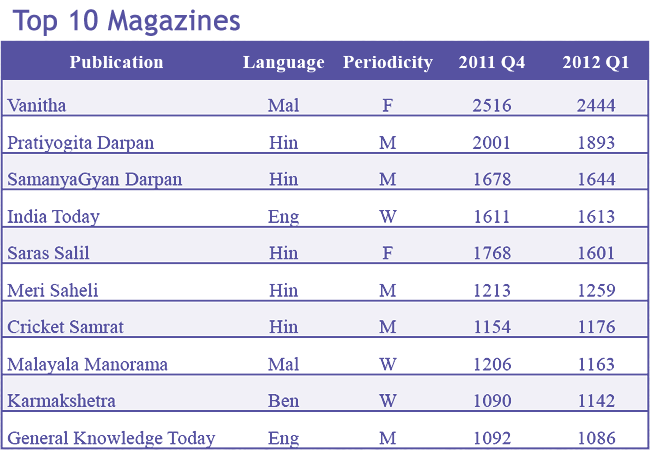
    The downfall story continues with magazines as well with leader Vanitha (Malayalam) reporting an AIR of 2,444 as against 2,516 in 2011Q4 – a decline by 3 per cent. Pratiyogita Darpan too sees a decline of 5.4 per cent having registered an AIR of 1,893 in 2012Q1 as against an AIR of 2001 in 2011Q4. SamanyaGyan Darpan sees a marginal decline with an AIR of 1,644 as against 1,678 reported last quarter. India Today is the topmost English magazine in this list and figures at the fourth spot with 1,613 as against an AIR of 1,611 reported last quarter. Saras Salil is next on the line-up and has reported a big drop of 9.5 per cent registering an AIR of 1601 as against an AIR of 1,768 reported in 2011Q4. Meri Saheli and Cricket Samrat have posted growth with an AIR of 1,259 and 1,176 respectively. Malayalam Manorama at 1,163 has seen a decline of 3.5 per cent while Bengali magazine Karmakshetra has seen a growth in its AIR at 1,142 as against 1,090 in 2011Q4. General Knowledge Today completes the list with an AIR of 1086.


    Throwing light on the trend spotted in magazines, Anamika Mehta said: “In the case of magazines, what we are seeing is that the time spent on magazines is going down but there are a lot of new and niche products being launched. A lot of international players too are coming into this market. So that should give it some scope for growth. But right now I think magazines are in a more worrying state than dailies in India but having said that I do not see the death of the medium coming here anytime soon.”


    (AIR numbers; all figures in ‘000)


  • Radio broadcasters thumbs up to Copyright Bill

    By A Correspondent


    The Copyright Amendment Act which was passed recently in Lok Sabha has come as a huge relief, not only for the artists, musicians and content creators, but also for the Indian radio fraternity.


    This bill will allow the Copyright Board to decide the royalty rates for the broadcasters, which until now was decided by the PPL (Phonographic Performance Ltd.). PPL is the copyright society with respect to sound recordings. While the bill is clearly beneficial for the rightful owners of the copyright, how much profitable will it be for the radio broadcasters, will be known only once the copyright board decides on the rates that the broadcasters may have to pay for the copyright owners.


    The Copyright Amendment Act 2012 allows artists, song writers and performers to claim the royalties for content creation. While the bill has also made it mandatory for both radio and television broadcasters pay royalty to the copyright owners each time their content is broadcasted, what it also ensures is that unlike before, the amended Copyright Act will allow broadcasters to pay music royalties on a pro-rata basis. As a result, it will help broadcasters generate more revenues.


    What they say:

    Speaking to MxMIndia, Ms Anurradha Prasad, Chairperson cum Managing Director, B.A.G Network and president of Association of Radio Operators for India (AROI) said: “We welcome the Copyright Amendment Act because it will bring a sea change in the industry. The radio industry has been bleeding because of the huge royalties it has to pay for the music. Therefore, it is a great step forward, and I believe it is a win-win situation for the entire chain because it will bring in more transparency and, as a result, more revenues will be generated.”


    Mr Vipul Pradhan, CEO of PPL said that while he welcomed the amendment that the royalties be given to the rightful owners of the content, what he is not pleased with is the statutory licensing for users as it would take away the monetizing rights of the music companies, nevertheless, PPL will abide by the law. “We welcome the Copyright Amendment Act and we will follow the new law. We welcome the first part of the amendment which allows the rightful owners of content to get their royalties. However, it is the second part of the amendment – the statutory licensing for the users is something that we are not happy about.”


    “The statutory licenses for the users are basically the people who are using our content as business activity which is where I think the statutory license of content for radio or television is something that is not desirable. We will see how the statutory licenses for users will impact the music companies in the long run. So, while we welcome the move to allow artists and content creators to claim their royalties for their work, it is the statutory licensing for users that concerns us because it will take away the monetization rights of the music companies, which in the long run could affect the creation of these rights,” he added.


    Rabe T Iyer, Business Head, Big FM explained: “It is a constructive and beneficial step in truly recognizing the real owners of music and not just the labels who pitch and buy them. It is also a fair distribution of rights which will lead to increasing talent pool, greater accountability of quality and continued effort to innovate. I believe it will provide greater flexibility for radio stations to play music recomposed or readjusted by creators of songs and it will allow more artists, song writers to get their dues.”


    Mr Amitabh Srivastava, Country Manager, Radio Netherlands noted that this move is very much in sync with industry requirements as it would resolve most of the royalty issues faced by the radio industry. Mr Srivastava also said that unlikeIndia, the international model of intellectual property rights is quite rigid as it ensures that the owners of the copyright get their due shares, and that with the passage of this legislation we can expect international standards in copyrights as well. “This bill is more beneficial for content owners than the radio broadcasters. This bill will bring legitimacy in the royalty issues and it will promote more self generating content which is not happening right now. So, it is a welcoming change because when copyright is legitimized, even the broadcasters will be allowed to create their own content which we do not see taking place as of now.”


    Shreyams Kumar, Director Mathrubhumi said: “We don’t mind paying money to the artists, but paying money to the music companies which does not reach the rightful owners is what we don’t approve. Thus the Copyright Amendment Act is a welcome move as it will lead to more transparency in the music and broadcast industry. This amended act will definitely be a cost saver for the radio industry and it will certainly help the radio industry in the long run.”


    Ms Monica Nayyar Patnaik, Joint Managing Director at Eastern Media Ltd and Mr Naval Toshniwal, CEO Tomato FM and Vice President, Pudhari Publications were of the view that this bill is a step in the right direction which will benefit the radio industry and act as a cost saver for the industry.


  • Industry gears up for India Radio Forum 2012

    By A Correspondent


    It is that time of the year, when radio players across the country meet to discuss issues pertaining to the industry, listen to ideas from advertisers and agencies, celebrate creativity in radio advertising and commemorate the medium itself. The seventh edition of India Radio Forum (IRF), organized by Partners in Media Asia (PIM), will be held on May 22 at JW Marriot Hotel in Mumbai.


    Amitabh Srivastava, Country Manager – South Asia, Radio Netherlands Worldwide who has been attending the IRF since the last four years and plans to do so this year, explained that radio is still at a nascent stage, thus such forums on radio are good for the industry as it discusses critical issues, it provides a good platform for all stakeholders, and in the long run, such forum on radio will benefit the industry. He further said that in the last four years that he has attended the annual event, he observed that IRF has ensured that every stakeholder participates in the event. He also said that smaller stations have been given their due weightage and their issues have also been discussed at various events.


    George Sebastian, COO, Club FM and GM Marketing, Mathrubhumi and Ravindran Nair, Director Programmes, Radio Mango would also be among the attendees at IRF 2012. When asked whether smaller stations have been isolated at the IRF this year, Mr Sebastian said that he has been attending the IRF since its inception and found that even the issues of smaller stations are addressed at the IRF. “IRF used to be a full day event, now it has been reduced to a little more than a half day. This is the only regret I have towards IRF. Such events most certainly benefit the industry, particularly the awards which recognizes good talents.”


    Mr Nair of Radio Mango said: “IRF helps maintain the vitality of radio stations, it gives one insights into how radio has developed in other parts of the world; it also provides ideas and new ways to monitise contents as well as gives us the client perspective about the medium. The only irony, however, is that the IRF has been reduced from a two day event to merely one day.”


    Unlike previous years, Mr Naval Toshniwal, CEO Tomato FM and Vice President, Pudhari Publications will not be attending the IRF this year. Ms Monica Nayyar Patnaik, Joint Managing Director at Eastern Media Ltd is also among the few industry veterans who would not be attending the IRF this year for personal reasons.


    Speaking to MxMIndia, Ms Patnaik was of the view that such forums do benefit the industry as it helps one learn from each other, helps find solutions to overcome issues and challenges, provides creative ideas and that awards also contribute in a bigger way in recognizing ones creative talents.


    Another industry player who did not wish to be mentioned was of the view that such events do help the industry positively, however, it all depends on implementing the lessons learnt from the various presentations made and panel discussions. “IRF is a good forum, but the industry must learn to implement what is discussed at such events, which has not happened so far. There has to be an action plan to implement all that is discussed at such events, only then will we see the industry grow even further.”


    Anurradha Prasad, President of Association of Radio Operators for India (AROI) and Chairperson cum Managing Director, B.A.G Network will also not be able to attend the IRF this year due to prior commitments. She, however, added that right now everything boils down to the passage of the Copyright Bill in the Lok Sabha. It has already been passed in the Upper House (Rajya Sabha), and once it is passed in the Lower House (Lok Sabha) too, and becomes law, it will significantly improve the growth of the Indian radio industry.


    The speakers list at IRF 2012 comprises of industry veterans not only from the radio industry, but also advertisers, and veterans from the creative and media agencies. IRF 2012 will kick-start with the CEO Roundtable, wherein industry biggies will discuss the current strength and weaknesses of the radio industry, and strategic options to improve the business and their vision for the industry in the coming three years. The panelists will include Apurva Purohit, CEO, Radio City; B Surendar, Sr. VP & National Sales Head, Red FM; Harrish Bhatia, CEO, My FM; Harshad Jain, Business Head, Fever FM; Joy Chakraborthy, CEO, Oye FM; Prashant Panday, CEO, Radio Mirchi and Rabe Iyer, Business Head, Big FM. This session will be moderated by Atul Phadnis, CEO, What’s-On-India.


    The second session at the forum – ‘It’s the Message, not the Medium: Growing your Advertising Revenues,’ will delve on important creative attributes that make radio commercials more effective and the unique qualities of radio as an advertising medium. Jason Brownlee, Founder, Dollywagon Media Sciences will be the speaker of this session.


    Another interesting session at this year’s IRF is ‘Radio and Social Media’, a panel discussion on the effect of social media on the listeners and the radio industry. This session will be moderated by Suman Srivastava, Founder & Innovation Artist, Marketing Unplugged. The panelists of this session include Premjeet Sodhi, COO, Lintas Media Group; Raj Nayak, CEO, Colors – Viacom18; Satbir Singh, Managing Partner and Chief Creative Officer, Euro RSCG; and Tushar Vyas, Managing Partner, GroupM South Asia.


    There will also be a session on ‘Maximising Radio’s Asset: How to Gain Share of Market Spend’. This session will be moderated by Apurva Purohit, CEO,RadioCity. The panel members are Ajit Varghese, Managing Director – South Asia, Maxus and Motivator; Arpita Menon, Head – Media Planning & Buying, STAR TV; and Shubha George, COO, MEC. This session aims to provide the client point of view and that of media planners and buyers on radio’s critical role in meeting market challenges and opportunity it presents in achieving a better ROI and sales goals.


    ‘The Radio Pitch Challenge’, the last session just before the 2012 ‘Excellence in Radio Awards’, will see planning teams from media agencies invited to pitch a compelling and effective presentation to the judges. Each team will talk about a product or service in five minutes or less. They will present 16 slides with only 15 seconds per slide, ending with a radio promo not more than a minute long. The winning team will be awarded two tickets worth over Rs1,00,000 to the 2012 Singapore Formula1 Grand Prix.