Tag: marketing

  • PoV by Pallavi Mathur Lal: It’s time for brands to bring sustainability conversation to consumers

    By Pallavi Mathur Lal


    Sustainability is a complex encompassing term that refers to the ability to maintain resources for use but also for future generations. While it is often associated with natural resources, it includes societal and economic resources. As Sustainability or ESG (Environmental, Societal, Governance) movement gathers steam all over the world, we see many ‘push’ factors for businesses and companies.


    In India, we see many actions of global companies as they follow their global directives as part of the UN Global Compact (2000), to adopt sustainable and socially responsible policies and practices. We see many corporates and businesses, both in public and private sectors, refer to the SDGs (17 UN Sustainable Development Goals formed in 2015) as informing their wider sustainability strategies.


    While Governments, NGOs, and businesses have sustainability mandates, the consumer sphere is still lacking this new infusion of sustainability as a critical focus.


    Sustainability, however, is not easily sold to consumers: In a global survey conducted by Ipsos on consumer attitudes toward sustainability issues, it was found that consumers hold companies and governments responsible for sustainability. They are willing to act but feel that their impact as individuals is limited. This is true if you look at the stats – the responsibility for 71% of global emissions lies with the top 100 companies!

    Brands and businesses, hence, have a crucial role to play in promoting sustainability, as they are major drivers of consumption and resource use. Brands have the window with consumers to communicate directly about their values and benefits. India, however, as a market is not as mature as the Western, more developed markets and so the questions for us are: Are consumers ready for this? Will it help brands to strengthen their relationship with consumers, ultimately moving towards consumers considering, buying, and advocating their brands?

    As per the Ipsos Global Trends survey 2023, in India, 60% of consumers strongly agree that we are headed for environmental disaster unless we change our habits quickly. Even with this realization, we know that sustainability is not an easy sell to consumers – the say-do gap is real. From another BCG Global study we know that while 80% consumers in 8 countries (including India) were concerned about the environment, only 1-7% have paid a premium for sustainable purchases.

    Seeing this hesitation in consumers, brands are also holding back talking about the sustainability benefits for the fear of being perceived as being more expensive and losing consumer approval (and demand). However, in this circle of communication and action, brands need to bring more progressive messaging toward the environment and even the societal action that they take. In this way, they build more value around sustainability.


    What brands can do to establish the right connection?: This is like the chicken and egg situation: Should the brands start talking sustainability first (even when the consumers seem unwilling) or should the consumers start demanding it first and then the brands get into action. Sustainability will come into the conversation sooner than later. There will be some brands which would have started building the connect early and benefiting from it, while other brands will be slower and more reactive.

    In addition, for brands to talk about sustainability and use the right messaging is tricky. Unless brands have sustainability built into their core, into their strategic priority, the messaging can backfire. Consumers are wary of, and call out greenwashing, which can end up harming the reputation of the brand, and examples of Volkswagen in 2015, and of H&M more recently in 2022 are before us.


    So, what can a brand do to establish this right connection with their consumers? Here are some research-backed pointers:

    1. Communicate the Co-Benefit: Sustainability as the key benefit, with a higher price is not going to go down well with the majority. All said and done, we have seen that the mass consumer is not going to pay extra for just a sustainable claim or benefit. Consumers still need to see any product performing well on its functional aspects or cater to them emotionally, with sustainability at best being a co-benefit.

    2. The ‘Push’ doesn’t work: Any ask/ call-to-action that requires a change in set behaviour patterns or a habit is going to be difficult for consumers to adopt. Hence, marketers are looking for ways to make changes in their products and packaging which do not alter or modify the performance of the product, nor does it expect consumers to make substantial changes.

    3. Create the ‘Pull’: An Ipsos meta-analysishas shown that it is important to focus on people, and their problems, rather than just the brand which is providing the sustainability message. No surprises here – consumer-centricity is already a mantra we follow, but this means that we need to dig even deeper into concerns, behaviours, and problems to see how we first highlight the key problem that the consumers are facing. After establishing this, and showing the current non-sustainable practices, a more sustainable solution can be offered by the product or brand.


    Use authentic cues and messaging – Dipping into our cultural heritage, and sustainable practices: The way awareness about the climate crisis is increasing and sustainability conversations are making their way into many aspects of our lives, brands will have no choice but to directly or indirectly cue that they support sustainability, promote some cause, or propagate good practices to stay connected to consumers. Fortunately, we have some particularly good practices in India, from our heritage and cultural roots, that brands can leverage to cue their sustainability leanings.

    :: Living in harmony with nature: Our traditional ways are nature and animal friendly and about peaceful coexistence with them. Some of our religions have us worshipping plants like tulsiand using plants for medicinal purposes and for cooking and flavoring. We also have in our mythology, animals as avatars of gods and goddesses or as mounts, making us sensitive and protective about animals.

    :: Frugal, low wastage, savings ethos: In India, we have an ethos of wasting very little material or food and conserving our resources. Traditionally, we have always saved money for the future. Food wastage is also not in our nature. Worshipping Annapoorna Devi, the goddess of food and nourishment, ensures that we have a respectful relationship with food and food sources.


    Frugality, to some extent, is getting replaced by ‘living life to the fullest’, ‘living for the moment’, YOLO and what have you. However, the frugal mindset does exist in our collective recent memories and can be rekindled by showing the positives associated with the larger good.

    :: Sustainable materials: Our everyday utensils are made of stainless steel and traditionally of brass or copper – unbreakable and non-disposable. This ensures long-lastingness and a one-time investment that pays off for years. Traditionally we have also used banana leaves which can be discarded, are biodegradable, and avoid the use of any cleaning materials. Till even three decades ago, plastic had not made such inroads into our daily lives. We used sustainable materials like paper to wrap things and carry bags. Cloth bags were carried when we left home for shopping and used for bringing back groceries and vegetables. Using earthenware to keep our water cool, was another sustainable way – with refrigerators and ACs being a relatively recent phenomenon.

    :: Sustainable practices: Till some years ago, new clotheswere bought only on birthdays or festivals. Maintaining one’s clothes or other objects around the house (like furniture or upholstery) was a matter of pride and care was taken to preserve them for years. We wore hand-me-downs not only from our own siblings but also cousins and neighbours’ older children. We also had their toys and books. In fact, the ‘pre-loved’ clothing trend is a hark back to the same philosophy. Bathing was from a bucket and not from water-wasting showers.


    With all this context, it seems that brands need to start the conversation on sustainability with consumers already. Consumers understand and are concerned about the Climate, about the environment. The increased conversation – cued directly or indirectly – will help highlight the criticality and will increase the value of a sustainability benefit to the consumers. There are consumers who will appreciate a brand for its progressive portrayals and messaging regarding sustainability, consumers who will bond with brands who start these conversations with honesty and transparency, and consumers who are looking for brands that fit with their own values and ethics.

    Brands also need to look at ways in which their sustainability claims and benefits make the most sense to consumers, by viewing them from a consumer problem-solving perspective. Our recent foray into globalisation and our memories of sustainable practices that we followed not too long ago can become part of these brand-consumer conversations – making them more realistic and relevant to the consumers.


    Pallavi Mathur Lal is Senior Director and Head of the Knowledge Initiative at Ipsos India
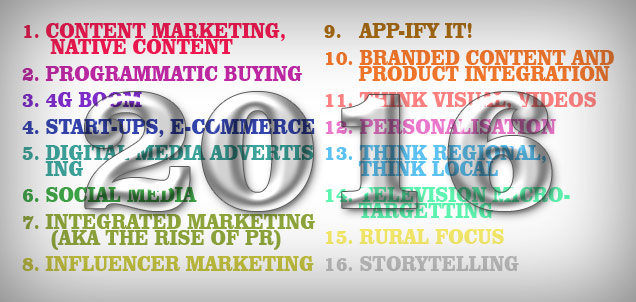
     

  • 16 buzzwords that will trend in A&M in 2016


    1. Content marketing, native content

    Yes, there may be a thin dividing line between advertorials and paid content being passed off as the regular thing, but in the digital domain, care is being taken to tag sponsored content and not devalue the brand. Other forms of content marketing will also gain ground, especially for products and services that need to promoted by editorial-like offerings


    2. Programmatic buying

    The large media agency networks and clients are talking of this already, but as the year progresses, programmatic will be the way to go on digital. Will it work for television and print? Not anytime soon.


    3. 4G boom

    Airtel, Idea and Vodafone already have their 4G offerings, and Reliance Jio recently launched it for its employees. Expect loads of action on the advertising and promotion front on this. But the real difference will be after the service becomes operational pan-India. Digital devices will boom.


    4. Start-ups, e-commerce

    We won’t get into the statistics of how many start-ups are launched every few hours in the country, but more than ever before, the start-up culture will proliferate. Not just in dotcoms, but also towards service-providers in the field of A&M


    5. Digital media advertising

    The smartphone is ubiquitous, not just in the towns and cities, but also in the hinterland. Once 4G becomes a reality — and with the government figuring that it is its telecom infra that will drive the nation — expect digital media advertising to finally take off.


    6. Social Media

    Social media just cannot be ignored when it comes to reaching out to the connected generation. There are already a category of goods and services whose primary medium is social. This is only going to increase as Facebook, Instagram and Twitter start doing their damnedest to reach out.


    7. Integrated marketing (aka The Rise of PR)

    Thanks to the rising costs of traditional media with doubts being expressed on its efficacy, there is a greater emphasis on integrated marketing. For instance, while public relations was always considered important by organisations, with social media around, it is now being actively integrated into the marketing function


    8. Influencer marketing

    While at one level it’s the way to go, given the rising influence of social media, reaching out to influentials in the environment they inhabit, also becomes crucial.


    9. App-ify it!

    Apps are everywhere, and a surer way to reach out to consumers and prospectives. In 2016, more and more consumer-facing organisations will app-ify their interactivity.


    10. Branded content and product integration

    With direct media costs becoming prohibitive, product integration with content – especially in films, television and print — is going to the order of the day.


    11. Think Visual, Videos

    With attention spans decreasing, the emphasis is on engagement and what better way to achieve this than with a visually-appealing presence. Digital is going to boom with videos. Okay, this was set to happen two years ago, but with 4G around, it’ll just become simpler.


    12. Personalisation

    It’s easier done in digital, and that’s the way it will be for websites and apps on all platforms. Give the consumer what s/he wants, goes the adage.


    13. Think Regional, Think Local

    With the growth of the digital medium, and digitally-served traditional media, the growth in going local will increase. With strong regional play, digital can leapfrog ahead. Shall we say, only with strong regional play…


    14. Television micro-targetting

    This isn’t new with geo/micro-targetting already on in television, and tried out much earlier in print. In digital, too, it’s easily done. More and more marketers will seek that in 2016.


    15. Rural Focus

    This is not just because of the recent introduction of rural audience measurement by the Broadcast Audience Research Council (BARC). Rural consumption is growing, and with better mobile connectivity, even media-dark pockets will see consumption of content and services.


    16. Storytelling

    With all the emphasis on technology and forms of delivery, remember what’s most important is the craft of telling a story. Often, strategy and the creative message are thrown out of the window, and it’s all considered a waste of time and money. Perhaps not.


    This first appeared in dna of brands dated January 4, 2016


  • AIMA World Marketing Congress pinpoints marketing myopia in digital age

    By A Correspondent


    All India Management Association (AIMA) Third World Marketing Congress concluded recently. It highlighted the need for a fundamental change in marketing in the age of digital media and empowerment of the consumer. The theme of the congress was “Marketing Myopia 2.0”.


    On the second and the final day of the event, the speakers shared their insights on many urgent marketing issues, including big data and analytics, future relevance of the traditional media, the role of NGOs in marketing social causes and the relevance of advertising agencies in the new era.


    Speaking about the relevance of traditional media in the current scenario, Shefalika Saxena, CMO, Microsoft India said, “Traditional media is not at all losing relevance. Media is only media and not new or old, which is constantly changing and evolving. It’s not about newspapers or television or any other media but it’s how one uses that media to engage with the customers to sell or to market a product.”


    “As world of marketing is changing rapidly every day, traditional media has to change ways of communicating with people and have to go where the audience is going rather than where media wants to take them,” Ashok Venkatramani, CEO, ABP News, said while commenting on role and relevance of traditional media in current scenario.


    Talking about the importance of analytics in marketing, Clifford Patrao, Director and Leader, Strategy & Transformation-Global Business Services, India/South Asia, IBM India Pvt. Ltd, said, “Analytics are for enriching customers experience and to make product branding more user friendly. We are seeing an era where data is empowering marketing and marketers.” The delegates also discussed the new age consumers, extending product lifecycles, defining business based on customers and not products, using Internet to gain competitive advantage and the rising importance of earned media.


    Koichiro Shima, Co-CEO, Creative Director and Editor, Hakuhodo Kettle Tokyo and Yasuharu Sasaki, ECD, Dentsu Network, New York presented five tips to avoid myopic campaigns. Co-presenting the tips, they said, “The agencies need to design the experience that people have never experienced. Creative rectors must be good facilitators and allow people to discover message on their own rather than follow directives. It is important that agencies are flexible and are ready to tune the content and budget anytime.” The fourth point they shared was to “forget digital’ since agencies focus too much on digital making it myopic. “It is not the technology but the idea that attracts people. We need to design human touch behind the technologies.” The last tip they shared was to create social significance with the digital medium, as it offers many opportunities.


    The Congress attracted more than 350 participants. The Congress afforded the delegates an opportunity to learn from the experts and share branding experience and insights with their peers.


  • Chitkara is new LG CMO, Agarwal sales head

    By Writankar Mukherjee


    LG Electronics India, the country’s largest electronics company, has replaced its heads of marketing and sales as part of a top-level reshuffle seen as a reaction to its failure to keep pace with revenue target.
     

    LK Gupta, chief marketing officer, has put in his papers after leading the role for five years and will be replaced by Sanjay Chitkara, who was earlier heading sales administration. Amitabh Tiwari, who was heading sales, will switch roles with Sanjeev Agarwal, who was the head of business excellence.


    They will report directly to company MD Soon Kwon, a senior company executive said.


    “Probably, the headquarters felt a big change was required since LG India is falling short of its revenue target,” the person said, requesting anonymity. “While changes in top management is an annual affair undertaken every December, but never before have there been such sweeping changes like now.”


    A detailed questionnaire sent to LG India’s corporate communications team on Wednesday to confirm the management changes and its business plans remained unanswered.


    The company has also made some changes in its product group heads and split the role of the head for refrigerators.


    Manish Gupta, the product group head for televisions, will now head microwave oven. Vijay Babu, who was heading microwave ovens, will look after frost-free refrigerators while Praveen Gosain-presently regional manager for East zone two that includes markets like Orissa, Jharkhand and Bihar-will head direct-cool refrigerators. Vishal Karan, who was the regional manager for Bengaluru, has been made the chief of modern trade. All the changes will be effective from January.


    While LG India is yet to give any indications about its sales this year, trade sources expect the company to fall short of its revenue target of 20,000 crore for the current fiscal. Last year, it grew marginally to 16,200 crore from 16,000 crore in 2010, falling short of a target of 20,000 crore.


    Trade sources say during Diwali, LG sales grew by 10% against a target of 15%-20% growth.


    LG has been trying to reposition itself as a premium brand. However, industry insiders say it has made limited success in this regard and Indian consumers regard Sony and Samsung more premium brands. The only major exception is the 3D TV segment where LG has emerged the market leader with 37% share, as per GfK-Nielsen retail audit for January-October 2012.


    India is identified as one of LG’s key growth markets and the company had earlier expected its Indian operations would outgrow the parent company by 2015.


    Source:The Economic Times

    Copyright © 2012, Bennett, Coleman & Co. Ltd. All Rights Reserved


  • DDB MudraMax, Aircel flash mob promotes Pocket Internet Games card

    By A Correspondent


    Aircel in collaboration with DDB Mudra Max organized an ‘exhilarating and exciting’ Flash mob at the Express Avenue Mall to promote their newly launched Pocket Internet Games card. The crowd at the Express Avenue mall in Chennai were entertained with music, footwork and the live gaming activities of boxing and football.


    For starters, two men materialized out of nowhere and got into a heated argument. Their heated argument got the whole crowd interested and even as they listened to the peppy background music. On cue, the duo stripped down to boxing attire, a referee jumped into the fray, cordoned off an impromptu ring and began a round of boxing. Football followed similarly.


    Mandeep Malhotra, President, DDB MudraMax, said, “The ‘Aircel Pocket Internet Games’ Card is a unique property, and we wanted to do justice to the same.  When the word ‘flash mob’ is used, we automatically picture a group of people getting together and dancing on a song. We wanted to change this assumption, so we brought in the idea of gaming in the form of a flash mob.


    Commenting on the idea behind the flash mob, Gunjan Arora, Group Director, Brand Communications, DDB MudraMax, said that Aircel as a brand has always been open to new ideas and innovative practices to aggressively engage consumers and make an impact.


  • Tanishq enters into fine fashion jewellery with ‘Iva’

    By A Correspondent


    Jewellery chain Tanishq has launched ‘Iva’ – a new fashion jewellery line in 18kt gold. Keeping the jewellery line minimalistic and yet contemporary, Iva also marks Tanishq’s entry into the fashion jewellery space. Tanishq has tied up with Tips Industries, producers of action thriller ‘Race 2’, and actresses Deepika Padukone, Jacqueline Fernandez and Ameesha Patel will be seen wearing the Tanishq Iva collection in the movie.


    Saumen Bhaumik, Associate Vice President & Regional Business Head-North, Tanishq, said, “We identified the need of the fashion-seeking Indian woman, someone who creates her own rules. There is currently no product offering for this set of consumers and Tanishq seeks to address this need with the Iva fashion line. The Race franchise is the perfect ally for Iva – scoring high on sophistication, cutting-edge design, the latest trends and wide/ popular appeal.”


    Speaking at the launch of the new jewellery line, Beate Stenfield, Head of Product Innovation at Tanishq said, “In her quest to be simplistic yet modern, the Indian woman has come a long way. In times of visual overload she seeks the beauty and serenity of a fresh aesthetic in her adornment. While the contemporary woman dabbles with several roles today, she is able to stand out and expresses herself with elegance and simplicity, wherein her accessory becomes a statement.”


    The Iva range is available from Rs 20,000 at Tanishq stores across major cities.


  • What do our metro collegians want?


    By A Correspondent


    From tracing behavioural patterns of the customers from the comfort of their offices a few years ago to carrying out extensive fieldwork in the remotest parts of India today, marketers have come to realize the facets that really drive the populace to take a liking to a product or an offering. In fact, analysis drawn up from extensive market research activities today enables marketers to go the extra mile and bombard the consumer with offerings that are relevant to his or her liking. But what such exercises have managed to do in the recent past is also gaze into patterns or strata that were not catered to in much detail before.


    Like for instance, the youth. There’s no denying what this TG has managed to do to every brand and the marketer who scamper to have a piece of his or her attention. That India is a nation where more than half its population is young (including children), makes this TG a goldmine for brands seeking them. But while brands are making use of umpteen mediums to pass on their message to the young populace, what was important was finding out whether the youth is satisfied with what is being thrown across to them. And if they are not satisfied, then what would be the ideal solutions they feel could drive the industry into the future.


    As part of the MxMIndia Annual print edition, MxMIndia commissioned youth marketing and communications consultancy firm DDB Mudra Concrea to conduct a survey and question a cross-section of the urban youth on a stream of solutions or ideas they felt were standouts from each of the following mediums -television, print, radio, digital, outdoor, creative and PR & events. The survey was conducted among 700 students from the top 5 colleges in Mumbai and Delhi NCR region. These comprised Jai Hind College, K.C College, St. Xavier’s College, H.R. College of Commerce & Economics and Sophia College for Women in Mumbai whereas from Delhi the list comprised Lady Shri Ram College, Hans Raj College, Hindu College, Indian Institute of Technology Delhi and Jesus & Mary College.


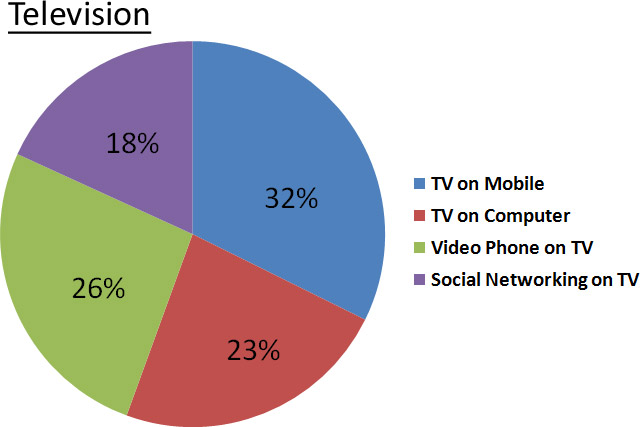
    To begin with, in the domain of television about 32 per cent respondents said watching television on mobile would be great, while 26 per cent said they preferred having video phone facility on television. A further 23 per cent said that they preferred watching television on computer while 18 per cent were in favour of having social networks on television.


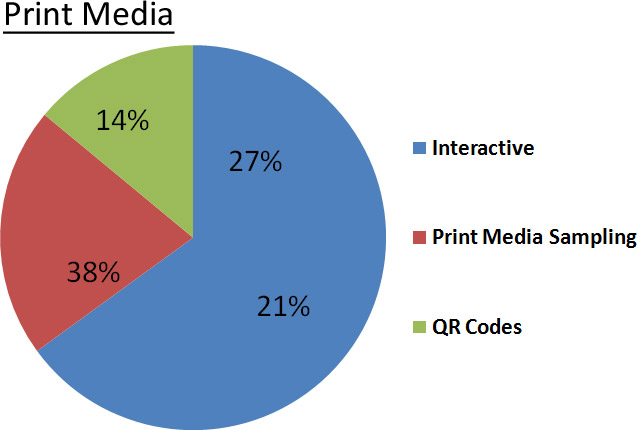
    For the domain of print, about 48 per cent respondents were in favour of the medium being interactive while 38 per cent said that print media sampling was what excited them. The remaining 14 per cent of the respondents thought that QR codes would be the next big thing that would drive this domain.


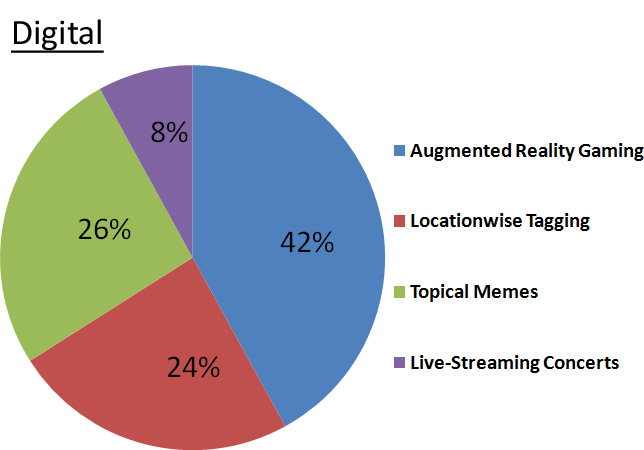
    When asked about digital, about 42 per cent respondents felt that augmented reality gaming was something unique while 26 per cent felt that topical memes was good. A further 24 per cent felt that location-wise tagging was a neat feature to exist while 8 per cent said that live streaming concerts was exciting.


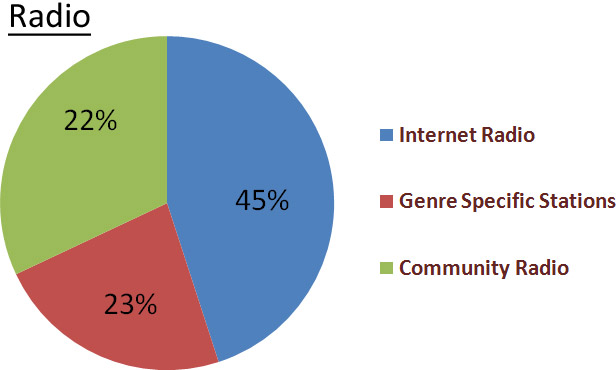
    As for radio, about 45 per cent respondents felt that consuming radio on the internet would be a big boon followed by 23 per cent respondents who said that having genre specific stations would drive the show in India. This was closely matched with 22 per cent respondents who said that community radio stations would be the way ahead for India.


    For the domain of outdoor, the idea that took the cake was installation art that was supported by about 35 per cent respondents. This was followed by 29 per cent respondents for whom augmented reality was important. Summing up the table was the remaining 17 per cent respondents who preferred having more LED-based hoardings.


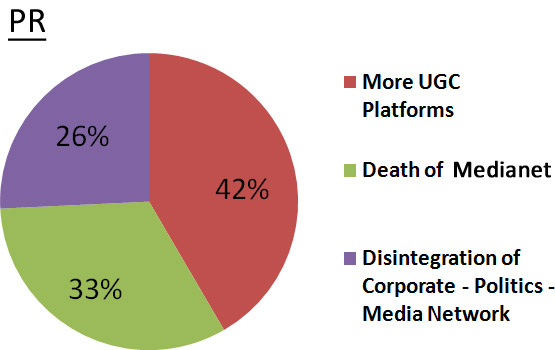
    In the domain of PR, about 42 per cent respondents were in favour of having more UGC-based platforms. A surprising 33 per cent felt that doing away with the regressive Medianet  offering would do wonders for the medium while the remaining 26 per cent felt that disintegration of corporate-politics-media will bode well for the domain. It is of course known that Medianet is not a policy of any PR agency, but that of a leading media company. The ‘paid editorial’ policy is also practised by many print and electronic media companies.


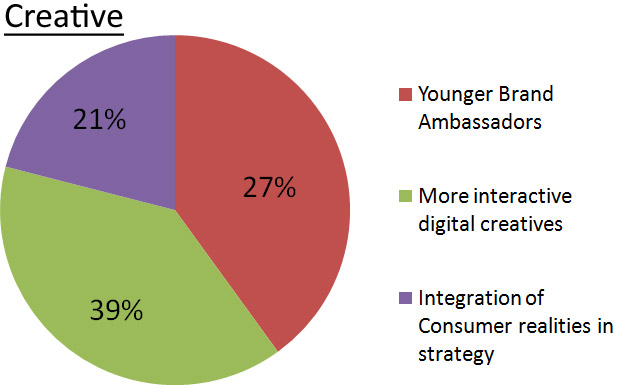
    For the domain of creative or advertising, about 40 per cent respondents said that it would be good to see young brand ambassadors while 39 per cent said that they wanted to see more interactive digital creatives and 21 per cent felt that integration of consumer realities in strategy would be useful.


    Youth Say:

    “I’m a TV addict. I live, eat, sleep TV. Thanks to 3G and TV-Mobile, I get to watch TV anywhere.”

    – Sarthak Nagpal on the medium of television

    “The Volkswagen ‘Feel the Shiver of Excitement’ print ad was one of my favourite newspaper ads of all time. Everyone talked about it for a whole week.”

    – Raghav Bagai on the print medium

    “The Nintendo Wii actually helped me lose weight! I think interactive gaming is the future of the gaming world.”

    – Faateh Ahmed on the digital medium

    “The fact that I listen to the radio anywhere and anytime on my mobile is surely one of the best innovations in this stream.”

    – Nitin Jethani on the radio medium

    “The best way you can market your product is to make the consumer experience it. So put it out there and let them perceive it.”

    – Barkha Singh on the medium of Outdoor

    “The City Ninjas initiative started by Anisha Sharma is an awesome way to get to know any city.”

    – Jubin Jacob on the medium of Creative

    “The Red Bull Stratos jump is probably one of the most memorable things to happen in our time. Our parents had Neil Armstrong, we have Felix Baumgartner!”

    – Priyanka Kumar on the PR medium


  • Jaldi 5 with Martin da Costa: Time is perfect to roll out ticketed IPR events

    While the last two years have been rough for the Events & Experiential domain in India, it has been smooth sailing for 70EMG that has managed to beat the odds and register good growth. According to Martin da Costa, CEO, 70EMG, the growth has been possible due to its focus on IPR development and experiential investment.

    Martin da Costa opens up to MxMIndia on what was the year 2012 like for his company and what is in store for 2013.


    01. As 2012 draws to a close, how would you define the growth journey for Seventy EMG this year? Anything you were particularly proud of?

    We’re looking at 15-20 percent growth over last year. Nowhere near the 50 percent plus levels we experienced up to 2010. The last two years have seen the Events & Experiential business largely flatline – a trend 70 EMG’s been able to beat through IPR development and experiential investment.


    The development and launch of the India Bike Week Festival brand with Fox TV as a major new festival for India’s huge community of bikers and bike fans was a unique experience.


    As for the business, it has performed more or less as expected. The IPR development business has exploded into action this year. We’re seeing a dramatic increase in paid experiential & entertainment activity.


    02. What are your expectations from India Bike Week that’s scheduled for Feb 2013?

    The biker profile today is wildly different from the late 90s. Harley-Davidson has changed the face of Indian leisure biking. The Superbikers, the Ducati dudes, the Japanese speed fans, and the Vintage bike collectors are growing at an incredible rate. And when you add in the 80 odd Bike Clubs that we’ve contacted so far, together with the astonishing fact that there’s over 30 bikes on the road per 1,000 Indians, that’s when the spectacular idea of a bikers festival hit us hard and you can agree that we have got something of a winner on our hands here.


    Basically, IBW will be a ton of fun, and a festival which we think will grow and grow in India.


    There are many elements to the weekend – a Vintage Bikes Concours, Superbike & Customization Stages, Stunt Arena, 3 Music Stages, great F&B, MMA Fight Stage, Open Gym, Cigar & Whiskey Club, a non-commercial Bike & Biker Flea Market, Speakers Corner, Biker Journey Cinema, Pimp My Bike & The Fixer Zone, Brand Exhibitor Zone, Men of Steel Parade & Ride of the Heavies (650CC plus bike parade through the center of IBW).


    As for the plans of taking it forward, we are hoping to see an exponential increase over the next 3-5 years as the festival matures and develops. And in future there will be plans to extend the Bike Week concept to other Asian markets but not before the brand have been established over three years in the Indian market.


    03. What are some of the hurdles that crop up while organizing large events in India?

    Venues, infrastructure, government licenses, local licenses – all the usual culprits. However, they’re tempered somewhat by the fact that 70EMG has had over 15 years of experience in this field. That we’re perhaps the largest festival planners in the country (Goafest, IndiaFest, The Kala Ghoda Art Festival). And finally, that there are so many areas of entertainment and cultural experience that are still untapped for live, ticketed events.


    04. How does the Events industry look like in India? Do you think the market is cluttered or is there scope for more growth?

    It’s looking increasingly robust. Unsurprisingly, given its relative youth. There’s scope for growth in almost every field of the Indian event and experiential business I believe, and whilst in the short term margins will be squeezed, this year and next will be the perfect time to roll out ticketed IPR events and experiences that will then reap the advantages that the eventual upturn will create.


    05. What is the current market share you occupy in India so far? What is the growth spike (in percentage) you hope to see for 2013?

    We’re not in the game of assessing market share – we don’t compete on the btl activation business for example, and we’re very circumspect about both the business we do, and the clients we work with. We’re very firmly a Festival and Special Events business – with the accent being on large format, high-end, well produced, well planned execution. We’re certainly large enough to be placed in the country’s top ten experiential agencies – but it’s probably not a fair comparison given the limited type of high-end / large format events and brand experiential work we like to do, and the fact that most of the other nine agencies in the top 10 compete in the BTL & Activation space.


  • Mahesh Israni, the ‘Go’-to guy at Parag Milk Foods

    By A Correspondent


    Parag Milk Foods (Pvt.) Ltd, one of the largest private dairy player and manufacturer of leading brands Go (cheese, Yoghurt etc) and Gowardhan (Milk, Ghee, Paneer etc) has announced the appointment of Mahesh Israni as Chief Marketing Officer.


    Mr Israni, who has over 25 years’ experience in sales and customer marketing in FMCG, will lead Gowarhan and Go’s global Sales and Marketing functions including marketing strategy, brand development, marketing communications, S&D and RTM Strategy


    Devendra Shah, Chairman, Parag Milk Foods Pvt Ltd said, “Mahesh is a vital addition to our leadership team and is a proven communicator and evangelist for rural marketing. This is a strategic appointment for Parag Milk Foods Pvt Ltd and signals the next phase in our evolution as a global business. It’s a pleasure to have such an experienced professional in place and leading this critical part of our business.”


    Prior to joining Parag Milk Foods Pvt Ltd, Mr Israni was Chief Rurban with Pidilite Industries Ltd, responsible for building up the business structure and creation of RTM strategy. Prior to Pidilite, he has worked with Hindustan Unilever Ltd in various roles in sales and customer marketing where his last assignment was as regional sales manager for Pureit business in the West.


  • Woodland on its Green Path

    By Tuhina Anand


    There has been an increased focus by brands today on being environment-friendly. The outdoor adventure brand, Woodland has been consistent in its effort to be Green conscious ever since its inception. However, now the company is making concerted efforts to imbibe a 360-degree approach going green. It started with in-house effort to go green in their manufacturing process to converting the retail stores to being environment friendly, now the effort it to communicate the same to consumers extensively and rope in partners who would help Woodland in their Green initiatives.


     

    Talking about their approach, Amol Dhillon, Vice President-Strategy & Planning, Woodland, said, “We have been constant in our effort to be environment friendly and sustainability. Our campaigns like Eco Everest, Leave No Trace and Proplanet have always conveyed the message. Our effort is to be carbon neutral by 2015. In this direction we have started listing the eco index on our products and educate our customers on the amount of carbon footprint that they are leaving with each Woodland product.”


    The company has been taking conscious effort to make earth a green place like its Eco Everest Campaign where teams of Sherpas who brought in trash from their climb in a bid to keep the Himalayas clean. Then there is the Leave no Trace campaign which is in collaboration with the music fests to connect with young TG and make them conscious about keeping the environment clean. In its effort, Woodland is looking at innovative ways to connect to the youth through popular interactive festivals and events like Sunburn (New Delhi) and Raagasthan (Jaisalmer). Woodland in partnership with these properties has been co-sponsoring the ‘Leave No Trace’ campaign to inculcate a sense of responsibility in the youth towards a clean and safe environment to meet their ultimate goal which is to inspire the next generation and increase their participation in the conservation of nature.


    The initiative is heavily promoted by a 360-degree approach thus Woodland making its stance clear on environment and sustainability once again.


    Mr Dhillon explained, “We are an outdoor and adventure brand and we believe that we must make an effort to keep our outdoors and environment clean thus we keep finding ways by which we can collaborate in our effort and thereby also connect with our TG.”


    The company is now looking at partners with whom they can collaborate in their green initiative. It has recently joined hands with Lufthansa as their green partner and even with Royal Challengers Bangalore in their green initiative. The focus is to partner with more stakeholders in this bid.


    Woodland last year committed 15 crore in its Proplanet campaign. In fact the focus is to allocate 5 percent of the total budget in innovation and communication of Green projects.


    Woodland hopes to end this financial year with 400 stores that are not just in tier 1 and II towns but also in tier III and IV tows too. The company has been seeing a year-on-year growth of 30 percent in the last few years and in fact the sales this year in November is 50 percent more than compared to the same month last year.


  • Tatas eye big foray into edutainment

    By Anshul Dhamija & Reeba Zachariah


    India’s oldest industrial house, the Tata Group, is sketching big plans for children’s edutainment market, a move signalling the tea-to-telecom conglomerate’s interest to tap business opportunities around the country’s 330 million population aged below 15 years.


    Bengaluru-based Titan Industries, a Tata Group company, is expected to finalize business plan for edutainment vertical, positioned as ‘after school education through gadgets and technology’, within a month, people familiar with the development said. This will be among the biggest growth drivers for watch and jewellery-maker, which is the fifth largest Tata firm by market valuation.


    The company’s new business division wants to develop a network of about 160 edutainment stores, expected to rake in more than $1 billion revenue by the end of the current decade. Titan scanned several business models targeted at the children’s market, including toy retailing, before narrowing its focus to edutainment stores.


    Titan’s edutainment business strategy will combine content with 3D and simulation technology with themes like ‘journey across time’, which sits well with the company’s watch business too. The company has prepared an extensive case study, with inputs from design architects, to be presented to the board of directors later this month.


    The edutainment business will be deemed to be formal only after the board approves it. A questionnaire to Titan Industries spokesperson remained unanswered at the time of going to press.


    Titan reported Rs 8,840 crore ($1.63 billion) revenue last fiscal powered by the watches and jewellery divisions. The company has explored plans to boost its top line revenue to $10 billion by 2020. The company, in which the Tatas hold more than 25% stake, closed the Friday trading on BSE almost flat at Rs 307.


    Tata Group companies with surplus cash on their books have been asked to draw up plans of how they would utilize their cash surpluses in adding value to shareholders. Titan had surplus cash of nearly Rs 800 crore at the end of last fiscal. The flagship edutainment stores will be more than 80,000 sq ft, located in the suburbs of the big metros, attracting investments of Rs 100 crore each. The stores in smaller cities will vary between 8,000 to 10,000 sq ft.


    Titan will start work on rolling out the initial stores in two southern metros, once the board approves the business plan.


    The $100-billion Tata Group’s interest in edutainment tracks the growing investments in this space. Last month, Bollywood star Shah Rukh Khan acquired 26% stake in the India franchise of Mexican edutainment brand KidZania, scheduled to open first store in a Mumbai suburb March next year.


    Source:The Economic Times

    Copyright © 2012, Bennett, Coleman & Co. Ltd. All Rights Reserved


  • MxM Monday: Is BTL gaining acceptance as a must-have in a media plan?


    By Ananya Saha


    Is Below-the-Line (BTL) advertising gaining bigger share of clients’ advertising budgets over the last few years? How innovative has BTL become, and what are the challenges it still faces?


    Anwesh Bose, Senior VP, DDB Mudra Max

    BTL has gained prominence over the years and will continue to do so as advertising communication is evolving from a ATL-BTL model to a Through the Line (TTL) model. The lines have blurred between ATL & BTL giving rise to a new phenomena where a medium can take the form of ATL or BTL depending on the need of the communication. The challenge today is for the communication professionals to justify the Return on Investments on any form of media and the pitch will keep getting higher. It is time for the industry to jointly work on a multimedia optimization model that would justify investments.


    Narayan Devanathan, SVP, National Planning Head, Dentsu India Group


    That’s a very broad question, but going by overall trends, the answer is probably yes. The more pertinent question, how much bigger is “bigger?” Who is measuring this? How does it differ by category? What all goes into the definition of BTL? For example, with the expansion of modern trade in retail, you’ll obviously see a lot more BTL money being spent on in-store merchandising, POS and promotional campaigns. A second factor affecting expanding BTL investments will likely be the short attention spans and the myriad of choices and screens that consumers interface with today. TV, radio, web and mobile are probably vying for the consumers’ attention simultaneously at all times. But with definitive metrics, the impact of last-mile tactics and campaigns will be a key differentiator between brand success and business success. All this does factor into the fact that, yes, BTL as a share of clients’ ad budgets is seeing an upsurge.


    Innovations can happen on three fronts: technology, measurability and the balancing act between strategic and tactical objectives of the campaign.


    On the technology front, something like RFID, for example, can turn walking behind a shopping cart into inputs for a shelf-stacking strategy in-store. A combination of GPS, augmented reality and a promotional scheme can turn a mobile phone into a CRM platform. But innovations like these and others depend on the evolution of both marketers and the retail (and other parts of the brand) environment.


    Technology can also be the difference between best-case guesstimates and data-driven strategies that reduce wastage of marketing investments.


    Finally, marketers have to find ways to close the gap between strategic and tactical goals. If brand-building is a strategic goal, how do you use BTL not just be a one-off tactic or part of promotions but contribute to brand-building?


    All said and done, as with ATL, the point of all communications, regardless of medium, is to create stories, conversations and transactions (not always monetary) that people want to engage in. If that perspective is missed, then we will continue to see a “line” and see “below” and “above” this imaginary line that only marketers – not consumers – see.


    Nina Jaipuria, EVP and Business Head, Sonic and Nickelodeon India

    Nickelodeon has always believed in the virtues of experiential marketing through on-ground engagements. While TV helps in reaching out to millions of viewers, it allows for only one way-communication. On the other hand, BTL promotions despite the high cost per contact have the potential of making the engagement truly memorable for consumers. There is nothing that can replace the experience and thrill that kids feel when they meet their favourite Nicktoons Ninja Hattori, Dora, SpongeBob or Keymon in person.


    In addition to engaging our young viewers at schools, malls, retail chains etc, we also conduct van activities that helps us reach out to smaller towns and villages in the interiors of India. For example during the launch of Motu-Patlu, we engaged kids in over 30 towns like Lucknow, Kanpur, Allahabad, Varanasi, Agra, Mathura, etc in Uttar Pradesh and Gwalior Khandwa, Indore, Ratlam, Bhopal, Jabalpur, etc in Madhya Pradesh. We often do mall activities to celebrate days and occasions that are important to kids.


    At Nickelodeon, we are constantly seeking new and innovative ways of connecting with kids all through the year. In-store promotions and toon visits at retail stores further helps in strengthening our on-ground presence when it comes to merchandize


    Brand partnerships also play a very important role in creating unique propositions for designing innovative on-ground programmes. BTL promotions are thus an integral part of our media plan as they enable us to connect with our consumers and give them a ‘Touch. Feel. Play.’ experience. In today’s day and age, it is imperative to be present across multiple touch points and to tangibilize the brand.


    Uday Mohan, Executive Director – North, MPG India

    With the increasing fragmentation of the media space it is not enough to just make “contact” with the consumer, but more importantly to “connect” with him. First hand experience of the product/service offering and the customization of it allow this impact extending it to sales as also brand perception. It is here where the relevance of BTL in the overall marketing/media mix is increasingly gaining importance.


    BTL is now moving from its earlier perception of basic activation to being an integral part of the consideration set at the media strategy formulation stage itself. FMCG for the mass audience spends even up to 25 percent of their advertising budget, luxury would spend more. Auto, telecom, food outlets also see the merits of BTL as we see more spends and ideas. It is getting very innovative using insights and planning; 3M Scotch-Brite came up with Wash your Bill, where you had the choice of washing dishes over paying the bill, adding a fun twist to the old adage of ‘pay your bill or wash the dishes’. The activation connected with a younger audience, made them use the product, gave immediate gratification, put it up on YouTube and created word-of mouth.


    Lack of quality data is a major challenge that BTL faces as there are as yet no set parameters for evaluation. Another challenge is the infrastructure and operational co-ordination required from global and nationalized brands of mass appeal where delivery to target audience becomes an issue. For example even Pepsi in its ‘Open Happiness’ campaign could create the reach because of the use of digital and social, else the cost would go out of hand. BTL activation for a mass brand would require innovative use of the media mix to get the desired effect.


    Ambika Sharma, MD & CEO, Pulp Strategy Communications

    There is a definitive shift in perception, below-the-line is media that barrier is fading, it is new media which adds the rich creamy layer to the traditional media plan. Inclusion of BTL in a plan has increased steadily but has seen a stronger spike in the last 2-3 years. It is not in the perfect place that it could be in the consideration set but it is no longer ignored like it used to be a decade ago.


    BTL is now increasingly being evaluated and included when developing the mix, for the simple reason that it cannot be ignored, as it is the only media that allows people to experience the product outside of the retail format. Below-the-line activations can be great when done cleverly. The medium provides the freedom to engage with your core consumers and almost always has the potential if designed wisely to be quirky and attention-grabbing.


    BTL needs to be carefully considered in the planning process and not as an after thought. A well-thought-out, through-the-line campaign (or 360-degree approach), will always have more impact than one curtailed to a limited approach. This is perhaps the most positive change where in some marketers are consciously choosing BTL within their plan with specific deliverables in mind. This way the plan is tighter knit, and the ROI is richer. This change has reflected in a higher share of voice for activation in the media budget.


    Other factors have also contributed, one is what we call the “Ego” slice in the media plan, prominent some time back its the forced fit into the prominent / upmarket ATL mediums because “presence there was a must” at times this ate into the working budget which would have been considered for new media including activation. This is no longer the case. Activation / BTL is holding its own in media plans and gaining its due in media budgets.


    Samar Singh Sheikhawat, Senior Vice President - Marketing, United Breweries Ltd

    We do not call it BTL, but refer to it as activation or leveraging. I would say that activation has always been an important part in the UB Group’s marketing intervention. And today it is almost equal to our sponsorship amount. So if we are involved with an event, property or platform, and suppose Rs 50 lakhs as sponsor, we will spend an equal amount in leveraging it or BTL. I would say, it is practically 1:1 for UBL and our portfolio of brands when it comes to the ad pie division of BTL with other media.


    I think a lot of things are happening apart from the display being used in this medium. The kind of consumer touchpoints being used, digital and social media is becoming a big thing and is being used increasingly as activation by us. Video mapping, production technologies have improved a lot. There are new techniques we are using from overseas in terms of projections, holograms, video mapping on walls etc. the ways to reaching out to consumer is getting innovative whether it be direct mailers that we do or CRM or get-togethers. The kind of media being used in activations is seeing innovation and substance that is being used in production is getting innovative.


    This medium faces challenges in terms of credibility and execution capability. Anything that you do in BTL needs to be relevant to your product, your target audience and to your brands’ positioning. A large part of differentiation in BTL goes towards execution.


    Raghu B Viswanath, Founder & Managing Director at Vertebrand Management Consulting

    Media today is fraught with many challenges. While the overall ADEX spends has been growing at a much higher rate than GDP increasingly clients are questioning whether they are getting enough bang for buck they have spent by advertising in media.


    Earlier brands focused on getting more eyeballs translating to more awareness on the brand. Since the competition intensity was earlier relatively low mere awareness got translated to purchase. That is not the case today. With increasing competition and very little differentiation, it is important for brands to not just enhance the brand – building efforts on awareness creation, but to go beyond and engage their customers meaningfully. This in turn means that brands need to connect with their customers through as many touch points as possible. So, non-traditional (BTL) lends itself to this two-way communication. The rules of the game is not about seeing or hearing. It is about experiencing the brand with all the senses. Hence, touch feel and other sensorial connects with the brand, is the need of the hour.


    For many brands, BTL is becoming a more significant component of their marketing spends (almost equal to ATL). I believe this trend is expected to grow, as brands pursue serious efforts to engage better with their customers.