Tag: Markandey Katju

  • Ramnath Goenka Awards presented, heated debate on journalists’ intellect ensues

    By Akash Raha


    The Ramnath Goenka Memorial Foundation hosted The Ramnath Goenka Excellence in Journalism Awards, one of the most prestigious awards that acknowledge excellence in all forms of journalism, print and broadcast, in all languages on January 16 in New Delhi.


    The awardees for the year 2012 are as follows.
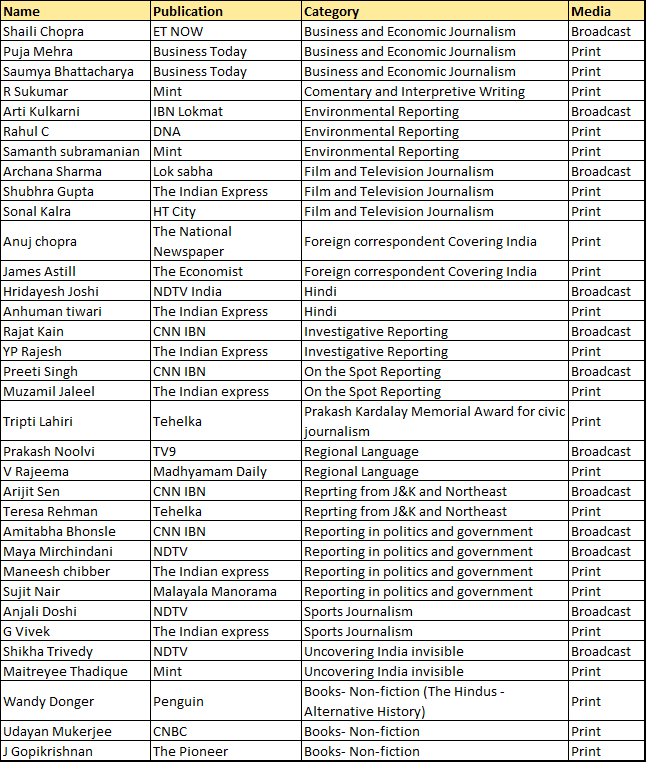


    Like every year, the award ceremony was followed by a panel discussion. This year, the subject based on the Press Council of India chairman Justice Markandey Katju’s observation: “The majority of media people are of poor intellectual level.”


    Justice Markandey Katju was present during the award ceremony and the discussion that followed. There were several politicians, journalists and academicians present, amongst the audience and the panel, who spoke on the topic and ensured that the discussion and debate was at a fever pitch with their war of words.


    Speaking on the issue, panelist Mr Digvijay Singh of Congress party said that there are black sheep in all works of life and the same holds true for the media as well, but to generalize and say that all of them have low intellectual level would be wrong. However, fellow politician and panel member Mr Sharad Yadav of JDU said that times have changed and with that the standards of journalism have fallen too, illustrating his argument by pointing towards the TV channels, who “invest too much in irrelevant news”. He also pointed at the issue of paid news which has tarnished the image of journalists and media houses alike. He said that the proliferation of media has caused the standards of news to fall.


    Furthermore, he said: “the media industry has to be accountable… If the Prime Minister of India is accountable for his deeds, so shall be the media.”


    Some panel members also raised the question whether it was important for journalists to be intellectually strong. According to some, journalism is of two kinds, hard news and opinion – and in the former, one does not need intellect, only moral integrity. LK Advani, who was the part of the audience said: “I don’t think that journalism has failed the democracy. However, there have been a few shortcomings off late. Yet, I will not say that they have low intellectual levels.”


    Digvijay Singh stated that intellect is required in the whole profession of journalism, be it opinion or reporting. However, he added that with the kind of expansion media has seen lately, it is possible that the training of young and budding journalists remains incomplete. He also advocated for accountability and self regulation in media.


    Union HRD minister Kapil Sibal agreed with Sibal: “Putting out information as soon as possible has become the need of the hour for those in visual media. At such times, news which needs to be evaluated is often not evaluated and is broadcasted without any checks. It is not the fault of the journalist, but that of the medium itself.”


    Pratap Bhanu Mehta, an academician, and a member of the panel said that when a state dictates terms as to what is to be broadcasted or not, it creates insecurity. He made his point when he censured Katju’s stand on Dev Anand’s demise, when he said that the news should not have been on the front page of all newspapers.


    Senior journalist and columnist Tavleen Singh engaged in a war of words with Katju when she questioned the credentials of judiciary. Katju evaded the question by asking her to “please confine yourself to the topic at hand… there will be other days for discussion on the judiciary,” but she persisted with her attacks on Katju and his authoritarian comments on media. She went on to say that PCI has to be more active in the future to regulate media, as judiciary is too incompetent to do so.


    Senior journalist Nalini Singh thought it important that journalists and media houses, especially the visual media, should introspect as to what kind of news stories they are doing. She said that usually only 5-6 big stories are followed on and so many news stories are ignored every day. Udayan Mukherjee of CNBC agreed: “A lot of our media are not up to the mark… and I don’t feel resentful of the idea that there is something wrong with the media.”


    When Shekhar Gupta of The Indian Express group was asked how he feels about visual media and the pace at which news is disseminated today he said: “Everybody with a camera is not a journalist, he is only a transmitter of raw unchecked data.” Editorial intimidation is very important and one has to ensure that the news published is factual, in public interest and of public interest.”


    The panel discussion was brought to an end by Mr Katju where he congratulated all the awardees.

     

  • Much ado as Sen does a Katju

    By Ranjona Banerji


    Amartya Sen has done a Markandey Katju on the Indian media, but unlike the outspoken Press Council chief, the Nobel Prize winning economist has piled on some flattery first – free, fair, objective, pillar of democracy and so on.


    (http://www.thehindu.com/opinion/op-ed/article2781128.ece?homepage=true)


    But his basic grouses are lack of grievance redressal protocols and a somewhat ambivalent approach towards accuracy. Do these problems sound a bit like from someone who has been at the receiving end? Well, yes. He explains his personal problems in great detail anyway, mainly to do with being misquoted.


    The other issue is one of having some sort of ombudsman (person?). Not too many newspapers bother and I am not sure of what happens in the world of TV.


    But what was intriguing was the whining and moaning by journalists on social media sites. No one ever talks about consumers, said one (the implication being that readers are to blame for the rubbish that goes into papers and on TV) or that Sen was just saying the same old thing. The comments under the article, of course, praised it wholesale – media bashing is such fun!


    Like Katju, Sen also pointed out that the media largely ignores the concerns of Unfortunate India, while concentrating on celebs, moneybags, film stars and the middle class.


    Still, one would imagine that journalists, being so used to dishing it out, should also learn to suck it up. Sen is not the Press Council chairman telling us what to do with a toothless threat hanging over our heads nor does he harp on about our inability to quote Ghalib couplets at the drop of a hat. It’s just a point of view.


    * * *


    Katju has come to the defence of Bigg Boss occupant (I think the latest edition is over) and porn actress Sunny Leone, saying that she’s not done any of those not-yet-respectable things in India so no one should target her. It’s an interesting way of getting round our moral policing hounds. Will it work for Salman Rushdie too, do you think?


    * * *


    Arnab Goswami tried to hold a discussion on the Deoband request to deny a visa to writer Salman Rushdie. However the guests were such that it would never have made for a fair or even constructive debate – Asaduddin Owaisi, MP, All India Majlis-e-Ittihad al-Muslimin; Alka Raghuvanshi, curator, India Habitat Centre; Sheebha Aslam Fehmi, Islamic feminist writer  and journalist and Zafaryab Jilani, Convener, Babri Masjid Action Committee. Jilani looked tired (been there, done that), Raghuvanshi hardly managed to say anything, Fehmi put up a lone defence for the liberal voice and Owaise shouted louder than everything else. Goswami pointed out that he could not single-handedly solve the problems of the nation, on being baited by Owaisi.


    * * *


    Now that Tuesday morning’s papers have told us that some prospective medical students were caught cheating in an entrance exam, there is hysteria in TV land over the fact that merit is being murdered. Please.

  • The Year in the News Media


    By Ranjona Banerji


    This year started with a hangover – like all New Years should. But unlike the pleasant pain that goes with the knowledge of a party that may have meant over-indulgence but was fun just the same, the media started 2011 with one of those truly mammoth unpleasant hangovers.


    The outcome of the Radia tapes was, at best, a loss of reputation for a few well-known journalists but at worst, a loss of faith in the media as an institution. Public knowledge about the somewhat questionable dealings between journalists and publicist Niira Radia meant that the media could no longer hide in those famous ivory towers. Even more unfortunate was that the finger of suspicion was pointed at all journalists because of the transgressions of a few. It did not help matters that although Vir Sanghvi lost or surrendered his influential column Counterpoint in the Hindustan Times, Barkha Dutt did not just continue with NDTV, but went from strength to strength.


    So it was a somewhat cautious Indian media which initially tackled the phone-hacking scandal in the UK and the closure of the Rupert Murdoch-owned News of the World. Here was journalistic excess in order to get a story taken to a whole other degree – criminality. The tabloid press and the British public and celebrities have historically had an interesting and confrontational relationship. But the desire to delve into every aspect of the lives of the rich and famous – without the reverence shown in our part of the world – made for big sales and bigger profits. The readers loved the sleaze and watching the powerful cringe.


    But this scandal was something else. It was newspapers hiring investigators to pry into the private lives of ordinary citizens and using dubious methods like hacking into voicemail messages to gain information. One reporter lost his job for spying on British royals; but what was the punishment for breaking into the cell phone of a murdered teenager, deleting her messages and not only giving hope to her family that she was still alive but also materially distorting a police investigation into her disappearance?


    As it turned out, the reprisal was fierce and final: a newspaper which was over 150 years old was shut down and the British parliament had a public questioning of the owners and editor of News of the World – Rupert Murdoch and his son James and Rebekkah Brooks.


    The world’s media watched shocked as skeleton after skeleton popped out of the News of the World and NewsCorp cupboards. But surely there was no room for complacency here in India. After all, the problem was not just the Radia tapes; it was also the elephant in the room – paid news. Media houses – without or without the collusion of journalists – had been selling editorial space to political parties. The reader or viewer, of course, was left in the dark and assumed s/he was reading or watching real news stories.


    In the midst of all these depressing signs that some media introspection was required, we had all the uncomfortable revelations by Wikileaks, which turned international diplomacy on its head and exposed lies about the US role in the Iraq war and the black money held by European banks. The subsequent arrest of Wikileaks editor Julian Assange in the UK, on an old sexual assault charges filed in Sweden added to the drama. Was Assange really guilty as charged or was this an international conspiracy to get him extradited to Sweden and from there to the US to punish him for publishing secret cables and other information on the internet? The jury’s still out on that one.


    Wikileaks, though, emphasised once more how the internet was changing journalism and anyone who ignored it, did it at their own peril. Social media is playing the role of a catalyst in creating public opinion outside of the traditional media. The traditional media may not be destroyed but it will be damaged if it does not pay attention.


    Back in India, though, we still had a couple of dramas to play out. The new chairman of the Press Council of India, retired judge Markandey Katju, decided that he didn’t want to be head of a toothless body that was limited to the print media. He proceeded to write a series of articles attacking journalists, calling them frivolous, badly educated and shallow. He listed the sort of news that should be carried and slammed the choices made. He also said that the Press Council’s ambit had to be increased to include television.


    Katju may have been wrong and he may have been right in his opinions, but unfortunately for him, the Press Council remains toothless. And besides, instructing newspapers and TV channels on what aspects of news should and should not be carried impinges directly on the freedom of the press. No one spared Katju and so he quickly backtracked a little.


    Then, perhaps just to prove Katju right, media coverage of the Anna Hazare-led anti-corruption agitation proceeded on just those shallow, one-sided and breathless lines that the former judge had bemoaned. This protest was covered as if it was the only one the country had ever seen. Numbers were inflated or exaggerated. Those who questioned aspects of the Jan Lokpal Bill were shouted down as enemies of the people. As is inevitable, the print media could not sustain its adoration of this movement and started asking uncomfortable questions. TV however continued with its happy path of supporting this “national movement” at all costs until, slowly, a bit of reason leaked into the emotion.


    The doubts had crept into TV studios after the standing committee submitted its version of the bill but the Anna Hazare movement remained adamant on its own stand. But it was really the indifference shown to the movement by the people of Mumbai which ended that love affair. Rather than focus their cameras on 4,000 people pretending they were 40,000, TV cameras panned empty grounds showing us how low the turnout was.


    In journalism, as in life, there are no absolute truths. But there are facts. In 2011, the facts have shown that the people are watching the media. And there’s hardly any place to run or hide. Like we’re forcing politicians and government servants to come clean on their dealings, a little bit of spring cleaning by the media would not be amiss in 2012.


  • Of course journos suffer for their mistakes!

    By Ranjona Banerji


    In case Press Council chairman Markandey Katju believes that journalists don’t suffer enough for their mistakes, he can perhaps get some satisfaction from the arrest of senior journalist Gurbir Singh in Mumbai on Tuesday night. Singh was arrested for ignoring a court summons in a “rasta roko” (street protest?) case which dates back 11 years. As a result, a non-bailable warrant was issued against him.


    Without commenting on this particular case, several journalists have cases like this against them and litigants sometimes file them all over India mainly as a form of harassment. The Indian legal system being what it is, the cases drag over years and when the journalist concerned will most likely have a changed a few jobs by then, the annoyance increases. The upshot for Shri Katju: The legal system has its own ways of torturing people.


    **


    I was quite unpleasantly surprised to see a half page feature in the Mumbai edition of The Times of India dedicated to the wonders of probiotics. I looked carefully to see if the page was sponsored but could find no such legend. There was a signed piece by a doctor about how probiotics were essential for a number of reasons and a corroborating article. There was not one single word about contraindications – and there is no substance on earth which does not have side effects. Since probiotics can be dangerous for diabetics – of which India has a substantial number – one would have expected a soupcon of caution from both the doctor and the newspaper.


    **


    Not surprisingly, FDI in retail has been the big subject in the news (even I succumbed, I admit, in my column for Mid-Day), but while newspapers gave us multiple opinions and pros and cons, one yearns for an intelligent discussion on television which does not descend into shouting, blaming and general hysterics.


    Contrast this to the discussions on the just-held elections in Egypt – surely an emotive subject – on Al Jazeera where guests had their say, disagreed or agreed and left un-bloodied.


    **


    One of Indian television’s most popular guests is Suhel Seth. He is known for his emphatic opinions on just about every subject and is as a result a love-him-or-hate-him chap. Seth has just written a sort of self-help book on how to get ahead in life. Those who both love and hate him must read a biting, caustic and very intelligent review of the book by Mihir Sharma for Caravan magazine.


    The Twitter world is full of the review, reactions to it and Seth’s own reactions. Highly entertaining.


    Ranjona Banerji is a Mumbai-based journalist and former editor. She is Contributing Editor, MxMIndia

  • Newswatch: Katju, a harmless Rip Van Winkle

    By Parsa Venkateshwar Rao Jr


    Justice Markandey Katju, the chairman of the Press Council of India, has written a long-winded piece in The Hindu of November 5, expressing his views on the state of Indian society, economy, media and what to do with it all. It is a meandering argument with usual college textbook learning thrown in, with quotes from Firaq Gorakhpuri, Tulsidas, Shakespeare, some kind of socialist critique, some talk of a transition from the feudal age to an industrial age.


    The basic premise of the good judge is that India is in the age of 18th-century Europe, and what Voltaire, Diderot and Rousseau did then should now be done by the Indian media; fight the establishment, fight feudalism, fight superstition and worry about the plight of the poor people and the suicides of farmers as does P Sainath in The Hindu (Katju mentions Sainath by name). That is, fight the evil windmills.


    Then he talks of the need to regulate the media, especially the electronic media, which have programmes on astrology, devote more newstime to Lady Gaga and Kareena Kapoor’s wax image at Madame Tussaud’s than to the health and educational problems of the country.


    It is clear that Katju is a confused man. He has a bird’s-eye view of the situation, and he seems to miss both the woods and the trees. The judge is gravely mistaken in saying that India is passing from the feudal to the industrial age. There is no feudalism except in the minds of Marxist historians. The rural social set-up we find today, including the rightly hated caste panchayats, is not an example of good old feudalism but of an undeveloped rural bourgeoisie, with false sense of honour and tradition, with enough money and little wit. To think this is feudalism is reading the situation wrong with the help of dated textbooks, especially banal liberalism of the HAL Fisher-type A History of Europe, which is a silly book in retrospect or the CPI-type NCERT history textbooks in India.


    Katju is worried as to what will happen to displaced farmers moving to cities and not finding jobs because steel and automobile companies are producing more with less workforce. This is a perennial problem that has been with us for the last 60 years and more.  Farmers will pick up new skills as time goes along. All migrations involve changing lifestyles and working conditions.


    Then he makes the futile observation that more than 90 per cent of Indians are migrants, excepting the pre-Dravidian tribal populations. Now that statement is neither true nor false in any meaningful sense of the term.


    So, why was the media, especially the electronic media, getting angry with Katju? He uttered the word ‘regulation’ and said that no freedom is absolute. In themselves there is nothing wrong with the two ideas. Regulation if translated to transparent and fair rules is indeed the basis of any institution or sector. And even ardent liberals would accept that no freedom is absolute. We do not have radical liberals who argue for absolute freedom of speech, including hate speech. Our liberals are timid and politically correct.


    The real red rag in Katju’s long homily is that he wants to set himself as the watchdog of the media, which is what the Press Council is supposed to be. Either there should be no Press Council, or if there is one it has to be watching over the media. The only effective way of refuting Katju is to dissolve the Press Council. If the council is allowed to exist, then this Katju-type of exhortation – vain and in vain – will have a place in the public sphere. It will be interesting to pick holes in it. And it can even be ignored.


    Katju’s attitude does hint of paternalist socialism, the kind favoured by the Congress in its unconscious mind, where the government wants to tell people what is good for the people. Katju is no Stalinist – he would be horrified to know that there are intimations of Stalinism in his pompous obiter dicta – but he sounds very much a schoolmaster. It is, perhaps, nice to hear a schoolmaster once in a while, especially when you do not have to fall in line which is the case with Katju and the Press Council. But the truth is that Katju is a harmless intellectual Rip Van Winkle, speaking in the dead debating terms of a bygone era.


    The media should not have gone into a frenzy over what he said. As always, the media was looking for a good bone of contention and Katju provided one. The media should be grateful that Katju chose to be provocative in his own outdated manner.


    The writer works with the DNA newspaper at its Delhi office.

  • More bite for toothless PCI?


    By Akash Raha

    Recently Chairperson of Press Council of India (PCI), Justice Markandey Katju triggered a volley of criticism and discussion after he lambasted the broadcast media, saying most of them suffer from “very poor intellectual level”. He went on to suggest that broadcast media should come under the purview of the PCI. MxM India asked some well-known media faces what they think.

    Arnab Goswami, Editor in Chief, Times Now and Vice President, Broadcast Editors’ Association (BEA) told MxMIndia: “I don’t know why Justice Katju is making these comments. There is absolutely no need to try and demolish the principle of self-regulation in TV news which ensures that electronic media is free and out of control of vested interests. Justice Katju should not make these sweeping generalizations.”

    Upset over Justice Katju’s comments on the media, former Chief Justice of India J S Verma too is reported to have recently called the PCI an “ineffective” body and said it should wrap up if it does not meet its mandate. Verma chairs the News Broadcasting Standard Authority (NBSA), which is set up by the News Broadcasters Association (NBA). In a recent statement Verma said that he is “deeply anguished” with the kind of language that Justice Katju uses which “sounds authoritarian”. NBA has requested the Prime Minister to stop the PCI from meddling with the dealings of broadcast media.

    On whether broadcast media should come under the ambit of the PCI, Rajdeep Sardesai, Editor in Chief, IBN18 Network said “I believe that the self-regulation mechanism which has been put in place by major news broadcasters must be allowed to strengthen itself. The Press Council has been unable to curb pernicious practices in the print media such as ‘paid news’, so I don’t see how mandating it to now to oversee the electronic media will serve any purpose.”

    Talking about whether he thinks electronic media should be brought under the purview of  PCI Paranjoy Guha Thakurta, an independent journalist and critic, said, “The electronic media needs to be regulated independently – this is because self-regulation is inadequate and ineffective under certain extreme circumstances. The regulator should be independent of both media interests – including the interests of the big corporate media – as well as the government. Even if the regulator is funded by the government, it can be truly autonomous and/or independent if it is Constitutionally mandated thus – such examples include the Supreme Court of India, the Election Commission of India and the Comptroller & Auditor General of India. Ideally the electronic media should have a separate regulator. Even if the ambit of the Press Council of India is widened to include the electronic medium, it has to be made truly independent and autonomous and, most importantly, empowered. The Press Council in its current form has no punitive powers and is hence akin to a toothless tiger.”

    To put things in perspective, PCI was established as a statutory print watchdog by an Act of Parliament in 1978. In recent times, PCI has come under question following chairperson Justice Markandey Katju’s recent remarks on the state of the media in India and its inability to keep a check on paid news.

    When asked if Justice Katju was trying to police the media, Mr Guha Thakurta played down the suggestion, saying, “The Press Council of India is a quasi-judicial body set up an act of Parliament. The way it is supposed to function has been clearly laid down. There is no question of Justice Katju (or for that matter, any Chairman of the Press Council) acting as either a good cop or a bad cop.”

    The question remains, should news broadcast come under the ambit of PCI? One of the reasons for opposing such a suggestion remains that since PCI has been unable to check the menace of paid news in print, there is no reason why it should make any positive change in the broadcast industry. Another argument says that the only reason why PCI has been unable to make a change is because it is still a toothless quasi-judiciary body and the government needs to empower it and give it some tooth. Either way, in this chatter and amidst much confusion is set Justice Katju and his criticism of media professionals as he sees them as naïve and stupid. Criticism which has obviously riled the veterans of the broadcast industry.

    In the wake of this controversy, several discussion forums are being organized on the PCI, the question of paid news, etc. The Foundation for Media Professionals (FMP) is organizing a panel discussion in collaboration with the Press Club of India on the topic ‘Media and Public Interest: Freedom vs Accountability’ on November 12 at Press Club of India, New Delhi. The panelists at this discussion will be Markandey Katju, Rajdeep Sardesai, Neelabh Mishra, Zoya Hasan, Pankaj Pachauri, Abheek Barman, Madabhushi Sridhar and Paranjoy Guha Thakurta with T R Ramachandran as moderator.

    Later, on November 18, MxMIndia has partnered the event ‘Paid News: Fooling People all the Time’ organised by Moneylife Foundation and Citizens Action Network with the support of industrialist Cyrus Guzder to be held in Mumbai’s Madame Cama Hall. The evening will see the screening of the documentary ‘Brokering News’ followed by a panel discussion with senior journalists and the film-maker Umesh Aggarwal. The panelists at this discussion are Umesh Aggarwal, Ayaz Memon, Paranjoy Guha Thakurta, Bhawana Somaaya, and Sucheta Dalal. This panel plans to discuss the issue of paid news, which has been a bugbear even for regulatory bodies such as the PCI.

    For more: http://www.mxmindia.com/2011/11/mxmindia-partners-%E2%80%98paid-news%E2%80%99-event/