Tag: Markandey Katju

  • Ranjona Banerji: The news that did not happen on TV

    By Ranjona Banerji


    All day on Monday all that happened in India was that yoga teacher Baba Ramdev and a few thousand followers continued their protest against corruption and black money in New Delhi. That is, if you watched television. As the day progressed, political leaders attended the protest and gave speeches. That was it. The rest of the news day was in Shavasana – the dead body pose.


    Not however, if you read the newspapers on Tuesday. Grains rotting in Gujarat, Haryana minister Gopal Kanda on the run after an employee’s suicide writes a letter saying that a suicide note is not admissible, the latest on the Mumbai violence, especially the provocative doctored videos on the attacks on Muslims in Myanmar, Sharad Pawar given the number 3 slot in the Cabinet behind AK Anthony, a woman researcher allegedly molested on the IIT Mumbai campus by a staff member and the end of the Olympics.


    This is just a smattering of the news that did not happen on TV. There is more, though undoubtedly a lot of it is city specific. However, it would have been interesting to know how Delhi reacted to the traffic snarls created by Ramdev’s protests, whether people suffered or not, how many were affected and so on. TV sadly did not oblige.


    ***


    Press Council of India chairman Markandey Katju has been mainly silent after his dramatic ascension to the throne. But now he’s popped up again. Strangely, it is not the media which is his focus. Rather it is West Bengal chief minister Mamata Banerjee, who he had once lauded for her honesty and determination. Now he is appalled at her authoritarian ways after a farmer was arrested after he questioned the CM at a rally. Banerjee accused the farmer of being a Maoist.


    Katju has also stated that Anna Hazare and Baba Ramdev’s anti-corruption movements are “empty gas”.


    He said: “Nothing is going to happen by Anna or Ramdev’s crusade against corruption”. The former judge said he was not justifying corruption but instead was pointing out that India was going through a “transitional period where there is no moral code”. His prophecy: corruption will continue for 15 years.


    Presumably, we will all become moral after that.


    * * *


    What does one make of anti-corruption activist Kiran Bedi’s statement that the media spends too much time on “small rapes” (she then said she meant rapes by “small” people) instead of corruption? In Bedi lies a lesson for the media. She was pumped up for being India’s first female IPL officers and qualities were attributed to her which she never had. Once she was made into a heroine in the people’s eyes, it became very difficult to dethrone her. As a result of all that hype, she is now in textbooks and has won numerous awards.


    Prolonged exposure to her during the Anna Hazare-led movement has however exposed her many short-comings. Now we know that amongst her other faults, she is also dismissive of rape. Some female role model.


  • Digitization is going to be the biggest reform in broadcast sector: Ambika Soni

    By Shruti Pushkarna


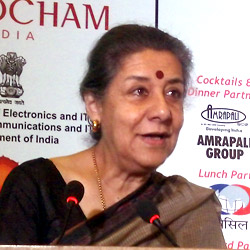
    High drama ensued at the Assocham event inNew Delhias local cable operators (LCOs) flagged black ribbons at the Minister for Information and Broadcasting, Mrs Ambika Soni. The Minister was attending the 6th Annual Summit on Entertainment and Media organized by Assocham, Focus 2012: Digitization for Inclusive Growth. As the theme suggests, one of the primary issues discussed at the event was Digitization of Cable television.


    The LCOs were protesting against the recent tariff order issued by the Telecom Regulatory Authority of India (TRAI), which they claim is an unfair order against all small operators. Following the heated arguments between cable operators present at the event venue and the Minister, one of the cable operators, Sandeep Mcgee who is based inEast Delhithreatened to commit suicide in front of the Minister. Mrs Soni, however, tried to pacify the operators’ fraternity and asked them to file a formal letter with all their grievances against the tariff order and the regulator. She also promised to address their concerns and, if need be, raise the same with the regulator.


    Addressing the concerns of broadcasters on the carriage fee mentioned in the same order, Mrs Soni said that the government will consult all stakeholders before taking a final call on the regulations decided by TRAI under which the Multi System Operators (MSOs) are allowed to charge a carriage fee from broadcasters.


    Earlier, in her inaugural address, the Minister emphasized the importance of digitization for the entire industry and all stakeholders: “Digitization is going to be the biggest reform in broadcast sector and enable operators to expand their revenue sources by providing more choice and variety to customers. Digitization is imperative to tabulate subscriber base and reduce carriage fee. Digitization will also help reduce all human error in the process.”


    Defending the tariff order issued by TRAI recently, she said that the government indulged in exhaustive consultations with all stakeholders on all issues including the carriage fee, and the main aim of the new regulations had been to benefit the consumer. Mrs Soni said: “The TRAI tariff order makes the viewer the most important beneficiary; the choice will be with the viewer.” As for the broadcasters, she said digitization would help reduce the dependence on TRPs and bring in transparency where every broadcaster would be in a position to identify exactly how many people are subscribing to the channel.


    On the issue of media regulation, Mrs Soni said: “Let’s not condemn self-regulation per se because even though self regulation is a slower way of correcting things, it is still a surer way as it involves converting minds and hearts in the process.” She added that in the whole race to growth, the provisions of the Cable Television Regulatory Act were overlooked and it was a fault in the functioning of the government that the act had been ignored.


    On the issue of Paid News, she said that while it was the worst phenomenon that existed, it’s not as easy to detect paid news. She was responding to scathing criticism of the media by the Chairman of Press Council of India, Justice Markandey Katju in his keynote address at the same event.


  • Full report of Assocham ‘focus’ on M&E

    By Shruti Pushkarna


    Assocham organized the 6th annual summit on entertainment and media, Focus 2012, inNew Delhion May 4 where the topic in focus was Digitization for Inclusive Growth. The event began with a keynote address by the Chairman of Press Council of India, Justice Markandey Katju, who came down heavily on the media once again, in his address.


    Justice Katju referred to the role played by the European media between the 17th and 19th century. He talked about the sacrifices made by writers like Voltaire, Rousseau and Thomas Paine to uplift the society and help it convert from a feudal state to a modern society. He criticised the Indian media for promoting superstition in form of cheap astrology shows on news television channels all day instead of promoting rational and scientific ideas. He said: “The function of the media is to uplift the intellectual levels of citizens, but our media instead has stooped down to the level of Indians, of which 90 per cent are fools.” He said that in the race for TRPs, the television channels focus on entertainment which constitutes 90 per cent of programming and leaves only 10 per cent room for real issues to be telecast.


    Justice Katju urged media professionals to play a socially responsible role at a time whenIndia, likeEuropein the 17th century, is going through a transitional phase. He emphasized on the need to promote rational ideas in this period of transition in Indian history. He also emphasized on the need for regulation as opposed to self regulation. He said, “I am the greatest fighter for freedom for press and that’s why I am not recommending control but regulation. In control, there is no freedom but in regulation there is reasonable restriction in the public interest.”


    Self regulation is no regulation, he added: “You cannot have absolute freedom to harm society. There is need for regulation, and this regulation cannot be from the government, it has to be from an independent regulatory authority which has penal powers.”
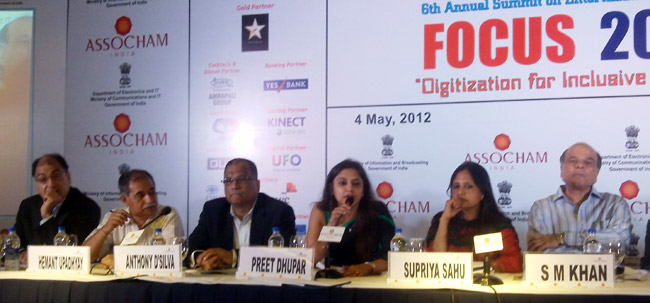


    Broadcasting & Digitization: India Goes Digital- Challenges & Way Forward

    The session on broadcasting and digitization was chaired by Supriya Sahu, Joint Secretary (Broadband & Policy), Ministry of Information and Broadcasting. The session was moderated by Preet Dhupar, Director, BBC World,India. The panelists included Anthony D’Silva, Group CEO, Sun Group; Hemant Upadhyay, Advisor, VOICE; Jehangir S Pocha, CEO, INX News; Roop Sharma, President, COFI; Vishal Mahajan, Sr. Director, Yes Bank; Himanshu Patel, COO Videocon D2H; Ashok Mansukhani, President, MSO Alliance; Joy Chakraborthy, CEO, TV Today Network; Pulak Bagchi, VP, Star India and SM Khan, DG, DD News.


    During the discussion, Ms Sahu said that the work on digitization, especially Phase 1, which looks at the four metros, was on track and with help from all stakeholders the government should be able to push digitization to happen in time. She defended the TRAI tariff order: “It is a win-win situation for every stakeholder. The clear winner, of course, is the consumer.” She said that the cities were almost ready for digitization, the government had made good progress as far as procurement of set top boxes (STBs) is concerned and the only area that needs attention is the seeding of these boxes. She agreed that for the target date to be achieved, around 20-25 lakh STBs have to be seeded and that makes it 1 lakh STBs to be seeded every day.
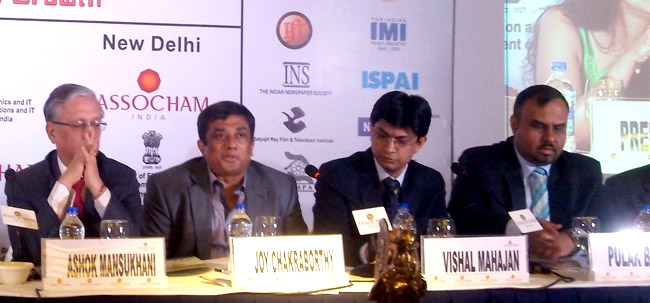


    Representing the MSO Alliance, Mr Mansukhani congratulated the government on taking up the challenge of digitization. He agreed that there were some concerns and issues on which they will seek clarification from the TRAI. He reiterated the commitment to digitization on part of MSOs and urged newspapers and business channels to clearly present all points of view to the debate on digitization.


    Ms Roop Sharma, President, COFI expressed hers and the cable operators’ disappointment at order issued by TRAI. She claimed that the order was unfair to LCOs and will result in putting them out of business: “Regulator wants to be the controller of the industry…the role of the regulator is very bad. We are all for digitization, but we are unhappy with the revenue share that has been decided in the order.” She added that 60 days are too less to meet the challenges of digitization and it is unlikely that the sunset date for Phase 1 is achievable.


    Jehangir Pocha, CEO INX News shared the plight of the broadcasters with the panelists on the issue of carriage fee. He said that a channel like Times Now had to pay a carriage fee of Rs50-55 crore to reach the viewers. He said: “I can’t applaud this order. Those who applaud this regulation perhaps benefit from it. It is the first time in the history ofIndiathat carriage fee is legalized, institutionalized and not regulated.” He said that the government claims to have taken the views of all stakeholders involved but their views were taken only in theory and not in spirit.


    The TRAI in its recommendations stated: “Keeping in view the fact that substantial investment for implementation of Digital Addressable Cable TV Systems is made by the MSO and the cost involved in carriage of channels, the Authority has decided that every MSO may fix the Carriage Fee.” But Mr Pocha argued that why should a channel pay for MSO investment. He said he would like the government to issue a white paper that looks at the earnings of all players.


    Sun Group CEO Anthony D’Silva said that the need of the hour is to get down to the nitty-gritties: “The lessons learnt from DTH are applicable to any other digital system. We need to look at how the subscriber management systems will work, what are the service parameters and who’ll set up the call centres because that involves huge costs.” He added that the government needs to look at  digitization as any other infrastructure project and support it by whatever means, whether its tax holiday or any other subsidies.


    Pulak Bagchi, VP, Star India expressed a need to recognize the challenge government and the regulator had in thinking through the entire process of digitization and the fact that it’s difficult to make everyone happy. He said: “Government and regulator are out there to protect the public interest and not to add to company bottom lines. We entrepreneurs need to work out our own course.”


    Responding to the issues voiced by the various panelists, Ms Sahu said: “All concerns are genuine and we would try and address them as well as we can but please read the fine print to clarify some of the concerns.” As for cable operators, she said that if cable operators don’t move to digitization fast enough, they will be wiped out by competition from DTH.
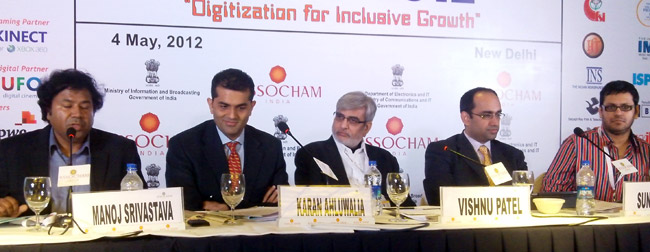


    Films, Animation and VFX: Digital Cinema- Present and Future

    The session was moderated by Karan Ahluwalia, Executive VP, Yes Bank and the panelists included, Ramesh Meer, CEO The FX Factory; Sunaman Sood, Co-founder, Director, Acendo Capital Advisors; Siddhartha M Jain, Producer@iRock; Vishnu Patel, CEO-Special projects, UFO Moviez and Manoj Srivastava, CEO, Enternainmentt Society of Goa.


    Siddhartha M Jain of iRock started the discussion by talking about the paradigm shift occurring in cinema: “Low budget films without stars which used to be niche earlier are picking up. We’ve had hits like Ragini MMS and Vicky Donor. So there is huge investor appetite, provided you have the right content. The key lies in keeping the budgets low and using the latest technology.” He added that there is also a huge power shift happening from Bollywood movies to movies outside Hindi cinema.


    Sunaman Sood said that producers have now begun to treat regional cinema with some seriousness, realising its potential. But Manoj Srivastava added that there is no platform or agency in the country that promotes regional cinema well enough.


    Speaking of digitization’s benefits to cinema, Vishnu Patel said that digital technology has helped revive the industry which was otherwise on a decline. He said that regional cinema has also benefitted from digital technology because digitization has cut down the distribution cost in terms of prints. Now regional film producers can distribute their films better without having to worry about prints’ costs.
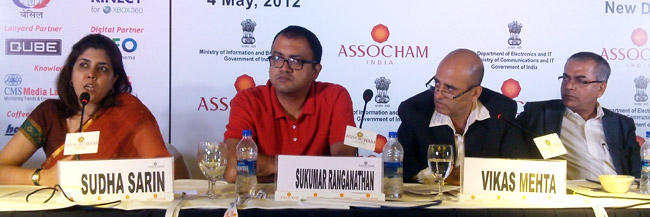


    Print Media: Challenges and Opportunities in Digital Age

    The session was chaired by Suprio Guha Thakurta, MD, The Economist Group India. The session was moderated by Vikas Mehta, VP & Executive Business Director, JWT Delhi. The panelists included, Sukumar Ranganathan, Editor, Mint; Vandana Das, President, DDB Mudra;Sudha Sarin,MD, Ipan Hill & Knowlton and Raghav Subramanian, COO, Lintas Initiative Media.


    Sukumar Ranganathan initiated the debate by making a strong point that print is here to stay: “We often look at the western trends to decide the future of print in the country but we forget that the dynamics of the western market are very different from the Indian market.” He said that Mint has never defined itself as a newspaper; rather it looks at itself as a ‘newsroom’. Talking about integration of content, he said: “We update a story online as soon as it breaks. We also use social media to amplify the news. And in the paper, we value add with analysis and so on. I think integration is key to what a newspaper needs to do to survive in a digital area.”


    Suprio Guha Thakurta echoed Mr Ranganathan’s views but he also emphasized on the fact that content for every platform needs to be looked at differently: “You can’t just cut and paste from print to online or any other device.” He added that The Economist, which at present has about 85 per cent of subscriptions from print, aims at converting these into at least 50 per cent in digital in the next two years.


    Raghav Subramanian said: “It’s not that print is going to go away but it’s being increasingly threatened by digitization. Print is slow as a medium and now with news all over the place, the tangible paper is eroding in terms of the first choice for the younger generation.”


    Concluding the debate, all panelists agreed on the need to integrate content across different media to reach out to consumers/viewers/readers at different touch points.
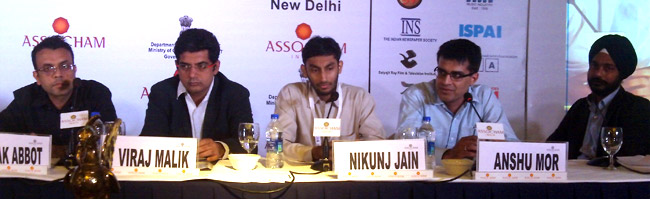


    Radio and Music: New Avenues for Revenue/ Social Media & Gaming: Creating New Markets

    The last two sessions on radio and gaming were merged into one discussion. The session was moderated by Uday Chawla, Secretary General, AROI and the panelists included, Anand Raj, Head- Non Traditional Revenue, Red FM; Geetanshu Anand, Head- Content, Mystica Music; Pallab Mitram Head- Consumer VAS, Tata Teleservices; Deepak Abbot, Head- Product, Zapak Digital Entertainment Pvt Ltd; Nikunj Jain, CEO, Inoxapps; Anshu Mor, Lead Entertainment & Media, Microsoft; CP Singh, CTO, Possible Worldwide; Akhilesh Saurikhia, Consultant, Department of Electronic and IT, Govt of India and Viraj Malik, CEO & MD, PK Online Ventures Pvt Ltd.


    Anand Raj of Red FM talked about alternate revenue avenues that radio stations can look at. He said that audio production is an unorganized market right now and if radio stations start looking at doing audio productions in-house, there is huge potential for revenues. He also pointed out initiative like the Mahabharata or Ramayana productions done by Fever and how radio stations can look at making money by selling productions like these to VAS mobile operators. Another area that radio stations haven’t exploited properly he said was social media. He said that radio can look at building communities on social media for commerce.


    Geetanshu Anand of Mystica Music said: “There is no lack of avenues for revenues; all we need to do is fill up the loopholes for revenues.” Radio industry, she said, plays a crucial role in promotion of music but when it comes to rights sharing then both radio and music companies get selfish and each wants a larger pie. She said that the need for the hour was to review the statutory licenses. She also said that it is important for radio to start promoting non-film music alongside film music.


    Talking about gaming and creating new markets for it, Anshu Mor of Microsoft said: “It’s important for us as an industry to change the concept of gaming and how we look at gaming.” He added that social media provides with an opportunity to promote the ‘Brand Me’ and hence plays a huge role in marketing.


    Viraj Malik added that mobile gaming is on a rise and will turn into a larger opportunity inIndiabecause mobile is fairly big in terms of reach and affordability. And this creates a huge opportunity for content and app developers, he said.

     

  • Murdoch inquiry: the murky side of media highlighted

    By Ranjona Banerji


    The questioning of Rupert and James Murdoch in the Leveson inquiry into media ethics in the UK was undoubtedly the highlight of this news week. Both the BBC and CNN showed major portions of the inquiry live and it was fascinating to watch these two very powerful men being closely questioned on their closeness to British politicians as well as on the way they ran their business.


    James Murdoch followed the line he had had at the earlier Parliamentary inquiry after the phone-hacking scandal broke which led to the closure of The News of The World: he remembered nothing. This is, even though he had been the recipient of a chain of emails which explained what was going on. Murdoch the younger claimed he had not read any of the emails.


    Two days were devoted to Rupert Murdoch who seemed far sharper than he had been during the Parliamentary inquiry. However, he also claimed to remember nothing, in spite of there being sufficient documentary evidence to prove his various meetings with various British prime ministers. Murdoch claimed that politicians always wanted to meet editors and proprietors but that did not mean that he wielded any influence.


    However, by the end of the second day of questioning, Murdoch admitted that there had been a cover-up of the practice of phone-hacking in his newspapers, which went at least up to the editor and beyond. He apologised and called it a failure.


    The venerable and respected Harold Evans, the one editor of the Times who Murdoch sacked, was scathing in his criticism of Murdoch’s testimony and his supposed inability to remember anything significant at all, in his piece in the Guardian on Thursday.


    In the backdrop of this questioning were the revelations that a close aide of British culture secretary Jeremy Hunt had been leaking secret information to the Murdoch organisations about the BSkyB deal, which has since been scuttled. But with both sides of the political spectrum in Britain being in the pockets of the Murdochs, finger-pointing is going to be a little difficult. In Prime Minister David Cameron’s favour is the fact that he commissioned this judicial inquiry.


    The parallels with India are fascinating, if at the least because media tycoons here remain shady figures, lurking in the background, pulling strings and manipulating policies. Also, despicable as phone-hacking was, it is hard to remember the last time any newspaper really spent any effort on news-gathering. We, in India, follow the other Murdoch model – use PR agencies to get everything done.


    Needless to say, Indian TV was not much taken with the Murdoch case, although newspapers gave it the mandatory space on their international pages.


    * * *


    The one story which got almost no space in the Indian media, in spite of the verdict being shown live on the BBC and CNN on Thursday, competing with Murdoch, was the trial of Charles Taylor. The former Liberian president was charged with war crimes for his role in the brutal and bloody war for power in the neighbouring Sierra Leone. Although the film Blood Diamonds got considerable media attention in India, the man who was part of that horror story, was obviously not worthy of too much space. For example, The Times of India had nothing, the Hindustan Times, a brief and The Indian Express a story on the international pages.


    * * *


    Instead the Indian media had absolute hysterics about Sachin Tendulkar accepting a nomination to the Rajya Sabha. One would imagine this was the first time anyone had ever accepted a Rajya Sabha nomination (12 distinguished persons are appointed every term) for all the hot air expended on TV. Newspapers also saw this as headline news.


    So far of course no one knows whether Tendulkar will be a good, bad or indifferent Parliamentarian. Therefore, tedious before-the-fact discussions and camera-inspired rage are pointless. Much time was spent on why Tendulkar was joining politics. It occurred to no one that being nominated to the Rajya Sabha is not “joining politics”. That would be when Tendulkar fights an election. Many nominated members gone back to their distinguished lives after their terms finished.


    The only benefit of such discussions is that you see just how stupid some people are.


    * * *

    Sometimes I find myself in full agreement with Press Council chairman Markandey Katju that 90 per cent of Indians are fools. And most of those fools find their way to TV studios.


  • [MJR] It’s all about how the media operates

    By Ranjona Banerji


    The most serious news programme on TV sometimes is The Daily Show by Jon Stewart, aired every week night on Comedy Central at 11.30pm. The only show that comes close is, of course, The Week That Wasn’t on CNN-IBN with Cyrus Broacha.


    On Monday night, on The Daily Show, Stewart was all ready to discuss the fact that the Trayvon Martin case was finally going to trial. He was ready with the legalities of the case. Only, his reporters all vanished on him. There they were in Florida, standing outside the courthouse, because story was now no longer about George Zimmerman shooting Trayvon Martin: it was about the media and its reactions.


    A programme with a 24-hour discussion on whether the media was over-reacting was proposed. As Stewart had fits in the studio and ordered his reporters to get back to New York, they refused saying that this case was already being called the “case of the century”, “case of the millennium” and “case of the millennia” and they were not going to lose out.


    What a fine exaggeration of the way the media operates, I giggled to myself.

    Then, at midnight, I shifted to Times Now. Only to see Arnab Goswami in fine form, as he held forth on morality and the nation and the alleged sex CD featuring former Congress spokesperson Abhishek Manu Singhvi and a lawyer. Some mention of becoming a high court judge as a result of this slap-and-tickle was made.


    The panel was three journalists (four, if you count Goswami) and Siddharth Singh of the BJP. The BJP was, as far as I could understand, upset that Singhvi had resigned from his posts. They wanted him to explain the CD in the house (presumably not in a sex education way but knowing the BJP’s penchant for porn in legislatures, anything is possible). If the CD was real, then a probe (not like that!) was required. And if it was not real – as Singhvi has said – then another probe was required.


    Vinod Mehta, guiding light of Outlook said it’s all over and done with, Singhvi has resigned and let this remain a private matter. Vinod Sharma of Hindustan Times said the BJP was trying to squeeze every last drop of political mileage out of this, in spite of their own transgressions and once the Pandora’s Box was opened, they would not be safe. Arati Jerath said if this is the way high court judges are appointed, it is shocking and the matter should not be ignored.


    Goswami said that politicians can no longer as for privacy when their private lives are made public by the media, given the BJP’s demands.


    If this wasn’t fascinating enough, the next debate turned to the rift within Team Anna. Here the viewer was spectator to an incredible public squabble between three Team Anna members as Goswami and Hartosh Singh Bal of Open magazine watched with their mouths opening astonishment. Truly it was jaw-dropping stuff. All sorts of internal problems and ego battles were revealed.


    At the end, Goswami sternly admonished Team Anna that the fight against corruption was not anyone’s monopoly!


    At the end – 1.30 am — there was only the terrible truth of The Daily Show to think about. I didn’t sleep till about 3am as a result.


    * * *


    There is plenty of cyber rage over Press Council chairman Markandey Katju’s “proof” that 90 per cent of Indians are fools. People, get over this. The man is entitled to his opinion!


  • [MJR] Katju rides to the rescue of the press!

    By Ranjona Banerji


    Thursday/Friday was one of those rare news cycles where TV and print appeared to agree with each other – at least when it came to the Supreme Court’s upholding the Right to Education Act and the reservation of 25 per cent of seats for the economically backward in non-government schools.


    Arnab Goswami of Times Now right off the bat said any opposition was elitist and demonstrated the deep rich-poor chasm in this country. This line is in keeping with his “simple living high thinking” mantra unveiled a few days ago in a debate about teenage violence. Other channels also presented the same line of thinking. This made life a little uncomfortable for those outraged that rich kiddies now had to sit next to the children of their domestics – although no one said that quite so openly, of course.


    Even as opponents of the idea went on about increase in fees and so on, no one quite bought it.


    Friday morning’s newspapers followed the same lines – with particularly vociferous arguments in favour of the RTE plan and with some tough words for those against it. For a middle class readership, it is class prejudices which are first priority and the media has certainly picked up on that without pandering to it.


    As the judgment sinks in, it can only be hoped that newspapers (TV cannot do it) delve deeper into the implementation of the act and keep track of what is actually going on. Sticky points include minority institutions and boarding schools which are currently exempt from this provision, what happens to a child after Class VIII and improvement of facilities in government schools.


    * * *


    Press Council chairman Markandey Katju has jumped on to his white horse and charged to the rescue of the freedom of the press. The Press Council is going to the Supreme Court to challenge the Allahabad High Court’s decision to stop the media from reporting on troop movement. The media, so upset has it been with the temerity of the Indian Express to carry the controversial story about fears of an army coup in some government circles, has remained largely silent on the court decision.


    This is an interesting maturity test for the media. Its compulsions to tailor material to reader demands and provide infotainment aside, there is also a larger role regarding the safeguarding of democracy and being a general watchdog. Patriotism in the media context does not mean bowing before every institution – it means quite the opposite.


    I cannot say this better than Katju himself: “…the Indian Army is not a colonial army, but the army of the Indian people who pay taxes for the entire Indian defence budget. Hence the people of India have a right to know about army affairs, except where that may compromise national security.”


    As Katju points out, the media has this freedom under Article 19 (1) (a) of the Constitution.


    Hear hear!


    * * *


    The media’s role in the Aarushi Talwar murder investigation remains questionable. It has swung from one extreme to another, drawing its own conclusions, dramatising the life and death of the young girl and encouraging the investigators’ own bizarre behaviour as a result.


    Right now, some in the media seem to have decided that the parents of the girl are innocent and being unduly targeted. Open magazine has carried a long article by historian Patrick French claiming this (he is a patient of the dentist couple).


    Unfortunately for everyone concerned, the courts will base their judgment on evidence collected and presented.


  • [MJR] The big wound in Indian newsgathering covered with Kareena Kapoor’s bandaid

    By Ranjona Banerji


    Even three years ago, my father couldn’t tell the difference between Kareena Kapoor and Shah Rukh Khan, if he even knew who they were. Now he can recognise every single Bollywood star and can even talk knowledgeably about their new films and their goings-on. He has not watched a film, I must clarify, in I-don’t-know-how-many years. But he is a news junkie. Therefore, when he told me on Saturday that the biggest TV news of the day was that Kareena Kapoor had a band-aid on her leg, I believe him.


    I think I also take back every criticism of Markandey Katju I ever made. I opened the e-paper of The Times of India this morning, to have a look at what was happening in the world. The front page of the main edition and the front page of Bombay Times opened next to each other. I have not read Bombay Times since Medianet began, so I did not look further. Why should I, when I already knew from opening the TOI website that Sajid Khan thinks that the Shah Rukh Khan-Farah Khan fight was meaningless and that Sachin Tendulkar had handed over the captaincy of the Mumbai Indians to Harbhajan Singh.


    Actually, it said ‘Bhajji” but by now we all know who that is. Should they have called Sachin “Tendlya” to keep the casual tone consistent? Maybe you’re not allowed to get casual with Sachin.


    I then went to Google to have a look at Hindustan Times. “Click for the latest Bollywood and cricket news” said the link. Ah well. I already know that, I thought. Kareena Kapoor has a band-aid on her leg and Sachin is no longer captain of the Mumbai Indians. Of course I was wrong. The most viewed story on the Hindustan Times website is “Akshay Kumar, John Abraham in a brawl”.


    I had foolishly thought that the Myanmar elections and Aung San Suu Kyi’s imminent victory was big news but couldn’t find it on the home page of these two worthy websites.


    So I went to the Times Now website and that is where normal service was resumed. Arnab Goswami, in save-India mode, looked at me sternly and I then knew all about Jaganmohan Reddy’s yatra as the CBI noose around him tightened, the fact that Team Anna was now taking on the BJP over Himachal Pradesh and the Lok Ayukta Bill, that the prime minister had refused to meet army chief VK Singh. I also saw Mynmar there.


    I hereby humbly take back all the nasty things I have ever said about Indian television. This I predict will last three days. Because I just remembered Kareena Kapoor and her band-aid.


  • Introducing the MxM Journalism Review

    So what’s a media, marketing and advertising website doing with a Journalism Review? Isn’t journalism at the bottom of the value chain for some or just one of those things that don’t quite matter? ‘Cos who will advertise on a website/microsite that’s only got journos hooked?


    Monsanto, perhaps, given that it was the benefactor for a major award recently. Or the Jaypee group or various others wanting to curry favour with news media professionals.


    There’s a reason why the MxM Journalism Review (MJR, for short) has happened. For one, we have received an astounding response to our journalism section. And two, as a media and marketing site, we can’t not track what’s happening in this part of the media. While the pressure of running the rest of the operations has taken a toll over my doing Mediaah! regularly, senior journalist, until last year senior editor at DNA and former colleague Ranjona Banerji’s ‘Freaking News’ has been attracting many hits. Plus Gouri Dange’s column ‘Naming no Names’, Deepa Gahlot’s review of reviews, Newswatch by well-known journos, Anil Thakraney’s frequent ‘hard knocks’ on news and of course our regular fare of stories.


    The objective of MJR is not to take journalists to the cleaners. Yes, it’s a ‘review’ but we aren’t watchdogs who like to bark at everyone. It’s more of a celebration of the profession, and in the process reporting on all the good and bad things in there. We don’t think there’s anything wrong with innovative advertising in print. So a coffee-flavoured newspaper is fine and if a newspaper wants to have a full page ad on Page 1 on a big news day, then we guess its folks know how it impacts the brand. We’ll have our commentators do the talking, but we surely don’t believe most publishers are evil.


    Yes, we have a very strong view on paid content. Our standpoint on the issue was evident when we were perhaps the only publication which said RJ mentions constituted an incorrect practice… quite the same when a newspaper asks a restaurant to pay for publishing a picture of its opening. We don’t think it’s right. We stand for integrity in the profession and are worried as media companies compromise on ethics when they get into allied activities like events – conferences, awards, et al.


    We think journalists who accept bribes are as corrupt as those indicted in the various scams. We believe journos who pass off readymade stories handed to them by PR agencies as their own are corrupt even if they may be senior editors at respected print media. We think award organisers who give out awards without a legit process and/or juries deciding on them must be damned.


    We also want private FM radio to air news. We think news journalism – especially local and cultural – will get a huge boost with FM radio. When Markandey Katju went on a rampage against journalists, we were upset because some of it was indeed true, except of course he had no business to do so as Press Council chief.


    The MxM Journalism Review isn’t just about news journalism. We are as interested in documenting how the Maxim editor is doing as is the editor of Hindustan Times. We will write about how Sun News is doing as much as, say, YouTube-based film news offering Lehren.


    A lot of it is tough doing, but we hope to achieve the impossible thanks to a network of well-wishers across the country. In the process, we may experiment. Our columns and features may upset Editors, CMOs and CEOs. While some may threaten to pull their advertising, a few may choose to invest their faith in us.

    MxMIndia’s MJR will strive to bring you unbiased news and views on Indian journalism. So help us God.


    -Pradyuman Maheshwari

    Editor-in-Chief and CEO, MxMIndia

    Email: pradyumanm@mxmindia.com,
    BBM: 23050B5D, Twitter: @pmahesh
    Gtalk: pradyumanm[at]gmail.com

    PS: Taaliyaan!

  • Yuvraj cancer news first lead?

    By Ranjona Banerji


    The unveiling of Justice OP Saini’s verdict on the petition filed by Subrahmaniam Swamy to make P Chidambaram a co-accused in the 2G spectrum case on Saturday was fascinating. Times Now gave us second by second coverage about nothing at all happening outside Patiala Court. The other channels thankfully limited themselves to studio panel discussions about the possible implications of this verdict.


    The BJP was very cocksure that Swamy would succeed. The Congress was largely invisible, relying on a few of its friends to state its case. The old telecom companies were part of the discussion. The new ones (and now licence-less) were invisible.


    As Navika Kumar talked about the butterflies in her stomach waiting for the verdict (why?), she conceded that Chidambaram may have bigger airborne insects inside his digestive organs. This waiting outside this courtroom was apparently the most exciting journalistic assignment ever! Wow!


    Anyway after hours of pointless speculation and some interesting debates on other channels, the judge then called Swamy for a private discussion and cleared the courtroom. Immediate outrage at this ill-treatment of the media! But then someone pointed out that the judge wasn’t in the courtroom at all. More inconsequential details followed. Then the judge just said the petition was dismissed.


    Suddenly, we were told that actually Swamy looked deflated when he came out of the private discussion with the judge. This, however, was not noticed before the petition was dismissed, a sort of after the fact observation.


    As expected the BJP tried to put up a brave face and then vanished and the Congress, to its credit, did not go too far in its victory dances. Swamy appeared “first” on Times Now but refused to answer who finances his penchant for litigation. By Sunday his bravado was back and in Monday morning’s papers he was saying the judge was good but his judgment was bad (damned with faint praise?) and Swamy would be going higher up the judicial ladder.


    * * *


    Sad as the news of cricketer Yuvraj Singh’s cancer is, am not sure whether it is first lead news, but most Indian papers seem to think so.


    * * *


    The divorce between Sahara and Indian cricket also appears to have come as a surprise to our intrepid sports journalists and here again Yuvraj Singh’s health seems to be have been an issue. Some further investigation here may be a good idea but whenever a big money player is involved, the media’s newsgathering resources seem to shrink.


    * * *


    Press Council of India chairman Markandey Katju is apparently on twitter with the handle (@mark_katju. There is some speculation on twitter whether this is a genuine account or not but today’s newspapers seem to think it is. I’m following it anyway just to check.


  • Time to rethink on Katju?

    By Ranjona Banerji


    So which was bigger – the slap that Bollywood mega star apparently gave small-time director Shirish Kunder or the attack on The Times of India Mumbai offices by supporters of a Shiv Sena politician?


    This is from Press Council of India chairman Markandey Katju’s letter to the chief minister of Maharashtra: “Please, therefore, let me know at the earliest what action have you taken against the hooligans who committed this outrage. In particular, please inform me whether the delinquents have been arrested and any criminal proceedings launched against them.


    I may mention that this is not the first time that such an incident has happened in Maharashtra. I had written to you earlier also about such assaults and harrassment (sic) of journalists. I, therefore, must tell you now that the Press Council may now have to take a serious view of the matter and take suitable action if such incidents are not curbed in your state.”


    It is heartening indeed for the press to get such support and perhaps we need to rethink our views on the honourable judge, his views on journalists notwithstanding? By the way, the misspelling of harassment is not mine; I have cut and pasted the extract from the letter. I make no comment here.


    At any rate, with the famous Khan-Kunder slap, Katju’s deepest fears about the media were fully realised. This made headline and front page news. But I think there is room for debate here. After all, Shah Rukh Khan is one of India’s biggest stars. If he gets caught in a late night fisticuffs at a fancy night club, then it is certainly news. The problem for me is that enough juice about this fight was not provided. I must confess I had no idea who this Kunder chap was when I first read about the fight on Twitter. It was later I realised that he is husband of Farah Khan, choreographer-turned-director. Most of the stories which appeared were written by insiders for insiders so outsiders like me, who had no idea of the stories within the stories, were left confused. I would say that this is a problem which journalists have to address – make everything clear to your readers. Do not assume that they know as much as you do about a particular subject which you have specialised in.


    As far as the attack on The Times of India is concerned, this is one more in a long list of intimidation tactics used on the media by political parties. And as long as nothing is done to those who instigate or participate in such attacks, they will continue. Hooliganism has almost become an accepted way of life and neither our government nor the police seem to be bothered.


    * * *


    What does one make of the excitement over baby Falak, the infant abandoned at AIIMS, Delhi on Republic Day? Instead of minute by minute updates on the condition of this unfortunate child, one would have expected newspapers at least to delve further into the status of abandoned and abused children in India. We expended much outrage over the actions of the Norwegian child services over the Bhattacharyas’ children but perhaps we need to examine whether we need such agencies ourselves. Right now what is happening with this baby is not concern; it is outright sensationalism.


  • Time for media to not get jingoistic

    By Ranjona Banerji


    After all the tears and threats, Salman Rushdie appeared on NDTV and said whatever he wanted – including praising his controversial Satanic Verses – in an interview with Barkha Dutt. So that’s a lot more potential viewers than at a literary festival – so much for fears of riots and violence.


    It is amusing to see that “liberals” are now a legitimate attackable category of people in India. Religious and social fundamentalists on television have a field day since liberals uphold the Constitution and other wishy-washy stuff like that. In print, several Muslims, prominent and otherwise, have said that this whole “ban Rushdie” idea is unacceptable – The Times of India has a report – but these presumably “liberal” Muslims do not usually find their way on to TV. The reasons are clear – they may not provide enough provocative drama.


    While Rushdie was calling Deobandi’s “dreadful people” on NDTV, Rahul Singh wondered on Times Now whether many Sikhs in the UK were not former Khalistanis! Everyone now in the mood to call spades shovels? TV has got needlessly exercised about this whole Jay Leno-Golden Temple fracas; today’s newspapers tell us that Sikhs in the US are not bothered by it. We also learn that Vylavar Ravi, Union minister for Indian overseas affairs, had not even seen the Leno show and did not know exactly what offence had been committed.


    The media needs to stand up and take a call about not getting all jingoistic about perceived insults. I have to side with Markandey Katju here – surely we have other things to worry about?


    **


    Republic Day tomorrow and I fear it is my cynicism, long years and grey hair which makes me feel like newspapers are really paying lip service and doing nothing new. The last week told us that our children are educated, our babies and young mothers are dying and we have no sanitation or hygiene systems to speak of. But we have to periodically be told what a great and wonderful country India is. The marketers and the believers in “good news” will get upset otherwise. O dear, I sound like Katju again.


    **


    The upcoming assembly elections are taking up newspaper space but not TV time. The reasons for this are obvious – TV in India thrives on sensationalism, so unless Mayawati sends another aeroplane to Mumbai to buy shoes, we will have to read not hear what she’s up to.


    **


    Mid-Day turned into a broadsheet for the day, for marketing reasons, but it actually looked quite nice.


    **


    India’s run in Australia has clearly upset our media so much that cricket is now restricted to the sports shows and pages. This is some change from the usual. Having said that, some very good daily cricket analysis from Ayaz Memon in Mail Today – he doesn’t hold his punches but given his experience, doesn’t fall into our current
    mood of patriotic funk! Insightful and scathing both.


    While on sports, it’s good to see tennis and the Australian Open sharing news space with everything else. (Go Federer!)

    Ranji matches have also been getting a fair run in newspapers.


    **


    And, Happy Republic Day!


  • Media frenzy over VK Singh’s age

    By Ranjona Banerji


    On Monday night, I really thought the world had come to an end, what with India’s army chief suing the government over his date of birth. At least, that’s what I understood from Times Now, Newsx and a random sampling of Hindi channels. NDTV had move on to Pakistan to look at their own crisis, with the military playing its usually stellar role of villain cum hero.


    But by Tuesday morning, oddly, India was no longer at the brink of some terrible crisis. Yes, the army chief’s problems were headlined everywhere and while newspapers found his court action unprecedented, they were not concerned that India was at some crossroads or the other. The issue is undoubtedly serious but TV likes to see everything as a catastrophe or a victory and this attitude can cloud real issues.


    From my point of view, the big story was the ASER report about the tragic state of rural education in India (I confess that column for Mid-Day tomorrow is about this). The report made to the front pages of most newspapers but the attitude of the Times of India, I found most intriguing. A single column on page 1 spent half the space talking about how this report wasn’t the biggest as it claimed to be – as if that was the main point of the exercise. One inside report was about a possible education ombudsman and the other about enrolment of girls being up. Compared to this meagre sampling, DNA, Indian Express, Hindustan Times focused on the revelation that class 5 students cannot even read class 2 textbooks.


    * * *


    The Times of India was the only paper (only?) to carry the story of the possibility of writer Salman Rushdie not attending the Jaipur Literary Fest because of security concerns raised by the government after some hardline Muslim groups objected to his presence. TV is all over this story now and judging from the latest “source” news, the government may well be changing its mind.


    The lack of commitment to freedom of speech and expression from our government agencies remains a worry. The attempts to muzzle Google and Facebook have also got plenty of newspaper space.


    * * *


    The Indian Express had its fifth Ramnath Goenka Awards for journalistic Excellence in Delhi on Monday. Vice-president Hamid Ansari said that “watchdog journalism” is “vibrant journalism”. He also pointed to the more pertinent problem – that the slow corporatisation of the media has led to falling standards. “The slow erosion of the institution of the editor in Indian media organisations is a reality. When media space and media products are treated solely in terms of revenue maximisation strategies, editors end up giving way to marketing departments.”


    The cat is out of the bag as far as the media is concerned and we need to address this issue more seriously than we have so far, no matter how many EMIs will suffer as a result.


    Press council chairman Markandey Katju couldn’t resist a little dig about the poor intellectual level of most media people but that still is the lesser problem. Ansari’s diagnosis is more apt.


    * * *


    One suspects that MS Dhoni must be thanking army chief VK Singh for taking him off headline news!