Tag: Madison World

  • ‘Achhe din’ are here again for adspends: Sam Balsara


    Because it’s the sentiment that counts, Sam Balsara, Chairman and MD of Madison World, tells Labonita Ghosh soon after the presentation of the Pitch Madison Advertising Outlook 2015. The current mood of optimism in India Inc, he feels, will translate into greater adspends, based on the expectation of a strong tomorrow.


    Senior industry person Deepak Parekh recently said that the ‘achhe din’ haven’t really arrived for Indian business. Would you echo a similar sentiment with respect to adspends and advertisers in India?

    It’s very important to understand that advertising works on India Inc’s sentiments, because everybody knows that you have to advertise first before you can get results on the ground. The advertiser has to make an investment first in advertising. So what does he base his advertising decisions on? He bases it on sentiment. He understands the mood of the nation, the mood of India Inc, what is happening today and expected to happen tomorrow, and takes a decision – on how much to spend on advertising – based on this. Clearly, he is guided by his P/L. But whether or not he should increase his investment on advertising is dependent on sentiment. Beyond doubt today, sentiment is high. My understanding is perhaps Mr Parekh was referring to the high, bullish sentiment not yet translating into higher sales for brands. Fortunately, it has translated into higher market valuation. I’m no expert, but I guess like advertising, the stock market, too, works on sentiment. So it is the expectation of a strong tomorrow on which you are valued today. Otherwise why are companies like Flipkart and Snapdeal valued so high? They have nothing to show for, except what we can expect from them in the years to come.


    In the light of the fact that there is no Parliamentary election this year only sporting actions, would you justify your forecast as realistic?

    Our forecast is always realistic. We never put out an either optimistic or pessimistic figure. It is a realistic figure, and that is why you will see that although we consider ourselves bullish, our actual forecast in 9.6 per cent versus what we’ve achieved in 2014 which is 16.4 per cent.This is so because last year, almost 50% of the increment came on account of the Lok Sabha elections. That will not be the case this year. But there are several other reasons – the World Cup, the continued aggressive push by e-commerce, other social media and apps; the appearance of Phase III in radio by the end of the year; the launch of new channels; geo-targetting becoming possible by newer advertisers and newer brands emerging and such. It is because of all this that we expect the television market to grow by 10%, and print by 5%, on the back of increased government spending.


    Could you specifically comment on print growth, particularly with respect to magazines and regional papers?

    We are extremely bullish about regional papers. English newspapers have already taken a hit in terms of percentage contribution. In the last decade, the contribution of English newspapers was dominant. All other languages, put together,could not match up to it. Today this is no longer the case. Now Hindi is the single largest language segment in terms of spend, and English is trailing behind it. And this will be the case in 2015 as well.


    Magazines are a niche player, and I think increasingly, we are seeing a not very healthy trend in magazines in terms of growth. We think the future of magazines is in niche magazines rather than general-purpose publications. Magazines that are focused on specific areas, like cooking or golf or architecture, these have a sensible future. As an advertiser, if I am interested in particular products, I will look at only those magazines that relate to these. For instance, if I want to sell golf balls, I don’t have to advertise in India Today because that ad will be wasted since non-golfers also read the magazine. I should, instead, advertise in a golf magazine which will provide restricted, focussed circulation. That focus will be of immense value to the product-specific advertiser. That is why magazine advertising as a segment is so small.


    Does all the sound and fury of news television attract good spends?

    It does. News television goes to male audiences, who are otherwise difficult to catch. So news channels are a useful medium for advertisers who want to speak to men. We saw in the genre by spend, the largest is Hindi satellite TV, followed by Tamil satellite TV and news comes in third.


    Digital growth may be high, but in terms of real spends it’s still low. Is it just a lot of euphoria?

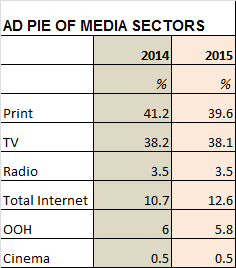
    By end of 2015, digital will account for 12%, but its growing at 30% (whereas print is growing at 5%). That’s why there is euphoria. But you can’t forget that while print is already at 40% plus, digital is simply growing from 10 to 12 %.


    This interview first appeared in dna of brands dated February 23, 2015
     

  • Adspend to grow 9.6% in 2015: Madison


    By Labonita Ghosh


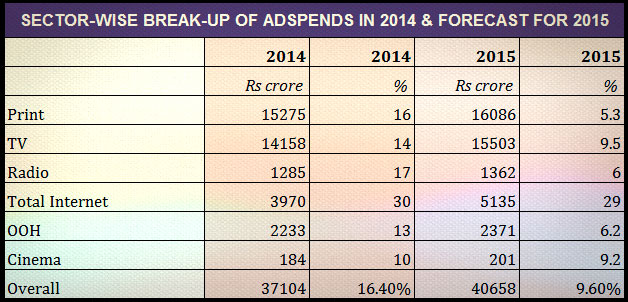
    The advertising industry is likely to grow 9.6 per cent this year, says the Pitch Madison Advertising Outlook Report 2015 released last Friday. While this looks like a tepid sequel to a blockbuster year – in 2014, the industry grew by a whopping 16.4% – the forecast is not without promises. For one, the slight uptick takes the total advertising market to Rs. 40,658 crore by end of 2015, from Rs 37,103 crore last year. Last year’s spurt was largely because of the spend on the Lok Sabha and some Assembly elections, says Sam Balsara, CMD of Madison World, which put the report together along with Pitch magazine. “The projection for 2015 is bullish, though tempered by the fact that this is not an election year,” says Mr Balsara. “There are other options, like the World Cup, the continued aggressive push by e-commerce companies, the launch of new channels and the emergence of new advertisers and new brands.”


    Among the more significant findings, print media continues to be the largest sector in advertising, and is expected to grab a 40% share this year. Brand advertising in print is likely to exceed Rs 16,000 crore. TV is next in line, and expected to touch Rs 15,500 crore. Digital, which has grown phenomenally in the last five years, is now larger than Outdoor, Cinema and Radio put together, will corner 12.6% of the market.
     

    The report finds that the FMCG sector, which has always been a dominant player on TV (contributing over 50%) is now also the largest contributor to print media for a second successive year. Though this contribution is just 13%. “Projections for the FMCG sector appear rosy, which is heartening,” says GK Suresh, Head of Marketing (Foods Division) at ITC, adding: “If this continues, I don’t see any reason media spends should not keep increasing as well. This provides a lot of confidence to manufacturers to launch new products, and companies to invest more in existing brands. I think the report forecast is fairly accurate; perhaps even a little conservative when it comes to FMCG.” While the print market constitutes many categories, FMCG, auto, education and real estate together contribute 43% of the total. For TV, the big players are telecom, digital, e-commerce and auto.


    “I would’ve expected FMCG spends in print to grow more rapidly,” adds Mr Suresh, “mainly because it offers many more opportunities to sharp-focus your advertising, and has less wastage than TV. But we in FMCG are really struggling with digital media right now. Everybody knows it’s growing and we need to be out there, but many of us are using it as just another medium.”


    According to Piyush Mathur, President, Nielsen India, the 9.6 % projection, close to a double-digit growth, is a realistic one. “A lot is riding on e-commerce, which is at an early stage and that means a lot will happen in 2015 and 2016,” he says. “As e-commerce companies get bigger valuations, there will be more spending on advertising.”


    Still, there are a few things advertisers need to do differently, says Mr Balsara. According to him, they should focus on effectiveness, and not just on efficiency, while always keeping in mind that the reason they advertise, is to increase their brand parameters. “I have seen marketing teams to be painfully slow on certain media decisions,” he adds. “We often suffer from analysis-paralysis.” Mr Balsara says most brands fail to take full advantage of what the media has to offer by under-resourcing their campaigns. “They will be well advised to focus on fewer brands of theirs, ignore some brands and advertise those few brands heavily,” he adds. “A corollary to this is that since budgets are often limited by P/L considerations, you need to prioritise markets sharply. Spend and exposure in Priority One markets should be at least three times that of Priority Three markets. Otherwise prioritisation is meaningless, and only remains in the hands of the brand manager.” Worryingly, Mr Balsara says he also finds that as media spends get larger and larger, media decisions get taken at lower levels. “These require greater involvement of the corner-room,” he says, and more participation by senior media agency leaders.


    This story first appeared in ‘dna of brands’ issued dated Febuary 23, 2015


  • Ogilvy & Mather powers government initiative to save 25,000 mw of electricity

    By Pritha Mitra Dasgupta


    The power ministry has launched a mega advertising campaign saying the country can save 25,000 MW of electricity every year by just being prudent. The first TV commercial of the campaign, with ‘Bijli Bachao, Desh Banao’ tagline, was unveiled on December 14 to mark the national energy conservation day.


    Piyush Pandey

    “This is part of a huge campaign which the ministry has planned and will be launched in phases,” said Piyush Pandey, executive chairman at Ogilvy & Mather India, which designed the campaign. The first leg of the campaign showcases school children as torchbearers of this initiative. The ministry has launched an on-ground school contact programme. The Bureau of Energy Efficiency hopes to register 1,000 schools on its portal in the next one year to will help spread the message.


    The power ministry recently roped in Pandey, Sam Balsara, CMD at Madison World, and Sunil Alagh, a marketing consultant, as part of its publicity committee. While the first leg of the ad campaign talks about saving domestic energy, the ministry has planned a separate campaign on how industries can save energy too.


    “The ministry will involve people from all walks of life to advocate the message as change of behaviour towards energy consumption and usage is the need of the day. I believe this campaign should go on even when we have saved enough power and energy,” said Pandey.


    Source:The Economic Times

    Copyright © 2014, Bennett, Coleman & Co. Ltd. All Rights Reserved

    Licensed to republish


  • Airtel calls for media agency pitch

    By Pritha Dasgupta


    Bharti Airtel, India’s largest mobile carrier by revenue and subscribers, has called for a media agency pitch. It is touted as one of the biggest advertising pitches of 2014.


    The company has just finished the process of sending out invites to leading media agencies including the Sam Balsara-led Madison World, which has been handling the account for the past 11 years. According to people in the know, other agencies in the fray include one of GroupM agencies, Lodestar, Dentsu Aegis Network, OMD and ZenithOptimedia.


    “Airtel has made all the media agencies sign a non-disclosure agreement barring them from talking about the pitch process,” said an executive with knowledge of the matter.


    Airtel has been calling for media pitches once every five years and the last time it reviewed the account was in early 2010, he said.


    Airtel didn’t respond an email seeking comment. A top executive at the New Delhi-based company said it “is just a part of the evolution process” as it periodically reviews the contract. “This time too we want to see who’s offering what and at what price,“ he said.Globally, Airtel is the fourth largest mobile telecommunications company by subscribers, with more than 300 million subscribers across 20 countries as of end-September. It is the largest cellular service provider in India, with over 200 million subscribers.


    During the last pitch process, Madison had faced stiff competition from agencies like TME, Starcom MediaVest, Percept, Mediaedge:cia (MEC) and Lintas Media Group. This year, it will be up against the mighty GroupM ­ the biggest media agency of the country.


    Interestingly, GroupM already has four telecom companies in its portfolio ­ Vodafone, Tata Docomo, Idea Cellular and Reliance Communications. “GroupM has five media agencies and four telecom clients. So they can still look at adding one more telecom business to its kitty,“ said a top industry executive in the know.When Madison retained the account in 2010, it was also given the outdoor duties of Airtel which were initially handled by Portland, a unit of GroupM.


    Later, Madison set up a dedicated outdoor team to handle the Airtel account.


    Source:The Economic Times

    Copyright © 2014, Bennett, Coleman & Co. Ltd. All Rights Reserved

    Licensed to republish


  • How advertising helped Modi get on road to PM


    By Shobhana Nair


    It’s a campaign that’s sure to enter India’s advertising hall of fame. A blitzkrieg that marketing boys from across the country are drooling over. The advertising mania around Brand Modi began a few months ago in right earnest. The seeds had been sown by way of a belligerent presence on the social media ended on the counting day.


    Piyush Pandey

    While the victory of Prime Minister-designate Narendra Modi has been attributed to many factors, one can’t overlook the advertising muscle put behind promoting a great brand. As Piyush Pandey, Executive Chairman and Creative Director for Ogilvy & Mather India and South Asia says, “You can only position and market something which is good and based on what the product is all about. Nobody has ever been able to sell a bad product. Nobody can as people are not stupid. So a good product is presented with its attributes and the marketing of the brand which was done by Soho Square is only a presentation of what is good in its intrinsic value.” A team of 25-odd creatives, planners and account management were working round the clock for three months in Mumbai and Delhi on the job. Soho Square, a part WPP’s Ogilvy & Mather India, bagged the account after nine rounds of pitching.  “The brief was to firstly, address the common man’s key issues through a comprehensive agenda and secondly, project Mr Modi as the next PM this country deserves,” shares Anuraag Khandelwal, Executive Creative Director and Creative Head, Soho Square, Mumbai.


    Ad campaigns like Abki Baar Modi Sarkar, Janata Maaf Nahin Karegi and Achche Din Aane Waale Hain were able to convey both – the current sentiment of the country and the BJP mandate – powerfully and effectively.


    Prasoon Joshi

    There was also Prasoon Joshi and his team from McCann’s TAG too who were involved to articulate the philosophical aspect of the party. Desh Ki Pukaar, Modi Sarkaar and Desh Nahi Jhugne Doonga were some of the campaigns which Joshi was involved in. “It is very important to know what your product has to offer and what people need. Only then will it resonate with the people. One of my biggest learning is that you need to have a right product, the right ingredients and you can’t confuse people with 10 things.”


    “Modi was portrayed as a single-minded person of the party with one single mandate. There has to be clarity of focus & product has to be superior. A great campaign in isolation will not work,” says Joshi.


    Ask the brand gurus on why the campaigns worked in favour of Modi and here comes the reply. Jagdeep Kapoor, Brand Guru & CMD, Samsika Marketing feels that the communication and advertising was simply strategic. “It entered the minds and heart, but more important was the great performance of Brand Modi over the decade, which helped them communicate.”


    Harish Bijoor

    Well-known brand expert and CEO, Harish Bijoor Consults Inc gives a thumbs up to Modi’s marketing, “Modi is the ultimate political marketer. He had able support, and he was decisive in the way he managed his campaign. His campaign was a 360-degree campaign that had everyone else watching with awe. The best of product marketing gyaan was brought into this campaign. And it worked. Modi is a product. And this product promised what the people wanted. And in him people saw a strong and decisive leader, someone who was an anti-thesis of sorts to the persona India was used to in the past decade with Manmohan Singh at the helm of affairs.”


    The media buying and planning was handled by Sam Balsara’s Madison World and he admits that a campaign as large as this came with its set of challenges. “Outdoor in UP posed huge challenges because of unfair play by the ruling party in granting permissions for putting up hoardings. The other challenge was negotiations with media, some of whom artificially inflated their rates for political campaigns! Random numbers floating around in the media of the budget of our campaign made our task more difficult.”


    While it may appear to have been all hunky-dory as one looks back at the BJP’s advertising campaign, Piyush Pandey adds: “No brand is built in a few months; a brand is built over a period of time. What Narendra Modi has done in the last 10 years has been valuable to him.”


    Pandey also hastens to add that good advertising wasn’t the only reason for the Modi’s success. “No election is ever won or lost because of advertising. Advertising is only an element. Advertising only presents it. With a great product, I can do great marketing.”  Indeed.


  • Sam Balsara on the BJP’s Media Magic


    By Shobhana Nair


    While there’s no doubting the fact that it was Narendra Modi who led the Bharatiya Janata Party to victory, there were many who worked backstage to create the message. MxMIndia spoke with Sam Balsara, Chairman & Managing Director of Madison World, the media planning and buying agency that worked along with Team Modi to pull of what was decidedly the biggest ever political campaign the country has ever seen. Excerpts from an interview:


    Learnings for other Advertisers:

    > Don’t under-spend; most brands make that mistake and dilute their campaigns and sometimes waste the entire advertising money

    > To change consumer behaviour or establish brand preference - multi-media is a must


    What the new government must do:

    The new government must focus on growth in economy and provide incentives for that, provide infrastructure, make India the toast of the world once again, not focus on giving doles to the poor. Even if you distribute all the money to the poor there isn’t enough money to go around. It needs to focus on growing the economy. Most of India’s problems would get taken care of. In the media area, it must not interfere and allow free market forces to play.


    How did the mandate come to Madison? Who from the BJP called you and how and why did you decide to work on the campaign?

    We were first contacted by Prashant Kishore in Ahmedabad through our client Lodha. Subsequently, we were contacted by Ajay Singh and Arun Narendranath. Then we met Piyush Goyal and Arun Jaitley. We entered the fray late. All major agencies were competing for the account. What won us the business was a lot of detail work revolving around media reach in different constituencies, grouping them in three priorities and summating the whole strategy in an elegant 10 pillar strategy. Our reputation for transparency and integrity sealed the deal.


    When you took on the mandate, or any time during the campaign, did you get any direct brief from Narendra Modi?

    Lara has met Narendra Modi. I haven’t, yet.


    When you took on the job was there any apprehension about delivering it? Political parties like BJP, RSS are known to be conservative, not open to modern ideas and so on. Was there a problem on that count?

    We were confident of delivering on our product not just because of faith in our own experience, expertise and capability but we knew we had a strong product, compared to competition. Advertising works brilliantly for a good product, but kills a bad product fast.


    For the first time ever in India a political party was presented as a brand. Was BJP open to this idea from the beginning? How did you sell your ideas?

    Yes. That was the very reason they reached out to professionals and then played a supportive role, not an interfering role. I must say the people at BJP are not the politician stereotypes; they are smart, savvy and intelligent managers who have left their corporate jobs to help the nation catch up on lost time.


    Reaching out to media dark markets like UP and Bihar seemed to be a big challenge for BJP. How did you resolve that?

    These markets did pose a challenge and obviously got our greater share of our attention. In addition to mass media these markets got intensive below-the-line support.


    What were some of the biggest challenges you faced while executing the campaign? We have heard in many regions district magistrates refused to cooperate.

    Outdoor in UP especially, posed huge challenges because of unfair play by the ruling party in granting permissions for putting up hoardings. The other challenge was negotiations with media, some of whom artificially inflated their rates for political campaigns! Random numbers floating around in the media of the budget of our campaign made our task more difficult. Ultimately, it worked out well and we were able to do our job without fear or favour and I hope the media owners are also happy.


    Will you call this the toughest campaign of your career?

    What made it tough were the frequent changes based on feedback from state units communicated to us through BJP HQs that necessitated my team to work almost every night till 3 and 4 am. Work-day timings for the team changed from 9 to 5 to 12 noon to 3am. In many cases we succeeded in releasing jackets in newspapers at four hours’ notice (2am to 6am) and TV spots too at 2 hours notice. We launched the campaign on cricket. You can’t do better than that, based on our experience and the creative also was specially created for cricket.


    Going forward, will you continue to work for BJP or the new government? Has there been any discussion?

    We hope so. In addition, what I would really like is for the Government of India to appoint us as media advisors for all their advertising! We could make a huge difference in terms of efficiency and effectiveness. Communication is a very important element in the nation-building process. Most political parties unfortunately think of it only at election time.


    A number of people said BJP spent close to Rs 5000 crore for the election ad campaign. What do you have to say to that?

    That is indeed the finest compliment that Madison Media has ever received. The actual is just a miniscule fraction of that number, but I am not at liberty to reveal the number. Some professionals have put the mass media campaign at Rs 1000 crore. I am offering a prize to anyone, mass media professionals included who can guess or calculate the exact number spent in mass media! The BJP campaign has once again proven that mass media has the power to move mountains; that mass media is not expensive as it is thought to be and multi-media is essential for effectiveness. I must also admit that in my view NDA would have won anyway; they had a strong product and the competition was weak. What our campaign achieved is that it cost effectively raised the pitch to a crescendo, constituency by constituency as polling day neared which converted a communication task into what you in media call a Modi WAVE that resulted in a landslide victory for the BJP.


  • #FF14 Day 2: Need to monetize big in a multi-platform era

    By A Correspondent


    There’s a lot that is being said on how the advent of technology has revolutionized the M&E ecosystem. With the emergence of newer technologies and players offering these services, it becomes a challenge to find a balance in providing technology with creativity and content. The session on ‘Monetization Opportunities in the Multiscreen World’ sought to throw light on how the ecosystem was witnessing an interesting shift in revenue-sharing models and how companies could monetize effectively during these challenging times.


    The panelists included Sam Balsara, Chairman & MD, Madison World; Satyan Gajwani, CEO, Times Internet Panel; Chakrapani Gollapali, General Manager, Consumer Channels Group, Microsoft India; Neeraj Roy, MD & CEO, Hungama Digital Media; Rishi Jaitly, India Market Director, Twitter; Nikhil Naik, Head – Director, Global Content and Distribution, Vuclip; Karan Bedi, Founder & CEO, Tutorific! and Ramki Sankaranarayanan, CEO, Prime Focus who moderated the session.


    Presenting an insightful outlook, Sam Balsara highlighted how the television and mobile will be the only two mediums that will continue to be dominant in the future and how the interplay between the two would result in positive growth of the industry. Balsara said that while television continued to find favour with advertisers, they were gradually waking up to the medium of digital as well. “But advertisers need to be flexible about how the viewer’s see their ads; not just on television but across multiple screens.”


    Cautioning the audience, Balsara expressed discontent on how the older norm of doing business was seeing a shift that was not healthy. “The older model of doing advertising was 50-50; half from subscription and half from advertisers. But that has changed of late with more revenues coming from advertisers allowing them to have a greater say in content. It is important that we move back to the old model of 50-50 so that equilibrium is maintained and focus around content remains intact.”


    According to Neeraj Roy, it is not true that monetization in India is not up to the mark. “Around Rs 1500-2000 crore is still being directed towards content and that was a very positive sign. But he expressed worry as he said that the monetization exercise was being limited to certain mediums only. The way out is to have a balance in the advertising-transaction ratio, said Roy. With the shift to 4G being imminent, Roy urged content providers to focus on providing content that is high on value as consumers will be willing to pay more provided they get quality content.


    Providing a synopsis of his company, Rishi Jaitly said that more than 25 million users use twitter to discover content. Jaitly said that if companies concentrated on investing in value then the monetization will actually go up. “The world today is becoming mobile-first, so content providers needs to work on providing content that is of context and relevant. As a network, our focus would continue to be on fueling public conversation across multiple platforms,” affirmed Jaitly.


    Highlighting the scope and challenges faced by his company, Satyan Gajwani said that it was great to see the digital ecosystem in India thriving but the challenge is in delivering content that is high-quality because at the end the customer is going to pay for it. Talking about the issue of piracy facing his portal gaana.com, Gajwani said that the only way to overcome that was by offering such high-value and widespread offering that the user will be forced to come back for anything and everything got to do with music. This will indirectly bring down the number of users going to pirated websites to seek such services.


  • Jaldi 5 with Sam Balsara: Industry’s cautious approach could be replaced by buoyant

    Like is the norm every year, Sam Balsara, CMD, Madison World took on the mantle of showcasing to the industry how the trade fared in the year gone by and what is expected out of it in the oncoming year. Johnson Napier chatted up with the media veteran on the sidelines of the Pitch-Madison report presentation and got him to spell out the mantras and growth trends expected in 2014. Excerpts:


    Is the media growth outlook a much positive one from what was initially expected from the year 2013?
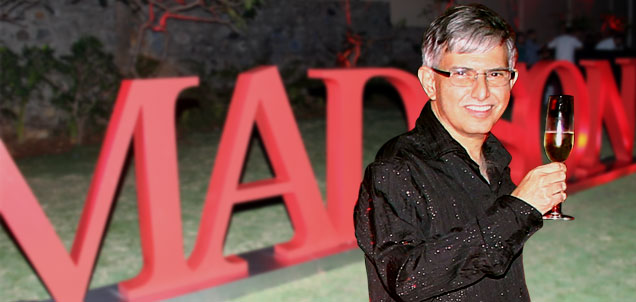

    The year 2013 has been more than good for the media industry in India with growth estimates at 11.1 per cent. That was much more than what was initially projected where the number was 7.4 per cent. So, yes, it has been good and I believe that the ‘cautious’ approach the industry was taking could be replaced by ‘buoyant’ where the growth projections for 2014 are concerned.


    Medium-wise, did you expect any surprises where market share was concerned or was it the same as last year?

    It was more or less what was predicted where Print continued to occupy the top slot followed by TV and Digital. In fact most of them have managed to post marginally higher rates than what was originally estimated from last year. So it’s a good sign. Moreover, I believe even 2014 will manage to throw up a few surprises if we go by the current trend.


    Apart from elections that you said will occupy a bulk of the adspends share, any other factors that you think will propel growth for the industry?

    In fact elections will be the single biggest thing to take place in 2014. What is heartening is that 50 per cent growth is expected to come from the elections coffers across political parties. Rs 5000 crore is quite a huge number, which is what we are estimating the revenues from elections to be.


    Which are the mediums that will largely drive the growth for the industry in 2014?

    All mediums would contribute in a significant manner with Print and TV continuing to be big, but Digital is something that will post good revenues again next year.


    Do you foresee any challenges for the industry in 2014?

    Challenges will always be there but we have to constantly strive to deliver good ROI to the advertiser and also pray and hope that advertising works. After all, an advertiser spends money so that he can increase his sales and if that does not happen then the entire foundation of advertising gets shattered. Agencies like us have to continuously be on the wall to discover newer ways of assuring the advertiser of adequate returns.


  • Say Cheers! Madison predicts 16.8% adspend growth in 2014


    By Johnson Napier


    With so much being reported and analysed about how the oncoming Lok Sabha elections would benefit or harm the prospects of the economy, there is one section of the trade for whom the election year indeed holds good stead. Going by the growth projections that the election season are expected to bring in 2014, the media advertising business in India is in for a big surprise if numbers revealed in a recent report are anything to go by.


    According to growth projections released by the Pitch Madison Media Advertising Outlook 2014 report in Mumbai yesterday, the advertising revenues are expected to grow by a robust 16.8 per cent in 2014 at Rs 37,216 crores. This is a sharp rise from the healthy 11.1 per cent that was reported by the industry in 2013. In fact the growth in 2013 is much more then the benchmarked figure of 7.4 per cent that was initially predicted by the report.


    Presenting the numbers to the fraternity in Mumbai, Sam Balsara, Chairman and Managing Director, of leading media services conglomerate Madison World said that the time to be cautious – which was the state that the industry was in for much of 2013 – was almost over and that the year ahead would be even more fulfilling with growth projected in the range of 16.8 per cent.  The report was presented by Madison World in conjunction with the exchange4media group’s Pitch magazine.


    “It is great to be clocking a growth rate in double digits, which has come as a boon to the industry that was stuck in clouds of uncertainty given the economic downturn that was witnessed for much of last year,” affirmed Mr Balsara. “Compared to 2012 that registered revenues to the tune of Rs 28,694 crore, the year 2013 reported numbers equalling Rs 31,877 crore, growing by 11.1 per cent. In fact 2014 would outperform the previous year and would register an estimated growth of 16.8 per cent, with revenues totalling Rs 37,216 crore,” said Mr Balsara, beaming.


    According to Mr Balsara, the core factor that would bring in the growth for the industry would be the Lok Sabha and the state Assembly elections scheduled for 2014. This would also include spendings by individual political candidates that would be investing money in reaching out to the masses.


    Presenting a medium-wise break-up to the gathering, Mr Balsara said that like last year, this year too belonged to Print that emerged as the numero uno medium. Advertisers took a liking to the medium as it reported a growth of 10 per cent with revenues equalling Rs 13,167 crore. This was largely due to increased advertising by sectors such as FMCG that contributed by 12.3 per cent to the overall ad pie (replacing Auto from the top spot) and Auto that contributed around 11.7 per cent. Education though saw a decline to 9.71 per cent versus 10.6 per cent share registered last year.


    When asked by MxMIndia to share his observations on the projections for the medium of Print, Varghese Chandy, Chief General Manager, Marketing, Advertising Sales, Malayala Manorama said that the growth was indeed a bullish one for the sector. “I am excited by the numbers that we have managed to throw up as a medium. The fact that we have still got the advertisers attention by being the number one medium of choice is a big thing.” Sharing further on what will drive the sector in 2014, he said that the Lok Sabha elections and the assembly elections that will take place in 2014 will bring in the necessary revenue growth that the medium is known for. But he had a word of caution for the magazine sector as he said that it would still be a task for magazines to contribute as much growth as newspapers too. “While niche and regional magazines will continue to deliver good growth, overall the magazine industry will still be challenged on the growth front.”


    Following the medium print closely was Television that recorded a growth of 8.2 per cent with revenues totalling Rs 12,410 crores. This was in sharp contrast to 2012 where the medium registered a zero per cent growth. Where sectoral contribution was concerned, Media, Retail, Alcoholic Beverages and Corporates registered a negative growth with only FMCG registering a positive growth for the medium. The medium is further expected to grow by 15 per cent in 2014.


    The next medium to vow the advertisers was Digital that has now become the third-most preferred medium for advertisers on a consistent basis. With revenues totalling Rs 3,050 crore the medium grew by a good 32.4 per cent and is expected to grow by 29.5 per cent in 2014 as well. Of this, display advertising will continue to have an upper hand compared to search with revenue numbers totalling to Rs 2,150 crore.


    Siddhartha Mukherjee, Category Director, Chocolate and Media, Cadbury India, Mondelez International was optimistic of the returns that the medium would deliver in 2014. Affirming to this writer, he said, “Going by the projections that were presented today and by the points bought up by panellists, there is no doubt that digital will continue to remain a go-to medium for many advertisers. That is what would be of importance to us too.”


    The mediums of Radio, Outdoor and Cinema combined accounted for the remainder 12-13 per cent of the ad chart with Radio accounting for revenues totalling Rs 1,097 crore (18 per cent growth), Outdoor clocking a growth of 6.2 per cent at Rs 1,977 crore and Cinema registering a growth of 10.4 per cent at Rs 167 crore.


    The evening also witnessed keynote addresses being delivered by dignitaries including Adi Godrej, Chairman of the Godrej Group, Uday Shankar, CEO of Star India, and Girish Agarwal, Director, Dainik Bhaskar Group who presented a roadmap that the industry could adopt to change their business fortunes and also derive positive growth for the several mediums under Media.


  • Veena Gidwani, others to conduct PR EDP at Northpoint

    By A Correspondent


    Veena Gidwani

    Northpoint Centre of Learning has has announced a programme for business managers titled   ‘Unleashing the Power of PR to Build Brand Equity’ in association with Veena Gidwani Associates. This has been created by veteran PR professional and former CEO of Madison PR Veena Gidwani to help business managers optimize the outcomes of PR for their brands through a holistic approach that integrates channels and messages that help drive brand and corporate reputation.


    The program has been designed for business executives with responsibility for corporate image building and integrated marketing communications.  It is specifically targeted at senior and middle management professionals in marketing ,sales, external relations/ corporate communications, Account Directors and Managers in PR Consultancies & Advertising Agencies, Promoters/senior executives of small- and medium-sized businesses.


    Through a combination of case studies, best practice examples and teamwork, Veena Gidwani and industry experts  like  Ajay Kakar (Aditya Birla Financial Services), Shweta Shukla (P&G), K Ramakrishnan (Cafe Coffee Day), Anuradha Sengupta (formerly with CNBC-TV18) and several others will  share their insights for  winning with consumers  and building brands through PR.


    Announcing the programme, Prem Mehta Chairman, Northpoint said,”Though brand marketers have begun to taste the gains from planned PR, its real value as a marketing tool has yet to be appreciated fully.  It is emerging as an essential communication medium, and when handled professionally, PR adds credibility to the message because it is not seen as manufacturer speak.”


    Sam Balsara

    Speaking about the importance of this effort, Sam Balsara CMD, Madison World said, “Brands who are spending crores of rupees in advertising are under utilizing the power of PR. This is a big mistake. PR can greatly strengthen an expensive mediaplan and thus help improve ROI of the overall campaign. I am glad Veena is running the Executive Development Programme at Northpoint on Power of PR. It should greatly help practising industry professionals to extract more from their marketing budgets.”


    Sharing the rationale  for  the programme, Veena Gidwani  said,”My experience of over 17 years in managing  PR agencies, interacting with client/corporate teams,  made me realise that a large number of Marketing/Sales  Managers and Account Managers, underutilize PR as they do not  fully understand  the power and dynamics of PR. This program has been created to meet this need. I am delighted that we have eminent industry experts on our faculty panel.”


    For details: www.northpointindia.com or contact Nitasha Gupta on +91 22-24212241, +91 9594992588.


  • Madison PR expands India presence

    By A Correspondent


    Madison Public Relations, the specialist image management unit of Madison World, has rapidly expanded in recent months, working across five offices across the country. With new clients and brands in healthcare, pharmaceuticals, lifestyle, food & beverage and education to service, the firm is growing at a rapid pace to establish a sizeable presence in the industry.


    Recently the agency added a range of new businesses from various sectors into its portfolio. These include:


    In the Healthcare sector, the firm won the mandate for one of the largest global pharmaceutical and healthcare company GlaxoSmithKline’s Vaccines business in India and The Cradle, a boutique birthing centre from Apollo Health and Lifestyles.


    In the Food & Beverage sector, the agency won the PR mandate for Budweiser, the world’s largest beer brand, Garuda Foods, an Indonesian Food Giant bringing a tempting line of food & beverage offerings to the Indian market, Hokey Pokey, leaders of finest quality vegetarian ice-creams, Radikal Premium Rice, one of the leading manufacturers and suppliers of premium basmati rice and Brbee Products Pvt. Ltd, into honey products from the Himalayan Range.


    In the Education sector, the agency won Institute of Finance and International Management (IFIM), a premier B School in Bengaluru and ITC’s Education & Stationery products business.


    In the Lifestyle sector, Madison PR bagged the mandate for sport lifestyle company Puma India and Skechers South Asia Pte Ltd, a global leader in the lifestyle footwear industry.


    The other significant wins were Go Air from the Wadia Group, Shenzhen State Micro Technology Co. Ltd (SMiT), Media Today Group, Hilton Hotel New Delhi, Wizzcare- Home Healthcare Specialists, Studio 169 in New Delhi, Panchantra Lifecare in Hyderabad, Meinhardt Infrastructure and McDowell Indian Derby in Mumbai.


    In the Construction & Aviation Sector, the agency won the mandate for Sany Heavy Industry India Pvt. Ltd from Pune and Deccan Charters Pvt Ltd. from Bangalore respectively. In the travel sector, the Agency bagged Fairfest Media Ltd, leading international tradeshow organizers and bC India Pvt Ltd.


    Paresh Chaudhry

    Commenting on the new wins, Paresh Chaudhry, Chief Executive Officer, Madison PR said, “Madison PR has worked with iconic brands over the past 13 years and we will continue to focus on creating client delight. We are very pleased to sign on these new businesses from different sectors across our various offices. Our recent wins will help us reinforce our credibility as communication partners, as we continue to invest in infrastructure, talent development and establish our expertise across various sectors which will help clients to achieve their overall communication objectives.”


  • Madison Media wins McCain Foods AOR

    By A Correspondent


    As Madison World celebrated its 25th anniversary, it received a gift with a difference – the win of the McCain Foods account. The account will be handled by Platinum Media in Delhi. McCain plans to substantially increase its spends in the coming year. The account was previously handled by Zenith Optimedia.


    McCain has a range of ready-to-cook frozen products including French fries, aloo tikki, idli sambar combo and cheese appetizers.


    This adds to Madison Media’s account-winning spree of Ruchi Soya, Max India’s corporate account, Cafe Coffee Day, Radikal Rice and Crompton Greaves.


    Gautam Kiyawat

    Gautam Kiyawat, Group CEO, Madison Media, said, “McCain as a brand has tremendous potential in the Indian market and I am excited to have them on board as our client. We are confident of helping them achieve their rightful dominant share.”


    Basabdatta Chowdhuri, CEO, Platinum Media, said, “We are absolutely delighted with this new win. What makes this win even more special is that it comes on our 25th anniversary.”


    Basabdatta Chowdhury

    Vikas Mittal, Managing Director, McCain Foods India Pvt Ltd, said, “We have a line-up of new business strategies and accompanying communication initiatives. Today, we are looking at increasing our media presence across all touch points.”


    Gunjan Pandey, General Manager-Marketing, McCain Foods India, added, “We wanted to take on board an agency that complimented our brand communication strategies. We look forward to create a more distinct market space for McCain.”