
Tag: LV Krishnan

  • Santa TAM has come to town today!


    By A Correspondent


    Oh! You better watch out,

    You better get set,

    You better not pout,

    I’m telling you that:

    Santa TAM is coming to town!


    He’s making the list,

    Checking it twice,

    Gonna tell us who’s popular or nice.

    Santa TAM is coming to town!


    He sees you when people are sleeping,

    He knows when people are watching.

    He knows if your shows are bad or good,

    So be good for goodness sake!


    Oh! You better watch out,

    You better not cry,

    You better not pout,

    I’m telling you why:

    Santa TAM is coming to town!


    With apologies to all for mauling the famed Christmas carol.  And we hope TAM CEO LV Krishnan and his team also take the doctoring of a Microsoft Clipart in the right spirit.


    For, it’s Christmas eve and the day when the ratings for the last week and that of the last two-odd months will be released.


    A settlement was reached in the first half of Saturday (Dec 23) where it was decided that the ratings of all channels save those news channels who produce a letter asking TAM not to share their individual channel’s numbers. These numbers which will not be disclosed are to be clubbed together in under an ‘others’ category.


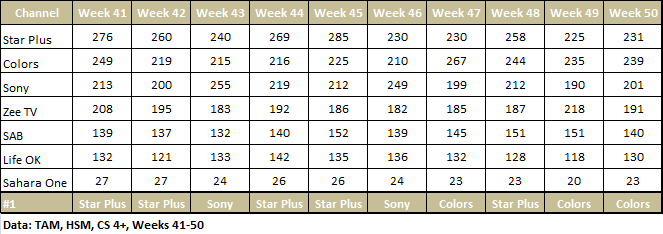
    Before we bring you the numbers of the all-important Hindi GEC category, here’s a disclaimer: It may be noted that from around mid-May 2012, TAM Media has not been giving out the ratings numbers proactively to the media. While the ratings we bring you are hence unverified by TAM, we assure readers that the source is reliable and the information is not incorrect. However, we would urge readers to make their own enquiries before being influenced by the numbers.


    General entertainment channel Colors has been #1 in Weeks 49 and 50. It also generated the highest in ratings in Week 47 as well. While Colors is #1 in three weeks, #2 in 4 weeks & #3 in three weeks, Star Plus has been a close #2 except in Week 47.  Sony was #1 twice while the highest rank Zee could attain was #2. Yes, there’s a neck-and-neck fight between #1 and #2.


    On Star Plus, the ‘Yeh Rishta’ leap on Dec 3 generated 5.4 TVR and the ‘Dabangg 2’ integration in ‘Diya Bati’ on Dec 12-13 got it 5.1 and 5.3 TVR respectively.

    On Colors, reality show Bigg Boss season 6 opened with 4.1 TVRs and has averaged 2.5 Monday to Friday in Week 41-50. The premiere of OMG generated 3.5 and 3.4 TVR delivering 39 GRPs.

    On Zee, Qubool Hai  opened with 2.5 TVR (Mon-Fri 9:30pm),  with latest week average  being 2.7.


    For Sony, the premiere of ‘Rowdy Rathore’ on Sunday Oct 21 garnered 5.1 TVR at the 12noon slot and 5.6 TVR at the  8:30pm slot  delivering 68 GRPs in all, whereas the premiere of ‘Ek Tha Tiger’ on November 11 fetched 3.3 TVR at the noon slot and 4.6 TVR at the 8.30pm slot delivering 55 GRPs. Kaun Banega Crorepati has been averaging 3.3 TVR.


    Earlier, the music genre numbers reached us, courtesy of 9XM. The flagship music channel has done remarkably well outwitting competition on most weeks.


    Meanwhile, you better not cry, you better get set… for Week 51 ratings are going to be out a day after Boxing Day. Yup, December 27! Week 52 data will be out on Jan 3 and the news channels on Jan 9.


    Imaging: Rafiq


  • Let the (ratings) games re-begin!


    By A Correspondent


    After a brief two-month hiatus, the broadcast industry will be waiting with bated breath to lay their hands on the viewership data that will be released by TAM tomorrow – that is, December 19 2012. The day will be of utmost importance in the broadcasting fraternity as it marks the release of data post the digitization drive that transpired across four major metros and also for the fact that the industry expects new trends to emerge, something that was amiss when the analog world was largely in operation until October 31, 2012.


    Just to recap, TAM had stopped issuing ratings to the industry citing deferment. In wake of the phase-wise DAS implementation that was scheduled to take place across the four metros, the custodians of TAM Media Research – Advertisers (ISA), Media Agencies (AAAI) and TV Broadcasters (IBF) – had arrived at a joint consensus on the need to temporarily defer TAM TV Viewing data release for the All India market for a period of 9 Weeks starting Week 41 (October 7, 2012, Sunday) and ending Week 49 (December 8, 2012). This deferred data will now be released on December 19, 2012 along with data for Week 50 (December 9-15, 2012).

     

    LV Krishnan

    At a press conference last week, LV Krishnan, CEO, TAM Media, highlighted the progress that had been made so far post the switch to digitization by the four metros and what were the immediate trends that were showing up in the new universe. What was heartening to note was that most analog homes in Mumbai and Delhi had made the imperative switch to digital with Mumbai recording a 93 per cent conversion rate compared to Delhi that recorded an impressive 97 per cent. On the other hand, Kolkata witnessed only 70 per cent conversion from C&S homes to digital while Chennai recorded more abysmal figure of just 26 per cent homes that had moved on to digital.


    Emphasising on the new rating mechanism, Krishnan said that as per the advice of the CIC committee, TAM will not report homes in the DAS area that are not digital. This will lead to the universe also shrinking correspondingly. Thus while analogue data from Mumbai, Delhi and Kolkata will not be released, an exception will be made for Chennai where it will continue to report analogue data given the low conversion rate observed there. Krishnan added here that the Urban Agglomeration or non-municipal corporation areas in Mumbai that consist of Navi Mumbai, Thane, Dombivli, Kalyan etc will continue to release analog data as they would be liable for conversion when the second phase kicks in. Thus, going forward, the data that would be released will be reported at breaks of C&S 4+, NCS (Terrestrial), C&S Digital 4+ and C&S Analogue 4+ (for non-DAS areas).


    Among the few trends that were observed as a result of the digitization drive, Krishnan pointed out the move had been a boon for niche genres like English and kids entertainment that witnessed a spike in viewership (time spent) during this phase. He noted that about 60 percent of channels with a pre-DAS share between 0 and 0.5% gain in share had witnessed a 4 percent net share gain post digitization. This was not the case for larger market share channels that witnessed a slight reduction in the net share gain.


    In order to facilitate the ever-expanding universe size, TAM has said that it would be increasing its sample size by about 400 peoplemeter boxes in the Mumbai and Delhi markets starting from the first quarter of 2013. It has also decided to add another 250 peoplemeter boxes to centres such as Chennai, Hyderabad, Bangalore and Kolkata.


    While all systems are set for the December 19, 2012 release Krishnan stated that with digitization having set in it was important to be cautious when analysing data in this phase like for example taking averages, looking at trends, not cutting data too fine such as a particular half hour on a particular day, ensuring that sample sizes are sufficient etc. Asserting his gameplan for the future, Krishnan said that for Phase 2, TAM seeks to carry-forward the learnings and continue working with the committee to make it conducive and resourceful for the broadcast environment.


    MxMIndia spoke to a few members from the broadcast fraternity to see if not having data for two months made any difference to their survival and what would be their expectations from the new ratings that get released from December 19, 2012.


    Ajay Bhalwankar, Head- Content – Hindi GECs, ZEE

    “There is a myth about every Wednesday morning being a scary one….You won’t find us running helter-skelter every Wednesday. Ratings tell you what has been liked and what has not been liked but not what has to be done! So they are just a reference point. We have an internal meter which we follow to check whether our shows are creating magic or not. Initiatives on digital and social media brought us closer to our audiences. This internal judgement is important. I started my career in the ’90s and we had no ratings then for nearly eight years. So, ratings do not bother me.”

     

    Anand Chakravarthy, Business Head, BIG CBS Networks

    “Our issue with TAM has always been that the English entertainment genre has never been well represented. The fact is that the English entertainment speaking audiences are never fairly represented in the sample, due to which the data released is not quite comprehensive. As a network, we have never depended on numbers to sell; we’ve always talked about the quality of content and the quality of our offering which has been our strength. In fact we have always maintained that TAM data is not a yardstick for niche channels like the English entertainment channels because the sample size of TAM does not represent this audience well.


    Even with digitization happening, the question, is how well will the new sample represent households that watch English entertainment channels? There could be some amount of movement of market shares between genres as we know that some parts of metros are still not disconnected completely. Therefore the universe size may reduce in some markets that will lead to change in ratings from the larger genres to possibly the smaller genres. But the fundamental issue, does the TAM ratings represent the English entertainment genre well enough and does it have the right sample size and profile of people, the answer to that is no. It will continue to be a problem unless it is addressed very clearly and head-on. That’s an issue that needs to be addressed very quickly. We are working with TAM to see how we can better evolve the system so that the English entertainment space is represented well enough.”

     

    Nina Elavia Jaipuria, EVP & Biz Head – Sonic & Nickelodeon India

    “What happened was for the good of the industry because it was required that everybody come to a consensus and see that the data is sanitised thanks to the changing environment and that it would give us a better understanding of phase 2. So while life was disrupted for about 8 weeks, it was all for a good cause. But having said that, I also believe that TAM is the only currency that exists in this industry and therefore we did miss its release to some extent. But it was a minor hurdle and nothing major so as to change our lives drastically.


    As for the release of data once again from tomorrow, we have to see what the new TAM has in store for the industry. They must be having their hands full as of now but then there is a committee which is looking to sanitize data that gets released. With the digitization numbers already pouring in, we are eager to see the kind of trends that the kids entertainment genre has managed to throw up. I see content and marketing playing important roles as they will drive viewership to the genre. So I would wait to see what TAM has to offer and take that lesson to phase 2 of digitization. I am sure that TAM will keep themselves abreast of the sample size and formation based on the manner in which digitization gains acceptance. So the universe will also move accordingly and I am sure that TAM would have taken into account that factor. Whether it is SEC fragmentation or it is the universe movement, TAM surely would have taken all these things into account. Also, digitization will only help the industry in terms of it becoming more transparent and more measurable and the fact that the niche genres will have a better chance to survive.


    Also, it will become an environment where the reliance on ad-sales will witness a drop. It will not vanish completely but we will see more reliance on subscription, which will be a good thing. All this won’t happen overnight as only 4 metros have been included in phase 1, which will move to 38 other cities in phase 2 that will take another 4-6 months. But in the end the country will be digitized for good.


    From a qualitative perspective, we would like to see different slicing of data especially from a demographic and psychographic perspective in the kids’ genre. Traditionally we have been doing 4-14 yrs which is sliced 4-9 and 10-14 yrs and the more we look at kids today and the fact that they are becoming more dynamic today, there is a need to relook at the slicing by TAM.


    Ajay Trigunayat, CEO, English Entertainment Channels, Times Television Network

    We are of the view that it’s difficult to capture rapid macro-transitional changes:


    1. Analog >> Digital migration

    2. Panel Updation

    3. Change in SEC definition


    We certainly understand it’s a challenge to condense this transitional period but we are hopeful TAM will accurately reflect these changes soon.

     

  • TAM to cross 10,000 Peoplemeter mark soon

    By Meghna Sharma


    In a country like India with numerous channels on air and where television watching is an obsession, it is vital for broadcasters and advertisers to know how well the channels and the various programmes on them fare. TAM, a joint venture between AC Nielson Research Services (Nielsen Company) & Kantar Market Research, was mandated by the broadcast and advertising industry to do exactly that. Over the last decade-and-a-half, TAM has been optimizing coverage of the growing TV audience across the country by increasing breadth (expanding to cover larger number of new markets) and depth (enable deeper level of analysis in existing data markets).


    By the year end, the TAM Media Research plans to increase its sample size by nearly 2000 households. The present expansion is in alignment with the above thought process and is an attempt to bring insights on audience engagement with TV Content. “The current Indian broadcast landscape is dotted with some very different and complex influencing factors like the need to dive deep into untapped semi-urban/rural markets and the upcoming mandate of digitization,” says LV Krishnan, CEO, TAM Media Research.


    He adds, “With digitization, we are already seeing increase in not only the channels entering the distribution pipe but also audiences trailing more content across newer genre of channels. As the long tail of unique content channels explode in 100% digital markets (Phase I being the Metros), TAM will be enhancing the sample size in these digital markets (Metros) to throw more light into audience consumption of these unique content channels. This enhancement will benefit micro targeting of viewer groups for not only broadcasters with their content but also advertisers interested in specific audience groups for their brand communication.”


    Keeping this in mind, TAM will be taking a few steps. The first initiative being taken is to increase the panel size in Mumbai, Delhi, Kolkata, Chennai, Bengaluru and Hyderabad totalling 650 homes. This will increase the SEC AB sample size in these metros by around 60%. All additional 650 homes will be recruited among C&S SEC AB homes.


    But that’s not all. As part of the initiative, TAM will expand in the less than class I India markets too. In the annual January 2012 establish report, the fastest growth for digital TV platform continued to be from less than Class I towns (with population of less than one lakh) and semi-rural markets in the Hindi belt markets. “This affirmed our hunch of the need to beef up representation in the semi-rural markets. Since 2009, we have been covering Maharashtra in the ‘Less than Class I’ geographic stratum. To this stratum, we are now adding seven more states: Gujarat, Madhya Pradesh, Punjab, Haryana, Himachal Pradesh, Rajasthan and UP. These will be reported as individual states except for Punjab, Haryana, Himachal Pradesh which will, as usual, be reported together as PHCHP,” adds Mr Krishnan. The increasing the sampling across these five new markets will be 1110.


    With this expansion, TAM will practically complete covering the entire urban stratum for the Hindi Speaking Market group. This also means that TAM will now cross the 10,000 Peoplemeter deployment mark and will be add 63 more towns to the existing base number of (162) sample towns with this expansion. Now, it will cover 225 towns.


    However, there are some who feel that an increase of a sample size of 2000 is not enough. “From the current sample size of around 8000, an increase of around 2000 more does brings up the number, but considering the size of the country it’s not an ideal number to know the ‘correct’ pulse of the viewers,” feels Anamika Mehta, COO, Lodestar UM.


    Agreeing with her, Tarun Katial, CEO, Reliance Broadcast Network Ltd., adds, “With the current sample size, it is very difficult to map the evolving choice of consumers. And right now TAM does not represent the digitalized packages. Therefore, until and unless it is done universally it won’t be able to ‘help’ like it should be. I would want TAM to look at their international counterparts to learn from them how they tackle the issues.”


    Even Sunil Lulla, MD and CEO at Times Television Network believes it’s high time that TAM woke up and smelled the coffee. “We are delighted that finally the industry pressure has worked. Many broadcasters, including us, have been telling TAM about various issues which affect our rating process. So, we hope that this increase in sample size, though small but relevant, will benefit and mark a beginning of improvement and swift growth of the system.”


    There are many who feel that the move by the TV audience measuring firm should be welcomed and shouldn’t be criticized. “We should understand what a tedious process it is. And over the years, TAM has been working to help the industry. TAM has been working with the over 8000 sample size for years now, so we should give them credit for increasing it. This move will not only increase the household numbers but also increase the cities which will make the sample more robust,” points out Anilkumar Sathiraju, Mudra Max Media, Head – South. As proposed, TAM has started preparing to implement both the initiatives in the full swing. Both the data cuts are targeted to be made available starting January 2013.


    Mr Sathiraju adds, “However, there is no denying the fact that over 10,000 sample size for a country with over one billion population isn’t correct. And I hope and wish that this will lead to a quicker growth in the next level of the phase. It is a challenge and hopefully won’t take years.”


    Mr Krishnan is of the view that the measures initiated will benefit broadcast. “Over the last three years, in our annual baseline (Establishment) study we conduct and release in Week 1 of January, we are witnessing a tremendous growth of Cable & Satellite TV and Digital TV platform penetration. This growth is fuelled by the growing aspiration to engage in multiple Content – Entertainment & Information, that these platforms are providing on a simple TV screen. In the Jan 2012 report, the fastest growth for Digital TV platform has come from less than Class I towns (with population of less than 100,000) and Semi Rural markets in the Hindi belt markets. Once access and engagement with multiple content happens, it is pertinent to measure the behaviour to help broadcasters, in particular, the regional language broadcasters for aligning content to these audiences. It also satisfies advertisers and nedia agencies needs as their need to target brand communications to consumers in these markets become a reality. Also, these new markets from TAM will give you a closer picture to the Rural India’s TV consumption habits in the Hindi heartland.”


    Meanwhile, with the imminent digitization in the four Metros, Mr Krishnan explains that in a market in Mumbai and  Delhi, with already 25% of the TAM panel and market digitized, his team and he are seeing new patterns of viewing settling in. “More viewers are glued to genres of their choice and landing straight on their favourite stations. Time spent with TV and within specific genres are increasing too. This will mean that there is enough scope for more channels to either get launched within the existing genres or new genres with Unique Content will launched soon in the new 100% digital era (given that creating access to the Content will be easy!). Tier packages will get formed and purchased by the potential viewers, thus sub-segmenting the audiences into more fractions! To capture these new behaviour trends, TAM is increasing the metro samples by almost 60% and in markets like Mumbai and Delhi, TAM is almost doubling the sample!! This will help broadcasters and bdvertisers to not only understand audience content consumption patterns but also target their programming and brand communications very well.”


    So what next? The preparation to implement both the initiatives is in “full swing”. Both data cuts will be made available starting January 2013.Also, with an eye to aid the understanding of the digitization progress, TAM has initiated The TAM DASES (DAS Estimation Study) : A study focused on the Phase 1 markets (as notified by the I&B Ministry for DAS implementation). Wait for it!


  • ASCI is not a toothless tiger: Bharat Patel


    Bharat Patel

    By Robin Thomas


    The Advertising Standards Council of India (ASCI) has joined hands with TAM Media Research to introduce National Advertising Monitoring Service (NAMS) which will come into effect from May 1. The aim of the monitoring service is to reduce the number of misleading and unsubstantiated advertisements (see accompanying story: ‘Paradigm shift for self-regulation’). AdEx India, a division of TAM, will monitor around 350 televisions and 10,860 newspaper advertisements released every week.


    In conversation with MxMIndia, Mr Bharat Patel, former chairman of Procter & Gamble and Board Consultative Committee Member and also former Chairman of ASCI spoke about NAMS and its impact on consumer complaints. And that ASCI is not a toothless tiger!


    NAMS has been introduced shortly after the government asked ASCI to fast-track the decision-making process…

    Absolutely. In order to speed up decision-making, the CCC (Consumer Complaints Council) decided to meet twice every month from the earlier once a month meeting. This decision was made following the advice of Ms Ambika Soni, the Minister of Information and Broadcasting. We are open to receiving suggestions, and when the Ministry of Consumer Affairs pointed out that something needs to be done on the increasing number of consumer complaints, we decided to do monitoring and thus the introduction of National Advertising Monitoring Service (NAMS).


    And the discussion to set up NAMS?

    The discussion started over three or four months ago. We were in talks with a lot of people, including consumer organizations and we found that TAM has the best availability and resources for the service.


    There were reports of the government planning to launch its own version of advertising monitoring services to reduce consumer complaints…

    I don’t think it’s true because the Additional Secretary at the Ministry of Consumer Affairs denied any such move. So we don’t know how true this is but, the Ministry denied it at this stage. The I&B Ministry has been very supportive of the ASCI. They have, in fact, mentioned in their codes that any advertisement that violates the code of ASCI will not be allowed. The Consumer Affairs Ministry is also supportive of self regulation.


    What is your reaction on ASCI being called a toothless tiger? Will NAMS give ASCI more teeth in dealing with ads that violate ASCI code?

    Calling ASCI a toothless tiger is absolutely wrong.  Cable TV Act Rules state that no ad which violates ASCI’s code can be released on TV.  Nowhere in the world has such recognition of an advertising Self Regulatory Organisation (SRO) been granted by the Government. All the ads, against which a complaint is upheld by CCC, are modified or withdrawn voluntarily in writing by advertiser. In fact, the I&B Ministry sends all the complaints it receives to ASCI for adjudication. In print, nearly 80 per cent ads voluntarily comply with CCC rulings. So, how can ASCI be called toothless tiger? ASCI is not a toothless tiger!


    It has been 26 years since ASCI was established, what are the changes you think ASCI has brought to the minds of the consumers and the advertising industry?

    ASCI has increased awareness, atleast among its members who release 80 per cent of non-government advertising in India, on the need to have ads which are true, decent and fair to competition.  Consumers are also made more aware of ASCI as a service that can help remove ads which they find misleading or indecent or displaying unsafe practices. As a result, the total number of complaints to ASCI has increased from 770 in 2010/11 to about 2,000 in 2011/12.


    ‘Paradigm shift for self-regulation’


    I Venkat
    LV Krishnan

    According to the Advertising Standards Council of India’s agreement with TAM, AdEx India will identify ads which are potential violation of Chapter 1 of ASCI code – to ensure truthfulness and honesty of representation and claims made by advertisements against misleading advertisements. The advertisements that violate the ASCI advertising code will be forwarded to ASCI on a weekly basis, post which ASCI would process them as per its complaint redressal procedure involving its Consumer Complaints Council (CCC) for adjudication.


    AdEx India will monitor ads in the auto, banking, financial services and insurance, FMCG (including F&B), consumer durables, educational institutions, health care products and services, telecom and real estate sectors. AdEx will track more than 30 newspapers which is said to contribute over 80 per cent of national newspaper readership and all television channels across India in all languages.


    Said Mr I Venkat, Chairman, ASCI: “The National Advertising Monitoring Service or NAMS initiative is a paradigm shift for self-regulation in Indian advertising and probably a benchmark for the other countries. For such an important industry central initiative, TAM’s AdExIndiawas the obvious option to handle such a large responsibility that brought in requisite infrastructure, neutrality, integrity and quality.NAMSwill strengthen the ad self regulation redressal process manifold, as we will be able to proactively monitor wider number of ads. This will be in the best interest of the Indian consumers as it will significantly reduce release of misleading advertising in India.”


    Mr LV Krishnan, CEO, TAM Media Research said: “Apart from media measurement, for decades now, we have been playing a silent, yet central industry, role towards media (advertising) monitoring and analytics as well. Our partnership with ASCI is yet another reiteration of the neutral role we play within the Indian landscape.”