Tag: Karan Bedi

  • ShareChat & MX Media merge

    By Our Staff


    MX Media Co. Ltd, the parent company of MX TakaTak, and ShareChat, the parent company of Moj, have announced a strategic merger between Moj and MX TakaTak, to create the largest short video platform for Indians, whereby the two platforms will now be controlled by ShareChat. The combined platform will have 100 million creators, over 300 million Monthly Active Users (MAU), and nearly 250 billion monthly video views. Post this transaction, MX Media and its shareholders will become strategic shareholders of ShareChat.


    Commenting on the merger, Ankush Sachdeva, CEO and Cofounder, ShareChat & Moj, said: “We at ShareChat are building India’s largest content ecosystem which has been on an unprecedented growth trajectory. MX TakaTak is a popular platform and this merger further solidifies our position in the short video ecosystem. With this development, we aim to build the largest original content platform on Moj along with the largest community of users across India.”


    Added Karan Bedi, CEO MX Media: “I am excited to announce the strategic merger of India’s two most popular social media platforms. As India’s largest digital entertainment platform, MX has always strived to build superior world class products, and TakaTak is no exception. This combined with Moj’s AI and execution capabilities makes the combined business a truly world class short video platform. MX has created two ‘unicorns’ within one business, unlocking significant value for our shareholders, and will now continue to double down on OTT, with significantly increased financial resources.”


  • TikTok’s Nikhil Gandhi joins MX Media as COO

    By Our Staff


    MX Media has announced the joining of Nikhil Gandhi joins as Chief Operating Officer. Based out of Mumbai and Singapore for this role at MX, Gandhi will be responsible for taking the platforms to their next phase of growth by expanding its geographical reach, enhancing data driven innovation, growing the scope and scale of revenue streams, and building maximum impact for all stakeholders – be it consumers, advertisers, or internal teams across verticals.


    Elaborating on the same, Karan Bedi, CEO of MX Media said “Nikhil brings decades of experience in both traditional and emerging media platforms, and will be a huge asset in taking MX to the next level of rocket fueled growth. We look forward to working closely with him.”


    Speaking about this new role, Gandhi added: “MX Player is by far the leader in the video entertainment space. I’m super excited to join the MX team and look forward to the next phase of our growth.”


  • Azaad Channel & MX Player ink partnership

    By Our Staff


    Beginnen Media’s rural entertainment channel, Azaad, and entertainment app MX player, have announced a strategic partnership to enable exponential growth and bring together the linear, rural and digital worlds together.


    Bharat Kumar Ranga
    Bharat Kumar Ranga

    Said Beginnen MD Bharat Kumar Ranga: “The UnionShip with MX Player offers a seamless consumer experience on both mediums as we attempt to be innovators at the intersection of TV and digital.  Azaad is for people with rural mindsets where people access entertainment on both TV and internet. We needed to find a right anchor that compliments Azaad on the internet. MX Player immediately aligned to our vision as we share a commonality of consumer centricity that will assist us with our expansion goals for Azaad and MX Player. MX valued our idea and intent and Azaad loved their youthfulness, vigour, hunger for growth and uncanny consumer centricity. For consumers, MX and Azaad will appear like one common platform. This reflects Beginnen Media’s entrepreneurial spirit and dedication to using our experience of innovation as the roadmap for propelling the industry forward to an all new way of doing business.”


    Karan Bedi
    Karan Bedi

    Elaborating on the same, Karan Bedi – CEO, MX Group added: “In an industry first, this association will transcend traditional TV and digital OTT to drive synergies and foster growth for both players, by creating innovative new content and catering to a larger audience set. As a platform that can reach consumers at every touchpoint, this strategic partnership with Azaad is sure to entertain the masses and drive more engagement for both brands.”


  • MX TakaTak lanches a Rs 100 crore creator fund

    By A Correspondent


    Short video platform MX TakaTak has announced a new initiative for creators – the MX TakaTak Creator Fund to encourage established and emerging creators to create engaging, impactful and inspiring content on the platform. The fund will deploy Rs 100 crore for creators.


    Said Karan Bedi – CEO, MX Player said: “The MX TakaTak Creator Fund is a way to give back to millions of people who bring their ideas into videos as well as to inspire other digital enthusiasts. Millions of users upload videos daily on the MX TakaTak App. We were thrilled to see the amount of creativity and hard work that our users put into bringing their dreams alive and into a video. We hope that the creator fund will not only reward them but also inspire them to continue creating impactful content, build an inspiring digital career, and help give back to the society that we all benefit from,” adding: “The short format video ecosystem is fast evolving and we’re delighted to have emerged as the market leaders in this category. Home to 70Mn Monthly Active Users and with over 10 Mn unique content creators, we are the preferred platform of choice for both the users and creators; we aim to further scale this in the new year.”


  • MX Player raises $110 million from Tencent and Times Internet

    By A Correspondent


    MX Player has received $110 million in fresh funding from Tencent and Times Internet. The deal marks Tencent’s second investment into a Times Internet asset, after it invested in sibling Gaana, the music streaming platform, in 2018.


    Speaking on the investment, Karan Bedi, CEO MX Player, said: “We’re happy to welcome our new partners, whose investment is a glowing endorsement of our stellar growth and huge future potential. Our vision is to be one of the world’s largest entertainment platforms, serving our users across their online entertainment needs, starting with streaming video and beyond.”


    Added Satyan Gajwani, Vice Chairman, Times Internet: “MX Player was our most ambitious investment last year, and it has the potential to change mobile entertainment in India and in the world. It plays an important part of Times Internet’s strategy of being the largest consumer platform in India, and we’re excited to have Tencent help us in this mission.”


  • MX Player appoints Viraj Jit Singh as Revenue Head

    By A Correspondent


    The Times group’s OTT platform MX Player has announced the appointment of Viraj Jit Singh as its SVP & Head – Revenue. Prior to joining MX Player, Viraj was responsible for revenue generation, communication and marketing strategy for brands like Viacom18 Media Pvt. Ltd., KidZania India, ESPN Star Sports and Reliance Broadcast Network.


    On his move to MX Player, Singh said: “I am excited and looking forward to my new role in the MX Player family. The OTT space has witnessed tremendous growth in the past few years and I look forward to applying my diverse skill-set to strengthen MX Player’s position in the market.”


    Commenting on the appointment, Karan Bedi, CEO, MX Player said: “I am delighted to welcome Viraj to MX Player. He brings with him a rich tapestry of experience that will be a great asset for our venture. Viraj’s extensive leadership and expertise across markets make him a terrific addition to the growth and strategy of MX Player.”


  • What will make Digital tick?


    By Anuka Roy


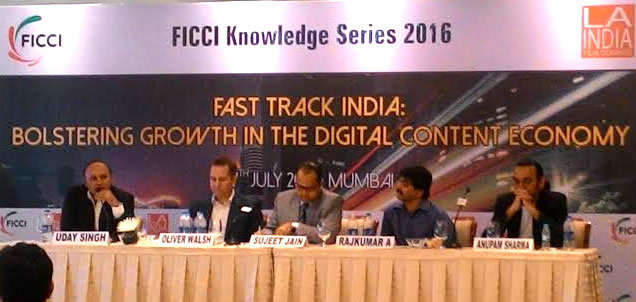
    For the past few years we have hearing that ‘Digital has arrived’. That ‘Digital is the future’ etc. But how has it arrived and more importantly how will it be our future? So, on Wednesday (July 27) some top executives from the India’s motion picture and digital industries concluded that accessibility, affordability, quality content and online content protection will be the key drivers to sustain growth in India’s digital economy.‘Fast Track India: Bolstering Growth in the Digital Content Economy’, a knowledge series forum by the Federation of Indian Chambers of Commerce (FICCI) in association with the Los Angeles India Film Council (LAIFC), assessed the extent to which screen content acts as a key driver of the digital economy in India. The industry experts assessed the current regulatory and infrastructural challenges, reviewed future growth trends and underlined innovative ways of monetising digital content to stimulate growth in India’s digital economy.


    Noted filmmaker and Co-Chairman, FICCI, Entertainment division, Ramesh Sippy started the conference by highlighting the fact that increased connectivity, technological innovation and new content delivery platforms all combine to increase growth. He said that government’s role is pivotal to enabling legitimate content delivery platforms to protect and monetise their content in order to achieve their full potential in a rapid changing marketplace. Digital India has the potential to create opportunities for businesses, promote innovation and create jobs. However online content theft, varying levels of broadband access and affordability in terms of data tariffs continue to present challenges for providers to deliver value to consumers. These factors will have a significant impact on how digital media evolves in the future.


    Girish Menon, Director, Transaction Services, KPMG India moderated as well as introduced the first panel discussion. The first panel ‘Making Sense of the Economics of Digital Media’ featured a keynote presentation by KPMG. Menon said, “The advent of the OTT services and on-the-go content aided with competitive tariffs and falling average retail price of smartphones has helped to drive video consumption in India. However, profitability still continues to be a major challenge coupled with infrastructure and affordability of data tariffs and payments models. It is imperative for the OTT players to address these concerns through innovative means to achieve the medium’s full potential.” Speaking about the future of OTT content services, Ajay Chacko Co-Founder and CEO, Arre said, “As in the case of broadcast TV in India, the relatively infant digital content economy is showing signs of secular, organic growth driven by an increasingly young India. We already have more than 120 million consumers of digital content. As with every paradigm shift, audience shifts will be followed by a shift in advertiser preferences and finally consumer monetisation. So I am quite hopeful that the digital content economy will see the exponential growth that has been witnessed in the 2000-2010 decade in TV, in the next three to five years.” While film producer Vishesh Bhatt, expressed his concern about serious content makers still not understanding the digital ecosystem. However, Karan Bedi, COO, Eros Digital, was optimistic about the future and gave the example of Pokemon Go, about how the game has caught the attention of the consumers. He said: if consumers are compelled by content, they will eventually pay for subscription as well.  Said Archana Anand, Business Head, dittoTV: “In light of the accelerated digital media consumption across the country, it is wonderful that FICCI and the LA India Film Council provides this much needed platform to discuss the market potential of this space and the innovations and challenges thereof.”


    Moving on from the concerns about monetising digital content, the other looming concern is around the rules and regulations of the digital media. The second panel discussion on ‘Regulatory and Infrastructural Challenges for Digital Media’, Abhishek Joshi, Head, Marketing and Analytics, Digital Business, Sony Pictures Networks India Pvt Ltd. said “The OTT industry has graduated from the innovators stage to the early adopters stage within the innovation diffusion curve, based on distinguished product strategies by players in the market. However to cross the chasm to gain the majority market, policy makers will have to play a very big role. Infrastructure and regulatory policies are going to be the biggest differentiators for industry growth for the next 18 months.” Akash Banerji, Head, Marketing and Partnerships, VOOT was very hopeful about the future. According to him, even though the industry is still learning, the consumers will be in a demanding position in the future and eventually mobile data will also come down. Siddharth Roy, COO, Hungama.com, stressed on the fact that branded IP (Intellectual Property) will be one of the key drivers of content regulation. But Rajeshree Naik, Co-founder, Ping Networks, had other concerns. She said that it is the collective responsibility of the industry is to see to it that government stays out of digital media regulations. This session was moderated by journalist and author Mayank Shekhar.


    The final panel discussion was on ‘Building a Robust Enforcement Model to Protect Content In a Digital Economy’ and was moderated by Uday Singh, Managing Director, Motion Pictures Association, India Office. Oliver Walsh, Regional Director, Online Content Protection, Motion Picture Association- International(MPA-I) said, “The Indian film and TV industry supports 1.8 million jobs which are at risk because of rising online content theft. The future of legitimate content delivery platforms depends on effective enforcement measures supported by Indian State Governments. The Telangana Intellectual Property Crime Unit (TIPCU) is a great example of a dedicated law enforcement unit to tackle organised online film piracy and will set a gold standard approach to significantly reduce online infringement of films and television shows. I hope it is the first of many such enforcement units across India.” Rajkumar Akella, Honorary Chairman, Governing Council, Anti Video Piracy Cell, Telugu Film Chamber of Commerce said, “As we have been witnessing in recent days, the problem of online piracy is most urgent. The greatest threat now has become the pre – movie release leakages. Without real time interventions from the government and industry, it will go out of control. In this scenario, the latest initiative – TIPCU by the Government of Telangana, the Telugu Film Industry & the Motion Picture Association, India office, is a very significant step in tackling Movie Piracy, particularly Online Piracy. It is a collaborative, dynamic model,where the Government works seamlessly with the Industry and all stakeholders. The unit will be making optimum use of Technology besides policy, enforcement and outreach. This is a step in the right direction to root out piracy in India.” The General Counsel of Viacom 18, Sujeet Jain suggested the formation of digital courts to deal with piracy and protect online content. Anupam Sharma, Director, Film and Casting Temple, Australia was of the opinion that educating the consumers was the first step in stopping illegal downloading of content. He showcased a short video where the cast and crew of his movie are shown to be thanking the audience for not watching pirated videos and acknowledging the fact that the audiences are also a part of the film industry. This video was made to create awareness against video piracy.


    Biren Ghose, Country Head, Technicolor India, in his concluding remarks, said, “Content is assuming new life in the emerging digital economy. Technology enables innovations in imagery that could hitherto neither be produced nor consumed. FICCI and LA India Film Council need to be complimented on encouraging the conversation for the Indian agenda in this space.” Panelists concluded that a combination of government and private initiatives would need to be rolled out to achieve the ambitious goal of a truly Digital India.


     

  • #FF14 Day 2: Need to monetize big in a multi-platform era

    By A Correspondent


    There’s a lot that is being said on how the advent of technology has revolutionized the M&E ecosystem. With the emergence of newer technologies and players offering these services, it becomes a challenge to find a balance in providing technology with creativity and content. The session on ‘Monetization Opportunities in the Multiscreen World’ sought to throw light on how the ecosystem was witnessing an interesting shift in revenue-sharing models and how companies could monetize effectively during these challenging times.


    The panelists included Sam Balsara, Chairman & MD, Madison World; Satyan Gajwani, CEO, Times Internet Panel; Chakrapani Gollapali, General Manager, Consumer Channels Group, Microsoft India; Neeraj Roy, MD & CEO, Hungama Digital Media; Rishi Jaitly, India Market Director, Twitter; Nikhil Naik, Head – Director, Global Content and Distribution, Vuclip; Karan Bedi, Founder & CEO, Tutorific! and Ramki Sankaranarayanan, CEO, Prime Focus who moderated the session.


    Presenting an insightful outlook, Sam Balsara highlighted how the television and mobile will be the only two mediums that will continue to be dominant in the future and how the interplay between the two would result in positive growth of the industry. Balsara said that while television continued to find favour with advertisers, they were gradually waking up to the medium of digital as well. “But advertisers need to be flexible about how the viewer’s see their ads; not just on television but across multiple screens.”


    Cautioning the audience, Balsara expressed discontent on how the older norm of doing business was seeing a shift that was not healthy. “The older model of doing advertising was 50-50; half from subscription and half from advertisers. But that has changed of late with more revenues coming from advertisers allowing them to have a greater say in content. It is important that we move back to the old model of 50-50 so that equilibrium is maintained and focus around content remains intact.”


    According to Neeraj Roy, it is not true that monetization in India is not up to the mark. “Around Rs 1500-2000 crore is still being directed towards content and that was a very positive sign. But he expressed worry as he said that the monetization exercise was being limited to certain mediums only. The way out is to have a balance in the advertising-transaction ratio, said Roy. With the shift to 4G being imminent, Roy urged content providers to focus on providing content that is high on value as consumers will be willing to pay more provided they get quality content.


    Providing a synopsis of his company, Rishi Jaitly said that more than 25 million users use twitter to discover content. Jaitly said that if companies concentrated on investing in value then the monetization will actually go up. “The world today is becoming mobile-first, so content providers needs to work on providing content that is of context and relevant. As a network, our focus would continue to be on fueling public conversation across multiple platforms,” affirmed Jaitly.


    Highlighting the scope and challenges faced by his company, Satyan Gajwani said that it was great to see the digital ecosystem in India thriving but the challenge is in delivering content that is high-quality because at the end the customer is going to pay for it. Talking about the issue of piracy facing his portal gaana.com, Gajwani said that the only way to overcome that was by offering such high-value and widespread offering that the user will be forced to come back for anything and everything got to do with music. This will indirectly bring down the number of users going to pirated websites to seek such services.