Tag: Jio

  • The Big OTT Growth Story: Chapter 3


    This is the third in a series of columns on the OTT Growth Story in India.

    Links to previous chapters: Chapter 1, Chapter 2

    By Shailesh Kapoor

    76.5 Million. That’s the all-important number to look at from The Ormax OTT Audience Report: 2019. The recently-concluded research, designed to size and profile the OTT audience market in India, took up the task of first measuring the number of ‘regular’ OTT audience that exist in the country currently.

    The definition of ‘regular’ can be subjective. Based on our category experience and market feedback, we defined it as: Audience who watch online videos for at least two hours every week, and use at least one OTT platform/ app, apart from YouTube and social media, to watch videos.

    The study covered 15+ audiences, and hence, does not include kids. It emerged that 76.5 Million, or 7.65 Crore, is the size of this market in India currently. The next track in 2020 will establish the growth rate. The question is: How small or big is this number?

    Comparing to TV universe can make the number look very small at this early stage of the OTT category. But a more obvious comparison can be made to the theatrical universe. The Bollywood regular theatre-goers universe stands at 33.3 Million, or 3.33 Crore. Add the unduplicated components of regional universes, especially the bigger ones in Tamil and Telugu, and the overall regular theatre-goers universe in India touches the 6 Crore mark.

    Let that sink in. The regular OTT audience universe in India is already bigger than the regular theatre-goers universe in India. And the former is growing in top gear, while the latter has flattened out for almost a decade now. This gap will only get wider.

    Only 15% of the regular OTT universe belongs to the top 6 metros in India. There’s a healthy longtail, created because of falling data costs and the penetration of Jio into small towns and villages in the last 2-3 years. But there’s enough scope for growth across markets. Mumbai and Delhi, the top 2 cities, have about 3.0 Million regular OTT audience each, which is nowhere close to saturation, given the huge adult population of these big metros. The equivalent theatre universe size in these metros is 3.2 Million (Mumbai) and 2.8 Million (Delhi). Hence, the two biggest cities have similar OTT and theatrical universe sizes. It’s beyond the metros, where theatre penetration, content relevance and ticket pricing remain key issues, that theatre-going habit loses out to OTT, a scenario that would have seemed quite unlikely till three years ago.

    The recent trend of films going directly to OTT (read here) is another sign of how OTT has emerged as a robust option for entertainment, and the price factor, which would have earlier been a big discussion point (“Indians are not used to paying for ‘television’ content”) is slowly becoming a lesser factor, with most OTT platforms coming up with rationalized pricing packages for the Indian market.

    As an aside, Amazon Prime Video’s The Family Man has emerged as the big show of the year, scoring an Advocacy Rating of 80, just a point below Sacred Games S1, to become the second most-liked India OTT show ever. A few more such winners and the OTT universe will continue to flourish.

    125 Million by 2020?


  • Road Safety World Series to be held in February 2020

    By A Correspondent


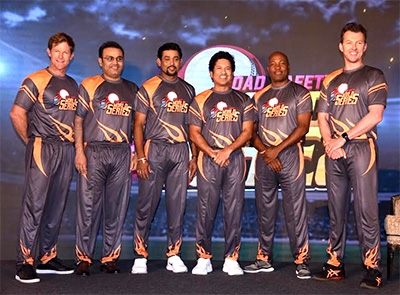
    Sachin Tendulkar, Virender Sehwag, Brian Lara, Bret Lee, Tillakaratne Dilshan and Jonty Rhodes, will lock horns for the Road Safety World Series scheduled to be held in India early next year.
     

    The Road Safety World Series will be an annual T20 cricket tournament between legends of five cricket playing nations—Australia, South Africa, Sri Lanka, West Indies and host India. Along with rivalry on the field, the cricketers will also spread the message of road safety during tournamenet. The tournament will be played from February 4 to 16, 2020, and will be hosted across premier venues in India.


    Viacom18’s Colors Cineplex is the broadcast partner while Voot and Jio are digital partners. Tik Tok is Online Community Partner of the League.


    Said Sudhanshu Vats, Group CEO and MD, Viacom18: “We have always believed that entertainment has the potential to bring about meaningful change and what better way of practising this philosophy than to bring cricketing legends in the popular T20 format to spread the message of road safety. An annual tourney spread over two weeks, I believe this league has the right balance of fandom, brevity and consumer connect to make this a viable long-term proposition – both in terms of sporting and business value. We are happy to partner with PMG and Road Safety Cell of Maharashtra Govt. to bring forth this cricketing tournament to viewers across the world.”


  • HDFC stays as #1 in BrandZ ranking


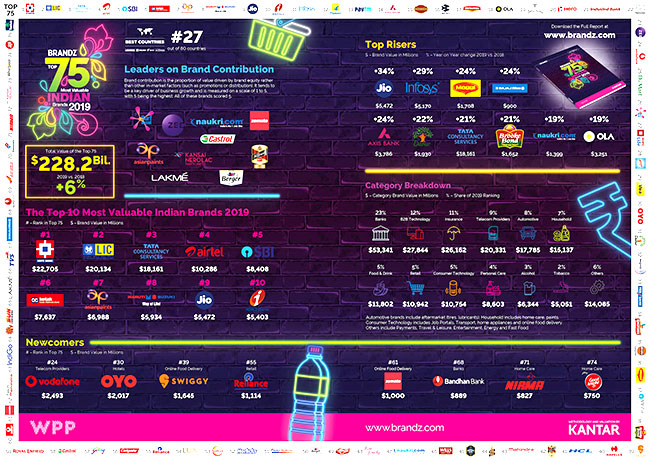
    The BrandZ study, which is the only brand valuation ranking to combine companies’ financial data with consumer insight and opinion, shows that trust is key to develop the stability required for long-term success; highly trusted brands in the Top 75 are worth 129% more than less trusted ones.


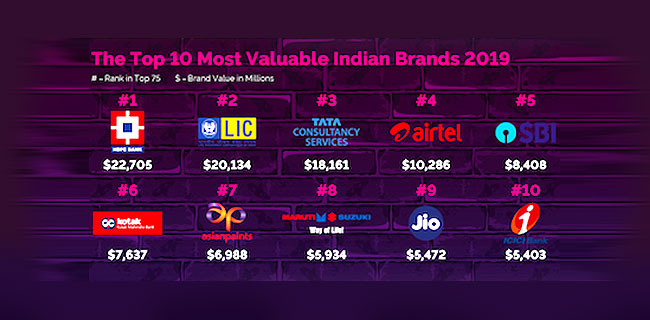
    BrandZ Top 10 Most Valuable Indian Brands 2019

    Rank 2019 Brand Category Brand Value 2019 ($M USD) Brand Value Change
    1 HDFC Bank Banks 22,705 +5%
    2 LIC Insurance 20,134 +2%
    3

    Tata Consultancy Services

    Technology 18,161 +21%
    4 Airtel Telecom providers 10,286 -10%
    5 State Bank of India Banks 8,408 +7%
    6 Kotak Mahindra Bank Banks 7,637 +15%
    7 Asian Paints Paints 6,988 +14%
    8 Maruti Suzuki Automobiles 5,934 -14%
    9 Jio Telecom providers 5,472 +34%
    10 ICICI Bank Banks 5,403 +11%


    Notable brands include ecommerce site Flipkart (No. 12), which increased its brand value 14% to $4.7 billion, while unicorn brands hotel booking site Oyo ($2.0 billion), online food ordering service Swiggy ($1.6 billion) and online restaurant marketplace Zomato ($1.0 billion) are newcomers to the ranking at No. 30, No. 39 and No. 61 respectively.


    The fastest riser in the 2019 ranking is telecom provider, Jio, which climbed one place to No. 9 with a 34% increase in brand value to $5.5 billion. Its disruptive business model has made internet access available to many Indians who were previously unable to afford it, thereby opening up access to digital platforms and services. Vodafone ($2.5 billion) meanwhile was the top-ranked newcomer at No. 24.


    Both digital and offline brands such as D-Mart (No. 25, $2.4 billion) have found success as a result of the rise of ‘middle India’; the growing number of people in the country’s second, third and fourth-tier cities and towns that are changing India’s traditional urban-rural divide.  These previously poorly-served segments increasingly have access to a variety of online services, with Swiggy and Zomato building much of their growth on this shift.


    Said David Roth, CEO of The Store WPP EMEA and Asia and Chairman of BrandZ: “As India flexes its muscles on the world stage, it faces increased macroeconomic headwinds which have combined with a rise in global trade tensions to create a challenging environment.  Successful Indian brands are adapting to these challenges and recognising that longevity requires them to do more than just disrupt the status quo; long-term brand building requires new strategies that major on stability.”


    Added Preeti Reddy, CEO South Asia, Insights Division, Kantar: “Consumer trust is a common thread among successful brands. However, it is concerning that only a few have succeeded in growing trust over the last five years. Those who done so, have done it through open and honest conversations with their customers. Brands would do well to consciously work at building consumer trust – it is the shield that gives a brand the resilience to face headwinds in uncertain times.”


    Said Vishikh Talwar, Chief Client Officer, Kantar Insights Division: “The rise of ‘middle India’ combined with rapid growth of the mobile internet is providing unprecedented opportunities for brands.  But, with an almost overwhelming choice of products and services to buy, consumers are increasingly discerning; the Indian psyche requires that brands cater for local needs with offerings that genuinely improve daily life. Today that’s as much about providing comfort and reliability as it is about generating new experiences.”


    Key trends highlighted in the BrandZ Indian Top 75 study include:

    :: Mobile internet access:Smartphone user numbers in India increased by 18% in 2018 (the fastest rate of growth in the world), mainly due to a combination of Jio’s own low tariffs and the renewed competition causing other telecom providers to reduce their rates.


    :: Buying power:Retail is the second fastest growing category, with online and offline both growing strongly. New entrant Reliance Retail (No. 55, $1.1 billion) opened  nearly 500 new stores and used Jio’s service to connect retail shops with grocery deliveries, while D-Mart ($2.4 billion) focused predominantly on offline, rising two places to No. 25.


    :: The Amazon effect: Amazon and Flipkart compete with many Indian brands across several sectors, with Amazon also opening its largest campus yet in India.  This has increased competition and driven brands to step up their operations to ensure they are meeting customers’ needs.


    :: A confident country: The success of unicorn brands such as Swiggy, Zomato and Oyo is fostering a new-found confidence in India. This is augmented with the increasingly global outlook of these new brands as they actively seek to expand their operations outside India.


  • Tata tops Brand Finance 2019 rankings


    By A Correspondent

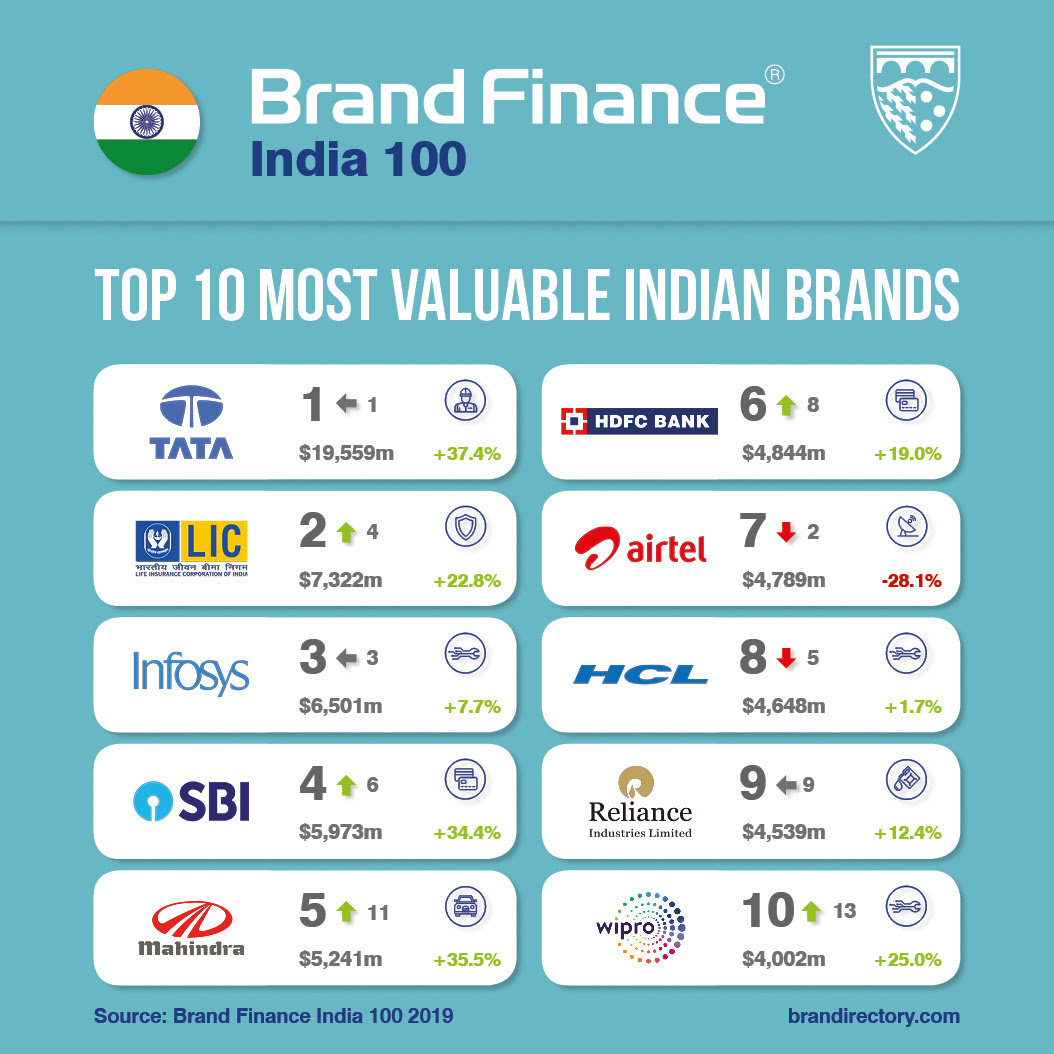
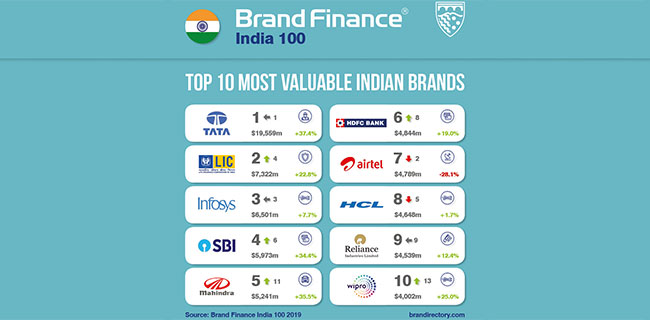
    Tata Group (brand value up 37% to US$19.6 billion) is once again India’s most valuable brand, according to the latest report by Brand Finance, the world’s leading independent brand valuation consultancy.

    Mumbai-headquartered Tata Group is one of India’s largest conglomerates, operating in over 100 countries, across 5 continents. The Group’s dominance is clear with its brand value totalling more than second-placed LIC’s (up 23% to US$7.3 billion) and third-placed Infosys’ (up 8% to US$6.5 billion) brand values combined.

    Said David Haigh, CEO of Brand Finance: “Tata Group is to be commended for its ability to scale new heights, as it is not only India’s most valuable brand, but has also recorded faster growth than any other top 25 brand, with an impressive 37% increase. The Group’s brand presence across autos, IT services, steel and chemicals continues to go from strength to strength and remains a pioneering force to be reckoned with”.

    Banks register solid growth

    Fourteen banking brands feature in this year’s Brand Finance India 100 report, with India’s three largest banks all registering solid growth:State Bank of India (up 34% to US$6.0 billion), HDFC Bank (up 19% to US$4.9 billion) and ICICI Bank (up 41% to US$3.9 billion).

    The banking sector is currently undertaking a major shift as a result of an increase in spending on infrastructure, technology and innovative customer experience tools, all of which have the potential to contribute to heightened brand values across the board for banks. Advancements in technology have brought mobile and internet banking platforms to the top of their game, keeping them well placed to serve their varied customer base against the backdrop of a well-regulated robust environment.

    India 100 Social Media Post.jpg

    Mahindra & Mahindra jump into top 5

    From farm tractors to financial services to cutting-edge IT services, Mahindra Group is going from strength to strength, its brand value growing 35% to US$5241 million and thus sealing its position in the top 5 for the first time. Mahindra group has been making strong inroads into US markets and is setting some strong global ambitions.

    ADAG suffers steep drop

    Anil Dhirubhai Ambani Group (ADAG) has witnessed the steepest drop in brand value, falling 65% to US$559 million and dropping 28 positions in the ranking. The brand has witnessed continuous erosion in its value creation due to increased pressure from various group businesses and is currently facing some stiff questions from its stakeholders.

    Jio is India’s strongest

    In addition to measuring overall brand value, Brand Finance also evaluates the relative strength of brands, based on factors such as marketing investment, familiarity, loyalty, staff satisfaction, and corporate reputation. Alongside revenue forecasts, brand strength is a crucial driver of brand value. According to these criteria, telecommunications brand Jio (brand value US$3.6 billion) is India’s strongest brand with a Brand Strength Index (BSI) score of 87.01 out of 100 and a corresponding AAA brand strength rating.

    Reliance Jio is making headway towards becoming India’s number 1 telecommunications provider. It seems likely that the brand will retain its low-price strategy as it continues to grow, gain and retain a solid reputation across its Indian customer base. Impressively, challenger brand Jio, is the highest new entrant in this year’s Brand Finance India 100 2019 in 14th position.

    New entrants

    Aside from Jio, 6 further brands have made their debut into the ranking, across a variety of sectors.

    Growing off the back of a huge organized retail opportunity in India, hypermarket chain DMart (US$937 million) has entered the ranking in 33rd position. India’s homegrown FMCG brand Patanjali (US$614 million) continues to make waves and steal market share from its multinational competitors and has entered the ranking in 51st position. Further down the table, new entrants Chennai Petroleum (US$258 million), Indian Overseas Bank (US$248 million) and Max Life Insurance (US$240 million) are all ones to watch for the year to come.


    View the full Brand Finance India 100 2019 report here

  • Rise of the Second Screen


    By A Correspondent


    One of the key trends seen in 2017 and 2018 has been the increased use of second screen interactivity by broadcasters as a means to engage more with their television audiences.


    Leading consulting firm Ernst & Young (EY) has published a report that delves deeper into this phenomenon, and provides case studies of how broadcasters and brands are using the 2nd screen along with television to enable a richer and more engaging customer experience.


    According to the report, 30 percent of the time spent on the mobile device is on entertainment. Its a natural extension that television uses the second screen, be it mobile, tablet or laptop, to provide its audiences the ability to interact more with television content, stories and celebrities.


    As broadcasters compete for advertising with new media companies who can provide millions of profiled audiences, interactivity helps broadcasters with generating viewer data, understanding consumption patterns and most importantly, increasing time spent on television, notes the report.


    Here’s more from the EY report. First the case studies and then looking at what makes it work and the future of the Second Screen:


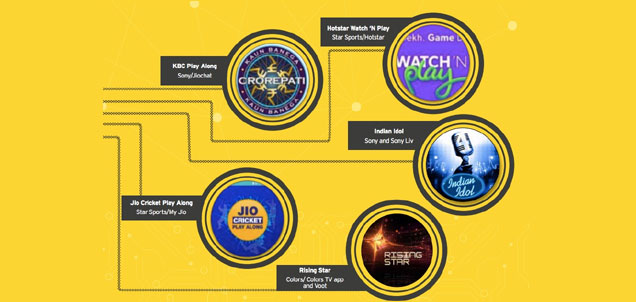
    KBC Play-Along

    Jio along with SET developed a play-along game for the ninth season of KBC. The idea of the app was to engage viewers so they could not only watch the show but also play along and answer the questions shown on TV, testing their knowledge against the TV contestant and scoring points.


    Hotstar Watch’N Play

    IPL 2018 was the 11th season of the highly popular T20 cricket league. This season Star decided to simulcast IPL on TV and Hotstar and introduce an interactive play-along app on Hotstar. 202 million viewers watched the matches on Hotstar.


    Jio Cricket Play-Along

    Jio decided to have a play along game for live cricket matches of IPL 11 broadcast on TV. While some played to win prizes, others played for the sheer excitement that came along.


    Colors Rising Star

    Colors Rising Star is a show adapted from the international format “Rising Star” and ran its second season in 2018. It was an engaging experience for viewers as they were able to see the results of their votes on a real-time basis.


    Sony Indian Idol

    In its tenth season, Indian idol has taken fan engagement to the next level with the Indian Idol Sing Along experience. SET has enabled millions of users to not only vote for their favourite Indian idol contestants, but also to sing along with them, in partnership with Smule. The best ‘Sing-Along’ performance of the week is featured on the show, giving the users their moment of fame on national television.


    So why does interactivity work? Interactivity enables broadcasters to further fulfil their core objectives of providing escapism, knowledge and social acceptance to their audiences.


    Social Acceptance: Second screen engagement can be used as a tool for social communication, by allowing users to share their scores, opinions, leaderboard, level-ups.


    Lean Forward: With reality shows only selecting a handful of contestants to play on each show, the second screen offers viewers the experience of participating on the show from the comfort of their homes.


    Immersive Experience: The TV audience’s expeirence is enhanced, they are playing the game/ performing alongside their favourite contestants and in front of the show host or judges. This is a far more intimate form of escapism.


    Future of interactivity: Second screen interactivity will not only help broadcasters understand their viewers better through the additional data that could be collected, but also help keep viewers more engaged helping drive the ratings for shows. We see broadcasters and other content owners partnering with tech/ telco companies to create some ‘never seen before’ experience for the viewers. If used wisely, second screen has the power to create its very own loyal viewers who can continue to engage even after the end of the show. It is no longer a just cost element but it has the potential to generate revenue and cut marketing costs as can be seen in the proactive engagement platform diagram alongside, which can help brands connect directly with the TV audiences. Second screen interactivity combined with an effective loyalty program will have the potential to reap never before seen benefits. The second screen revolution has begun and results are there to be seen. Broadcasters have benefited, platform operators have benefitted and advertisers have benefited, too. But the viewers are the real winners. Interactivity to become more prevalent not just across game shows and sports but across genres such as music, fiction and film.


  • Can Republic TV kill Competition?


     By Pradyuman Maheshwari [updated]

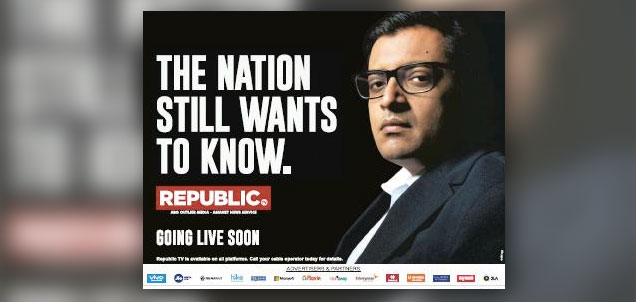
    For a television channel that’s determined to fight for the need for transparency in public life and government, its launch date appears to be a closely guarded secret. But now it’s confirmed: Tomorrow, May 6. Why a Saturday, one may ask. Because that’s the first day of the week (Week #19 of 2017) as per BARC measurement. And Goswami, as he must, keeps a close watch on his viewership numbers.

    Before we had  confirmation on the date, we did have word from the Star India Corporate’s PR agency that Republic TV would start streaming on the OTT platform with effect from tomorrow. No time stated.

    Having said that, Republic is on a roll in terms of marketing across media. It has a healthy set of advertisers: Vivo, Jio, Renault, Hike, Yes Bank, Microsoft, Ravin, Nestaway, Future Group, Havell’s, Gionee, Lloyd, Raymond and Ola. Star India, we are told by sources, will continue to be an advertiser, though its logo is missing from today’s Mint ad.

    We asked ChromeDM, specialists in research on connectivity to give us a report on the availability of Republic TV, for, distribution along with content and revenues will eventually speak about the success of the channel.

    And this is what Pankaj Krishna, Founder & CEO, Chrome DM said: “Currently, on an average, an English News Channels has an availability of 45.1% among Urban Homes in India. With its soft launch, Republic has 18.4% Urban India availability (as per Chrome OTS or Opportunity to See, 3rd May 2017). In Mega Cities, Republic is currently available in 32% of the Households.”

    Note this is for data as of May 3. A distribution industry expert we spoke with said that the availability will leapfrog once the channel goes on air, as even though the deal is inked, some discerning networks do not like to air test signals. So the expert we spoke with said the ChromeDM data as of now may not be the right measure to look at right now.

    However, MxMIndia is a neutral observer and it’s important that you know facts as they are. Also, according to the ad, distribution deals have been inked with all platforms. Other than Hotstar, Republic will be available on Jio, Ditto and we are sure other platforms too.

    “There’s a buzz around Republic TV, and even if deals aren’t inked, viewers will want to watch it and will ask for it… at least for the first few weeks. Moreover, it’s free-to-air, so the pull factor increases,” said one distribution network owner.

    A media buyer and marketer we spoke with requested to speak on anonymity. Here’s what both echoed.

    1. That the buzz around Arnab Goswami has increased after he quit his previous employer.
    2. The legal notice which Goswami spoke about making an emotional appeal touched a chord, and there is a certain amount of sympathy for him.
    3. The issues with Pakistan are raging, and that’s a topic Goswami is passionate about
    4. There are enough inefficiencies across the country which Goswami will definitely dwell on

    Meanwhile, other channels are also getting their act together. Both India Today and CNN-IBN have launched shows at 7pm and also relooked at the rest of the primetime programming. Extension of primetime to 7pm will expand the viewership in all.

    As per BARC ratings for Week 17 (April 22 to 28), Times Now was the leader followed by India Today, CNN-News18, NDTV 24×7 and BBC World News. NewsX and WION didn’t figure in the Top 5. This data is for urban and rural viewership from amongst males of 22 years and above.

    MxMIndia also spoke to industry captains and while all of them wish Republic TV and Arnab Goswami the very best, they do acknowledge that it’s not going to be an easy ask. There are comparisons made to how CNN-IBN (now CNN-News18) scored a march over NDTV 24×7 when Rajdeep Sardesai started the channel, but those were early in the history of English news television in India. Times Now didn’t exist and Headlines Today (now India Today) was near-inconsequential.

    And what is our view? Well, who doesn’t like a David outwits/ outshines/ kills Goliath story. We all love it. But then we are going to be as neutral as it’s possible. We report on the business regardless who gives us business.

    However, there are issues which are beyond just R&R… in this case ratings and revenues. It’s the kind of journalism we will see on Republic TV. And hence across all channels. Will channels talking about the noise be contributing to the noise in their own way? Will the new style of television journalism – nationalism and raising questions against it – actually damage situation on the ground, even though the viewership of English news channels is limited.

    It’s our third ‘Big Story’ on Republic. Or fourth? We’ve lost count. But, then, it’s possibly one of the biggest media launches in the last decade.

    The last question to ourselves (and as in the headline): Do we see Republic TV killing Competition?

    Our response: We don’t know. Yes, we do care and we will be delighted to report on the numbers. We will await the BARC ratings over the next few weeks quite how in the old Hindi films the old parents would wait for the ‘daakiya’ for an update.

    Our normal end-line would’ve been: May the best channel win.

    But here, we will say: May good (and smart) journalism win.

    Now don’t say who cares!


  • Twitter announces Amplify partnership with FilmFare and Jio

    By A Correspondent


    Twitter announced a partnership with Jio Filmfare Awards through Twitter Amplify, a content sponsorship package that will enable the brands to extend their presence to targeted Twitter audiences in India. The first Twitter Amplify deal in the entertainment industry in India, @Filmfare will broadcast exclusive curated content live from the Twitter Blueroom at 6:30pm IST on 18th February 2017, an hour before Jio Filmfare Awards television telecast, available worldwide to Twitter’s logged-in and logged-out audience and connected devices.


    The special broadcast will include a special show LIVE on Twitter from the #BlueRoom with film director Karan Johar (@KaranJohar) and Jitesh Pillaai (@jiteshpillaai), editor Filmfare; hosted by digital creator and comedian Abish Mathew (@abishmathew). The special broadcast streamed from @Filmfare will see Karan and Jitesh revealing inside scoop on Bollywood’s biggest stars and sharing interesting backstage trivia from this year’s awards. As the trio speak about movies and more and engage in a fun Rapid Fire Round that will pit Karan and Jitesh against each other, fans will get a special sneak peek into Bollywood’s biggest night exclusively on Twitter.


    Jio’s pre-roll video will be added to the multiple creative executions including behind the scenes, sneak peeks from the Red Carpet, nominations and celebrity reactions from the event itself. The Amplify deal for the 62nd JioFilmfare Awards 2017 began with the Red Carpet episode and runs through the final broadcast of the awards on television this weekend.


    Twitter Amplify enables media companies and brands to capture the excitement on TV and distribute it to fans and audiences across Twitter, far beyond their existing followers. Audiences can immediately relive that moment or experience it for the first time on their mobile phones while they engage in Twitter conversations.


    Viral Jani, Head of Entertainment, Twitter India said, “People come to Twitter to be a part of the social TV conversation around celebrities which is constant on Twitter. Twitter is where the virtual world of entertainment unfolds and we are excited to have Jio and Filmfare on board to further enhance Twitter’s second screen experience. Our collaboration with Filmfare will give fans a sneak peek into exclusive content that they can engage with on Twitter while viewing the content on television.”


    “Filmfare is always looking for innovative ways to bring the best of Bollywood to fans all over the world. We are thrilled to team up with Twitter and provide users around the world never before seen glimpses from the event and behind the scenes peek to one of the most prestigious awards in the film industry.The idea is to enhance the digital footprint of the Filmfare brand with this first of a kind partnership for any awards property in India.” says Deepak Lamba, CEO, Worldwide Media that owns Filmfare.


  • M&E set to boom with Reliance Jio-led data thrust


    By A Correspondent


    It’s the last mile that matters. And it didn’t need any rocket science to appreciate that telecos will rule the next wave of media and entertainment across the world. But it needed the combination of vision and moneypower that Reliance Industries Chairman Mukesh Ambani has to realise the dreams of Prime Minister Narendra Modi’s dream of a digital India.


    If you think we’ve turned symapathisers for either Reliance Industries or the ruling dispensation, let’s put it down loud and clear: we haven’t. However, we can’t deny that the September 1 announcement at the RIL AGM, announcing the launch of Reliance Jio is perhaps the most significant development in not just telecom, but also media and entertainment in recent years.


    Ambani’s move of making voice and roaming free of cost is a masterstroke. For the real battle is in data. As he said, it’s going to be datagiri from now on. Right now though, as he hinted in his address, he is experiencing some dadagiri from some other players in terms of voice interconnect.


    The Jio Welcome Offer will be effective from September 5.  As part of the Jio Welcome Offer, users will have access to unlimited LTE data and national voice, video and messaging services along with the full bouquet of Jio applications and conten, free-of-cost up to December 31, 2016. The company has filed its tariff plans with the Telecom Regulatory Authority of India (“TRAI”).


    Ambani announced that domestic voice calls to any network across the country would be free for Jio subscribers even beyond the Jio Welcome Offer. Domestic roaming services would also not be charged separately. Average data prices would be around Rs. 50 per GB, which would be amongst the lowest in the world.


    The digital services business has been rolled out pan-India. In addition to fixed and wireless broadband connectivity offering voice and data services on an all-IP network, Jio will also offer end-to-end solutions that address the entire value chain across various digital services in key domains such as education, healthcare, security, communication, financial services, government-citizen interfaces and entertainment.

    Ambani spoke about the five fundamental pillars of the Jio ecosystem: (i) best quality

    broadband network with the highest capacity; (ii) A world of affordable, cutting-edge devices;

    (iii) Compelling applications and content; (iv) Superior digital service experiences; and

    (v) Affordable and simple tariffs.

    Ambani said that the key brand values for Jio included affordable, high quality and abundant data; connected intelligence; smart, simple and secure services; and bringing people together.

    He also announced the setting up of the Jio Digital India Start-up Fund. Jio will work on creating Jio Digital Entrepreneurship Hubs in key cities and towns of India. The Jio Digital India Startup Fund has set aside Rs 5000 crore to be invested over the next five years.

    AGM presentation slides