Tag: Jio

  • Google, Tata Motors, Amazon, Jio & Apple Most Inclusive Brands in India

    Google, Tata Motors, Amazon, Jio & Apple Most Inclusive Brands in India

    Leading marketing data and analytics firm Kantar has launched its Brand Inclusion Index (BII), a global study which reveals that 75% of consumers say that a brand’s diversity and inclusion reputation influences their purchase decisions.


    A staggering 68% Indians claim to have been discriminated against, and in majority of cases in commercial places and brand touchpoints, which is substantially higher than the global figure which stands at 46%. The study also showcases that DEI is important for an overwhelming majority of Indians, both in life and while making brand choices, with 86% of respondents.


    The first edition of India Brand Inclusion Index study explores skincare, banking, automotive and Technology categories. In its Index of the world’s most inclusive brands, Kantar ranked Google, Amazon, Nike, Dove and McDonald’s in its global top five while in India, it is Google, Tata Motors, Amazon, Jio and Apple. The brands were recognised by consumers for setting a positive example by demonstrating a genuine commitment to diversity, equity, and inclusion (DE&I).


    The study identifies that inclusive marketing is a significant opportunity to drive brand growth. It is clear that brands who fail to address discrimination, risk alienating a significant portion of their customer base. Despite progress made by some brands, the Brand Inclusion Index 2024 reveals a significant inclusion gap that businesses must address. This gap is the difference between the proportion of people in a market who have experienced discrimination and the percentage who believe in the importance and influence of diversity and inclusion.


    Kantar’s Brand Inclusion Index 2024 is a survey of more than 23,000 people in 18 countries, the India leg comprises 1000-plus respondents with an inclusive demographic which is gender expansive, disability, socio-economic class, religion etc.


    The findings of the Brand Inclusion Index sit in the context of preliminary research from the Unstereotype Alliance with Oxford University’s Saïd Business School, using data from Alliance members including Kantar. This study has found that progressive, inclusive advertising drives a significant sales uplift of over 16% when compared with less progressive ad content and has a significant impact on consumer loyalty, buying intentions and a brand’s pricing power. Respondents assess brands on different dimensions – brave brand DEI strategy, diversity, equity, and inclusion – from the absence of negative actions, to the presence of positive initiatives.


    Key findings:

    • There’s an urgent need for brands to address DE&I failures: A staggering, 68% Indians claim to have been discriminated against, and in majority of cases in commercial places and brand touchpoints, which is substantially higher than the global figure which stands at 46%. The study also showcases that DEI is important for an overwhelming majority of Indians, both in life and while making brand choices with 86% respondents
    • Consumer expectations are high, globally: 75% of consumers globally say that diversity and inclusion – or a lack thereof – influence their purchase decisions
    • DEI is yet to make its mark on Indian advertising:
      • More women are seen in Indian ads than global average but they remain bound by traditional roles of homemakers and mothers (7% women are featured in non-traditional roles)
      • Fairness of skin may have transitioned to glow but skin colourism continues to exist in creatives
      • Sizes remain slim and small. (7% diverse body shapes)
      • Ageism dominates with 40+ women represented in less than one out of five ads (15% in India vs 26% globally)
    • Underrepresented groups are most vulnerable: Ad protagonists and characters in India are painted in broad strokes of what they, their homes, beliefs and lifestyles look like, ignoring ethnic minorities, LGBTQ
    • Ads that successfully portray people positively provide greater predicted ROI for advertising investment. There has been growth in the industry in positive portrayal of Males over the last year, but a drop in Female portrayal since last 2 years
    • Globally, people with disabilities and LGBTQ+ individuals report the highest rates of discrimination (81% and 62% respectively), emphasising the need for targeted efforts to create more inclusive environments and content
    • Google, recognised as most inclusive brand in India as well as globally. It emerges as a beacon of hope, ranked by Kantar as the most inclusive brand globally. Consumers, particularly in marginalised communities, praised Google for its unwavering commitment to DE&I in its internal policies, products and marketing, its authentic representation of people from all walks of life and its leading-edge innovation for inclusion
    • Alongside Google, Tata Motors, Amazon, Jio and Apple emerged in the top five winners in India. Category wise, the India top Brand Inclusion Index scorers are – Google (Technology), Tata Motors (Automotive), SBI (Banking), Dove (Skincare).


    Said Valeria Piaggio, global head of diversity, equity and inclusion at Kantar: “It’s a myth that inclusion marketing is about marketing to minorities. Inclusion marketing is expansive marketing. One of the fundamental ways to grow your brand is to predispose more people to it. Yet when brands exclude consumers – whether that’s because people don’t feel welcomed when shopping in stores or their advertising doesn’t reflect diverse communities – it’s an easy miss.


    “Millennials and Gen Z prioritise diversity and inclusion even more than other groups, and as these populations grow in size and buying power these issues will carry more weight. Brands will be rewarded if they stand by their values – especially in the face of vocal communities which stoke the culture wars by pitting minority groups against one another.”


    Said Soumya Mohanty, Managing Director & Chief Client Officer- South Asia, Insights Division, Kantar: “In a country of India’s size, the term under-represented groups can be misleading for brands to use as a guiding light. Minorities can translate into millions of people who may choose or not choose to buy your brand, based on how well they feel seen, heard and voiced in your brands. It is a business imperative for brands to prove that they are serious and committed about DEI. The Brand Inclusion Index – our breakthrough study on brand inclusion – gives clear indications of how to achieve the inclusivity imperative. Our analysis of what’s behind the most inclusive brands is that they all have three things: a well-thought-out DEI strategy that stems from company actions and is committed long-term, impeccable creative execution, and bravery. The element of bravery will be increasingly important. As in other moments in history, when there’s significant social change, there are groups of society that seek to maintain the status quo, feel threatened, and as a result, react loudly,” adding: “To avoid backlash, brands today need to be extra careful. Full inclusion needs to work at both ends of the spectrum: reaching out to underrepresented populations and making them count, while avoiding negative reactions from people who are used to seeing themselves well-represented by brands and don’t want to be left behind. This study brings understanding of how people perceive brands based on their DEI efforts, focusing on populations that tend to be excluded, underserved, or misrepresented. The Brand Inclusion Index gives marketers clear benchmarks for brand inclusion and inspiration from brave brands that are seen as diverse, fair, and inclusive.”

  • NBCUniversal and JioCinema enter into a multi-year partnership

    By Our Staff


    NBCUniversal (NBCU) and JioCinema, Viacom18’s streaming service, have entered into a multi-year partnership bringing thousands of hours of NBCU films and TV series to India. This partnership significantly bolsters JioCinema’s program offering and ensures that their viewers will be able to enjoy titles from NBCU’s world-renowned content portfolio.  That portfolio is fueled by Comcast NBCUniversal’s powerhouse production entities and brands, which includes Universal Television, UCP, Universal International Studios, Universal Television Alternative Studio, Sky Studios, DreamWorks Animation, Universal Pictures, Focus Features, Bravo, and more.


    Fans of reality television will also be able to indulge in all the drama, laughter, and emotional highs and lows found in NBCU’s unscripted series. Encompassed in the deal are shows like the hugely popular The Real Housewives of Beverly Hills and Vanderpump Rules; in addition to Family Karma, which follows seven Indian-American friends as they navigate life, love, careers and expectations of their traditional families; and The Gentle Art of Swedish Death Cleaning, a transformational show – narrated by Amy Poehler – where three Swedes (an organizer, a designer and a psychologist), known as the ‘Death Cleaners,’ come to America to help people face mortality and remind us of all the ways we are alive.


    This partnership leverages JioCinema’s reach and expertise to introduce Indian audiences to the Peacock brand and NBCU’s portfolio, while JioCinema cements its position as the largest OTT service in the market, now reinforced by an unprecedented volume of best-in-class films and series from NBCU.


  • Pepsi, Tata Neu & Jio. Business as unusual?


    By Vikas Mehta


    Vikas MehtaHow hardwired we have become to sensation. It’s not a rhetorical question but an emphatic statement. This IPL, everyone is talking about CSK and Mumbai Indians. Not because they are doing well but because both these teams, who, between them have won 9 out of 15 trophies, have lost their first four matches. We are not celebrating that a new team Gujarat Titans hasn’t lost a match yet. We are not celebrating that a forgotten hero, Kuldeep Yadav, has risen again to become the leading wicket-taker. We are glossing over the spunk shown by newcomers Anuj Rawat or Abhishek Sharma against the same two teams. It’s business as “unusual”, I say.

     

    And then one comes across the Tata Neu ads. After a nice round of teasers which raised expectations of a great product, I am confused about this Tata Neu Pass. It’s all in the family. What’s Neu Pass? What’s all in the family? Whose family? Tata family? The only thing that made sense to me was the advice to download the app. Which I did. Now mind you, I am a Big Basket consumer. So, I think the app was smart enough to recognise me and my location after I keyed in my mobile number. But then it sent me another message. That it is not yet available at my location. Well, who wants to argue with a Super App.  I, therefore immediately clicked on the Big Basket app, worried, that I may have been ejected from the BB platform. Thankfully, I could order my groceries on BB as usual. I then tried some apparel and when I clicked on a product, I immediately got an email from Tata Cliq saying that it has created an account for me. Err! Why? Can’t I just shop from the app and check out? I did not bother to find out and with the temperature rising outside, I did not want my temperature to rise too.


    Temperature of course reminded me about the new Pepsi ad. More Fizz, More refreshing. Formula change? Something new? And then I thought I saw an asterisk at the end of the baseline. I promptly checked the ad on YouTube again and discovered that both Fizz and Refreshing had asterisk and the explanation was that some research done by an independent body in Jaipur and Lucknow determined that Pepsi had more fizz and another research conducted in Mumbai, Jaipur and Lucknow determined that Pepsi was more refreshing. So, I have lived to see the day when taglines have to be validated by research. And we wonder why the advertising model is crumbling.


    Having ditched the thought of having Pepsi and given that fresh mangoes are available in market, I decided to try Slice. The image of Aamsutra with Katrina was still in my mind. But I did a double-take when I saw the new Slice ad with Katrina. It was a taste challenge. And it again quoted some research which said that 73% people voted Slice to be the most thick. Ahem! Is PepsiCo the parent company of Pepsi and Slice using the US Pepsi taste challenge of the 70s as a blueprint for its brands in India? For the uninitiated, Pepsi did some live taste challenges in the US, asking people to rate two unmarked Colas on whose taste is better. Majority favoured Pepsi, though lot of statisticians debunked the research as a sweeter drink will always win on one sip taste challenge. But that’s another story. Will PepsiCo India now launch 7Up too based on some taste research?


    Did you notice that there are three Swiggy brands advertising on IPL? Swiggy Instamart, which claims quick grocery delivery, Swiggy match day mania which is about large orders at a discount and then just Swiggy. All the three brands have done a good job in communicating their benefits. Swiggy has a simple though of “Aap kiske saath dekhoge” which is very IPL-centric and have carried that thought into both Instamart as well as match day mania very well. My favourite of course is the Instamart ad of the young kid bawling about her empty cereal box as the father is watching the IPL. Quick delivery saves the day for him and therefore when he is asked at the office “kal match kiske saath dekha” he answers with a satisfied look “Shanti ke saath”. Smart.


    I started off about the unusual performances in the IPL. But then I discovered that a most unusual thing has also occurred on the IPL ad scene. If my memory serves me right, it’s the first time since the launch of Jio that no Jio ads have been aired on IPL. Yet. No plethora of stars, no tacky execution, no Bollywood-style jhatkas. Sometimes we should thank our respective Gods for small mercies. Amen to that.


  • Viacom18 bags TV & digital rights for Italian Serie A

    By Our Staff


    Viacom18 has announced that it has acquired the broadcast and digital rights for Italian Serie A for the Indian sub-continent region for the next three seasons. The latest edition of Italian Serie A will kick off tomorrow, that’s August 21 at 10pm IST. Matches will be available live across Voot, Viacom18’s TV channels and Jio. This is close on the heels of multi-year partnerships for Spanish La Liga (football) and Abu Dhabi T10 League (cricket).


    Said Gourav Rakshit, Chief Operating Officer, Viacom18 Digital Ventures: “One of the core propositions of our network is the promise of variety in content. Sports is a whitespace that we have been consciously experimenting with for some time now. The response to our initiatives, thus far, has been very encouraging. Italian Serie A is one of the most exciting & competitive leagues in Europe and we are excited to bring it to our viewers across digital and broadcast platforms.”


    Added Ferzad Palia, Head – SVOD and International Business, Viacom18 Digital Ventures: “We are delighted to host the Italian Serie A across our network. The league enjoys great affinity with football lovers in India. Some of the world’s top clubs, coaches and players make the Serie A stand out as one of the best leagues in the football world. We are confident of growing the fan base through a slew of initiatives that are lined up.”


    Viacom18 has entered into a partnership with Infront, whom Italian Serie A has appointed to manage its international media rights for all platforms across many geographies. Added Amikam Kranz, Vice President Media Sales and Operations, Infront said: “This is the start of what we hope will be a positive relationship between Infront and Viacom18. Serie A already has a significant resonance with Indian football fans and this will help us further grow the audience in the country. We believe this is the beginning of what we hope will be a promising future.”


  • Viacom18 bags rights for LaLiga

    By Our Staff


    Viacom18 Media has bagged rights for Spanish Football League LaLiga exclusively to the Indian subcontinent for the next three years. Enabled and supported by Rise Worldwide, LaLiga will air exclusively on MTV in India, along with select national and regional network channels and live-streamed on Voot and Jio platforms. The 2021 event kicks off on August 13.


    Speaking about LaLiga on MTV, Anshul Ailawadi, Business Head – Youth, Music and English Entertainment said, “We at MTV have always known that football enjoys a groundswell of support amongst young-at-heart Indians. The LaLiga in particular, is a cultural phenomenon all over the World. When the folks from RISE Worldwide introduced us to LaLiga team, we realised that this was a partnership waiting to happen – the vision was common, the vibes were good, and we quickly put pen to paper.”


    On the association with Viacom18, Oscar Mayo, Executive Director, LaLiga said: “We are excited to partner with Viacom18 (MTV India) and further bolster the LaLiga fandom to an ever-growing football fan base in India. Having set one of the highest standards of football globally and India gaining tremendous momentum, we are confident that we will reach and engage with the youthful audience that MTV as a destination appeals to.”


  • Tata Sky refreshes brand purpose

    By Our Staff


    These are interesting times for the old older in the television broadcast front. OTT platforms are gaining popularity esp in urban India and telcos and broadband players like Jio and Airtel are gaining currency to access linear television. Life’s a-changin’. In the midst of all this, Tata Sky has unveiled its new Brand Purpose with the following statement: Tata Sky exists to make tomorrow better than today for family and home.


    “A set of core beliefs have always guided brand Tata Sky” said Harit Nagpal, MD & CEO, Tata Sky in a statement. “Expressing our brand purpose solidifies our intent to continue to add value to people’s lives,” he  added. His PR agency said he wasn’t available for a one-on-one.

    Anurag Kumar
    Anurag Kumar

    Added Anurag Kumar, Chief Communications Officer, Tata Sky in a statment: “The statement ‘Tata Sky exists to make tomorrow better than today for family and home’ exemplifies the brand’s belief in the emotional power of entertainment which we trust can move, motivate, inspire and help people to enjoy a better life. We believe that this reinforces the brand’s focus in simplifying content access, discovery and consumption in newer and more delightful ways that lead to betterment in customer’s lives”,

    Sukesh Nayak
    Sukesh Nayak

    Said Sukesh Nayak, Chief Creative Officer – Ogilvy India, West, Tata Sky’s long-standing creative: “This campaign is an ode to the magical ‘Khidki’ in our lives that has been entertaining us for all these years. Be it on the walls, tables or in our hands, these Khidkis powered by Tata Sky, truly makes our lives Jingalala.”

    The new campaign is across a few languages like Hindi, Marathi, Telugu, Tamil, Kannada, Malayalam, Bengali and Odia. The video above is in Odia.

  • Sweet news on Sankranti. Uday Shankar joins James Murdoch to grow Lupa Systems

    By Our Staff


    So where’s Uday Shankar going? That was the question everyone seemed to ask when he announced his decision to move from Star/Disney last year? But the two big rumours were him joining former Star India owners – the Murdochs and Mukesh Ambani’s Jio.

    Some meetings with the Jio bosses are said to have happened, but we know we haven’t heard the last on this from the Reliance Industries headquarters.

    In the meantime, Shankar took charge as the FICCI big boss, and we do know that he wouldn’t have assumed that position without something major that we was going to be doing.

    So here’s News #1:

    CEO James Murdoch and and the former Chairman and CEO of Star India and President of Walt Disney Asia Pacific, have announced that they are forming a new venture to explore technology and media opportunities in emerging markets.

    The new partnership reunites Murdoch and Shankar, who worked together building Star India into the region’s largest media company, prior to its sale as part of the merger of 21st Century Fox and The Walt Disney Company.  Star now reaches 600m+ viewers every week and operates Hotstar, Asia’s leading OTT platform.

    Said Murdoch in a statement: “After two decades of working in India and the region, at Star and more recently at Lupa Systems, it’s great to be entering into a renewed partnership with Uday.  Our collaborations over the years have been immensely rewarding for consumers, our various shareholders, and our colleagues. I’m very pleased to be renewing that partnership now.  As connectivity continues to accelerate and expand across South Asia and the whole region, new opportunities for innovation, across consumer sectors, will multiply.”

    And this is what Shankar said: “James and I enjoyed a great partnership at Star and I am enormously excited to be in partnership with him again.  At Star, we had the great benefit of working with the best and brightest Indian talent, combined with global vision and a desire to disrupt the old order. Digital Technology promises to transform the lives of many millions of people in this part of the world and I have every confidence that we can harness technology, enterprise, and tremendous talent to create a great business that is also great for society.”

    The communique misspelt Shankar’s name as Shakar, which perhaps is appropriate. Shakar is Sugar in Hindi, and this is a sweet piece of news for media watchers in India.

    “Lupa Systems set up its India presence less than two years ago and has already created a promising portfolio of technology investments. Partnering with Uday, to build ambitiously for the long term, will take us to another level,” said Nitin Kukreja, Managing Director of Lupa Systems India. Kukreja, if one remembers, was with Star India/Disney and was the boss of Star Sports.

    What’s News #2. Like you, we too are waiting.


  • Jio & RF ESA to sponsor Women’s T20 tournament

    By A Correspondent


    Nita Ambani, Founder and Chairperson, Reliance Foundation has announced a significant support for women’s cricket in India. As the first step in this direction, Jio and Reliance Foundation Education and Sports For All (RF ESA) have come in as sponsor for the upcoming Women’s T20 Challenge. An extension of the IPL, the Women’s T20 Challenge will be played at Sharjah between three franchises – Supernovas, Trailblazers and Velocity led by Harmanpreet Kaur, Smriti Mandhana and Mithali Raj respectively, starting November 4, 2020.


    In addition, Ambani has offered the cricket facility at Jio Cricket Stadium, Navi Mumbai, for women cricketers. The stadium can be availed to conduct trials, camps and host competitive matches, throughout the year – all free of cost for our national women team. Furthermore, women cricketers can now benefit from the amenities for rehabilitation and sports science available at the reputed Sir HN Reliance Foundation Hospital & Research Centre in Mumbai.


    Commenting on her support for women’s cricket, Ambani said: “My heartiest congratulations to BCCI for organising the Women’s T20 Challenge. This is a progressive step towards the growth of women’s cricket in India. I am delighted to offer my full support to this wonderful initiative. I have immense faith in the potential and capabilities of all our sportswomen. Indian women cricketers have made the country proud with their outstanding achievements in ICC events over the last couple of years. Our aim is to ensure that we offer the best of infrastructure, training and rehab facilities to our girls. Players like Anjum, Mithali, Smriti, Harmanpreet and Poonam are great role models. I wish them and every member of the Indian women’s squad even greater success and glory in their journey ahead.”


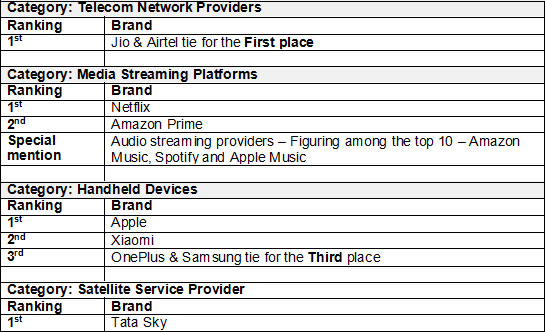
  • Jio,Airtel,Netflix,Apple,Tata Sky top Kantar CX+ 2020 TMT

    By A Correspondent


    Jio, Airtel, Netflix, Apple, Tata Sky have topped the Kantar CX+ 2020 for TMT. The Kantar CX+ report evaluates the CX performance of companies in the Telecom, Media and Technology sectors, using the Kantar’s CX+ index. CX+ is a sector-specific index to look at brands in the context of their category. It uses customer centricity as its core to evaluate CX performance of a company.


    As per a communique, the basic premise of CX+ is that brand and customer experience have become synonymous, in this increasingly connected environment.


    The roadmap to delivering a holistic experience is based on five key CX success factors:

    1. Clarity of brand promise

    2. Empowered employees

    3. Empowered customers

    4. Creating lasting memories

    5. Reinforcement of brand choice


    Additionally, the study also identifies each brand’s Experience Gap – which quantifies the difference between the Brand Promise and the actual customer experience delivered.


    The CX+ index for each brand is derived based on a combination of the CX Performance and the Experience Gap.


    The TMT study covered Telecom Network Providers, Media Streaming Platforms and Handheld Devices. In this study conducted in early 2020, clear winners emerged in each of the sectors.


    Commenting on the launch of the CX+ TMT report findings, Sushmita Balasubramaniam, Domain Lead for CX and Commerce – South Asia, Insights Division, Kantar said: “The landscape across the TMT sectors has changed drastically over the last one year. Consumers’ adoption of and dependence on digital, whether for basic everyday living, working, studying or entertainment has presented enormous challenges to companies in these sectors. And, the changes in usage of products and services will also mean that customer priorities on the kind of experience they are seeking will be different from the pre-Covid era.”


    Added Soumya Mohanty, Chief Client Officer, South Asia, Insights Division, Kantar: “In the current scenario, with tech convergence and emerging global media giants, the world will see vigorous competition in the TMT sector. This is an arena where tech credentials will become increasingly hygiene, CX will be critical. As network services providers, handheld device brands and streaming media providers, all will leverage customer data to build personalised journeys, CX and owning the relationship with the end user will become increasingly important.”


    Kantar CX+ 2020: Leaders in the TMT sector in India


    The Kantar CX+ TMT 2020 study analysed 6,000+ customers drawn from users across the sectors in India and was conducted in early 2020.


  • Lionsgate bets big with JioFiber

    By A Correspondent


    Global content leader Lionsgate has formed an alliance with Jio to bring the Lionsgate Play streaming service to JioFiber customers as part of the studio’s biggest partnership to date for large screens in South Asia.


    Rohit Jain

    Commenting on the partnership, Rohit Jain, Managing Director, Lionsgate South Asia, said: “We have recently seen a surge in viewership across Indian platforms as more and more people stream premium content.  What began as a smart phone-led content revolution is transitioning and expanding to encompass consumer televisions and other large screens in the home.  In response, we will continue to invest in technology and distribution with great partners like Jio that give our consumers the option of watching our movies either on large screens or on their smartphones. This alliance with JioFiber is our first major step amongst several such initiatives to come in taking content on large screens within comforts of consumers’ home”


  • Facebook takes 9.9% of Jio Platforms (Reliance Jio’s holding co) at Rs 43,574cr

    By A Correspondent


    It’s been in the works for a while, and then there have been rumours to the effect that this is set to happen. And then the Covid-19 scare happened, and one didn’t know when it would actually happen. If at all.

    But in the wee hours of today (and April 21 in the United States), a statement came in from Facebook and Reliance Industries.

    First the Facebook note by David Fischer, Chief Revenue Officer, and Ajit Mohan, VP and Managing Director, India: “Today we are announcing a $5.7 billion, or INR 43,574 crore, investment in Jio Platforms Limited, part of Reliance Industries Limited, making Facebook its largest minority shareholder.

    “This investment underscores our commitment to India, and our excitement for the dramatic transformation that Jio has spurred in the country. In less than four years, Jio has brought more than 388 million people online, fueling the creation of innovative new enterprises and connecting people in new ways. We are committed to connecting more people in India together with Jio.

    “India is in the midst of one of the most dynamic social and economic transformations the world has ever seen, driven by the rapid adoption of digital technologies. In just the past five years, more than 560 million people in India have gained access to the internet.

    “Our goal is to enable new opportunities for businesses of all sizes, but especially for the more than 60 million small businesses across India. They account for the majority of jobs in the country, and form the heart and soul of rural and urban communities alike. In the face of the coronavirus, it is important that we both combat this global pandemic now, and lay the groundwork to help people and businesses in the years to come.

    “One focus of our collaboration with Jio will be creating new ways for people and businesses to operate more effectively in the growing digital economy. For instance, by bringing together JioMart, Jio’s small business initiative, with the power of WhatsApp, we can enable people to connect with businesses, shop and ultimately purchase products in a seamless mobile experience.

    “India is a special country for us. Over the years, Facebook has invested in India to connect people and help businesses launch and grow. WhatsApp is so ingrained in Indian life that it has become a commonly used verb across many Indian languages and dialects. Facebook brings together friends and families, but moreover, it’s one of the country’s biggest enablers of growth for small businesses. And Instagram has grown dramatically in India in recent years as the place where people follow their interests and passions.

    “We are excited about furthering our investment in India’s vibrant digital economy. Our efforts with Jio will be focused on opening new doors and fueling India’s economic growth and the prosperity of its people. We look forward to working with Jio, and to future collaborations in India to advance this vision.”


    And here goes the communique from Reliance:

    “Reliance Industries Limited (“Reliance Industries”), Jio Platforms Limited (“Jio Platforms”) and Facebook, Inc. (“Facebook”) today announced the signing of binding agreements for an investment of ₹ 43,574 crore by Facebook into Jio Platforms. This investment by Facebook values Jio Platforms at ₹ 4.62 lakh crore pre-money enterprise value ($65.95 billion, assuming a conversion rate of ₹ 70 to a US Dollar). Facebook’s investment will translate into a 9.99% equity stake in Jio Platforms on a fully diluted basis.

    “Jio Platforms, a wholly-owned subsidiary of Reliance Industries Limited, is a next-generation technology company building a Digital Society for India by bringing together Jio’s leading digital apps, digital ecosystems and India’s #1 high speed connectivity platform under one umbrella. Reliance Jio Infocomm Limited, which provides connectivity platform to over 388 million subscribers, will continue to be a wholly-owned subsidiary of Jio Platforms.

    “Jio’s vision is to enable a Digital India for 1.3 billion Indians and Indian businesses, especially small merchants, micro-businesses and farmers. Jio has brought transformational changes in the Indian digital services space and propelled India on the path towards becoming a global technology leader and among the leading digital economies in the world.

    “Jio has built a world-class digital platform powered by leading technologies such as Broadband connectivity, Smart Devices, Cloud and Edge Computing, Big Data Analytics, Artificial Intelligence, Internet of Things, Augmented and Mixed Reality and Blockchain.

    “Jio has created an ecosystem comprising network, devices, applications, content, service experiences and affordable tariffs for every Indian to experience the Jio Digital Life. During the current Covid-19 crisis, Jio’s platforms have been a dependable and inclusive Digital Lifeline for our Nation.

    “As one of the largest countries in the world, India is home to some of Facebook’s most thriving communities on WhatsApp, Facebook and Instagram. Over the years, Facebook has invested in India based on a strong belief in India’s entrepreneurial talent and opportunity, to help create meaningful impact for Indians and Indian businesses using their multiple platforms.

    “The partnership between Facebook and Jio is unprecedented in many ways. This is the largest investment for a minority stake by a technology company anywhere in the world and the largest FDI in the technology sector in India. The investment values Jio Platforms amongst the top 5 listed companies in India by market capitalization, within just three and a half years of launch of commercial services, validating Reliance Industries’ capability in incubating and building disruptive next-generation businesses, while delivering market defining shareholder value.

    “Our goal with this investment is to enable new opportunities for businesses of all sizes, but especially for small businesses across India and create new and exciting digital ecosystems that will empower, enrich and uplift the lives of all 1.3 billion Indians.

    “This partnership will accelerate India’s all-round development, fulfilling the needs of Indian people and the Indian economy. Our focus will be India’s 60 million micro, small and medium businesses, 120 million farmers, 30 million small merchants and millions of small and medium enterprises in the informal sector, in addition to empowering people seeking various digital services.

    “The partnership assumes special significance for India in the wake of the severe disruptions caused by the coronavirus pandemic in the Indian — and the global — economy. In the post- Covid era, comprehensive digitalisation will be an absolute necessity for revitalisation of the Indian economy. It is our common belief and commitment that no Indian should be deprived of the tremendous new opportunities, including opportunities for new employment and new businesses, in the process of India’s 360-degree digital transformation.

    “Concurrent with the investment, Jio Platforms, Reliance Retail Limited (“Reliance Retail”) and WhatsApp have also entered into a commercial partnership agreement to further accelerate Reliance Retail’s New Commerce business on the JioMart platform using WhatsApp and to support small businesses on WhatsApp. WhatsApp already plays an important role in helping people and businesses connect in India. Reliance Retail’s New Commerce platform, JioMart, is being built in partnership with millions of small merchants and kirana shops to empower them to better serve the needs of Indian consumers. The companies will work closely to ensure that consumers are able to access the nearest kiranas who can provide products and services to their homes by transacting seamlessly with JioMart using WhatsApp.

    “Commenting on the partnership with Facebook, Mr Mukesh Ambani, Chairman and Managing Director, Reliance Industries Ltd, said, “When Reliance launched Jio in 2016, we were driven by the dream of India’s Digital Sarvodaya– India’s Inclusive Digital Rise to improve the quality of life of every single Indian and to propel India as the world’s leading Digital Society. All of us at Reliance are therefore humbled by the opportunity to welcome Facebook as our long-term partner in continuing to grow and transform the digital ecosystem of India for the benefit of all Indians. The synergy between Jio and Facebook will help realise Prime Minister Shri Narendra Modi’s ‘Digital India’ Mission with its two ambitious goals — ‘Ease of Living’ and ‘Ease of Doing Business’ – for every single category of Indian people without exception. In the post-Corona era, I am confident of India’s economic recovery and resurgence in the shortest period of time. The partnership will surely make an important contribution to this transformation.”


  • Milestone Year for Mobile


    By Indrani Sen


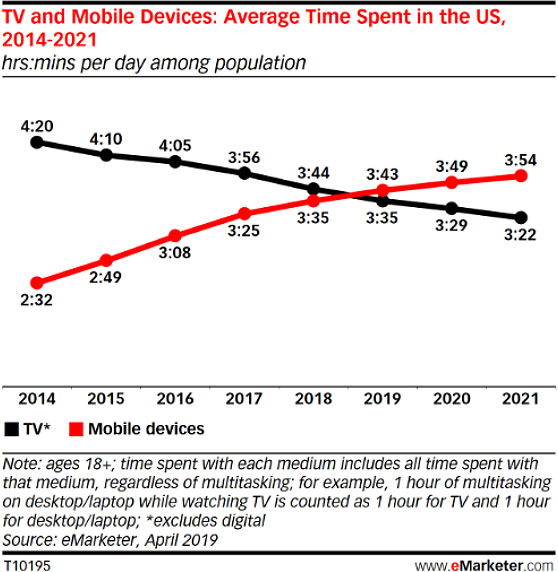
    The current year will go down as a milestone year in the history of Mobile when 5G networks, the next generation of mobile internet connectivity was launched and in US TV was dethroned for the first time by Mobile as the media channel where Adults in US spend the most time.
     

    In April, 2019 Verizon surprised most of the world by launching first its 5G network in Chicago and few other locations. UK was not far behind as EE launch its 5G network, switching it on in six cities in UK in May 30 2019,  followed by Vodafone launching 5G  in seven cities in July 3, 2019. Australia soon followed suit. China and Korea have also been planning 5G network for a long time and launched the services around mid- 2019. China has officially announced that they will have 150 million 5G mobile subscribers by 2020. By end of 2019, 5 million Koreans are expected to have 5G phones.


    On December 19, 2019 www.emarketer.com  announced in a report that the average US adult spent 3 hours, 43 minutes (3:43) on their mobile devices in 2019, compared with the average 3:35 spent watching TV (https://www.emarketer.com/content/mobile-year-in-review-the-launch-of-5g-is-the-biggest-story-in-a-busy-year-for-mobile?ecid=NL1001). Only three years back, in 2016 the same US adults watched nearly an hour more of TV than they spent on their smartphones and tablets (4:05 vs. 3:08). The forecast made by www.emarketer.com shows that the trend is going to continue with the share of time spent on mobile climbing higher year on year.


    In India, we are seeing the trend of increasing time spent on digital media driven mainly by mobile, but we have still years to go before an average adult Indian starts spending more time on mobile than on TV. But the trend has set in among select target audience groups including millennials at the upper and lower end of the economic ladder. A survey is conducted among college going students who including their travel and class hours spend a lot of time outside their home about time spend on TV and on mobile, may find that they are already spending more time on mobile than on TV, helped by the choices available on OTT platforms. The student community is a mix of young people coming from lower middle class to upper class homes, but almost everyone today owns a mobile which has become a necessity rather than a luxury.


    Reliance Telecom Services celebrated three years of Jio in 2019. Jio has revolutionised the use of mobile among certain working class people like auto rickshaw drivers, household maids who often indulge in seeking entertainment through their mobiles during short breaks in their work schedule. Such people usually have long working hours and as a result may have started spending more time on their mobiles than on watching TV at home. Again a survey conducted among such target audience groups may reflect the truth, but as these people have poor purchasing power, a survey among them will serve only academic interest.


    Current research conducted by different agencies are showing that time spent on digital media including mobile is growing at a faster rate than all other media in India. A recent report by McKinsey showed that with data becoming more accessible, monthly mobile data consumption per user is growing at 152 per cent annually in India — more than twice the rates in the United States and China and internet users will rise by about 40 per cent and number of smartphones will be double by 2023.
    (https://economictimes.indiatimes.com/tech/internet/internet-users-in-india-to-rise-by-40-smartphones-to-double-by-2023-mckinsey/articleshow/69040395.cms?from=mdr ) Time spent on mobile internet has gone up from 9.4 minutes daily in 2013 to 54 minutes in 2019 and is expected to reach 79 minutes by 2021.


    Global Web Index’s Social Media Trends 2019 Report showed that Indian users spent 2.4 hours on social media, in line with the global average (https://www.globalwebindex.com/reports/social) This finding is confusing as if the average time spent on mobile internet is 54 minutes then how can Indian users spent 2.4 hours on social media which is mostly consumed through mobile internet? The sample size of the social media survey covered 15000 Indians among 2.78 lakh respondents across 45 countries, but the details of the sampling frame work is not available, so it is difficult to figure out if the survey was limited to mobile users only which will explain the discrepancy.


    The writings on the walls are very clear, like the rest of the world the average adult Indian will also be gradually moving to spending more time on mobile than on TV. The global milestone year 2019 should be an inspiration for our telecom industry to accelerate their growth plans and move in that direction.