Tag: J Walter Thompson

  • Thompson, with a ‘p’


    By Avik Chattopadhyay

     

    Avik ChattopadhyayHere I am, on a blue-blooded advertising and marketing platform, taking a chance at expressing my opinion on WPP finally doing away with the famed “J. Walter Thompson” name. I am not an advertising professional, so do I have the very credibility to write on this subject? I think I do as I have been a ‘client’ for almost two decades dealing with various advertising agencies, including the one with a ‘p’.


    Since WPP decided to give the agency a new name, or impose a name of an existing much smaller agency on the bigger one, many advertising professionals have lamented and lambasted the decision. “How can you take away such a venerable name?” has been the common refrain. “Who on earth knows the new name? No one!” has been the second most popular one. Most of these people have had careers in HTA / JWT / WT and have moved on in life.


    So, will the name change see a change in business? Will it see a change in the ethos and culture? Will clients leave as they do not like the new name? Will employees leave as clients are leaving? Will the entire business come crashing down?


    As someone had told me early in my career, “An agency is as good as the client.” This adage has had a 100% success rate in my professional career till now across eight organisations, six as a client and two as an agency. At every stage, whatever the context or occasion, the communication output has been as effective, efficient and enriching as the quality of the brief, the level of the involvement and most importantly, the depth of the understanding. Right across conventional advertising to media planning to digital marketing to out-of-home to on-ground activation and event management.


    Just like brands have grown being with the right communications partner, so have the partners grown continuing with the right brands. The relationship is mutually impactful. If HTA / JWT / WP is the intellectual behemoth that it is today, it is because its relationships with certain brand behemoths have endured over decades. And these relationships have built its reputation. Just like any superstar, more than 50% of its work would be mediocre or pedestrian but it is that balance that has created the magic for it.


    Over the years I have realised that using “partner” in place of agency and “brand” in place of client works better if you keep repeating them a thousand times in your head as then you start respecting the agency more as a partner and a client more as a brand. That makes a huge difference in the relationship and the quality of the communication.


    Fiat became FCA. Peugeot became PSA. Then Fiat and Peugeot became Stellantis. One may argue that only the corporation names have changed while the customer-facing brands have remained the same. Okay. Ciba-Geigy and Sandoz became Novartis. ICI became Akzo Nobel. Sakura became Konika. Vam Organics became Jubilant. Phoenix became Firefox. Danone’s Bio became Activia. Bombay became Mumbai. The legacy brands wore new clothes and went about their work. The earth did not part consuming them for this act of blasphemy.


    In fact, most of them benefited from donning a new name. it gave a new sense of purpose and direction. And the customer was the biggest gainer. In the enthusiasm of the new name, new ways of customer delivery, product innovation and delight were conjured up by the same team, almost like saying, “We have not only changed, we have gotten better!”


    Advertising has evolved into communication. Communication is going through a tectonic change with the AI interface now rubbing shoulders with the creative human being. Mediums and methods are changing as rapidly as you can say “James Walter Thompson”. The new name VML has been consciously chosen to denote a fresh look at the world of communication. The consumer is changing. The brands needs to change. Should not the communication partner change too? As long as the people are the same and the intellectual capital only increases, the lamenters can rest easy. The clients will not run away. Neither will the employees. Nor will the operating standards fall.


    As long as the ‘p’ of Thompson remains intact.

    ‘P’ for partner.

    Cheers.

     

  • WPP fells two great brands in one stroke

    Courtesy Pexels, under Creative Commons Licence


    Prabhakar MundkurBy Prabhakar Mundkur


    Is this the final death of advertising as we know it? The last nail on the coffin? Or is it that the communications conglomerate that started it all has forgotten what is branding in their quest for “interconnectivity of brand experience, commerce and customer experiences” words that Jon Cook, Global CEO of VML used to the announce the death of Thomspon, previously J Walter Thompson and Y & R, previously Young & Rubicam.

    Not to speak of Wunderman.  

    Although I don’t think Wunderman was nearly as great a brand as either J Walter Thompson or Y & R, it had certainly gained a reputation starting from its origins as a direct marketing agency.  Somehow I am unable to shed tears for Wunderman but to think that both J Walter Thompson and Y & R do not exist even as the initials depresses me. To me, it is the death of creativity and strategy more than the death of advertising. The fact that they had been reduced to initials itself was depressing but I had just begun to accept it.

    Strangely, the erstwhile JWT which was named after its founder J Walter Thompson had sold the business at the turn of the early twentieth century because he thought that advertising had no future.  While it did well in the intervening 100 years or so it is strange that his spooky prediction about the future of JWT should finally turn out to be true. 


    So what is VML?

    Do those 3 letters conjure up any images in my mind? I am afraid not. Who do those initials belong to and what do they mean to the rest of us? To me, I am sorry to say, it sounds like a company producing scooters at best. Maybe that classifies me as an advertising dinosaur. But even dinosaurs must have their say on history.

    John Valentine, Scott McCormick and Craig Legible started VML in 1992 in Kansas City.  I never thought that a great communications company would emerge out of Kansas City. Kansas city is known only for BBQ and a mighty good time!


    The Challenge for WPP

    The question really is how WPP is going to transfer the legacy of JWT and Y & R into a Johnny-come-lately company such as VML. What happens to 100 years of thinking about advertising and branding that made JWT famous?  Thanks to stalwarts like Stephen King, Jeremy Bullmore and many others.  People who laid down the foundation of the advertising business and built interesting theories about how communication worked. Or the creativity of Y & R who is known to have produced the first colour television commercial in advertising history? Or the theory of Archetypes and how that could be brought to hear on advertising which first emerged from writers that worked at Y & R?

    What happens to the legacy of proprietary knowledge, analytical rigour and creative solutions  these two great advertising agencies brought to bear on the rest of the communications industry?

    Or are 100 years of history and knowledge going to dissolve in the vacuous nothingness of AI, technology, customer experience and commerce? That is a lot of words that somehow  don’t convey much to me but are found in the press releases of the new age communications companies.

    In retrospect, Wunderman-Thompson was a good example of bad branding from the world’s largest communications conglomerate. Why would they have  delegated Thompson to second place in the first instance? More people surely knew Thompson rather than Wunderman. And in process kill an over 130 year old brand with much higher equity. 

    Wunderman was a small entity. Thompson was a big entity.  Wunderman-Thompson was a non-entity. So I am not even sure I  should be shedding any tears now that both of them are dead. 

    I am sure  “Commodore”  J Walter Thompson as he was lovingly called must have flipped a few times sadly in his grave last evening when he saw the VML press release.

    Goodbye, J Walter Thompson, Young & Rubicam and Wunderman.  

    Hello, VML, whoever you are!

    And Sir Martin what do you think of what your successor is doing?


    PS: Meanwhile, Sir Martin’s successor has just got himself another five-year contract from the Board. Share price is trending at a third of its 2015 peak and lagging behind Publicis and Omnicom to No 3.


  • Wunderman Thompson: Pinning the tail on the donkey


    By Prabhakar Mundkur


    Prabhakar MundkurSir Martin Sorrell when asked what he thought of the Wunderman-JWT merger had once used a euphemism in his characteristic style when he said: “So in a way, and I will probably be chastised for saying that, but Wunderman would be like pinning the tail on the donkey here.” Of course his comment was on the Indian market, where JWT was a giant and Wunderman a little, fledging marketing services agency. Unfortunately, many other markets faced the same situation.
     

    Thompsonites, which normally refers to JWT employees and alummi who are still very much in love with the agency, shed a few silent tears to mourn the merger three years ago. After all, JWT left a huge impression on the world – in fact often known as the University of Advertising.


    First established in 1864, no doubt old Commodore J Walter Thompson must have done a few backward flips in pain in his grave. It was not just the merger but the ignominy of it. I have always wondered if the Thompson employees in the merger felt like losers?


    Everyone knows that there are possibly only three alternatives to a post-merger branding situation.


    :: Adopt the name of the stronger brand for the merger. When US Airways merged with America West, its executives decided to retire America West. Made sense since US Airways was the stronger brand. Or when DHL acquired Airborne Express. Incidentally, I think JWT was the stronger brand in this particular case.

    :: Using the best of both brands. Wunderman Thompson falls in this category. But the first name of the double barrelled name, normally means that the first name is the horse they are backing. Considering the relative fame of JWT and Wunderman and their relative sizes it was a bit of a surprise to the Thompsonite. While using both the names is a good strategy, usually which names comes first also signifies that there is a winner and a loser. In the Wunderman Thompson case clearly JWT was the loser.

    :: The merger creates a new brand name and identity for the merged companies. Bell Atlantic’s merger with Nynex 2000 created Verizon for example.


    I think what irked most Thompsonites was the backbench given to their favourite agency.


    The redeeming feature of course was that given the relative sizes of JWT and Wunderman in India, the man incharge of the combined entity was Tarun Rai, earlier CEO of JWT, a deviation actually from the global formula where the merger was largely headed by the Wunderman chief. Thompsonites in India took some solace from that. But this fate has affected all the other great brand names in the WPP group as well. Y&R, Grey unfortunately have also had the short end of the stick. As a global rule, Mark Reed of WPP seems to have made the digital head the CEO of the merger. Has this preference or bias to do with the fact that Mark Reed himself was a Wunderman chief? Maybe.


    A number of marketers do claim that while digital is growing by leaps and bounds, it is having a detrimental impact on creativity. A study by Simzek in 2018 which surveyed more than 500 marketers around the world suggests that the industry is still struggling to nail the marriage of digital advertising and powerful creative work. I can’t help feeling that the Wunderman-JWT merger is likely to have impacted the overall creative quality of the new agency. In the larger quest for digital to deliver on measurability, the quality of creative has often been suspect.


    I have often also wondered how clients have reacted to the change over the last few years. My favourite clients Unilever, Kelloggs, to name a few, have always put good strategy and creative quality in the front. As an industry outsider now, I wonder how they are adjusting to the change.


    With Tarun Rai taking up another assignment within the network, the last vestiges of a Thompson company in India blur into the distance. I of course wish Wunderman Thompson and its new leader the very best for the future. But clearly all the remnants of my Thompson memory have been as brutally deleted as when you reformat a hard disk. And all the wonderful JWT memorabilia of yesteryears that I carried with me perhaps now has no real heir.


    I will give them a decent burial in my memory.


  • The Death of Advertising As We Know It

    Image courtesy : Suzy Hazelwood at Pexels.com


    By Prabhakar Mundkur


    Prediction on the death of advertising started at the turn of the millennium.  Perhaps the first stirrings on the death of advertising almost started with the birth of the internet. Pooh-poohed for most of the time, most advertising folk refused to accept the death of their industry and were filled with a strong sense of self-denial.  The way that people consume media has probably dealt the final blow on the advertising industry.

    When I joined advertising in 1977, advertising was considered an art form. And like most art there was an air of gay abandon about it, that went well with its brand of creativity.


    The Big Bang 

    In 1987, WPP which swooped down on poor old J Walter Thompson who was ripe for an acquisition attack. Poor old ‘Commodore’ Thompson might have flipped in his grave. Ogilvy was acquired two years later. David Ogilvy is known to have called Sorrell an ‘odious little shit’ later softened to ‘odious little jerk’ by the media.

    I call this the first Big Bang in the advertising industry. The culture of ad agencies was to start to change forever. They would become so bottom line oriented that all other lines in the agencies including strategy planning and creativity would start to become affected. You can imagine the shock – a math man running a bunch of mad men.  I was at JWT at that time and the first effect I saw was suddenly the exit of the best minds in JWT.

    The second Big Bang was the painful extraction of the media business from the main agency to create stand-up independent media agencies. In 1998, I was in JWT Shanghai at the time, and we were the second JWT office in the world to create an independent media agency and tear it away brutally from the creative agency. The 15% media commission which was beginning to break down any way suddenly became the norm rather than the exception.  The net effect of this Big Bang was that the media plus creative function was being paid much less than ever before. This resulted in less training, lower salaries, less interest from business school graduates to join advertising, less travel, and less talented people finally willing to join advertising.  In a way it was the beginning of the slow downfall of advertising.


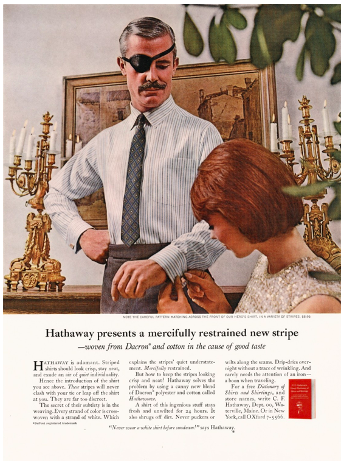
    Famous ads written by Sir David Ogilvy


    Enter the New Millennium

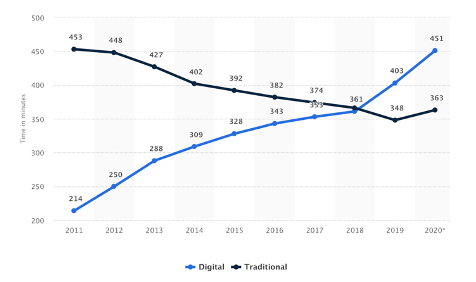
    The new millennium brought with it some profound changes.  The internet was beginning to change the way people live, read, do business, buy, and connect with other people.  In 2004, Mark Zuckerberg launched Facebook.  We learnt a new term called ‘social media’ with its advent. LinkedIn was launched earlier in 2003 and Twitter later in 2006. A host of other social media would completely change the way we live.  So would advertising unfortunately. Because people were spending much less time watching television and reading the newspapers and listening to radio.  In 2019 people spent more time with digital media than with traditional media in the US.


    Time spent per day


    Source: statistica.com


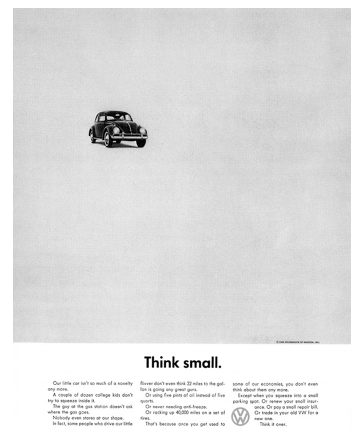
    The world of digital and social media meant new ways of talking to consumers.  This gave rise to new techniques in communicating. It meant that the skill needed to produce the famous Volkswagen Beetle ad by Bill Bernbach that made it a cultural icon that sold millions of cars were no longer needed. One can’t forget of course the degree of difficulty posed to sell an ugly German small car soon after World War II, to Americans used to the luxury of large cars, something the Volkswagen ads achieved admirably.

    1959


    2019


    In fact, the brilliance of the written word employed by master craftsmen like Bill Bernbach and David Ogilvy or the keen visual eye of Helmut Krone was perhaps no longer needed.  In the new millennium creativity had played hide and seek behind a much-abused word called ‘content’. Content was very forgiving of real creativity and happy to make friends with mediocrity.  In contrast to the Think Small ad, the Facebook ad of today for Volkswagen will be judged by the number of likes, comments and shares.  And not purely by how much the ad moves you like the Thing Small ad.  In fact, there seems to be no particular skill this Facebook ad might need either in terms of word or visual craftsmanship.  Suddenly communication had become the domain of data scientists and engineers whose province was machines, algorithms, big data and artificial intelligence. And perhaps creativity was reluctantly but surely taking a back seat.


    How Advertising finally died


    While many predicted the death of advertising no one quite predicted how it would go.


    In the last year, it certainly seems that advertising agencies will get gobbled up by digital agencies in the same group. Grey Advertising is the most recent example which merged with AKQA to form AKQA Group.  Last year similarly JWT merged with Wunderman to form Wunderman Thompson.  And Y&R merged with VML to form VMLY&R. I wonder who is next?


    Suddenly the heritage of a 100 years seems to have gone into the dust. And with the merger goes their history and great creativity of several decades.  When a brand dies, everything it meant to people dies along with it. It is ironic that WPP the group that bought over JWT, Ogilvy, Y & R and Grey is also the company that killed those very iconic advertising agency brands.


    It’s a pity that advertising had to die so suddenly and just get obliterated from the face of this earth.


    Prabhakar Mundkur is a veteran advertising professional and now a prolific commentator. He spent 17 of his 42 years in advertising with the agency once known as J Walter Thompson working with them across three continents. He has also worked with Havas and Hakuhodo. He has been voted Top Voice on LinkedIn, one of the Top Emerging Voices in yourstory.com and has written nearly 400 articles in the last four years. He was once an HMV and Polydor recording artist playing both the guitar and piano and still joins the occasional gig for friends. You will find him on Spotify and Apple Music with his recent compositions. He can be reached via Twitter at @wisecowboy. His views here are personal.


  • Pepsi gets the swag for Summer of 2019

    By A Correspondent


    The summer is setting in and Pepsi has brought it with a celebrating of the ‘swag’ with its ‘Har Ghoont Mein Swag’ campaign.


    Speaking on this campaign, Tarun Bhagat, Director-Marketing, Hydration and Cola, PepsiCo India, said: “Pepsi is a brand which has resonated with the voice of today’s generation. This summer, Pepsi is acknowledging and celebrating a word that defines today’s millennials’ – swag. ‘Har Ghoont Mein Swag’ is all about living in the moment, seizing new, interesting opportunities and doing it all with swag. The new campaign is a progressive approach to truly reflect the self-belief of today’s generation.”


    Added Senthil Kumar, Creative Chief at Wunderman Thompson (eka J Walter Thompson): “Pepsi has always been the cult brand that creates and curates culture for the young and the restless with every new campaign and the result has always been popular content that echoes the self-belief and celebrates the self-confidence of youth. This new generation is armed with self-belief and Swag, read as effortless cool, in every step of their individual and collective journeys. They don’t hesitate to stand up for what they believe in and stand out because they right the wrong themselves, not waiting for course correction from others. This Summer, Pepsi celebrates this bubbling self-belief and sizzling Swag of India’s young with the campaign “Har Ghoont Mein Swag“. And when this spirit of self-belief leads to self-confident action, every drop rises to the occasion, creating an ocean of youthful Swag.”


  • TOI espouses cause of ‘Lost Votes’ in latest social initiative

    By A Correspondent


    Given that the general election are coming up in a few months, The Times of India has launched a nationwide campaign to generate conversations and make a real difference. The ‘Lost Votes’ movement calls for policy and electoral reforms to bring in the vote of Indian migrant into country’s general elections.


    Commenting on the campaign, Sanjeev Bhargava, Director, TOI Brand said: “We are the largest democracy in the world. But are we the most robust? To strengthen our democracy, it is important that the right to vote and the facility to vote both be made available to the entire voting population.”


    Added Senthil Kumar, Chief Creative Officer, J Walter Thompson: “The idea of the film is to evoke the voice of the lost vote. A voice that amplifies the angst and echoes the emotion of over 20 crore Indians losing their vote. To play the voice of the lost votes on loud speakers and yet feel the voice being drowned by the distance, lost in the middle class multitudes out there. Losing your right to vote is like that fading homing signal. It’s like missing the last train home and losing the hope of making a difference in your hometown from your distant work station. Mera Haq Kahin Pe Kho Gaya,”


  • Tinder’s new ads say ‘Adulting can wait’

    By A Correspondent


    Dating app Tinder has rolled out a new brand campaign ‘Adulting Can Wait’.  Commenting on the campaign, Taru Kapoor, GM, Tinder India said: “Experiences in our early 20s serve as lessons in how to adult and eventually “settle down”. Growing up isn’t really optional, and we will achieve the goals that we seek and the ones we didn’t know we seek. We will all get there, whatever ‘there’ is. But until then, we want to celebrate the unexpected surprises at every corner – the craziness we will be nostalgic about sooner than we think, the relationships that will leave us better than they found us, the adventures that will make us challenge our own limits, and the people who will leave an indelible mark on our lives. Tinder represents endless possibilities where each right swipe opens up a new world of unique possibilities. Every swipe is a new connection, a potential epic memory or a valuable lesson in self-discovery. The film captures all the potential connections and social interactions, which eventually shape our world views as well as self-identity, that Tinder can facilitate. ”


    The film was created and conceptualised by J Walter Thompson, Delhi, directed by Rajneesh Ghai ‘Razy’ with the soundtrack composed by music director Mikey McCleary and sung by Anjali Sivaraman.


    Added Sambit Mohanty, National Creative Director, J Walter Thompson Sambit Mohanty “Tinder is more than just an app that enables ‘dating’. It’s a plethora of life experiences and a whole lot of fun. That’s the spirit we wanted to capture with our new campaign – tailor-made for a young and restless generation that doesn’t want to commit to adult choices.”


  • DS Group takes humorous rote for Pass Pass Pulse

    By A Correspondent


    Pass Pass Pulse, the candy from DS Group, has rolled out a set of three ad films promoting the product. This takes forward the ‘Pran jaaye par Pulse na jaaye’ narrative that was introduced with the release of the first TVC.


    The TVCs have been conceptualised by J Walter Thompson Company and the three commercials being released are titled, Astronaut, the Swing and the Bedroom. Each commercial showcases how the protagonists upon seeing a Pulse Candy in their proximity reach out to grab it, even in unfavorable situations.


    Speaking on the brand, Shashank Surana, VP, New Product Development, DS Group, said: “The Pulse candy has retained number one position, second year in row due to its irresistible taste heightened by tangy twist. The communication of Pulse is hinged on the temptation to seize a Pulse candy, whatever the circumstances. This three film campaign also highlights the extend people go to get one in ‘Pran jaaye par Pulse na jaaye’, situations presented in comical and eccentric plots.’’


  • Sagar Mahabaleshwarkar joins Contract as CCO

    By  A Correspondent


    Contract Advertising has announced the appointment of Sagar Mahabaleshwarkar as Chief Creative Officer.


    Tarun Rai

    Said Tarun Rai, Chairman & Group CEO, J. Walter Thompson: “We have been in discussions with Sagar for the last few months. And I am very happy that we have him on board, finally. Sagar is an industry stalwart. He has built his reputation over the years across many agencies in India and abroad. He has worked with more traditional FMCG clients as well as some of the iconic technology companies. And he has excelled across media platforms – with the last decade, especially, building his reputation as a digital-first creative leader. Contract has some of the most exciting and high-profile brands. We have big ambitions for the agency. With Raji Ramaswamy as the CEO and Rohit Srivastava, one of the finest strategic minds in the country, what Contract needed was a CCO with the depth of experience and a solid reputation of creative excellence that Sagar brings to the agency. He is the ideal creative leader to take Contract to the next level and make it a creative powerhouse”.


    Raji Ramaswamy

    Added Raji Ramaswamy, CEO, Contract: “I am delighted to welcome Sagar Mahabaleshwarkar as the Chief Creative Officer responsible for guiding the creative output of Contract in the digital age. He is a seasoned new age creative leader who has the finest art and design sensibilities. He has worked on some of the biggest brands in the country across both traditional and new media platforms and excelled in every one of them. Contract manages some of the biggest brands and businesses in the country and we believe Sagar will be able to contribute and add value to each one of them.”


    Sagar Mahabaleshwarkar

    Commenting on his appointment, Mahabaleshwarkar said: “The vision of Contract and the direction that JWT group is taking globally, is to make brands agile and to make brands purposeful. That’s a dynamic shift which is challenging and forward looking. I am excited with Tarun’s strategy. Having worked on a winning note in a highly competitive, tech-first consumer business for the last three years, I am confident the shift is in the right direction.”


  • JWT partners Tata Pravesh, urges people to make positive moves

    By A Correspondent


    To spread awareness on the need to include HIV patients, the team at J Walter Thompson identified a unique initiative which is being supported by OFFER (Organisation for Friends, Energies and Resources founded by Kallol Ghosh) and came up with a digital film.


    Conceptualised by J Walter Thompson, the digital film called ‘The Positive Move’ tells the stories of some HIV positive teenagers who refused to give up, dared to dream and gave birth to ‘Café Positive’ – Asia’s first café run only by HIV Positive people. The film portrays how these people were neglected emotionally and physically by their friends, families and society and then goes on to show how instead of fading away, they started a café with their own initiative and how a few good people stepped forward to the open the doors of hope for these bravehearts.


    Sharing his views on this unique film, P Anand (Chief – Services & Solutions, Tata Steel) said: “We, at Tata Steel, have always been concerned about being a true corporate citizen and firmly believe in a closely bonded society. The idea emanating from the film is to go forth and tell this story about how one can survive and thrive when doors of hope are collectively opened.”


    Added Vijay Jacob Parakkal, Senior VP & Managing Partner, J Walter Thompson, Kolkata says: “We found the Café Positive story of grit, determination and acceptance by people very touching. It does open our doors of perception. We are thrilled to partner with the Tata Pravesh marketing team to tell this story with a powerful message on the World AIDS Day.


  • Finally, J Walter put to rest!


    By Prabhakar Mundkur


    J Walter Thompson the agency which was first established in 1864, and celebrated its 150th anniversary with aplomb in 2014 is finally putting James Walter Thompson the founder to rest. In 2005, the agency tried to rid itself of any connection with its founder by rechristening the agency to its initials JWT, which involved a logo change from the earlier famous signature of its founder.  That seemed like an effort to tear away from its past.  In the process it might have lost some of its charm.  But on its 150th anniversary good sense prevailed and Sir Martin Sorrell decided to rechristen the agency as J Walter Thompson because he thought the name was immensely powerful.


    Now finally with the merger announced yesterday by WPP with Wunderman to make it Wunderman Thompson, the ad agency finally puts the first two names of its founder to rest.  In some ways, the merger and the double-barreled name reflect changing times for the ad agency business.  It is no coincidence that the merged entity has been named Wunderman Thompson rather than Thompson Wunderman.  Neither is it a surprise that Mel Edwards earlier CEO of Wunderman is the global CEO of the merged entity and will have operational control of the merged entity. And Tamara Ingram the global CEO of JWT has been relegated to the position of Chairman of the combined entity, always a less active and more ceremonial role.   It is a clear signal to the marketing industry that the ad agency is now playing second fiddle in the communication business.


    WPP earlier did the same with Y & R when it merged it with VML a digital marketing agency in the WPP group.  By calling the new entity VMLY&R it reiterated that the ad agency was probably no longer as important as it earlier was.


    But with this new merger and name change, we lose over 150 years of the J Walter Thompson heritage.  Its culture, its many innovative firsts in the advertising business, its prominent place as the University of Advertising and last but not least its status as the inventor of strategic planning thanks to the famous Stephen King.


    So, what does the future hold?


    Certainly, it does seem that Wunderman will lead the merger.  Wunderman was founded in 1958 by the Wunderman brothers and has over the years transformed itself from a direct marketing shop to a modern digital agency. Mike Reed now CEO of WPP, is known to have steered Wunderman to its current position of ‘creative driven, data inspired’ in his earlier stint as CEO of Wunderman.  His affection for Wunderman is therefore quite natural given his earlier acquaintance.   He once defended the onslaught of the consulting businesses into the communication arena by differentiating Wunderman as, “We are different from Accenture. We are creative”.


    In many ways, the new merger in theory at least would be a very powerful entity with both digital and traditional marketing skills.  But the advertising business has yet to prove beyond doubt that integrating balance sheets necessarily lead to integration of diversity in communication skills. Sir Martin’s famous coinage of “horizontality “has remained more or less an admirable mission rather than transformed into regular practice.


    One can’t therefore help but wonder if JWT and Wunderman continue to operate as two different silos under one merged name.  It would certainly be a pity if it did.  What is intriguing is that if this is the model of the future for communication businesses, will the other large groups like Publicis, Denstu Aegis, Omnicom and Interpublic follow?  That’s a million-dollar question.


    We will need to wait and see!


  • JWT elevates Shujoy Dutta as Head of Planning, Bengaluru

    By A Correspondent


    Shujoy Dutta

    Shujoy Dutta has been appointed as the Head of Planning for J Walter Thompson’s Bengaluru office. Dutta has been with J. Walter Thompson for over nine years and in his last role at JWT Delhi, he has been the planning lead on brands like Airtel, Hero Motocorp, etc to name a few.


    Bindu Sethi

    Announcing the appointment, Bindu Sethi, Chief Strategy Officer, J Walter Thompson said; “Shujoy, is an author and a story teller. The humans in his stories are people you want to love or trample; the response is strong and emotional. He constructs his brand stories to get noticed, to shift behavior. Shujoy, is a treat for clients and colleagues. I look forward to seeing Shujoy build strong brands and stronger client relationships.”


    Commenting on his new role, Dutta said; “I’m very excited about my new role. This city has tremendous potential and JWT Bangalore packs in significant Creative firepower. So, I look forward to forging new partnerships and creating a bouquet of memorable work, and of course, consuming lots of filter coffee.”