
By Kunal Sinha
 In the late 1990s, I visited countless haats across India with my colleagues, understanding the rural residents’ shopping behaviour, helping develop strategies to engage and convince them.
On those trips, we chanced across a plethora of copycat brands. Funny & Lovely, Fairy & Lovely fairness creams, Polands cream and talcum powder, Dafur and Babur Dant Manjan, Nise and Pearl biscuits. With their limited ability to read the English alphabet, villagers looked at the brand’s logo as the visual ID, because the rest of the packaging was pretty identical to the original brand.
The makers of these copycat brands were small, local entrepreneurs, riding on the popularity of brands that enjoyed high equity and trust, and out to make a quick buck. They were hard to track down.
Nearly three decades later, we are witnessing an upsurge of brands that have no qualms about capitalising on the equity of market leaders. The difference: these are brands owned and introduced to the market by well-established, reputable companies.
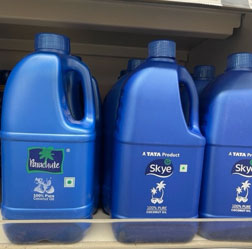 One need not travel to a small town or village to find many of these brands. They are available both online and your neighbouring Star Bazaar. Not only that, the placement on the shelf is right next to the original brand. How brazen could that be?
Tata’s Skye range is astonishingly similar to several brands which are leaders in their categories. The coconut oil has the same bottle shape and colour, identical product description as Marico’s Parachute. The mnemonics of coconut palms and half coconut have been integrated into one visual, as opposed to separate for Parachute. Small mercies.
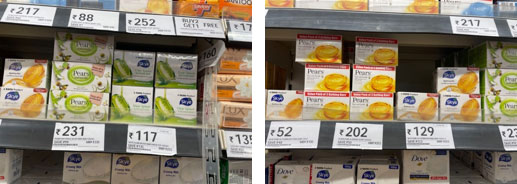
For its glycerine soap range, Tata Skye turns to HUL’s Pears for inspiration. Again, similar colour schemes – white and green / orange are used, and the soap bar is prominently pictured on the pack. The price? Rs 231 for Pears Aloe Vera vs Rs 117 for the Tata Skye version; Rs 202 for the Pure and Gentle version vs Rs 129 for Tata’s glycerine soap. All these for a pack of three.
Now imagine a budget-stretched couple in Dum Dum or Govindpuri doing their weekend shopping. For them, there is no better assurance than seeing the words ‘A TATA Product’ emblazoned on the label. With such a significant price benefit, which brand do you think they would pick up?
Let’s look at another popular brand – Mondelez’s popular Oreo cookies, which became a runaway success in the Indian market since its launch.
In 2020, Parle, by far a much bigger maker of biscuits and cookies, decided to launch a chocolate-vanilla cream cookie by the brand name FAB!O, with identical packaging. Mondelez took Parle to court, and the latter was forced to withdraw its product from the market.
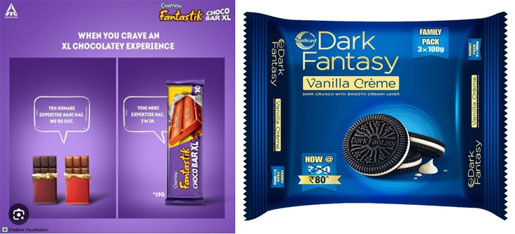 That judgment did not deter another leading CPG company – ITC Foods, from creating and selling its own chocolate-cream cookie, Sunfeast Dark Fantasy Vanilla Crème. As it branched out into chocolates, the packaging and advertising for Candyman Fantastik makes no apologies about borrowing from Cadbury’s colour codes.
So, what’s with this penchant for copying? And does the adoption of these practices by market-leading companies give copying legitimacy?
Let’s put it down to lazy marketing and short-termism.
When marketers see a competitor do well, the easiest trick in the world is to say, “Let’s do what makes them successful! There’s already a model in place, and if we adopt it, we’ll be able to make money quickly.”
According to Sabeer Bhatia, founder of Hotmail, speaking at a Nasscom event, “90 per cent of the innovation industry is copycat in India, there is nothing new.”
It’s a refrain one keeps hearing in the agency world. The client asking “Can you give me something new, innovative?” Upon being presented a bunch of new ideas, they’ll respond by saying, “Can you show me examples of how this has worked?”
Google might be phasing out cookies, but in business it is still a cookie-cutter world!
Kunal Sinha is a senior strategy and foresights executive based in Jakarta, Indonesia. He is the author of several books including The Future of India’s Rural Markets and Raw – Pervasive Creativity in Asia. He writes for MxMIndia every other Monday. His views here are personal.


 Said Anand Siva, founder of Customer Shastra: “ITC Foods has always been a very forward thinking & innovating company, reimagining and redefining in every sphere – and that’s what excites us at Customer Shastra. It’s inspiring to work with a company that puts customers first, and is obsessive about addressing their needs, and that’s what we will deliver.”

 The 23rd edition of the Big Bang Awards by Ad Club Bangalore, brought to fore the rising talent poll in advertising industry. Mindshare bagged four out of the top nine most coveted awards while The Social Street bagged the ‘Creative Agency of the Year’ award.