Tag: IPL

  • Robin Uthappa is brand ambassador of Sportiqo

    By Our Staff


    With the IPL fever gripping the country, Sportiqo, a blockchain-based fantasy sports platform, has announced the launch of a new digital campaign featuring cricketer Robin Uthappa. The campaign is aimed at promoting Sportiqo’s innovative sports solutions and engaging with sports enthusiasts worldwide.


    The digital campaign, titled, “Khel On. Trade On,” will showcase Robin Uthappa – the brand ambassador of Sportiqo, highlighting the company’s cutting-edge sports technology products and services.


    Said Anindya Kar, Chief Product Officer and Co-Founder of Sportiqo: “I am thrilled to have Robin as the face of our digital campaign. He brings an unparalleled level of talent, dedication, and passion to the game, and we are honoured to have him represent our team and brand. We are confident that Robin will inspire and captivate fans all over the world. Our digital campaign is a testament to our commitment to delivering extraordinary experiences to our fans. Together, we will continue to push the boundaries of what is possible in the world of sports and online gaming.”


    Raj R Gupta, director of the digital campaign added: “Like every other person in India, most of my fond memories of childhood involve cricket. While shooting these ads I felt a personal resonance with the stories I was telling. As a filmmaker, I have always wanted to entertain and engage an audience. I like to tell stories about people who inspire others. This was what excited me most when I got to know that I will be working with Robin Uthappa. He has inspired the budding cricketers of a whole generation with his work ethic and sportsmanship. And I needed to bring out those qualities on screen when we were shooting these ad films.”


  • Rapido campaign on JioCinemas for IPL

    By Our Staff


    Rapido has launched a campaign titled ‘Bike Wali Taxi, Sabse Saxi’  to drive consideration for the category in the e-mobility space.


    The campaign has been created by Enormous and it comprises four films that showcase Rapido Bike-Taxi as a smart alternative in different scenarios.


    Notesa communique: “With a digital-first approach, for the first time, Rapido has collaborated with the OTT platform JioCinema. Capitalizing on the reach and frequency of IPL on the platform, JioCinema serves as the lead channel. This will be followed by TV for amplification, and OOH as the recall channel.”


  • ‘57% prefer watching IPL on TV, 30% on mobile’


    By Our Staff


    Pause for a moment. Look to the left or right of the screen. Or text in a different colour. This is no marketing initial or promotional exercise done at the behest of one of the competing platforms. It’s the main finding of an Axis My India survey of 10,034 people surveyed, 66% of who are from Rural India while 34% are from Urban India. This is part of the India Consumer Sentiment Index (CSI), a monthly analysis of consumer perception on a wide range of issues. The April report highlights that 19% of families have reported a rise in media consumption. Moreover, the survey reveals that urban areas and male viewers are leading the surge in media viewership. The enthusiasm for IPL is expected to increase further, with both TV & mobile contributing to viewership. The study also delved into the key factors that influence consumers’ buying decisions, revealing that product quality and brand name remain important considerations. Additionally, the survey sheds light on the role of celebrity endorsements in driving product purchases, with younger age groups being more susceptible to their influence.


    The April net CSI score, calculated by percentage increase minus percentage decrease in sentiment, is at +8, which is the same as last month. The corresponding net score last year was +11.


    The sentiment analysis delves into five relevant sub-indices – Overall household spending, spending on essential and non-essential items, spending on healthcare, media consumption habits, entertainment & tourism trends.


    The survey was carried out via Computer-Aided Telephonic Interviews with a sample size of 10,034 people across 33 states and UTs. 66% belonged to rural India, while 34% belonged to urban counterparts. In terms of regional spread, 25% belong to the Northern parts while 26% belong to the Eastern parts of India. Moreover, 28% and 21% belonged to Western and Southern parts of India respectively. 63% of the respondents were male, while 37% were female. In terms of the two majority sample groups, 29% reflect the age group 36YO to 50YO and 29% reflect the age group of 26YO to 35YO.


    Commenting on the CSI report, Pradeep Gupta, Chairman & MD, Axis My India, said: “Closely examining the findings of our latest survey, it is clear that media consumption habits are not uniform across demographics, with variations emerging among different age and gender groups. It is noteworthy that younger age groups are showing a greater appetite for media consumption, with a particular interest in watching the Indian Premier League. Digital is expected to contribute significantly to the rise of IPL viewership. As we delve deeper into consumer behaviour, it is evident that product quality and brand name remain key considerations, but we are also seeing a significant impact of celebrity endorsements on purchasing decisions, especially among younger age groups. These insights highlight the need for brands to stay attuned to the evolving consumer preferences and tailor their marketing strategies accordingly to drive engagement and enhance customer loyalty.”


    On topics of current national interest


    • :: • This month Axis My India’s CSI survey further deep dived to understand citizens’ sentiments towards the 16th edition of Indian Premier League. As per the survey 42% would watch IPL this season, out of this 19% would watch all the matches whereas 22% would only watch matches where their ‘favourite’ teams will play or critical matches like eliminators and finals. About 26% of youngsters (18-25YO) wants to watch all the matches as compared to older age group highlighting their younger spirit and interest in IPL. In addition, male viewers and urban areas show more interest in watching the tournament.

    • :: • Further investigating sentiments, the study discovered that 57% would watch the matches only on cable/DTH Television sets while 30% will watch it only on mobile – Jio Cinema. 8% said they would watch on both TV and mobile. 3% plans to watch the tournament physically from the stadium. About 32% from rural areas show more interest in watching IPL on mobile given the free telecast of IPL matches. Middle age groups, of 26-50 YO would prefer watching more on television than younger age groups.

    • :: • In an attempt to understand product purchase behaviour, the survey found out that 52% considers product quality and 33% considers brand name as important factors. 60% of 18-25YO puts weightage on the product quality whereas 35% of 36-50YO considers brand name as important factors. Price is overall considered as the third most important factor with a vote of only 22%.

    • :: • The survey also unveiled that advertisement in which celebrities feature, influence product buying decisions of 30% to some extent. Of this, about 35% of them are youngsters (of age 18-25) and 27% are middle-old and older age group.

    • :: • With summers approaching, the survey highlighted that overall 15% plans to buy durables like AC or Refrigerators in the next 2-3 months. Moreover 19% of youngsters (18-25 YO), highest amongst all age groups are considering to buy durables like AC, fridge etc. this summer season.

    • :: • The survey also threw light on consumer travel plans this summer season. Overall 24% plans to travel of which 23% said they are planning for a domestic holiday while 1% is planning for an international vacation. Plans of travel is higher in the younger age group of 18-25 years at 30%.

    • :: • On employment opportunities the survey revealed that 50% believe that there are more openings/opportunities as compared to last 10 years. 53% of the female population have a positive outlook regarding the same highlighting the raise in the number of jobs available for the gender. In addition, younger age group (18-25YO) also thinks job opportunities have increased overtime.

    • :: • Moreover, the survey discovered that among the top professions in the country 25% would prefer their children to enrol in the Govt service, 16% would prefer them to be in medical profession while 10% would prefer them to work in fields related to Engineering, Computer application, IT. A majority of 35% are of the view that their children should do whatever they want to do.


    Key findings


    • :: • Overall household spending has increased for 56% of the families, this reflects a decrease of 2% from last month and 6% from April’22. The net score, which was +51 last month and +53 in April’22 has reduced to +49 this month. The two states, which reflected the highest increase, are Telangana with 70%, followed by Andhra Pradesh with 66%. The age group between 26-50 showcased the highest increase (58%).

    • :: • Spends on essentials like personal care & household items has increased for 33% of the families, which reflects a dip by 3% from last month and 15% from April’22. The net score, which was at +23 last month and +29 in April’22, has decreased to +21 this month. Essential spends has increased more for rural segment (33%) as compared to the urban counterparts (31%). Karnataka and Tamil Nadu reflects the highest essential spends with 50% and 49% respectively. The age group between 36-50 showcased the highest increase (36%).

    • :: • Spends on non-essential & discretionary products like AC, Car, and Refrigerator have increased for 4% of families, which is the same as last month and reflects a dip by 9% from April’22. The net score, which was at 0 last month, remains the same.

    • :: • Expenses towards health-related items such as vitamins, tests, healthy food has surged for 32% of the families. This reflects a decrease in consumption by 3% from last month and 6% from April’22. The health score which has a negative connotation i.e., the lesser the spends on health items the better the sentiments, has a net score value -22 this month. Health related products consumption increased more in rural areas (33%) and among age group of 26-35 (about 34%). Karnataka with 49% and Bihar with 43% reflect the highest spends in health-related products.

    • :: • Consumption of media (TV, Internet, Radio etc.) has increased for 19% of the families, which is the same as last month and reflects a dip by 3% from April’22. The overall, net score is at 0 this month. Media viewership has increased more in urban areas (21%) and among males (20%) while it is only 17% among females. In addition, media consumption is more among 18-25 YO which (29%) as compared to older age groups.

    • :: • Mobility has increased for 6% of the families, which reflects a decrease by 1% from last month and same as April’22. The overall mobility net indicator score, which was at 0 last month, is at -1 this month. 10% of the youngsters from the age group of 18-25, has gone out more in the last month as compared to other age groups.


  • Not at all Quiet on the OTT Front


    By Shailesh Kapoor


    Shailesh KapoorOver the last three years, it became abundantly clear that streaming (or OTT, as it’s called in India) is the medium of the future in this country, even as other media will continue to co-exist. Linear television always had the numbers. But thanks to a mix of factors, ranging from the pandemic, to ever-reducing data costs, to a nosey TRAI, linear television has barely managed to stay afloat. Pressure on revenues has been felt across the board, and that’s never a good sign.

     

    Streaming itself is trying to find its sweet spot. Is it a premium paid (SVOD) medium, as all the promotions of well-mounted web-series suggest? Or is it a medium for the ‘masses’, where free (AVOD) content is going to dictate the future? The jury has been out. And the last few weeks have seen their share of action on this front.


    Perhaps the biggest shift in the dynamic has been around the IPL. The 16th edition of the league, which starts March 31, will stream free on JioCinema. That’s a polar opposite to how it was thus far: IPL was a subscription (and hence, revenue) driver for Disney+ Hotstar, not just in India but at a global level too.


    Then, there’s the talk of the largest AVOD player in India outside of YouTube, i.e., MX Player, being up for sale. The content side is going through its continuous evolution. For example, price points for acquiring streaming licences to theatrical releases have not stabilised yet.


    All these are healthy signs, one would think. A growing category is bound to see new ideas, new strategies, and new alignments. And some of these may shape the future of the category. For example, there is little doubt in my mind that IPL’s streaming viewership will outnumber that on linear television this year.


    How did linear television find itself in this situation is a matter of another debate. But it should not have, because it’s still the staple, go-to medium for millions of Indian families every night. But the only way you can fight technology is by building a precise and relevant narrative. The linear TV industry has failed to do that for itself.


    Amidst all the positive action, the talk of censorship of streaming content has started again. This week, the I&B minister advocated censoring “vulgarity”. The genesis of this not-so-veiled threat lies in a Delhi High Court judgment will handling a complaint on TVF’s show College Romance. The state and the judiciary playing moral police can be a major irritant in a category that’s otherwise amid a period of high activity and growth.


    All eyes, hence, are on India’s streaming story, in its second phase, where the category seeks stabilization and re-alignments. And the upcoming IPL will set the ball rolling on that front.


  • What’s common to advertising & cricket


    By Ashoke Agarrwal


    Ashoke AgarrwalI am a student of both cricket and advertising.


    The cricketing season in India starts in the post-monsoon months and nears its end in the dog days of April with the IPL. As the different hues of cricket play out this year, the parallels between cricket and advertising strike me.


    Cricket is the only sport with three widely played versions – Tests, One-dayers (ODIs) and the T20s. The shorter versions – the ODIs and the T20s – are later versions of the game whose oldest form is the five-day Tests.


    Let’s think of advertising agencies as the players, their client brands as the team they play for, and the advertising campaigns the agency and the brand management create as the type of cricket match.


    Test matches are games of deep strategy akin to a game of chess—the results of a Test take days to unfold. A Test match might end without a winner, but with every Test, a player’s reputation is either enhanced or diminished.


    An advertising campaign akin to a Test match focuses on creating a long-term positioning and equity for the brand. Therefore, the campaign’s planning horizon is over the long term, measured in years. Like in cricket, in the “Mad Men” era of advertising – stretching from the 50s to the 80s – Test-type campaigns were the norm. In the Test match era of advertising, the client’s management considered their advertising agencies as brand custodians and partners and paid them as such. As a result, advertising agencies could afford to hire intellectual and creative talent that could deliver long-term results, setting up a virtuous cycle.


    In the late eighties, Wall Street replaced Madison Avenue as the valued partner of companies in the US. The phenomenon soon spread across the world. As a result, the planning horizon shrunk from years to the next quarter. And the era of the ODI began in advertising.


    Client management tasked agencies with creating ODI-type campaigns to deliver sales and results reflected in the next quarter’s financials. As a result, agencies took on the role of a vendor who supplied services to specifications set by the clients. As a result, agency compensation changed to reflect the new realities, and agency talent pools shallowed.


    With the digital age coming, the era of T20 in advertising dawned. Performance marketing became the new mantra, and the planning horizon shrank further from the quarter to the click of a like, share or buy button. Agencies became clickbait suppliers, and desk jockeys’ armies paid like wage earners while the platform behemoths like Facebook and Google ate everybody else’s lunch.


    Like in cricket, all three forms of advertising – Tests, ODI and T20 – continue to co-exist with Test and, lately, ODIs yielding market share to T20s.


    Like top-rung cricket players like Virat Kohli and Ben Stokes, who are superb at all three forms of cricket, a few super agencies play, and the brands they handle continue to create all three types of campaigns. But the preponderance of agencies and brands, driven by market realities, are becoming predominantly T20 players.


    The super agencies cross-pollinate the skills and capabilities practising all three forms of advertising. Test teams, like the current English team, win Tests playing “Baz Ball”, bringing the aggression of T20 to the Test arena. Super agencies can bring speed and accountability to long-term brand-building campaigns—or strategic nous to the daily toil of performance marketing.


    Over the next decade, AI is going to change many businesses. How will it change advertising? Will AI engines take over the quotidian tasks of the ODI and T20 kind of advertising? Will the business of advertising go back to being the fine art of positioning, building and nurturing brands over periods of years and decades? Will such agencies attract, once again, a new generation of brilliant strategic and creative minds?


    While we ponder advertising in the age of AI, let me give you a taste of why the much-ballyhooed generative AI technology is unlikely to replace true creativity in advertising in the near future. I asked Chat GPT to provide me with a 50-word mini-essay on “Why Advertising is like Cricket”. Here is the response.


    Advertising and Cricket both require strategy, patience, and a keen eye for opportunities. In cricket, a team must carefully plan their moves, adjust to changing conditions, and seize moments of weakness in their opponents. Similarly, in advertising, a brand must develop a clear strategy, adapt to changing consumer behaviors, and capitalize on emerging trends. Both cricket and advertising also rely on effective communication and teamwork to achieve their objectives. Finally, just as cricket has its own set of rules and regulations, advertising also operates within a set of guidelines and best practices to ensure fair play and positive outcomes for all involved.”


    Isn’t it as bland as can be? I suspect it would be the same answer if I replaced “Cricket” with any other team sport or “Advertising” with any other business service. Try it for yourselves. This proforma response is because the core of the current state-of-the-art generative AI bases its response on probability curves trained on static data without any actual capability to explore the context and synthesize creativity.


  • 400 Not Out: Feels like Brian Lara


    From the Editor: When we invited Shailesh Kapoor to write for MxMIndia in 2012, a year after we started, we didn’t know how important a position his column would have in Indian broadcast. Our reason for inviting Shailesh to write was simple: the super-large broadcast sector depends on content as its primary fuel, and there is need to track trends and comment on what’s working. And what’s not. And Shailesh, thanks to the splendid work Ormax Media was doing (then and now) was in the best position to write for us.


    Even as we say it ourselves, what makes MxM stand out from amongst the rest is our commentary on content. That we know is fraught with a lot of dangers, especially when it comes to revenues. But our allegiance is not to our advertiser or shareholders, but to you, dear reader. Meanwhile, join me in congratulating Shailesh Kapoor.


    By Shailesh Kapoor


    Shailesh KapoorFrom August 9, 2012, when I first wrote the first column for this website, it’s been more than 11 years. This is my 400th column here, no less. Don’t blame me for feeling like Brian Lara today!


    It offers me just the perfect excuse to share some of my favourite columns from the past. I rarely read my columns after mailing them out. But there are some that one remembers for many years, for either the satisfaction of writing, or for the feedback that came one’s way. Be warned: some of the older ones may have wobbly special characters.


    I have written more than a few times about TV ratings, but the absurdity of 5am ratings at that time prompted me to write this piece back in 2013.


    A column from May 2013, titled Five Tips for Young TV Executives, is a personal favorite, because it got shared widely in many media companies at that time, and continues to somehow stay relevant, with occasional messages from people who read it almost a decade after it was published!


    News has been my go-to topic in weeks when I have struggled to decide what to write on. The column titled Are we a Noise-loving Nation? looks at news (as also television) in a larger socio-cultural context. Just the headline itself seems ever-so-relevant in 2023.


    There have been a few columns on Kapil Sharma, as the 11 years of this column was also the period of him going through the beats of fame and success. Sharma keeps going at it now, like an old warhorse. His film Zwigato releases next week. Of all the Kapil Sharma columns, I enjoyed writing these two the most: Kapil Sharma and the Loss of Innocence in 2016, and Kapil Sharma: Definitely Not Done Yet in 2022.


    The 2017 column titled Panic Times for Hindi GECs? has a special place in my list. It’s one of the several (50+, I’d say) columns on the state of general entertainment television in India. But this one, in particular, got great traction, and led to extended conversations with several channels. I have rarely looked at writing here as a way of furthering Ormax Media’s business interests, but if I had to pick one column that managed that, it is this one.


    Sports, particularly cricket, has been a regular feature on this column. I have been a keen supporter of women’s cricket, and have written a few times on it, including this column titled Stars in the Making. To watch Women’s IPL become a real thing in 2023 is immensely satisfying.


    TRAI’s meddling with private television’s affairs, via the New Tariff Order (among other things), and the damage it has done, will be a dark chapter in Indian television’s history. The saga continues even as I write this 400th edition. This column from last year, titled Genre by Genre… Tumbling of the Telly, paints a grim picture of what the future of television may look like, in the current circumstances.


    The column started covering theatrical and streaming content a lot more frequently in the last 3-4 years. These recent columns on Pathaan and Farzi were fun to write.


    400 done, it’s time to chase the 500-mark now!


  • The Myth called ‘Too Much Cricket’


    By Shailesh Kapoor


    Shailesh KapoorThose of my vintage often lament that ‘These days, there’s too much cricket happening all the time’. Factually, this is indeed true. The Indian national team played about 75 days of international cricket in 2022. Add the IPL to it, and they were on field for almost 100 days in the year. And this was a year whose early part was impacted by the pandemic.


    The average number of Test matches played by India was seven per year in the 90s. It went up to 10 per year in the decade 2000-2009, and has since then averaged at 13 per year, excluding the pandemic-impacted months. Not all Test matches last the full distance, or the number of playing days would be even higher. But a typical Indian cricketer is on tour for almost 150 days in a year, not counting the training camps that precede these tours or home series.


    From a viewer perspective, there is all of this, plus key non-India matches, like those in a World Cup, to watch. Women’s cricket is on the rise too, and WPL is round the corner. It means potentially about 150 days of relevant cricket being telecast live every year. And this does not include non-India bilateral series, like the Ashes.


    I don’t know another sport that has so much going on round the year. Yet, there is no sign of cricket fatigue. Viewership numbers have not dropped in recent years, and a new generation of young Indians seem to have taken to T20 cricket, especially IPL, quite well. With no other sport on the ascendancy, cricket is set to dominate the Indian media landscape for another decade at least.


    It’s no secret, though, that cricket is not the most profitable investment for linear television or streaming broadcasters. The licensing rates keep going up every year, and yet, the strategic power the sport wields in India is significant enough to keep the broadcasters and the streamers interested.


    We have been a single-sport country for long. But cricket has gone on to take an even more prestigious position: It is literally the only marquee media category India has today. No national GEC show (fiction or reality) or movie airing can match the impact of good cricket series, or a key event like a tournament knockout game. Everything else is getting increasingly fragmented, even as viewership continues to consolidate around cricket. Even election coverage is losing steam in recent years, except a short block of 4-6 hours on result days.


    Interestingly, there is very little ancillary programming around cricket that has managed to cut through. Live cricket continues to grow in its appeal, but packaged content is largely limited to free platforms like YouTube. The communal impact of live cricket, which is at the heart of its popularity in India, is difficult to replicate in cricket game shows, chat shows or analysis. Broadcasters have tried this for years, but unsuccessfully. These properties now exist only because some sponsors are willing to pay to be on them, coming as they do at lesser price points than the live game.


    With large-scale technology-led changes and changes in audience behaviour, all else in the Indian media landscape will evolve over the coming decade. But the sport of cricket will stand tall, invincible.


  • Women’s IPL: Better Late Than Never


    By Shailesh Kapoor


    Shailesh KapoorThis has been a significant week in the India’s modern sporting history. The bidding process of WPL (Women’s Premier League, i.e., the women version of the IPL) concluded Wednesday, with five team owners shelling out a cumulative INR 4,670. WPL will be played between five teams during this year.


    It’s taken BCCI a few more years than expected, to action this evident spin-off that combines the success of IPL with the growing popularity of women’s cricket. Perhaps the Covid years pushed their plans back. But better late than ever, as it’s said.


    Women’s cricket has found traction in the recent years, because of more consistent performances by the Indian team, as well as better television coverage and marketing for women’s cricket events by Star Sports in particular. WPL can take the awareness and interest in women’s cricket to a whole new level, not just in India but worldwide. Given how good the standard of women’s cricket at the highest level now is, it’s only appropriate that the richest cricket body in the world has invested in it. Australia has had the Women’s Big Bash League for several years now. But WPL will be several times bigger, in its viewership, revenues, and hence, the impact.


    India, as a country, can do well with stronger female presence in mainstream sports. In our monthly tracker Ormax Sports Stars, as many as 94% sports viewers pick a male sportsperson as their favourite, marginalising the female representation to badminton stars PV Sindhu and Saina Nehwal, and tennis star Sania Mirza. There are no other names, including cricketers, of note on the women’s list. Even female sports audience (a high 91%), pick sportsmen as their favorite.


    While sport, in general, tends to be male-skewed across the world, the extremity of this skew in India is a worrying indicator, from a socio-cultural perspective. In the recent years, Indian women have matched the men at the Olympics, accounting for seven out of India’s 14 individual medals at the games since 2012. However, the media and government attention these winners have received has been short-lived. While there continues to the improvement in facilities available for aspiring women sportspersons at the ground level, the audiences, who eventually drive revenue into sports, have been untouched by it.


    WPL can be that big-ticket idea that unleashes the true power of women in sport, for the wider audience. One could argue that anything that works with cricket is not replicable to other sports. But here, gender, and not sport alone, is the operative word. And if one needs cricket to start the process of building awareness, then so be it.


    I can’t wait for WPL 2023. Hope BCCI treats the event with great respect, and gives it the attention and the stature it deserves. The degree of WPL’s success will surprise many, is my little prediction.


  • IPL valuation jumps 75% to USD 10.9 bn in 2022


    By Our Staff


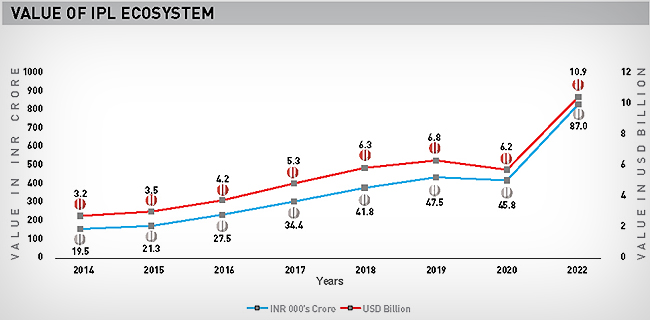
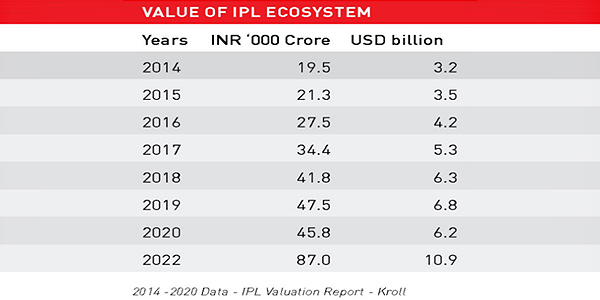
    D and P Advisory, a leading providers of consulting and advisory services, has announced the launch of a valuation report on the Indian Premier League (IPL) for 2022. The report titled ‘Beyond 22 Yards’ highlights that the value of IPL ecosystem registered a 75% growth since 2020, and now stands at USD 10.9 billion.


    Here are highlights of the report:

    In 2020, the IPL was valued at USD 6.2 billion. This valuation makes IPL a Decacorn (a business with a value more than USD 10.0 billion) within 15 years of inception. The IPL Ecosystem represents the value generated by the IPL as a business.


    A landmark event this time was the auction of the IPL media rights for 2023 to 2027. For the first time, media rights were spread among different broadcasters, breaking the monopoly of one company. The league has sold media rights at USD 6.2 billion, registering a three-fold jump compared to the previous 5-year cycle in 2017. Additionally, the tournament in 2022 also registered a record breaking combined viewership of 426 million on television and OTT platforms.


    With two new teams (Gujarat Titans and Lucknow SuperGiants) getting bought last year at a combined staggering value of USD 1.6 billion, the average price tag of a team has seen a whopping 16-fold jump from its inception. These two factors were instrumental in boosting the valuation of IPL to become a Decacorn and the second largest sporting league (on a per match basis from broadcasting fees) globally.


    To add to the momentum, the Board of Control for Cricket in India (BCCI) has announced the launch of Women’s Indian Premier League with a base price for a franchise at INR 400 crore (USD 50 million). This price is higher than most other cricket leagues globally, and will add immense value to the overall IPL Ecosystem.


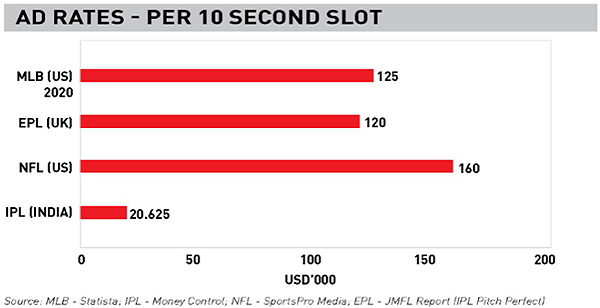
    However, on a broader scale, IPL is significantly behind in terms of ad rates, when compared with some of the other global sporting leagues. For example, a 10-second slot for an ad during IPL 2022 costed nearly USD 20,000; whereas, the ad rates for the same time slots at National Football League, English Premier League and Major League Baseball were over USD 1,00,000. Drawing this comparison, the report mentions how IPL has a lot more space to grow in future provided broadcasters are able to monetise the content well.


    On the launch, Santosh N, Managing Partner, D and P Advisory sid: “Since its launch in 2008, IPL has reimagined the nation’s cricket competition. IPL 2022 witnessed some major milestones and captivating games throughout the season. The renewed media rights deal was a major contributor towards a substantial jump in value for a relatively young league like IPL. These observations are an assurance of the fact that the IPL will continue to revolutionise the game of cricket and will be etched in the hearts of millions of fans for years to come.”


    The report goes on to say that the IPL team owners are looking to replicate the multi-club ownership model as part of their long term strategy. For example- The Knight Riders Group owning the right to Trinbago Knight Riders in the Caribbean Premier League, and a franchise of the UAE T20. It also has plans to build cricket stadiums in Los Angeles, USA, in partnership with the Major League cricket. Reliance Industries, the owners of Mumbai Indians, recently unveiled two new franchises in UAE’s International League T20 and Cricket South Africa T20 League.


    Furthermore, with BCCI having forged and locked in new broadcasting deals for the next five years, the report foresees a more stable phase in terms of the value of the IPL Ecosystem. “The value appreciation may not be as fast as seen in the earlier years”, it states.


    The report also states that the digital rights being sold separately from TV rights would result in greater engagement on the digital platforms. Further, the impending introduction of 5G services, greater penetration of the internet and increased smartphone usage will add to the rise in viewership.


    The report concluded stating that for these growth trajectories to maintain their momentum, all teams need to continue broadening their footprint, forming relationships, and generating revenue opportunities in different markets. Ultimately, apart from the love for cricket that viewers have, much of cricket’s future depends on ensuring quality; not just for the fans, but also to attract sponsors and broadcasters, the latter of which have become vital for the game’s financial health.


  • Emotion & Technology can go hand in hand


    With apologies to none at all

    By Vikas Mehta


    Vikas MehtaDiwali, IPL and World Cup cricket are the times when Indian marketers unveil new campaigns and this year the T20 World Cup coinciding with the Diwali season meant that a deluge of new campaigns could be expected. But now there is also technology into play and this means that the communication is well targeted and not necessarily mass. To this mix, throw in the long videos which advertisers hope will go viral through social media and it becomes more difficult to keep track of such new campaigns.


    This is also the time when brands attempt feel-good campaigns. Family bonding, celebrations, helping the needy, are the themes that become norm de rigueur. And many brands flaunt brand purpose at this time. Something which I highlighted in my last post (Festival Videos Article)


    It’s definitely a plus for the brands to leave one with a lump in the throat or a tear in the eye with such videos. But a greater impact can be created when brands actually do something which can make a difference in real life. Coke always has an interesting communication around getting together, family values etc. But they would not really do anything to highlight the same. On the other hand, I have seen HP actually do stuff like creating space for local artisans in HP stores to display their talent, bring alive the purpose of helping those who struggled to find space for display (HP Diwali).


    Predictably, Coke released an ad which was about not just wishing but meeting people for Diwali. Iss baar gale milke kaho Happy Diwali (say happy Diwali by hugging) was the thought. Watch it here Nice, cute and I thought that was it. So, imagine my surprise when I came across two more versions of the same thought but these used technology to make people actually meet up. Specially locked Coke bottles, which could be ordered using a QR code and unlocked only when the people met, with a code (Watch).


    It’s not that Coke has not done something similar in the past. I remember some Open Happiness videos of Coke in various countries where Coke installed phone booths to help migrant workers in the middle east connect back home or the valentine’s day free coke can if one kisses your partner in front of the specially designed vending machine in Europe; this was to me a very good example of taking a festival thought not just as a tagline of an ad but actually making it happen. The most important thing for me was the use of technology.


    In marketing and marketing communication, technology was all about either a product improvement or a media innovation. What Coke has achieved is significant as it has transcended the feel-good factor into actually making people experience the feel-good factor. It’s not just preaching about hugging people but enabling them to do so.


    And that brings me to the bigger issue. When the first murmurs of brand purpose broke out with the ex-Unilever CEO Paul Polman suggesting brand purpose as mandatory for all Unilever brands, there was lot of hue and cry and pessimism from investors. It exists today also with some pundits asking what could be the brand purpose for Walls Ice cream or Lux Soap. The same argument could be extended to a carbonated sweet drink like Coke. I am not suggesting that Coke has discovered brand purpose but it has shown that using technology any brand can make its promise come alive.  To me that’s as close to brand purpose than anything else.


    Till now most of the Diwali or festival ads were woke advertising. But Coke has demonstrated that using technology, one can take the leap to make the emotion come alive. I have no clue how many people actually got the locked Coke bottles and were the bottles easy available. To be honest, I did try to get a locked bottle by scanning the QR code but the message I got was that they have run out of bottles. This could well mean that the locked bottles were a sell out or maybe Coke did a very modest run of the locked bottles. Whatever, this is proof that using technology, brands can make their emotions, if not exactly the purpose, come alive. And that is sure to make the brands more attractive to its potential customers.


    Indeed, the brand which has been a pioneer in this field, at least in India has been Cadbury. More than two decades ago the brand came in with a gifting pack called Celebrations. It would be available during Diwali time and with deft and emotional communication the brand took off. Over the last two decades, the brand has become synonymous with gifting and is available through the year. I dare say, today the idea has actually become outdated as every tom dick and harry in confectionary or even Indian namkeens has a gift pack.


    Therefore, when Cadbury Celebrations used technology to promote small neighbourhood retailers by using pincodes and geo-location to highlight the name of the retailers in the particular pincode where the ad was played, it was a great breakthrough. This was 2020 when all small local retailers had taken a hit due to pandemic induced lockdowns. The brand reinvented itself by having a strong purpose of helping local retailers and brought its tagline of Kuch meetha ho jaye, kuch achha ho jaye (Have a sweet. Do some good) alive in real terms.


    In 2021 the brand went one step further. It used Artificial Intelligence and any retailer, through a website could get its own name endorsed in an ad by Shah Rukh Khan. The ad was then sent by Whatsapp to the retailer who could use it as he desired. And all this happened in almost real time. I helped a neighbourhood retailer in my city to download his personalised ad and he forwarded it to his customers. Many came in just out of curiosity to know how could he get SRK to endorse him.


    This year, the brand with QR code on the pack is helping hawkers to put their merchandising on a website and one can find a hawker in the neighbourhood through pincode (Cadbury 2022).


    We all talk about technology being an enabler. These examples are showing that in communication too, technology can be an active enabler. For brands which spend money on advertising or brand videos during festival season, the time has come to put the horse before the cart. Be clear on your purpose or on your promise. Decide what will the brand do on ground to make the promise come alive. Then think of the communication. The idea of the activity has to be bigger than the idea of the communication. And tap technology, both for the activity and also for the communication.


    The more brands use technology to bring alive its promise, the stronger will the emotional connect of the brand be. I see more such technology induced activities and communication during the festive season in the near future.


  • Zee & Disney Star sign agreement for ICC cricket

    By Our Staff


    Zee Entertainment Enterprises Ltd and Disney Star have signed a strategic licensing agreement. Disney Star will license the television broadcasting rights of the International Cricket Council’s (ICC) Men’s and Under 19 (U-19) global events for a period of four years, to Zee. Disney Star will continue to be the exclusive home for streaming of all ICC tournaments through its digital platform – Disney+ Hotstar. ICC has in principle approved this arrangement.


    This association enables Zee to be the exclusive television rights holder of ICC men’s events, including the coveted ICC Men’s T20 World Cup (2024, 2026), ICC Men’s Champions Trophy (2025), and the ICC Men’s Cricket World Cup (2027) along with key ICC U-19 events.


    Speaking about the strategic development, Punit Goenka, MD & CEO, ZEE Entertainment Enterprises Ltd. said: “This is a first-of-its-kind partnership in the Indian media & entertainment landscape, and this association with Disney Star reflects our sharp, strategic vision for the sports business in India. As a one-stop television destination for ICC men’s cricket events until 2027, ZEE will leverage the strength of its network to offer a compelling experience for its viewers and a great return on investment for its advertisers. Long-term profitability and value-generation continue to be our areas of focus across the business, and we will always evaluate all the necessary steps that will enable us to make sports a compelling value proposition for the Company. We look forward to working with ICC and Disney Star, to enable this strategic offering for our television viewers in India.”


    Added K Madhavan, Country Manager & President, Disney Star: “By securing the IPL television broadcast rights for 2023-27 and now opting to retain only the digital rights for ICC tournaments for 2024-27, we have in place a balanced and robust cricket offering for our audiences across linear and digital. Over the years, Disney Star has strengthened the appeal of international cricket in India, enabling it to reach diverse age groups and cultural demographics across all parts of the country. As India’s leading media house, we will continue to do so with our strong portfolio of cricket properties across television and digital.”


  • 57% consider brand’s rep while purchasing: Axis My India survey

    By Our Staff


    Axis My India, the leading consumer data insights firm, released the latest findings of the India Consumer Sentiment Index (CSI), a monthly analysis of consumer perception on a wide range of issues. The July 2022 report highlights that 25% of Indians watched IPL this year, which means a significant 75% didn’t watch IPL. The survey further discovered that 65% have watched IPL through television and 29% through digital platforms. These numbers gain significant importance given the unprecedented valuation at which the IPL media rights were recently sold.


    The July net CSI score, calculated by percentage increase minus percentage decrease in sentiment, is at +9, from +10 last month reflecting a very minor decrease by 1 point. The sentiment analysis delves into five relevant sub-indices – Overall household spending, spending on essential and non-essential items, spending on healthcare, media consumption habits & mobility trends.


    Commenting on the CSI report, Pradeep Gupta, Chairman & MD, Axis My India, said, “Overtime, consumer spending has reached a status quo bias where the keenness to increase consumption has been limited. This is mainly due to inflation and the after effects of pandemic which has made it difficult for consumers to see their nominal incomes recover to pre-pandemic levels. While in response to this the government has reduced the petrol and diesel prices, a major chunk of consumers are still looking for further ease. Similarly in media, one can witness respondents suffering from consumption fatigue which could be related to innumerable choice of content, ease in mobility and the availability of experiencing ‘cinema’ etc. The craze around IPL persists across platforms but whether this excitement justifies its high media rights, time will tell. Digital viewership is on a high trajectory. In terms of consumption behaviour, a significant proportion of consumers are increasingly taking their purchase decision basis reputation of the brand with price as the second key factor, which shows the growing maturity of Indian consumers.