Tag: IPL

  • Housing.com’s TVC launch in IPL

    By A Correspondent


    Housing.com announced the launch of its first ever TV campaign during this IPL. This TVC will showcase the company’s core value – home buying in India is an emotional journey, and Housing.com will be the trusted partner, every step of the way.


    The TVC is targeted towards the first-time home buyers, between the age group of 25 to 40 years. The media outreach will include channels across GECs, Sports, News, Movies and Regional. The campaign will also be amplified across online, social and mobile platforms.


    The TVC has been created by Propaganda India and explores the varied emotions one experiences while buying a home encapsulating the central thought, “Yeh ghar sirf ghar nahi, Yeh ghar meri jaan hai”. The film is about stories of people and what home means for them. There are multiple situations in the film, each showcasing a different emotional bond that people share with their homes. Stories are about different life stages, from a young couple moving into a new home to the great Indian joint family living together.


    Commenting on the TVC Nikhil Rungta, CMO, Housing.com said, “We understand buying a home is an extremely emotional decision for each one of us, and a decision that often stays with us over generations. We have tried to showcase some of those special and unforgettable moments, through this TVC. Housing.com has always gone that extra mile to transform home buying from a stressful process, to one full of ease. We believe that with this ad, our connect with the TG will get stronger, confirming our commitment to being the most trusted platform to buy and sell homes in the country.”


    The company has also refreshed its branding, to further strengthen its presence as a leading technology company in the real estate sector.


    “The addition of ‘.com’ will help differentiate Housing.com from the generic word ‘Housing’ and enable consumers to know that we are the ideal platform for them to find their perfect home online. The new logo is symbolic of our business principles of transparency, value and simplicity of use”, added Rungta.


    Priya Jayaraman, Co-Founder and Business Director, Propaganda India, said “Home ownership is a feeling of pride, something that shapes our lives. Homes play a central role to each one of us growing up, there’s a lot of heart and soul one puts into it while looking for one. Yeh Ghar Meri Jaan Hai captures that emotion and how a brand like Housing.com actually has made this journey as much theirs. As an enabler brand, it is the power of being part of this customer journey, of a life decision, that has made this campaign.”


  • Vodafone keeps partnership with IPL intact

    By A Correspondent


    Vodafone India and the Indian Premier League (IPL) have over the years gone on to strike a special chord with cricket enthusiasts and consumers alike. This bond gets further strengthened with Vodafone continuing its association for the 9th consecutive year as the Official Partner and official sponsor (on-air) of Vivo IPL 2016.


    Vodafone India is the only national brand to be associated with IPL since its inception in 2008. Since then, Vodafone and IPL have become synonymous with each other and in the minds of sports lovers.


    Sandeep Kataria

    Sandeep Kataria, Director – Commercial, Vodafone India, “IPL is one of the biggest sporting platforms in India designed to appeal to a wide section of consumers across the country. Vodafone was one of the very first few brands to associate with IPL and we are very happy with the way our association has shaped up through the years. Our partnership with IPL has helped Vodafone connect with cross segments of Television viewers and cricket lovers in India. Infact, the unique format of this tournament led to the birth of one of our favourites and most loved iconic mascot – the Zoozoos. At Vivo IPL 2016, Vodafone customers can look forward to an array of exciting and innovative engagement initiatives to participate in and enhance the spirit and passion surrounding IPL”.


    Rajiv Shukla, Chairman, IPL (Indian Premier League), said, “We are delighted with the long and enriching affiliation with Vodafone as co-presenting sponsor since inception in 2008. IPL is a platform where talent meets opportunities and Vodafone has always with its innovative and engaging on-ground initiatives provided the fans loads of fun, frolic and entertainment. We look forward to another successful year of association.”


    Vodafone has always used IPL to high-decibel brand and marketing initiatives that its core to its business and growth strategy. The company will soon announce its annual much anticipated 360 degree marketing campaign for Vivo IPL 2016, beginning with the inaugural match to be played on 9th April, 2016.


  • Paper Boat set for summer with new flavours

    By A Correspondent


    Paper Boat has launched its new flavour Chilli Guava that seeks to relive inseparable friendships – exactly like chilli powder and guavas – sweet, sour, with a tang of spice and a raw bite.


    Another launch this summer will be Paper Boat Neer More. Straight from the heart of South India, this recipe spells instant relief from parched afternoons of ceaseless cricket. A tumbler of this spiced buttermilk was also a favourite when guests would come home.


    To spread the word about these new drinks, Paper Boat will be airing short films across television and digital platforms. The summer campaign will also see two films dedicated to Paper Boat’s all-time class-toppers, Aamras and Aam Panna. Conceptualized and written by Lowe Lintas, four short stories (one each for Chilli Guava, Neer More, Aamras and Aam Panna) explore memories triggered by the drinks themselves. The campaign was shot over four days at various locations in Mumbai.


    Adding much heft to the films is Gulzar’s simple, enduring and evocative poetry – and he lends his voice to its recital too. Paper Boat continues to use the glorious soundtrack from Malgudi Days in a rendition that is guaranteed to mesmerize.


    The 20-second films are supported by a marketing plan that has been designed to maximize reach for the new products. This includes airtime across general entertainment channels (GEC), English news, and prominent spots during the Indian Premier League (IPL).


    Neeraj Kakkar, Co-Founder and CEO, Hector Beverages Pvt Ltd says, “Summers are here and this season we are launching new drinks that will strengthen our presence region-wise. As always, we have worked very hard to stay true to our promise of preserving authentic recipes that don’t just taste great, but have the ability to instantly take you back to your childhood. For each of us, the memory will be a different one – where it is Neer More for the South, and Aam Panna for the North – but the memory is a given, and that is the promise that Paper Boat makes.”


  • Budgeted brands may join IPL bandwagon after entry of two new teams

    By Ravi Teja Sharma


    The entry of two new teams could offer an opportunity to brands that want to jump on to the IPL bandwagon but have limited budgets, said media planners and agencies.


    Each of the two teams will have 10 sponsorship slots to sell on the jersey – on the cap, shirt and trouser. None of these is pre-committed to any brands, unlike in the case of Chennai Super Kings (CSK) and Rajasthan (RR), the teams that have been suspended for two years.


    In the reverse auction conducted by the Indian cricket board earlier this week, industrialist Sanjiv Goenka’s New Rising won the Pune team with a bid of minus Rs 16 crore and handset maker Intex got Rajkot with a bid of minus Rs 10 crore.


    The bid amounts in the negative mean the two teams won’t get any share of revenue from the board’s central pool, but have to pay money to it. Because of this, these teams are expected to go the whole hog to minimise their losses.


    Vinit Karnik, national director at ESP Properties, a sports and entertainment consultancy of media management giant Group M, said the two new teams might not be able to charge a premium immediately. But since they would be getting top players from both CSK and RR, they might still be able to ride on these players to gain traction.


    Among the eight original IPL franchises, Mumbai Indians, Kolkata Knight Riders and Chennai Super Kings (before they were suspended) earned Rs 40 crore to Rs 50 crore a year from sponsorship deals. Other teams such as Delhi Daredevils and Royal Challengers Bangalore get around Rs 30 crore. The new teams could make around Rs 20-25 crore from sponsorship a year, media planners said.


    Melroy D’Souza, chief operating officer at sports marketing firm Professional Management Group, said Pune would do better than Rajkot on sponsorships, especially with the possibility that New Rising, which got Pune with the lower bid among the two winners, would get to pick the first player from the draft.


    That could probably be MS Dhoni, who remains the most sought after player in IPL.


    “For the audience in small towns (such as Rajkot), there will be limited amount of brands that will be interested,” said D’Souza. Karnik, however, said Rajkot would be the real hotspot among the two new teams.


    “This is the first time that an IPL team has come from Gujarat. The state is a passionate follower of cricket and it has a big base of local business houses, who would love to leverage on the opportunity.”


    Large businesses and local brands from Gujarat include the likes of Adani, the tile manufacturers of Morbi, large watch manufacturers such as Ajanta and Orpat and diamond trading houses of Surat.


    On air and on ground sponsorship in IPL is very expensive and out of the reach of brands with smaller budgets, said Basabdatta Chowdhuri, chief executive at Madison Media Group’s Platinum Media. “But there is still considerable visibility to be had by signing up with newer teams. In a limited budget, you can get decent mileage through a new team as well. In that same money, a brand will only get a few spots on television during IPL,” she said.


    A media planner who did not wish to be named said the other advantage with newer and relatively smaller teams is that brands can negotiate that much more and get more bang for their buck.


    Source:The Economic Times

    Copyright © 2015, Bennett, Coleman & Co. Ltd. All Rights Reserved

    Licensed to republish


  • Is IPL the right choice for Pepsi?


    By Ratna Bhushan


    PepsiCo may not rebid for title sponsorship of the Indian Premier League after its five-year contract ends in 2017, three industry insiders said, a day after a Supreme Court panel called for the suspension of two IPL teams for two years.


    “There has been too much controversy in the IPL and the internal thought process is that the company doesn’t want to re-bid for the title sponsorship,” said an executive with knowledge of internal discussions at Pepsi.


    “Title sponsorship is a direct association with the brand image, which directly risks getting impacted by controversy,” the executive said.


    PepsiCo won the right to attach its name to the tournament with a .’396 crore bid for a five-year period that started 2013, the very year in which the spot fixing scandal broke with the arrest of three cricketers. Pepsi’s bid was almost twice what the previous sponsor, real estate firm DLF, had paid the Board of Control for Cricket in India (BCCI) for the 2008-12 term.


    The company declined to comment on the matter.


    “We do not comment on speculation,” said Vipul Prakash, vice president, beverages, PepsiCo. “We have not seen the copy of the complete order and hence will not be able to comment any further at this stage. We remain committed to ethical conduct in sport and expect that issues surrounding IPL are adequately and swiftly addressed. The faith of cricket fans is important and needs to be restored in the interest of the game.” The Supreme Court-appointed RM Lodha committee on Tuesday suspended the Chennai Super Kings (CSK) and Rajasthan Royals (RR) franchises for two years, besides banning Gurunath Meiyappan of the first team and Raj Kundra of the second for life. The move could force the IPL to go into the next season with just six teams, although the CSK owner plans to appeal the decision. The other team is also expected to appeal.


    TIES TO CONTINUE

    The beverage company won’t be snapping its ties completely with the tournament after 2017, said the persons cited above.


    “PepsiCo, however, will continue to be associated with the IPL through other platforms, such as on-air broadcast sponsorship, pouring rights etc. That’s because IPL, which is held in April-May, is peak season for soft drink firms and PepsiCo spends heavily on marketing,” said one of the executives. Since becoming the IPL title sponsor, PepsiCo has pegged its summer strategy to the tournament. This year, it ran the “Crash the IPL” campaign, which asked viewers to create their own Pepsi ads. The previous year, it had run the “Oh yes, Abhi” campaign. Summer accounts for 40 per cent of overall soft drinks sales, and the April-June quarter generally sets the pace for the rest of the year.


    PepsiCo chairperson and chief executive Indra Nooyi had alluded to some discomfort over the IPL spot-fixing scandal in an interview in 2013. “We would like to see no controversy of the sport… We hope they fix it,” she had told ET. “We are a highly ethical and principled organisation. So we want to associate with organisations that are principled and ethical. We hope the current problems of IPL are short term and they are addressed. But if they are not, we will have to go back and rethink.”


    Brand consultant Harish Bijoor drew comparisons with the Maggi noodles episode. After the product was banned in June for excessive lead content, brand endorsers such as actresses Madhuri Dixit and Preity Zinta also got sucked into the row.


    “This (latest development) has stirred a hornest’s nest and all lead sponsors would question their association with the team. In the consumer’s mind, lead sponsors could be also painted with a negative brush, which is what the brands have to be careful about,” Bijoor said.


    An executive involved with PepsiCo’s advertising campaign said the company may have to rework its marketing strategy because CSK team captain MS Dhoni has been one of the most visible brand ambassadors of Pepsi Cola and Lay’s chips.


    “As a brand, anyone wants to be associated with something positive,” said Varun Gupta, managing director at global consultancy American Appraisal. “There will be some negative connotations with the tournament at least in the short term. But this also gives the IPL an opportunity to clean up and move forward competitively.”


    To be sure, IPL has been an attractive property for advertisers despite the various controversies attached to it. This year, tournament broadcast rights holder Multi Screen Media (MSM) generated about Rs 1,000 crore from sponsors and the sale of advertising time. Besides PepsiCo, key IPL sponsors included Vodafone, Hero MotoCorp, Amazon, Paytm and Magicbricks.


    Source:The Economic Times

    Copyright © 2015, Bennett, Coleman & Co. Ltd. All Rights Reserved

    Licensed to republish


  • Sports will soon be as big as Entertainment


    By Dyanne Coelho


    The state of the sports industry in India is changing, and at a fast pace, says Bunty Sajdeh, the man who manages cricketers Virat Kohli, Rohit Sharma and Shikhar Dhawan. “I’ve been working since 1998. In a span of 10 years, I saw sports grow from nothing. While sports is still no competition to entertainment, it’s definitely growing,” says Sajdeh.


    The Indian Premier League is a format that has definitely helped cricket, Sajdeh feels, but even apart from this, there is a lot of growth on the way that is slow and steady, but is happening. Today that growth is visible with the pro kabaddi league, the hockey league and the badminton league. “The US has nine hugely-successful sports leagues, and sport is a much bigger market than entertainment in the US – or anywhere else in the world actually. I think India is the only place where it is the other way around,” Sajdeh added. When he started his own company, Cornerstone Sport and Entertainment, he began by managing both celebrities in Bollywood as well as sportspersons. Gradually, the company made the shift to only sportspersons. “I think there is a lot more scope working with athletes from my experience,” says Sajdeh. “When you represent athletes, there is a certain aspirational aspect to it. That’s there in Bollywood as well, but here there is more of an emotional and patriotic factor.”


    Sajdeh feels in the next three to five years, sport will be at par with entertainment, if not supersede it. Brands are investing, leagues are coming up and the sports industry looks promising, says the man who put his faith in Virat Kohli even before he played for India. “We signed Virat before he played for India. We travelled, we evaluated, we went to domestic games, so we could get people like Virat, Rohit, Raina, and Shikhar early on in their careers.”


    The sports world and the world of business are also beginning to come together in a whole new way. Sportspersons are looking to invest outside of the field and are planning ahead for retirement as well. “Virat Kohli owns more than 10 percent of FC Goa. He has also invested money in the team, and he is very bullish about it,” says Sajdeh. “He is already looking at simultaneous opportunities off the field that will last beyond his playing career.”


    Kohli is now bigger than a cricketer, he has become a brand in himself, says Sajdeh. Following the Maggi controversy, Twitter was abuzz with talk about whether celebrities endorsing products should be responsible for the products’ quality. At Cornerstone, the team works closely with brands as well. According to Sajdeh, the controversy is unfairly skewed towards celebrities that endorse the product. “Our endorsement contracts with brands are very stringent. We have a very clear clause which indemnifies our celebrities and our athletes a 100 per cent from exactly such instances,” he says. “As a matter of fact after this whole controversy, we went back to our legal team and revisited our contracts to make sure that we were protected from all sides and we didn’t have to change a thing. So our athletes are very well-protected,” he said.


    Sajdeh has signed a couple of young cricketers and is constantly on the hunt for new talent across all sports. “We are looking at a portfolio of another eight to 10 athletes who will be the next Virats and the next Rohits and the next Sanias of the world,” he adds. “And it’s for us to then replicate what we’ve done with the existing lot and learn from our mistakes, and do a better job with the next generation of athletes that give us the honour of working with them.” As for Cornerstone, Sajdeh says the company will certainly go on even after his top sportspersons retire.


    In our fast-paced lives, even sport has moved to a fast-paced format. In cricket, the 50 overs game has gotten compressed to the 20 overs format, and has been readily accepted and followed with immense passion. Internationally as well, a majority of leagues which are multi-billion dollar properties, like the National Football League, ice-hockey, basketball, baseball,  are all multi-billion dollar events, but the duration of the games are all one-and-a-half to two hour, at best.  That’s all the time people have to dedicate to a sport they love. Sajdeh believes that sport has to keep up with changing times as well, “I think the move from 50 overs to a 20:20 game is easily understandable in our fast-paced lives,” he says. “Today if you ask any cricketer in the Indian team what they would rather play, forget the money and the fame, they would look at Test cricket. But watching a Test match means eight hours a day for five days. And when you have a series of three Test matches, nobody can devote that kind of time.”


    Following the huge success of IPL, other leagues like the ISL and the PKL have emerged as well. While many argue that these have sort of stolen the thunder of the IPL, Sajdeh is all praise for them. “I think this is a very good thing. I’m sure all of these will coexist and will move ahead and be profitable in their respective spaces,” he says. “In the next three to five years, I see sport coming up and matching our entertainment industry in terms of market share.”


    This story first appeared in dna of brands dated June 15


  • The IPL8 wrap-up from TAM


    By Our Research Editor


    Although TAM is not being officially followed by most top broadcasters and media agencies, the fact is that many still look at it with reasonable intent.


    And until there’s some historic data available with BARC, comparisons with programming of yore is impossible. Given this, it makes sense to compare IPL 8 viewership data with that of the previous edition.


    What the TAM Sports PowerPoint Screenshare here offers is:

    Comparison of IPL 8 and IPL 7 viewership:

    • Top 10 matches of IPL 8
    • Match wise rating of IPL matches
    • Audience Profile of IPL 8
    • Top 3 metros and Top 5 states contributing to IPL 8 viewership


    A look at Advertising: 

    • Count of brands in IPL 8 and IPL 7
    • Top 10 brands in Commercial, On-screen and Instadia Advertising
    • Rank shift of top 10 categories in commercial advertising (IPL 8 vs. IPL 7)
    • Celebrity endorsement during IPL 8 commercial breaks
    • Celebrity endorsement trend since IPL 4


    Read on.


  • Cricket losing its charm, sponsors bat big time for hockey, football, says GroupM ESP report

    By Pritha Mitra Dasgupta & Ravi Teja Sharma


    Cricket, which has ruled the hearts of millions of Indians for years, may be losing just a little bit of its magic. In 2014, other sports — football, tennis, hockey and even kabaddi — gained in popularity, according to a report by GroupM ESP, the entertainment, sports and content arm of media agency GroupM.


    Value of ground sponsorship for cricket fell to Rs 464.7 crore in 2014 from Rs 508.3 crore in 2013 while team sponsorship fell from Rs 389.2 crore in 2013 to Rs 347.8 crore, even as the sports industry grew 10 per cent.


    Ground sponsorship is the money central sponsors in any sport pay to the organisers of a tournament. Team sponsorship is the money each team earns from selling the real estate on its apparel. The report compares calendar years. The 10 per cent growth in the sports industry, from Rs 4,372.5 crore in calendar year 2013 to Rs 4,809.69 crore in 2014, is due to the emergence of new tournaments.


    Indian Super League for football, two tournaments each for hockey and kabaddi as well as the International Premier Tennis League, among others. The size of the sports industry by revenue includes a number of components: ground and team sponsorships, franchise fees, endorsements and on-air revenues of advertisers.


    For cricket, the numbers seem low in 2014 because India played host to fewer international games than in the previous year, says Vinit Karnik, national director (sports and live events) at GroupM ESP. “But it is a fact that there was a price correction in the payouts to BCCI from title rights holders in 2014.”


    The Indian cricket team’s sponsorship price dipped to Rs 2 crore per match in 2014, the amount Star agreed to pay, from Rs 3.33 crore per match in 2013 that Airtel was paying. The downward trajectory in the level of interest in cricket can be gauged by the fact that only two companies — Star and Micromax — showed interest in obtaining title rights compared with the last bidding cycle when over 10 contenders were in the fray.


    Other sports are starting to attract serious money. Football, for instance, saw a 227 per cent year-on-year increase in the total value of team sponsorship from Rs 26.5 crore in 2013 to Rs 60.3 crore on the back of the new Rupert Murdoch and Mukesh Ambani-backed Indian Super League. Other sports leagues — kabaddi, tennis and others — saw a massive jump of 1,064 per cent in team sponsorship, from just Rs 7 crore in 2013 to Rs 74.5 crore in 2014.


    GroupM ESP says in the report that overall team sponsorship across all sports rose a healthy 14 per cent from Rs 432.7 crore in 2013 to Rs 493.6 crore in 2014, despite the 10.6 per cent fall in cricket team sponsorship. And while noncricket sports together accounted for just 10 per cent of the team sponsorship pie in 2013, it has now risen significantly to just under 30 per cent, a startling shift in the course of a year.


    IPL STILL GOING STRONG

    IPL, the Twenty20 cricket tournament, still remains a strong franchise with Pepsi committing Rs 80 crore a year to bag the title sponsorship of the league, despite the controversies it has sometimes seen. After a dip in revenues in 2014 because of the Lok Sabha elections and the consequent shifting of a part of the league to the United Arab Emirates (UAE), IPL’s broadcaster Multi Screen Media is expected to make close to Rs 950 crore from the ongoing 2015 edition.


    While Pepsi might have grown on the back of non-cricket sports properties globally, here in India, it is one of the biggest spenders on cricket.


    Ruchira Jaitly, senior director-marketing (beverages) at PepsiCo India, contends that cricket hasn’t taken any hit. “It’s just that the pool has expanded because of the emergence of other sports in India,” she says. However, as other sports gain in popularity, Pepsi is seriously investing in kabaddi, soccer and hockey. “This is also because international quality of programming has arrived in India,” Jaitly says.


    “While cricket continues to be the mother ship, and will continue to be big, brands are slowly opening up to the potential of other sports, especially brands that don’t have massive budgets,” says Indranil Das Blah, CEO of sports management firm Kwan.


    For big brands with national campaign plans, cricket and Bollywood are still the preferred platforms, he says, but for smaller brands one can use that money a lot more intelligently by associating with other sports. However, in terms of numbers or reach, no other sport will even come close to cricket in the next five years.


    “But the bridge is certainly forming. Five years ago, there were no options, three years ago there were a few options but now there are loads of options. So that gap is slowing being reduced between cricket and other sports,” he says.


    Source:The Economic Times

    Copyright © 2015, Bennett, Coleman & Co. Ltd. All Rights Reserved

    Licensed to republish


  • IPL teams to mop up Rs 300 crore in sponsorship deals as most brands stay committed

    By Ravi Teja Sharma & Nandini Raghavendra


    That the Indian Premier League (IPL) has emerged as the choicest new brandbuilding opportunity can be gauged from the sheer stickiness that brands have displayed with the teams, and this year too most of the sponsors have decided to renew their contracts for at least the next two years. Together, the eight teams in the T20 league are estimated to mop up close to Rs 300 crore from kit deals — sponsorship on shirts, trousers and caps of players – with existing as well as some new sponsors this season.


    Media planners and industry sources say sponsorship rates have risen 10-15% over last year, when the eight teams put together made just over Rs 250 crore from sponsorship. “A lot of companies today want to invest in sports. Those who were already there felt the tournament has given them a good bang for their buck,” says Mohit Burman, co-owner of Kings XI Punjab.


    Among the newcomers to the IPL party this year is Chinese mobile handset maker Gionee, which will be seen on the front of the shirt of Kolkata Knight Riders’ players, replacing longstanding sponsor Nokia. The brand believed to have paid between Rs 15 crore and Rs 18 crore a year for the three-year deal. Another brand that has come in this year is Japanese air conditioner maker Daikin, which has signed up with Delhi Daredevils for an estimated Rs 10-11 crore.


    Among those who have renewed, Aircel’s deal with Chennai Super Kings is the most expensive at Rs 22 crore a year. For Mumbai Indians, Videocon d2h has renewed sponsorship at Rs 15-16 crore a year. Huawei has renewed with Royal Challengers Bangalore for Rs 10-12 crore, while Ultratech logo will again be seen on Rajasthan Royals shirts at Rs 9 crore.


    “Even the ground sponsors for teams look closely at ratings and reach of the tournament. These aspects have done well in recent years and that is what they see value in,” says Rohit Gupta, president of Multi Screen Media, official IPL broadcaster.


    The cumulative reach of the IPL has risen from about 100 million in its first edition in 2008 to 191.4 million in 2014.


    Last year, rating for the tournament grew to 3.6 from 3.2 in 2013 despite a part of the tournament being played in the UAE and stiff competition from Lok Sabha election. “In early years of the tournament, rating was over 4 but it has now stabilised which is attractive for sponsors,” says Gupta.


    Rajasthan Royals has added a new sponsor in Kalasalingam University from Chennai, which is advertising for the first time in the IPL. “They see this as the right platform for visibility within other states of India,” says team Chief Executive Raghu Iyer.


    Venky Mysore, the chief executive of Shah Rukh Khan-owned Kolkata Knight Riders, says they have seen a 15% increase in pricing. “Brands evaluate the value they see and the fan base, which for KKR has grown hugely, which is why we can command a premium,” says Mysore.


    One of the most high talked about franchisees, Royal Challengers, has seen a churn in the last few years. While initially most of its sponsors were in-house brands of the UB Group — Royal Challenge, Whyte & Mackay, McDowell’s No. 1, White Mischief — over the last few years they have been replaced by outside brands. Huawei India, Tata Motors Bolt, Britannia and Kingfisher Beer have renewed their deals.


    Vinit Karnik

    While the World Cup viewership didn’t exactly set record, IPL, experts feel, will be a different ball game. “Fatigue levels for prime time cricket viewing is not there because the World Cup was not prime time,” says Vinit Karnik, national director, sports and live events at GroupM ESP. “What is also helping is the realistic pricing despite a slight increase in pricing this time.” IPL teams can be put into two buckets. The three top teams — Chennai Super Kings, Mumbai Indians and Kolkata Knight Riders — are in a different league when it comes to pricing of their kit deals.


    Source:The Economic Times

    Copyright © 2015, Bennett, Coleman & Co. Ltd. All Rights Reserved

    Licensed to republish


  • Top 10 trends of IPL Season 8


    According to GroupM ESP, the entertainment and sports partnerships unit of media buying house GroupM, the sports industry has come of age in addressing sponsorship sales and integrating technology to drive audience engagement and advertising deals. “From selling tickets to selling an experience, Indian Premier League has come a long way,” said Vinit Karnik, National Director, GroupM ESP.


    In 2015, while teams will continue to beef up the in-stadium experience, there is an additional focus on technology integration. “It makes sense because if fans aren’t in the stadium, they’re watching it somewhere else – at work or home or in a café. And we also see a lot of new generation brands jump onto the IPL bandwagon,” he added.


    Here are the top 10 trends of IPL season 8, says GroupM ESP:

    1. E-commerce brands will dominate ad spends on broadcast platform. Top e-commerce companies including Amazon, Quikr, Flipkart, Paytm, Go-Daddy and Car Dekho have signed up for IPL 8


    2. Realistic sponsorship pricing strategies resulting in repeat purchases and a stable sponsor ecosystem Brands including USPA, Flying Machine, Ed Hardy, Ultratech, Videocon D2H, Sansui, Aircel, Etihad, HDIL, Tata Prima, HTC, Huawei and Idea Cellular have renewed contracts


    3. Increased dependence on crowdsourcing to create excitement around brands. Pepsi’s main summer campaign that will break during IPL 8 is crowdsourced and made by consumers


    4. Apparel is an emerging and popular sponsor category among franchises. Top brands like USPA, Flying Machine, Ed Hardy, Jack & Jones have committed to spending with various IPL teams


    5. IPL Fan Park idea to heighten interest and involvement in smaller cities and towns. IPL has launched Fan Parks – to create a stadiumlike experience by showing matches on giant screens – in 14-15 cities


    6. Enhanced broadcast production quality with regional language feeds. Sony Max is expected to broadcast the match in at least five regional languages including Tamil, Telugu and Bengali


    7. Digital platforms to create sustained and deep engagement with real-time analytics. All sports apps including those owned by Multi Screen Media, the cricket board and IPL teams are going to be active on Facebook and Twitter and other platforms to grab fan attention. This will also help with interactive data analysis


    8. Technology to enhance spectator interactions and engagement inside stadium. Mumbai Indians, Royal Challengers Bangalore and Kolkata Knight Riders are planning Wi-Fi inside stadiums


    9. Surround content to drive social conversations. The cricket board and all IPL teams have planned to release behind-the-scene content and is planning contest around IPL 8


    10. Smart talent acquisition by franchises has increased competitiveness with teams evenly matched. Post the auction in February, all IPL teams look equally competitive in Season 8.


    Source:The Economic Times

    Copyright © 2015, Bennett, Coleman & Co. Ltd. All Rights Reserved

    Licensed to republish


  • Is the form of Dhoni & Co keeping advertisers at bay?


    By A Correspondent


    Is the Indian team’s cricketing form a worry for advertisers? We spoke to a few sports marketing specialists and this is their analysis: While the likelihood of India entering the quarter-finals is very high,    let’s take a close at look at the India fixtures and the time at which each of them is going to be aired (all timings in Indian Standard Time).


    Sun, Feb 15 v/s Pakistan, 9am

    Sun, Feb 22 v/s South Africa, 9am

    Sat, Feb 28, v/s UAE, 12 noon

    Fri, Mar 06  v/s West Indies, 12 noon

    Tue, Mar 10  v/s Ireland, 6.30am

    Sat, Mar 14  v/s Zimbabwe, 6.30am


    The first two matches will have much bearing on how India fares in the Cup. While the UAE and Ireland matches are India’s unless there is a major upset, the West Indies and Zimbabwe could not be taken too lightly. The last two matches start at 6.30am on Tuesday and Saturday so could see a beating in viewership and Feb 28 is Budget Day and will clash with Finance Arun Jaitley’s speech.


    And this is how the last seven fixtures are scheduled:

    Quarter-finals 1-3 March 18-20, 9am

    Quarter-final 4 March 21, 6.30am

    Semi-final 1 March 24, 6.30am

    Semi-final 2 March 26, 9am

    Final: March 29, 9am


    The likelihood of India reaching the quarter-finals is a near-certainty unless there are some major upsets, the likes of which we have seen in the group. But India has to play really badly to make way for the UAE, Ireland and Zimbabwe in the final four.


    Is India in really bad form? Could the performance of Dhoni & Co in the recent past have been caused due to some experimenting with the mix of the team?


    So what explains the lukewarm interest in the Cup? That’s more because every advertiser and media agency wants to beat the broadcaster on ad rates, which some advertisers told us was on the higher side. The later you sign up, the better the negotiations.


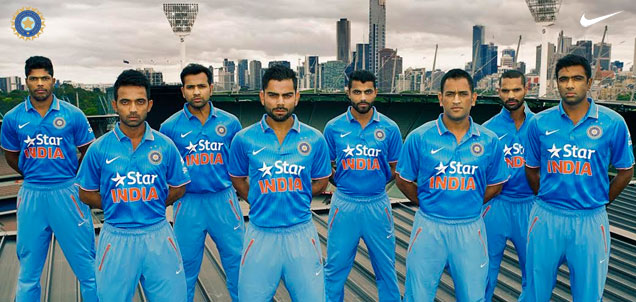
    Image: Nike publicity material of the unveiling of tge One Day International kit that the Indian Cricket team was to starting January 18 in Australia


    Rs 25 lakh for 10 seconds?!
     

    Ads get expensive as Star India seeks Rs 25 lakh for 10-sec slots during India-Pak ICC World Cup tie


    By Ravi Teja Sharma & Pritha Mitra Dasgupta


    Diehard cricket fans will remember the memorable India-Pakistan battles of the past World Cups. The tense standoff in Bangalore in 1996 when Ajay Jadeja went on a rampage and Venkatesh Prasad showed Aamir Sohail the way to the pavilion after sending his stumps clattering; that glorious Saturday seven years later in Centurion Park when fiery Shoaib Akhtar’s missiles were smacked by Sachin Tendulkar to all parts of the stadium, in the process delivering a huge win for India and a big confidence boost after a demoralising loss to Australia early in the tournament.


    This World Cup, the old enemies meet again. Not in the final as many fans would hope for or in the semi-finals like in 2011, but in the opening league match on February 15.


    Well ahead of that epic India-Pakistan encounter, a different kind of a battle is being fought behind the scenes. On one side are the advertisers who want to exploit the big viewership numbers that this match promises to deliver, and sitting tight on the other is Star India, the official broadcaster, who wants to milk the match by jacking up the advertising rates.


    More than 70 brands, including some regional brands and first-time advertisers, have booked slots for the game, which is 50% more than the count for 2011 World Cup final, said a spokesperson for Star India. At Rs 25 lakh per 10 seconds, this is going to be the most expensive advertising opportunity ever in cricket, but one that not many advertisers would want to miss. The match will see Amitabh Bachchan making his debut as commentator.


    Star India had sold the match between the two nations in the 2011 edition – the semi-finals – at Rs 20 lakh per 10 seconds but the final between India and Sri Lanka had come close to Rs 25 lakh per 10 seconds. “From a business and brand perspective, very few events can match the potential of an India-Pakistan match. I can understand paying a premium for this match, but Rs 25 lakh is too steep,” said Basabdatta Chowdhuri, chief executive at Platinum Media, which is part of the Madison Media Group.


    Media planners and agencies contest that number. According to them, Star has sold around 75% of its inventory for the India-Pakistan match and about 70% for the entire World Cup so far.


    Clearly, Star India is going for the kill, seeking Rs 25 lakh per 10 seconds from those who want to advertise across all its feeds during this match, according to people in the know. But top advertisers and media planners say they would rather wait and watch, as they feel prices will dip closer to the game


    Speaking on the condition of anonymity, a senior executive at a large advertiser said there is enough inventory available at the moment and they are waiting for rates, even for the India-Pakistan match, to correct closer to the tournament beginning


    A spokesperson for Star India said the ad slots for the match have been sold out much in advance.


    “No other game of cricket draws as much passion, emotion and following as an India versus Pakistan World Cup game,” he said.


    The channel has packaged the India-Pakistan match in several ways. There are advertisers who have bought combined airtimes across several matches, including the most talked-about match. For them, though, the average airtime rate is working out to between Rs  4.5 lakh and Rs 5 lakh per 10 seconds. Floating inventory for the match, however, have been categorised and priced according to the feeds.


    An advertiser that wants all the feeds including English, Hindi, South Indian feeds and high definition will have to pay Rs 25 lakh per 10 seconds. This means an advertising spot of 30-40 seconds would cost anywhere between Rs 75 lakh and Rs 1 crore. If an advertiser wants only English and HD feed, then it will have to pay Rs16-18 lakh per 10 seconds.


    “This is by far the highest rate that has ever been charged for a cricket match by a channel and I think it is a huge risk for advertisers,” said a top GroupM official, who didn’t wished to be named.


    Another media planner from the Dentsu Aegis Network said it doesn’t make sense for an advertiser to pay this kind of money when there is enough cricket happening in the country with both ICC and IPL matches.


    According to Indranil Das Blah, chief operating officer of sports management firm Kwan, this is undoubtedly the most high-profile match of this World Cup. “I don’t know if the ad rates are justified or not, but it can’t get bigger than this and no advertisers would risk missing it,” said Blah.


    For the larger World Cup, though, Star has signed up the likes of Sony, Airtel, Gaana.com, Hero and Karbonn as sponsors, alongside Maruti, Nestle, Raymonds, Marico, Pidilite, Yepme-.com and Paytm. To cater to a wider audience, it is broadcasting the tournament in Tamil, Malayalam, Kannada and Bengali alongside Hindi and English that it hopes will bring in a large number of new advertisers to the World Cup as it will become more affordable for smaller advertisers.


    But media planners say there is some level of concern around the Indian team’s performance as well and also the timing of the matches, but these concerns will not matter if India begin the World Cup journey with a big win over Pakistan.


  • BCCI extends deadline for IPL media rights bidding to Feb 10

    By Ravi Teja Sharma


    Potential bidders for the IPL media rights will get a week more to decipher the Indian cricket board’s well-crafted doosra in the form of new terms.


    The BCCI on Tuesday announced that it has extended the deadline to submit bids for IPL media rights to February 10.


    The board recently invited bids for media rights for the 2015-2017 editions of the cricket tournament. But in contrast to terms in the previous bidding round in 2011, it excluded the lucrative television and digital rights for the UK, US and Africa and also audio rights, which will be offered separately.


    Media planners and broadcasting executives say this is likely to drive down bid value since the US, UK and Middle East together account for anywhere between 60-70% of Indians who watch the game outside the country.


    The rights offered by the BCCI this time include Internet and mobile rights for the Indian subcontinent and exclusive television, Internet, mobile and audio rights for the rest of the world, excluding the Middle East, Africa, Europe and the US. Segregating it further, Internet rights for the Middle East have been kept non-exclusive while mobile rights in the region are exclusive. “This takes away a large chunk of money,” said a top executive with a broadcaster, not wanting to be named.


    Viewers in the US and UK are high-value consumers and these territories are valuable in terms of rights for anyone who bids, he said.


    A media planner said these territories accounted for close to 50% of the total bid value in 2011.


    Internet and mobile rights for the Indian subcontinent, however, are likely to be valued higher this time because Internet and mobile coverage has risen over the past four years. “From a monetisation perspective, the bet will be on improved advertising revenues from (Internet) streaming,” said the media planner.


    “However, mobile revenues which are usually earned by partnering with telecom companies have declined in value as the VAS ecosystem has not done as well.” Times Internet Ltd, part of the Times of India group, had paid just over Rs 260 crore in 2011 for IPL rights that covered mobile, radio and Internet along with TV rights for certain territories for 2011-2014.


    According to industry sources, the likely bidders for these rights are Star India, Sony, Times Internet and Zee group. TV rights for the Indian subcontinent are held by SET Max till 2017.


    Source:The Economic Times

    Copyright © 2015, Bennett, Coleman & Co. Ltd. All Rights Reserved

    Licensed to republish