Tag: Internet And Mobile Association of India

  • IAMAI to host 14th edition of Marketing Conclave in Mumbai

    By A Correspondent


    The Internet and Mobile Association of India (IAMAI) is set to host the 14th edition of the Marketing Conclave on December 5, 2018 at Taj Lands End, Mumbai. The day-long conference is themed after the famous television series ‘Game Of Thrones’.


    Based on the TV series the summit has divided into 3 houses namely House of Digital Marketing, Content & Martech, also there will be a case study room where industry experts will share their success stories. The event will have industry leaders like Ronnie Screwvala – Co-Founder, UpGrad; Ben Phillips – Vice President Of Strategic Accounts, Blis; Vivek Sharma-Chief Marketing Officer, Pidilite Industries; Ashwath Swaminathan – Head- Lakme, HUL; Pawan Singh-National Marketing Head, Deputy General Manager- Amul; UT Ramprasad – Head Marketing Communications, Tata Motors; Sandeep Verma – President Bajaj Corp Ltd among others and will have discussions around topics like ‘The art of brand storytelling’, ‘Marketing to millennials’, ‘Mobile location and audience data: The new oil’, ‘Designing digital experiences for the complete customer journey’ among others.


  • Digital Commerce to reach Rs 220,330 cr by Dec 2017: IAMAI-IMRB


    By A Correspondent


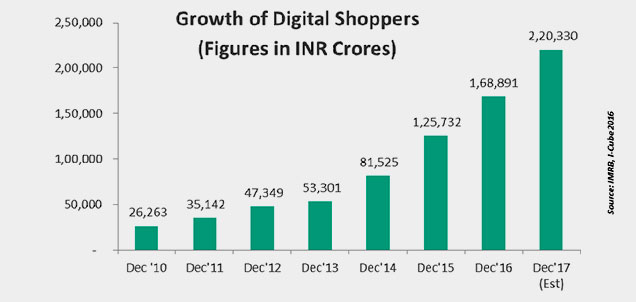
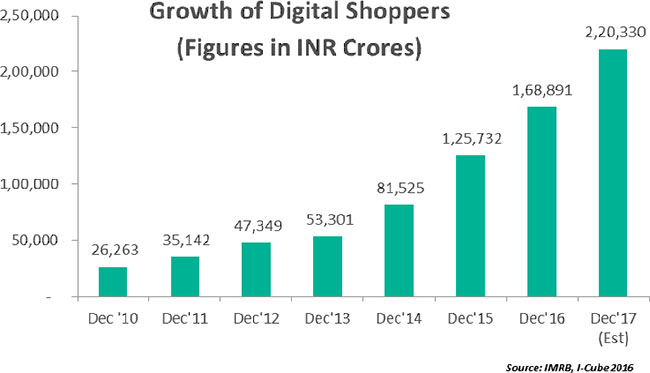
    The Digital Commerce Market has grown at a CAGR of 30 per cent, between December 2011 and December 2016 to reach INR 168,891 crores by the end of December 2016. It is estimated to reach INR 220,330 crores by December 2017, according to the Digital Commerce report 2016, published by the Internet and Mobile Association of India (IAMAI) and IMRB Kantar.


    The report finds that Online Travel industry continues to grow strongly with 56 per cent share while share of online non-travel has improved over the previous year to reach 44 per cent.


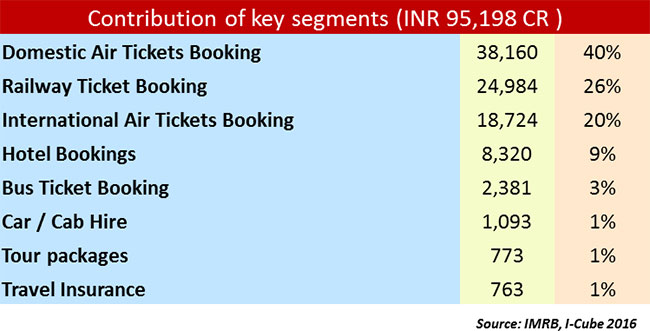
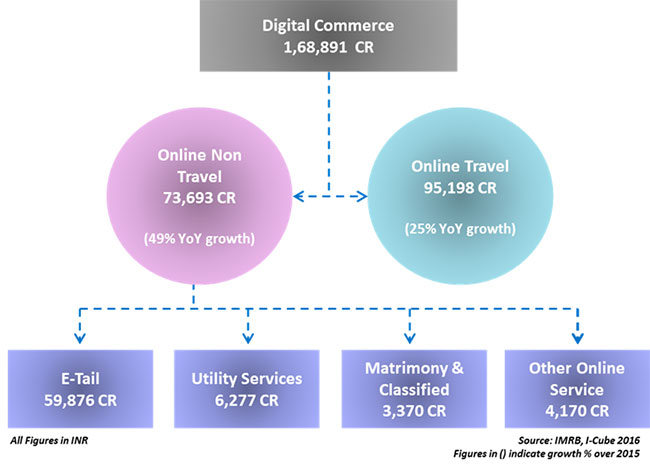
    Domestic air ticket and railways booking continue to be among top contributors to the Online Travel spends. These were the segments that were the top contributors in previous year also. Hotel Booking has seen a substantial growth of 60 per cent, from INR 5200 crore in December 2015 to INR 8320 crore in December 2016. Domestic Air Tickets Booking is the highest contributor in this segment and has grown 20 per cent from INR 31,619 crore to INR 38,160 crore in 2016. The online travel market is expected to reach close to INR 1, 18,598 crore by December 2017. The segment was valued at INR 95,198 crores in December 2016.


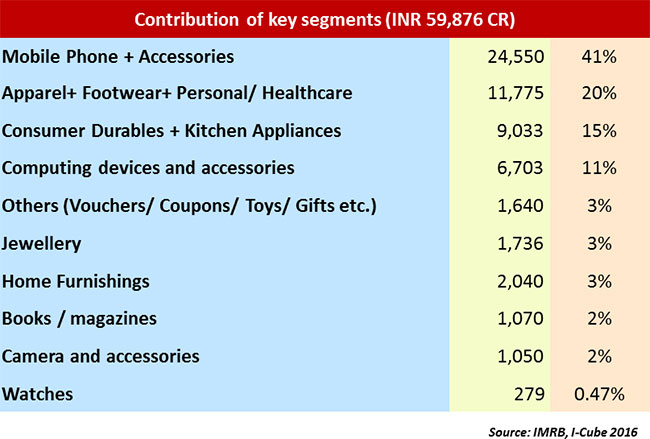
    The report also finds that E-Tailing maintained a strong performance with 59 per cent growth. In the E-Tail category, Mobile Phone and Mobile Accessories continue to be the top contributor to the overall pie. Another product category that has registered sharp growth is apparel, personal health care products and accessories. These two categories collectively account for 60 per cent of the overall spend in E- Tail segment. The E- Tail segment is expected to reach around INR 94,964 crores by December 2017. It was pegged at INR 59,876 crores in December 2016.


    The report also finds that Online utility services market (eg: payment for DTH/ Telephone Bills/ Electricity Bills etc) registered close to 20% growth between 2015 and 2016. The market reached close to INR 6277 crores in terms of overall online transactions as on December 16.  The segment is expected to reach INR 7,532 crore by December 2017.

    Other online service market that includes online bookings done for entertainment, online grocery and online food delivery, was pegged at INR 3823 crores in December 2015. In December 2016 the market reached close to INR 4,170 crores. Online food delivery is the top contributor within this segment with a market value of INR 2,040 crores. This growth is expected to continue in future and the market is expected to reach INR 4,587 crores by December 2017.


  • Vanakkam! Indian languages need to rule. Theek hai?


    By A Correspondent


    Advocating the need for more content in Indian languages to propel internet penetration, a report titled ‘Proliferation of Indian Languages on Internet’ finds that enabling local language content on the Internet will lead to a growth of 39 per cent in the current Internet user base. 75 per cent growth will be from the rural users while only 16 per cent growth will come from urban India.


    The report, published by the Internet and Mobile Association of India (IAMAI), finds that English language still accounts for 56 per cent of the content on the worldwide web, while Indian languages account for less than 0.1 per cent. However, while Internet in India is predominantly English, there is high potential for regional language content. According to the report, in the last year alone, Hindi content on the web has grown by about 94 per cent, whereas English content has grown only at 19 per cent.


    The report further asserts that there is significant scope for various stakeholders to benefit financially while addressing the needs of the local language content consumers. If the Indian language book publishing industry moves online, it can create a digital opportunity worth nearly US$ 7 billion for both the content providers and technology players.


    According to the report, accessing the internet in local language broadly has two challenges.

    1. The first challenge is to generate content in local languages and popularising such content for broader adoption2. The second challenge is on the technical front, pertaining to availability of Indian scripts for generating digital content


    Currently, local content availability is restricted largely to news agencies as other forms/sources of content generation are extremely limited. User generated local content is still very low, as adoption of local language usage in social media and other such fields are still restricted.


    The report cites some of the following initiatives that can help increase public awareness and engagement in local language content.


    1. Development of websites in local languages and providing a user-friendly interface for local language user can be an integral part of e-governance initiatives by the State Governments.

    2. Media companies should adopt digital media as a separate entity from print media and actively expand their e-presence. Currently, the former is seen as merely an extension of the latter.

    3. Increased spending on online advertisements in local languages would help the companies generate higher revenues through online content in local language.

    4. Digitalization and online release of the various local language archives and books in various libraries and universities across the country can be undertaken to increase local content availability

    5. Social media companies need to support local languages and promote their availability. The interface has to be user friendly to provide easy interaction for the users.


  • Digital start-ups need specific incentives: IAMAI

    By A Correspondent


    To implement the Prime Minister’s twin vision of ‘Stand-up India’ and ‘Digital India’, the industry body Internet and Mobile Association of India (IAMAI) has come up with specific fiscal and non-fiscal measures required by the internet industry. According to the association, the digital start-up ecosystem in India should be systematically encouraged by focussing on specific fiscal interventions.


    On the fiscal incentives, the association has suggested the following:

    1.   Improve Investment Environment:

    India’s entrepreneurs need early stage venture capital – but the domestic venture capital sector needs to develop further. In the US, the VC industry took off when their government allowed the large pension funds to put 5-10 per cent of their assets into VC firms.

    1.1 Angel Tax: Angel Tax under Sec 56 (2) of the Income Tax Act has not been actually tailored to restrict start-ups funding but it has put start-ups under the Income tax scanner, questioning the valuation by domestic individual investors. The criteria to qualify as an angel fund are stringent and need to be eased to support the start-up ecosystem in the country.


    The association suggests that there should be tax breaks and incentives for individuals supporting start-ups with capital.


    2. Incentivize Internet Services Start-ups:

    These are the largest chunk of internet companies in India. This sector, which comprises of aggregators, digital advertisers, online classifieds, bring in a lot of efficiency, and are the largest employment generators. They are either enabling businesses, or they are creating lot of employment in the country, resulting in many people are earning a lot of money than they should otherwise have.

    2.1 Service Tax: Unfortunately, Start-ups have to pay huge amount over the first three years in way of service tax. It is not that they don’t want to pay, but they have survival issues and this takes a back seat and penalties just make a struggling start-up’s life harder.


    The association recommends that for the first three years, the service tax could be waived off or incentivizes the start-ups, if they pay their service taxes on time.


    3. Streamline taxation for e-Commerce marketplace Start-ups:

    Online market places are changing the way businesses are done in India. Small players are setting up niche businesses in India and are attracting lot of investments in India. Online marketplaces bring in a lot of efficiency in the entire retail value chain from customer experience to payments and delivery.


    3.1 Taxes on e-commerce Transactions: The e-commerce marketplace industry is being subjected to onerous VAT demands from several states. They should be recognized as marketplaces and exempt from VAT demands in states. As market places they provide a service to online sellers and pay the service tax on that account. The State of Rajasthan for example treats e-commerce players as market places.


    4. Boost FinTech Start-ups:

    FinTech plays a significant role in serving those underserved or not served by formal institutional mechanisms. They are also likely to play a significant role in various financial inclusion programmes of the government. Various forms of FInTech services such as pre-paid instruments, wallets and others create efficiency, transparency and wider reach in financial transaction.
     

    4.1  P2P lending and crowd-funding need an impetus and clarity from Government: While some early inroads have been made in the P2P lending segment in the country, individual efforts have not translated into a policy from the government. The lack of clarity of rules and regulations has meant the industry is shooting in the dark. In the absence of dictated policy or scriptures, it is quite plausible that misguided individuals may fall prey to unscrupulous operators that may look to make a quick buck.


    4.2 Easy KYC through aadhar will allow innovators build new services which in turn will help bring more people under the ambit of financial services: Various forms of digital payments such as pre-paid instruments, wallets and others create efficiency, transparency and wider reach in financial transaction.
     

  • IAMAI names Kunal Shah as its new Chairman

    By A Correspondent


    Kunal Shah

    The Internet and Mobile Association of India (IAMAI) has named Kunal Shah, Co-founder & Chief Executive Officer, FreeCharge as the new Chairman of IAMAI. The move was necessitated following Nishant Rao’s move to join Freshdesk as the global Chief Operating Officer, from Linkedin.


    The Association has also announced Vishwas Patel, Chief Executive Officer – CCAvenue as the new treasurer. Vinodh Bhat, Co-founder, President & Chief Strategy Officer at Saavn remains the Vice-Chairman of the Association.


    Vinodh Bhat is a serial entrepreneur, who co-founded Saavn, which is a revolutionary streaming music service, reinventing how people listen to and share music, in India and around the world.


  • Internet user base to zoom past 400 mn by Dec’15, notes study

    By A Correspondent


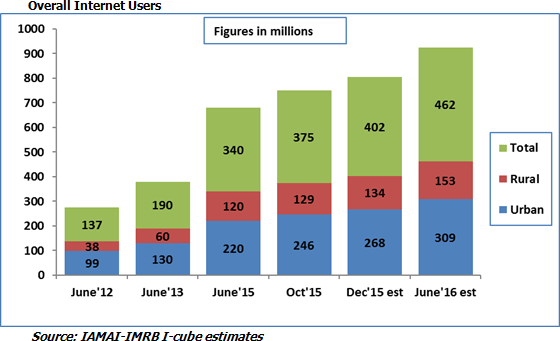
    The number of Internet users in India is expected to reach 402 million by December 2015, registering a growth of 49 per cent over last year, according to a report ‘Internet in India 2015’, jointly published by the Internet and Mobile Association of India (IAMAI) and IMRB International. While Internet in India took more than a decade to move from 10 million to 100 million and 3 years from 100 to 200 million, it took only a year to move from 300 to 400 million users. Clearly, Internet is main stream in India today. And the large internet users base is definitely a good news for the overall growth of the digital industry.


    In October 2015, there were 375 million internet users in India. Currently, India has the third largest internet users’ base in the word but it is estimated that by December, India will overtake the US as the second largest Internet users’ base in the world. China currently leads with more than 600 million internet users. This makes India the second largest internet user’s base in the world behind China, but is ranked first as the largest internet users in a free market democratic setup.


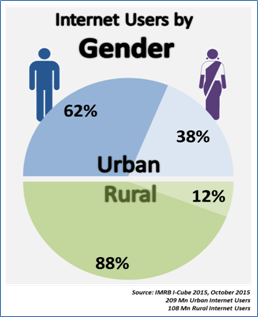
    According to the report, 71 per cent male and 29 per cent female are Internet users in India. The Internet usage among males has been growing at a rate of 50 per cent while it is growing at 46 per cent for female users. However, in Urban India, the ratio between male to female Internet users is 62:38. Significantly, Internet users among females are growing at a rate of 39 compared to 28 per cent among males.


    Among the Rural Internet users, 88 per cent are males. The Internet users among females are growing at 61 and 79 per cent among males. 75 per cent of the rural internet users belong to the age group of 18-30 years. Another 11 per cent are in the age group of <18 years, while 8 per cent belong to 31-45 years age group.


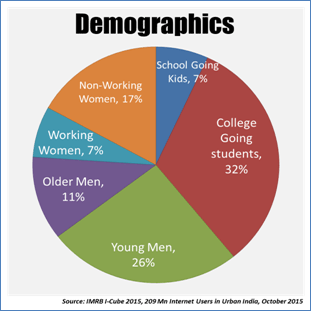
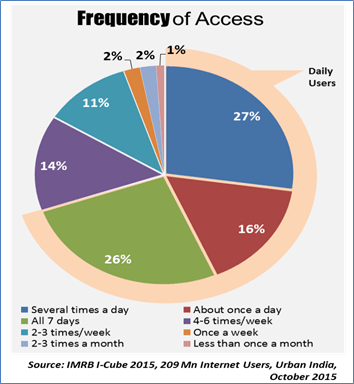
    Significantly, there has been a huge spurt in the number of people accessing internet on a daily basis in Urban India. As on October 2015, 69% of Users are using Internet on a daily basis. This daily user base has gone up by 60% from last year. However, the high frequency usage is not restricted to only the youth and the College going students; this habit of accessing the Internet daily can be seen among other demographic segments as well including Older Men and Non-Working Women. 75% of the Working Women access Internet daily. 37% of the male internet users are daily users whereas only 23% of the female internet users are accessing internet daily. 75% of internet users among both genders access internet at least once a week.


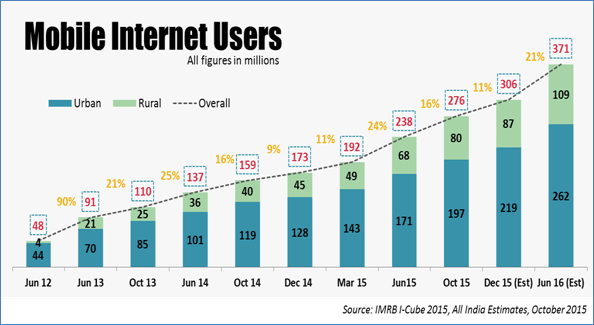
    The findings of the report further reveal that in Urban India, Mobile Internet user base has grown at a rate of 65% over last year to reach 197 million in October 2015. The Mobile Internet Users have surged to 80 million by October 2015 growing at 99% over last year. The user base of Mobile Internet users in Rural India is expected to reach 87 million by December 2015 and 109 million by June 2016.


    Interestingly, the report also reveals that out of all the Internet non-users surveyed in the 35 cities as part of this study, 11.4 million Non-Users are willing to access the Internet in the next one year and over 2/3rd of them intend to do so through mobile phones.


  • Social Media Week to delve on ‘Upwardly Mobile’ this year

    By A Correspondent


    Mumbai will be one of the 12 cities across the world to host the fifth edition of the leading international digital conference, Social Media Week from November 16 – 20. The platform is an effort to bring leading social influencers together to re-imagine human connectivity and to understand how humanity and technology can come together to change the ways we live, work and create. This year, the theme is ‘Upwardly mobile: The rise of the connected class’. The other host cities are Berlin, Chicago, Johannesburg, London, Los Angeles, Miami, Mumbai, Rome, Rotterdam, São Paulo, Sydney, and Toronto. The conference will be held at the ISDI Parsons School of Innovation and Design at Lower Parel.


    “The world of social media has subsumed almost all aspects of our lives today. At Social Media Week, we bring together the contributors and pioneers of this change to help the community acquaint themselves with the dynamics of human connectivity via mobile platforms, through sharing of ideas and experiences.” said, Rohit Varma, Founder RSQUARE Consulting and Director Social Media Week, which brought Social Media Week to India.


    The Internet and Mobile Association of India recently announced that internet users in India now exceed 350 million out of which, 45 per cent users access the internet through mobile phones. Out of our total population of 1,285 million, 46 per cent (590 million) are mobile users. These advancements have enabled a myriad of new innovations in areas as diverse as marketing, entrepreneurship and regulation of traffic. Social Media Week will curate and share the best ideas, innovations and insights into how social media and technology are changing business, society and culture in India.


    With its impressive line-up of speakers and exciting and relevant themes, it promises to be a rewarding opportunity for participants. The speakers include brand expert Suhel Seth and international news anchor Richard Lui. Joint Commissioner of Police (Traffic), Milind Bharambe, will share the experience of successfully tapping social media to influence behaviour and run social campaigns. Ansoo Gupta, a pioneer of safe and affordable adventure travel for women and COO of Pinstorm will also address the audience. Munaf Kapadia, CEO of The Bohri Kitchen and other ‘foodpreneurs’ will share insights on how social media has impacted the food business.


    Started in New York in 2012 by Crowdcentric Media LLC, Social Media Week has evolved into a global movement that taps into human networks to create and share a knowledge bank, through debates, discussions and talks, which helps people stay connected the world-over.


  • Three hundred two million internet users!


    By A Correspondent


    The Internet and Mobile Association of India [IAMAI] believes that the year 2014 was the year of internet and is of the firm view that internet has reached an inflection point. The consolidated numbers taken out by IAMAI for FY 2014 affirms the fact that internet in India has now becoming inclusive, which augurs well for the industry and society at large.


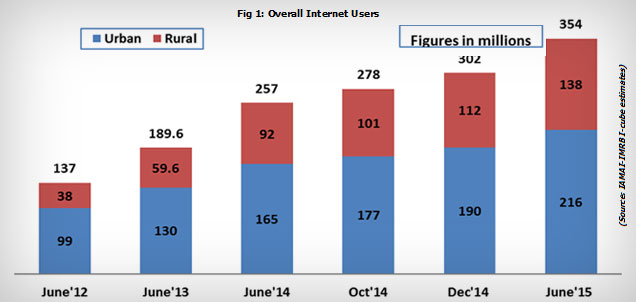
    The number of Internet users in India reached 302 million by December 2014, registering a Y-o-Y growth of 32% over FY 2013. The Internet in India took more than a decade to move from 10 million to 100 million and 3 years from 100 to 200 million. However, it took only a year to move from 200 to 300 million users. Clearly, Internet is mainstream in India today, an IAMAI communiqué adds.


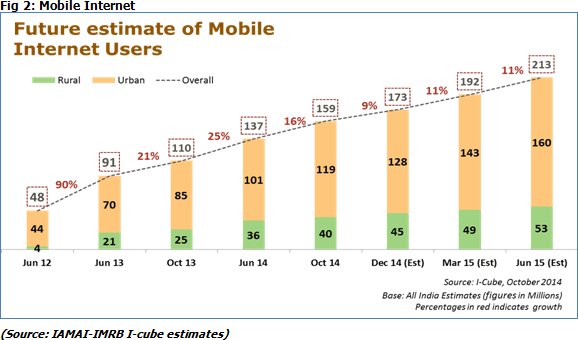
    The Mobile Internet in India also witnessed significant growth rate. If the following chart is anything to go by, the future of Mobile Internet in India is set to growth at an exponential rate. India had 159 million mobile Internet users as on October 2014. Out of this, 119 million users were from Urban India and the rest 40 million were from Rural India. There has been a growth of 45% from October 2013. Mobile Internet users reached 213 million by June 2015.


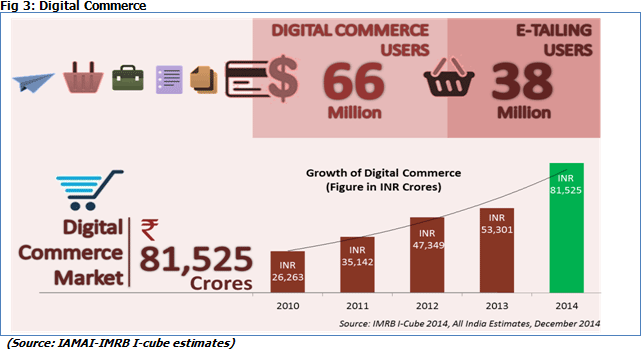
    The impact of internet penetration has seen a huge spurt in Digital Commerce. The digital commerce market was valued at INR 81,525 crores by the end of December 2014, and registered a growth of 53% over 2013. According to IAMAI-IMRB estimates, the industry is estimated to grow further at a rate of 33% and cross INR one lakh crores by the end of 2015.


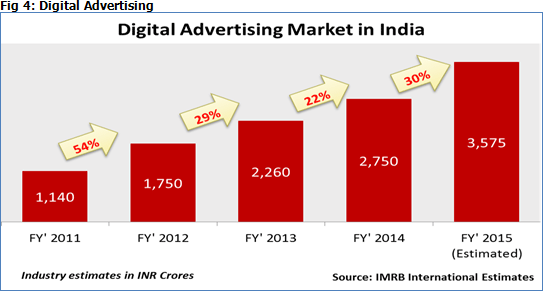
    Digital Advertising has also been witnessing a steady growth. The online advertising market in India was projected to reach INR 3,575 Crore by March 2015 with a Y-o-Y growth rate of 30%. The online advertising market was pegged at INR 2,750 Crore in March 2014. Search and Display are the top two contributors to the total Digital Advertisement Spends in India. Of the INR 2,750 Crore Digital Advertisement Market, Search ads constitute 38% of the overall ad spends followed by Display ads which contribute 29% and Social Media contributing 13% of overall Digital Advertisement spends.


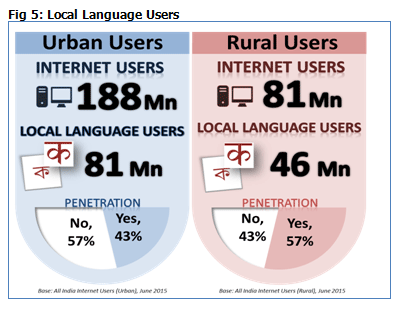
    IAMAI has also said that increase in local language content on the Internet will lead to a growth of 39% in the current Internet user base. Rural India will be the primary driver of this growth (75%) while in Urban India, the growth will be 16%. The local language user base is growing at 47% Y-o-Y to reach 127 million in June 2015. IAMAI believes that the next set of internet users will come from rural India and the availability of local language content on internet will be the key for the growth of Internet industry in India.


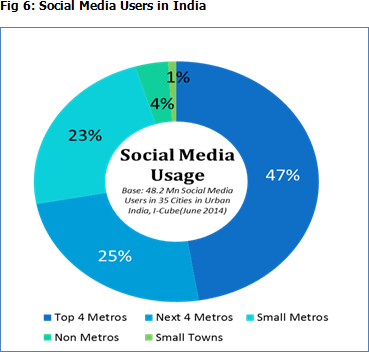
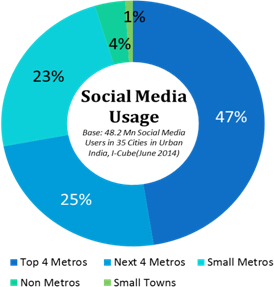
    Data on social media users also reflect that the usage of Social Media in Rural India has grown by an impressive 100 percent during the last one year with 25 million users in Rural India. On the other hand, Urban India registered a relatively lower growth of 35% with the total number of users at 118 million as on April 2015. According to IAMAI and IMRB estimates, there are 143 million social media users in India as on April 2015. The report also finds that the top 4 Metros continue to account for almost half of the Social Media users in Urban India.


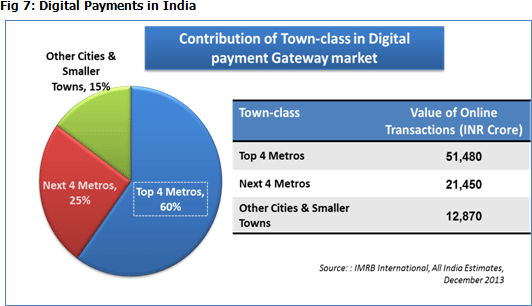
    The digital industry is also buoyed by the fact that the digital payments industry is maturing at a fast clip. The digital payments industry grew at a rate of 40% to reach INR 120,120 crore by December 2014. The digital payment industry was pegged at INR 85,800 crore in December 2013. The report finds that the top 4 metros which include Delhi, Mumbai, Kolkata and Chennai are approximately 60% of the total Digital payment gateway market size. Next 4 metros – Bangalore, Hyderabad, Ahmedabad, Pune together contributes only 25% to the total market size.


  • IAMAI toughens stand on Zero Rated Services

    By A Correspondent


    In its recent response to the DoT paper on Net Neutrality, the Internet and Mobile Association of India [IAMAI] has clearly and unambiguously opposed zero-rated plans of any type. In its submission made last week IAMAI has held that “these plans will ultimately harm Internet content and service providers by limiting competition among them, and, by extension, limit consumer choice”. Such plans will also “allow the operators, if given control of which apps/services to push to consumers, to discriminate and privilege certain web services over others, and throttle innovation”. The association has also reiterated that it does not support any plans that violate principles of net neutrality “especially paid or unpaid prioritization or other discriminatory practices”.


    IAMAI has also reacted strongly against the proposal to license domestic and national VoIP, as suggested by the DoT paper. The association contends that such a regime will be directly against consumer interest and against future innovations. The association contends that licensing any domestic and national Internet based voice communications services would be impractical especially since such services in many instances are offered as bundled services. The association also feared that licensing one type of internet service may be the beginning of a “slippery slope” and may lead to a clamour for so called “same service same rules” for other internet services.


    The association has also cautioned that while traffic management is a technical right vested with telecom operators, this right should not be misused to charge customers differentially for different types of data. Technical requirements of traffic management should also not be used to promote operators own services at the cost of other services, the association cautioned.


  • Notice to ISPs is misleading, cautions IAMAI

    By A Correspondent


    Internet and Mobile Association of India [IAMAI], in a press statement has said that the latest Government notice dated August 4, 2015, to the Intermediaries (ISPs) is vague and has led to a chilling effect.


    The notice states that the intermediaries (ISPs) are free not to disable any of the 857 URLs, as provided in the list earlier, which do not have child pornographic content. However, the problem is with the caveat in the notice mentioning “which do not have child pornographic content.”


    The problem is that the said notice is not accompanied by any specific list of sites or links and the Intermediaries (ISPs) are expected to find out the links or sites containing child pornography themselves. This is not how it works under the law. The correct procedure should have been to provide the Intermediaries (ISPs) with a specific list along with the notification, as was done in the earlier notice dated July 31, 2015.


    The ISPs have rightly asked the Government to withdraw the notification. The ISPAI letter states: “We urge you to withdraw the said vague directive as it is not only confusing, but also putting responsibility on ISPs of the website on which ISPs does not have any control.” However, they are wrong in saying “But till further directives, the said 857 sites will continue to be blocked.”


  • Rural India outperforms Urban India in Social Media Usage


    By A Correspondent


    Usage of Social Media in Rural India has grown by an impressive 100 percent during the last one year with 25 million users being recorded in rural India. On the other hand, Urban India registered a relatively lower growth of 35 percent with the total number of users at 118 million as on April 2015. According to the Social Media in India 2014 report by the Internet and Mobile Association of India [IAMAI] and IMRB International, there are 143 million social media users in India as on April 2015.


    The report also finds that the top 4 Metros continue to account for almost half of the Social Media users in Urban India.


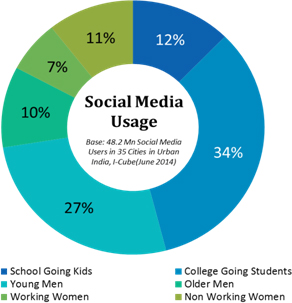
    According to the latest report, the largest segment accessing Social Media consists of the College Going Students with 34 per cent followed by Young Men at 27 per cent School going children constitute 12 per cent of the social media users. College Going Students and Young Men still form the 60 per cent of the Social Media users in Urban India.


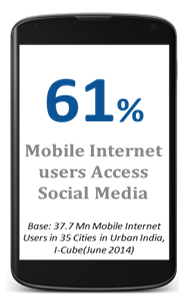
    The report further finds that 61 per cent of these users access Social Media on their mobile device. The fact that almost two thirds of the users are already accessing social media through their mobile is a promising sign. With the expected increase in mobile traffic the number of users accessing social media on mobile is only bound to increase.


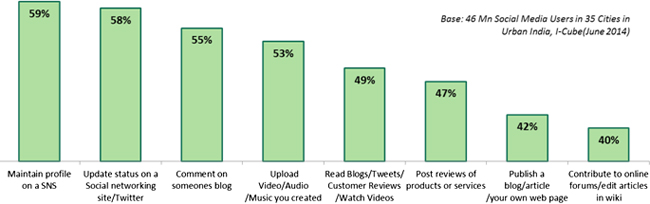
    According to the report, maintaining a profile on social networking sites are a top activity of users followed by updating status.  Commenting on a blog site is the third most popular activity among users in social networking sites.


  • The Changing Role of the CMO in the Digital Era…

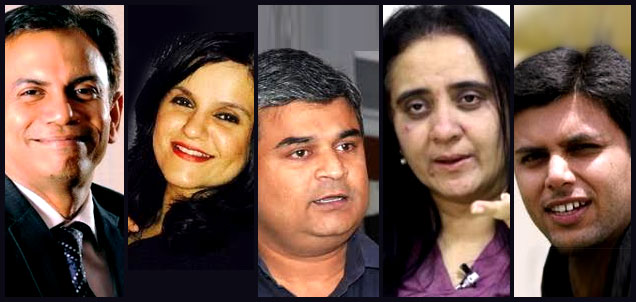
    L to R : Sanjay Tripathy, Uma Talreja, GK Suresh, Anuradha Narasimhan and Chinmay Bajpai


    By Dyanne Coelho


    At the Internet and Mobile Association of India (IAMAI)’s marketing conclave last week, industry stalwarts delve into the topic of ‘Untangling Marketing Convolutions’. In this digital era, the role of the chief marketing officer (CMO) has expanded at a fast pace and it now requires him or her to act as the Digital Media Officer, Customer Experience Officer and Chief Content Officer all rolled into one. The CMO’s role is no longer about just creative skills, but about being able to crunch data and interpret and analyse the behavioural patterns and buying habits of consumers. Dinesh Mishra, Partner – Advisory Services and Customer Practice Leader (India), Ernst & Young, who moderated the discussion said: “The speed at which the CMO needs to react is increasing gradually. The CMO is enjoying his/her role in an organisation, as compared with other C-Suite roles. About 44 per cent of senior leadership says the CMO cannot strive without big data. By 2020, the CMO will spend more than the CIO on IT.”

    Now, let’s hear it from the CMOs.


    Chinmay Bajpai, Head – Enterprise Sales and Alliances, Thoughtbuzz

    It is important to understand that a marketer is more connected to the consumer. Hence, he or shee needs to be more connected to the CIO to get consumer details from IT systems. The customer experience design has always been important. Before, the customer never had a voice after he purchased the product. That has changed with the digital era. We cannot rely on just customer service teams any more. Today analytics have to move beyond the product to the consumer. That’s where the skillsets of technology partners have to be imbibed by CMOs.


    Anuradha Narasimhan, EVP – Sales and Marketing, Global Consumer Products

    I don’t believe the CEO is the stakeholder for the CMO. The CMO-CIO relationship is the youngest in an organisation. The partnership with the CTO is yet another new one. The consumer is no longer a passive participant in the process. The customer experience design is not a new thing for the CMO role, it has always existed. The customer experience has always been the focus. The CMO needs to be like the conductor of an orchestra, someone who leads it. Then, it won’t matter who plays in the orchestra as long as s/he is a specialist.


    GK Suresh, Head of Marketing – Foods Division, ITC Limited

    I don’t believe that the CMO will spend more than the CIO. As a marketer I have to know my consumer, even if that means spending the entire day with the consumer at his/her house. I would say invest in the consumer rather than on technology. A lot of communication going into the digital space is unsupervised. I don’t know if youngsters should be handling digital. It’s as good as saying that a housewife watching TV seven hours a day should make TV ads. The fundamentals of brand building don’t change. At the end of the day, engagement has to result in business. The rules of the game have changed. Just like in hockey, we’ve moved from grass to Astroturf. So now the way you play changes and the way you score a goal also changes.


    Uma Talreja, CMO, Burger King India

    We all have a vision for the consumer. But contact with the CIO is necessary to deliver that vision. You need to change the environment for your consumer. Public opinion on your brand is out there. Your consumer is reaching out to other consumers. If you don’t reach out in time, then you have no control of the situation. Today, data is moving faster than you; public opinion is moving faster than you.


    Sanjay Tripathy, Senior Executive VP – Marketing, Product, Digital and E-Commerce, HDFC Life

    We are seeing spends in the digital space increasing in our industry. But the question to ask is, is the CMO capable enough to deploy the money? Who is taking the lead in understanding what is needed for the company? People are changing today; the ways of interaction and engagement have changed. CMOs are now ahead of others in the C-Suite in terms of understanding what is happening in the market. Marketing understands the consumer, but cannot enable the systems and processes. We at HDFC Life have created a team to digitise the company. It has become an organisation within an organisation. Ours is an intangible product that lots of people buy. What customers talk about is very important. With digital, marketing has moved from one channel to multiple channels. Now marketing gets information from various channels and needs to pass it on to multiple channels as well.