Tag: Internet And Mobile Association of India

  • Digital Personal Data Protection Bill Industry-Friendly: IAMAI

    By Our Staff


    The Internet and Mobile Association of India (IAMAI, www.iamai.in) in a statement issued today has lauded the Digital Personal Data Protection Bill (DPDP) as industry-friendly. It has struck the right balance between protecting the interests of the data principals while leaving enough room for tech start-ups to innovate and grow.


    According to the feedback received from the majority of IAMAI members, the reconceptualization of the data protection framework in the DPDP to balance innovation and economic growth with the interests of users will go a long way to assuage concerns of digital businesses and help make India a trillion-dollar digital economy by 2025. In particular, IAMAI appreciates the more liberalized framework for cross-border data flows and the exclusion of non-personal data from the ambit of the DPDP Bill. IAMAI also appreciates that the Bill imposes only financial penalties for non-compliance as opposed to both financial and criminal penalties.


    Commenting on the Bill, Dr. Subho Ray, president, IAMAI said: “By following a deep and wide process of consultation including that of a joint parliamentary committee, excluding non-essential provisions, by making a clear commitment that no Rules exceeding the provisions of the Act would be made, and yet protecting the interests of the state, citizens and the digital economy, this Bill has possibly set up new standards of law-making.”


    On behalf of its members, the association has requested the government to provide clarifications regarding the DPDP so that once it is passed into an Act, there is better compliance by IAMAI members. In particular, there remain ambiguities surrounding the timelines for implementing the various provisions of the Bill and mechanisms for obtaining verifiable parental consent to process the personal data of children. As the inclusion of specific timelines will provide a roadmap for the industry to better comply with the Bill, IAMAI has requested the government to clearly indicate reasonable timelines by which the various provisions of the DPDP will be implemented and to adopt a graded approach to prescribing such timelines. IAMAI has also urged the government to consider a flexible approach to obtaining parental consent, as prescriptive mandates may have an adverse cascading impact on sectors that provide services to younger individuals.


    IAMAI is confident that through consultation and collaboration, the final version of the law will help stakeholders who are invested in and committed to the digital ecosystem of India.


  • Tracking the Metaverse


    By Our Staff


    The Internet and Mobile Association of India (IAMAI) in association with Deloitte launched a report titled ‘Metaverse – The Hype, Possibilities, and Beyond’ at Digital Marketing Conference, ‘Marcon 2022’ in Mumbai on Monday (Dec 12).


    The report was launched by Sreeram Ananthasayanam, Partner, Deloitte. The event also saw a panel discussion after the launch.


    Here is the Executive Summary of the report:

    Technology is getting affordable, scalable, and trustable, and transforming business models and consumer expectations. Robust and scalable digital infrastructure and applications are enabling personalisation for a generation that prefers differentiated experiences. In addition, alternative technologies (Decentralized Autonomous Organizations [DAO], Decentralized finance [DeFi], Nonfungible token [NFTs]) are disrupting digital ecosystems by disintermediating intermediaries and decentralising ownership. Technology is building decentralised trust to make processes and transactions efficient, transparent, and seamless.


    One such technology is Metaverse, which refers to an immersive, interactive, and live virtual environment, distinguished by its ability to transport the real-world experience into a virtual world. In this world, people across locations can interact live and work in real time. This is supported by a digital economic infrastructure powered by virtual digital assets. Metaverse is a confluence of technologies that aims to integrate businesses in innovative ways, enhances operational efficiencies and transactions, and provides an experience par excellence. It creates new market avenues, which are futuristic, yet revolutionary. The exponential nature of technology growth is only going to make it more feasible and affordable. Several enterprises and customers are foraying into this space that is redefining business models and customer expectations.


    In this report, we aim to understand how businesses engage and interact with each other in a Business-to-Business (B2B) and Businessto-Consumer (B2C) ecosystem. We believe that adopting Metaverse is possible through the merging together of the physical and digital worlds (phygital). It will help businesses reduce costs, collaborate in real time, overcome logistics issues, provide enhanced opportunities and productivity, improve feedback processes, and offer possibilities for product and service augmentations. All these will not only generate revenue but may tilt the competitive advantages in favour of those ahead in the adoption curve. It will enable businesses to take a step towards introducing environment friendly policies and sustainability.


    Metaverse is a ‘virtual world’ with real people in digital avatars, who come together to interact and transact. Hence, the boundaries for work and play are blurred. Such a concept is hard to understand, monitor, and regulate because of the undefined rules and unimaginable complexities that may exist. In the following chapters, we begin with our understanding of Metaverse as the world is still exploring its confluence in the Phygital space. We also debate on the possibilities of different types of Metaverse architectures and their potential across enterprises. Subsequently, we discuss the challenges that will likely arise while implementing the Metaverse ecosystem and the possible measures to sustain business in a dynamic marketplace.


    There is also a section that provides an overview of the applications of Metaverse and its potential across sectors. We will discuss the art of possibilities for enterprise Metaverse and how it will help enterprises scale and diversify their businesses and opportunities by using the myriad elements of the Metaverse economy. While most of the current use cases on Metaverse primarily relate to the B2C segment, this report also explains the potential enterprise-grade use cases that address the B2B segment.


    Conclusion of the report:

    The Metaverse technology is likely to see exponential growth in the coming years with rising awareness about its applications and rapid advancements in the digital infrastructure and digital natives gaining purchasing power.


    On one hand, as the supply side of the Metaverse ecosystem develops, more organisations are likely to reorient their business to take advantage of this evolving technology. Several organisations have already announced their Metaverse offerings, which may help achieve the required scale and demand to improve cost-effectiveness and adoption rate. On the other hand, the demand side of this ecosystem. has been driven by demography, along with phygital worlds, virtual work/play facilitated due to the pandemic, and Moore’s law playing its role in making the infrastructure affordable.


    The success of Metaverse penetration will depend on the time organisations take to understand its relevance to their business and the pace of this ecosystem’s development. The ability to ramp up the technical skills and readiness, and deal with rising cyber threats will be critical to its adoption. Governments can play an important role through the right regulatory policies and incentives for new-gen tech adoption.


  • Rohit Jain appointed new chairman of Digital Entertainment Committee at IAMAI

    By Our Staff


    Rohit Jain
    Rohit Jain

    The Internet and Mobile Association of India (IAMAI) has appointed Rohit Jain, MD, Emerging Markets Asia, Lionsgate, as the new Chairman of their Digital Entertainment Committee for the period of 2022 to 2024. Jain succeeds Amit Goenka, Head of Zee5 Global. Amit Doshi, Head, IVM Podcasts has also been appointed Co-Chair, alongside Rohit Jain.


    Said Jain: “Indian media sector has shown immense potential in the last decade and now the OTT industry is in the spotlight owing to the work that’s happened for the last many years. I would say we are at the cusp of greatness; India truly has the scope of becoming one of the largest OTT markets in the world. It’s looking like we will end 2023 with a whopping 125 Mn OTT subscribers and that’s just the tip of the iceberg. India today is clearly the innovation hub for OTT be it technology, pricing, or content experimentation. This rocket ship has the potential to lead the Indian media and entertainment sector to 2.5 trillion dollars in the next few years. There can’t be a more exciting time to be in this business and I am truly humbled to play a small role in contributing towards the vision of creating a promising digital entertainment ecosystem that will provide access to the best of experiences for all.”


  • GST Rate to be continued at 18 % for online gaming

    By Our Staff


    The Internet and Mobile Association of India (IAMAI) in a statement issued on Monday urged the GST Council to continue maintaining the GST on online gaming at 18 percent. For real money games in particular the GST should continue to be levied on the Platform Fee only at the rate of 18 percent. Any increase in the GST rates in this sector will be detrimental to the overall wellbeing of the industry, seriously impacting the industry’s contribution to the nation’s economy through revenue generation, livelihood creation and foreign investments.


    IAMAI notes with concern that there is an ongoing discussion to increase the GST taxation rate to 28 percent for the online gaming industry. There is also no clarity on whether this will apply only to real money games or casual games as well, given that the former being a sub-segment of online gaming. Further, it appears from the reports in the media that for real money games this may be applied to the entire Contest Fee.


    IAMAI is of the opinion that any such increase in the GST rate is likely to turn businesses in the sector unviable, leading to complete shutdown, which in turn will result in loss of a large number of jobs and a loss of investor-confidence debilitating India’s online gaming industry, which is currently witnessing fast and exponential growth of 35 percent CAGR.


    That apart increasing the GST rate will lead to an erosion of tax-base on the one hand, and encourage the spawning of grey markets on the other.


  • IAMAI establishes India EdTech Consortium

    By Our Staff


    Leading EdTech companies under the aegis of Internet and Mobile Association of India (IAMAI) have announced the formation of the India EdTech Consortium (IEC).  Aligned with the government’s recent advisory, the IEC will ensure that every learner shall have access to quality and affordable education, which not only improves their academic performance but also makes them future-ready.


    With consumer interest at the core of the consortium, the EdTech companies have committed to observe and adhere to a common ‘Code of Conduct’ and establish a Two-tier Grievance Redressal Mechanism to ensure that the positive impact of the industry reaches every deserving consumer while protecting their interests and promoting their rights.


    Several EdTech entities have joined the IEC such as such as Byju’s, Careers 360,Classplus, Doubtnut, Great Learning, Harappa, Times Edutech & Events Ltd, Scaler, Simplilearn, Toppr, Unacademy, upGrad, UNext Learning, Vedantu & WhiteHat Jr.


    Said Subho Ray, President, Internet and Mobile Association of India, said: “IAMAI and members of the India EdTech Consortium (IEC) are deeply committed to ensuring ethical standards to protect learners on online educational platforms. IEC seeks to empower the learners by not just helping them make informed decisions but by also having their grievances redressed timely. The formation of this self-regulatory body is an important step towards protecting learners as more and more students, teachers and stakeholders are becoming a part of the online education ecosystem.”


  • IAMAI-BACC appoints cyber security coordinator

    By Our Staff


    The Blockchain and Crypto Assets Council (BACC), an industry body formed under the aegis of the Fintech Convergence Council of the Internet and Mobile Association of India (IAMAI), has announced the appointment of Dr Gulshan Rai, the leading cybersecurity coordinator, as its Advisory Board Member.


    Commenting on his appointment, Naveen Surya, Advisory Board Member, IAMAI-BACC, said: “It’s a privilege and a proud moment for us to have Dr Rai on board. His vast experience will help shape BACC further and lay a very strong and secure foundation for this innovative industry. It’s an impetus for the industry, which is at a nascent stage but has bigger dreams. We feel privileged that Dr Rai’s rich experience will be tremendously beneficial for the council and continue to drive the industry in the right direction.”


  • IAMAI institutes grievance redressal cell

    By Our Staff


    The Internet and Mobile Association of India (IAMAI) has announced the formation of the Digital Publishers Content Grievances Council (DPCGC). Notes a communique: “Over the past two years, IAMAI has worked collectively with its members towards establishing a self-regulatory and grievance redressal framework for Online Curated Content [OCC] Publishers. In light of the Information Technology (Intermediary Guidelines and Digital Media Ethics Code) Rules, 2021, IAMAI is establishing the DPCGC as the Level-II Self-Regulatory Body for publishers of OCC as required under Rule 12, with the intent to empower consumers to make informed viewing choices.”


    The DPCGC will have an OCCP Council composed of publishers of OCC as members and an independent Grievance Redressal Board [GRB] — consisting of a chairperson and six members. The GRB will be chaired by a retired Supreme Court/High Court judge and the members would comprise eminent persons from the media and entertainment industry, experts from various fields including child rights, minority rights, and media law.


    The GRB will oversee and ensure the alignment and adherence to the Code of Ethics by the OCCP Council members, provide guidance to entities on Code of Ethics, address grievances that have not been resolved by the publisher within 15 days and hear grievances/appeals filed by the complainant(s).


    Said Subho Ray, President, Internet and Mobile Association of India: “IAMAI and members of the DPCGC are deeply committed to protecting consumer rights and empowering consumers with the right tools to make informed decisions, as well as have their grievances addressed. The formation of this body is an important step towards consumer choice, as more and more people are viewing content online.”


    IAMAI has notified the Ministry of Information and Broadcasting that they are in the process of forming the DPCGC and has also shared a list of publishers who have confirmed to be members of the Council. So far, IAMAI has received confirmation from 10 publishers, including 1.) Alt Balaji 2.) Amazon Prime Video 3.) Arha Media 4.) Firework 5.) Hoichoi 6.) Hungama 7.) Lionsgate Play 8.) MX Player 9.) Netflix and 10) Shemaroo. IAMAI is also awaiting confirmation from several other such digital publishers.


  • IAMAI seeks public consultation on OTT

    By Our Staff


    Given the news that the government intends to notify guidelines for OTT streaming, members of the Internet and Mobile Association of India (IAMAI) have decided to not stay quiet.


    Notes a communique sent by IAMAI vice-president Gaurav Chopra: “IAMAI is of the view that they have recently in consultation with the Ministry of Information & Broadcasting agreed to a Universal self-regulatory code that has been adopted by 17 of the leading Online Curated Content Platforms [OCCPs] in India, and have committed to its speedy rollout through an ’Implementation Toolkit’. The self-regulatory code, which is under implementation, effectively delivers on the goal of providing strong consumer protection, while delivering a solid foundation for content providers to build from.

    “Unfortunately, as things stand, as a responsible industry body and an ardent supporter of all Government policies and regulations, IAMAI is surprised to be not consulted on the draft guidelines for OCCPs that is being quoted in the media. Also, apart from the 17 OCC platforms that are signatories to IAMAI’s Universal Self-Regulation Code, there are producers, actors and other stakeholders who too should have been consulted before the guidelines are published. We firmly believe that regulations arrived at through wide stakeholder consultations are much more effective and more easily implementable.

    “On behalf of its members, IAMAI would like to appeal to the concerned Ministry to consider initiating a public dialogue by inviting comments on the draft guidelines for OTT Streaming Platforms, as was done in the case of Personal Data Protection Bill, Non-personal Data Governance Framework and numerous other rules and regulations.

  • Game on! Digital Gaming, we mean


    By Our Staff

    The Indian gaming market stands at USD 930 million today and the industry is predicted to soon grow bigger than the music, movie and television industries put together, according to a report by the Internet and Mobile Association of India (IAMAI) and Ikigai Law, titled ‘Unpacking a Billion Dollar Industry: Digital Sports & Games in India’.

    According to the report, the industry presents a promising future and can be a key pillar of India’s digital ecosystem. This Report puts in perspective the value of digital games and sports for our society and economy. Hence, the report strongly suggests legal and policy changes that could help unlock the industry’s true potential.

    The report finds that there has been a rapid investment in the Indian gaming industry. India’s gaming industry has attracted approximately USD 900 million between 2014 and 2020. Marquee investors such as Sequoia and Softbank are key investors in Indian market, and the government also investing in the sector. The Karnataka government has set up an INR 20 crore fund for animation, visual effects, and gaming.

    Digital games and sports industry has opened numerous job opportunities in India with close to 23,000 gaming-based job openings in India, with annual salary packages ranging from INR 3 lakh to over INR 40 lakhs. Jobs for game design, technology, marketing, sales, data analysis, among others, have emerged. The industry has also created ancillary jobs for live streamers, coaches, mentors, sport therapists, and marketing agents.

    Here’s the executive summary of the report:

    From their humble beginning as pixelated games in the 1950s, digital games and sports have evolved into a USD 150 billion global industry. The Indian market is nearing the USD 1 billion mark. Smartphones brought heavy and complex games closer to audiences and have made them more immersive. At the same time, digital payments and other technological innovations propelled the industry’s growth. Consequently, the industry has garnered the attention of policy makers, world leaders, economists, industrialists, businesses, and educationalists. Digital games are also increasingly being viewed as more than recreation.

    Gamification, for instance, has become a growth driver in many key sectors like education, health, business administration, and governance. The Covid-19 pandemic further highlighted the social value of digital games, and how they help forge human connections in the time of ‘social isolation’. The industry has created  employment and attracted foreign investment, making it a crucial part of the national economic revival.


    The industry presents a promising future and can be a key pillar of India’s digital ecosystem. This Report puts in perspective the value of digital games and sports for our society and economy. In this Report, we describe the different types of digital games and sports and present key trends in the industry. We counter some of the negative societal perceptions around gaming. We also intend for this to be a starting point for legal and policy changes that could help unlock the industry’s true potential.


    Categories of Digital Games & Sports


    Digital games and sports are played for several reasons, ranging from recreation and learning, to competitive play, earning money, and better sports engagement. For your convenience, we have split the digital games and sports industry into 4 (four) categories: casual games, other e-competitions, esports, and fantasy sports.


    We use the umbrella term ‘digital games and sports,’ or simply ‘digital games,’ to encapsulate the wide range of games and sports. Casual games and other e-competitions fit the mould of a ‘digital game’. And esports are closer to ‘digital sports’. Fantasy sports, on the other hand, are a unique category in itself (associated closely with sports). This Report unpacks each of these segments.


    GROWTH DRIVERS FOR THE INDIAN INDUSTRY


    Emergence of mobile-first games

    Availability of cheap smartphones and affordable data has revolutionised mobile gaming in India, forecasted to grow to USD 1.1 billion by 2020. More than 43% of mobile users engage with at least one digital game.


    India has more than 500 million smartphone users today with forecasts to reach 859 million by 2021. Among these, mobile gamers are projected to reach 368 million by 2022.


    Growth of digital games as spectator sports

    Esports and other e-competitions command a loyal fanbase and are emerging as spectator sports. Globally, esports viewership is expected to compete with and possibly surpass traditional sporting events by 2021.

    Gaming tournaments have also emerged with televised competitions like UCypher and stadium events like the 2019 PUBG Mobile Club Open in Mumbai that was attended by over 5000 people.


    Increased marketing spends by gaming companies

    Companies rely on various marketing modes to attract users and promote their brands. Dream11 spent INR 222 crore to bag the title sponsorship rights for the 13th Indian Premier League. And Mobile Premier League became the official kit sponsor for Indian men’s cricket team. Brands also on-board celebrities for endorsement. MS Dhoni, for instance, is the brand ambassador for Dream11 and PokerStars, and Sourav Ganguly promotes fantasy sports platform My11Circle.


    Use of digital games as marketing platforms

    Games based on movie adaptations such as Dhoom 3: the game, Fan: the game, and The Sultan help create interest in the underlying movie and its songs. Digital games are also used to create awareness and social impact like the Chhota Bheem Swachh Bharat Run inspired from the Swachh Bharat Abhiyan.


    Emergence of local gaming content

    India’s push for ‘Vocal for Local’ and Prime Minister Narendra Modi’s emphasis on games based on Indian culture has pushed local games and regional gaming content to rise. The recent ‘AatmaNirbhar Bharat App Innovation Challenge’ saw games like Hitwicket Superstars, World Cricket Championship 2, and Scarfall: The Royale Combat emerge as winners. Digital version of traditional games like Carrom Clash and Ludo King are

    also quite popular with monthly average users crossing the millions.


    ECONOMIC GROWTH THROUGH DIGITAL GAMES AND SPORTS


    The Indian gaming market stands at USD 930 million today. The industry is predicted to soon grow bigger than the music, movie, and television industries put together. Investments in the sector have grown rapidly.


    Indian start-ups have boomed while local companies have also collaborated with global gaming brands. The industry has created significant employment opportunities. It has also given rise to allied professions.


    Rapid investments in the Indian gaming industry


    India’s gaming industry has attracted about USD 575 million between 2014 and 2020 (excluding USD 225 million raised by Dream11 and USD 90 million raised by Mobile Premier League recently). Marquee investors such as Sequoia and Softbank are key investors in Indian market, whereas Indian investors are investing in gaming markets outside India. The government has also emerged as an investor in the sector, with the Karnataka government setting up an INR 20 crore fund for animation, visual effects, and gaming.


    The rise of Indian game developers

    India has 275 game development companies with over 15000 game developers. Around 5468 Indian game publishers are present on the Google Play Store offering 19518 games across categories. India is also a global talent hub for the gaming industry. International studios like Electronic Arts, Ubisoft, Nvidia, and Zynga already have centres in India. With ‘AatmaNirbhar Bharat’ and ‘Make in India’, promoting Indian game developers will create huge returns and help India position itself as a market leader in gaming.


    Job opportunities


    Digital games and sports industry have emerged as a leading employer. There are close to 23,000 gaming-based job openings in India, with annual salary packages ranging from INR 3 lakhs to over INR 40 lakhs.


    Jobs for game design, technology, marketing, sales, data analysis, among others, have emerged. The industry has also created ancillary jobs for live streamers, coaches, mentors, sport therapists, and marketing agents.


    Revenue generation and tax collection


    Huge investments and rapid revenue generation in the industry can create sizable tax income for the exchequer, a rising trend in foreign countries. Collaboration between Indian game developers and foreign gaming companies also brings foreign exchange into the country.


    NEED FOR AN ENABLING LEGAL AND POLICY FRAMEWORK


    Every industry needs a robust legal framework to grow and digital gaming is no different. India’s gaming sector faces uncertain laws that are inconducive to innovation. While changes in state gambling laws create uncertainty, the inability of the law to address issues around tax, intellectual property, and content pushes companies to rehash business models. At the same time, unlike its global counterparts, India is yet to focus on the skilfulness of its labour that can fit into the gaming industry. We are also behind in leveraging the

    potential of gamification to boost key economic sectors. While fantasy sports can open a new dimension to sports engagement, recognition and promotion of esports as a profession will help to create global esports athletes from India.


  • IAMAI’s ‘Universal Self-Regulation Code’ onboards SonyLIV & Lionsgate

    By A Correspondent


    The Internet and Mobile Association of India (IAMAI) has announced SonyLIV and Lionsgate as the latest amngst the leading Online Curated Content Providers (OCCPs) in India to sign the Universal Self-Regulation Code. The code has garnered support from the industry and has onboarded 15 OCCPs like Zee5, Viacom18, Disney Hotstar, Amazon Prime Video, Netflix, MX Player, Jio Cinema, Eros Now, Alt Balaji, Arre, HoiChoi, Hungama, Shemaroo, Discovery Plus and Flickstree.


    Said Tarun Katial, Chair, Digital Entertainment Committee, IAMAI: “I am overwhelmed with the support received on the code and delighted to welcome SonyLIV and Lionsgate as the 16th and 17th leading OCC providers in India to sign the ‘Universal Self-Regulation Code’. We already have India’s leading OTT providers as the signatories and expect more players to join the initiative in the coming weeks.”


    Added Ashok Nambissan, General Counsel, Sony Pictures Networks India: “We are delighted to join the league of signatories of the Universal Self-Regulation Code. We look to working closely with the IAMAI and other OTT players to get broader acceptance for the Code as well as the Government’s support for the industry’s efforts at self-regulation.”


    The Code is effective from August 15, 2020 and allows OCCPs to comply with all the guidelines in a time-bound manner. Each signatory to the code has agreed to appoint an external advisor as part of the grievance redressal mechanism within 60 days from the launch of the code – that September 4, 2020.


  • Self-Regulation by news portals and platforms key: Prakash Javadekar

    By A Correspondent


    Addressing the delegates at the 16th Marketing Conclave organised by the Internet and Mobile Association of India (IAMAI), Chief Guest Prakash Javadekar, Minister of Information & Broadcasting, Environment, Forest and Climate Change and Heavy Industries & Public Enterprises, Government of India today said that fake news is a deadly virus, and the way forward to tackle the menace is self-regulation by the digital platforms.


    Seeking greater accountability from social media platforms, he said misinformation weakens the functioning of a democracy and there should be a calibrated approach to thwart the spread of lies and disinformation. With all villages in India set to be connected, thanks to Bharatnet, there is a greater need to educate the masses about the detection of fake news.


    Speaking about the importance of the digital medium, the minister said that digital advertising is the future. “We must understand that with the speed it is growing and with the number of smart phones users increasing, digital content and digital advertising has become very important because of its reach and speed. Acknowledging the importance of the medium, he said that even the government has started to leverage the medium and are advertising through the medium.”


    The lead speakers from media and platforms at the conference include Anant Goenka, Executive Director, The Indian Express, Harsh Mariwala, Founder and Chairman, Marico, Satyan Gajwani, Vice-chairman, Times Internet, Girish Agarwal, Director, Dainik Bhaskar Group, Mark Read, CEO, WPP and Nitin Paranjpe, Chief Operating Officer, Unilever.


  • IAMAI conclave highlights smartphone trends in India

    By A Correspondent


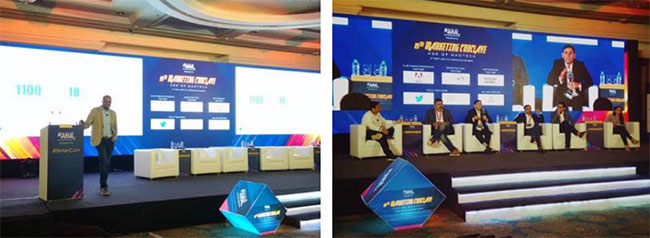
    The Internet and Mobile Association of India (IAMAI) conducted the fifteenth edition of its Marketing Conclave last week. The theme of the event was ‘Age of MadTech’ and the discussions were centered around ‘Future of Marketing.’


    Delivering the keynote address Manish Maheshwari, Managing Director, India Operations at Twitter India said there are 1.1 billion expected smartphone users in India by 2024, Internet users in rural India are growing at the rate of 35 per cent and Indians at large are expected to consume 18GB data per day by 2024.


    Manish Maheshwari – Managing Director, India Operations – Twitter | Panel Discussion


    Speakers at the conference were of the view that digital was the way forward for brands to achieve the highest RoI, and also to build trust and enagage with the consumers. The speakers opined that this being the age of millennials, digital would play a critical role to capture and engage with that generation. This would also pose exciting challenges for brands to capture their imagination.


    Commenting on the success of the conclave, Gaurav Chopra, Vice President, IAMAI said: “The conference is a great platform for aspiring marketers from various industries to discover the Age of MADTech. Experts from the marketing and advertising fraternity shared wonderful stories of how many brands have transformed/evolved with time using the right mix of marketing, advertising and technology. IAMAI strives to work with industry to push the envelope further for the betterment of the industry.”