Tag: InMobi

  • InMobi partners with Ad Net Zero

    By Our Staff


    InMobi, provider of content, monetisation and marketing technologies, has partnered with Ad Net Zero, the climate action programme with the mission to accelerate the decarbonisation of the advertising industry.


    Said Kunal Nagpal, Chief Business Officer at InMobi: “InMobi’s partnership with Ad Net Zero symbolizes our dedication to ushering in a more sustainable era for the advertising industry.  We are proud to stand alongside fellow tech companies and agencies, united in the pursuit of a greener, more responsible future. By fully embracing Ad Net Zero’s comprehensive plan, we are steadfast in our commitment to minimizing our environmental impact while advancing the power of advertising.”


    Added John Osborn, Director of Ad Net Zero in the U.S.: “Ad Net Zero is thrilled to work with InMobi as they support more sustainable advertising solutions, contributing to our collective global impact. InMobi’s commitment is another significant step toward an eco-friendly future for the industry.”


  • InMobi Report: Use of mobile phones peaked during lockdown

    By Our Staff


    Mobile advertising tech firm InMobi has unveiled a report on second wave lockdown audience insights. According to the report, 2021’s lockdown saw users relying on their smartphones specifically around weekends, compared to weekdays in 2020. Social distancing, work from home, and lock-down regulations boosted mobile consumption.


    Said Vasuta Agarwal, Managing Director, Asia Pacific, InMobi: “We have witnessed a drastic acceleration of the mobile-first consumer economy since the onset of the pandemic. With the second wave, we see that these “new normal” mobile-first consumer habits and preferences have become more mainstream.”

  • InMobi launches report on mobile video ads

    By Our Staff


    According to InMobi’s State of Programmatic Mobile Video Advertising in India report, there are 356 million mobile video viewers in India. The report throws insights on the change in advertiser spends and the performance of video as a format from data analysed on the InMobi Advertising Platform between January 2020 and January 2021.


    Commenting on the state of programmatic videos in India, Vasuta Agarwal, Managing Director, Asia Pacific, said: “In the recent years, online video consumption has exploded across the globe. The increasing mobile video consumption, which was seemingly an emerging trend during the lockdown, is now redefining the advertising strategies of some of the leading brands. With the time spent in watching videos at an all-time high and the growing engagement, we see a strong potential for programmatic advertising across sectors.”


  • 45% of mobile users in India introduced to gaming in pandemic


    From an InMobi communique with minor tweaks


    India, a mobile-first economy, is also the land of committed mobile gamers who belonging to different age groups, gender, and geography, said InMobi’s 2021 Gaming Report, India. The report title “Everyone’s Gaming Among Us – Mobile Gaming through the Pandemic and Beyond” reveals insights derived from the app usage patterns and trends that were analysed basis 1.7 trillion ad requests between January 2020 and January 2021 on the InMobi Marketing Cloud and Audience Intelligence Platform, and a survey conducted among over 1000 smartphone users from across India using InMobi Pulse.

    InMobi Pulse is a leading mobile consumer intelligence platform powered by artificial intelligence (AI). Overall, the report indicates that in India, which is home to 1 out of 10 gamers across the globe, mobile gaming is a source of entertainment as well as relaxation, and it has become a mainstay in the life of the average citizen.

    Commenting on the changing gaming pattern in India, Vasuta Agarwal, Managing Director, Asia Pacific, InMobi, said: “Mobile gaming accelerated due to the lockdown in India as people continued to shelter at place and work from home. What was seemingly an emerging trend is now a lasting behaviour with a 1.5x growth in gaming users. With over 80% of mobile gamers playing every day, it has evolved to become an integral part of the connected consumer’s life!”


    India: The Land of the Committed Mobile Gamer

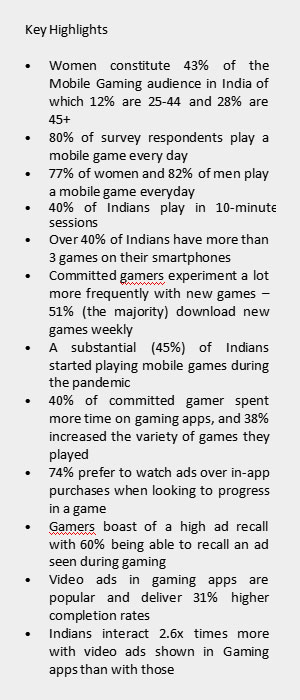
    Gaming in India is no longer restricted to young men. Majority of Indians are committed gamers who play at least once or more every day. Accessibility and affordability of smartphones and high-speed internet are some of the factors which have made mobile gaming a popular source of entertainment for people regardless of age and location. The report highlights that women constitute 43 per cent of the Mobile Gaming audience in India of which 12 per cent are in the age group of 25-44 and 28 per cent are over 45 years.

    Typically, Indians play mobile games in multiple short spurts during the day. 40 per cent of the respondents who participated in the InMobi Pulse survey indicated that they usually play in 10-minute sessions – in between meetings, chores, meals, etc. However, committed gamers, on the contrary, spend substantially more time per session than other gamers, with over 84 per cent of the players spending up to an hour on mobile gaming in a single sitting.

    According to the report, committed Indian gamers love experimenting with new games. More than half of the survey respondents said they download a new game every week while over 40 per cent have more than three games on their smartphones at any given time. Given the vast app universe and increasing size of the apps, Indian gamers say they have to constantly choose between apps that they want to keep on their smartphones. While casual and card/puzzle/board games are a popular choice among all gamers, the committed players and Gen Z gamers have a greater inclination towards MOBA (Multiplayer Online Battle Arena), simulation, and action games.

    Advertisements on gaming apps and other apps and word-of-mouth are the most preferred ways of finding new games. While committed gamers prefer app store recommendations and ads on gaming apps to find new games, occasional gamers mainly rely on word-of-mouth, in-app ads and social media to discover new games.


    Emerging Trends and Lasting Behaviour

    The onset of the pandemic and the subsequent lockdown resulted in a significant shift in mobile usage and consequently has been a catalyst in boosting mobile gaming in India. During this period, the survey shows that 45 per cent of Indians started playing games on their smartphones. This also resulted in a spike in the amount of time spend on mobile gaming as well as the number of apps they experimented with. Among the committed gamers, 40 per cent spent more time on gaming apps while 38 per cent of them increased the variety of games they played. During COVID-19, on an average day, time spent on gaming apps surged through the day as people played a lot more often starting as early as 7:30 AM till 11:30 PM. The sharpest surge in the use of gaming apps occurred at 11:30 AM, with a 6.6x increase in gameplay.

    The lasting impact of COVID-19 shows that Indians are continuing to play a lot more on their smartphones throughout the day. Mobile Gaming has grown from being just a hobby to becoming synonymous with a medium of relaxation. The Gen X (45+ age group) users were seen indulging in multiplayer games to connect with family, friends, and other like-minded people on the platform.


    Importance of Mobile Gaming for brands

    Despite the huge opportunity right in front of them, most marketers seem to be hesitant when it comes to investing in the gaming space. They carry misplaced notions on the lack of personas, placements, engagement, and of course brand safety – but this couldn’t be further from the truth! Contrary to the popular notion, women today are highly committed gamers, with 77 per cent of them playing at least once a day if not more, to relax and stay connected with family and friends. Data finds that around 32 per cent of women games play in 10-minute sessions while 23 per cent tend to play for over an hour every day.

    Even the most committed gamers don’t limit themselves just to games but keep a variety of other interests both online and offline. These people can be found all across the internet, be it on social media platforms, video and music streaming apps, or at a retail outlet. Today, the probability of mobile gamers being the target audience of any business is extremely high which means one can effectively engage with these user groups to market their brands. Data also shows that 74 per cent of the gamers prefer to watch gaming advertisements over in-app purchases in order to move to the next stage in the game. They also boast of a high ad recall with 60 per cent being able to recall an ad seen in or during a game.

    Indians interact 2.6x times more with video ads shown in Gaming apps than with those shown in other apps. Video advertisements in gaming apps are among the most popular and deliver 31 per cent higher completion rates for publishers (over the MOAT benchmark) on the InMobi Advertising Platform.

    “Gaming is one of the most scalable channels for brands to reach diverse target audiences. Be it women, millennials, sports enthusiasts, or OTT viewers, everybody is gaming among us. Moreover, mobile gamers are receptive to advertising with 3 in 4 consumers preferring to see an ad and 60% of them being able to recall the ads they see. Gaming is the biggest opportunity for brands to maximize impact with video and other engaging formats in 2021,” added Agarwal.

    According to the report, the Indian gaming ecosystem has matured by leaps and bounds over the past year. India is the 5th largest mobile gaming market across the world and the gaming culture has now achieved escape velocity in the country, competing with other popular entertainment categories such as short-form videos, streaming services and social networks. As brands continue to traverse different stages of digital marketing maturity, leveraging this platform would be extremely critical for brands to meet the consumers where they are, and continue to stay relevant.

  • InMobi adds Microsoft Advtg platform for marketers

    By A Correspondent


    InMobi announced that it has extended its partnership with Microsoft by adding the Microsoft Advertising business to its current portfolio of offerings. InMobi will now be able to offer marketers an integrated solution to power their campaigns built on search capability of Microsoft Advertising and mobile capability of InMobi Marketing Cloud.


    Said Mark Richardson, VP of Global Corporate Sales at Microsoft: “We see an immense opportunity to grow the search and display market in India where digital is growing thirty percent year on year. Our relationship with InMobi, India’s first tech unicorn ,will enable Microsoft Advertising to leverage InMobi’s knowledge of the Indian mobile landscape and its go-to-market platform to grow the business further.”


    Added Vasuta Agarwal, MD, Asia Pacific at InMobi: “The extended partnership between Microsoft Advertising and the InMobi Marketing Cloud will enable marketers to deliver a unified brand experience to customers by bringing together the best of search and display platforms. Our deep appreciation of Indian marketers’ needs, a keen understanding of the Indian market and a customer-obsessed team, position us uniquely to bring Microsoft Advertising to marketers in India.”


  • Martech and Adtech Predictions 2019


    Over the years, mobile marketing leader InMobi has been releasing its annual research and predictions on the state of mobile marketing. Here we bring you the executive summary from The InMobi Almanac for Marketers 2019. It delves into the top trends emerging from the consolidation of adtech and martech solutions. The ones that InMobi thinks will define the industry for years to come.


    Here goes:

    Today, marketing is no longer a one-sided game. The power dynamics have shifted – with the consumer now having more control over what they consume. As consumers seamlessly hop, skip and jump between various digital and offline channels, they leave behind a treasure trove of data in their wake. And with all this data at the marketer’s disposal, marketing can no longer remain a pre-planned agenda but an agile and real-time network.. The industry stands at the cusp of a transformation, and data is at the center of it all.


    As pioneers of the mobile advertising platform – we have witnessed the transformation of this industry first-hand. In this year’s report, we share our predictions on what lies ahead for marketers in 2019 and a repository of information that taps into these learnings – all witnessed first-hand by our in-house business leaders, balanced by industry perspectives from renowned thought leaders. It’s a quintessential guide capturing trends and innovations that will shape the global ad tech and martech sector in the coming years.


    InMobi Predictions

    Owning Customer Experiences Will Be the Future of Marketing

    Today, in our connected worlds, marketing efforts without a unified view of the customer is not only unfathomable but equivalent to a crime. The growing focus on customer experience requires a 360-degree view of the customer, which today has been made possible by a combination of factors like the ubiquity of mobile, technological advancements in processing speed and AI, and the proliferation of various tools and platforms that offer solutions to specific needs in the marketing journey. In addition, the recent spate of acquisitions, along with data partnerships in martech, are paving the way for a more hopeful future. It is time for marketers to rethink their siloed approach to data if they haven’t already, or else they risk losing the race to owning personalization.


    Consolidation in Martech Will Increase Marketing Efficiencies

    In the coming years, oversaturation in point solutions will drive changes in the industry. If companies have a relevant proposition in the market, they’ll likely be bought by the big players. And, if not, the effects of the investment drought will see them shrivel away as the industry rids itself of dead weight. The outcome will be a far scaled-down version of the Lumascape. Cutting out the noise will, ultimately, drive better revenue for all industry sectors, and provide a greater experience for the consumer. In today’s over-stimulated martech landscape, it’s easy for marketers to lose sight of their martech stack’s ultimate goal: ROI. On collecting data on their current tech stack, marketers can then focus on connecting these various technologies and eliminating data silos.


    The Rapid Diffusion of OTT Will Diversify the Marketing Mix

    For the marketer, OTT brings to the table an array of advertising opportunities characterized primarily by video ads. OTT also provides them with opportunities to better understand the consumer’s journey and path to purchase. The consumer may view video content on a tablet, engage with social media through a phone but eventually use a laptop to make a purchase. They can gain greater insights across all touchpoints – so long as they have knowledge across all of these devices and interactions. However, the ability to track overall media consumption behavior comes with the additional need to be connected in terms of systems, technologies and partners. But, if done right, the future of OTT is an optimistic one.


    Voice-Activated Tech Will Become the New Normal

    A perfect example of technology that caters to how humans work naturally – is voice technology. Communicating through voice is more natural to us than say, typing. With the onset of AI and IoT connectivity, more and more people are now replacing the act of typing with voice. The connected home and smart speakers are also penetrating Wi-Fi enabled households and are here to stay. Not only is voice tech gaining popularity in the consumer’s purchase journey (voice commerce), it also acts as a advertising channel with great potential. Brands can now have the window to interact with the consumer through dialogue – a very unconventional brand-consumer relationship compared to other marketing tactics.


    5G Will Pave the Way for a New Era of Connected Cars, IoT and More

    5G, with speeds up to 20 times faster than 4G, could offer a quantum leap, especially when it’s developing alongside continuing advances in AI and the worldwide rollout of IoT devices. Smart 5G wearables, 5G-powered IoT devices and AR/VR/mixed reality will empower mobile advertisers with unprecedented access to consumers, their personal interests and their activities. In addition, many rural areas who missed out on the broadband revolution can be brought online since since it’s much easier to set up a wireless network. Forward thinking in terms of preparing adequately and planning out possible strategies will get businesses that initial step ahead of the competition. With 5G, the possibilities are seemingly endless.


    Data Privacy, Trust and Accountability Will Change Consumer Relationships Forever

    Increased consumer awareness surrounding data privacy, coupled with growing concerns about data protection, has mobilized countries and companies to be more stringent about safeguarding consumer privacy. The EU’s GDPR, for example, is a  crucial step in giving consumers more control over their personal data. In order to establish a more trustworthy relationship with the consumers, marketers will have to consider some best practices, the primary of them being a consistent adherence to data privacy regulations. In the absence of such regulation, companies must handle consumer data with a greater sense of responsibility and accountability in order to continue enjoying the consumer’s trust.


    The Enabler of the Future: Artificial Intelligence and Machine Learning

    What’s particularly interesting about these trends is that they are panning out alongside continuing advances in Artificial Intelligence and Machine Learning. AI and deep learning technologies will be the underlying engines of the changes to come and the transformations waiting to happen. Whether it is to predict the consumer’s next move, to prevent fraud or to enable customer-centric personalization, AI & ML will continue to be adopted more and more by the marketer.


  • Eros Now announces partnership with InMobi

    By A Correspondent


    Eros International has announced that its OTT platform, Eros Now, has partnered with InMobi, a global provider of enterprise platforms for marketers.


    Commenting on this association, Rishika Lulla Singh, CEO, Eros Digital, said: “With the advertising landscape transforming into immersive engagement, brands can now leverage deep story-telling to collaborate with the audience. The digital penetration is seeing an incremental growth across cities in India and the consumer is increasingly spending much more time on their mobile devices than they did a few years ago, making it one of the most sought-after platforms for advertising. We are happy to join hands with one of the leading advertising platforms in India and aim to continue providing a seamless experience to all our subscribers.”


    Added Naveen Tewari, Founder and CEO, InMobi: “Our association with Eros Now marks an industry first partnership in the OTT space which is the next big thing after the app economy. It will be a trendsetter in many ways. Our distinction lies in our core business which centers around the primary screen – Mobile; making this an organic progression for us, and that’s where our decade-long expertise also comes at play. Our full-stack mobile OTT solutions hinged on in-app and our video-first platform will not only allow for deep brand integrations but will improve the overall efficacy of content monetization, driven through Eros Now’s original video content.”


  • MMA announces new appointments to Asia Pacific Board of Directors

    By A Correspondent

    The Mobile Marketing Association (MMA) has announced the appointment of six new Board Members, to its Asia Pacific Board of Directors. Elected by the MMA’s APAC membership, the newly-appointed board members will serve a two-year term, beginning immediately.

    The new Board Members include: Vipul Chawla, Managing Director, Pizza Hut – Asia Pacific, Yum! Brands; Pham Nha Uyen, Regional Marketing Manager, Coca-Cola Indochina; Richard Murphy, Corporate Vice President, Digital; Growth & Foundational Markets, McDonald’s Corporation; D Shivakumar, Chairman & CEO, PepsiCo India Holdings Pvt. Ltd.; Vikas Gulati, Managing Director, APAC, AdColony; David Porter, Vice President, Media, AAR, Unilever Asia Pte Ltd.

    “The appointment of some of the most influential marketing leaders to its APAC Board reflects MMA’s commitment to leading the mobile industry, and driving our charter in such a fast growing and diverse region,” said Ashutosh Srivastava, Chairman of the MMA APAC Board of Directors, and Chairman & CEO for AMEA, Russia/CIS, Mindshare. “Asia is the fastest growing market for mobile. I look forward to join forces with these industry leaders to accelerate growth of the mobile marketing industry and help marketers, publishers and technology providers across the region unlock the full potential of mobile to drive business growth.”

    Continuing board members, whose terms were not up for re-election include: Jayesh Easwaramony, VP & GM, Asia Pacific, Middle East and Africa, InMobi; Dong Hyun Kim, Asia Digital/eCommerce Leader, Procter & Gamble; Bessie Lee, CEO & Founder, Withinlink; Vishnu Mohan, Chief Executive Officer, Havas Media Group Asia Pacific; Dick Van Motman, Chairman & CEO, Dentsu Aegis Network South East Asia; Dan Neary, Vice President of Asia Pacific, Facebook; Sean Rach, Chief Marketing Officer, Prudential Corporation Asia; Praveen Sharma, Regional Director, Mobile Sales and Solutions, Google APAC; Joe Nguyen, Senior Vice President, Asia Pacific, comScore, Inc.; Rahul Welde, Vice President – Media, Unilever.

    “The role mobile plays in marketing strategy is now indisputable, and the outstanding composition of our Board is testament to the power mobile has in building business capabilities for brands across the region,” said Rohit Dadwal, Managing Director for MMA in APAC. “I believe the new Board will propel the mobile marketing industry to greater heights, and I look forward to working with them to drive MMA’s agenda and develop best practices for the industry, be it viewability standards or multi-touch attribution, so that marketers can execute their business strategies more effectively.”

  • InMobi and Tapjoy forge partnership in India

    By A Correspondent


    InMobi has announced that it is partnering with Tapjoy, a leading platform for mobile advertising and app monetization, to monetise Tapjoy’s inventory in India.


    Mobile gaming continues to see growing adoption in India. According to a report by Nasscom, mobile game downloads are expected to grow at a CAGR of 58 per cent over the next five years, touching an estimated 5.3 billion downloads in 2020.


    Capitalising on this trend, InMobi’s partnership with Tapjoy presents a robust opportunity for Indian advertisers to enhance their reach to a wide selection of global mobile gaming apps. Tapjoy has 40 million unique users in India across popular mobile games such as 8 Ball Pool, Criminal Case, Shadow Fight 2, and Subway Surfers, and advertisers will be able to expand their reach beyond InMobi’s 135mn unique devices in India through access to Tapjoy’s India inventory.


    Tapjoy’s Interplay ads help marketers connect with a qualified audience in premium apps.  Tapjoy offers a complete suite of advertising products including engagement-based ad experiences like video and gamified rich media, as well as performance-based ad solutions to drive a direct response, grow advertisers’ consumer base, and increase in-app engagement.


    “We are excited to be Tapjoy’s exclusive monetisation partner in India.  Mobile gaming is growing at an exponential pace in India and through this partnership we are bringing the best of global mobile gaming inventory to advertisers in India who want to reach high quality users,” said Vasuta Agarwal, VP and GM India, InMobi.


    “InMobi is a fantastic partner for Tapjoy in India thanks to it’s long-standing reputation for delivering high-quality mobile advertising solutions for local performance advertisers and brand agencies,” said Paul Longhenry, SVP of Strategy, Business and Corporate Development for Tapjoy. “Our international game studio partners are seeing very strong growth with Indian consumers and we’re excited to work with InMobi to ensure those audiences are presented with highly engaging rewarded ads from their favorite local brands.”


  • App publishers counter undercutting ad networks

    By Krithika Krishnamurthy


    Ad network Adatha was born four months ago when Venkatesh Rajendran, co-founder of online magazine publishing firm Magster, found discrepancies in the manner in which he was being paid for his services.


    Magster was advertising the mobile apps of Flipkart, Mobikwik and Snapdeal through various ad networks such as China-based Avazu, InMobi and SVG Media.


    For the same app, Rajendran said, he was getting different payments from different networks. Advertisers pay ad networks to display ads on relevant apps, mobile sites and websites. The websites like Magster get paid for the ads they showcase.


    “We got paid differently from different ad networks. Why were there variations for the same app?” he asked himself, he said. When he dug deeper, he said he found that despite having got impressions, the ad networks were undercutting him, by showing him the wrong metrics.


    In this case, Avazu was paying him a slightly higher amount for every ad installed, but it reduced the overall number of installs, he said. So, Rajendran said, the final payments would be much lesser at the end of the day. This prompted him to form an association of about 15 members called Indian Mobile App Publishers’ Network that aims to blacklist and showcase suspicious ad networks to publishers.


    CashOn, Pokkt and EarnTalk Time are some of the publishers that have come on board. Publishers claim Indian players like InMobi, SVGMedia and VServ are known to play by the rules, but those in China, especially YeahMobi and Avazu don’t necessarily do.


    Avazu refuted the claim while YeahMobi did not respond to requests for comment till late evening on Tuesday.


    “That’s not really true. We only cut publisher payments when we find fraudulent traffic or when publishers are not compliant with our advertisers’ policies and we always provide evidence on that, and provide all the guidelines within campaign descriptions of each advertiser campaign,” said Yi Shi, chief executive and founder of Avazu.


    Not just publishers, even advertisers claim they are getting the short end of the stick. Advertisers or brands pay for people who are viewing their ads; some pay for clicks while others pay for installing apps. But about 5-10% of it is generated by machines, according to online measurement firm comScore.


    AdCovenant, an ad agency, has come up with a solution that specifically aims to tackle the number of false clicks through rates with their solution. “We ensure 50% better return on investment as all of it is human impressions,” said Chetan Ahuja, spokesperson of Pune-based AdCovenant.


    Source:The Economic Times

    Copyright © 2015, Bennett, Coleman & Co. Ltd. All Rights Reserved

    Licensed to republish


  • Hot, happenin’ and most wanted!


    By N Shivapriya


    Last week, early talks were reported between Google and ad tech firm Inmobi for a possible valuation of over Rs 12,000 crore. Inmobi founder Naveen Tewari later told employees that he was not looking for such a deal. The same day, it was also reported that e-commerce firm Snapdeal was looking to acquire Komli Media, another ad tech firm, for a potential valuation of over Rs 1,800 crore. Flipkart acquired Adiquity earlier this month.


    All this comes in the backdrop of a squeeze in the US. After an early flurry in 2013 and the first half of 2014, the number of ad tech initial public offerings have now dried up. But that hasn’t deterred new firms and existing ones from aiming for a slice for huge spends that are on stake as online ad spend continues to grow on the PC and mobile. It could also very soon enter the universe of wearables.


    inMobi: Going After Mobiles

    CEO: Naveen Tiwari, Employees: 900


    Last month, inMobi said it reached 1 billion unique mobile devices. This is precious real estate in the ad targeting world.


    inMobi connects those that want to sell ad space, like content sites, apps or game developers, with those that want to advertise on the mobile platform. Its technology helps to serve the right ad to the right user. For instance, when you are in your newspaper app you could be shown an ad for a bag you were planning to buy earlier on an e-commerce app. This is a simplistic scenario.


    inMobi builds audience personas and uses various targeting capabilities such as appographic targeting (based on a user’s app preferences) to determine the right user for the right ad.


    When the user engages with the ad by clicking on it, inMobi gets paid. Cost per click or cost per mille (mille referring to a thousand ad impressions) are some commonly used metrics.


    In addition to guaranteed engagement, there could other payment metrics such as guaranteed outcomes. For a game ad, the outcome could be a download, for an auto ad, it could a test drive query.


    A game developer who is an advertiser can also specify the goal of the campaign to be a certain number of high lifetime value users, who download the game and play it frequently by purchasing features such as lives and coins.


    “So as our ad network gets bigger, our knowledge about user behaviour gets better,” says Richard Sullivan, vice president and general manager, who attributes this and analytics and data sciences to better ad targeting and performance.


    To improve engagement, inMobi also innovates on how the ad is delivered. Native ads, where the ad looks and feels like the rest of the content on the page, although it is called out as an ad or sponsored content, is one such innovation that’s been found to increase user engagement.


    Komli Media: Helping marketers squeeze more value

    CEO: Amar Goel, Employees: 300


    It started as an ad network bringing together ad supply and demand for India and South East Asia. Today, Goel says part of its business is a demand-side platform and part of it is an ad network. The company is mostly about helping advertisers and marketers drive value through its offerings, such as the re-marketing demand-side platform, RevX, that is has developed.


    RevX is programmatically driven and is used by almost all the leading e-commerce firms in India and South East Asia, Goel says. The platform also integrates with customer relationship management data.


    The programmatic capabilities it is building are becoming a larger share of its business. It also executes rich-media campaigns and crossdevice campaigns, which are hard to do programmatically.


    Media.net: Money in Targeting at Scale

    CEO: Divyank Turakhia, Employees: 500+


    It is positioned as a contextual targeting specialist. Contextual targeting serves ads relevant to the context of the page as opposed to what the user was doing a while ago or a few days back. For instance, a user may have been on makemytrip.com to check out some flights. But if the user is currently reading an article on used cars, then contextual targeting will analyse the content of the page real-time to show ads relevant to it – an ad for a second-hand cars website, for example.


    “As of now the user may not be interested in seeing an ad about flights because he is researching cars,” says Turakhia. Most ad tech firms start with one niche and then expand to other areas, he adds.


    Media.Net gets a cut from what the advertiser pays the publisher. “Publishers will come to us only if we are able to offer them good rates and advertisers will pay more only if they get the desired results. So our targeting has to be really good,” says Turakhia.


    Source:The Economic Times

    Copyright © 2015, Bennett, Coleman & Co. Ltd.

    All Rights Reserved, Licensed to republish

     

    Future of Ad Tech Firms

    Globally, companies spent about $140 billion on digital advertising last year. One or more ad tech firms have a role to play in every one of these dollars spent. Going forward, ad tech will continue to play a crucial role in targeting ad spends precisely at the right consumers.


    “The key shift we are seeing is in making marketing personal again,” says Kirthiga Reddy, MD, Facebook India. She compares it to the convenience of a kirana store that can predict what you will buy and also suggest something new you may like, but with the scale of mass media.


    Facebook along with Google is leading the charge of ad tech with precise targeting and measurement capabilities in ways that weren’t possible earlier with a number of their products. They are the giants in the field. Every ad tech firm competes with them in some way but also collaborates with them because the size of the pie is so big.


    Of the $ 50 billion US digital ad spend, for instance, over 35% is with companies that are not household names like Google, Facebook, Microsoft and AOL, points out Divyank Turakhia, CEO of Media.net, an ad tech firm that runs the contextual ad programme for the Yahoo-Bing network. His firm serves ads on websites that are part of the Yahoo-Bing network.


    Ad tech firms – both big and small – are re-writing the rules of advertising, changing how online campaigns are created and priced and setting goals so precise that shopping for customers is no different from say, drawing up a grocery list.


    For instance, an advertiser may want to target, say, only South Korean men between the ages of 25 and 40 years and who have a taste for Indian food. The advertiser can also specify the purse: $100,000. After the campaign, the ad tech firm will return measurable results and any remaining dollars as well.


    The simplest kind is search targeting, where a person searches for a particular term. Here, the intent of the person and what he or she is looking for is clear. So the ads that come up are related to the search keywords. But a person searching for pizza delivery in Mumbai wouldn’t want to see an ad for a pizza delivery place in New York. This is where geo-targeting comes in, explains Turakhia.


    “Similarly, there is demographic targeting based on what your age group is or whether you are male or female. These are conventional ways of targeting that advertisers used for their campaigns. But today there are multiple mechanisms of ad targeting in so many complex forms, which combines all the data signals that are available,” he adds.


    A pizza delivery chain based only in New York can set a goal of 20 pizza deliveries for every $100 spent and the ad tech firm will try to get the results by optimising the ads to a suitable audience.


    Sophisticated ad buyers such as eBay India place several millions of ad bids a day based on multiple variables and parameters to get the best bang for its advertising buck. “On a daily basis, we place about 40-50 million bids. When you’re working with such large numbers there is no way it can be done manually,” says Shivani Dhanda, head – marketing, eBay India.


    It uses a bid management system that evaluates how much to bid for a particular user and if eBay wins the ad impression, the appropriate ad is dynamically put together. For instance, if the user is searching for a keyword ‘mobile phones’, the bid management system will consider various parameters such as if the user visited eBay, which phones he searched for and how likely he is convert before deciding how much to bid. The entire process from placing the bid in a realtime auction to when the ad is dynamically put together takes about 100-150 milliseconds and happens even as the user is entering a url.


    The tools that help advertisers do this are also supplied by ad tech firms. eBay, for instance, uses software from Pune-based firm Sokrati, founded by former Amazon executives, to manage its bids, along with an in-house bid management system.


    “Display (advertising) has risen from the ashes. Programmatic (real-time bidding) technology allows bidding for each of display unit on a one-to-one basis, recognising who the user trying to access the website is, what the context of the page is, and what the size of the ad unit is,” says Subra Krishnan, vice-president (products) at Vizury, a Bengaluru-headquartered ad tech firm, which has raised $27 million so far from multiple investors and has a presence in China, Japan, Korea and emerging markets such as India.


    Players are Evolving

    The industry has become so complex that most firms are reluctant to label themselves as anything more specific than ad tech players as they venture into areas that can add more intelligence and help in more relevant targeting of customers.


    Vizury, for instance, is known in India for its ad re-targeting products on the mobile and desktop. But it is now venturing into proprietary data and the kind of work that large software companies typically do with business intelligence software. Its newest offering integrates multiple customer data such as call centre and loyalty programmes to provide better market segmentation and targeting of the customer.


    “There are probably 100 different types of ad tech companies. It’s a kind of battlefield where various entities are trying to optimise various parts of the business and yet ultimately, there is the consumer who takes the final call,” says Tamara Gaffney, principal analyst, Adobe Digital Index, which provides research and insights on digital marketing.


    Adobe also has offerings in ad tech, which integrate a number of technologies.


    “It’s hard to explain but there would be players around targeting, optimisation, analytics… a good analogy would be the financial services industry where are buyers and sellers but many intermediaries,” says Amar Goel, CEO, Komli Media, which started off as an ad network bringing buyers and sellers together but is now building a lot of programmatic (realtime-bidding) technology and leveraging data.


    He declined to comment on reports of Snapdeal acquiring Komli. The driver for such ad tech deals, says Anupam Mittal, CEO of People Group and angel investor, is the access that large e-commerce firms like Flipkart and Snapdeal have to customer shopping patterns and behaviour. “These ecommerce firms have billions of page views. They know people’s shopping habits and what they are looking for, so they have some level of context just like Facebook and Google. They also want to acquire good teams that can help to build their own ad proposition to customers,” he says.


    Still, many listed ad tech firms have seen their market value fall on Wall Street. “Ultimately, there are two kinds of ad tech: one captures the intent of the user, and Google does that.


    The second is when you know so much about the user that you can present the relevant ads. Facebook does that. Everything in between is a promise of something that will be built. Margins are wafer-thin if at all they are there.


    Google and Facebook own their audience so their margins are much better because they are not sharing the outgo with the publisher,” adds Mittal (see table).


    However, it’s equally true that there are smaller firms building smart capabilities that the likes of Google, Facebook and Twitter are interested in. “The very fact that Google buys companies nearly every year shows that they are getting beaten at their own game,” points out the CEO of an ad tech firm, requesting anonymity.


    Google’s mobile ad platform, AdMob, was through an acquisition in 2009. Similarly, Twitter bought MoPub, a startup helping mobile publishers manage their inventory


    Consumer is The Sweet Spot

    Fashion e-tailer Myntra, which uses both Vizury and Komli, says it has translated to higher revenues. “Our pain point as an e-commerce player is we create the intent but the average conversion rate (people who buy after visiting the site) is only two out of 100,” says Priyanshu Kumar, digital marketing manager, Myntra.


    On January 3, when Myntra held its ‘End of Reason’ sale, it notched up a record Rs 100 crore in eight hours. At least 3% of that revenue could be attributed to the re-marketing campaigns run by Komli and Vizury on that day as they brought back potential customers who had visited the site but dropped off, says Kumar. “They were very aggressive going after the users who had visited our site but not converted,” he says. Myntra saw a conversion rate of 6% on that day as compared to the e-commerce industry average of 0.8% – 2.5%.


    The most reliable data about users online is first-party data, which is collected by the site you are browsing, says Gaffney. Second-party data is obtained from exchanges which, in turn, get the information from participating sites that sell their information to the exchange for a fee.


    Such success stories are also helping ad tech win new following among companies in manufacturing, consumer and other industries in India. “Three years back, only internet companies were the most visible users of our ad offerings. But since then we have seen traditional industries like auto, FMCG and the government take it up signficantly,” says Nitin Bawankule, industry director (Ecommerce, Local, Technology), Google India.


    Ford India has hiked its digital ad spends from 5% of its ad budget to 15%-20% in less than four years, says Anurag Mehrotra, director (marketing, sales and service). Tushar Vyas, head digital (South Asia) at advertising agency, GroupM, says digital ad spends are growing three times faster than the overall ad growth.


    The mobile is the next frontier in advertising with its ability to identify the user location as well as predict user behaviour based on the device being used.


    This could be the next level of evolution for ad tech firms. With the mobile, for instance, advertising technology can even find out if the user is standing or sitting, says an ad tech executive.


    “If the advertising landscape is complex, the mobile landscape will make it more so. When you combine the advertising technology landscape with the mobile technology landscape, you could end up with this almost supernova of advertising targeting and data collection opportunity,” says Gaffney. The launch of Apple’s smartwatch and other smartwatches could take that to another level. Ad tech is here to stay and grow.


    Source:The Economic Times

    Copyright © 2015, Bennett, Coleman & Co. Ltd.

    All Rights Reserved, Licensed to republish
     

  • InMobi ‘pivots’ to take on online Ad giants like Google, Acxiom, Experian directly

    By Krithika Krishnamurthy & Peerzada Abrar


    Mobile advertising network InMobi is all set to woo large enterprises with a new analytics service that will mark a crucial shift in the business model of the eight-year old company that is looking to revive growth and investor interest.


    The move, termed as a “pivot”, will see InMobi ­ combine data from clients with insights on consumer behaviour that it has gathered ­ create new marketing strategies for enterprises. This will pitch the company into direct competition with global players such as Google, Acxiom and Harte Hanks.


    “The trials have already begun,” said a person with direct knowledge of the development. “This pivot will make In Mobi an early mover in this space.”


    Experts are of the view that for mobile advertising networks that are increasingly dependent on algorithms that churn out programmed output, looking beyond is proving to be crucial.


    “Companies like InMobi have to pivot because of the complex channels of data involved (online, offline, beacon, mobile),” said Michael J Becker, managing partner of mCordis, a consulting firm that advises companies on mobile trends and advertising strategies.


    InMobi has so far gathered data from third-party website and partners, and mostly competed with Google and Facebook. It will now not only push advertisements on smartphones but will run marketing campaigns through email and other channels. Manish Dugar, InMobi’s vicepresident for finance and legal, declined to term the new business model as a “pivot” saying “finding new initiatives and scaling them is a regular activity in our industry.” The company according to him follows an investment philosophy of 60:30:10. While the bulk of the money is used to run the existing business, a tenth of the money goes into trying out “moonshots” which are at an idea stage.The ideas that make it past this stage are then provided with investment to scale and commercialise the idea.


    “Big data analytics is one such initiative,” he said. The shift in business comes at a time when InMobi has been out in the market since last year to attract new funding of about $300 million (Rs 1,896 crore). According to people in the know, the company is seeking a valuation of $2 billion (Rs 12,640 crore) but not many investors have stepped up. SoftBank which invested $200 million (Rs 1,250 crore) in 2011 has since invested an additional’ . 30 crore so far.


    InMobi’s competitors are closely watching the new moves by the Bengaluru-based company.


    Mobile advertising company AdNear gathers both online and offline data, much like InMobi plans to do, and unlike InMobi, which is a third-party intermediary player, it works directly with brands.


    “It’s (InMobi) a good company, but it has grown too big to pivot at this stage,” said Anil Mathews, chief executive of AdNear, whose startup raised $19 million last October from Telstra Ventures and Global Brain.


    “The ad network business is dead. It’s gone long ago. The ‘network effect’ of an ad network doesn’t hold strength,” he said, referring to the emergence of exchanges that publishers and advertisers can plug into and bid for ads in real time. People with knowledge of the developments said InMobi’s CEO Naveen Tewari is trying to wooe investors with big-data analytics pitch.


    InMobi is also looking to raise funding through debt from foreign banks if it does not get the valuation it wants from the investors, according to a source with direct knowledge of InMobi’s funding plans. According to a senior executive, InMobi which has 900 employees has crossed revenue of over $200 million `1,264 crore). “We are com(.mitted to our business model which continues to deliver phenomenal results,” said Dugar, who said the company serves ads to 872 million monthly active unique (devices).


    The company announced that it turned profitable in the last quarter of 2014.


    Competitors however question the company’s ability to survive cut-throat competition from the likes of Google, Facebook, Microsoft, Millennial Media, Twitter and Yahoo. “I agree they were early movers in mobile advertising and ran it very well, but the entire industry has become programmatic. They need a brute force to catch up,” said another top executive at a rival firm who did not wish to be quoted.


    Source:The Economic Times

    Copyright © 2015, Bennett, Coleman & Co. Ltd. All Rights Reserved

    Licensed to republish