Tag: Indian Premier League

  • Halfway through, IPL 5 ratings stabilize

    By A Correspondent


    The downward slide continues though not as stark as it is made out to be. Numbers released by TAM Sports for the first 48 matches of IPL 5 have shown the ratings to be the least recorded thus far compared to previous four seasons. At 3.40 TVR (CS 4+, all India), IPL 5 is faring poorly when compared to 2011 where it recorded a TVR of 3.54, 4.53 in 2010, 4.05 in 2009 and 4.72 in 2008.


    It may be recalled that for the first 36 matches, IPL 5 delivered a TVR of 3.41 per cent, for the first 27 matches, it delivered a TVR of 3.53 per cent and the first 16 matches, a TVR of 3.65 per cent.


    What has shown improvement is the cumulative reach for these 48 matches in IPL 5 that stands at 151 million. This is nearly the same for IPL 4 where the reach was 152 million and far better than IPL 3, 2, and 1 where the reach measured was 137 million, 118 million and 98 million respectively.


    Delving on the suggested trend, Janardhan Pandey, Associate Vice President, DDB Mudra Group said: “Despite what is being said, the sport remains most popular and the reach deliveries also seem to be in line with our expectations. Maybe it’s a period of stabilization for IPL20 viewership. It cannot be doing excellent forever after all. There were many issues to start with such as overdose of cricket & the consistent poor performance by Indian cricket team. Keeping all those factors in mind I will give thumbs up to overall performance of IPL 5.”


    On the reported rise in reach numbers, Mr Pandey said: “This shows the strong appeal that the game of cricket enjoys in India. The ever increasing eye balls for cricket are testimony to this fact.”


    Program TVR %
    IPL5 Opening Ceremony 1.16
    Viewership of IPL Seasons for first 48 matches
    Year Season No. of Matches Avg. TVR % Cum Reach 000s
    2008 IPL 1 *47 4.72 98988
    2009 IPL 2 *46 4.05 118698
    2010 IPL 3 48 4.53 137049
    2011 IPL 4 *47 3.54 152720
    2012 IPL 5 *46 3.40 151585


    (Source: TAM Sports; Market: All India; TG: CS 4+ yrs; Period: Wk 14 to 18, 2012; this data is for first 48 matches of all IPL seasons.)

    * In IPL 1 one match (47th) was abandoned due to rain

    * In IPL 2 two matches (7th & 13th) were abandoned due to rain

    * In IPL 4 one match (20th) was abandoned due to rain

    * In IPL 5 two matches (32th & 34th) were abandoned due to rain


  • IPL 5: 38 matches later, ave TVR touches 3.41

    By A Correspondent


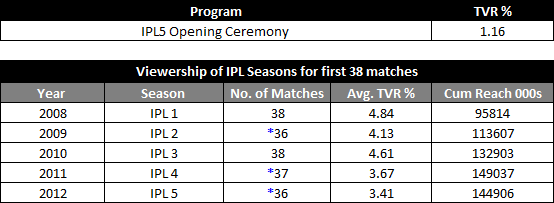
    The ratings for the first 38 of the Indian Premier League (IPL) season 5 continue to be lower than the previous seasons. According to TAM Sports, CS 4+, All India, IPL 5 delivered a TVR of 3.41 per cent in the 36 matches played so far during the tournament. Interestingly, media planners point out that one of the plus points of IPL5 is that it has been consistent in its ratings, which will lead to better ROI for advertisers.


    It may be recalled that first 27 matches of season 5 delivered a TVR of 3.53 per cent and the first 16 matches, a TVR of 3.65 per cent. The inaugural season (IPL1) however continues to remain the highest viewed season with a TVR of a whopping 4.84 per cent. Too much cricket in the past few months,India’s dismal ODI and Test match performance and too many matches in season 5 leading to cricket fatigue are said to be the possible reasons for the low ratings.


    Media planners believe that as the tournament progresses, especially towards the semi-finals and the finals, the ratings are expected to further increase. According to Mr Dinesh Vyas, GM, MEC India: “IPL 5 may have been receiving the lowest TVR as compared to the previous seasons, but it is also the only programme on television which has been delivering consistently. Therefore a TVR of 3.41 per cent for the first 36 matches is a good. In fact, now is the time that we will see more and more people viewing IPL matches and the ratings will only further increase.”


    Mr R Venkata Subramanian, Senior Director-Investments, MPG India was of the view that one of the plus points of season five is its consistency: “There has been consistency in the ratings which is certainly beneficial for advertisers however the numbers continue to be lower than the previous seasons. Despite some really good matches, the numbers have been low, probably because of too many matches leading to cricket fatigue. Nonetheless as the tournament progresses, I do expect the viewership to grow but, I don’t expect a dramatic increase.”


    Source : TAM Sports, Period : First 38 matches of all IPL Seasons, TG : CS 4+ yrs, Market : All India, Channel : MAX


    * In IPL 1 one match (47th) was abandoned due to rain
    * In IPL 2 two matches (7th & 13th)were abandoned due to rain
    * In IPL 4 one match (20th) was abandoned due to rain
    * In IPL 5 two matches (32th & 34th) were abandoned due to rain


  • Star to go solo in sports, buy ESPN from JV

    By Nandini Raghavendra & Ratna Bhushan


    Broadcast major Star Group’s 16-year-old equal joint venture with sports broadcaster ESPN is being dissolved with Star buying out ESPN’s stake in the JV, three people familiar with the development said.


    Once the transaction is complete, Rupert Murdoch-owned Star will become the owner of ESPN’s India business, the people said. Two of them said the companies were finalising details of the deal and an announcement was likely to be made shortly. They declined to disclose details.


    ESPN Software India, which operates ESPN Star Sports’ India operations, generates revenues of about Rs2,500 crore through channels that include Star Sports, ESPN and Star Cricket. ESPN Star Sports owns television broadcast rights for the ICC World Cup Cricket and T20 Champions League.


    ESPN’s Singapore office said they did not comment on speculation. A spokesperson for ESS said, “We do not comment on speculations and rumours. ESPN Star Sports continues to run the business as usual. Two partner companies frequently discuss business plans and both the companies, ESPN and News Corp, are proud of the success ESS has made since its inception, and the relationship it shares with fans and business partners. They extend complete assurance for delivering value to our partners as committed by ESS.”


    Star India Chief Executive Officer Uday Shankar did not respond to an email and text messages sent to his mobile.


    “Star wants a bigger play in the sports broadcasting space,” one of the people quoted earlier said.


    “Star’s recent Rs4,000-crore acquisition of the rights to Indian cricket from the Board of Control for Cricket in India, beating rival Sony, are indications of its ambitions in this space,” one of the people quoted earlier said.


    It is not yet clear how many of the 200 employees of ESPN, who work for the joint venture, would be retained by Star. An ESPN official, requesting not to be quoted, said employees were uncertain about their future after the deal.


    A deal between the two companies could potentially be a complex one as they have a bouquet of advertising deals and cross-sponsorships. But senior executives at two leading media-buying companies, who deal closely with both broadcasting networks, said they did not foresee any impact on advertising deals and sponsorships.


    ESPN, Star Sports and Star Cricket either sell airtime and sponsorship inventory independently or as bulk package deals, they said. An analyst from one of the big four audit firms said the battle for the rights to various cricket events will now be fought out between Star and Sony, with the latter holding the rights for Indian Premier League, the 20-overs cricket tournament. ESPN Star Sports was formed as a 50:50 JV between two of the world’s leading cable and satellite broadcasters – Walt Disney, the owner of ESPN, and Rupert Murdoch’s News Corporation – in 1996 for Asia.


    It has offices in China, Hong Kong, India, Malaysia, Taiwan and Singapore, and employs more than 650 employees across the region. Star is fast changing gears in India. In the past two months, the broadcaster has launched its second Hindi movie channel under its new brand ‘OK’, called Movies OK. It recently exited its television news business and dissolved its JV with the ABP Group. It also purchased the broadcast rights to Indian cricket for around Rs4,000 crore.


    Star seems confident of making money from its cricketing ventures. Speaking to reporters a few days ago, Mr Shankar said the deal for cricket rights would not affect the JV with ESPN. However, the market has been abuzz with the latter’s exit. “Many permutations and combinations of the deal have been worked out, which has taken this long, but ESPN is now fully exiting,” said an official from a firm with knowledge of the deal.


    Source: The Economic Times
    Copyright © 2012, Bennett, Coleman & Co. Ltd. All Rights Reserved
     

  • 27 matches later, IPL 5 is the lowest ever with 3.53 per cent TVR

    By a Correspondent


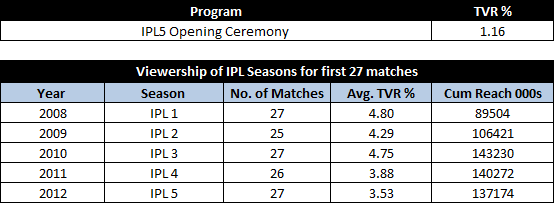
    The ratings for the first 27 matches of the Indian Premier League (IPL) Season 5 are out. As per TAM Sports, CS 4+ years, All India, IPL5 continues to deliver lower ratings as compared to the previous seasons. While the average TVR for the first 27 matches stood at 3.53 per cent, the ratings for the initial 26 matches played during IPL4 were at a TVR of 3.88 per cent.


    The inaugural season (IPL1) continues to remain the highest viewed with a TVR of a whopping 4.80 per cent. Although these are still initial stages, what remains to be seen is whether the ratings show any improvement as the tournament progresses.


    Interestingly, while the cumulative reach has been increasing year on year, the cumulative reach for the first twenty seven matches in season five on the other hand has shown a reverse trend with a marginal decline as compared to the first three IPL seasons.


    It may be recalled that while the opening ceremony had received a mere 1.16 per cent of the TVR, the first six matches witnessed its lowest ever TVR in the history of the tournament. A number of factors have been attributed for the low IPL viewership this season – too much cricket, India’s dismal performance the Test and ODI matches against England and Australia and so on.


    According to Jacinta S Bhoite, Director, Minesweeper: “The ratings are certainly not good and there are a number of factors responsible for the low viewership. The entertainment factor seems to be missing this year, there is a perception among viewers that the matches are fully predictable and hence they continue watching their regular television programmes. However as the tournament progress, especially after the final four teams are selected, the ratings are expected to see some improvements.”


    Source : TAM Sports, Period : First 27 matches of all IPL Seasons, TG : CS 4+ yrs, Market : All India, Channel : MAX


    * In IPL 1 one match (47th) was abandoned due to rain
    * In IPL 2 two matches (7th & 13th)were abandoned due to rain
    * In IPL 4 one match (20th) was abandoned due to rain


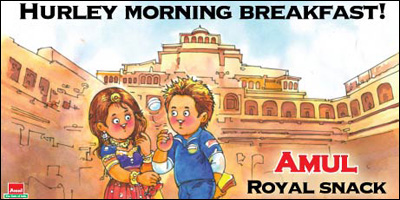
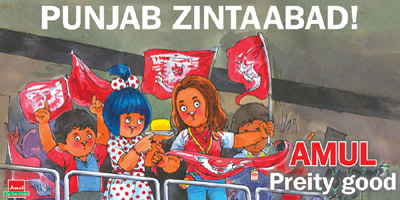
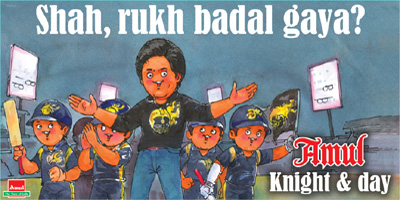
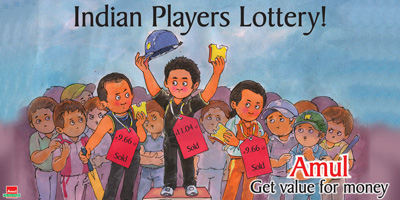
  • The Anchor: 20 Amul ads that tell the IPL story

    By AN Chorrea


    There are many who believe that the Indian Premier League’s fifth edition is not as much of a rage as its earlier editions were, but there’s no denying that the IPL does dominate discussions in the advertising, marketing and media frat.


    Given the huge response to our feature tracking Sachin Tendulkar’s career via Amul ads, we dug into the archives to bring you these Amul ads on the cricketing league.


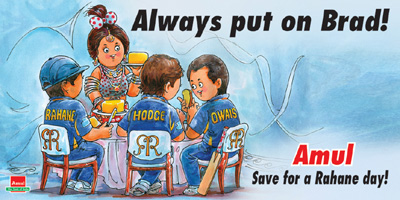
    1. On outstanding performers of Rajastan Royal Cricket team (Apr 2012)


    2. On the commencement of Indian Premier League 5 (Apr 2012)


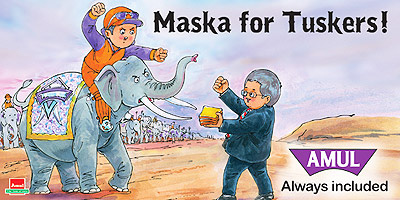
    3. On BCCI terminating franchise of Team ‘Kochi Tuskers Kerala’ for default of payment (Sep 2011)


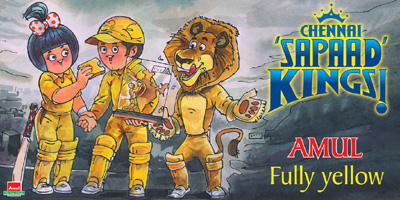
    4. On Chennai Super Kings winning the finals of IPL 4 (May 2011)


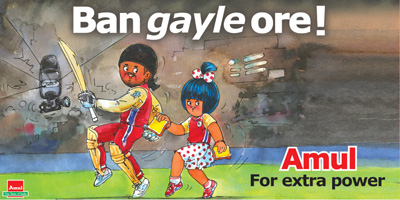
    5 .The West Indian cricketer in top form in IPL 4 (May 2011)


    6. Hype around the relationship between Shane Warne and actress Elizabeth Hurley (Apr 2011)


    7 .Preity Zinta’s cricket team winning an IPL match (Apr 2011)


    8. SRK performs after his team wins an IPL match (Apr 2011)


    9. At IPL auction last year, Saurav Ganguly was not bid for (Jan 2011)


    10. On the auction of cricketers ahead of IPL 4 (Jan 2011)


    11. On the termination of two IPL franchises from IPL 4 (Oct 2010)


    12. On the victory of Chennai Super Kings over Mumbai Indians in the IPL 3 final


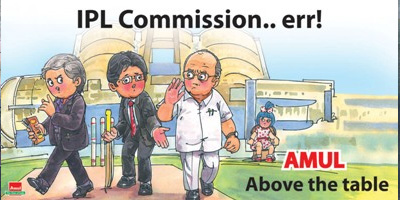
    13. Controversy surounding IPL Commissioner Lalit Modi (Apr 2010)


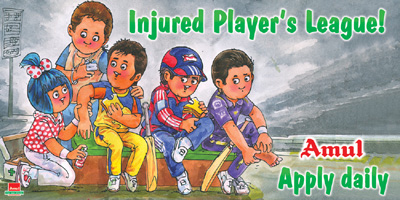
    14. Several cricketers drop out of IPL due to injuries (Mar 2010)


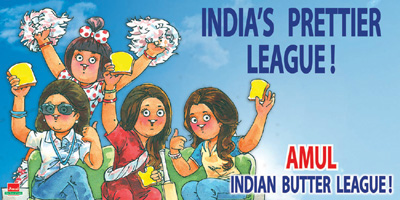
    15. On the glamorous women being co-owners of some of the IPL teams (Mar 2010)


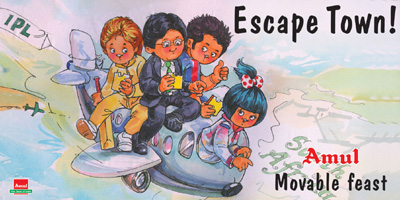
    16. Rain plays spoilsport during the IPL2 matches being played inSouth Africa(Apr 2009)


    17. Venue of IPL shifts fromIndiatoSouth Africa(Apr 2009)


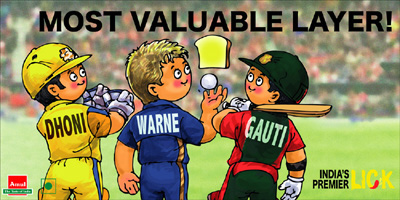
    18. IPL cricketers in race for top positions – Delhi Daredevils batsman Gautam Gambhir top run-getter, Rajasthan Royals captain Shane Warne leading wicket-taker & Chennai Super Kings captian M S Dhoni bastman for the most boundaries segment (May 2008)


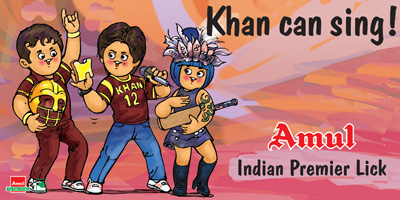
    19. Shah Rukh Khan sings for Indian Premier League (IPL) music video ‘Run Just Run’ his franchisee IPL Kolkata Knight Riders cricket team – (Apr 2008)


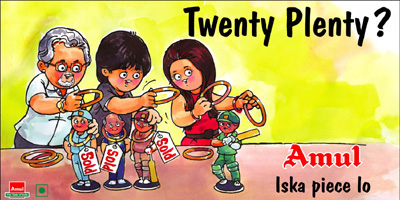
    20. Indian Premier League (IPL) franchisees ranging from Indian business tycoons to Bollywood stars bid for top Indian & International Cricketers during an amazing price auction (Feb 2008)


  • [MJR] Crime & transport are issues of national importance

    By Ranjona Banerji


    Newspapers in Mumbai this week have been pre-occupied – and quite rightly – with two major issues: transport and crime. A fire at a signalling cabin crippled the Central Railway’s Main and Harbour lines, affecting some 40 lakh commuters. The problems are not likely to vanish fast either.


    The coverage has been comprehensive and detailed – and it is difficult to fault any paper here.


    In fact, even with the other more sensational case of murders and the underbelly of the glamour industry, newspapers have shown remarkable restraint while still providing blanket coverage.


    Both stories in a sense are not Mumbai-centric. The collapse of a commuter system in the country’s financial capital means that millions cannot get to work on time, if at all. This affects productivity and, ultimately, profits for everyone. Also, for other large and growing metros there is a lesson here about the importance of infrastructure and alternative public transport systems.


    The case of the murders may be murky but also affect the nation. Thousands still flock to Mumbai as the mecca of the film and television world. Many of these are innocent or naïve in the ways of the world and get easily conned by the criminal elements that hang around the fringes of the industry. The three murders being investigated – an old gentleman whose son was fooled by the suspects, a young man who was trying to cut business deals with them and a young model – are cases in point and all the victims came from outside the city.


    The larger point is that these are issues – logistic and sociological – which affect the whole country. Newspapers elsewhere should take them up. And not just for the salacious context of the murders.


    * * *


    The successful launch of Agni V got its space on TV and in newspapers but perhaps nowhere so much as on Twitter and in cyberspace. People were breathless with excitement over this great achievement by India and there was little or any objective or even critical comment. It is quite difficult to be critical about “nationalistic” issue on the Internet because of the waves of patriotism which sweep all over it!


    * * *


    The fifth edition of the Indian Premier League reveals some maturity on part of the Indian media. The last four years have been filled with enthusiastic hyperbole or visceral hatred all over TV and pages of print. Since last year was something of a flop and the opening ceremony of this season a damp squib, there was general wariness all around.


    However, with the IPL being treated more as a sporting encounter with elements of fun rather than a be-all-end-all mega-event which must bring our lives to a standstill, it is well on its way to being a success. Media hype has been limited but media coverage has been adequate. This year, hysteria over the owners and their glamorous friends has been limited.


    The worst you can say about the IPL is that the studio shows are enormously irritating and tacky, where seasoned cricketers are forced into silliness by the hosts. When these same hosts prance all over the cricket field, they are no less silly and the cheerleaders in the studio just look tacky. No one seems to care much about those on the field either – and their dancing hasn’t reached the high level of gymnastic ability and artistic proficiency that American cheerleaders have to display. In fact there is a lot of wiggling and waving but practically no dancing. Just saying.


    * * *


    As you may have guessed, I have been sadly deficient in my TV news watching this week. Blame it on the weather – didn’t want to get any hotter under the collar!


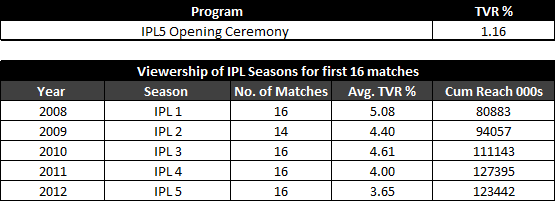
  • First 16 matches of IPL5 score 3.65 TVR

    By A Correspondent


    The ratings for the first sixteen matches of the Indian Premier League (IPL) season five are out. As per TAM Sports, CS 4+ years, All India, IPL5 continues to deliver lower ratings as compared to the previous seasons. While the average TVR for the first 16 matches stood at 3.65 per cent, the ratings for the same number of matches during IPL4 were at a TVR of 4 per cent.


    The inaugural season (IPL1) continues to remain the highest viewed with a TVR of a whopping 5.08 per cent. Although these are still initial stages, what remains to be seen is whether the ratings show any improvement as the tournament progresses. Interestingly, while the cumulative reach has been increasing every IPL season, the cumulative reach for the first sixteen matches in season five showed a reverse trend with a marginal decline as compared to the cumulative reach it had in IPL4.


    According to Mr Ajay Rao, Vice President, Dentsu, these numbers are not surprising because they were expected to be lower than the previous seasons. He was also of the view that the GECs will not be impacted by IPL as most of the GECs have their own loyal viewers. “I don’t find the ratings surprising at all, these numbers were as per expectations. The opening ceremony itself was a damp squib which could perhaps be a sign of things to come. Once the initial glam is over, IPL5 could witness further decline in viewership. However, I don’t think GEC’s have much to worry about this season because over the years they have developed their own loyal viewers. Perhaps the challenge now for GECs is to not just focus on their loyal viewers but, find ways how to garner new viewers.”


    Source : TAM Sports, Period : First 16 matches of all IPL Seasons, TG : CS4+, Market : All India, Channel : MAX

     * In IPL 1 one match (47th) was abandoned due to rain, * In IPL 2 two matches (7th & 13th)were abandoned due to rain, * In IPL 4 one match (20th) was abandoned due to rain


  • IPL 2012 first week online viewership registers a 56% increase

    By A Correspondent


    Solidifying last year’s stupendous growth during Indian Premier League (IPL), Times Internet Limited (TIL), in partnership with YouTube, is on an upward curve, yet again. In the first week of the tournament, including the opening ceremony, the IPL website has already recorded 13.7 million views, as against 8.8 million views last year. This represents a 56 per cent growth over last year.


    New DelhiandBangalorelead the viewership with 14 per cent each, with Mumbai coming in a close second at 13 percent. This leap reflects the growing trend of watching IPL matches online. This year, the IPL website offers a virtual battleground for fans to fight it out, which got 1.5 million engagements in the first week itself.


    The matches registered the maximum online views on 10th April for the matches between Royal Challengers Bangalore and Kolkata Knight Riders, and between Delhi Daredevils and Chennai Super Kings. The day saw a total of 2.15 million views on the site, which included 0.7 million unique visitors.


    Almost 0.6 million viewers have enjoyed the match action on their mobiles over the last seven days on Apalya mobile TV platform across Airtel, Idea and Vodafone. This is double the traffic registered last year.


    Rishi Khiani, CEO, Times Internet Ltd said: “Last year, we delivered a superior viewing experience and garnered significant audiences. This year, our emphasis is on higher interactivity and our strong social focus has paid off right at the start, becoming a sign of things to come over the season.”


    Praveen Sharma, Head of Media Sales GoogleIndiasaid: “We’re really excited to see the continuous growth in online viewer ship of IPL. This is the third year of our association with live streaming of IPL and the viewership numbers clearly indicate the distributed media consumption pattern of the Indian consumers.”


  • Why IPLs are no fun without this man


    By Biswadeep Ghosh


    Think of the Indian Premier League. Forget your favourite cricketers for a while. One, two, three, four… now that you have managed to push the players into the backyard of your mind, who is that one person whose association with the tournament is a fact you just cannot ignore? Rest assured, they aren’t Shibani Dandekar and Archana Vijaya, the two young ladies who do the rounds within the venues, asking unintelligent questions to intelligent cricketers when not busy matching their knowledge of the game with equally informed (or uninformed) celebrities. Despite the presence of so much glamour – which includes one Shah Rukh Khan – the man who is managing to colonise the maximum amount of attention is Navjot Singh Sidhu.


    After having been a successful international cricketer for sixteen long years in which he metamorphosed from being a maha-boring batsman to watch – particularly in today’s T20 terms – to someone who could step out and send the ball flying for miles while dealing with the spinners in particular, Sidhu’s second innings as a commentator has been comparably notice-worthy. He has irritated purists with his style of commentating, which is based on a unique formula. He talks very little cricket, and talks too much. As if that is not enough, he showers similes, metaphors, shayaris and proverbs on the viewers, hijacking the time of his colleagues who can do nothing apart from watching him with a partly amused, partly stunned look.


    When Sidhu joined the IPL5 commentary team as part of the Sony Max show Extraaa Innings, he had reportedly said that the show beats ‘Vidya Balan in terms of entertainment quotient’, the reference being to the actress’s affirmation that a film is about ‘entertainment’ in The Dirty Picture. Balan’s character Silk had used the word ‘entertainment’ three times, and Sidhu had promised five times more than that.


    Somewhat confusing, no doubt about that, since exactly how much entertainment did Silk promise by uttering the word three times? Sidhu may not know that, but he will have an answer to this query for sure. He has an answer for everything.


    What kind of rubbish does he talk? How much can he talk? How can he remember so many shayaris, proverbs and god knows what else? How does he misinterpret half the things he knows with so much confidence? As time has flown since the day he became a commentator many turbans ago – he started his career when India toured Sri Lanka in 2001 – what is amply obvious is that he has added a lot of new material to his arsenal, stuff he uses the way only he can.


    In the studio of Extraaa Innings, Sidhu, who says ‘gurrru’ whenever presented with an opportunity, came up with an outstanding statement the other day: outstanding since not even George Bush could have given rise to so much unintentional humour. Sachin Tendulkar, he said, is a genius, just as Adolf Hitler and Benito Mussolini were. Hence, the Master Blaster is meant to be admired. Sourav Ganguly, on the contrary, is a man of character. So, he is meant to be trusted.


    Presenting, some possible conclusions drawn from what Sidhu said:

    *Tendulkar is characterless, and hence, not supposed to be trusted.

    *Ganguly is not a genius and, therefore, should not be admired.

    *Tendulkar’s genius has parallels in Hitler and Mussolini.

    *A man of character cannot be a genius, and vice-versa.

    *Hitler and Mussolini are meant to be admired.


    Poor Harsha Bhogle, who sits right next to the man. Having been reminded of his hair transplant by Sidhu – for the consumption of the entire world, by the garrulous Sardar, who else? – he keeps staring at our protagonist, doing hee-hee-hee, distinctly clumsy and uneasy, acutely aware, one is sure, that he has been condemned to become one part of the ‘Jai and Veeru’ pair in the present edition of Extraaa Innings.


    That Harsha and Sidhu have become Jai and Veeru – the legendary characters played by Dharmendra and Amitabh Bachchan in the curry Western Sholay – tells us two things. Firstly, Extraaa Innings is not meant for the cricket connoisseur: which is fine, since neither is T20. Secondly, a character like Sidhu can only make its TRPs shoot heavenward, many watching the show seek the sort of humour that he has come to epitomize.


    That Sidhu’s prattle is not a 24-hour-reality in our lives is what works for the man. In a serious moment, when a batsman has failed to negotiate delivery after delivery, he has been known to irritate the hell out of a listener by comparing the batsman to a ‘one-legged man in a bum-kicking competition’. (He is not doing that in this edition of IPL, having been confined to the studios, but he has made many such comparisons in the past). But the thing is, the ‘idea’ of Sidhu has become an addiction with the passage of time. As his loyal fans will tell you, it is not an addiction which is subversive, like heroin, but a habit which makes one smile even when one gets completely exasperated.


    As a person talking cricket, Sidhu, having been a top-level cricketer himself, makes a lot more sense than, say, Mandira Bedi, who possibly believed that the leg stump was tied to a batsman’s leg when she had started out. Unlike serious commentators, however, nobody hears him for his reflections on the game. Sidhu’s USP is the ‘out-of-placeness’ of his thoughts, a carefully manicured image he has developed by insisting that the Indian team ‘without Sachin is like giving a kiss without a squeeze.’


    As someone who seesaws between being a purist and a lover of baseball cricket’s entertainment – the former, when I watch test matches and the latter, when T20 hits the mart – I am among many who lose it when he starts burying voices around him, and cracking meandering jokes in the middle of a serious discussion. But, my anger subsides when Sidhu says what he thinks is funny and introspective by combining humour with deep thought. He is at his best when devotedly absurd: an entertainer who puts up a whole-hearted performance. He is what every T20 player on the cricket field ought to be. Now, is that a Sidhuism?


    Born in Patna but based in Pune, independent writer-journalist Biswadeep Ghosh enjoys writing on films, literature and music. But, yes, cricket is his passion, and he (even) follows matches featuring Canada and Namibia whenever he can.


    Photograph: Fotocorp


  • TIL brings a bigger and better IPL season 5

    By A Correspondent


    Times Internet Limited (TIL), in partnership with YouTube, is back with a slew of new features to woo cricket lovers for the fifth edition of the Indian Premier League (IPL), which starts on Wednesday.


    TIL’s dedicated IPL site, ipl.indiatimes.com, now offers interactive scorecards, high-definition streaming of IPL matches, DVR features (to rewind during a match), online radio commentary in partnership with AIR , video-on-demand facility, and an all new ‘Battleground’ section.


    Making its debut this year is the interactive 10 minute video show ‘Pitch Studio’, where fans can interact with stalwarts from the cricketing world including a former cricket team captain and expert, by posting their comments and questions on Facebook and Twitter. These pre-match shows will give a quick recap of past matches and talk about key events, with guest stars adding an element of surprise.


    “Having attracted a total of 72 million global views last year, we are looking to make IPL 2012 a lot more user-centric, giving user’s total control over their IPL viewing experience,” says Rishi Khiani, CEO, Times Internet Limited.


    In the ‘Battleground’ section, IPL fans can post their comments and also indulge in activities such as throwing tomatoes and eggs at the other side during a live match. The new DVR feature will allow fans to rewind on the time-line and watch any part of the match that they may have missed. Adding to all the fun is the cheerleader application, video scorecard that captures video highlights on the fly during the match stream, and the video-on-demand feature, which offers match highlights such as fours, sixes and face-offs between players.


    Given the phenomenal success of the Indiatimes platform during the previous IPL season, it’s no surprise that this year too, some of its heavy weight sponsors including Maruti, Coca Cola, and Samsung, have put their weight behind TIL as premium sponsors.

  • Life beyond cricket: 5 new leagues in 1.5yrs

    By Bhanu Pande


    If Pepsi’s latest commercial, ‘change the game’, prods people to switch from cricket to football, it hints at a fundamental shift in the way the cola major plans to use sports as a brand-building platform. It feeds off – and feeds into – a fundamental change happening in the Indian sporting landscape.


    Inspired by the success of the Indian Premier League (IPL) in cricket, almost every sport with some following in India is launching a city-based, professional league. Five new professional leagues have been announced in the last 18 months and, word is, two others are being revived. “The Indian sports consumer is looking for entertainment, diversion, passion and emotion,” said Shailendra Singh, joint managing director, Percept India, which is behind the Indian Boxing League (IBL). “League sport will ensure that.”


    But for leagues to become a permanent fixture, something only the IPL has managed so far, paramount is drawing sponsors and advertisers. If the initial response is any indication, sponsors of many hues are warming to them. Hero Motocorp is making big investments in hockey, the Mahindra Group in basketball, and the ongoing World Series Hockey (WSH) has Bridgestone and Vodafone among its sponsors.


    “Those chasing cricket will have to move to a life beyond it,” said Sanjay Sharma, head of JK Motorsport. “The canvas has to enlarge for brand marketers as cricket won’t continue to enjoy the status it does.” Besides cricket fatigue and the gathering momentum of other sports, there are three reasons why marketers and sponsors are gravitating towards these new leagues.


    Low-risk investment

    The new leagues offer a low-cost proposition. Unlike cricket, they don’t have to put a lot at stake. CVL Srinivas, chairman of Starcom MediaVest India, a global communication & media services group, said while sports is a good medium for brands to connect to the youth, the most popular of them, cricket, poses an entry barrier for many advertisers. “Many advertisers today see cricket as overpriced,” he said. “Emerging new leagues could give them an opportunity to enter sports in some way at a much lower cost.”


    Four years ago, when Bridgestone considered IPL as a medium for brand communication, it was put off by the price tags for premium rights. For example, DLF pays 40 crore per year to be the title sponsor of IPL. So, Bridgestone made a modest entry into cricket as a co-sponsor of IPL team Mumbai Indians. The decision to become the title sponsor for the ongoing World Series Hockey (WSH) came easy.


    The investment was low: Bridgestone is paying 2 crore per year in a three-year deal. And it gives the tyre company an opportunity to target North India, a market where hockey is popular and where Bridgestone was weak. “South India has always been our strong market and our association with Mumbai Indians is good enough to deliver there,” explained Vaibhav Saraf, GM (sales & marketing), Bridgestone India.


    Similarly, a 10-second spot on IPL cost 4-5 lakh, but just one-tenth on WSH. “Returns in non-cricket sports would be much lower,” Mr Srinivas qualified. Even then, the cost value equation works just fine for Bridgestone. “Even if our return on investment (RoI) from WSH is 10 crore worth of media mileage, we are happy,” said Mr Saraf.


    Besides Bridgestone, the other principal sponsors of WSH are Vodafone and Imperial Blue (Pernod Ricard India). “We evaluate all sponsorship proposals on a cost per reach and level of consumer engagement possible,” said Anuradha Aggarwal, senior vice-president-consumer insights & communications, Vodafone. “The WSH was efficient on both.” The early days of WSH have seen modest to half-filled stadiums.


    “Hockey is still not a proven sport, we are building it,” said Yannick Colaco, chief operating officer of Nimbus Sports, the promoter of WSH. “Some leagues in the past haven’t delivered, which is likely to make sponsors and advertiser sceptical for any new league.” Mr Colaco claimed the league has booked 15 brands on-air in the first week.


    He expects this number to increase to 40-50 by the time the tournament ends on April 2, yielding 50-60 crore from sponsorship and advertising revenues. “WSH is not here to topple cricket, but we hope to make it a strong number two property before we enter the second season,” he said, adding that marketers will have to have “realistic expectations” during early days and come in with a “long-term vision.”


    Proof of Concept

    One factor that gives the new leagues a greater chance is how they are structured. They follow the IPL model, which is city-based and essentially pays for itself by riding on a big TV rights sale. “IPL has proven that city loyalties exist, which has prepared the ground for other professional sporting leagues to take off,” said Darshan M, CEO of Machdar Motorsports, promoters of i1Super Car Race Series.


    In Premier League Soccer, Uro Infra Realty, a Kolkata-based real estate company, was the highest bidder for a franchise – 25 crore for Team Barasat over 10 years, or a franchisee fee of 2.5 crore per year. Each team can spend up to Rs 12.5 crore on players, which means Barasat (Uno Infra) will spend a total of 15 crore a year.


    Now, 50 per cent of the central revenues – essentially, the sale of TV rights and central sponsorships – would be equally divided among the six franchisees. In return, each team gets 2.5 crore as match rights fee for its five home matches. Then, each team can have eight sponsors, apart from ticketing and hospitality rights in home matches. “Considering the league will be broadcast in 50 countries other than India, it won’t be a problem for franchisees to recover their investment,” predicted Bhaswar Goswami, executive director, CMG, the promoter of PLS.


    The new leagues have learnt from the failure of the past. For example, the Indian Cricket League (ICL), promoted by Zee, died because it did not have a buy in from the Indian board that runs cricket in India and so could not draw the best of the current players. The new leagues are either taking the boards of their respective sports along (soccer, boxing and basketball) or are working towards it (hockey).


    Another learning is spreading it out. Premier Hockey League (PHL) – India’s first sporting league event launched in 2005 and WSH’s predecessor – was discontinued in 2008. “Any successful league the world over has had two fundamental elements: multiple ownership and multiple match locations,” said Mr Colaco of Nimbus. “PHL ignored both.” PHL teams were all owned by ESPN and all matches were held in Chandigarh. By comparison, WSH has eight franchisee teams playing in eight cities.


    When Fragmentation Works

    Sports promoters and marketers say sports like soccer and wrestling have a significant regional following, and brands can tap that. “For instance, a brand that wants to target audience in soccer-crazy West Bengal may want to ride the PLS,” said Indranil Das Blah, chief operating officer, Kwan Entertainment & Sport Solutions.


    Mr Aggarwal of Vodafone sees a fragmented market as more of an opportunity rather than a threat. “Marketing investments are fixed and need to deliver maximum RoI,” she said. “If local fragmentation delivers a higher RoI, marketers like us will not have any problem going regional.”


    Similarly, Mr Colaco points to how motor sports can target auto brands, be it cars, tyres, lubes or accessories. However, eventually, feels Mr Srinivas, leagues will have to make a national impact. “To sustain, they’ll have to become pan-India properties,” he said.


    Source: The Economic Times

    Copyright © 2012, Bennett, Coleman & Co. Ltd. All Rights Reserved